Home › Field notes › BOM Structure for Modular Backpacks: Levels, Alternates and Waste Fact
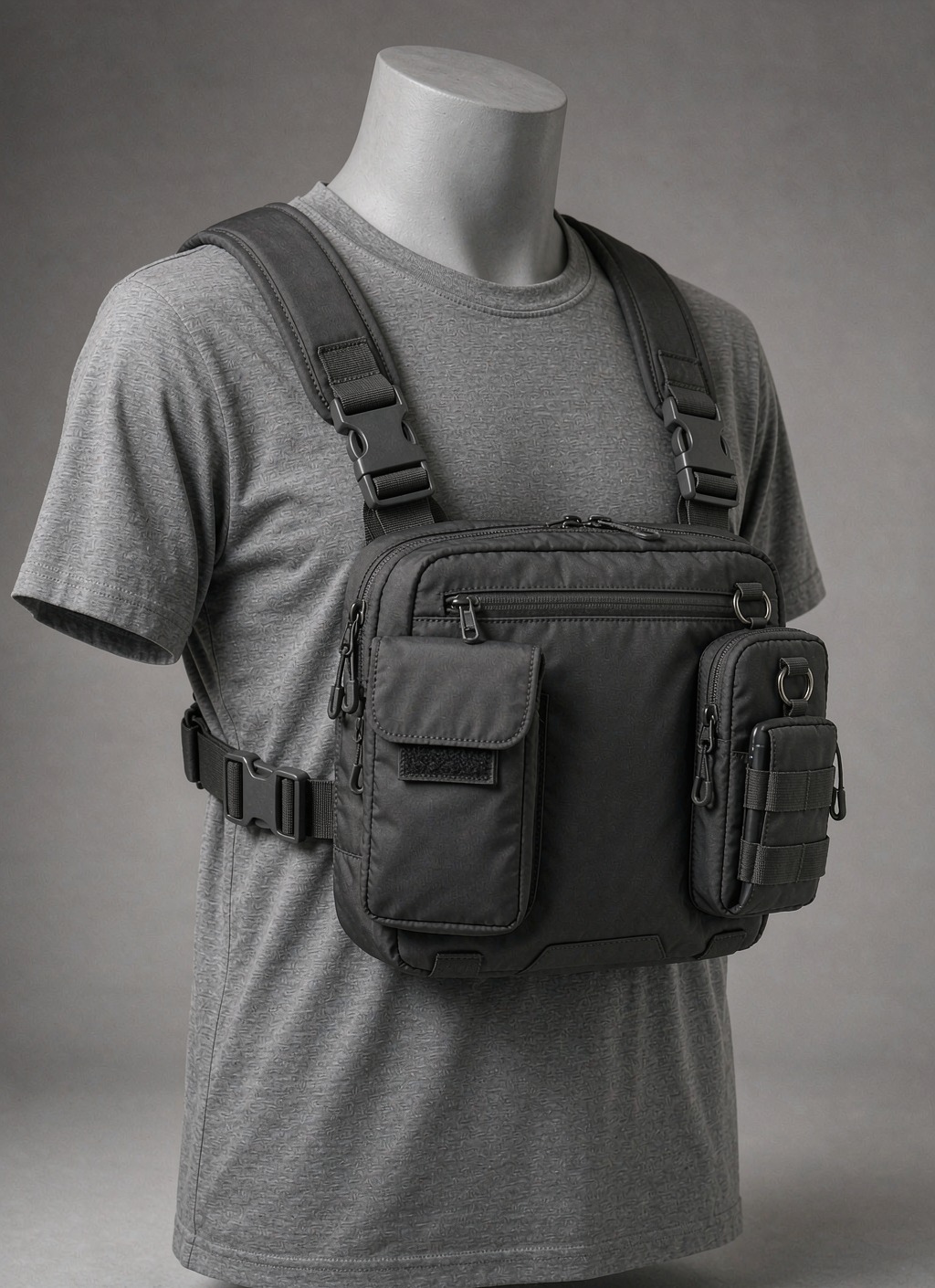
A BOM structure for modular backpacks is a four-level hierarchy separating finished good, sub-assembly, cut part and raw material, so that a shared component has one home and every assembly above it points to that line instead of copying it. Modular programmes need those extra levels because pouches, panels and host bags draw on the same tape, hardware and cloth, often across several colourways and seasons. With the hierarchy in place, sampling runs 6-10 working days and volume completes in 35-50 days above a 500-piece floor on each reference. The structure described here applies to civilian carry goods — hiking, commuting, worksite tool carriage and first-aid modules. Nothing in it extends to weapon carriage, ballistic protection or claims of military certification.
Why a Modular BOM Needs More Levels Than a Simple Bag BOM
A simple bag can be described by a list: shell, lining, webbing, zipper, buckle, thread, label, carton. That list works because nothing on it is used anywhere else. A modular programme breaks the assumption on its first day, because the same 25 mm tape, the same ladder lock and the same bar-tack thread appear on a host bag, on a side pouch and on a chest rig, sometimes in different colourways and frequently in different seasons.
Once a shared component is repeated as a line inside every finished good, three problems arrive together. A change has to be made in three places and gets made in two. Consumption is counted per finished good, so the true seasonal total stays invisible until purchase orders are raised. And an alternate approval applies to one reference only, leaving the other two still buying the original.
Levels fix all three by giving the shared component exactly one address. Finished goods reference it rather than duplicating it, and the reference is what makes a change propagate.
The second reason is inspection. A grid panel and a harness set are real objects that get built and checked before the pack is closed. A flat list has nowhere to put them, so they are treated as loose cut parts and the check disappears with them.
A third reason is commercial rather than technical. When a customer asks what changes if the tape supplier moves, a flat list cannot answer without a manual recount, and the recount is the reason such questions take a week. A structured bill answers in a minute, because the answer is one line and the list of everything referencing it.
Bottom line: Give every shared component one line at the lowest level where it is common and let assemblies reference that line, because a component copied into three finished goods will be changed in two of them.
Level Zero to Level Three: Finished Good, Sub-assembly, Cut Part, Raw Material
Four levels are enough for a modular programme, and more than four usually means somebody is modelling the factory rather than the product. Level 0 is what ships, level 1 is what is built before final assembly, level 2 is what is cut, level 3 is what is bought.
| Level | Items held | Question answered |
|---|---|---|
| Level 0 — finished good | Complete pack, pouch, chest rig or insert, packed | What is being shipped |
| Level 1 — sub-assembly | Back panel with grid fitted, harness set, lid, removable organiser | What is built before closing |
| Level 2 — cut part | Shell panel, lining panel, webbing length, binding length | What is cut, and to what length |
| Level 3 — raw material | Base cloth, coating, tape by the metre, thread, hardware | What is purchased |
Level 1 is the one most bag bills skip, and it is where modular work actually happens. A back panel carrying a fitted attachment field is built, inspected and stored before the pack is assembled around it. Record it as a cut part and both the labour and the inspection step vanish from the record.
Level 3 is the purchasing level. Orders are raised here against consumption rolled up from level 2, with the waste allowance applied between the two. Nothing below level 3 exists; if a line appears there, the structure is modelling a process rather than a component.
The test for any item is which question it answers. If an item answers two of them, it probably belongs at two levels — a tape bought by the metre at level 3 and issued as a cut length at level 2 is the normal case, not an exception.
Verdict: Record a fitted grid panel and a harness set at level 1 rather than as cut parts, because sub-assemblies carry their own labour and inspection and a flat structure hides both.
Shared Components: Why Common Parts Earn Their Own Line
A shared component is anything used by more than one level 0 or level 1 item. On a modular programme the list is longer than most teams expect: tape, binding, ladder locks, D-rings, sliders, hook-and-loop, thread, labels, and quite often the same shell cloth across a pouch and its host bag.
The rule is short. A shared component gets one line at the lowest level at which it is common, and every assembly above references that line. It is never copied, even when the copy looks harmless because the usage is small.
The payoff arrives at the moment of a change. Replace a tape supplier and one line moves, with every reference following automatically. Keep the same tape embedded in five finished goods and five lines move, and the one somebody forgets is the one that turns up in a mixed shipment where two references visibly differ.
Shared lines also make demand visible. Rolled-up seasonal consumption of one tape across a programme is a figure purchasing can act on; per-finished-good consumption is a figure nobody ever aggregates. The same logic applies to hardware, where a single ladder lock shared across four references is often the largest single piece-count line in the programme and almost never spotted as such on a flat list.
There is an exception worth naming. Where a component is shared only by accident — two references happen to use the same buckle but would not deliberately change together — a single line forces them to change together. In that case keep two lines and record why, rather than merging and hoping.
Takeaway: Put tape, hardware, thread and any shared cloth on one line at the lowest common level, because rolled-up demand is the only version of the number a buyer can negotiate against.
Alternate and Substitute Materials: How Blocking Rules Work
An alternate is an approved second source recorded against the same line as the primary. A substitute is what occurs when no alternate was recorded and the line used something anyway. The two words sound similar and describe opposite states of control.
Three fields per alternate: the component code, the condition that permits its use, and whether the customer has to be informed. The condition is the field that goes missing. May be used if the primary is unavailable is not a condition; it is a shrug written in specification language.
Qualify an alternate by the same method as the primary rather than by eye. Abrasion resistance measured by ASTM D3884, and coating adhesion by ASTM D751, give a buyer something to check; a swatch photograph gives nothing.
Then the blocking rule, which is one column on the bill and prevents most arguments: an alternate may be used where the specification permits it, and never where the customer has made a brand mandatory. Where both apply to different lines, the column says which, line by line.
Judgement: Record the condition that permits an alternate and whether the customer must be told, because an alternate without a stated condition is a substitute waiting to be discovered at goods-in.
Waste, Yield and Consumption Factors
Consumption on a bill of materials is never the net figure. It is the net figure plus what the cutting room loses, what a marker cannot nest, and what fails inspection. Those three are different things and they are not covered by one number.
| Component class | Allowance basis | Applied where |
|---|---|---|
| Shell cloth | Marker efficiency against stated fabric width | Level 2 roll-up into level 3 |
| Coated laminate | Nesting plus any directional constraint | Level 2 roll-up into level 3 |
| Webbing and tape | End loss generated per cut piece | Level 2 issue quantity |
| Hardware | Fitting loss plus defect rate | Level 3 order quantity |
| Thread | Consumption per unit of seam length | Level 3 order quantity |
| Cartons and polybags | Damage allowance in transit and handling | Packing material order |
Two mistakes recur across programmes. The first is applying one blanket percentage to every line, which over-buys hardware and under-buys cloth, since the two lose material for entirely different reasons. The second is confusing the planning allowance with the purchasing allowance, which are separate figures because purchase lots arrive in fixed quantities that rarely match the calculated need.
Yield deserves its own line wherever a coated laminate is cut. A directional constraint on a patterned or coated face reduces usable area in a way a plain cloth does not, and a bill that ignores it will run short in week three of a long run.
Spec rule: Apply waste per component class with a stated basis rather than one blanket percentage, because cloth loses area to marker efficiency while hardware loses pieces to fitting defects.
Unit Conversion: Metre, Piece, Square Metre and Weight
Four units appear on a bag bill of materials, and mixing them is behind most reconciliation errors. The full range of parts behind such a bill can be seen in the product catalogue. Cloth is bought by the metre against a stated width. Tape and webbing are bought by the metre and issued by the piece. Thread is bought by weight or by the cone and consumed by length. Hardware is counted in pieces.
State the width every time a linear metre appears. A metre of 1,500 mm cloth and a metre of 1,400 mm cloth are not the same purchase, and a bill recording only metres invites the wrong one into the order.
Square metres are the honest unit for comparing two cloth options. Convert consumption to area before deciding between constructions, because a cheaper metre of narrower cloth is frequently the more expensive panel once marker efficiency is accounted for.
Hardware counted in pieces still needs size and finish on the same line. A piece count with no size is not an orderable quantity, and the line will be interpreted by whoever happens to be holding it.
Selection rule: Record cloth in square metres for comparison and in linear metres with width stated for purchasing, because a linear metre quoted without a width is not a quantity anyone can order correctly.
BOM Structures Compared: Flat List, Two-Level and Multi-Level
Three structures are in common use. A flat component list is one row per item per finished good. A two-level bill groups raw materials under one finished good. A multi-level bill carries the four levels described above and lets sub-assemblies be shared.
| Compared by | Flat component list | Two-level BOM | Multi-level modular BOM |
|---|---|---|---|
| Shared components | Copied into every style | Grouped under one style | One line, referenced upward |
| Change propagation | Manual, often partial | Partial | Automatic |
| Waste accounting | Blanket percentage | Per component class | Per class and per level |
| Upkeep burden | Low at first, then rising | Moderate | Higher to establish, low after |
| Characteristic failure | Silent substitution | Stale cross-references | Abandoned if nobody maintains it |
| Best used for | A single one-off item | A small range with no shared modules | A modular programme with variants |
The middle column is where most programmes start and where many stay, and that is reasonable until two references begin sharing a component. The moment they do, the two-level bill starts copying, and copying is the failure the hierarchy exists to prevent.
The last row of the first column deserves emphasis: a multi-level bill that nobody maintains is worse than a flat list, because it looks authoritative while being stale. Assigning an owner matters more than choosing the structure, and that applies from the first custom modular backpack reference onward.
Colourway and Size Matrix: How Variants Are Carried
Two approaches exist. One bill per variant, or one bill with a variant matrix. The first is simpler to write and wrong at scale; the second is harder to establish and correct from the second colourway onward.
A matrix carries the shared structure once and then lists only what differs: shell colour code, lining colour code, tape colour code and hardware finish. Four columns cover most programmes, and everything else is inherited rather than repeated.
Where a variant changes a component rather than a colour — a different buckle, a longer tape run, an extra row of grid — that belongs on the matrix as an explicit override. A quiet edit to the base bill changes every variant and is discovered by the customer rather than by the team, which is the worst possible place for a specification question to be answered.
Size variants behave differently from colour variants. A longer host bag changes cut parts and therefore consumption, so it needs its own level 2 entries rather than a colour code, and the matrix should say so explicitly instead of leaving the reader to infer it from the consumption figures.
Colour codes need a reference system and a stated light source. Black on a shell, on a lining and on a tape are three dye lots, and three dye lots viewed under different lighting is how a matched set becomes a mismatched one.
Vetted partner facilities provide the capacity behind this work: our SGS-verified production base runs 7 production lines and 149 machines across 4,950 m², staffed by 137 people, with monthly output placed at 200,000 units. The founder started in bag production back in 2004, and the business itself began in 2014. Each bill travels sampling, PP sample, release inspection and then shipment.
BOM Freeze, Change Control and What Happens After Release
The freeze point is PP sample approval. Before it, edits cost time and nothing else. After it, every change carries a dated note recording the level affected, the reason, the pages touched and the person who approved it.
A change note without the level affected is the common weakness, because a level 3 change and a level 1 change have completely different consequences. The first is a purchasing question; the second can invalidate inspection records already signed off.
After release, orders are raised at level 3 against rolled-up consumption with allowances applied. Production occupies 35-50 days above a 500-piece floor on each reference, and release inspection runs to ISO 2859-1 under an AQL 2.5 limit before the goods leave.
Tooling is the exception to the freeze being cheap. A change reaching tooling or print screens after approval adds a separate charge, generally USD 300 to 2,500, and that is the practical argument for settling the bill before the sample rather than after it. A bill settled early also lets the sampling window be used for construction checks rather than for re-approving components that were never agreed.
Frequently asked questions
What is a BOM structure for modular backpacks?
A four-level hierarchy separating finished good, sub-assembly, cut part and raw material, so a shared component has one home that every assembly references. Modular programmes need the extra levels because pouches, panels and host bags use the same tape and hardware. Volume completes in 35-50 days.
- One line per shared component
- Sub-assemblies recorded at level 1
- Purchasing raised at level 3
Why do modular programmes need more BOM levels than simple bags?
Because components are shared across references. A flat list copies the same tape into every finished good, so a supplier change must be applied to each copy and usually is not. Levels give the tape a single line that everything above it points to instead.
What sits at each BOM level?
Level 0 is the finished good, level 1 the sub-assembly such as a grid panel or harness set, level 2 the cut part with its length, and level 3 the raw material purchased. Orders are raised at level 3 against consumption rolled up from level 2.
Why should shared components get their own line?
Because a copied component breaks change control. One line means a supplier change reaches every reference automatically; five copies mean five edits and one missed. Shared lines also make seasonal demand for a single tape visible to whoever negotiates the purchase.
How are alternates recorded on a bag BOM?
Against the same line as the primary, with a component code, the condition permitting use, and whether the customer must be told. Qualify the alternate by the same method as the primary, such as abrasion to ASTM D3884, rather than approving it from a photograph.
What is the difference between an alternate and a substitute?
An alternate is approved and written down; a substitute is what happens when nothing was recorded and the line used something anyway. Recording an alternate turns a shortage into a decision, while a blank column turns the same shortage into a claim.
How is waste calculated on a bag BOM?
Per component class rather than with one blanket percentage. Cloth takes a marker efficiency allowance against fabric width, tape takes an end-loss allowance per cut piece, hardware takes a fitting and defect allowance, and orders are then rounded to purchase lots.
Which units are used on a bag bill of materials?
Metres for cloth and tape, pieces for hardware, square metres when comparing cloth cost, and weight or cones for thread. Always state fabric width beside a linear metre, since a metre of 1,500 mm cloth differs from one of 1,400 mm.
How is a modular BOM frozen?
At PP sample approval. Before that, edits cost only time. After it, a dated note records the level affected, the reason and the approver, and any change reaching tooling can add a separate charge, generally USD 300 to 2,500.
How are colourways carried on a modular BOM?
Through a variant matrix rather than one bill per colourway. The shared structure appears once; the matrix lists only shell, lining and tape colour codes plus hardware finish. A component change goes on the matrix as an explicit override.
How does BOM structure affect sampling?
A structured bill shortens sampling because shared components are already specified and need no re-approval each round. Sampling occupies 6-10 working days, rising to 12-15 when tooling must be cut, and quotations come back in 24-48 hours.
What happens after a modular BOM is released?
Orders are raised at level 3 against rolled-up consumption with allowances applied, production occupies 35-50 days, and release inspection runs to ISO 2859-1 under an AQL 2.5 limit before the shipment leaves by sea, air or courier.
Why is level one often missing from bag BOMs?
Because a conventional bag has no meaningful sub-assembly, so nobody adds the level. A modular pack does: a back panel with its grid fitted, a harness set, a removable organiser. Each is built and checked before final assembly, so each needs its own line.
Can a flat BOM work for a small modular range?
It can for a single host bag with no shared modules. As soon as two references share tape, hardware or cloth, a flat list copies that component and change control fails. Move to two levels at that point and to multi-level once variants appear.