Home › Modular EDC
Field-tested modular load carriage
Modular EDC Backpack Engineering: Everyday Carry Platform Design
A modular EDC system is an everyday carry backpack whose carrier, mounting faces and internal zones are specified together as one controlled platform instead of being assembled from unrelated pouches. That distinction decides whether a programme can absorb new devices, new tools and new checkpoint rules by swapping an insert, or whether every refresh reopens the shell pattern. This page treats modular EDC as a load-carriage problem: six task clusters, three capacity bands, one interface grammar, and a retrieval sequence that survives a crowded commute. Acoustic behaviour, screening friction, key abrasion and grime are written as testable requirements rather than afterthoughts. Commercial reality is fixed early as well, with MOQ 500, a sampling window of 6–10 working days and mass production planned at 35–50 days, so that aesthetic decisions are weighed against the calendar they consume. The result is a brief a buyer can send to a controlled modular programme and receive comparable quotations back.
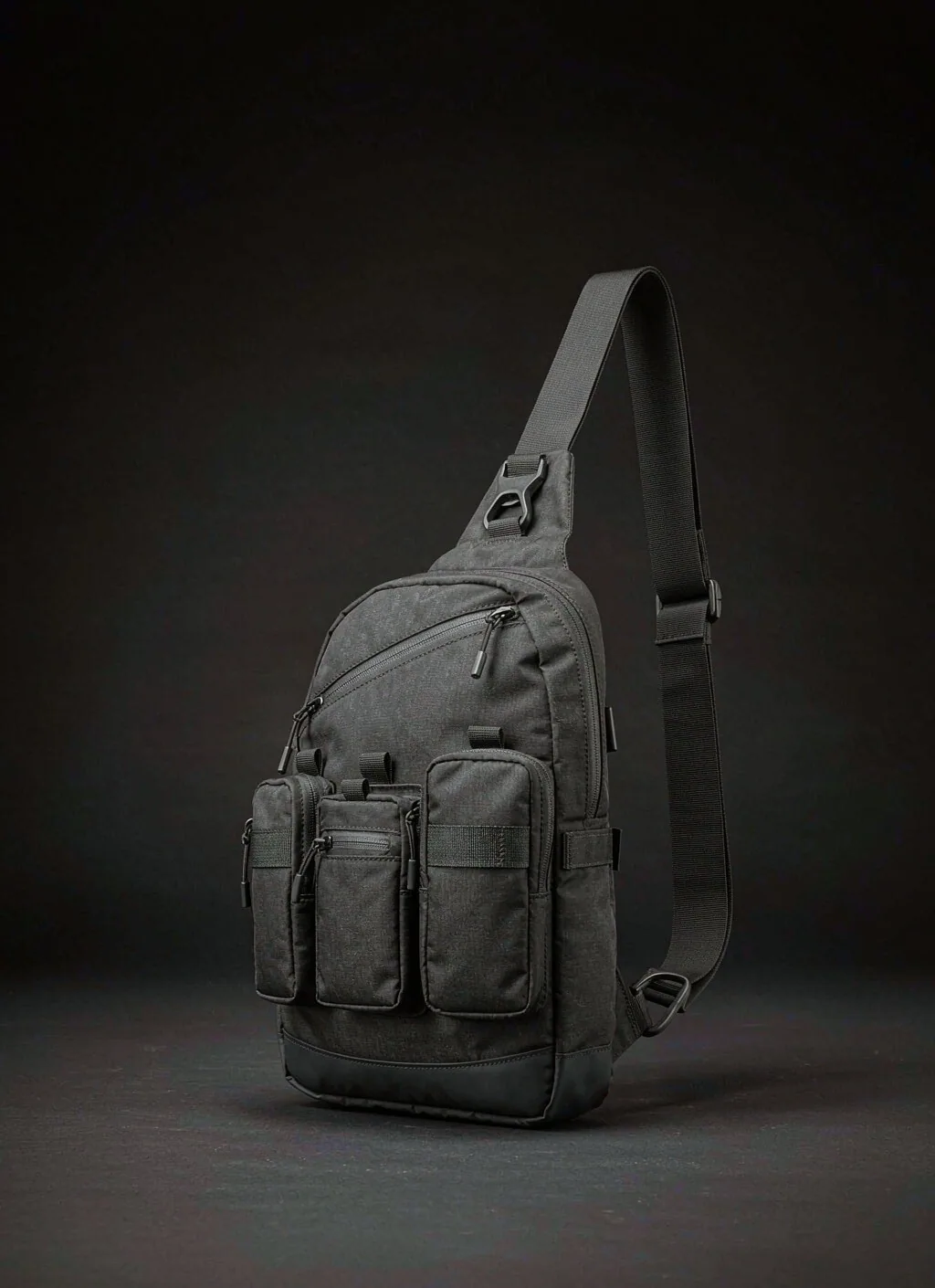
Task Decomposition: What Everyday Carry Actually Carries
Everyday carry fails as a specification when it is written as a list of objects. Phones, wallets, power banks and bottles change model, size and shape faster than a pattern can be revised, and a compartment cut for one device becomes a liability a season later. The durable unit of specification is the task: what the user must do, how often, in what posture, under what lighting, and with which hand already occupied. Six clusters cover almost all lawful civilian everyday carry. They are personal items normally kept near the body, hand tools, electronics and power, credentials and documents, first-aid provision, and water. Each cluster carries a different access cadence, a different density, a different contamination profile and a different consequence when it goes missing. A brief built on those clusters can absorb device churn, because the module changes while the position, the interface and the retrieval rule stay put.
The personal cluster behaves differently from every other group because much of it never belongs inside the bag. Wallets, phones, transit cards, eyewear and daily medication live in pockets or on the body and enter the carrier only when clothing has no room or when the user sits down. Designing for it therefore means providing a shallow, hard-wearing landing zone near the top or front of the carrier, a key anchor that stops metal migrating into the lining, and enough internal contrast that a small dark object can be found without emptying the pocket. Access cadence here is measured in minutes, which makes one-handed operation and a closure that does not demand visual alignment more valuable than raw volume. A pocket that requires two hands and eye contact is a pocket the user will stop using by the second week.
Hand tools are the opposite case. A multitool, compact flashlight, pen, bit driver or small pry bar is touched rarely, but it is dense, angular and frequently dirty. Left loose in a main compartment it abrades linings, snags hook-and-loop, dents softer contents and rattles against hard surfaces. The engineering response is isolation: a dedicated sleeve or removable roll with a stiffener that turns corners away from the shell, a depth that keeps the tool below the zipper line, and a position close to the back plane so concentrated mass does not lever the carrier rearward. Because access is infrequent, slower closures and secondary retention are acceptable here in a way they would never be for a transit card.
Electronics and power form the cluster that generates most returns in this category. Cables tangle, power banks are dense and warm, earbud cases are small and easily lost, and connectors suffer strain wherever a cable is bent at a fixed radius against a hard edge. A controlled programme specifies a padded cell with stated internal dimensions, a cable route with generous bend allowance, and separation both from water and from loose metal that could bridge contacts. Heat dissipation and connector strain deserve explicit callouts, since both shorten the life of the contents more reliably than shell abrasion ever does. Credentials follow a similar logic from a different direction: passports, cards and site badges must stay flat and dry, so they belong in a slip panel that resists creasing rather than in a general-purpose mesh pocket.
First-aid provision and water complete the decomposition. A civilian everyday first-aid module is a small, clearly marked set of dressings, gloves and a few basic items; the contents themselves, their expiry control and any registration obligation sit with the buyer or a licensed distributor, not with the bag programme. What the carrier supplies is presentation logic, dirt protection and a position another person can locate quickly. Water introduces a rigid cylinder, condensation and leakage risk. A bottle pocket needs base support, an upper stabiliser to control swing, a drain path and physical separation from the electronics cell. Treated as a cluster rather than as an accessory, water also fixes the height and depth of one flank of the carrier, which then constrains how much usable mounting face is left on that side.
One boundary should be stated before design work starts. Everyday carry in this document means lawful civilian carriage: commuting, worksite duty, field service, photography, travel and organised personal kit. It does not include armament carriage, ammunition storage, personal armour or any controlled article, and nothing here implies approval by any defence authority. Many EDC silhouettes borrow visual language from duty equipment, and buyers should expect that resemblance to attract questions at borders, venues and workplaces. The specification answer is not to add capability but to keep the architecture defensible: ordinary organisation, declared contents, documented materials and no hidden compartment whose only purpose is to defeat inspection.
| Task cluster | Representative contents | Access cadence and condition | Placement bias | Control to write into the brief |
|---|---|---|---|---|
| Personal and on-body | Wallet, phone, transit card, eyewear, daily medication | Every few minutes, often one-handed and without looking | Shallow top or front zone with high internal contrast | Key anchor point, snag-free mouth, closure operable without visual alignment |
| Hand tools | Multitool, torch, pen, bit driver, small pry bar | A few times per day, usually stationary | Isolated sleeve near the back plane | Corner stiffener, depth below the zipper line, secondary retention |
| Electronics and power | Power bank, cables, earbud case, compact charger | Several times per day, seated and standing | Padded cell inside the main body, away from liquids | Stated internal dimensions, bend allowance, heat path, separation from loose metal |
| Credentials and documents | Passport, cards, site badge, folded papers | At checkpoints, under time pressure | Flat slip panel that resists creasing | Crease control, dry location, removal without disturbing other clusters |
| First-aid module | Dressings, gloves, a few basic items supplied by the buyer | Rarely, but must be obvious to a second person | Marked removable panel or dedicated pocket | Identification, contents responsibility statement, dirt protection |
| Water | Bottle or flask | Regularly, often while walking | Exterior flank with base and upper stabiliser | Drain path, swing control, separation from the electronics cell |
Capacity Bands for an EDC Backpack: Under 10 L, 10-20 L and 20-30 L
Capacity is the first number a catalogue prints and the least useful one in a brief. Litres describe enclosed space, not reachable volume, not carried mass and not the shape of what fits. An everyday carry buyer should instead start from the band that matches the day, then check whether the shell can be compressed when the load is half of what the label promises. Three bands cover the market. Under 10 L serves a minimal kit and is usually carried at the front or on one shoulder. The 10-20 L band is the true core of the EDC backpack category because it holds a full working day without committing the user to a bulky profile. The 20-30 L band absorbs mixed duty where a laptop, a tool roll and a bottle have to coexist, and it is where discipline matters most because the extra space invites over-carrying.
Under 10 L, the constraint is not storage but rotation. This band works when the carrier can swing to the chest for access without being removed, which suits travel documents, a compact camera, a small tool set and personal items. Its structural risk is asymmetry: everything hangs from one anchor or sits high on the chest, so the strap needs width, grip and a stabilising secondary strap, and the contents have to remain light and flat. Mounting face is scarce, so the allocation should be deliberately narrow: a short exterior field for one utility module, an internal loop strip for a flat organiser, and nothing on the base that would catch on a chair back. Programmes that try to fit a full PALS grid into this band usually end up with webbing the user cannot reach and a shell that no longer folds flat.
The 10-20 L band carries the widest range of daily work. It can hold a padded electronics cell, a cable organiser, a tool sleeve, a water flank and a credentials panel while remaining acceptable in a meeting, on transit and in an overhead locker. Because the profile is still moderate, exterior mounting must be rationed: one structured front face for a utility or admin module, a modest side field for water retention, and internal hook-backed fields for flat organisation. The trap at this band is depth creep. Adding front pocket depth increases perceived capacity while pushing the centre of mass away from the spine, so a nominally comfortable pack starts to feel rear-heavy the moment a dense module is fitted. Compression should draw the whole assembly back toward the body rather than simply flattening an empty outer pocket.
From 20-30 L, an EDC backpack starts behaving like a small duty pack, and the brief should acknowledge that change. There is room for a suspended laptop cell, a full first-aid module, a rolled tool set and a hydration option, which makes the configuration attractive to field service and technical users. The costs are silhouette, weight and discipline: a larger shell invites contents that do not belong in a daily carry, exceeds some workplace locker dimensions, and can read as duty equipment in contexts where discretion matters. Mounting allocation should therefore be concentrated on the front face and the lower flanks, leaving the upper back panel clean so the carrier sits comfortably against a seat or a vehicle seatback. Any exterior module in this band should be checked for width as well as mass, because a deep pouch on each flank can turn a legal carry-on into an obstacle.
Mounting-face allocation is best expressed as a budget rather than a wish list. Decide how many horizontal rows of woven attachment the front face can genuinely offer after the main opening, the compression path and the shoulder roots have taken their space. Treat loop field area as a separate budget, because it serves flat internal organisation far better than it serves protruding exterior pouches. Reserve the base and lower corners for abrasion material rather than for attachment, since those zones meet floors, kerbs and vehicle sills. Whatever the band, publish a configuration map stating which module may occupy which face and which combinations are excluded, because undocumented freedom is how a coherent platform becomes a bag with random accessories clipped to it.
| Capacity band | Realistic contents envelope | Carrier formats that suit it | Mounting-face allocation | Dominant risk | Design response |
|---|---|---|---|---|---|
| Under 10 L | Minimal kit, documents, compact tool set, small electronics | Sling, waist-mounted, chest-mounted, compact day shell | One short utility field, one internal loop strip, no base attachment | Asymmetric load and unreachable webbing | Wide grip strap, stabilising secondary strap, mounting kept to the reachable arc |
| 10-20 L | Full working day: electronics cell, cable organiser, tool sleeve, bottle | The core everyday carry backpack body | Structured front face, one side retention field, internal hook-backed panels | Depth creep moving mass away from the spine | Compression that pulls toward the back plane and a stated pocket depth limit |
| 20-30 L | Mixed duty: laptop cell, first-aid module, rolled tools, hydration option | Larger daily shell, small duty pattern, work-oriented body | Front face plus lower flanks, upper back panel kept clean | Over-carrying, silhouette growth, width at checkpoints | Configuration map with excluded combinations and a width check at packing |
Carry Format Differences: Single-Shoulder, Chest and Waist by Task
Format choice in everyday carry is a task decision disguised as a style decision. A single-shoulder sling, a chest-mounted panel and a waist-mounted pouch solve different problems, and each fails in a predictable way when it is asked to do another one's job. The three variables that separate them are rotation, symmetry and interference. Rotation describes whether the user can bring the contents to the front without removing the carrier. Symmetry describes whether the load is shared by two anchors or hangs from one. Interference describes what the format collides with: a seatbelt, a vehicle seat, a backpack shoulder strap already in place, a workbench edge or the user's own field of view.
A single-shoulder sling earns its place with rotation. The body swings across the chest, the user reaches in while standing in a queue, and the whole thing goes back behind the hip without touching the ground. That behaviour suits credentials, a compact camera, hand tools and personal items accessed constantly. Its cost is asymmetry: one shoulder takes everything, so the strap needs width, a grippy underside and a stabilising secondary strap, and the contents must stay light and flat. Dense objects in a sling produce a persistent rotational moment that no amount of padding removes, which is why a sling is a poor home for a brick-shaped power bank or a full bottle on its own flank. Specification controls should cover strap width, grip material, stabiliser geometry, and the swing path over the shoulder rather than around the neck.
Chest-mounted carriage puts the working face where the user can see it, which is why it suits tasks performed with both hands: ticketing, inspection, photography, sampling and light first-aid access. Its limits are physiological rather than structural. Load placed high on the chest restricts ribcage movement during exertion, and a panel carried too wide interferes with the arm swing and with downward vision. Weight should therefore stay modest and distributed, with dense items kept low and close to the sternum rather than stacked outward. The interface has to be resolved against a backpack already being worn: harness straps, sternum position and module footprint all contend for the same area. Teams working in this space usually treat the chest layer as one branch of a broader chest and waist module family so the two layers can be specified against the same anchors.
Waist-mounted carriage is the most underrated everyday format and the most misused. Worn correctly it keeps hands free, sits below the visual field, and gives fast access to a small tool set, credentials or a first-aid module. Worn badly it collides with seatbelts, digs into the hip when seated, rotates around the body during walking, and blocks trouser pockets. The load character must stay light and flat; a waist platform is not a place for dense or swinging mass, because the anchor is a single belt line with no vertical support. Specification should cover belt width and stiffness, the anti-rotation interface, padded contact geometry, and how the pack behaves when the user sits in a vehicle or at a desk. Where programmes need both a waist layer and a shoulder layer, the brief should state which one is primary and which is the removable second layer, because two equal layers designed independently will fight each other.
Conversion between these formats is where modular design pays for itself, and where it most often goes wrong. A small pouch that can be worn on a belt, swung on a sling or mounted to a chest harness is attractive commercially, but each mode imposes different anchor geometry. A belt path needs horizontal stiffness and low profile; a sling needs a rotational anchor and a swing path; a chest mount needs vertical strap clearance and a non-slip back. Reusing one shell for all three is possible when the anchor points are designed as a controlled set from the start, with declared load limits per mode rather than one universal figure. Programmes that want this flexibility should also look at how a convertible carry architecture defines its mode changes, because the same interface control discipline applies at both scales.
| Format | Tasks it serves best | Load character it tolerates | Ergonomic limit | Interference to check | Control to specify |
|---|---|---|---|---|---|
| Single-shoulder sling | Constant access, queue and transit use, compact tool and camera carriage | Light, flat, balanced across one anchor | Rotational moment from dense objects; shoulder fatigue over a long day | Car door frames, crowd contact, rotation during brisk walking | Strap width, grip underside, stabiliser geometry, swing path over the shoulder |
| Chest-mounted panel | Two-handed work, ticketing, inspection, sampling, first-aid access | Light and distributed, dense items low and central | Ribcage movement, arm swing, downward vision | Existing backpack straps, sternum strap position, harness routing | Vertical strap clearance, footprint limit, non-slip back panel |
| Waist-mounted pouch | Hands-free periods, small tool set, credentials, personal items | Light and flat only; no swinging mass | Single belt line with no vertical support | Seatbelts, hip pressure when seated, trouser pocket access | Belt width and stiffness, anti-rotation interface, padded contact geometry |
| Converted small shell | Programmes needing one body across several modes | Declared per mode, never one universal figure | Anchor geometry differs by mode | Mode change hardware protruding in the unused mode | Controlled anchor set, per-mode load statement, mode-change cycle limit |
Mounting Face Allocation and Interface Density on a Small Platform
Interface density on an everyday carry body is an exercise in subtraction. Every row of woven attachment consumes shell area, adds mass, introduces needle holes and raises the acoustic signature of the product. On a small platform the front face also has to host the main opening, the compression path, a reflective or identity detail, and whatever discretion the target market requires. The correct question is therefore not how much attachment can be fitted, but which modules must live outside the shell and how few rows will hold them. A woven field earns its place when a module is dense, dirty or needed in a hurry; it is wasted when the same task could be solved by an internal slip panel that costs less, weighs less and makes no noise.
Where a woven field is justified, its geometry must be drawn rather than described. Controlled PALS work states the webbing width at 25 mm, sets rows at 38 mm vertical spacing and repeats columns on a 50 mm horizontal repeat, with backing construction, row count and usable clearances written into the same drawing. Naming the interface is not enough: two fields can both be described with the same word and still refuse the same pouch once pitch drifts or a seam steals a column. Buyers should also decide where the field terminates. A field that stops in the middle of a face fabric behaves like an applied label; a field whose webbing continues into a reinforced side seam or base seam returns force into the structure and survives far longer under a loaded module.
Not every everyday carry module belongs on a woven field. Hook-backed organisation excels inside the shell, where loads are flat, positions are frequent and the user benefits from continuous adjustment. Protruding exterior pouches create peel at an exposed edge, which is exactly the loading case a broad field handles worst, so they need either a woven connection or a positive mechanical support in addition to the field. Daisy chains offer low-mass lashing points for a carabiner, a cord or a strap, but loop size and stitching decide their behaviour and a concentrated clip load can distort the base textile. Guided magnetic hardware such as Fidlock V-BUCKLE gives an intuitive closure when its mating orientation and strap path are designed; it should not quietly become the sole retention element for a dense module unless that assembly was validated for it. Familiar squeeze-release components from ITW/Nexus, Duraflex or Woojin give tactile confirmation and replaceable strap connections, provided both halves are controlled as a matched pair.
Allocation also has a human dimension. Anything mounted on the shoulder strap competes with the user's hand, chest and collar; anything mounted low on a flank competes with chair backs, door frames and turnstiles; anything mounted on the base meets every surface the bag is set down on. A useful rule is to reserve the reachable arc, roughly from the front face across to the leading flank, for modules the user needs while standing, and to keep the rear panel and base clean except for abrasion material. The brief should then state exclusions explicitly: no module crossing the main zipper run, none covering a compression anchor, none extending past a declared width, and none mounted where it would press into the wearer's lumbar region when the carrier is fully packed.
Third-party compatibility deserves a bounded statement rather than an open promise. Publish the geometry the platform controls, the zones where outside modules are welcome, the packed mass those zones were validated for, and the zones reserved for approved parts. Assess an unfamiliar accessory against pitch, webbing width, mating depth, occupied rows, peel direction, packed mass, access interference and material interaction, because an aggressive hook can abrade a light liner and a stiff tab can cut a coated shell long before anything actually falls off. Buyers who want the underlying geometry explained in depth can follow the dedicated MOLLE attachment engineering material, then apply the acceptance rules above to their own module list.
| Face or zone | What belongs there | Interface choice | Contention to resolve | Acceptance check |
|---|---|---|---|---|
| Front face | One utility or admin module needed while standing | Woven field with declared row count, or a guided closure panel | Main opening run, compression anchors, identity detail | Open and close the main compartment with the module fully packed |
| Leading flank | Water retention or a shallow quick-access pocket | Side field with base and upper stabiliser | Reach over the shoulder, chair backs, turnstile width | Remove and replace the vessel one-handed while the carrier is worn |
| Internal back wall | Flat organisation, cable panels, credentials | Hook-backed field with a peel-resistant edge | Laptop or device cell depth, frame sheet curvature | Lift the organiser out and refit it without disturbing the cell |
| Shoulder strap | Only very light items: a small pouch or a radio clip | Narrow woven strip or a controlled clip interface | Collar contact, chest reach, strap adjustment travel | Adjust the strap through its full range with the item fitted |
| Base and lower corners | Abrasion material, not attachment | Reinforced panel bound into the structure | Floor contact, vehicle sills, wet surfaces | Inspect after a set-down and drag sequence on a representative surface |
Internal Zoning and Retrieval Sequence in Everyday Carry
Internal layout is a sequence problem before it is a storage problem. Users do not open a bag and survey it; they reach for a known object in a known position under time pressure, often with one hand and often while moving. A zoning model built on retrieval tiers converts that behaviour into something a factory can build and a buyer can verify. Tier zero never enters the bag at all and stays on the body. Tier one is touched every few minutes and demands external or top access. Tier two is touched several times a day and belongs in a secondary opening. Tier three is occasional and can live deeper or in a removable module. Tier four is contingency and should be packed last, clearly identified and not allowed to displace anything above it.
Opening geometry follows from the tier map. A top opening protects the structural side seams and keeps a narrow silhouette, but it makes lower contents harder to reach and encourages digging. A panel opening balances reach and containment when the hinge, the zipper ends and the compression anchors are coordinated, and it is the usual choice for an everyday carry body. A clamshell opening gives full laid-out access, which suits inspection and photography kit, but it needs a clear floor area and can spill contents when opened upright on a lap. Whichever geometry is chosen, the zipper path must be checked with every approved module fitted, because a pouch crossing the run is the most common reason a good shell becomes unusable in the field.
Removable organisation is what makes a platform modular on the inside. Hook-backed panels, padded cells and slip wallets that lift out let the same shell serve a commuter, a technician and a photographer, and they let the user reconfigure without buying a second bag. The trade-off is that removable parts add mass, can migrate, and introduce hook-and-loop noise every time they are lifted. Fixed dividers are quieter and lighter but freeze the configuration at the factory. A balanced brief keeps the structural cell fixed where protection matters, such as around a device, and makes the surrounding organisation removable where taste and task vary. Every removable item needs a stated home face, a compatible-neighbour list and a packed thickness limit, because a thick organiser in a shallow shell silently steals the volume the main compartment advertised.
Retrieval order also determines what may share a pocket. Items from different tiers should not compete for the same mouth, and items with different contamination profiles should not share a lining. Keys and tools abrade; water condenses; pens leak; food and cosmetics leave residue. A practical rule is to give each contamination class its own pocket or its own removable sleeve, and to place the messiest, least frequently accessed items lowest, where a spill damages the least. First-aid and credentials are the exceptions: both must remain visible and reachable regardless of how the rest of the bag is packed, because in the moments they are needed there is no time to unpack anything else.
Verification should reproduce the awkward conditions rather than the ideal ones. A useful method is a timed retrieval script performed with the carrier worn, one hand occupied, low light, and the approved module set fitted; record which tier failed, how long each retrieval took, and what the user had to move to get there. Repeat the script seated, in a simulated crowd, and with gloves if the audience wears them. Then repeat it after a week of normal use, because organisers sag and contents migrate once a bag stops being new. The output is not a marketing claim but a configuration map: which tier sits where, which combinations are approved, and which contents the platform should refuse.
| Retrieval tier | Representative contents | Access condition | Required position | Verification method |
|---|---|---|---|---|
| Tier zero | Wallet, phone, medication normally kept on the body | Continuous, no bag opening | Body pockets, with a defined landing zone when carried | Confirm the landing zone accepts the item without removing other contents |
| Tier one | Transit card, keys, earbud case | Every few minutes, one-handed, no visual alignment | External or top zone with a snag-free mouth | Timed one-handed retrieval with the carrier worn and one hand occupied |
| Tier two | Power bank, cable set, notebook | Several times a day, seated or standing | Secondary opening or removable panel | Retrieval script repeated seated and in a simulated crowd |
| Tier three | Tool roll, first-aid module, spare layer | Occasional, usually stationary | Deeper position or a removable sleeve | Check that removal does not disturb tier one or tier two contents |
| Tier four | Contingency items | Rarely, under stress | Identified location packed last | Identification review and a spill-consequence check for the lowest pocket |
Noise Control: Zippers, Hook-and-Loop and Hardware in Shared Spaces
Acoustic behaviour is a real specification item for everyday carry because the product is used in lifts, open-plan offices, libraries, trains and meetings. Users rarely complain about noise directly; they stop carrying the bag, or they stop using the pocket that announces every opening. Four sources dominate. A metal puller striking a zipper stop or a hardware ring produces an intermittent metallic tick. Hook-and-loop separation produces a broadband tear that carries across a quiet room. Unmanaged strap tails and loose webbing produce a continuous slap against the shell during walking. Contents themselves, particularly keys, bottles and metal tools, generate impact noise inside a pocket that has no damping.
Zipper noise is managed at the puller and at the path. A puller with a soft or elastomeric cover, a garage that captures the puller when closed, and a stop arrangement that prevents metal-to-metal contact remove most of the tick without changing the chain. The path matters too: a zipper running over a stiff fold or across a loaded module will rattle under vibration even with a quiet puller. Where the opening is on the front face, consider whether the puller can rest against a textile rather than against a buckle or a D-ring, and whether the chain gauge suits the packed pressure, since an over-tight path forces the user to work the slider and generates more noise than a correctly sized one.
Hook-and-loop is the hardest source to manage because its noise is intrinsic to its function. Partial solutions exist and are worth specifying: a lower-profile hook grade, a field positioned so the peel edge faces the body, a cover flap that lets the user open a pocket without lifting the whole panel, and an alternative closure for pockets opened in public. The honest trade-off is that quieter mating generally means lower retention, so the decision must be made per pocket. Keep hook-and-loop inside the shell where quick, frequent reconfiguration is genuinely needed, and use mechanical or guided closures on exterior modules where both retention and quiet behaviour are expected.
Hardware selection closes the acoustic problem. Coated or polymer hardware eliminates most metallic contact noise but changes wear behaviour and perceived quality; bare metal hardware reads as durable and can be specified with a finish, but it must be checked for contact points and for the plating evidence discussed later. Whatever is chosen, every hard component needs a defined rest position, because a free-swinging ring or a loose gate generates noise whether or not it is made of metal. Strap management completes the work: keepers, elastic loops and tail routing should be drawn, not left to the operator, and the shell should provide damping behind any exterior module so a hard object cannot drum against the panel.
Measurement should be a project method rather than a borrowed claim. Define a motion script, a microphone distance, a background condition and an acceptance threshold in A-weighted terms, then compare candidate constructions against each other under identical conditions. That approach gives a repeatable internal yardstick and a way to check a production sample against the approved reference. It does not produce a certified acoustic rating, and it should not be marketed as one. What it does produce is a defensible answer when a customer reports that the sample is louder than the prototype, which is otherwise an argument nobody can resolve.
| Noise source | Mechanism | Control measure | Side effect to accept | How to check |
|---|---|---|---|---|
| Zipper puller | Metal puller striking a stop, slider body or hardware ring | Covered puller, captured garage, textile rest position | Slightly larger closure detail and a little more assembly time | Repeat open-close cycles with a fixed microphone distance |
| Zipper path | Chain vibrating over a stiff fold or a loaded module | Re-route the path, add backing, size the chain to packed pressure | Pattern change and possible loss of a feature line | Walking script with the approved module set fitted |
| Hook-and-loop | Broadband tear as the mating surfaces separate | Lower-profile hook, body-facing peel edge, cover flap, alternative closure | Lower retention for the quieter option | Peel-force comparison plus a subjective panel review |
| Loose straps and tails | Continuous slap against the shell during movement | Keepers, elastic loops, defined tail routing | Extra trim and one more assembly operation | Brisk walking and stair script with the carrier loaded |
| Contents impact | Keys, bottles and tools striking each other or the panel | Damped pocket lining, separated sleeves, isolation from hard surfaces | Additional mass and one more component in the bill | Shake and step script with representative contents or surrogates |
| Free hardware | Unrestrained ring or gate contacting a hard neighbour | Defined rest positions, coated finishes, polymer alternative where suitable | Different wear behaviour and perceived quality | Inspect contact points after a movement script |
Security Screening and Metal Detection at Daily Checkpoints
Everyday carry products meet checkpoints far more often than they meet wilderness. Airport security, transit gates, stadium entry, courthouse screening and controlled workplace access all impose the same basic demand: contents must come out quickly, lie flat, and go back in without a struggle. A carrier designed around that demand saves the user a minute at every encounter and reduces the chance that a small object is left behind in a tray. The design work is unglamorous but specific. Flat-lay geometry, single-motion electronics removal, a tray-friendly silhouette, and metal distributed in small dispersed masses rather than concentrated in one plate all reduce friction.
Metal content is the part buyers most often overlook. A large metal frame sheet, a heavy buckle cluster, a steel-reinforced base or a dense stack of rings can trigger a hand-search even when the bag itself is innocuous. Dispersing hardware, selecting polymer where the load case allows it, and keeping the largest metal parts low and close to the back plane reduce that risk without weakening the product. Plating and coating choices matter for a second reason: nickel release from metal components in prolonged skin contact is assessed through EN 1811, and that evidence belongs in the compliance file alongside restricted-substance documentation. Hardware is not decoration here; it is a compliance surface.
Electronics and liquids deserve a planning note rather than a promise. Screening rules on device size, battery carriage and liquid volume are set by authorities and carriers, they differ by jurisdiction, and they change; IATA material is a useful planning reference, but the importer and the end user remain responsible for the rules that apply to their route. What a bag programme can control is the friction: a device cell that opens flat and releases the device without unpacking, a liquid position that can be reached and replaced one-handed, and a pocket layout that lets the user empty the tray contents back into the same places every time. Repeatability is the real feature, because a user who knows exactly where each item lives moves through screening faster and loses less.
Checkpoint-friendly design also intersects with discretion. A carrier covered in dense exterior attachment reads as equipment, attracts additional questions at venue entry, and may be refused in some workplaces. The resolution is not to abandon modularity but to place it where it does not dominate the silhouette: interior organisation, a controlled front field that can be covered, and exterior modules that are optional rather than permanent. Programmes serving office-based users frequently converge on the same answer as a dedicated work-oriented modular carrier, where mounting capacity is traded for a calmer outline without giving up internal structure.
Finally, handle the lock question carefully. A lockable slider or a small cable loop is a legitimate everyday feature for gym lockers, shared offices and transit; it is not a security certification and should never be described as one. If a programme wants a lockable closure, specify the slider geometry, the compatible lock type and the fact that no claim of theft prevention is being made. The same restraint applies to signal-blocking language: shielding claims belong to components with their own evidence, and a bag programme should not inherit a marketing promise it cannot verify.
| Checkpoint step | Friction created | Design response | Boundary note |
|---|---|---|---|
| Tray unloading | Small objects scattered across several pockets and lost | A defined landing zone for personal items with contrast lining | Convenience only; no claim about screening acceptance |
| Device presentation | Laptop or tablet buried behind other contents | Flat-opening device cell reachable without unpacking the body | Device rules are set by authorities and carriers |
| Liquids handling | Bottle difficult to extract and replace one-handed | Exterior flank pocket with base and upper stabiliser | Volume rules vary by jurisdiction and change over time |
| Walk-through or hand-held screening | Concentrated metal triggering secondary inspection | Disperse hardware, use polymer where the load case allows, keep large metal low | Nickel release assessed through EN 1811 for skin-contact metal |
| Repacking | User refills pockets differently each time | Fixed positions per retrieval tier with a documented layout | Reduces loss risk; does not guarantee it |
| Venue and workplace entry | Dense exterior attachment attracting additional questions | Coverable fields and optional rather than permanent exterior modules | Access policy belongs to the venue or employer |
Abrasion, Contamination and Cleaning from Keys, Tools and Daily Grime
Everyday carry destroys bags from the inside out. The shell usually survives; the lining, the binding and the pocket edges fail first because they meet the objects users actually carry. Keys are the classic culprit: a ring of keys works against a liner with every step, cutting yarns at the pocket floor and eventually appearing through the shell. Tool corners, charger bricks, torch bezels, pen clips, coins and umbrella tips do the same work with different geometry. Liquids are the second class of enemy, from a leaking bottle to hand sanitiser, cosmetics and coffee, and they interact badly with coatings, adhesives and printed labels.
The material answer starts with zone allocation rather than with a heavier shell. A 500D Cordura face is a reasonable general choice for an everyday body because it balances abrasion behaviour, hand and seam bulk; 1000D Cordura is justified only where a surface receives concentrated abuse, such as a base or a tool flank, because its stiffness and mass cost comfort and foldability everywhere else. Inside, a 210D-420D lining range supports visibility and low bulk, but the grade must be matched to the pocket duty: a liner that is perfect for documents will be destroyed by a key ring in a season. Where the risk is high, the better answer is a sacrificial solution: a replaceable sleeve, a stiffened tool pocket with its own wear surface, or an isolation pocket whose failure does not condemn the whole bag.
Construction detail decides whether the material choice holds. Bound seams, turned and topstitched pocket mouths, reinforced pocket floors, and a key anchor that keeps metal off the lining all extend service life more reliably than a denier increase. Needle selection and stitch density matter at coating transitions, because a coated fabric perforated too densely becomes a tear line. Drainage should be designed rather than assumed: a bottle pocket that holds water will eventually defeat any coating. Where a product is expected to be washed, the care instruction has to be validated, and ISO 6330 gives a domestic washing and drying procedure that can support that work.
Contamination behaviour also has a compliance dimension. Colour transfer onto light clothing is assessed through AATCC 8 crocking evidence; abrasion resistance is commonly reviewed through ISO 12947 or ASTM D3884; coated fabrics are examined with routes such as ASTM D751; and resistance to water passage at the textile level is measured by AATCC 127. None of those reports describes the finished article, because seams, needle holes, zipper construction and abrasion during assembly all change the outcome. They are material evidence, and they belong in the file next to the bill of materials, the colour standard and the lot reference rather than on a hangtag.
Cleaning strategy should be stated before the product ships. Decide whether the article is wipe-clean, hand-wash or machine-wash, whether removable organisers can be laundered separately, and what the user should do about a spill in the bottle pocket. Dark linings hide grime but reduce visibility; light linings improve contrast but show every mark, and either choice should be made deliberately by pocket rather than by default. A short, honest care statement reduces returns more effectively than a durability adjective, because it sets expectations the product can actually meet.
| Source | Damage mechanism | Construction response | Useful material evidence | Care implication |
|---|---|---|---|---|
| Key ring | Repeated cutting action at the pocket floor | Key anchor, sacrificial sleeve, reinforced pocket base | ISO 12947 or ASTM D3884 abrasion review on the pocket textile | Advise anchoring keys rather than dropping them loose |
| Tool corners | Point pressure puncturing or creasing the lining | Stiffened sleeve with corners turned away from the shell | ASTM D5034 tensile evidence on the sleeve textile | Inspect sleeve before the shell; replace the sleeve first |
| Charger bricks and coins | Concentrated mass abrading a seam stack | Padded cell with a defined position and bend allowance | Seam and tear review on the cell construction | Keep dense objects in the cell, not in general pockets |
| Bottle leakage and condensation | Coating breakdown and trapped moisture | Drain path, separation from electronics, coated pocket floor | AATCC 127 for the textile, ASTM D751 for coated fabrics | Empty and air the pocket; state whether it is machine-washable |
| Sanitiser, cosmetics, coffee | Staining and adhesive or print attack | Print and adhesive selection reviewed against likely contact | AATCC 8 crocking evidence for colour transfer | Wipe-clean instruction with a stated method |
| Grit and sand | Abrasive paste inside pocket floors and zipper chains | Bound seams, cleanable pocket shapes, zipper garage | Assembly-level inspection after a grit exposure script | Shake out and brush; avoid laundering with grit present |
Validation Route, Compliance File and Commercial Terms
Validation for everyday carry should follow the order in which uncertainty is reduced. Start with geometry: confirm that the woven field, the loop area, the pocket mouths and the opening path match the drawing on a production-representative sample, because a geometric error invalidates every later test. Move to assembly behaviour: fit the approved module set, pack to the declared contents, and run pull, peel, movement and set-down sequences in the directions real use produces. Then address the environment: abrasion, colour transfer, water passage at textile level, corrosion on metal components, and laundering if the care statement promises it. Only after those results agree with the tech pack should a pre-production sample be released as the mass reference.
Textile evidence supports the material decision and does not replace assembly verification. ASTM D5034 provides grab tensile data; ISO 12947 and ASTM D3884 address abrasion behaviour; AATCC 8 covers crocking; AATCC 127 addresses resistance to water passage; ASTM D751 covers coated fabrics; ASTM B117 supports a salt spray review of metal finishes; and ISO 6330 provides a laundering procedure where care validation is required. Environmental conditioning is often discussed with reference to MIL-STD-810, which is useful as a planning framework, but no result here should be presented as a certification or as a defence qualification. Reports must be tied to the actual substrate, colour, finish, component reference and lot, because a nominally similar material is not automatically covered.
Inspection and release need the same discipline. Final inspection runs at AQL 2.5 with sampling grounded in ISO 2859-1, the successor route to the older MIL-STD-105 tables. The defect library should separate critical retention and safety issues from major function defects and minor appearance variation, and it should name everyday carry failures specifically: a key anchor missing, a puller that will not seat in its garage, an organiser that interferes with the device cell, a strap keeper omitted, a module that crosses the main zipper run. Final inspection cannot substitute for process control, because hidden backing, webbing overlap and stitch paths are no longer visible once the shell is closed. Approved component boards, first-piece checks and configuration audits keep our production team aligned with the signed sample.
Compliance is a documented market-access process rather than a set of logos. REACH (EC 1907/2006) supports chemical-substance control for relevant European obligations; California Prop 65 requires an exposure-based review for products distributed in California; CPSIA becomes relevant where the product scope and intended user create applicable consumer-product obligations; OEKO-TEX Standard 100 can supply useful textile and component substance evidence within its certified scope. ISO 9001 describes a quality-management framework and BSCI a social-compliance monitoring framework; neither certifies the performance of a particular article. ISTA 3A can inform packaged-product distribution testing where parcel conditions apply. The file needs declarations, scoped reports, certificates with validity, bill-of-material links and a change trigger whenever a material, plating, print or component is substituted.
Commercial terms should be fixed before artwork starts. The programme baseline is MOQ 500, with a sampling window of 6-10 working days, extended to 12-15 working days for complex constructions, and mass production planned at 35-50 days after approvals and inputs are complete. Payment runs T/T 30/70 and the commercial basis is FOB Xiamen. Any price discussed is indicative only, FOB Xiamen, 500-unit MOQ. Logistics options are sea freight 25-35 days, air 5-8 days and courier 3-5 days, and the choice should be made against the launch calendar rather than after it. Capacity planning is handled across our 4,950 m2 SGS-verified production floor, staffed by 137 people operating 7 production lines and 149 machines, with our vetted partner facilities available for overflow; combined output is planned at 200,000 units per month. That scale matters to an everyday carry programme only if the interface control, the inspection plan and the approved sample are equally disciplined, which is why the brief, the tech pack and the configuration map are the real deliverables.
| Stage | Question it answers | Representative setup | Evidence to record | Release judgement |
|---|---|---|---|---|
| Geometry audit | Do field pitch, pocket mouths and opening paths match the drawing? | Production-representative shell measured against the control drawing | Pitch, spacing, repeat, clearances, usable rows and columns | Every later test is invalid if this fails |
| Assembly verification | Do approved modules stay put in the directions real use creates? | Declared contents packed into the approved configuration | Pull, peel, movement and set-down behaviour with failure origins | No release and no unacceptable deformation in the approved envelope |
| Acoustic comparison | Is the sample quieter than or equal to the approved reference? | Fixed motion script, fixed microphone distance, stated background | A-weighted comparison between candidate and reference | Internal yardstick only; never a certified rating |
| Material and component review | Do textiles, coatings, hardware and prints carry valid evidence? | Approved boards with lot, colour, finish and component references | Tensile, abrasion, crocking, water passage, corrosion and substance reports | Reports must map to the actual bill of materials |
| Care validation | Does the stated cleaning method leave the product usable? | Samples washed or cleaned according to the care statement | Dimensional change, seam behaviour, print and coating condition | Care text must match the validated method |
| Inspection and release | Can the shipment be released against agreed criteria? | AQL 2.5 sampling under ISO 2859-1 with the project defect library | Defect classification, configuration audit and packaging reconciliation | Critical defects cleared before any shipment discussion |
| Item | Stated baseline | What it depends on | Buyer action |
|---|---|---|---|
| Minimum order | MOQ 500 | Colourway and configuration split across the shared carrier | Fix the configuration map before splitting the quantity |
| Sampling | 6-10 working days, complex constructions 12-15 working days | Complete brief, tech pack, artwork and component availability | Approve the interface drawing before the sample is cut |
| Mass production | 35-50 days | Approvals, testing outcomes and component lead times | Freeze the bill of materials and the configuration map |
| Inspection | AQL 2.5 under ISO 2859-1 | An agreed defect library and a retained reference sample | Name everyday carry failures in the defect library |
| Payment and terms | T/T 30/70, FOB Xiamen, indicative only | Confirmed specification and destination | Treat any figure as indicative until inputs are frozen |
| Transport | Sea freight 25-35 days, air 5-8 days, courier 3-5 days | Launch calendar, budget and destination | Choose the mode against the calendar, not after it |
| Capacity context | 4,950 m2 SGS-verified floor, 137 people, 7 production lines, 149 machines, 200,000 units per month | Interface control, inspection plan and approved sample discipline | Request the configuration map alongside the capacity statement |
Frequently asked questions
What is a modular EDC system?
A modular EDC system is an everyday carry carrier whose mounting faces, internal zones and module interfaces are specified as one controlled platform. The carrier fixes capacity, opening geometry, retrieval positions and attachment zones. Modules then handle tools, electronics, credentials, first-aid provision and water. The test of a genuine system is whether a new device or tool is absorbed by changing an insert rather than by re-cutting the shell, and whether each approved combination has been checked for access, balance and interference.
How is an EDC backpack different from an ordinary daypack?
An EDC backpack is specified around daily retrieval rather than around occasional outings. That means a defined landing zone for personal items, isolation for tools, a padded cell for electronics, flat storage for credentials and a supported water position, all arranged by retrieval tier. An ordinary daypack usually offers one large cavity and a few pockets. The practical difference shows up after two weeks, when the user either knows exactly where each item lives or has stopped using half the pockets.
Which capacity band should a first everyday carry programme choose?
Most programmes should start in the 10-20 L band. It holds a full working day, accepts a padded device cell and a tool sleeve, and still passes in an office or on transit. Under 10 L suits a minimal kit and front-of-body rotation but limits tool carriage. The 20-30 L band serves mixed duty with a laptop and a rolled tool set, at the cost of silhouette, locker fit and a greater temptation to over-carry.
How much mounting face does a small everyday carry body actually need?
Less than most briefs request. Decide which modules genuinely have to live outside the shell, then allocate the fewest rows that will hold them. A short woven field on the front face plus internal hook-backed organisation usually covers daily work. Adding rows beyond that consumes shell area, adds mass, introduces needle holes and raises the acoustic signature without adding tasks the user can perform.
What PALS geometry should the interface drawing control?
Control the webbing width at 25 mm, set rows at 38 mm vertical spacing and repeat columns on a 50 mm horizontal repeat, with backing construction, usable row count and clearances on the same drawing. Also state where each field terminates, because webbing that stops in face fabric behaves like an applied label, while webbing carried into a reinforced side or base seam returns force into the structure.
When should hook-and-loop be used instead of a woven field?
Use hook-and-loop inside the shell for flat organisation, where loads are light, positions change often and continuous adjustment helps. Avoid relying on it for a protruding exterior pouch, because a thick module creates peel at an exposed edge, which is the loading case a broad field handles worst. In public-facing positions a mechanical or guided closure is usually quieter and more predictable.
Can one small pouch be worn on a belt, a sling and a chest harness?
Yes, but only when the anchors are designed as a controlled set from the start and each mode carries its own declared load statement. A belt path needs horizontal stiffness and a low profile; a sling needs a rotational anchor and a clear swing path; a chest mount needs vertical strap clearance and a non-slip back. One universal load figure across three modes is not defensible.
Why do chest and waist formats have lower practical load limits?
A chest panel sits where the ribcage needs to move, so mass placed high or outward restricts breathing, arm swing and downward vision. A waist pouch hangs from a single belt line with no vertical support, so any dense or swinging object rotates around the body. Both are excellent for light, flat, frequently accessed kit and are poor choices for concentrated mass.
What is a retrieval tier and why does it matter?
A retrieval tier ranks contents by how often and under what conditions they are needed. Tier zero stays on the body, tier one needs one-handed external access every few minutes, tier two belongs in a secondary opening, tier three can sit deeper or in a removable sleeve, and tier four is contingency packed last. Tiering turns user behaviour into pocket positions a factory can build and a buyer can verify with a timed script.
How should interior organisation balance removable panels against fixed dividers?
Keep the protective cell fixed, because device protection depends on consistent geometry, and make surrounding organisation removable where task and taste vary. Removable panels let one shell serve a commuter and a technician, but they add mass, can migrate and introduce noise when lifted. Every removable item needs a stated home face, a compatible-neighbour list and a packed thickness limit.
How is noise from zippers and hardware controlled without weakening the bag?
Cover the puller, capture it in a garage when closed, and give it a textile rest position instead of a metal one. Route the chain away from stiff folds and loaded modules. Restrain strap tails with keepers, and give free hardware a defined rest position. Polymer or coated components remove most metallic contact noise, but check their wear behaviour before committing.
Can hook-and-loop be made quiet without losing too much holding power?
Partially. A lower-profile hook grade, a field positioned so the peel edge faces the body, and a cover flap that avoids lifting the whole panel all reduce the noise. The trade-off is real: quieter mating generally means less retention. Decide pocket by pocket, keeping hook-and-loop inside the shell and using mechanical or guided closures where both quiet behaviour and retention matter.
How should a programme measure acoustic performance?
Define an internal project method: a fixed motion script, a stated microphone distance, a background condition and an acceptance threshold in A-weighted terms, then compare candidates with the approved reference under identical conditions. This gives a repeatable yardstick and a way to challenge a production sample. It is not a certified acoustic rating and must never be marketed as one.
What makes an everyday carry bag easier to live with at security checkpoints?
Flat-lay geometry, a device cell that releases without unpacking the body, an exterior water position reachable one-handed, and fixed positions per retrieval tier so repacking is repeatable. Dispersing hardware and keeping the largest metal parts low and close to the back plane reduces secondary inspection. These are convenience measures, not assurances about any screening outcome.
Does metal hardware create compliance obligations?
Yes. Dispersing metal and choosing polymer where the load case allows reduces screening friction, and metal in prolonged skin contact is assessed for nickel release through EN 1811. Plating and coating choices therefore belong in the compliance file alongside restricted-substance evidence, with the component reference and lot recorded so a substitution can be traced.
Which parts of an everyday carry bag fail first?
Linings, pocket floors, binding and pocket mouths usually fail before the shell. A key ring cuts yarns at a pocket base, tool corners apply point pressure, charger bricks abrade seam stacks and grit works into zipper chains. The response is zone-based: reinforced pocket floors, a key anchor, stiffened tool sleeves and cleanable pocket shapes rather than a blanket increase in shell denier.
How should 500D and 1000D textiles be allocated on an EDC body?
Use 500D Cordura as the general shell where abrasion behaviour, hand and seam bulk need to balance, and reserve 1000D Cordura for zones that take concentrated abuse such as a base or a tool flank. Heavier textile everywhere costs comfort and foldability without solving attachment-path weakness. Linings in the 210D-420D range should be selected by pocket duty, not by denier alone.
Which laboratory routes support an everyday carry material file?
ASTM D5034 for grab tensile behaviour, ISO 12947 and ASTM D3884 for abrasion, AATCC 8 for crocking, AATCC 127 for resistance to water passage at textile level, ASTM D751 for coated fabrics, ASTM B117 for metal finish review and ISO 6330 where a laundering claim is made. MIL-STD-810 is useful as a conditioning reference but confers no certification and must not be presented as a qualification.
What commercial terms apply to a modular everyday carry programme?
The baseline is MOQ 500, sampling in 6-10 working days and 12-15 working days for complex builds, mass production at 35-50 days, inspection at AQL 2.5 under ISO 2859-1, payment T/T 30/70 and the commercial basis FOB Xiamen. Any figure quoted is indicative only, FOB Xiamen, 500-unit MOQ, and it depends on the brief, materials, artwork and approvals being complete.
How long should transport be planned for?
Plan sea freight at 25-35 days, air at 5-8 days and courier at 3-5 days, then choose the mode against the launch calendar rather than after it. Sampling and mass production windows sit upstream of those figures, so a late interface change can consume the schedule long before the goods are ready to move.