Home › Convertible Backpacks
Field-tested modular load carriage
Convertible Backpack Engineering: Best Convertible Backpack Criteria
A convertible backpack carries one packed load in more than one working configuration: the wearer can change how the bag is worn, how much it holds, or which units travel with it, without transferring contents into a second product. The best convertible backpack treats that change as engineered behaviour with defined anchors, controlled mating hardware, a stated cycle expectation and an acceptance route, rather than as a styling impression produced by a strap that happens to unclip. Buyers writing a brief for commuter, travel or light-outdoor ranges should therefore issue three independent requirements: carry-mode change, capacity change and module change. Each layer has its own force path, its own wear mechanism and its own failure consequence, and each needs evidence before tooling is released. Schedule has to be priced in at the same time: MOQ 500 applies to each configuration family, samples take 6–10 working days to arrive, more involved builds take 12–15, and bulk assembly then fills 35–50 days from the moment signed approvals and bought-in components are settled. This page works through the conversion taxonomy, harness anchor engineering, expansion geometry, concealed strap construction, duty-cycle specification, failure modes, laboratory evidence, shared-carrier range planning and the commercial gates that turn a convertible concept into a repeatable product.
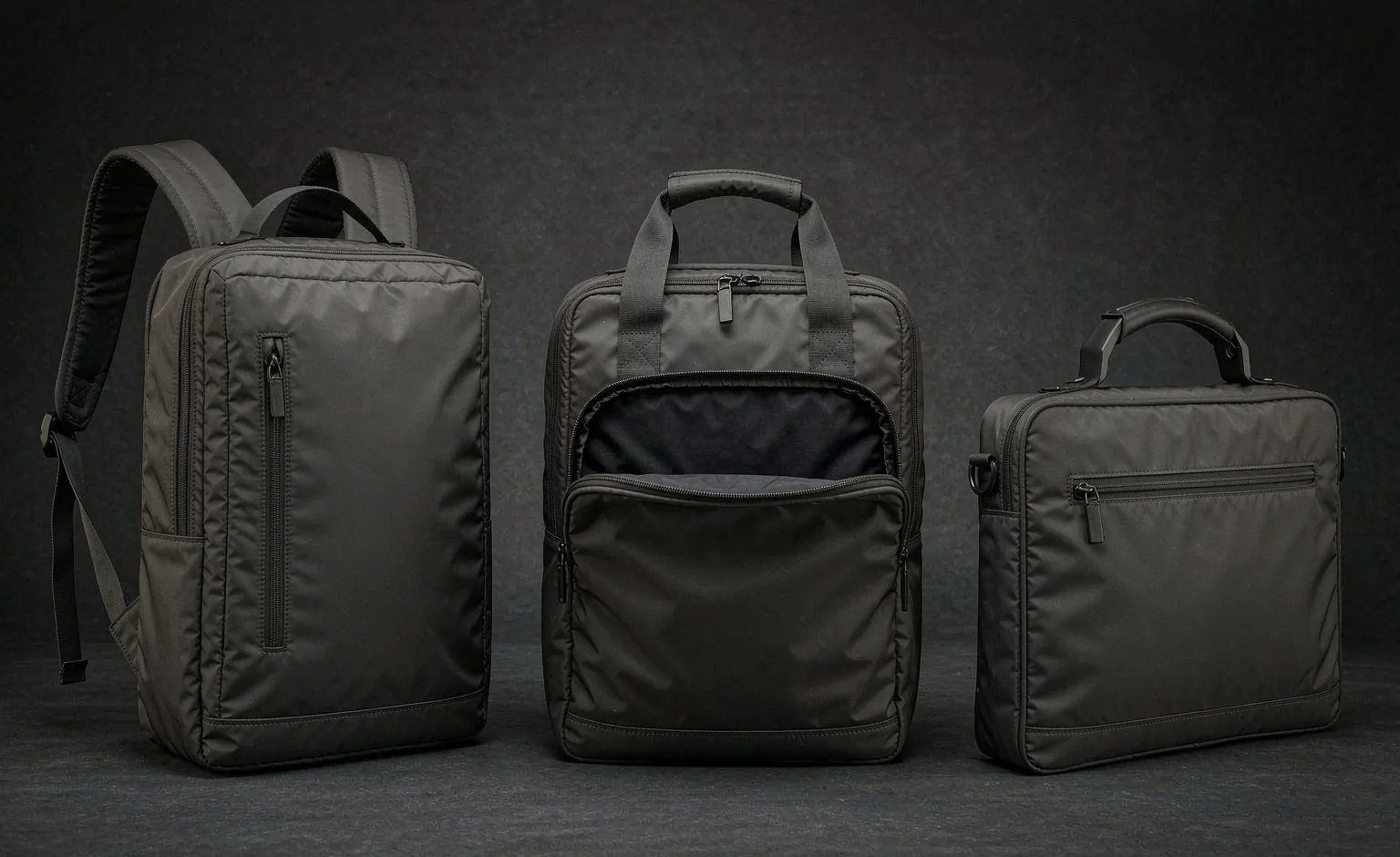
What Convertible Means in Specification Terms: Carry, Capacity and Module Layers
The word convertible is used loosely in retail copy, so a technical brief has to define it before any pattern is cut. A useful definition starts from behaviour: the product delivers two or more working states from one shell, and the transition between states is deliberate, repeatable and documented. That definition excludes a pack that merely looks adaptable because it has a strap loop. It also excludes products where the second state exists only in photography and collapses when the bag is actually loaded. For procurement purposes the behaviour splits into three layers, and conflating them is the single most common cause of a failed convertible programme. A brand asks for one feature, receives another, and discovers the mismatch only after samples arrive because nobody wrote down which layer was being bought.
Carry-mode conversion changes how the load reaches the wearer. The harness is reconfigured: two shoulder straps become a single diagonal sling, both straps stow away so a briefcase handle takes over, a hip belt appears or disappears, or a detachable strap turns the shell into a shoulder bag. This is the highest-consequence layer because the entire packed mass is rerouted. A shell that is comfortable on two shoulder roots may twist, swing or strain a single anchor when converted, and the anchor that was adequate as a secondary restraint becomes the primary support. Carry-mode conversion also changes the rescue path: if a release opens while the bag hangs from one point, the whole contents drop, so mating hardware here deserves paired-part control and proof testing rather than a generic catalogue reference.
Capacity conversion changes the envelope rather than the suspension. A roll-top closes down or extends, a zippered gusset releases a hidden band of volume, a bellows panel opens, or a compression set draws the same shell back to a compact section. The engineering problem is not the added litres; it is what those litres do to packing density, centre of gravity and zipper loading. A half-filled expanded bag often behaves worse than a fully packed compressed one, because contents migrate downward and outward and the back panel loses contact with the wearer. Capacity conversion also interacts with airline sizers, locker dimensions and retail shelf depth, so the expanded and compressed envelopes both belong on the drawing.
Module conversion changes what travels with the shell. A front pouch detaches, an organiser lifts out, a waist unit unclips and becomes a sling in its own right, a laptop cell or wet compartment is removed at destination. This layer depends almost entirely on interface control. Where woven attachment is used, the drawing has to state 25 mm webbing, 38 mm of vertical spacing and a 50 mm horizontal repeat rather than leaning on the word MOLLE, because the word alone does not govern retention. Where a hook-backed field or a guided buckle is used, the mating material, engagement depth and release direction need the same discipline. Module conversion is the layer most easily extended after launch, and therefore the layer most exposed to uncontrolled third-party parts.
Most credible products combine two layers. A travel shell might pair capacity conversion with a stowable harness; a commuter shell might pair module conversion with a briefcase handle. Programmes that attempt all three at once frequently compromise each one, because every added mechanism steals reinforcement space, adds mass and creates a new access conflict. The brief should therefore state which layers are in scope, which combinations are approved, and which are explicitly excluded. That single paragraph prevents more rework than any laboratory test, because it stops the sample room from inventing configurations nobody has validated.
| Conversion layer | What physically changes | Dominant force consequence | Typical wear mechanism | Procurement question |
|---|---|---|---|---|
| Carry-mode conversion | Harness path: two-shoulder, single-shoulder sling, hand or briefcase carry | Whole packed mass reroutes through one anchor set or a handle group | Buckle tooth wear, webbing creep at adjusters, strap twist, anchor stitch fatigue | Are both mating halves controlled by reference, and is the single-anchor path reinforced? |
| Capacity conversion | Envelope volume through roll-top, release gusset or bellows panel | Packing density and centre of gravity shift as contents migrate | Zipper tape and slider wear, gusset abrasion, compression strap relaxation | Does the expanded condition still keep dense mass close to the back plane? |
| Module conversion | Detachable pouches, cells, or a waist unit that becomes a sling | Local loads enter the carrier at defined footprints | Hook pile matting, webbing polishing, partial buckle engagement | Is interface geometry drawn with datums, tolerances and revision control? |
| Combined conversion | Two or three layers operating in one product | Interactions: an expanded gusset may cover harness anchors or stow zips | Cumulative wear plus access interference between systems | Which combinations are approved, and were they evaluated together? |
Detachable Shoulder Straps and Hip Belts: Anchors, Load Paths and Release Logic
The harness is the highest-consequence element in any convertible build because it carries everything else. Specification starts by locating anchors and then by deciding which end of each strap is permanent. A strap sewn permanently at the upper yoke and released only at the lower tail keeps gravity load in a heavily reinforced shoulder root, while the removable end handles lower tension and adjustment. That arrangement is usually the safest for commuter shells. A strap detachable at both ends converts faster and packs flatter, but it puts the entire packed mass through two mating connectors and demands that reinforcement reach structural seams at both points. Neither choice is universally correct; the right answer follows from how often conversion happens and what the consequence of an unexpected release is.
Reinforcement must be treated as part of the anchor, not as an afterthought. A buckle sewn to a single layer of face textile can tear out well before the hardware approaches its published rating, because the failure sits in the panel and the stitch line rather than in the moulding. The specification should call out backing layers, webbing overlap length, bar-tack position and length, stitch density, thread, edge distance and the seam into which the load finally runs. Where the architecture allows, continuous webbing should pass behind the face and terminate in a structural side, base or yoke seam so the anchor behaves as part of the shell. A shaped stay or internal frame sheet keeps dense contents from printing through the back, yet it does not by itself anchor a strap; the connection to that support still has to be drawn.
Hardware selection needs exact references rather than a family name. Side-release buckles, ladderlocks, triglides, G-hooks and guided magnetic closures all behave differently under contamination, off-axis pull and repeated release. Approved components from Duraflex, Woojin or ITW/Nexus families should be specified as matched pairs, because a male half from one moulding and a female half from another may latch while sitting short of full tooth engagement. Fidlock V-BUCKLE hardware gives guided alignment and a deliberate release gesture where its orientation, strap path and backup restraint suit the location, but it must not be presented as proof that any magnetic buckle will hold any load. Webbing finish matters too: a slick strap may creep through an adjuster under sustained tension, while a thick or stiff strap may resist adjustment or prevent complete closure. Webbing width is controlled at 25 mm in this programme framework, and that dimension should appear on the drawing alongside fibre, weave, thickness, colour tolerance and the adjuster it is paired with.
Release logic has to be evaluated in the posture the user will actually adopt. A buckle that frees easily on a bench can be awkward when the bag hangs away from the body, when the actuator is covered by adjacent fabric, or when the wearer is gloved and cannot see the mechanism. The review should cover engagement confirmation, release force, orientation relative to the load, one-hand operation, accidental actuation by a neighbouring strap or a seat belt, and behaviour after contamination. Hip belts introduce their own cases: a removable belt that sits in a sleeve transfers part of the mass to the pelvis when fitted, but the sleeve becomes a shear and distortion case when the belt is removed and re-seated repeatedly. The acceptance record should state the packed mass, mounting position, conditioning and endpoint for every check rather than a general statement that the harness is detachable.
Single-side loading deserves its own clause. Users stow or detach one strap and keep carrying on the other, and the shell then twists while the working anchor sees the entire mass at an angle it was never tested at. The brief should either publish a reduced single-strap carry condition with a stated mass, or reinforce and test both anchors for that event. Asymmetric wear is also a commercial signal: warranty data showing anchor distortion usually means the published instruction was ignored or was never written, and both are fixable through clearer guidance and a stronger anchor path.
| Anchor arrangement | Load behaviour | Conversion speed | Main risk | Where it suits |
|---|---|---|---|---|
| Fixed upper yoke anchor with detachable lower tail | Gravity load stays in the reinforced shoulder root while the free end carries lower tension | Moderate | Lower tail slip through the adjuster under sustained packed weight | Commuter shells converted occasionally to hand carry |
| Fully detachable strap released at both ends | Both terminations rely on mating hardware; reinforcement must reach structure at each point | Fast | Hardware mismatch, lost straps, higher consequence if one connector opens | Travel carriers converting to briefcase or single-shoulder use |
| Stowable strap kept permanently at one end | One end sewn into structure; the other parks in a sleeve or channel | Moderate | Added bulk behind the back plane and dependence on a stow closure | Low-visual commuter shells where straps must disappear |
| Removable hip belt on a sleeve or buckle pair | Moves part of the mass to the pelvis when the belt is fitted | Slow | Sleeve distortion and shear from repeated removal and re-seating | Light-outdoor configurations carrying denser contents |
| Convertible single sling strap | Diagonal path across the torso with one working anchor set | Fast | Torsional pull rotates the shell and concentrates wear on one side | Short-duration carry where quick access outranks balance |
Capacity Conversion: Expansion Geometry, Compression Return and Load Containment
Expansion looks simple on a drawing and behaves badly in service when the return path is ignored. A roll-top offers continuous adjustment and a forgiving seal line, but it lengthens the pack upward, moves mass away from the back and can obstruct a top-facing access point when fully extended. A zippered gusset releases a fixed band of volume and closes cleanly, but the release zipper becomes a pressure case: packed contents push outward on a chain that is already curved, and the slider may separate behind itself under that load. A bellows panel adds depth at the front or sides and can be shaped, yet it introduces folds that abrade and corners that catch. Each mechanism should be specified by the volume it adds, the section it produces and the compression route that returns it.
Centre of gravity is the reason expansion needs engineering rather than arithmetic. Added volume that sits behind the back plane is tolerable; added volume that projects forward or upward increases the rearward or top-heavy moment and makes the shell swing during walking, stair use or a sudden stop. A partly filled expanded bag is worse than a full one because contents settle low and outward and the suspension no longer controls them. Packing guidance should therefore accompany the drawing: dense items near the structural back plane, compressible items forward, balanced side loads, and compression engaged before the wearer moves. That guidance belongs in the instruction sheet, because users cannot be expected to rediscover load distribution by trial.
Compression straps are frequently mis-specified. They are treated as a styling line and sewn into a face panel, when their actual job is to pull the complete expanded load back toward the carrier and to stop migration. Anchor placement, strap path over the shell, buckle orientation and the seam each end terminates in all determine whether compression does work or merely decorates the front. A strap anchored only to outer fabric will distort the panel without reducing the moment arm. Where compression crosses a zipper or a module attachment, the interaction should be reviewed with the bag packed, because a strap routed over a slider will jam it.
Zipper choice follows the expansion duty. In this programme framework the controlled chain references are YKK #5/#8/#10, and selection depends on path curvature, packed pressure, opening frequency and repair consequence. A release gusset under outward pressure usually warrants a heavier gauge than an internal organiser opening, but a larger gauge will not fix a sharp turn, a poor seam allowance, a trapped slider or chronic overpacking. A documented callout should therefore name the construction of every element: the chain build, the size band it belongs to, how many sliders run and where each parks, the form of the puller, the shade of the tape, how each end is finished, plus whatever moisture-barrier build has been agreed. Operation then has to be checked with the shell opened out, squeezed down and worn. Pressure figures read under AATCC 127 and coated-cloth results from ASTM D751 can steer fabric choice, yet the behaviour of a finished unit is governed by bonded seams, needle perforations, closure runs and the geometry with which the gusset shuts.
Containment also includes the closure sequence. A roll-top that must be folded three times before buckling is secure but slow; a two-fold version is faster and leaks more at the corners. A gusset that releases with one zipper invites over-expansion because the user cannot feel a limit. The brief should state the intended sequence, the closure under which any water-resistance description is made, and the packed condition used for testing. Buyers comparing a convertible backpack across suppliers should insist on the same packed condition in every demonstration, because an empty expanded shell hides exactly the behaviour that will generate complaints.
Module Conversion and Interface Control on a Convertible Carrier
The module layer is where a convertible shell earns long-term value, and it is also where most compatibility claims quietly fail. A module has a task, a packed mass, a mounting footprint, a reach direction and a removal order; the carrier has mounting zones, reinforcement and clearance limits. Between them sits the interface specification, and that document is what makes a second generation module possible. Where woven attachment is specified, the drawing has to control webbing at 25 mm, rows set 38 mm apart measured vertically and a column repeat of 50 mm, together with how each row lines up, where the stitches sit, what sits behind the panel and how much working clearance is left once a strap has been woven through. Naming the standard is not enough; the measurements are what a sewing line can be held to. Further detail on woven field behaviour is covered in the PALS attachment geometry reference.
Alternative interfaces each have a defensible domain. Hook-and-loop fields allow almost continuous positioning and fast removal for flat organisers and identity panels, but holding behaviour varies with field area, pile build, contamination and peel leverage, so a thick protruding module can start releasing at an exposed edge. A daisy chain gives discrete lashing points at low material mass, yet loop size and stitch construction govern its behaviour and it should not be assumed equivalent to a woven field. Fidlock V-BUCKLE hardware gives guided alignment plus a deliberate release gesture when its strap path and mating orientation are protected. Pure magnetic placement works well for locating a unit before mechanical engagement and poorly as an undocumented sole retention method, since the available force falls off with gap and peel angle. In most convertible builds magnets belong alongside a latch, strap or captured edge.
Outside-module compatibility needs a written rule set rather than a promise. Check row pitch, webbing width, engagement depth, buckle family and size, gate clearance, field dimensions and the footprint a module occupies. Then assess packed mass, peel direction, motion environment, access interference and material interaction. Hard hook can wear through a light lining; a rigid tab may slice a coated face; halves from different mouldings can look latched while sitting short of full engagement; magnets can disturb a compass or sensitive contents. A brand may publish an open geometric band yet still reserve high-consequence positions for approved modules; that keeps useful interoperability alive without letting each outside accessory become an implied structural claim.
Revision control closes the loop. Let a field measurement, a clip reference, the grade of hook tape or any strengthening layer shift, and units made afterwards can be impossible to separate from earlier stock by eye even though their behaviour under load is different. Every module should carry a compatibility mark and a revision record, and the carrier should carry the corresponding revision in its tech pack. Spare-part availability should be planned at the same time: a convertible range that sells replacement straps, belts and pouches keeps the shell in service and reduces full-product returns. That inventory decision is commercial, but it depends on an engineering choice made early, namely that anchors and interfaces are documented well enough for a spare to be manufactured against the original drawing months later.
Appearance Against Structure: Hidden Straps, Zip Channels and Cover Flaps
Professional appearance is a genuine buying requirement for commuter and corporate travel ranges, and it collides directly with conversion engineering. A harness that converts well is usually visible; a harness that disappears usually acquires a zipper, a sleeve or a flap, and each of those adds a failure route on the very panel that carries the load. The design task is to choose which cost the programme accepts. A concealed harness is not free, and the price is paid in back-panel thickness, zipper duty, drying behaviour, cleaning difficulty and user time on every conversion.
A zipped stow compartment across the back panel hides straps completely and gives the cleanest silhouette. Its cost is structural: the closure crosses the load-bearing plane, the stowed bundle adds bulk exactly where the wearer feels pressure, and a jammed or separated chain leaves the harness inaccessible when it is needed most. The zipper also has to operate while the shell is packed, because the panel is being pressed outward by contents. Mitigation includes protecting the chain from strap tails and lining, providing a generous garage, selecting a gauge appropriate to the packed pressure, and reviewing pressure distribution with the straps stowed. Drying and cleaning deserve attention too: a closed compartment holding damp webbing will retain moisture, so the construction should either allow drainage or the care label should say so.
A cover flap over an exposed harness is usually the better structural compromise. The straps stay accessible, no closure sits across the load plane, and the flap can be shaped to shed water. Its problems are different: flutter in wind or at speed, snag on protruding webbing, noise from a hook closure in quiet environments, and the user having to manage the flap on every conversion. Closure selection matters here. A magnetic or hook-and-loop closure is convenient but opens under peel leverage from a strap tail, so a mechanical secondary is often justified. A cover flap over a sleeve channel can combine both approaches, keeping dust off the entry while leaving the strap reachable.
Slip channels inside the back panel avoid a zipper on the load plane and work well when insertion geometry is controlled. Entry binding is the recurring complaint: webbing twists, the lining grips, and the user pushes harder against a seam that was not designed for that force. The fix is a bound and reinforced entry, a lining grade chosen for low friction against the webbing, a rounded webbing fold, and an insertion-force check written into the specification. Abrasion of the channel lining should also be cycled, because a hole at the entry makes the whole stowage idea unusable long before the shell wears out.
Acceptance for any concealed-harness construction should include retrieval time with the bag packed, pressure mapping against the back, zipper or closure cycling at the stated duty, insertion-force measurement where a channel is used, snag and flutter review in motion, and a laundering or drying check where the care instructions permit it. Those checks are cheap compared with a corporate range returning because the harness could not be retrieved in an airport queue. Related carry formats, including units that move between waist and chest positions, are discussed in the chest and waist carry page.
| Construction | Appearance gain | Structural cost | User-handling consequence | Verification focus |
|---|---|---|---|---|
| Zipped back-panel stow compartment | Straps fully concealed; clean front and back silhouette | Closure crosses the load-bearing plane; adds bulk and pressure points | Stowage takes time and is awkward with a full shell | Closure cycling under packed pressure, retrieval time, drying behaviour |
| Cover flap over exposed straps | Webbing hidden when closed while straps stay reachable | Extra layers at the back; closure must resist flutter and snag | User manages the flap on every conversion | Flutter and peel review in motion, noise check, closure endurance |
| Slip channel inside the back panel | No closure on the load plane; tidy closed back | Channel adds thickness and can trap grit or moisture | Insertion binds when webbing twists | Insertion force, lining abrasion cycles, entry reinforcement |
| Tuck-in strap tail | Fewest added parts; minimal silhouette change | Tail can bunch and print through the panel | Fast but untidy; tail may work loose | Pressure mapping, tail retention, repeated tuck cycles |
| Covered anchor garage with removable strap | Anchors disappear when the strap is off | Garage must not cut into the anchor reinforcement | Small parts can be mislaid between modes | Anchor pull with garage fitted, garage closure durability |
Duty Cycles: Turning Conversion Frequency into a Written Specification Number
Connectors wear by events, not by calendar time. A buckle opened four times a day fails by cycling long before a buckle opened four times a year, even though both sit in the same warehouse for the same period. A convertible backpack specification that omits cycle count therefore contains a silent assumption, and that assumption will be wrong for at least one audience in the range. Writing the number down is straightforward once the team accepts that it is a project acceptance value set by the buyer, not a capacity claim made by the supplier.
The arithmetic starts from scenario. A daily commuter converting between backpack and briefcase or shoulder mode may perform two to four events per working day. A business traveller converts far less often in absolute terms but concentrates events into transit days and adds packed handling, curbside drops and overhead-lift stress. Light-outdoor users convert a few times per outing, usually with grit and moisture present, which changes the wear mechanism more than the count does. An issued corporate fleet sits somewhere between these patterns and runs for longer, so its target should be set with spare-part availability in mind. Each scenario produces a different number, and a range serving several audiences should specify the highest justified figure or split the requirement by SKU.
The written clause needs five parts to be enforceable. First, the cycle count and what counts as one cycle, normally a full engage and release at the stated alignment. Second, the conditioning before cycling, for example dry, dusted, wetted or after laundering under ISO 6330 procedures. Third, the load or proof value held during the test and whether it is static or dynamic. Fourth, the acceptance definition: no release, no crack, no stitch failure, engagement force remaining inside a stated band, and continued one-hand operation. Fifth, the sample size and whether the test repeats after any component or material change. Without those parts the number is decorative, because two laboratories will interpret it differently and neither result will survive a dispute.
Post-cycling inspection is where the useful information appears. Webbing should be examined for polishing, yarn damage and stitch migration at adjusters. Buckle teeth and housings should be checked for wear flats, cracks and change in engagement force. Hook-and-loop fields should be assessed for pile matting and loss of contact at the edges. Zipper tapes and sliders should be reviewed for separation behind the slider and wear at the ends. Channel linings and cover flaps should be inspected for abrasion and flutter damage. Photographs before and after, with the same lighting and magnification, make the record comparable across revisions and are far more persuasive than a pass statement.
Cycle targets also drive commercial decisions. A higher target usually means a more expensive connector, a reinforced anchor and a longer sampling window, and it should be justified by the audience rather than applied universally. Where the number is uncertain, the safer route is to specify a moderate count, publish an inspection and replacement interval, and make spare straps and belts available. That approach costs less than over-engineering every anchor and protects the user experience better than a high cycle figure that nobody verified.
| User scenario | Conversion events per day (planning assumption) | Service-life assumption | Derived acceptance target (buyer-set) | Clause to write into the specification |
|---|---|---|---|---|
| Daily commuter | 2–4 | About 250 working days per year over 2 years | 3,000 mating cycles with the proof load held | After 3,000 engage and release cycles the connector stays fully engaged and passes the project pull check |
| Business traveller | 1–2 on transit days | Roughly 60 travel days per year over 3 years | 1,500 cycles plus a packed handling sequence | After 1,500 cycles and the packed drop sequence there is no hardware crack, webbing cut or stitch failure |
| Light outdoor weekend use | 2–6 per outing | About 40 outings per year over 3 years | 1,200 cycles after dust and moisture conditioning | After 1,200 cycles following contamination conditioning, engagement force stays within the approved band |
| Issued corporate fleet | 1–3 mixed duty | 5 years with pooled use | 4,000 cycles with spare-part support | After 4,000 cycles the assembly remains serviceable and replacement straps are available as spares |
Failure Modes in Convertible Hardware and How Each One Is Verified
Failures in convertible products cluster at the interface, and they usually indicate an architecture gap rather than a defective component. A strap that pulls out points to an anchor whose load stops in face fabric. A buckle that lets go while the wearer is moving is frequently well moulded in itself; the trouble usually lies in the direction it has been turned, how far it actually seated, whether a neighbouring length of tape can press its release button, or whether the other half was sourced from another moulding family. A cover flap that lifts is usually a peel case created by a strap tail the designer did not route. Diagnosing the mechanism first avoids the expensive reflex of specifying heavier materials, which moves the failure into a seam, adds mass and leaves the leverage untouched.
Hardware mismatch deserves particular attention because it is invisible until it fails. Buckle halves from different moulding families can produce a positive-feeling latch while sitting short of full tooth engagement. Silhouette similarity is not evidence of compatibility, and a purchasing team that allows substitution on appearance alone will eventually ship an inconsistent range. Control both halves by reference, keep an approved component board, and require a first-piece engagement check at the start of every production run. Where a guided magnetic closure is used, add a partial-engagement and off-axis review, because those closures can feel secure when they are not seated.
Webbing creep is the second recurring problem. Under sustained tension a strap can slide through an adjuster, so the wearer ends the day carrying a longer strap than in the morning and the load sits lower and further from the back. The causes are usually a mismatch between webbing finish, thickness and adjuster geometry, an undersized fold, or a strap path that lets the tail work loose. The test is simple and should be routine: mark the webbing, apply the proof load for a defined period, and measure movement. A small amount of initial bedding is normal; progressive movement is not, and it should be designed out rather than accepted.
Single-side and asymmetric loading produce the third cluster. When one strap is stowed and the shell hangs from the other, the working anchor sees the entire mass at an angle, the shell rotates, and the wearer reports shoulder pull and strap twist. Asymmetric side mounting creates a quieter version of the same problem, with persistent lateral sway and uneven wear on one anchor. Both cases are addressable: publish a single-strap carry condition with a stated mass, reinforce both anchor paths, and test the asymmetric event rather than assuming users will always wear two straps.
The remaining failures are construction-specific. Stow zippers jam when grit, a strap tail or lining catches the chain, and the panel is simultaneously pressed outward by contents. Channel linings wear through at the entry, where every insertion drags webbing across the same few millimetres. Cover-flap closures open under peel leverage and flutter in wind. Stow compartments abrade the harness webbing where it rubs against a seam allowance. Each has a cheap preventive action and an equally cheap verification route, provided the programme owner writes them into the test plan before the first sample rather than after the first complaint.
| Observed failure | Physical mechanism | Early diagnostic sign | Corrective direction | Acceptance check |
|---|---|---|---|---|
| Buckle opens in motion | Halves from different families, partial tooth engagement, or an actuator pressed by adjacent webbing | Inconsistent click, visible gap at the latch, release when the shell is set down | Control both halves by reference, protect the actuator, orient the buckle to the force | Engagement audit, angled pull, gloved release trial |
| Strap length creeps | Webbing slides through the adjuster under sustained tension | Strap measurably longer at the end of a day than at the start | Match webbing finish and thickness to the adjuster; review fold and strap path | Marked-webbing creep test under sustained proof load |
| Shell twists under one-strap carry | Full mass hangs on a single anchor at an untested angle | Rotation of the shell, anchor panel distortion, shoulder pull reported | Reinforce both anchors and publish a single-strap carry limit | Asymmetric load test at the stated mass |
| Stow closure jams | Grit, strap tail or lining caught in the chain while the panel is pressed outward | Slider stalls at the same point; teeth separate behind the slider | Protect the chain, review garage and lining allowance, specify the puller | Closure cycling under packed back pressure |
| Cover flap lifts | Peel leverage from a protruding strap tail or insufficient closure area | Corner lifts during walking; audible opening in quiet spaces | Increase closure area, reroute the tail, add a mechanical secondary | Flutter and peel review in motion |
| Channel lining wears through | Webbing edge abrades the sleeve at the entry on every insertion | Linting, thinning, or a visible hole at the entry | Bind and reinforce the entry, change lining grade, round the webbing fold | Insertion-cycling abrasion check |
Laboratory Routes and Evidence for Convertible Assemblies
Evidence should be gathered in the order that reduces uncertainty cheapest. Component review comes first: confirm exact textiles, webbing, zipper references, buckle pairs, hook grade, boards, foams and thread against an approved component board. Construction review follows, checking reinforcement paths, stitch placement, seam allowances, anchor geometry and access clearance on a cut sample. Configuration review then examines every approved conversion mode and every approved module combination, not only the one that photographs well. Packed verification applies load, movement, drops and cycling to representative assemblies. Conditioning and care review establishes how dirt, moisture, cleaning and repeated conversion change behaviour. Packaging review confirms that conversion parts arrive undamaged, complete and correctly paired.
Bench methods can guide the choice of cloth and trim, yet they never substitute for trials run on a fully built unit. Under ASTM D5034 the laboratory produces grab-type strength figures that speak to the base cloth alone; they reveal nothing about whether a stitch line tears out, whether a clip releases, or whether a panel distorts. Resistance to surface wear, read through ISO 12947 and through the rotary route in ASTM D3884, matters most for sleeve linings, folded gusset corners and anywhere a strap rides repeatedly against fabric. Migration of colour under rubbing is judged with AATCC 8, which becomes relevant once dark webbing or a cover panel lies against a pale shell. Wherever a care instruction involves domestic laundering, the repeatable reference is the washing cycle laid down in ISO 6330. Resistance to water passage for a chosen cloth is read through AATCC 127, while ASTM D751 deals with the behaviour of coated constructions, and metal fittings headed for coastal service can be screened in the salt-fog cabinet of ASTM B117. Every report has to be anchored to the precise base cloth, dyeing batch, finishing route, coating formulation and production lot it was produced from; figures borrowed from a look-alike fabric should never be carried across automatically.
Drop and impact planning for a convertible shell can be shaped by MIL-STD-810 as a planning reference, but that reference should be used as a method discipline and never presented as a certification of the finished product. The value lies in defining orientation, packed condition, drop height rationale, number of events and endpoint criteria in a way that a second laboratory can repeat. Convertible assemblies add a specific case: drops should be performed in each carry mode, because a briefcase orientation loads a handle group that the backpack orientation never exercises.
Cycle rigs need realism more than sophistication. The fixture should hold the connector at the alignment, angle and speed the user produces, apply the load the packed shell generates, and run to the specified endpoint without introducing a failure mode the field would never see. Clamping only face textile can understate support; gripping a strap by a rigid plate can bypass flexible behaviour. Record the exact part references, mounting position, conditioning, alignment, load, speed, cycle count, endpoint and observed damage. Where engagement force is measured, record the method and the band, because a single number without a method is not comparable between revisions.
Examination at the end of the line can never take the place of controls applied while units are being made, because hidden backing plies, lap lengths of webbing and the routes taken by needles stop being observable the moment the body is closed up. Incoming checks on hardware and webbing, first-piece engagement verification, in-process anchor and reinforcement audits, configuration checks and packaging reconciliation all belong in the plan. Accept/reject counting for outgoing audit sits at an AQL of 2.5, drawing its sample size out of ISO 2859-1, the document that displaced MIL-STD-105 in ordinary commercial use. The plan should also contain a fault register that sorts situations endangering retention or personal safety away from functional shortcomings and from cosmetic deviations that no user would notice, and it has to spell out the items peculiar to convertible products: a connector that has not gone fully home, halves sourced from different mouldings, a spare strap left out of the carton, the wrong kit packed, a stow closure that refuses to run, and webbing twisted while being fitted.
| Stage | Question answered | Representative setup | Evidence captured | Release idea |
|---|---|---|---|---|
| Interface audit | Are mating parts documented and correct as a pair? | Bill of materials checked against the approved component board | Part references, halves pairing, revision, photographs | No undocumented substitution accepted |
| Anchor pull | Can the loaded anchor path hold the packed mass with margin? | Production-representative shell with the strap mounted as instructed | Load and displacement behaviour, stitch movement, failure origin | Project proof value reached without release |
| Cycle endurance | Does the connector survive the specified mating count? | Fixture at realistic alignment, speed and load | Engagement force before and after, wear photographs | Function retained at the target cycle count |
| Packed configuration test | Do access and balance hold in each approved mode? | Every approved combination packed to the stated guide | Access time, sway, pressure distribution, closure operation | No blocked opening and no unacceptable imbalance |
| Conditioning and care | How do grit, moisture or laundering change behaviour? | Dusted, wetted or washed samples then cycled | Post-conditioning engagement force and inspection results | Performance stays inside the approved band |
| Distribution test | Do conversion parts arrive undamaged and correctly paired? | Packaged unit in its ship carton | ISTA 3A sequence result where applied, kit reconciliation | No damage, complete kit, correct labelling |
Shared-Carrier Range Planning for Convertible Configurations
Commercial efficiency arrives once variety is carried by kitting rather than by additional bodies. Everything costly, and every decision that governs how the item sits against a human being, belongs in the one shared shell: curvature of the rear plane, strengthening at each shoulder root, arrangement of the main aperture, seams carrying structural duty, floor build, the layout of anchor points, how stowage is arranged, and the principal material zones. Differences between audiences can then be expressed purely through strap sets, gusset options, module selections, trim palettes, the instruction card and the way the item is presented. On that basis an additional use case requested by a channel can be served without another round of pattern work, so effort concentrates on proving one structural shell while the checks unique to each configuration stay small.
Every discipline has its boundary. Should a proposed variant call for an alternative body length to sit against another spine shape, a heavier grade of suspension, extra principal capacity, or a rerouted structural force path, the honest answer is to commission a second shell rather than force a kit onto the existing one. Pretending otherwise produces a shell that fits nobody well and a validation file full of exceptions. The range review should therefore ask one question of every new proposal: does this stay inside the shared carrier envelope, or does it change the platform? Answering that honestly at concept stage is cheaper than discovering it during sampling.
Laying out between six and twelve variants begins with clusters of jobs to be done, not with lists of attributes. For every audience record what normally travels, which article has to stay within fingertip reach, what is heavy or vulnerable, which piece is detached on arrival, and which two things must be kept out of one another's space. Convert that record into a compact kit vocabulary: carry configuration, gusset group, organiser insert, protection for electronics, external retention and quick-grab utility. Once expressed that way, a variant becomes an agreed bill of contents instead of a fresh sewing pattern hiding behind a fresh name, and the internal code used for it should correspond item for item with its packing list and with the mounting locations that have been cleared, so nobody can alter structural behaviour by changing the box late in the day.
Tiers of price ought to be created out of what goes into the carton, not by quietly thinning what all versions share. At the opening tier the proven shell ships with nothing beyond the minimum conversion parts. Mid-tier adds purpose-built pieces that make contents easier to reach and easier to keep apart; the top tier assembles protective inserts, guided fittings or a richer presentation for audiences prepared to pay. Nothing about the strengthening at anchor points, the route taken by the harness, the discipline applied to interfaces, or the extent of testing performed may be allowed to erode simply because a model sits lower down the ladder, since doing so shatters the family into unrelated products and muddles every statement made about any of them. Any pricing discussed at this stage is indicative only, quoted FOB Xiamen on a 500-unit MOQ basis, and it should be revisited once the kit bill of materials is final.
Governance is what stops a family from wandering. Keep one matrix recording which modes are cleared, which pairings are forbidden, the assumptions made about how each unit is packed, allowable colours and trims, regulatory variants and what each carton contains. Before money goes into graphics or promises are made to a retail buyer, any fresh idea has to clear a platform-level examination asking whether it reuses an existing part, whether it needs one new part built inside the established connection rules, or whether it steps beyond the envelope the shell was validated for. Strict version tracking is required each time an anchor location, a clip reference, a channel measurement or a strengthening layer is altered: units made before and after such an edit can be indistinguishable to the eye yet perform differently in service, and only a stamped compatibility indication plus a dated revision entry keeps the population already in customers' hands safe. Held to that standard, the family can tell separate stories for different audiences, including commuter work configurations, travel carry configurations and weekend trail configurations, without quietly accumulating hidden operations and extra testing duties under each new name.
| Configuration | Common carrier elements | Conversion kit contents | Target channel | Positioning note |
|---|---|---|---|---|
| Commuter convertible | Shell, back panel, main opening, anchor map | Stowable strap set, document cell, cable wallet | Corporate issue and daily retail | Entry band preserves the validated body with minimal kit |
| Business travel convertible | Shell, back panel, main opening, anchor map | Briefcase handle kit, packing cells, sling strap | Frequent flyer and cabin-bag programmes | Core band adds destination-side removal |
| Light outdoor convertible | Shell, back panel, main opening, anchor map | Hip belt kit, bottle cradle, expandable front panel | Weekend and trail programmes | Core band accepts abrasion and grit duty |
| Hybrid work and travel | Shell, back panel, main opening, anchor map | Combined document cell, sling strap, compression set | Buyers needing one item across two audiences | Premium band carries the fuller kit |
| Field service convertible | Shell, back panel, main opening, anchor map | Tool sleeve, protected electronics cell, harness cover | Inspection and site support teams | Premium band where kit complexity is justified |
Programme Terms, Market-Access Records and Release Gates
Every convertible programme deserves to start with a tightly framed written scope rather than an accumulating wish list of clever details. That document records the market being served, the jobs users actually perform, which layers of conversion are included, which configurations are sanctioned, the duty figures aimed at, what sort of contents will commonly travel inside, where the finished item must land on cost, how buyers are likely to order, how the goods will be boxed, and the regulations the destination imposes. It separates mandatory behaviour from preferences so that trade-offs stay visible. Commercial baselines are MOQ 500, with sampling at 6–10 working days, or 12–15 working days for complex builds, while mass production occupies 35–50 days once approvals and inputs are complete. Settlement runs on T/T 30/70, quoted FOB Xiamen. Every one of those numbers stays honest only while it remains bound to preconditions covering fabric supply, whether the chosen fittings can actually be bought, print and labelling readiness, the schedule for testing, and how quickly signed approvals come back; swapping an interface family or bolting on another insert once the first samples have been seen tends to restart technical work and push the critical path out again.
Capacity and logistics planning should be realistic from the first forecast. Output planning referenced to our SGS-verified production base, covering 4,950 m² and staffed by 137 people across 7 production lines with 149 machines and 200,000 units per month, gives a buyer a basis for discussing seasonality and repeat orders. Transit choices are sea at 25–35 days, air at 5–8 days, and courier at 3–5 days, and the choice is usually dictated by launch date rather than by unit cost alone, because a missed retail window costs more than the freight difference. Our production team works from approved component boards and sealed reference samples, while our vetted partner facilities can supplement capacity on defined programmes when volume requires it.
Reaching a market is an exercise in documented discipline, not a matter of collecting badges. Shipments destined for Europe must be answered material by material against the chemical-restriction regime established under REACH (EC 1907/2006). Distribution into California invokes Prop 65, and the answer there is a written exposure determination rather than a blanket assumption. Where the classification of the article and the age of whoever uses it pull the product into consumer-safety legislation, the duties set by CPSIA attach, most obviously inside the children's category. Declarations issued through OEKO-TEX Standard 100 are genuinely helpful on restricted substances in cloth and trim, provided the certified article list really covers what is being shipped. Components of metal that rest against bare skin, such as buckle bodies, sliders and the housings of closures on a harness, are assessed through the nickel-release route EN 1811. What ISO 9001 speaks to is how audited management routines are organised, and BSCI supplies a mechanism for monitoring labour and social practice; taken together, the two confirm nothing at all about how well any individual rucksack behaves. Each item in the dossier then needs a live expiry date, a stated scope, a path back to specific lines on the bill of materials, and a rule forcing re-approval the instant any covered input is swapped.
Sequence the release gates so that the largest exposures are retired earliest. Requirement freeze confirms conversion layers, approved modes and cycle targets before detail work starts. Component approval signs exact hardware, webbing, closure and textile references. Construction release verifies anchor reinforcement, channel geometry and cover behaviour, and produces a sealed reference sample. Inspection release agrees defect classes and criteria before packing. Shipment release confirms packaging, documentation and kit completeness. Each gate has an owner, a deliverable and a hold condition, and skipping one in order to save a week usually costs a month later. Buyers planning a branded version can follow the route described for a custom modular backpack programme, where the same gates apply with artwork, labelling and packaging added.
The closing discipline is record keeping. A convertible range accumulates hardware references, kit lists, revision marks, test reports and inspection records across several seasons, and without a single controlled file those records diverge. Keep one configuration matrix, one approved component board, one test index and one revision log, and require that any substitution, however small, passes through the same approval path. That is what allows a replacement strap ordered two years later to fit a shell already in service, and it is what makes the difference between a convertible range that compounds in value and one that fragments into incompatible generations.
| Gate | Owner decision | Deliverable | Commercial anchor | Hold risk |
|---|---|---|---|---|
| Requirement freeze | Conversion layers, approved modes and cycle targets agreed | Written brief with priorities and exclusions | MOQ 500 per configuration family | Undefined modes reopen the pattern later |
| Component approval | Exact hardware, webbing, closure and textile references signed | Component board and paired-part list | Sampling 6–10 working days, complex 12–15 | Late hardware change restarts sampling |
| Construction release | Anchor reinforcement, channel and cover geometry verified | Sealed reference sample and tech-pack revision | Mass production 35–50 days | Hidden operations depend on operator judgement |
| Inspection release | Defect classes and criteria agreed before packing | Inspection plan and AQL 2.5 record | T/T 30/70, FOB Xiamen | Critical defects found only at final audit |
| Shipment release | Packaging, documentation and kit completeness confirmed | Packing list, test file, market-access pack | Sea transit 25–35 days; by air 5–8 days; by courier 3–5 days | Missing spare straps or mismatched kits at destination |
Frequently asked questions
What is a convertible backpack?
A convertible backpack delivers more than one working state from a single shell: the wearer changes how the bag is carried, how much it holds, or which modules travel with it, without repacking into another product. The change must be deliberate and repeatable, with documented anchors, controlled mating hardware and a stated cycle expectation. A strap that unclips is not enough on its own; the converted state has to carry the packed load safely and remain accessible in real use.
How is the best convertible backpack different from an ordinary backpack with a removable strap?
The distinction is documented behaviour. An ordinary pack with a detachable strap usually leaves the anchor load path, cycle expectation and converted-state balance undefined. The best convertible backpack specifies anchor reinforcement reaching structural seams, matched buckle halves, a mating-cycle target, an approved carry-mode list and verification in each mode. It also states what happens when one strap is stowed, rather than assuming the user will never do that.
What are the three conversion layers a brief should separate?
Carry-mode conversion changes the harness path, for example backpack to sling, briefcase or shoulder carry. Capacity conversion changes the envelope through a roll-top, release gusset or bellows panel. Module conversion changes what travels with the shell, such as detachable pouches, organisers or a waist unit that becomes a sling. Each layer has its own force path, wear mechanism and failure consequence, so each needs its own requirement and test.
Which conversion layer carries the highest engineering risk?
Carry-mode conversion, because it reroutes the entire packed mass. A shell that is comfortable on two shoulder roots can twist, swing or overload a single anchor when converted. If a release opens while the bag hangs from one point, the whole contents drop. That is why harness hardware needs paired-part control, reinforced anchors reaching structural seams and proof testing rather than a generic catalogue reference.
Should shoulder straps be fully detachable or stowable?
Fully detachable straps convert faster and pack flatter but put the whole packed mass through two mating connectors. A fixed upper anchor with a detachable lower tail keeps gravity load in a reinforced shoulder root and is usually safer for commuter shells. A stowable strap kept permanently at one end avoids connector risk but adds bulk behind the back plane and depends on a closure that can jam.
Why does anchor reinforcement matter more than buckle strength?
A buckle sewn to a single layer of face textile can tear out long before the moulding reaches its published rating, because the failure sits in the panel and stitch line. Reinforcement, backing layers, webbing overlap, bar-tack position, stitch density, edge distance and the structural seam the load finally reaches all determine real capacity. Hardware selection and anchor construction have to be specified together.
What causes buckle mismatch, and how is it prevented?
Mismatch occurs when halves come from different moulding families, or when substitution is approved on silhouette rather than reference. The result can latch with a positive feel while sitting short of full tooth engagement. Prevention means specifying approved components from Duraflex, Woojin or ITW/Nexus families as matched pairs, keeping an approved component board and running a first-piece engagement check at the start of every production run.
What is webbing creep and how should it be tested?
Creep is gradual sliding of a strap through an adjuster under sustained tension, so the wearer ends the day with a longer strap and a load sitting lower and further from the back. Causes include a mismatch between webbing finish, thickness and adjuster geometry, or an undersized fold. Test by marking the webbing, applying the proof load for a defined period and measuring movement; initial bedding is normal, progressive movement is not.
How should a specification state a mating-cycle requirement?
Give five parts: the cycle count and what counts as one cycle; the conditioning before cycling, for example dry, dusted, wetted or after ISO 6330 laundering; the load or proof value held; the acceptance definition, covering no release, no crack, no stitch failure and engagement force inside a stated band; and the sample size plus retest rule after any component change. Without all five, two laboratories will interpret the number differently.
What cycle targets suit commuter, travel and outdoor programmes?
Figures are project acceptance values set by the buyer, not supplier capacity claims. A daily commuter at two to four conversions per working day over roughly two years might justify 3,000 cycles. A business traveller at one to two events on transit days over three years might justify 1,500 cycles plus packed handling. An outdoor user converting two to six times per outing might justify 1,200 cycles after contamination conditioning.
What are the trade-offs of hiding shoulder straps in the back panel?
A zipped stow compartment gives the cleanest silhouette but places a closure across the load-bearing plane, adds bulk where the wearer feels pressure, retains moisture and can leave the harness inaccessible if the chain jams. A cover flap keeps straps reachable and avoids a closure on the load plane but adds flutter, snag and noise. A slip channel avoids the zipper but can bind on insertion and wear at the entry.
How does expansion change load behaviour?
Added volume that projects forward or upward increases the rearward or top-heavy moment, so the shell swings during walking or sudden stops. A partly filled expanded bag behaves worse than a full one because contents settle low and outward and the back panel loses contact. Packing guidance should keep dense items near the structural back plane, place compressible items forward and engage compression before moving.
Which zipper gauges are specified for convertible builds?
The controlled references in this programme framework are YKK #5/#8/#10. Selection depends on path curvature, packed pressure, opening frequency and repair consequence: a release gusset under outward pressure warrants a heavier gauge than an internal organiser opening. A larger gauge will not fix a sharp turn, a poor seam allowance or chronic overpacking, so the closure must be reviewed with the bag expanded, compressed and carried.
How is woven module attachment controlled on a convertible carrier?
The drawing has to specify 25 mm tape, 38 mm between successive rows and a 50 mm repeat measured across those rows, plus how each row lines up, where stitches are placed, what is layered behind the panel and the space remaining once a strap has been woven through. Invoking MOLLE alone does not govern retention. Alternative connections such as hook-and-loop fields, daisy chains and Fidlock V-BUCKLE hardware each have a defensible domain, yet all of them need mating references, engagement depth and release direction recorded.
Can magnetic closure be the only retention method on a convertible part?
Only where that exact assembly has been engineered and proven for the load directions and consequences involved. Available magnetic force falls off with gap and peel angle, and impacts or debris can shift behaviour. In most convertible builds a magnet works best as a locating aid or guided closure paired with a mechanical latch, strap or captured edge rather than as the sole load path.
What laboratory evidence should a buyer request?
Ask for textile tensile data from ASTM D5034, abrasion evidence from ISO 12947 or ASTM D3884, crocking results from AATCC 8, hydrostatic data from AATCC 127 and coated-fabric results from ASTM D751 where relevant. Add ASTM B117 salt-spray review for metal hardware on coastal programmes, ISO 6330 where a care claim is made, and drop planning shaped by MIL-STD-810 as a repeatable method discipline rather than a certification claim.
What is the stated inspection level for finished shipments?
Outgoing audit is governed by an acceptance quality limit of 2.5, with sample sizes drawn from ISO 2859-1, the successor document to MIL-STD-105. The register of faults should sort anything endangering retention or user safety away from functional shortcomings and from cosmetic differences no purchaser would notice, and it must list the problems peculiar to convertible units: a connector that has not fully seated, halves taken from different mouldings, a missing spare strap, contents packed against the wrong list, and a stow closure that jams.
How can one carrier support several convertible configurations?
Lock the outer shell, rear panel, main aperture, structural seams, anchor layout and stowage build down as elements shared by every version, then create variety through strap sets, gusset groups, module choices, trim colours and retail presentation. Between half a dozen and a dozen variants can then be expressed as agreed kit lists instead of separate sewn patterns. A request that would alter the length carried against the spine, upgrade the suspension grade or change principal volume belongs in a different shell rather than being squeezed onto this one.
What commercial terms apply to a convertible backpack programme?
Baselines are MOQ 500 per configuration family, sampling at 6–10 working days, or 12–15 working days where the build is complex, mass production 35–50 days, final inspection at AQL 2.5, settlement T/T 30/70, and shipment FOB Xiamen. Shipping choices are sea transit 25–35 days, air 5–8 days, or courier 3–5 days. All figures assume the brief, tech pack, components, artwork, tests and approvals proceed without reopening development.
Which market-access records belong in the file?
The dossier should tie evidence issued under REACH (EC 1907/2006) to the real inputs and shipping destinations concerned, keep a Prop 65 exposure determination wherever Californian retail is intended, retain any consumer-safety classification work done for CPSIA, and file the restricted-substance declarations supplied through OEKO-TEX Standard 100. Figures for nickel release obtained via EN 1811 belong alongside them for hardware resting on skin, meaning buckles, sliders and magnetic closures, and the current scope of both ISO 9001 and BSCI records should be kept on file too. Where parcel-transit trials are commissioned, results referenced to ISTA 3A support the packaging argument. Each certificate then needs a current expiry date, a defined scope, a route back to individual bills of materials, and a rule forcing review whenever anything covered is substituted.