Home › Programmes
Field-tested modular load carriage
Custom Modular and Tactical Backpack Programs: Brief to Shipment
A custom modular backpack programme is a documented engineering sequence rather than a colour swap: nine gates run from requirements capture through interface definition, BOM and tooling, sampling, validation, pre-production reference, mass production, final inspection and outbound shipment, and every gate releases a deliverable that the next one depends on. A custom tactical backpack built the same way differs from a catalogue body only in that the interface geometry, the module kit and the marking set are written into a control drawing before any cutting begins, so a repeat order twelve months later matches the first one. The scope here is civilian load carriage only: outdoor, worksite, commuting, response and first-aid kits, field electronics and organised daily carry. Weapon carriage, ammunition storage and ballistic protection fall outside it, and nothing in this document is offered as defence-approved product. The commercial frame around the sequence is fixed: MOQ 500, sampling in 6–10 working days with complex interfaces at 12–15, mass production 35–50 days, final inspection at AQL 2.5, settlement by T/T 30/70, trade basis FOB Xiamen, and an indicative quotation returned within 24–48 hours of a complete brief.
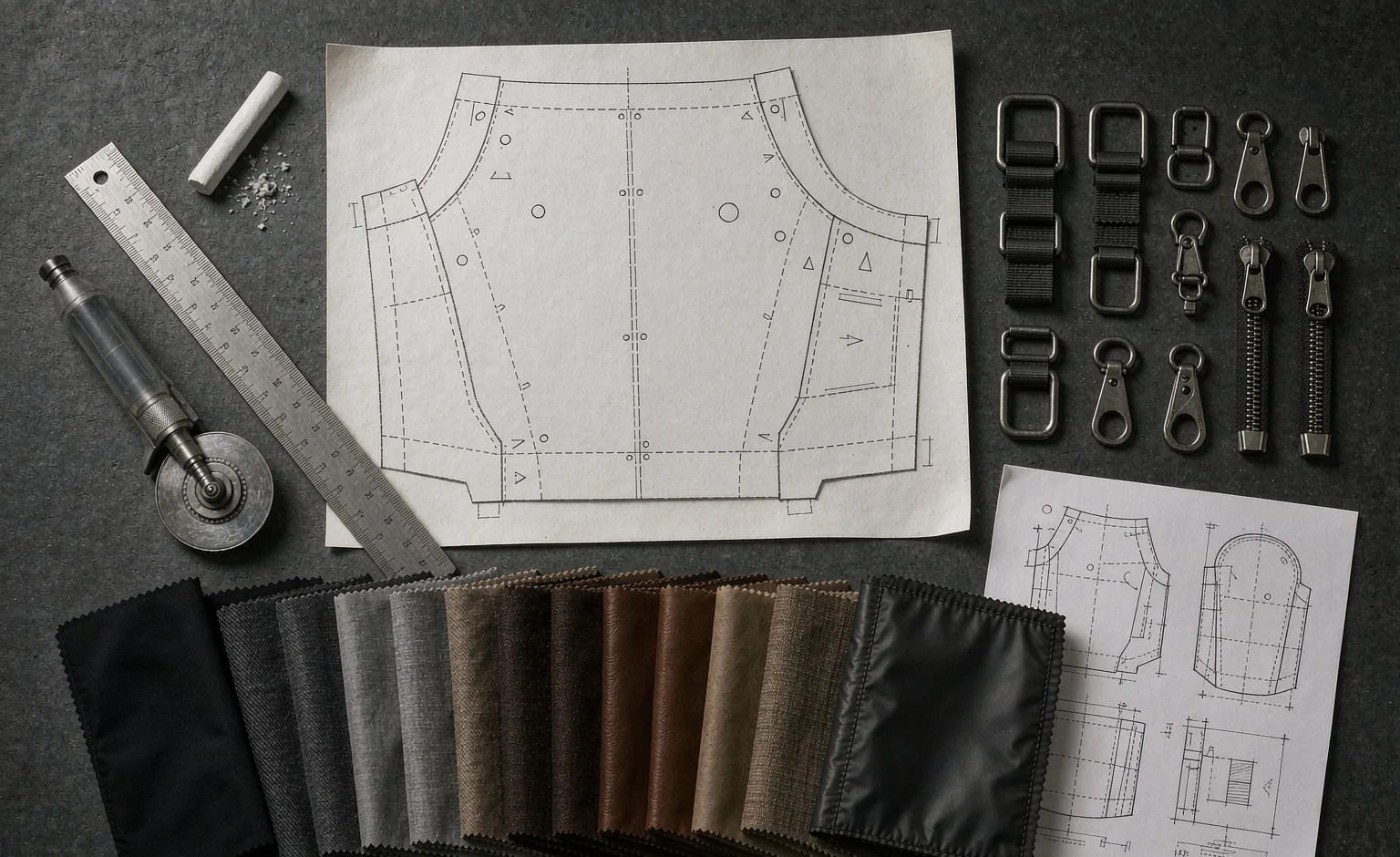
Requirements Capture: Turning a Channel Brief Into Written Engineering Inputs
Every schedule slip that later gets blamed on the sewing floor started on a spreadsheet nobody finished. A development programme needs nine inputs closed before a quotation means anything: who carries the product, what goes inside it, how often each item is reached, which markets it enters, what it must cost landed, how it leaves the dock, how it is marked, how many units the year will absorb, and who signs each answer. With those nine written down and owned, the engineering route is short. Without them, the sample round becomes the requirements meeting, and a build that should occupy 6–10 working days turns into three rounds because each round discovers a decision nobody made.
The first conversion moves an audience description into content classes. Phrases such as commuter, technician or weekend user have to become a list of objects with dimensions and mass. Dense hard items, soft compressible items, electronics and cables, flat documents, fluids, first-aid materials and hand tools each behave differently inside a carrier: dense hard contents need to sit close to the back plane, soft compressible contents can ride outside, and anything reached while the wearer is moving needs a clear corridor instead of a pocket buried under a flap. For each class the brief records nominal dimensions, packed mass, accesses per day, and whether access has to happen with the body still worn. A range already selling a shared modular backpack platform can reuse its class definitions, which is one of the quiet paybacks of building a platform before building styles.
The second conversion turns content classes into a module kit, and the kit is where cost hides. Every extra module adds a pattern, a marker, a cutting operation and a line in the kitting instruction. The brief should state how many modules travel with the carrier, the footprint each one occupies in rows and columns, whether modules ship attached or packed separately, and whether the kit is common across markets or varies by channel. Where the carrier carries an external woven grid, the footprint question also decides how many rows stay usable once the kit is fitted, which is why module definition belongs beside attachment geometry and usable row planning rather than after it.
The third conversion is commercial. A target retail price is not a target cost: landed cost carries freight, duty and the packaging needed to survive the chosen channel. The brief states the landed band, the markets that bring compliance obligations, the retail or fulfilment format, the twelve-month forecast and the replenishment cadence. With those answers an indicative quotation comes back within 24–48 hours on FOB Xiamen terms against the 500-unit minimum. Without them any number produced is a guess, and a guess that lands too low creates pressure later to remove structural items that should never be negotiable.
Development itself is charged separately and transparently. A prototype carries a sampling fee of USD 50–150, refunded against a confirmed order, while dedicated screens, moulds and dies fall in the USD 300–2,500 band depending on what has to be made. Stating both figures up front lets a brand decide whether a detail is worth its tooling before the tool is cut, instead of meeting the charge on an invoice after approval.
| Brief field | Why unit price depends on it | Weak answer that causes rework | Decision owner | Artefact produced |
|---|---|---|---|---|
| End user and duty cycle | Sets fabric weight, coating, reinforcement count and stitch specification | Two audiences named with no frequency or load | Product manager | Written use-case statement |
| Content classes with nominal dimensions | Drives volume, panel count, divider count and module footprint | A mood board with no measurements | Design lead | Dimensioned content register |
| Mass and access frequency per class | Decides suspension, backing stack and mounting zone assignment | Mass guessed from the empty product | Engineering | Load and reach map |
| Module kit definition | Sets pattern count, marker count and kitting operations | Modules listed as to be confirmed later | Product manager | Module list with row and column footprint |
| Compliance markets | Determines substance restrictions, label language and test scope | A region named instead of countries | Compliance owner | Market and test matrix |
| Target landed price band | Selects which material and hardware families can be quoted at all | A retail price with no freight or duty inside it | Commercial lead | Price band with stated freight assumption |
| Retail or fulfilment format | Decides polybag, hangtag, barcode and whether parcel validation applies | Format chosen after the container is booked | Packaging owner | Packaging specification draft |
| Marking and brand assets | Determines tooling, screens, placement clearance and approval route | Logo supplied as a low-resolution raster | Brand | Vector artwork and placement drawing |
| Forecast and repeat cadence | Sets tooling amortisation and whether a platform body pays for itself | A single order with no follow-on view | Demand planner | Rolling forecast with revision date |
Interface Definition: Control Drawings and Revision Discipline
Interface definition is the moment a custom modular backpack stops being a drawing and becomes a platform. The interface is the controlled set of dimensions and material references that lets a module produced next year fit a carrier produced this year, and lets two lines in the same building turn out interchangeable parts. It has to be frozen before artwork, because decoration placed across a load path or a threading row cannot be moved afterwards without reopening the pattern.
The control drawing carries the grid and the structure behind it. Where an external woven grid is used, the frozen callouts are 25 mm webbing, 38 mm vertical spacing and 50 mm horizontal repeat, alongside island length, backing stack layer count and coverage, bar-tack count and position, edge distance and end anchoring. Where a cut-slot face or an internal board is chosen instead, the equivalents are slot height, slot-end reinforcement, board backing and the clearance between the face closure and the board. Either way the drawing needs a tolerance band and a revision block, since a dimension without a tolerance is a wish rather than a specification.
Hardware and closure references sit on the same drawing. A buckle family is not interchangeable at part-number level: the two halves are approved as a pair, the plating is recorded, and any metal component sitting near skin contact has its finish considered against EN 1811. Zipper chain size, slider type and puller reference are controlled identically, because a quiet substitution at the slider is one of the most common reasons a lot looks correct on the table and fails in the field.
Revision discipline is what makes the freeze worth anything. Each controlled item carries a revision mark that appears on the drawing, on the BOM line, on the packaging specification and on the golden sample tag, so a later order can be reconciled against the build that was signed off. Requests to move a controlled item travel through a written change note naming the item, the reason, the affected documents and the re-validation required. Cost-down requests go through the same route rather than through a verbal agreement at the line, because most cost-down requests touch exactly the items that carry load.
| Frozen callout | Change tolerated without re-validation | Re-validation triggered by | Control record | Approval owner |
|---|---|---|---|---|
| 25 mm webbing width and channel | None below the module strap thickness limit | Any supplier, coating or dye-lot change | Webbing specification with lot reference | Engineering |
| 38 mm vertical spacing | None; pitch is frozen at the pre-production reference | New panel pattern or new marker layout | Full-width pitch measurement on the reference unit | Engineering |
| 50 mm repeat and island length | None | Island pattern revision or machine change | Island layout drawing with revision mark | Engineering |
| Backing stack layers and coverage | None; it is a structural callout | Fabric substitution or a cost-down request | Cut-sample photograph against the revision | Engineering and quality |
| Bar-tack count and position | None | Needle or thread change, or operator rotation | Marked drawing plus first-piece record | Quality |
| Hardware family and finish | Like-for-like inside an approved family | Brand change, plating change or skin-contact change | Component approval board with finish record | Engineering |
| Module footprint and strap path | Change requires a fresh threading trial | Any module added to the approved kit | Threading trial record per module | Engineering |
| Colourway and dye lot | New shade inside an approved substrate | Cross-substrate colour matching attempt | Lab dip and shade band under controlled light | Brand and quality |
| Decoration placement | Shift inside an approved clearance zone | Placement crossing an attachment row or closure corridor | Decorated first-piece photograph | Brand and engineering |
| Carton quantity and pack | Quantity change inside the validated pack | Carton dimension or drop orientation change | Transit validation report where parcels apply | Packaging owner |
One rule keeps the discipline cheap: freeze in two stages. Geometry and structure freeze at the pre-production reference and cannot move without testing. Colour, decoration placement inside an approved clearance zone and carton quantity can move later within defined limits. That split stops a shade decision from blocking a structural approval, and stops a structural change from riding in on a colour request.
BOM, Pattern Engineering and Tooling: Where Unit Cost Is Actually Set
Unit price is settled on the BOM and the pattern long before the first seam is sewn. A buyer reading a quotation is really reading three nested decisions: which material family was selected, how many operations the pattern demands, and how much one-off tooling has to be amortised across the run. Moving any of the three after approval moves the number, which is why the BOM is a controlled document carrying revision marks rather than a shopping list.
Pattern engineering converts the drawing into a nesting plan and an operation sequence. Marker efficiency decides how much textile becomes product and how much becomes waste; seam sequencing decides how many times a unit is handled; part count drives both. A pattern that looks elegant can be expensive if it forces extra handling, while a plain-looking pattern can be cheap to run and still hold every structural callout. The pattern is also where hidden operations live. Backing coverage, bar-tack count and reinforcement placement cannot be seen on a finished unit, so they have to be written into the operation sheet instead of left to operator habit.
Tooling falls into three groups. Cutting templates, dies and jigs support the pattern and are quick to make. Moulds for buckles, pullers, plates and patches take longer and gate the sample, because a moulded component has to exist before a representative unit can be assembled. Decoration set-up, meaning screens, digitising files and heat-transfer films, runs in parallel and is quoted inside the USD 300–2,500 band. Tooling ownership belongs in writing: the sensible default is that brand-specific tooling paid for by the brand belongs to the brand and is never used for another programme.
Lead time is set by inbound materials more often than by capacity. Custom-coloured webbing, coated substrates outside standard shade ranges and moulded hardware are the three items that most often push a schedule. Our production team sequences the critical path against those inbound dates, and our 4,950 m² SGS-verified production floor is planned so that once inputs are complete, line allocation is not the binding constraint. Brands running several styles shorten inbound time by consolidating onto one substrate and one hardware family, which is also the largest single cost lever available to them.
| Cost line | Primary driver | Pattern or tooling consequence | Effect on critical path | Reduction route that keeps duty |
|---|---|---|---|---|
| Face textile and coating | Fibre, denier, coating type, finish and shade | New marker nesting, possibly new needle and thread | Longest inbound lead in most programmes | One approved substrate across all colourways |
| Webbing and narrow fabric | Row count, island count, tail length and grade | Cutting length program and threading jig | Colour-matched webbing is the slowest narrow item | Remove decorative rows; shorten tails inside spec |
| Hardware family | Buckle, adjuster and ladderlock grade and brand | Moulded parts need tooling and first-piece approval | Moulded items set the earliest gate | Standardise one family across the style set |
| Zipper chain and sliders | Chain size, coil or tooth, slider type, puller | Puller tooling or custom moulding | Stock chain is fast; custom pullers are not | Keep the stock chain, customise the puller only |
| Foam, frame sheet and backing | Density, thickness, lamination and coverage | Cutting template per part | Readily available in standard forms | Share one frame sheet across sizes |
| Lining and binding | Grade chosen against hook-and-loop duty | Binding width change alters the marker | Short | Match lining grade to measured abrasion duty |
| Marking and brand assets | Process, coverage area, colour count | Screens, digitising file or mould, USD 300–2,500 | Runs parallel with sampling | One placement and one colour where design allows |
| Packaging | Carton grade, print method, insert count | Print plate or label tooling | Usually off the critical path | Right-size the carton to lift container fill |
| Testing and compliance | Market count and test scope | No tooling, but report turnaround time | Reports can gate the release | Scope tests to declared markets only |
Sampling, Laboratory Validation and the Pre-Production Reference
A prototype exists to answer questions, not to be admired. The questions arrive in a fixed order: does the module kit fit, is the geometry on the control drawing actually achieved on a sewn unit, does the marking sit inside its clearance zone, does the packed unit fit the specified carton, and does the construction survive the tests attached to the declared markets. Signing off from photographs answers none of those, because backing coverage, bar-tack position and accumulated pitch drift are invisible from outside.
Sampling occupies 6–10 working days once materials and any dedicated tooling are on hand, stretching to 12–15 when the interface itself is complex, meaning moulded parts, cut-slot panels, multi-layer backing or a kit carrying several modules. The fee is USD 50–150 and is refunded against a confirmed order. A unit built before component approval is a shape study; a unit built after component approval is a reference worth keeping, because webbing, hardware and backing tend to be swapped as one group once cost pressure arrives, and a group behaves differently from the sum of its parts.
Validation is scoped by market and by material rather than collected as decoration. Textile tensile behaviour runs through ASTM D5034; abrasion through ISO 12947, or ASTM D3884 where a rotary route is preferred; water resistance through AATCC 127, with ASTM D751 relevant to coated and laminated panels; colour transfer through AATCC 8; and care language through ISO 6330 where washing is intended. Hardware is treated apart: ASTM B117 supplies a comparative salt fog exposure that only means something when the exposed part is operated afterwards, since an appearance grade alone will not reveal a buckle that no longer latches, and EN 1811 covers nickel release from components resting against skin. Structural planning may borrow method structure from MIL-STD-810, though citing it carries no certification weight and must never be presented as approval.
The pre-production reference is the unit that authorises bulk. It is built on production tooling, from bulk-lot materials, on the line that will run the order, by the operators who will run it. It is measured against the control drawing, photographed, cut where necessary to confirm backing and anchoring, and retained as the golden sample with its revision mark. Exit criteria are written before the build rather than after: every controlled callout measured, every module threading confirmed, decoration inside clearance, packaging fit checked and the inspection plan agreed. Programmes that jump from prototype straight into bulk are the ones whose second order does not match the first.
Where a range serves several audiences, validation can be shared. One validated carrier can carry different module kits for different channels, which is how a civilian tactical backpack configuration and an urban commuter variant end up sharing a single engineering file. What cannot be shared is a test report across substrates: any change in fabric, coating or colour needs its own evidence, because a report names the substrate, the colour and the lot.
| Gate | Deliverable | Exit criterion | Rework trigger | Record retained |
|---|---|---|---|---|
| Brief close | Requirements register with named owners | All nine fields answered and signed | Any field still marked to be confirmed | Signed requirements register |
| Component approval | Boards for fabric, webbing, hardware and thread | Boards matched to the BOM references | Substitution proposed late for cost | Board photographs with lot references |
| First sample, 6–10 working days, 12–15 if complex | Prototype built to the current revision | Fit, threading and geometry measured, not judged | Cosmetic sign-off before geometry review | Measurement record and sample photographs |
| Fit and geometry review | Marked-up unit and revised drawing | Every controlled callout measured on a sewn unit | Pitch drift or rows that cannot be threaded | Revised drawing carrying the new revision mark |
| Laboratory validation | Reports against the declared market matrix | Acceptance criteria met as written before testing | Criteria drafted after results arrived | Reports naming substrate, colour and lot |
| Pre-production reference | Unit built on production tooling and bulk materials | Match to the golden sample in every controlled callout | Material or operator change after approval | Golden sample plus retained cut sample |
| Production release | Confirmed BOM, packaging spec and inspection plan | All approvals filed against the order number | Any approval still open at release | Release checklist with signatories |
Mass Production, In-Process Records and Final Inspection at AQL 2.5
Mass production occupies 35–50 days once approvals and inbound materials have closed. Capacity context matters for planning rather than for persuasion: 7 production lines carrying 149 machines, worked by 137 people across a 4,950 m² SGS-verified production floor, with a monthly plan built around 200,000 units. Our production team allocates a line against inbound material dates and ties the line plan to the order reference, so a subsequent run can be scheduled with the same operators and jigs that built the reference.
Three records carry the quality of the run. First-piece inspection confirms the controlled callouts on the first unit off the line, including the items final inspection will never see: backing coverage, bar-tack count and position, and reinforcement placement. In-process patrol watches for skipped tacks, thread breaks and misalignment after any needle change or operator rotation. Final inspection at AQL 2.5 then samples the finished population under the system set out in ISO 2859-1 at level II, with Critical 0 / Major 2.5 / Minor 4.0; the historical predecessor of that system is MIL-STD-105, and buyers still working from it are reading the same tables.
A generic bag checklist will not do for a modular programme, because the failures that matter here are interface and kit failures rather than appearance failures. The defect library below is agreed before production opens and travels with the order, so classification never becomes a negotiation at the carton. Kitting is audited separately: the module set inside each unit, its bag and the carton list all have to match the approved kit for the destination market. Retained samples from the run, held alongside the golden sample, settle any later dispute about what was actually approved.
| Class | Representative finding | Stage it is caught | Disposition | Preventive control |
|---|---|---|---|---|
| Critical | Bar tack absent at a load anchor, or hardware that will not engage | First piece and in-process patrol | Stop the line and re-inspect the lot | Marked drawing with tack count checked at first piece |
| Critical | Backing stack missing or stopping short of the outer row | First-piece cut sample | Stop and rebuild to the approved construction | Cut-sample photograph against the revision |
| Major | Pitch drift that prevents full threading | Final inspection at AQL 2.5 | Rework or reject according to class | Full-width measurement in process, not only at final |
| Major | Module kit not matching the approved list | Pre-shipment configuration audit | Re-kit before release | Kit list printed on the carton and on the order |
| Major | Zipper chain or slider substitution | Component approval and first piece | Reject the lot | Hardware board matched to the BOM reference |
| Major | Decoration crossing an attachment row or closure corridor | Decorated first piece | Rework before bulk cutting | Placement drawing with clearance zones drawn |
| Minor | Shade variation between webbing and face panel | Final inspection at AQL 2.5 | Accept inside the agreed shade band | Shade band approved under controlled light |
| Minor | Tail length inconsistency or uneven stitch appearance | Final inspection at AQL 2.5 | Accept inside the minor allowance | Operator reference sample held at the line |
| Minor | Carton marking or barcode scan grade below requirement | Packing audit | Repack or relabel | Barcode verification before carton close |
Cost Structure and the Levers That Reduce Price Without Cutting Duty
A unit price is a stack of nine blocks, and only three of them respond well to pressure. Material, hardware and operations respond to design decisions taken early. Pattern and tooling is a one-off that responds to volume and to platform reuse. Packaging, testing, freight and overhead respond to planning rather than to negotiation. Knowing which block a requested discount touches is the difference between a genuine saving and a structural downgrade that nobody can see afterwards.
The safe reductions come from consolidation. One substrate across colourways removes dye-lot handling and lifts marker efficiency. One hardware family across styles removes approval work and improves purchasing. A shared platform body lets several channel variants amortise the same pattern and tooling, so the per-unit tooling component falls without touching construction. Right-sizing the export carton lifts container utilisation against the 28 CBM and 68 CBM planning figures, which lowers freight per unit and changes nothing about the product.
The reductions to refuse are equally identifiable. Deleting a bar tack, trimming a backing stack below its coverage dimension, moving to an unapproved hardware family, dropping a zipper chain size, or thinning a lining below the grade matched to hook-and-loop duty all remove capability that no later inspection can detect, and all of them invalidate the test evidence attached to the programme. When a cost-down request arrives late, the correct answer is a change note with a re-validation scope, not a concession agreed verbally at the line.
| Cost block | Behaviour at 500 units | Lever available | Risk the lever introduces | Approval needed |
|---|---|---|---|---|
| Face textile and coating | Largest single material line; steps at lot size | Consolidate substrates and colourways | Shade consistency across dye lots | Brand and engineering |
| Webbing and narrow fabric | Scales with row count and tail length | Remove decorative rows and shorten tails | Fewer usable mounting rows for the customer | Engineering |
| Hardware | Fixed per unit plus amortised tooling | Standardise on one approved family | Perceived quality change at touch points | Brand |
| Cutting and sewing operations | Driven by operation count, not by size | Simplify seam sequence and cut part count | Seam strength falls if a structural step is removed | Engineering and quality |
| Pattern and tooling | One-off, in the USD 300–2,500 band | Amortise over a platform serving several styles | Upfront cash before the first unit | Commercial |
| Marking and brand assets | Set-up plus per-unit running cost | Single placement, fewer colours | Brand impact at the point of sale | Brand |
| Packaging | Material plus cube; cube drives freight per unit | Right-size carton and reduce insert count | Transit damage if protection is removed | Packaging and quality |
| Testing and compliance | Fixed per market per material set | Scope to declared markets only | Access gap if a market is added later | Compliance owner |
| Freight and duty | Cube and weight driven | Lift fill toward the 28 CBM or 68 CBM plan | Longer consolidation wait before sailing | Logistics |
One lever deserves a warning because it is frequently misused: the module kit. Trimming a kit is a legitimate saving and is visible to the customer, so it belongs as a brand decision recorded on the specification. Trimming construction is invisible, which is precisely why it is the wrong lever. Ranges needing both variety and a defensible cost base usually reach it through convertible carry configurations that share one carrier and differentiate only by module set.
MOQ 500: Splitting Colourways and Rationalising Styles
The order floor is 500 pieces, and the useful question is what the 500 counts. In practice it applies per style and per colourway rather than per order, because every variation carries its own cutting plan, hardware colour run, shade approval and kitting instruction. Splitting is permitted and common; it is simply not free, and the cost of a split is heavier at low volume because set-up is spread across fewer units.
Colourway splits are the cheaper kind. Two colourways of one style on one substrate, sharing hardware, usually add only cutting and kitting time. Three or more begin to add real changeover and shade-matching work, and each colourway needs its own approval sample checked against the shade band under controlled light. Style splits cost more: a second style means a second pattern, a second BOM, a second pre-production reference and a second inspection plan, even when both styles hang off the same carrier body.
The way to buy variety at 500 is therefore platform thinking: one carrier, one interface, one approved hardware family, with differentiation carried by colourway, module kit and marking. That structure keeps the engineering file single, lets a second season add volume without reopening validation, and makes a repeat order predictable because the revision mark on the golden sample still applies. It also makes the quotation stable, since the BOM under it has fewer moving parts.
| Split pattern | Where it works | Effect on unit price | Effect on schedule | Control requirement |
|---|---|---|---|---|
| 500 of one style in one colourway | Launch quantities and first-season tests | Lowest unit price and best marker efficiency | Shortest; no line changeover | One shade band, one kit list |
| 500 across two colourways of one style | Retailers needing shelf variety | Small increase from cutting and hardware colour runs | No change where hardware is common | Two lab dips on one substrate |
| 500 across three colourways | Only where substrate and hardware are identical | Increase grows with each changeover | Adds cutting and kitting time | Shade band approved per colourway |
| 500 across two styles on one platform body | Brands serving two channels from one carrier | Base stays efficient; modules add cost | Adds a second BOM and inspection plan | Two interface control drawings |
| 500 across sizes of one style | Rare; sizes change patterns and markers | Highest; each size is effectively a new pattern | Longest sampling route | Separate reference unit per size |
| 500 split by module kit | Same body, different kits per market | Kit cost moves; body cost stays put | Kitting complexity rises | Kit list per carton and per market |
| Under the 500 floor on a first order | Market tests handled as development | Unit price rises; tooling is not amortised | No schedule advantage at all | Written note that it is a development lot |
Brands testing a market sometimes ask to run beneath the floor. That is possible as a paid development lot, with the unit price reflecting unamortised tooling and short-run cutting, and with a written note in the file that it is a development quantity rather than a production price. Used well, such a lot closes the nine brief fields and validates the interface before a full run is committed, which is usually a cheaper route than discovering the same answers at 500 units.
Packaging, Carton Specification, ISTA 3A and Market-Access Files
Packaging is specified inside the same revision system as the product, because it carries cost, transit risk and market-access obligations simultaneously. The elements are single-unit protection, retail identification, care and content labelling, the module kit packing instruction, the export carton, carton quantity and cube, the shipping mark, the pallet pattern, and any transit validation the channel requires. Leaving any of these to the packing day is how cartons get booked before their contents are known.
Cube planning drives freight per unit. A carton quantity picked without reference to container capacity leaves money on the pallet: planning backward from a 20GP at roughly 28 CBM or a 40HQ at roughly 68 CBM lets the packing list be designed to the container instead of to a convenient round number. Carton grade, flute and closure method have to suit the stacking and handling the load will actually meet, and moisture control matters across a 25–35 day sea transit, where trapped humidity causes more complaints than impact does.
Transit validation follows the channel. Where units move as retail parcels through a parcel network, ISTA 3A gives a recognised distribution simulation for individually packaged products, and the report has to name the pack exactly as it will ship. Where units travel as full cartons inside a container, the relevant evidence is carton compression plus a loading inspection with photographs, not a parcel test. Air movements add their own documentation discipline under IATA rules where any component of the shipment brings them into play.
Market-access documentation has to match the real BOM rather than a template. Most programmes are covered by a REACH declaration under EC 1907/2006, a Prop 65 exposure assessment for California, CPSIA documentation wherever the declared user group makes it relevant, and OEKO-TEX Standard 100 evidence held inside its certificate scope, with EN 1811 considered for metal parts resting against skin. BSCI and ISO 9001 sit in the file as management and social system evidence rather than as conformance proof for one consignment, and belong there as system documents, not as a per-lot certificate. Because the substance file is compiled against approved substrate, colour and hardware references, a late substitution reopens it.
| Packaging element | Decision to record | Failure prevented | How it is verified | Document filed |
|---|---|---|---|---|
| Single-unit polybag | Film gauge, venting, closure and warning print | Moisture trapped in the carton and mould after a long voyage | Conditioned storage check before booking | Packaging specification line |
| Hangtag and retail card | Stock, print method, hole position, attachment | Tag tearing in store or covering a mounting row | Attach-and-hang trial on a dressed unit | Approved tag sample |
| Care and content label | Fibre content, care symbols checked through ISO 6330, origin wording | Market-access rejection and consumer complaints | Wash validation where washing is intended | Label artwork with revision mark |
| Barcode | Symbology, number allocation, scan grade | Checkout failure and retailer chargebacks | Verified scan grade on the retail pack | Barcode verification record |
| Inner pack and kitting | Module set per unit, bag, and placement | Missing modules and mixed kits on arrival | Pre-shipment configuration audit | Kit list per order |
| Export carton | Grade, flute, closure, strap or tape method | Carton burst under stacking or handling | Compression and handling review | Carton specification sheet |
| Carton quantity and dimensions | Units per carton and the resulting cube | Container under-fill against the 28 CBM or 68 CBM plan | Cube calculation checked against the booking | Draft packing list |
| Shipping mark and carton print | Consignee, destination, carton sequence, origin | Misrouted or partly delivered consignments | Print proof matched to the order | Approved print proof |
| Palletisation and loading | Pattern, wrap, dunnage, moisture control | Load shift and crushed base cartons | Loading inspection with photographs | Loading report |
| Transit validation | ISTA 3A where units ship as retail parcels | Damage in parcel networks that never see a full carton | ISTA 3A report on the retail pack | Test report naming the pack |
Brand Assets: Logo Processes, Labelling and Documentation Control
Brand assets are engineering items dressed as artwork. A logo placed across a load path stiffens a panel, blocks a threading row or perforates a coating along a stitch line; a label placed on a contact zone abrades; a barcode that will not scan at the till costs a chargeback. Every marking decision therefore carries a substrate, a placement clearance and a durability exposure, and all three belong on the control drawing beside the structural callouts.
Process selection follows the substrate and the duty. Embroidery reads well on woven faces and stable panels and poorly on thin laminates, where needle holes become a tear line, and it adds abrasion exposure wherever webbing crosses the mark. Heat transfer suits coated faces for exactly the reason embroidery does not. Screen print is economical on flat woven substrates and cracks at folds. Woven labels suit facings and webbing ends; silicone and rubber patches give a quiet raised mark but depend on adhesive bond integrity; metal plates add mass at their anchor and bring EN 1811 into the discussion. Set-up for all of these falls inside the USD 300–2,500 tooling and screens band.
Colour approval has to happen on the real substrate under controlled light, because a shade matched on card behaves differently on coated textile. The approval artefact is a physical stitch-out, press-out or label sample retained with its revision, not a digital proof. Registration tolerance and placement tolerance are stated on the drawing, and the decorated first piece is reviewed before bulk cutting rather than after the first carton is packed.
Labelling carries legal content. Care labels need fibre content and care symbols consistent with ISO 6330 validation where washing is intended, country-of-origin wording for the destination, and the brand's own identifiers. Barcodes need allocated numbers plus a verified scan grade on the actual retail pack; a number that prints legibly but fails to scan is a failed label. Instruction sheets, warnings and any QR destination are controlled documents with revision marks, and the artwork files remain the property of the brand under the confidentiality terms agreed for the programme.
| Marking method | Substrates that accept it | Durability exposure | Set-up item | Approval artefact |
|---|---|---|---|---|
| Embroidery | Woven faces and stable panels; poor on thin laminates | Thread abrasion where webbing crosses the mark | Digitising file and backing selection | Stitch-out on the production substrate |
| Woven label | Flat panels, interior facings, webbing ends | Edge fray and curl after washing | Weave file and loom set-up | Approved label with wash check |
| Heat transfer | Coated and laminated faces where needle holes are unwanted | Edge lift after flexing or heat exposure | Film and press profile | Pressed sample with peel check |
| Screen print | Flat woven substrates with low stretch | Cracking at folds and high-wear zones | Screens inside the USD 300–2,500 band | Printed sample with registration check |
| Silicone or rubber patch | Exterior faces needing a raised, quiet mark | Adhesive bond loss starting at the edge | Mould | Bonded sample with edge inspection |
| Metal or alloy plate | Flat reinforced zones; adds mass at the anchor | Plating wear and EN 1811 exposure near skin | Mould and plating specification | Plate sample with finish reference |
| Debossed or embossed patch | Synthetic leather and thick laminates | Recovery loss after compression | Press tool | Pressed sample retained with revision |
| Laser-marked panel | Selected synthetics; colour response varies by substrate | Fade under ultraviolet exposure | Program and material trial | Marked sample with exposure check |
| Printed carton and insert | Paperboard only | Scuff across a long transit | Plate or digital file | Proof matched to the order |
Shipment Windows, Settlement Terms and the Pitfalls That Recur
Transit mode is chosen against order profile rather than habit. Sea freight at 25–35 days carries planned volume at the lowest cost per unit. Air freight at 5–8 days suits launches, short selling seasons and high value density, and is charged on dimensional as well as actual weight. Express courier at 3–5 days is realistic for samples, documents, replacement parts and urgent top-ups. Consolidation lowers cost on small volumes at the price of a longer wait for a sailing.
Payment runs T/T, 30/70, and the quoted basis stays FOB Xiamen; the balance falls due against the agreed shipping document set. That document set is part of the deliverable: commercial invoice, packing list, bill of lading, certificate of origin where required, test reports named to the real materials, and the compliance declarations for the destination. Numbers circulated before a sample is signed off remain indicative, quoted FOB Xiamen against the 500-unit floor, because fabric, hardware, module kit content and test scope all move them.
Ten failure patterns account for most of the trouble seen in custom modular programmes. Approving a prototype from photographs instead of measurements. Changing webbing, hardware or backing after the pre-production reference without a change note and a re-validation scope. Over-splitting a 500-unit order across colourways and then meeting a higher unit price. Failing to retain a golden sample with its revision mark, so a repeat order has nothing to match. Commissioning artwork before the interface is frozen, so decoration lands on a threading row. Deciding packaging after the container is booked, which locks in poor cube. Commissioning tests after production has started, so a failed result has no remedy. Compiling the compliance file from a template rather than from the approved BOM. Placing a label or patch across a load path. And treating an indicative quotation as a fixed price. Each of those has a control described earlier on this page, and each control leaves a document behind it.
The practical test of whether a programme file is complete is simple: hand it to someone who was not involved and ask them to place a repeat order. If the interface control drawing, the BOM with revisions, the golden sample reference, the defect library, the packaging specification and the compliance file let them do it without a single clarification, the programme is ready. Where clarifications surface, those are precisely the gaps that will cost time on the next run. Teams starting from a clean sheet usually begin with the development and sampling scope and settle the interface before anything else; programme-specific questions belong at the engineering enquiry desk.
| Mode | Transit window | Cost behaviour | Risk carried | Control action |
|---|---|---|---|---|
| Sea freight, full container | 25–35 days | Lowest cost per unit at volume | Long humidity exposure and slow exception recovery | Book against the 28 CBM or 68 CBM plan and control moisture |
| Sea freight, consolidated | 25–35 days plus consolidation wait | Lower than a direct booking at small volume | Dependent on consolidation partner performance | Confirm cut-off and sailing date in writing |
| Air freight | 5–8 days | High per unit; suits high value density | Tight cut-off and dimensional weight charging | Confirm chargeable weight before booking |
| Express courier | 3–5 days | Highest per unit | Size limits and limited handling control | Reserve for samples, documents and spare parts |
| Document and sample movement | 3–5 days by courier | Negligible against order value | Lost approvals delay the next gate | Send tracked and file a receipt against the order |
Frequently asked questions
What is the minimum order quantity for a custom modular backpack programme?
The floor is 500 pieces, and it applies per style and per colourway rather than per order, because each variation carries its own cutting plan, hardware colour run, shade approval and kitting instruction. A single style in a single colourway gives the lowest unit price and the shortest schedule. Splits are permitted across colourways, module kits or styles, and each split adds some cost. Quantities below the floor can be run as a paid development lot, priced to reflect unamortised tooling, and recorded in the file as development rather than production volume.
How long does sampling take for a custom tactical backpack?
Prototype build occupies 6–10 working days once materials and any dedicated tooling are on hand. Interfaces that are genuinely complex, meaning moulded hardware, cut-slot panels, multi-layer backing or a kit carrying several modules, run 12–15 working days. The clock starts at material readiness, not at brief acceptance, so custom-coloured webbing and moulded components usually decide the actual date. A sampling fee of USD 50–150 applies and is refunded against a confirmed order.
Is the sampling fee refunded when the order is placed?
Yes. The sampling fee of USD 50–150 is refunded against a confirmed order placed on the same specification. It covers the pattern work, the short-run cutting and the operator time needed to build a unit that can actually be measured rather than a shape study. Dedicated tooling is quoted separately and is not normally refundable, since it produces a physical asset: screens, moulds and dies fall in the USD 300–2,500 band depending on what has to be made.
What does tooling cost, and who owns it afterwards?
Tooling and screens are quoted in the USD 300–2,500 band, the spread depending on whether the programme needs only cutting templates and screens or also moulded buckles, pullers, patches and plates. Ownership should be settled in writing before the tool is cut. The sensible default is that brand-specific tooling paid for by the brand belongs to the brand and is not used for another programme, while generic templates and jigs stay with the production base that maintains them.
How long does mass production take once approvals are closed?
Bulk runs occupy 35–50 days once approvals and inbound materials are complete. The range reflects interface complexity, module kit content, colourway count and the season the line is running in. Planning context: 7 production lines carrying 149 machines, worked by 137 people across a 4,950 m² SGS-verified production floor, with a monthly plan built around 200,000 units. Inbound materials, not line capacity, are the usual cause of a date moving.
How quickly will I receive a quotation?
An indicative quotation is returned within 24–48 hours of a complete brief, meaning one that has closed the nine fields described above: end user, content classes, mass and access frequency, module kit, compliance markets, landed price band, retail format, marking and forecast. Incomplete briefs still get a number, but it carries wider tolerance. Figures circulated before sample sign-off remain indicative and are quoted FOB Xiamen against the 500-unit floor.
What inspection standard applies to the finished shipment?
Final inspection runs at AQL 2.5 under the sampling system in ISO 2859-1 at level II, with Critical 0 / Major 2.5 / Minor 4.0. Buyers working from MIL-STD-105 are reading the historical predecessor of the same tables. A final sampling pass reads only what is visible from outside, so it is backed by first-piece records and in-process patrol that capture backing coverage, bar-tack position and reinforcement placement while those items are still visible. The defect library is agreed with the order before production opens.
Can one 500-unit order be split across several colourways?
Yes, and colourway splits are the cheapest kind. Two colourways of one style on one substrate, sharing hardware, usually add only cutting and kitting time. Three or more start to add real changeover and shade-matching work, and every colourway needs its own approval sample checked against the shade band under controlled light. The economical way to buy shelf variety is to keep substrate and hardware constant and let colour, module kit and marking carry the differentiation.
Can 500 units be split across two different styles?
It can, at a cost worth understanding in advance. A second style means a second pattern, a second BOM, a second pre-production reference and a second inspection plan, even when both styles hang off the same carrier body. Where the two styles genuinely share a platform, the base stays efficient and only the module kit and marking change, which is the structure most brands should aim for. Sizes are the most expensive split, because each size is effectively a new pattern.
What is a pre-production reference, and how does it differ from a prototype?
A prototype answers whether the design works. A pre-production reference authorises bulk: it is built on production tooling, from bulk-lot materials, on the line that will run the order, by the operators who will run it. It is measured against the control drawing, photographed, cut where necessary to confirm backing and anchoring, and retained as the golden sample with its revision mark. Skipping it is the usual reason a second order does not match the first one.
Which callouts belong on an interface control drawing?
Grid geometry where a woven field is used: 25 mm webbing, 38 mm vertical spacing, 50 mm horizontal repeat, island length and end treatment. Structure behind it: backing stack layer count and coverage, bar-tack count and position, edge distance and end anchoring. Then hardware family and finish, zipper chain and slider reference, module footprint and strap path, colourway and dye lot, decoration clearance zones, and a tolerance band with a revision block on every one of them.
What happens if I want to change the webbing or hardware after approval?
Both are controlled items, so the change travels through a written note naming the item, the reason, the affected documents and the re-validation required. Webbing supplier, coating or dye-lot changes trigger a fresh threading trial and a pitch measurement, because modules cleared against the previous build can react differently once one item in the group moves. Hardware changes trigger a new component approval board and, where a part sits near skin contact, a fresh look at EN 1811. Cost-down requests take exactly the same route.
Which laboratory tests should a custom modular backpack programme run?
Scope follows the market and the material set. Textile tensile behaviour through ASTM D5034; abrasion through ISO 12947 or ASTM D3884; water resistance through AATCC 127, with ASTM D751 for coated and laminated panels; colour transfer through AATCC 8; care language through ISO 6330 where washing is intended. Hardware needs separate evidence: ASTM B117 salt fog with the part operated afterwards, and EN 1811 for nickel release. MIL-STD-810 may shape how a plan is written but confers no certification.
How is packaging specified, and when does ISTA 3A apply?
The specification records film gauge, hangtag stock, care label content, module kit packing instruction, carton grade, carton quantity and cube, shipping mark, pallet pattern and moisture control. ISTA 3A applies where units travel as individual retail parcels through a parcel network, and the report must name the pack exactly as it ships. Full cartons inside a container are instead evidenced by carton compression and a loading inspection with photographs. Cube is planned against roughly 28 CBM for a 20GP and 68 CBM for a 40HQ.
What compliance documentation accompanies a shipment?
The substance file is compiled against the approved BOM: A REACH declaration under EC 1907/2006, a Prop 65 exposure assessment for California, CPSIA documentation wherever the declared user group makes it relevant, and OEKO-TEX Standard 100 evidence held inside its certificate scope, with EN 1811 considered for metal parts resting against skin. BSCI and ISO 9001 belong in the file as management and social system evidence rather than as conformance proof for one consignment. A late material substitution reopens the whole file.
Which logo process should I choose for a coated or laminated fabric?
Heat transfer is usually the right answer, because it avoids the needle holes that turn a coated face into a tear line. Embroidery reads beautifully on woven faces and stable panels but adds abrasion exposure wherever webbing crosses the mark, and performs poorly on thin laminates. Screen print suits flat woven substrates and cracks at folds. Whichever is chosen, colour is approved on the real substrate under controlled light, and the physical sample is retained with its revision.
Are barcodes, care labels and instruction sheets produced with the order?
Yes, all three are produced as controlled documents with revision marks. Care labels carry fibre content and care symbols consistent with ISO 6330 validation where washing is intended, plus country-of-origin wording for the destination. Barcodes need allocated numbers and a verified scan grade on the actual retail pack, since a number that prints legibly but fails to scan is a failed label. Instruction sheets, warnings and any QR destination are filed against the order number.
What payment and trade terms apply to a custom modular programme?
Payment runs T/T, 30/70, and every figure is quoted FOB Xiamen; the balance falls due against the agreed shipping document set: commercial invoice, packing list, bill of lading, certificate of origin where required, and the test and compliance reports named to the real materials. Sampling is charged at USD 50–150 and refunded against the order; tooling and screens are quoted separately in the USD 300–2,500 band. Prices quoted before sample approval remain indicative.
What shipping options are available and how long does each take?
Sea freight runs 25–35 days and carries planned volume at the lowest cost per unit. Air freight runs 5–8 days and suits launches and high value density, charged on dimensional as well as actual weight. Express courier runs 3–5 days and is realistic for samples, documents, replacement parts and urgent top-ups. Consolidated sea lowers cost on small volumes at the price of a longer wait for a sailing, so the cut-off and sailing date should be confirmed in writing.
How many units fit in a 20GP or a 40HQ container?
Planning figures are roughly 28 CBM for a 20GP and roughly 68 CBM for a 40HQ. The practical method is to design the carton quantity backward from the container rather than forward from a convenient number, because a carton dimension that wastes a few centimetres per layer costs real money across a full load. Freight per unit is one of the few cost levers that changes no part of the product, so it is worth settling before the carton is specified.