Home › Tactical Backpacks
Field-tested modular load carriage
Tactical Backpack Engineering: Selecting the Best Tactical Backpack for Civilian Duty
The best tactical backpack for civilian programmes is defined by structure rather than by styling: layered storage that keeps dense equipment away from soft kit, a suspension that holds packed mass close to the spine, and attachment geometry that is drawn and verified instead of merely photographed. This page treats the tactical backpack strictly as durable civilian equipment for outdoor travel, worksite duty, response and first-aid kits, field electronics carried by licensed users, and organised everyday carry. Nothing here offers defence equipment, armament carriage, ballistic protection or any controlled capability, and importers remain responsible for classification and end-use documentation under the law that applies to them. Seven format families sit inside the category, each mapping a capacity band to a realistic carry duration and carrying different consequences for access, balance and quiet handling. This guide follows that logic from family selection through structural engineering, interface density, low-visibility trade-offs, textiles, laboratory routes and programme terms, using baselines of MOQ 500, sampling 6–10 working days and mass production 35–50 days so every specification choice can be weighed against schedule instead of aspiration.
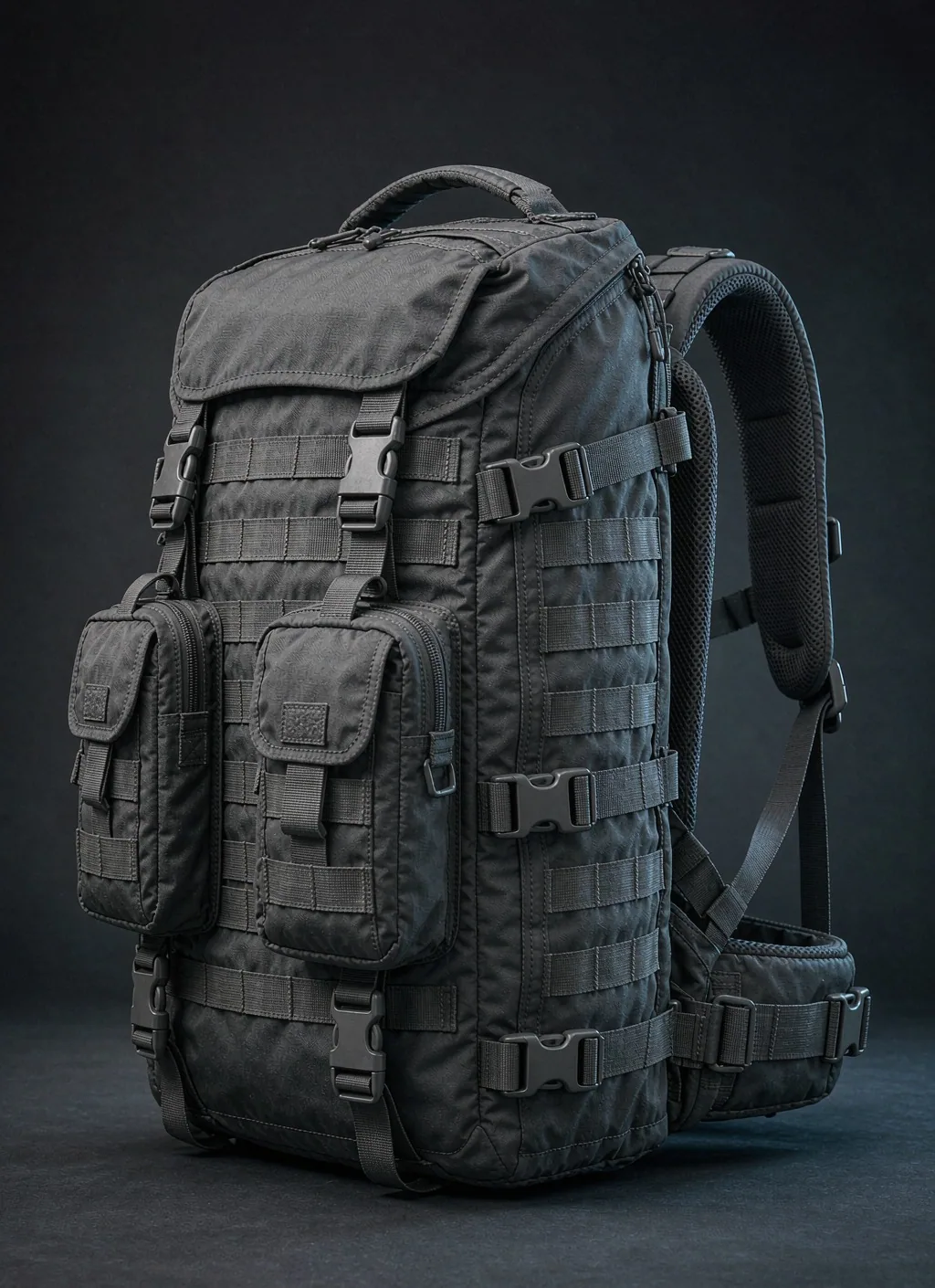
What Qualifies as a Tactical Backpack in Civilian Buying Terms
The label circulates in retail far faster than its meaning. A pack earns the word tactical in a catalogue because it carries rows of webbing, wears a subdued colour, uses a squared silhouette, or appears next to boots and torches in a photographic spread. None of those cues predicts behaviour under load. For buying purposes the description has to be earned by architecture: separated storage that keeps hard objects away from compressible kit, a controllable suspension returning packed mass toward the wearer's centreline, and exterior fields documented by drawing rather than by accessory photography. When those three conditions exist in one controlled construction, the product behaves differently over a long walk, inside a vehicle, on a wet worksite and at a baggage belt. When they are absent, the same visual language delivers an ordinary daypack wearing a costume.
Four claims deserve scrutiny before anything else. First, stated litres describe enclosed space, not usable carried mass or reachable volume; a nominally larger pack can feel worse because the extra space sits where nothing can be stabilised. Second, an attachment phrase is not geometry; a controlled PALS field states 25 mm webbing, 38 mm vertical spacing and 50 mm horizontal repeat, plus backing construction and usable column count. Third, a robustness word is not evidence; it needs fabric identity, coating record, stitch construction, hardware part numbers and a test route behind it. Fourth, weather language attaches to the finished article, so seams, openings, needle holes and closure construction decide the outcome more than fabric swatch data does.
The civilian applications are broad and legitimate. They include outdoor and expedition programmes, industrial maintenance crews carrying diagnostic tools, event and venue technical staff, volunteer emergency responders working under civilian authority, licensed radio operators managing field equipment, survey and inspection teams, location photographers, and commuters who simply want organisation that survives daily abuse. Each of these groups rewards different behaviour: reversible packing, quiet closures, cleanability, reach without removing the pack, or protection for costly electronics. Writing those behaviours into the brief before discussing appearance prevents the familiar outcome in which a good-looking sample fails inside two weeks of real duty.
The boundary matters as much as the definition. This document discusses durable load carriage for lawful civilian purposes. It does not offer military equipment, weapons, ammunition storage, personal armour, ballistic protection or items whose movement is restricted, and it does not suggest that any product mentioned here has been approved by any defence authority. Buyers should also understand that jurisdictions differ sharply on articles with dedicated retention compartments, on chemical content rules and on labelling language. The compliance material later in this page is general trade information, not legal advice; importers and brands must obtain their own counsel where classification, licensing, warning or end-use documentation is in question.
The order of decisions below reflects how uncertainty is actually reduced. Pick the family from realistic duration and contents, then fix internal layering, then suspension and egress detail, then exterior interface density, then discretion level, then materials, then laboratory routes, and only then commercial terms. Reversing that order produces the common failure: a colour chosen before the load case, and an interface chosen before anyone knows what will hang on it. Groups running several related lines can treat the result as one branch of a wider modular backpack platform strategy rather than as an isolated purchase.
Family Tree: Seven Formats and the Capacity Each One Really Serves
Format families exist because duration changes everything about internal organisation. A pack intended for one overnight needs fast external reach and a narrow profile; a pack intended for several days needs volume that can be stabilised, a real hip interface and a compression strategy that still works when the main body is half empty. Confusing the two is the most frequent buying error in this category, because both look similar in photography and both can be described with the same adjectives. Duration also determines contents character: food and clothing bulk versus tools and electronics, compressible versus rigid, frequently touched versus contingency-only.
The short-duration assault pattern occupies roughly 20–35 L and targets 24–48 h of activity. Its defining virtue is restraint. The profile stays narrow enough to move through scrub, vehicle doors and crowded corridors, and the exterior carries only what must be reachable while the product stays worn. Typical contents are hydration, a shell layer, food, a compact tool set and a small first-aid module. Because carried mass remains modest, the builder can trade some suspension sophistication for lower weight and a cleaner silhouette, provided the hip interface still controls bounce during movement and the back panel does not collapse around hard contents.
The three-day pattern, around 35–55 L, is where suspension becomes the dominant engineering subject. Once carried mass grows, no amount of padding compensates for poor torso match or a hip interface that cannot transfer share. Expect a structured back for extended loads, genuine compression travel to stabilise partial loads, and access planning that lets users reach lower contents without emptying the whole upper half. The trap here is treating litres as capability: a larger shell that cannot be compressed or balanced feels worse than a smaller one that can, and it also risks exceeding airline and locker dimensions that civilian programmes frequently depend on.
The recon sling and cross-body everyday formats occupy roughly 8–20 L. Their advantage is rotation: the body swings to the chest for access without removal, which suits travel documents, tablets, hand tools and photographic accessories. The engineering cost is asymmetry. A single shoulder carries everything, so the strap needs width, grip and a stabilising secondary strap, and contents have to stay light and flat. Sling formats reward people who touch their kit constantly and punish anyone who fills them with dense objects, because there is no second anchor to share the moment.
Response and first-aid packs in the 15–35 L band are organised around opening sequence rather than storage volume. They usually open flat, present contents in coded or labelled panels, and use pulls that work with gloves. What they carry is not supplied with the bag: medical contents, expiry control and regulatory registration remain entirely with the buyer or licensed distributor. What the bag supplies is presentation logic, impact and dirt protection, and a carrying body that lets another person locate items quickly, which is why internal panel layout deserves more attention than the shell does.
Radio and field-electronics packs typically run 20–40 L and deal with concentrated dense mass rather than bulk. A transceiver, spare batteries and cable sets are heavy for their size, so they belong near the spine in a padded cell with sensible routing points for antenna elements and leads. Heat, connector strain and separation from water deserve explicit attention, since all three shorten equipment life far faster than shell abrasion does. The hydration carrier, usually 6–15 L, solves one narrow problem well: reservoir support, cleanable tube routing with left or right exits, and enough room for minimal essentials before pairing with a larger bag.
A final family is the discreet-retention variant sold openly in civilian markets, typically 18–30 L. Objectively it combines ordinary daily organisation with a dedicated padded compartment fitted with retention hardware and often lockable closures. Whether such articles may be sold or carried depends entirely on local law, licensing regimes and venue policy, and those rules change. Anyone placing this format must verify legality per destination with qualified counsel; nothing on this page constitutes legal advice, and no firearm, ammunition or related article is offered here. From an engineering view the compartment simply adds one dense rigid object that must sit near the back plane and stay separated from soft items.
| Family | Capacity band | Duration it serves | Typical contents | Priority features | Main compromise |
|---|---|---|---|---|---|
| Short-duration assault pack | 20–35 L | 24–48 h | Hydration, shell layer, food, compact tools, small first-aid module | Narrow profile, external reach while worn, moderate mounting density | Room for bulky clothing layers stays limited |
| Three-day pack | 35–55 L | Multi-day loads | Sleep system, clothing layers, larger tool set, expanded ration module | Structured suspension, genuine hip share, torso adjustment | Bulk and fitted-dimension risk grow quickly |
| Recon sling and cross-body | 8–20 L | A few hours | Tablet, documents, tools, personal items | Chest rotation without removal, single-handed reach | Shoulder asymmetry needs a stabilising secondary strap |
| Response and first-aid pack | 15–35 L | Event or shift duty | Categorised supplies arranged by treatment sequence | Flat-open access, coded inner panels, glove-compatible pulls | Contents, expiry and registration stay with the buyer |
| Radio and electronics pack | 20–40 L | Duty period | Transceiver, spare batteries, antenna elements, cable sets | Padded cell, pass-through routing, separated battery zone | Dense mass demands strict close-to-spine placement |
| Hydration carrier | 6–15 L | Short hydration-focused activity | Reservoir, tube, minimal essentials | Insulated route, left or right exits, easy reservoir removal | Minimal storage; usually paired with another bag |
| Discreet-retention variant | 18–30 L | Daily carry governed by local law | Everyday items plus one dense retained object | Hidden back-panel sleeve, lockable closures, low-contrast trim | Legality varies by jurisdiction and must be verified independently |
Internal Architecture: Layering, Compression Lines and Rigid Content Control
Internal organisation is a load-management decision before it is a convenience decision. Think of the shell as four interacting zones. The back-adjacent zone takes flat, dense or fragile objects and keeps them near the spine where leverage is lowest. The central volume carries the heaviest bulk. The lower zone concentrates compact tools and anything wet or dirty. The front face handles items that must be reached without removing the product. When that arrangement is reversed, with dense objects floating outward and soft bulk pressing against the wearer, total mass has not changed but perceived weight rises sharply and sway appears on every step.
Access logic has to be chosen alongside layering, not afterwards. A top-loading body is strong and simple but buries lower contents; a full clamshell opens flat for inspection yet introduces a long zipper path that can be blocked by anything mounted on the front face. A panel opening sits between the two and suits programmes where the user wants partial reach in tight spaces. Whatever is chosen, the closure route needs clearance testing with the product fully dressed: compression engaged, external pouches mounted, and the body supported rather than held in the hand.
Compression is frequently misunderstood as cosmetic shaping. It performs three separate jobs. It suppresses internal movement so contents do not migrate into a single settled lump. It draws the load inward, shortening the moment arm between packed mass and the spine. And it stabilises exterior attachments by removing the slack that would otherwise let a mounted pouch swing. Side straps generally do most of the second job; front or lower straps handle the third. The failure mode appears when compression is used to hide an overfilled body, because the resulting pressure loads the closure path rather than reducing carried weight.
Hydration and cabling deserve dedicated routes rather than improvised gaps. A bladder sleeve should suspend the reservoir so a full load does not sag into the floor seam, while tube exits on both left and right let users cross either shoulder without kinking. Ports need reinforcement because they are repeatedly forced open, and they should sit clear of pinch points created by compression straps. The same reasoning applies to antenna pass-through and charging leads: define where they exit, protect the opening from fraying, and keep them away from anything that flexes repeatedly.
Separating a radio or equipment cell from general contents is usually worth the small volume penalty. A rigid device should not share space with tools, food or a hydration reservoir, because contact points concentrate pressure, dust transfer is unpleasant, and heat has nowhere to go. A suspended sleeve with clearance above the floor protects against the set-down cycle every user performs hundreds of times. The base itself deserves its own specification: structural seams, reinforced corners, drainage thinking where mud is expected, and enough separation between the floor and any delicate internal sleeve.
| Layer | Accepts | Load consequence | Access consequence | Construction requirement |
|---|---|---|---|---|
| Back-adjacent sleeve zone | Reservoir, laptop, rigid panels, flat documents | Holds dense objects near the spine and limits rearward leverage | Reached from above or through a separate panel | Suspended construction with clearance over the floor |
| Central general volume | Clothing layers, food, compressible bulk | Sets baseline balance for the whole product | Top, clamshell or panel opening depending on format | Structural side seams returning main loads upward |
| Lower utility zone | Tools, wet items, spare footwear | Concentrates hard mass at the bottom | Often served by a dedicated lower opening | Reinforced floor with careful seam treatment |
| Front utility face | Frequently touched small items | Pulls modest mass outward and raises sway if overloaded | Fast reach without removing the product | Stabilising points tied into shell structure |
| External attachment face | User-selected pouches | Places mass furthest from the wearer | Depends entirely on the accessory selected | Documented geometry returning force to reinforced backing |
| Lid and collar region | Maps, gloves, light soft items | Raises the centre of mass slightly | Reachable without opening the main body | Anchors routed clear of the principal zipper |
Carry Systems: Frame Elements, Release Shoulders and Drag Handle Construction
Suspension decides whether a correct internal layout can actually be carried. A frame sheet is a shaped panel that converts point loads into a distributed band, keeps rigid contents from printing against the wearer, and preserves back geometry when the body is half full. It adds little weight and suits most civilian duty envelopes. An aluminium stay or a pair of stays does a related but distinct job: it holds a defined curvature when loads are heavy enough to flatten a sheet, and it lets a designer tune flex behaviour. The heavier route is not automatically better, since it costs room at seam stacks, raises mass, and needs careful end treatment so nothing migrates through surrounding fabric over time.
Torso range is the next decision, because one shell rarely fits an entire size curve. Options include a ladder-style adjustment at the shoulder root, interchangeable harness boards, or simply offering several nominal sizes. Whichever is used, the adjustment range, increment and locking behaviour belong in the brief; a usable range that is too narrow produces returns rather than goodwill. Fit review should cover boundary sizes rather than only the middle, and should be done with realistic clothing layers, since thick outer garments change effective torso length noticeably.
Shoulder straps do more than cushion. Their foam density, taper from neck to underarm, curvature and the angle of load-lifter webbing determine whether the position feels supported or whether the product constantly slides backward. Straps that are too thick near the neck chafe; straps that are too narrow concentrate pressure. Quick-release paths deserve particular attention. The reason to specify them is legitimate and entirely civilian: removing a loaded body inside a vehicle, freeing movement when working near machinery, or taking the bag off without lifting a heavy mass overhead. The consequence is accidental actuation, so the specification must guard the actuator, orient release away from harness pressure, and include a retention check after repeated cycling.
Sternum control and the hip interface finish the system. A sternum strap stops strap spread and reduces sway, but on its own it transmits almost nothing. A hip belt only transfers share if it is a wrapped, padded structure sitting on the pelvis; a length of webbing with no structure is position control and should never be presented as a load-bearing device. Programmes aimed at longer walking distances can borrow thinking from long-distance load carriage, where hip share and torso match are treated as primary requirements rather than optional extras.
The drag handle is often specified as a one-line afterthought and then fails. Its purpose is repositioning: hauling or lifting a body toward you from a vehicle floor, a rack or a doorway. That action sends a large fraction of packed mass through a small anchor, so the handle webbing must continue into structural seams rather than terminating in face fabric. It also needs enough width to grip, a clean load path when the product lies on its base, and a clear statement in the user documentation that it is a repositioning feature rather than a suspension-rated lift point unless the project has validated exactly that use.
| Component | Function performed | Decision to record | Typical oversight | How to judge it |
|---|---|---|---|---|
| Frame sheet | Spreads point loads and shields the back from rigid contents | Thickness, taper, removability | Assuming it also strengthens exterior attachment | Loaded wear trial with rigid contents fitted |
| Aluminium stay | Retains defined curvature under heavier extended loads | Count, placement, radius, end treatment | Ends migrating through surrounding fabric | Flex cycling followed by careful inspection |
| Torso adjustment ladder | Adapts one shell across several body lengths | Range, increment, locking behaviour | Range too narrow for the target size curve | Fit review at both boundary sizes |
| Shoulder strap geometry | Moves load from shell to shoulders comfortably | Foam density, taper, load-lifter angle | Excess bulk where the strap meets the neck | Wear trial layered over thick clothing |
| Quick-release path | Controlled removal without lifting overhead | Release location, guarding, secondary retention | Actuator exposed to accidental contact | Repeat cycles plus loaded retention check |
| Sternum and hip interface | Controls sway and shifts share away from shoulders | Belt structure, padding, removability | Webbing-only belt presented as load-bearing | Review hip wrap under packed condition |
| Drag handle | Repositioning and recovery of a loaded body | Webbing route into structural seams | Terminating the anchor in face fabric only | Pull test in the actual drag direction |
MOLLE and PALS in Daily Use: Density, Reach Envelopes and Noise
Exterior webbing is the most recognisable element of this category and the most frequently misapplied. A functional PALS field is a controlled construction: 25 mm webbing, 38 mm vertical spacing and 50 mm horizontal repeat, with rows anchored so a strap weaves through without skipping, and with backing that returns force into structure. Decorative rows with an inaccurate repeat may look identical in photography and still refuse to accept any partner pouch tightly. Where a programme intends real interoperability, the drawing must state the three dimensions plus width tolerance, row count, backing construction and the columns genuinely usable rather than merely present. Interface detail across the wider range sits in the MOLLE and PALS control notes.
Density decisions are really decisions about where mass and attention go. Every row added across a front panel invites additional mounted weight, and the ability to hang accessories is not the same as wisdom in doing so. A useful planning distinction borrowed from load-carriage history separates what a person needs immediately from what sustains them across a longer span; the terminology is historical and is used here only as civilian packing logic, never as a capability claim. The immediate group holds items touched dozens of times an hour, the sustainment group items touched a few times a day. Mixing them produces a product that must be removed and reopened constantly.
Placement drives comfort more than count does. Anything across the shoulder blades presses into the back when seated against a vehicle seat. Anything low and rearward strikes the legs during stride and catches chair backs. Anything wide and high increases lateral sway, because distance from the spine multiplies the moment created by the same grams. Anything crossing the main opening forces a partial unpack to reach something buried. Before approving a layout, mark the panel with the user's actual reach envelope while the product is worn rather than on a table, and check seated posture, vehicle entry and doorway clearance.
Noise control separates a pleasant product from an irritating one, particularly for civilian work, photography and travel applications. Contributors include loose webbing tails flapping against the shell, metal pullers striking hardware or floors, coil chains rattling along unprotected runs, and buckle halves clicking against each other. Remedies are straightforward when specified early: elastic keepers or trimmed and heat-finished tails, fabric zipper garages, shaped pullers retained by a loop, soft reverse-coil chain on frequently used openings, and a matte or rubberised finish on exposed metal. None of these measures changes structural capacity, but each measurably changes what it feels like to live with the product.
Finally, treat webbing as a dimensional component with real tolerance. Width drift changes how easily straps weave, edge finish affects abrasion against the shell, stiffness influences whether a mount lies flat, and colour consistency across lots matters when replacement pouches are sold later. Where solution-dyed yarn is used for branded webbing, lot variation usually improves, reducing visible mismatch between a carrier and accessories introduced afterwards. Specifying the field this way costs minutes during drafting and saves an entire replacement conversation later.
| Layer | Contents character | Where it belongs | Connection requirement | Consequence if misplaced |
|---|---|---|---|---|
| Immediate reach | Touched repeatedly without setting the pack down | Lid, chest line, upper side | High cycle durability and one-handed access | Constant removal and reopening of everything |
| Task layer | Tools and equipment used at intervals | Mid-height external face or upper shell | Stable retention with a protected actuator | Sway develops and straps loosen repeatedly |
| Sustainment layer | Food, spare clothing, bulk consumables | Deep main volume close to the spine | Compression that prevents migration | Weight drifts outward and balance degrades |
| Reserve layer | Contingency items used rarely | Bottom or rear of the main body | Contained so they cannot trap other items | Frequent digging disturbs everything above |
| Routing layer | Reservoir tube, antenna, charging leads | Dedicated internal paths with defined exits | Smooth routing free of sharp bends | Kinking, chafing or snagging on contents |
| Protected rigid layer | Electronics, glass, spare hardware | Suspended near the back plane with clearance | Padding plus separation from hard neighbours | Impact damage at corners and floor |
Low-Visibility Builds and What Discretion Actually Costs
A low-visibility variant, sometimes called a grey configuration, exists for a practical reason: many civilian users do not want equipment that advertises either its contents or its cost. Worksite staff entering client premises, photographers working in crowds, commuters on public transport and corporate teams distributing branded kit all benefit from something that reads as ordinary. The objective is not hiding capability from the user; it is removing visual signals that draw attention. That can be achieved without pretending the product is something else, and it can be achieved while retaining genuinely useful organisation.
The most expensive lever is also the most effective: removing exterior webbing. It eliminates the strongest visual cue and simultaneously removes most external reconfiguration. Programmes that still want modularity usually move it inward, replacing rows with an internal slot panel or a hidden organiser board behind a plain face. This keeps directory-like organisation and removable panels while cutting silhouette and snag risk. The cost is slower swaps, since external pouches can no longer be repositioned on the fly, so a stricter contents plan must be agreed with end users before ordering.
Second-order cues matter as much as rows. Shiny black metal reads as equipment; matte or coated finishes do not. Exposed coil chain and long runners read as technical; covered paths with tucked pullers do not. High-contrast logos read as advertising; a tone-on-tone woven label or debossed patch does not. Then comes the conflict every safety-focused programme eventually meets: visibility requirements may demand bright panels or retroreflective trim, which directly opposes discretion. The resolution is usually a compromise zone, with reflective detail concentrated somewhere it can be covered, or a hi-vis overlay carried separately.
Material choice reinforces all of this. Softer-hand face fabrics drape quietly and fold rather than creak; glossy coatings announce themselves under lights; stiff shells hold a squared equipment silhouette even when empty. Low-sheen finishes, subtle texture and a restrained thread decision move perception a long way without altering structure. The hidden consequence of inward organisation is that internal panels need real backing, because without rows to distribute load the face fabric alone must support whatever is mounted behind it.
| Discretion lever | Attention reduction | Capability given up | Material implication | Where it belongs |
|---|---|---|---|---|
| Removing exterior webbing rows | Largest single reduction | Most external reconfiguration | Smooth face fabric with fewer stitch lines | Urban commuting and client-facing duty |
| Internal slot panel behind a plain face | Keeps the exterior ordinary | Slower external swaps | Face fabric needs genuine backing support | Programmes still requiring organisation |
| Matte hardware and covered pulls | Removes shine and reflection | Some tactile confirmation of placement | Dull finishes plus fabric zipper garages | Mixed urban and outdoor routes |
| Neutral low-contrast colourway | Blends with ordinary travel bags | Visibility in low light where safety matters | Solution-dyed options improve lot consistency | Corporate and travel programmes |
| Covered or reverse-coil closures | Hides the strongest equipment cue | Slightly slower opening | Coil chain, storm flap, retained pullers | Venues with conservative dress expectations |
| Understated brand mark | Avoids signalling expensive contents | Reduced retail presence | Woven label, debossed patch, tone-on-tone print | Private-channel and corporate distributions |
Failure Signature Analysis: Tracing Field Returns to a Fixable Root Cause
Warranty data is the cheapest engineering input a programme can buy, provided somebody classifies it properly. Return piles almost always cluster into a handful of mechanisms rather than spreading evenly: a closure that stops running, a strap anchor that lets go, a back-coat that turns tacky, or a bottom corner that abrades through long before fabric elsewhere shows any wear. Recording the signature, its exact location and the elapsed service time at first triage converts anecdote into a distribution with a usable shape. Once that shape exists, corrective effort can be spent on the two or three causes driving most of the cost instead of chasing every forwarded complaint equally.
Structural complaints usually begin at the stitch line. A webbing row losing its anchoring shows lifting at the ends well before anything tears. Gradual seam jump appears as missed stitches after repeated flexing, typically around corners where the foot changes direction. Bar-tack pull-out tends to prove that the reinforcement sat on a face ply rather than continuing into structural seams. In none of these cases is the remedy simply more thread; it is edge distance, backing stack, stitch density and a defined anchoring route so force from a loaded pouch reaches the side seams instead of terminating where cloth is thinnest.
Coating behaviour produces a distinct signature. A polyurethane back-coat that has hydrolysed becomes tacky and then flakes, normally beginning at fold lines and wherever the article was stored damp. Storage conditions frequently explain failures better than service weeks, which is one reason a later batch can fail while an earlier one survives identical duty. Colour transfer is judged separately through rubbing work referenced to AATCC 8, while resistance to water penetration is read through hydrostatic testing referenced to AATCC 127. Neither result should be sold as finished-article weather behaviour, because needle holes, seam treatment, flap geometry and closure design decide that outcome far more than any fabric datum.
Hardware and closures generate the complaints end users notice first. Sliders spread under lateral pull, chain bursts when closure entries are misaligned, buckle tongues whiten at the stress radius before separating, and webbing creeps slowly through a slide adjuster on every stride of a loaded walk. Low temperature changes the picture again, because many moulded polymers lose impact tolerance when cold, which explains winter failures in lines that were only ever validated at room conditions. Accepting a hardware family therefore means accepting it across the whole temperature range the programme will actually meet, with agreed plating and colour-fastness expectations where brand matching matters.
The accountability loop closes the subject. Every recurring signature deserves a documented root cause, a corrective action with an owner, and a verification lot rather than a verbal assurance. Retention samples pulled from each shipment give a reference when a claim arrives months later, and lot coding lets the affected group be isolated if a material change is implicated. Documentation discipline referenced to ISO 9001 makes this habit auditable, while a sampling plan built on ISO 2859-1 and applied at AQL 2.5 tells both sides how much evidence counts as representative instead of leaving that argument until something has already gone wrong.
| Observed signature | Probable mechanism | First diagnostic to run | Corrective lever | Likelihood designs must change |
|---|---|---|---|---|
| Row ends lifting away from the face | Anchoring insufficient for peel loading | Inspect edge distance and anchoring route | Extend ends into structural seams | High, because the face ply cannot carry it alone |
| Skipped stitches after repeated flexing | Needle heating, blunt point or excessive density | Review stitch count per unit length and corners | Adjust density, needle size and thread count | Moderate, since sewing parameters often suffice |
| Tacky then flaking internal coating | Hydrolysis accelerated by damp storage | Check storage humidity history and fold lines | Change coating chemistry and storage guidance | High if the chemistry itself is unsuitable |
| Spreading slider or burst chain | Lateral loading or misaligned entry | Pull test the closure under side load | Rescue spacing, add a garage, re-orient the entry | Moderate, usually a closure detail fix |
| Webbing slipping through an adjuster | Creep under body movement loads | Cycle the adjuster at realistic pack mass | Specify grip geometry and a keeper | Low, often resolvable with hardware choice |
| Corner abrading through early | Abrasion zone lacks reinforcement | Compare worn area against intended contact zone | Add a bottom panel with higher mass fabric | High, because it changes the panel pattern |
Cost Behaviour Across Formats: What Each Extra Feature Actually Buys
Programme budgets rarely fail because somebody chose expensive cloth. They fail because a specification accumulated features whose cost was never weighed against the duty the buyer described at the start. It helps to separate three contributors before negotiating anything: material mass, work content, and the fixed costs attached to every new reference. Material behaves roughly linearly, since heavier-shell constructions and larger trims cost more per unit. Work content is the hidden driver, because every webbing row, bar-tack, reinforced corner and additional closure stage consumes floor minutes that no later conversation removes. Fixed cost per reference is what quietly surprises new programmes, for each additional reference carries its own pattern development, marking, operator training and line changeover.
Exterior interface choice illustrates the split neatly. Rows of 25 mm webbing add material plus a great deal of sewing; laser-cut slots largely convert that work into machine cutting time, lowering floor minutes but introducing heat-affected edges that must be qualified. A hidden internal panel shifts the expense into backing support, since without rows to distribute force the face ply alone must carry what is hung behind it. The relevant question is not which construction is cheaper in the abstract. It is which one matches the reconfiguration frequency end users really exhibit, because paying for external rows that stay bare is funding something nobody uses, while removing them from a programme that lives on swaps costs more in lost goodwill than it saved.
Hardware behaves similarly. Coil sizes in the #5, #8 and #10 families differ in both cost and perceived robustness, and specifying the largest everywhere inflates price without improving the closures anyone touches often. Buckle families reward consistency: once a programme accepts one approved family across sizes, tooling, spares planning and operator familiarity all improve. Conversely, mixing several hardware suppliers inside one dossier creates appearance mismatch risk between lots, which is expensive to unwind after retail photography is finished.
Consolidation is where real leverage usually sits. Sharing one chassis across two or three nominal capacities absorbs the fixed cost of a reference across a larger annual volume, and planning colourways against a minimum of MOQ 500 keeps changeovers economical rather than punitive. Repeat orders booked against a standing specification avoid repeating development cost altogether. Where a buyer genuinely needs several distinct products, the smarter route is often fewer references with stronger shared modules, which is the whole argument behind treating the range as branches of one programmed platform rather than a list of unrelated buys.
The last contributor is the cost of getting it wrong. Inspection effort, rework and replacement units are usually more expensive than the difference between two reasonable material options, so there is little sense in arguing about grams while leaving the acceptance route undefined. A documented testing plan, a clear inspection level and unambiguous colour standards cost money once and remove arguments later. Teams that wish to formalise that trade can fold it into their development roadmap and specification freeze, so cost conversations happen while change is still cheap.
| Cost lever | Where the saving appears | Risk introduced | Safe boundary | Who must agree |
|---|---|---|---|---|
| Reducing work content | Fewer floor minutes per unit | Weaker reinforcement at stressed points | Keep every structural anchoring operation untouched | Engineering and the line supervisor |
| Standardising one hardware family | Lower tooling and simpler spares | Less freedom for special features | Approve the family before the first sample | Design, sourcing and after-sales |
| Sharing one chassis across capacities | Development cost spread over more units | Fit compromise at size extremes | Validate the chassis at both boundary sizes | Product and wear-trial participants |
| Limiting colourways within a purchase order | Fewer changeovers per run | Reduced retail variety | Keep to the contracted minimum per colourway | Sales planning and the buyer |
| Replacing rows with slot cutting | Less sewing time per panel | Edge behaviour must be qualified | Finish edges against abrasion and heat checks | Engineering with the cut parameter owner |
| Removing rarely used modules | Less trim, fewer packages | Users lose future expansion | Drop only what field data shows unused | Buyer reviewing actual usage returns |
Duty Profiles: Configuring for Field Programmes, Worksite Crews, Response Teams and Commuters
The same chassis answers four very different questions depending on who carries it, and most specification mistakes come from answering the wrong one. Field programmes care about stability over distance and about everything staying dry and reachable when the ground is uneven. Worksite crews care about tools staying separated, cleanability, and not drawing attention inside a client's premises. Response volunteers care about another person being able to find something inside the bag under pressure. Commuters care about electronics protection, discreet appearance and moving through crowded transport without snagging. Writing the profile into the brief before choosing features keeps a programme from buying capability that will never be exercised.
Field use rewards moderation. A mid-sized body with genuine hip share, a reservoir sleeve, defined compression and modest external density will outperform a larger shell festooned with rows, because every gram hung away from the spine multiplies sway during a long walk upslope. Prioritise abrasion at the base and lower corners, protect closure entries from grit, and keep routing decisions for tube and leads simple enough to be cleared with wet hands. Users on longer approaches can borrow discipline from distance load-carriage practice, where hip transfer and torso match are treated as primary requirements.
Worksite duty has different economics. Tools damage interiors, so a dedicated lower zone with easily cleaned lining protects the rest of the build, and pale or mid-tone interiors make small objects findable. Sound matters more than buyers expect: metal pullers striking concrete, Velcro-style hooks tearing open at dawn, or loose tails slapping against a hard shell all become daily irritations on a quiet site. Exterior organisation helps here, provided rows sit clear of door frames and vehicle seats; where dust or client-facing appearance argues against rows, an internal panel carries the same organisation behind a plain face.
Response and volunteer first-aid configurations are about presentation and someone else's hands. Flat opening, labelled or colour-coded internal panels, glove-compatible pulls and contents protected from impact are worth more than any additional litre. It bears repeating that supplies, their expiry control and any required registration stay entirely with the buyer or licensed distributor; what this article supplies is storage logic and protection. Where teams need exterior expansion later, the convertible school of thought captured in our reconfigurable carry formats note explains what conversion mechanisms tolerate repeated cycles.
Commuter and corporate allocations invert nearly every priority above. Discretion dominates: no rows, matte hardware, covered closures, restrained branding. Electronics sit in a suspended sleeve with clearance over the floor, sized to whatever device class the organisation actually issues, and nothing rigid shares that cell with tools or cables. Organisation should be internal, predictable and quiet. Hygiene and cleanability climb the list when borrowed kit circulates between users, so removable boards and washable linings earn their place even though they add operations. Because this profile sees the most public contact, it also benefits most from documented care guidance and a spares policy.
| Duty profile | Attributes that earn their cost | Features to de-prioritise | Typical mis-specification | Acceptance activity |
|---|---|---|---|---|
| Field and expedition | Hip share, compression, water management, reinforced base | High external row counts | Litres chosen before suspension | Loaded walk over uneven ground |
| Worksite and maintenance | Separated tool zone, wipeable lining, quiet closures | Glossy appearance cues | Interior too dark to locate small parts | Searched-object trial in poor light |
| Response volunteers | Flat access, coded panels, glove-friendly pulls | Decorative external volume | Assuming contents arrive with the bag | Timed retrieval by an unfamiliar user |
| Commuter and corporate | Discretion, suspended electronics cell, internal order | Exterior modularity | Device cell sharing space with tools | Low-light discreet handling review |
| Field electronics | Padded cell near the spine, pass-through routing | Compressible bulk | Batteries stored against cables | Connector strain check after transport |
| Photography and survey | Divided cells, fast side access, stable tripod points | Excessive compression of optics | Assuming dividers substitute for structure | Set-down cycle with equipment fitted |
Maintenance, Repairability and Service-Life Planning Before Launch
Service life is decided less by what the product survives than by what its owner does to it afterwards. Storage habits explain a surprising share of premature failures: articles put away damp grow mildew behind linings, compressed under other stock lose foam recovery, and anything left in direct sun degrades thread and coating long before seams have been loaded. Care instructions therefore belong inside the product, not only in a PDF nobody opens. Keep them short and physical: dry fully before storing, air-dry away from heat sources, avoid solvents and machine cycles unless laundering has actually been validated against a household washing reference such as ISO 6330, and store loosely packed rather than flattened under weight.
Cleaning method should follow the material rather than habit. Coated constructions tolerate gentle washing with mild soap and a soft brush, while aggressive solvents strip finishes and can carry plasticiser migration that leaves the shell brittle. Zippers deserve occasional fresh-water rinsing after grit or salt exposure, followed by complete drying before the slider is run repeatedly; nothing destroys a chain faster than dragging abrasive particles along it. Hook-and-loop regions collect lint, which quietly reduces engagement, so a soft brush there preserves retention. Where the care label permits, sanitising wipes are usually kinder to coatings than immersion.
Inspection intervals turn maintenance from theory into practice. Field-orientated organisations do well with a short monthly review and a fuller quarterly one. The monthly pass looks for webbing fuzz at contact points, buckle tongues with whitening at the stress radius, slider bodies showing play, sticky or flaking coatings at fold lines and incoherent stitching at highly loaded corners. The quarterly pass adds closure travel under load, strap-anchor integrity at every bar-tack, accumulated dirt along hidden seam tape, and residual capacity of compression after cycling. Fleets can go further by keeping a small register of unit identifiers and service dates, which makes recurring patterns visible early and turns them into evidence a supplier can act upon rather than a series of unrelated complaints. Any finding that recurs across units is a specification signal rather than an accident.
Repairability is a design decision made long before returns exist. Sewn-in hardware is stronger but harder to replace; riveted or bolted alternatives enable field service yet introduce a hole that must be treated as a design rather than an afterthought. Specifying widely available fastener sizes and a standard webbing width lets a distributor repair locally instead of shipping units back across an ocean. Planning a small spares allocation — sliders, buckle halves, strap keepers — inside the same purchase avoids a separate minimum-order conversation later and keeps damaged units in service rather than in a skip.
The honest part of the conversation is knowing when repair stops being sensible. Once a shell coating has hydrolysed across whole panels, or the base fabric has thinned through, continued stitching spends money on a product that will fail elsewhere next month. Retirement criteria help distributors decide quickly and reduce returns friction, and they also protect brand perception, because nobody remembers which unit was economically repairable; they remember whether the brand resolved the problem without argument. Clear warranty wording written before launch does more for goodwill than any claim printed on a hangtag.
Export Packing, Transit Planning and the Market-Access File
A perfectly engineered unit can still arrive unsellable if the packing plan was treated as an afterthought. Single-piece protection sets the baseline: a polybag with a printed suffocation warning appropriate to the destination, hanger card placement agreed with retail, silica where moisture is plausible, and barcodes verified against the buyer's own numbering before the first carton closes. Cartons then need real dimension work, because freight cost follows volume far more than weight for this category. Box specification, stacking height, pallet pattern and container utilisation should all be settled before booking, and transit simulation referenced to ISTA 3A is a reasonable way to confirm that cartons arrive square rather than crushed at the bottom layer.
Mode selection follows the same logic as elsewhere in planning. Sea freight 25–35 days suits replenishment of steady references where forecast exists; air 5–8 days covers launch windows and urgent restocks; courier 3–5 days carries samples, replacement parts and first-article documents. Each mode has paperwork consequences, particularly regarding which documents can follow after departure, so it is worth agreeing early who holds originals. Buyers should also understand named-port responsibility: quoting on FOB Xiamen places transport, insurance and onward clearance with the buyer from loading onward, and landed-cost modelling should reflect that rather than assuming a delivered figure.
The market-access file deserves its own checklist, because missing paperwork delays release even when the product itself passes. Typical contents include a commercial invoice and packing list matched line by line, transport documentation from the carrier, a certificate of origin where preferential treatment is claimed, and test reports referenced to the routes already discussed: strength sampling lineage from MIL-STD-105 through ISO 2859-1, tensile work under ASTM D5034, abrasion under ISO 12947 or ASTM D3884, water behaviour under AATCC 127 and coated-fabric evaluation under ASTM D751. Metal hardware in skin contact is often asked to demonstrate nickel release behaviour against EN 1811. Chemical declarations relevant to REACH (EC 1907/2006), warnings needed under California Prop 65, children's-product considerations under CPSIA where applicable, nickel and other restricted-substance evidence, OEKO-TEX Standard 100 where upstream inputs are claimed, alongside social compliance material under BSCI and quality-system evidence under ISO 9001, complete the usual set.
Three traps recur. The first is treating a test report as permanent; reports belong to a defined material and construction, so any change in cloth, coating or hardware invalidates the result and quietly reopens the question. The second is inconsistency in origin and content labelling between carton, hangtag and sewn label, which inspectors notice quickly. The third is assuming one market's acceptance covers another; requirements genuinely differ by destination and can change, so validation belongs to each individual destination rather than to a single generic file.
| Document | Who issues it | What it supports | Common rejection cause | When to request it |
|---|---|---|---|---|
| Commercial invoice and packing list | Shipping desk | Customs valuation and quantity check | Carton numbers not matching physically | Before booking the vessel |
| Transport document | Carrier or forwarder | Title transfer and release at destination | Consignee details inconsistent with invoice | At loading confirmation |
| Certificate of origin | Competent authority in origin country | Preferential duty treatment where agreed | Classification discussed too late | Several weeks before sailing |
| Laboratory test reports | Accredited third-party laboratory | Substantiation of performance claims | Construction changed since testing | After specification freeze |
| Restricted-substance declaration | Supply chain with laboratory support | Chemical compliance and retail onboarding | Incomplete component coverage | Before first shipment |
| Social compliance evidence | Recognised audit programme | Retailer ethical-sourcing onboarding | Validity window already expired | At buyer onboarding |
Frequently asked questions
What minimum order applies to a first tactical backpack programme?
Plan first business against MOQ 500 per reference. That figure exists because imported material lots, pattern preparation, marker work and the line changeover itself all carry fixed cost, so treating it purely as a negotiating hurdle misunderstands what it covers. Buyers wanting several colours usually either plan each colourway to the same MOQ 500 threshold or consolidate onto one chassis with interchangeable branding so the run clears efficiently. Where a pilot cannot reach that volume honestly, the saner alternatives are adopting an existing construction with different labelling, or paying a premium unit figure. Both are weaker than planning volumes properly, and both belong in the conversation before tooling rather than after.
How long does sampling take for a structured pack carrying sewn attachment rows?
Sampling 6–10 working days covers a standard structured build once drawings, materials and trim references are confirmed. Complex programmes extend to 12–15 working days, typically where multiple closure routes, bonded panels or hardware originally tooled for another application are involved. The clock begins at confirmation, not at first discussion, so most delay originates on the buyer side waiting on graphics and colour decisions rather than on the floor. Treat this window as a test cycle rather than a photography opportunity: thread real pouches through the rows, load the body to realistic weight, and run every closure repeatedly before granting approval. Discoveries after sign-off convert sampling time into lost schedule.
What should we assume for production time once a sample is approved?
Allow mass production 35–50 days from a confirmed pre-production sample together with the deposit. The window accommodates material procurement, cutting, sewing, finishing, inspection and packing; across 7 production lines the limiting factor is usually confirmed trim arrival rather than machine availability. Programmes that protect this window do two things early: they freeze drawings before releasing the deposit, and they schedule laboratory work to run alongside make-up rather than after it. Specification changes after cutting starts are the classic source of overtime and quality drift, because part-finished bodies cannot be cleanly rebuilt once the line is running.
Which inspection level will be applied before goods are released?
Finished-goods inspection is normally planned at AQL 2.5 for major defects, using a sampling plan referenced to ISO 2859-1, whose statistical lineage runs back to MIL-STD-105. That means defects are counted against a defined sample size taken from the lot rather than judged impressionistically from a single carton. Buyers should state which defect classes matter most for their programme, since cosmetic grading deserves different tolerance than structural findings such as missed bar-tacks or non-functioning sliders. Written acceptance criteria, agreed drawing revision and an unbroken lot identifier should all exist before the inspector arrives; otherwise even the fairest result becomes arguable.
How is payment structured, and what exactly does FOB Xiamen include?
Standard terms are T/T 30/70, meaning thirty per cent deposit to release materials and the balance before shipment release once inspection passes. Quoting at FOB Xiamen places responsibility for carriage, insurance and onward customs clearance with the buyer from the moment goods are loaded, so landed-cost models should add those legs rather than assume a delivered figure. Incoterms revisions change these allocations, so cite the edition in the contract. When indicative unit budget is discussed, record it as indicative only, FOB Xiamen, 500-unit MOQ, because any figure produced outside that frame will not survive contact with freight, duty or currency movement.
Which transit mode suits a first drop, and which suits replenishment?
Steady replenishment belongs on sea freight 25–35 days, where forecast exists and the saving per carton is substantial. Launch dates and unplanned restocks fall to air 5–8 days, accepting a far higher cost per unit to protect shelf presence. Courier 3–5 days carries samples, spares and paperwork, where speed outweighs anything else. Choose per shipment rather than once: many programmes combine modes, couriering a small advance quantity ahead of the vessel. Each mode also changes when original documents can be released, so agree document custody with the forwarder at booking instead of discovering a mismatch while goods sit at destination accumulating demurrage.
How large is the production base supporting these programmes?
The operation runs from a 4,950 m² SGS-verified production floor staffed by 137 people working 149 machines, arranged as 7 production lines with combined output capacity of 200,000 units per month. Capacity figures should be read as a ceiling for planning rather than a promise for any particular week: attainable throughput depends on how much work content a given specification carries, because every additional bar-tack, reinforcement panel and closure stage consumes floor minutes. Realistic programmes therefore discuss peak weeks in advance, spread launches away from known freight congestion, and confirm line allocation at deposit stage so nothing depends on assumption.
What exactly should the drawing state for an exterior attachment field?
Channels take 25 mm webbing, rows step at 38 mm vertically, and sewn interruptions repeat horizontally every 50 mm, and all three belong on the drawing with tolerance rather than in prose. Add the number of rows actually usable rather than present, island length, backing stack behind the field, end anchoring route into structural seams, and the edge distance from row to zipper line. Without those entries a panel can photograph convincingly yet refuse a strap, or accept one loosely and release under motion. Also record the thread construction, stitch density and acceptable colour variation so replacements ordered later still fit.
When should a programme choose a discreet configuration over a webbed one?
Choose discretion whenever users operate around clients, crowds or public transport, since attention drawn to expensive contents is a real commercial risk. Removing rows is the strongest single lever but costs external reconfiguration, so judge it against how often users genuinely reposition pouches in a working day. Where organisation must survive, move it behind a plain face onto an internal panel, supported by backing adequate to carry hung mass without transferring strain into the outer cloth. Pair that with matte hardware, covered pulls and a restrained label, and accept slightly slower opening as the price paid for looking ordinary.
Which laboratory route substantiates a claim about rain behaviour?
Fabric resistance to water penetration is measured under hydrostatic head testing referenced to AATCC 127, and coated constructions are often evaluated for coating adhesion and blocking resistance under methods such as ASTM D751. Neither result equals finished-article performance, because closures, needle holes, seam treatment and flap geometry decide real outcomes. Buyers wanting honest support should test both: run material on the standard method, then subject completed units to a defined shower-and-carry cycle with realistic internal loading. Report the results separately and market them separately, because treating a swatch number as a finished-product warranty is precisely how a defensible claim becomes a legal problem.
How should abrasion and tear performance be evidenced?
Combine three lines of evidence. Abrasion resistance is read through Martindale work referenced to ISO 12947 or rotary methods under ASTM D3884 depending on whether rubbing is multidirectional or rotational in service. Tensile and tear behaviour come from grab and tongue methods under ASTM D5034, which are especially relevant wherever webbing loads transfer into face cloth. Those laboratory results should then be corroborated by field routing carried over grips, vehicle sills and rough ground, since real wear concentrates at corners and contact points rather than distributing across panels. Recording location alongside cycles makes the comparison meaningful between candidates.
What care instructions should ship inside every unit?
Instructions should be physical, brief and written around the materials actually used. Ask users to dry fully before storage, avoid solvents, keep away from direct heat sources, and store loosely rather than compressed beneath other stock, since coating ageing and foam recovery both respond to how the product is put away. Where laundering has been validated, cite the household washing reference used, such as ISO 6330, with the cycle permitted. Add guidance on rinsing closures after salt or grit exposure, clearing lint from hook-and-loop zones, and inspecting strap anchors and bar-tacks at intervals. Clear care text reduces preventable returns and strengthens after-sales relationships.
Which compliance files should be requested before the first shipment?
Request a matched set rather than a single certificate. Restricted-substance declarations referencing REACH (EC 1907/2006) cover downstream chemical obligations; laboratory evidence on nickel release under EN 1811 applies to metal hardware resting against skin; warning language may be needed under California Prop 65; where articles could be treated as children's goods, additional consideration under CPSIA applies. Inputs backed by OEKO-TEX Standard 100 certificates should be listed by component, since each certificate names a specific article. Add social-compliance evidence under BSCI and quality-system evidence under ISO 9001 where retail onboarding requires them. Check every document for validity dates and for whether the named construction still matches what is shipping.
Are these backpacks military equipment, and can any certification be claimed?
No. Everything described here is durable civilian equipment intended for lawful outdoor, worksite, volunteer response, photography, radio and commuting use. No armour, ballistic capability, armament carriage or controlled article is offered, no military specification compliance is claimed, and no defence organisation approval should be implied in any listing. Buyers carrying packs with dedicated retention compartments must verify legality for each destination themselves, because rules on such articles differ and change. Standard citations appearing on this page are used as testing references only; referencing a test method is not the same as holding a certification against it, and the two should never be blurred in customer-facing copy.
What makes a quick-release shoulder path safe for everyday civilian use?
The legitimate reasons are removing a loaded body inside a vehicle, freeing movement near machinery, and avoiding lifting mass overhead. Those reasons make accidental actuation the only serious hazard, so the specification has to guard the actuator, route the release away from harness pressure, and add secondary retention that survives a hard pull in either direction. Validation should combine repeat cycling, a loaded retention check and one-handed operation wearing gloves. Documentation must also state that the feature aids removal rather than forming a suspension-rated point, because users will otherwise assume it can be grabbed for recovery in situations involving a drag handle instead.
Where can cost be reduced without weakening the build?
Target work content and reference count before touching materials. Sewing minutes accumulate through every extra row, reinforcement and closure stage, so removing features nobody needs saves more than downgrading cloth. Standardising one hardware family across sizes reduces tooling, simplifies operator familiarisation and keeps appearance consistent; coil sizes in the #5, #8 and #10 range should be matched to how often each opening is used rather than maximised everywhere. Sharing one chassis across two capacities spreads development over more units. Finally, remember rework costs more than the gap between sensible options, so never trade away the acceptance route to save a few cents.
Can several pack families be combined within one purchase order?
Yes, provided each reference is planned as its own line. In practice the constraint is not the line itself but whether each variant clears MOQ 500 and whether trims were confirmed early enough to arrive together. Mixing a three-day shell with a hydration carrier works well because trims overlap, whereas adding a discreet variant late usually introduces new hardware finishes, new fabrics and new patterns that delay everything. The most reliable approach is to nominate families at deposit, confirm materials jointly, and accept one production window rather than expecting partial deliveries spread over several weeks for the convenience of downstream logistics.
How should a distributor plan spares and repairs for units already in service?
Plan before launch, because after-sales economics follow decisions made during design. Specify widely available slider and buckle sizes plus standard webbing widths so local repair is feasible, and order a supplementary allocation of sliders, buckle halves and strap keepers alongside the main consignment rather than negotiating a separate minimum afterwards. Publish short repair procedures describing what a distributor may safely replace and what requires return, since unclear guidance generates either unnecessary claims or unsafe fixes. Finally agree retirement criteria: once a coating has degraded across whole panels or base fabric has thinned through, replacement is more honest than continued stitching.