Home › Field notes › How to Calculate Landed Cost for Custom Modular Bag Programs
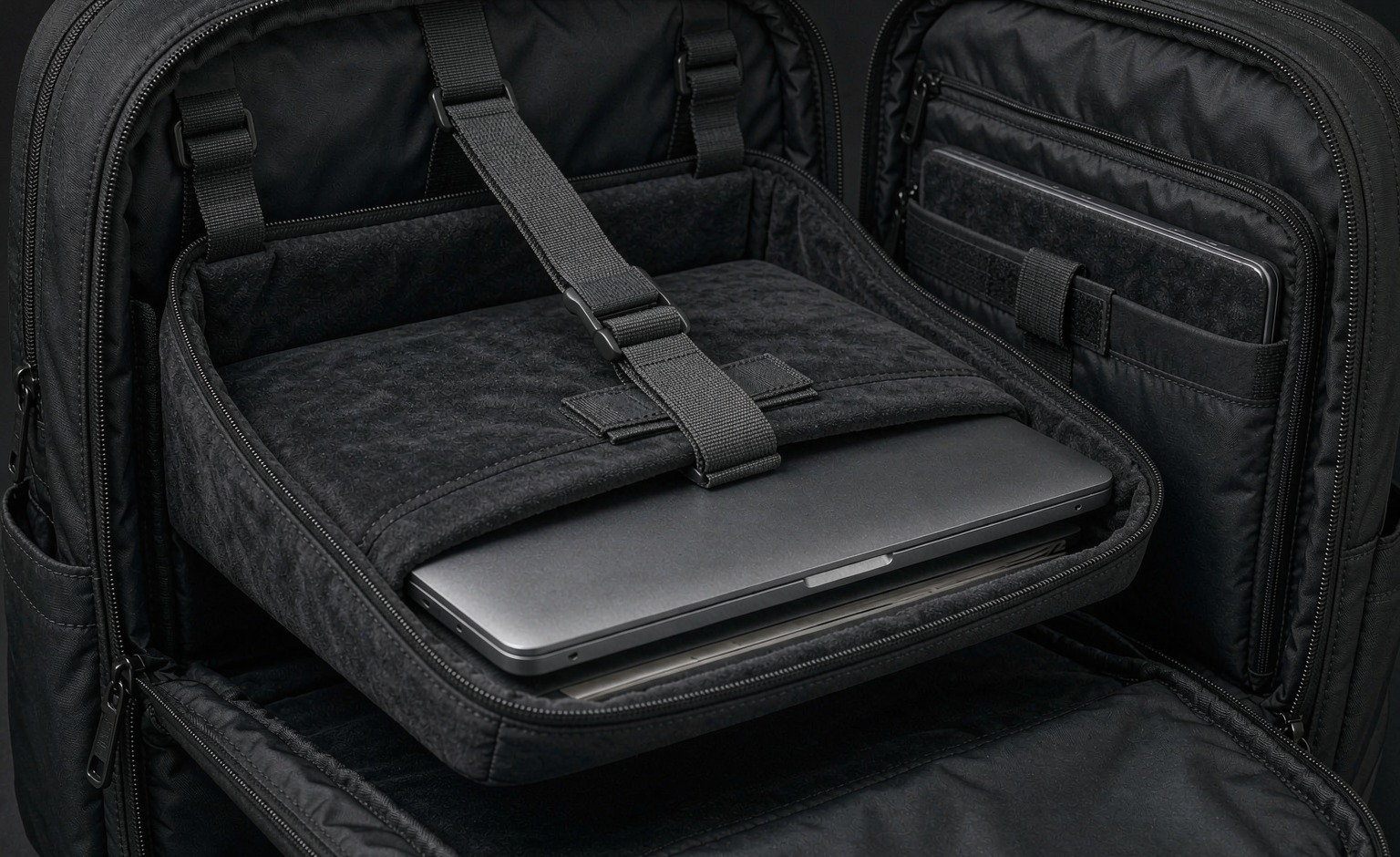
Landed cost for a custom modular bag programme is the unit price plus every cost required to put that unit on your shelf, and on most programmes the non-unit blocks move the margin more than the unit price does. Modularity makes this sharper: an interface that adds attachment appeal also adds cubic volume, inspection time and rework exposure, and all three are charged further down the chain. This guide breaks the calculation into seven blocks, shows a worked example from an FOB figure to a shelf cost, and ranks the levers by how much they actually move the result — for importers and finance teams working at MOQ 500 with assembly measured in 35–50 day blocks and sampling in 6–10 working day rounds. It closes with the modelling errors that make a landed-cost number look precise while being wrong in a predictable direction, and with the structure of a quotation request that produces a comparable answer from two suppliers.
Landed cost defined: the seven blocks
A landed-cost model fails for one of two reasons: it stops at the unit price, or it hides the variable blocks inside a single overhead percentage. Both produce a number that looks precise and is wrong in a predictable direction — too low, and confidently so.
Split the calculation into seven blocks and the arithmetic becomes auditable. Block one is the unit price as quoted. Block two is international freight and terminal charges. Block three is duty, calculated on the customs value of the destination. Block four is inland delivery to your distribution point. Block five is testing, certification and compliance documentation. Block six is sample and tooling amortisation. Block seven is the overhead of running the programme: buying time, inspection, banking and the cost of capital tied up in transit.
The discipline that matters is to keep the blocks separate in the model even when they are consolidated in the ledger. When freight spikes, a consolidated percentage hides the cause; a separated block shows it in one line and lets the buyer argue about the right thing.
Modularity adds a specific complication worth naming at the outset: the same nominal product can be shipped assembled or flat, with modules fitted or separate, and the two configurations have different cubic volumes and different duty treatments. Decide the configuration before the model is built, because it changes more than one block at once.
Bottom line: Model landed cost as seven blocks rather than as unit price plus freight, because the blocks that move most are the ones nobody prices at quotation stage for a first MOQ 500 order.
Unit price: what is actually inside an FOB number
An FOB Xiamen price covers the goods, the export clearance and the loading onto the vessel. It does not cover anything that happens afterwards, and it does not cover anything that happened before the material was bought. Understanding what sits inside it is what lets a buyer negotiate sensibly rather than asking for a discount against an unknown.
The constituent lines are material, hardware and trim, direct labour, production overhead, packaging, and margin. On a modular platform, three of those behave differently from a conventional pack. Material includes the interface system — webbing, backing, reinforcement — which is a real cost that a conventional shell does not carry. Labour includes the stitch operations for the field, which are slow operations relative to a plain panel. Packaging may include the module set, which raises both material and cube.
Hardware deserves its own line in the buyer's thinking. A magnetic quick-attach set costs materially more than a webbing-and-hook arrangement, and the difference is per unit across the whole order. Where a brand chooses a premium interface for the user experience, it should be priced as a decision rather than discovered as a surprise in the first quotation.
| Constituent line | What it contains on a modular build | Buyer question that changes it |
|---|---|---|
| Material | Shell, liner, interface webbing and reinforcement | How large is the mounting field? |
| Hardware | Buckles, sliders, magnets, attachment sets | Is the interface premium or standard? |
| Direct labour | Cutting, field stitching, assembly, finishing | How many stitch operations does the field add? |
| Overhead | Line allocation, quality control, supervision | What inspection intensity does the interface need? |
| Packaging | Polybag, carton, module set, printed inserts | Assembled or flat, and how many printed pieces? |
Any figure quoted before the inputs are confirmed should be marked indicative only, FOB Xiamen, 500-unit MOQ. That is not hedging; it is the accurate description of a number produced before fabric consumption, hardware pricing and operation times are known.
Freight and the volume problem
Freight is charged on volume or weight, whichever is greater, and a modular platform is usually volume-bound. That makes cubic measurement the highest-leverage number in the whole model after unit price, and it is the one most buyers never measure.
Start with the packing unit. A carton of twelve assembled packs occupies more cube than a carton of twelve flat-packed packs with modules nested separately, and the difference compounds across a container. Ask for the carton dimensions and the units-per-carton figure before booking, and verify it on the first article rather than accepting an estimate.
Container planning then follows from cube. A 20GP holds roughly 28 CBM of usable volume and a 40HQ roughly 68 CBM; those figures set the order quantity at which a full container becomes efficient. Programmes that order just below a container threshold pay part-container rates on every unit, which is one of the few pure losses available in this calculation.
Mode choice is a margin decision dressed as a logistics one. Sea freight takes 25–35 days and is the default; air takes 5–8 days and is priced for urgency, not for routine; courier takes 3–5 days and suits samples and approval pieces. A buyer who air-freights because the brief was late is paying a schedule penalty that should appear as a line in the post-mortem, not as a freight cost.
| Freight mode | Transit | Cost character | Situation that justifies it |
|---|---|---|---|
| Sea, full container | 25–35 days | Lowest per unit at volume | Planned replenishment |
| Sea, less than container | 25–35 days plus consolidation | Higher per unit, fixed charges dominate | Below roughly half a container |
| Air | 5–8 days | Priced by chargeable weight | Launch date genuinely at risk |
| Courier | 3–5 days | Highest per kilo | Samples, approval references, urgent spares |
Terminal charges, documentation fees and destination handling deserve their own lines, because they are fixed per shipment rather than per unit. On a small order they are a meaningful percentage; on a full container they are noise. That is the arithmetic behind consolidating orders.
Takeaway: Quote freight in cubic metres before booking, then re-run the model whenever carton dimensions change, since moving from 25-35 days at sea to 5-8 days by air moves more than any material substitution does.
Duty, customs value and classification discipline
Duty is a percentage applied to a customs value under a classification, and both the percentage and the value are the importer's responsibility. Getting either wrong is expensive in a way that no supplier quotation can fix.
The classification determines the rate. Backpacks, pouches and travel goods sit in different headings, and a modular system shipped as one article may classify differently from the same components shipped separately. Decide the shipping configuration deliberately and confirm the classification with a broker before the order is placed, not after the vessel sails.
The customs value is usually derived from the transaction value, and it includes items that buyers forget: assists, tooling supplied free of charge, and certain packaging and design work performed outside the destination country. If you provide branded trim or pay for tooling directly, ask whether it belongs in the customs value, because under-declaring it is a compliance exposure rather than a saving.
Preferential origin is the other lever. Where a trade arrangement applies, the origin evidence has to exist and be correct — a claim without supporting documentation is a liability. Build the origin question into the sourcing stage, because the evidence is generated during production and cannot be reconstructed afterwards.
Classification and valuation are reference-heavy subjects, so reconcile declarations with WTO valuation rules and confirm destination paperwork against exporter guidance published by trade.gov before goods move rather than during clearance.
The costs that hide: testing, samples, tooling and rework
Four cost blocks rarely appear in a first budget and reliably appear in the final one. Naming them converts a surprise into a line item.
Testing and compliance is the first. Laboratory work is charged per report, and a modular programme generates more reports than a conventional one because the interface needs its own evidence. Budget for abrasion to ASTM D3884 or ISO 12947, tear to ASTM D5034, coating or laminate bond to ASTM D751, water resistance to AATCC 127, colourfastness to AATCC 8 and ISO 6330, plus destination-specific substance work. EU destinations need REACH documentation, California needs a Prop 65 assessment, CPSIA applies where relevant, and OEKO-TEX evidence plus EN 1811 results cover textiles and metal parts.
Sampling and tooling is the second. A sampling fee of USD 50–150 per round is refundable against the order on most programmes; tooling and screens run USD 300–2,500 depending on whether a moulded part or a new print screen is involved. Express courier for approval pieces adds a small charge at 3–5 days transit, and revision rounds add calendar time even when they add no cash.
Rework and inspection is the third, and it is the block buyers most consistently underestimate. Inspection under ISO 2859-1 at AQL 2.5 is a per-day cost; a failed inspection costs a re-inspection; a rework costs handling. On a modular platform the interface is the most likely cause, because dimensional drift in a webbing field is a common and entirely preventable failure.
| Hidden block | When it is incurred | Reduction lever |
|---|---|---|
| Laboratory testing | Before first shipment, per report | Share reports across colourways on one construction |
| Sampling fee | Per round, USD 50–150 | Close the brief before round one |
| Tooling and screens | Once, USD 300–2,500 | Standardise hardware across the module set |
| Inspection | Per inspection day | Define defect classes so the first pass is final |
| Rework | After a failed inspection | Add an in-process gauge check on the interface |
| Cost of capital | Across transit and production | Negotiate terms and compress the calendar |
Cost of capital is the last hidden block and the one finance teams notice. Payment on T/T 30/70 means thirty percent leaves before production and seventy percent at shipment, with the goods unsold for weeks afterwards. On a seasonal programme that is a real carrying cost and it belongs in the margin discussion.
Verdict: Carry testing, samples, tooling and rework as separate lines instead of overhead, because one re-test inside the 6-10 working days sampling round can exceed the saving that skipping that round was meant to protect.
A worked example from FOB to landed
A worked example makes the arithmetic checkable. The unit price below is illustrative only — indicative only, FOB Xiamen, 500-unit MOQ — and every other figure is a placeholder the buyer replaces with real quotations.
Take an order of 1,000 units at an indicative FOB Xiamen unit price of USD 12.00. Goods value is USD 12,000. Freight for a part-container shipment is quoted per cubic metre, so the buyer multiplies the carton cube by the rate and adds terminal and destination charges. Duty is the rate for the confirmed classification applied to the customs value. Inland delivery, testing, sampling amortisation and inspection are added as absolute amounts. The sum divided by 1,000 is the landed unit cost.
The value of doing it this way is not precision; it is sensitivity. Once every block is a line, the buyer can change one input and see the result. Doubling the order quantity spreads fixed charges across more units and lowers landed cost per unit even when the unit price does not move — which is usually the largest single improvement available to a mid-sized programme.
| Block | Basis | Illustrative per-unit amount | Sensitivity |
|---|---|---|---|
| Goods, FOB Xiamen | Indicative only, 500-unit MOQ | USD 12.00 | High |
| International freight | Per cubic metre plus terminal charges | USD 1.10 | Medium; falls with cube optimisation |
| Duty | Rate on customs value, by classification | USD 1.44 | High; set by classification |
| Inland delivery | Per pallet or per carton | USD 0.35 | Low |
| Testing and compliance | Amortised across the order | USD 0.28 | Falls sharply with volume |
| Sampling and tooling | Amortised across the order | USD 0.09 | Falls sharply with volume |
| Programme overhead | Buying time, inspection, capital | USD 0.52 | Medium |
Note which blocks are fixed and which scale. Testing, tooling and sampling are effectively fixed per programme; freight and duty scale with units and value. A 500-unit order therefore carries roughly twice the per-unit burden of a 1,000-unit order on those lines, which is the honest argument for consolidating colourways into one production run.
Spec rule: Build any worked example from a FOB Xiamen unit price, add duty at the real classification, then reconcile the result against T/T 30/70 payment terms so finance reads cash and cost on one page.
Sensitivity: which lever actually moves the number
Not every lever is worth pulling. Ranked by typical effect on landed unit cost on a mid-sized modular programme, the order is usually: order quantity, unit price, freight cube, duty classification, inspection efficiency, then everything else.
Order quantity is first because fixed blocks amortise. Moving from 500 to 1,000 units on one production run halves the per-unit testing, tooling and sampling burden and improves the freight rate tier, without touching the unit price at all. Where a brand is uncertain about a colourway, running it as a second colour in one order is often cheaper than running it as a separate order later.
Unit price is second and the most argued about. It responds to material and hardware decisions more than to negotiation: standardising the interface hardware across the module set, holding one fabric construction across colourways and avoiding a custom dyed lot all reduce it more reliably than a volume promise.
Freight cube is third and the most commonly ignored. A flat-packed configuration with modules nested separately can reduce carton cube materially against an assembled shipment, and cube is what freight is charged on. Ask for both configurations to be measured and compare landed cost, not just freight cost, because flat packing may add destination handling.
Duty classification is fourth and binary: correct or expensive. Inspection efficiency is fifth, and it is bought with documentation rather than with money — clear defect classes and an in-process gauge check cost very little and prevent the re-inspection that costs the most.
Five modelling errors that produce a confident wrong number
Every landed-cost model contains assumptions, and five of them recur often enough to be worth naming. Each produces a number that looks precise and is wrong in the same direction — optimistically.
The first is using the unit price as the landed cost. It is the most common, and it understates the total by the whole of freight, duty, testing and overhead. The second is amortising fixed costs across an optimistic volume: testing and tooling spread across 5,000 units look negligible, and across 500 units they do not. Model the volume you will actually order, not the volume you hope to reorder.
The third is treating freight as a stable percentage. Freight is charged on cube and moves with the market; a percentage carried over from a previous season is a guess with a decimal point. The fourth is ignoring the configuration decision: a modular system shipped assembled has different cube and different duty treatment from the same system shipped flat, and modelling one while shipping the other invalidates the result.
The fifth is omitting the cost of a failure. A failed inspection, a rework and a re-inspection are real costs that occur often enough on a first programme to deserve a contingency line. It does not have to be large; it has to exist, because the alternative is discovering the cost inside a margin that has already been committed to a retail price.
Requests for a comparable quotation should start from the contact page with volumes, destination port and delivery date stated in one message.
How to write a landed-cost request that gets a usable answer
Most unusable quotations are the result of an unusable request. A supplier asked for "a price" will produce a number with assumptions buried in it. A buyer who sends a structured request gets a quotation that can be compared across suppliers and audited afterwards.
Specify: quantity per colourway and in total; the shipping configuration, assembled or flat; packing requirements including printed inserts; the destination port and the delivery point; the required testing and certification; the delivery date; and the quoting basis. Ask the supplier to state units per carton and carton dimensions in the quotation, because those two numbers drive the freight block and are usually omitted.
Ask also for the inputs that set the calendar: prototypes arrive in 6–10 working days, or 12–15 working days where a moulded part or a bonded construction is involved, and the bulk block is 35–50 days from approval. Those durations decide whether sea freight at 25–35 days remains viable or whether air at 5–8 days becomes the expensive default.
Finally, ask for the price validity window and the assumptions behind it. A quotation valid for thirty days against a fabric price that moves weekly is a planning figure, and a buyer who knows that will re-confirm before ordering rather than after. Where a modular platform shares a chassis across several SKUs, the range planning on custom modular backpack programmes is the context that makes consolidation — and therefore landed cost — work in your favour.
Judgement: State volumes, destination port, requested terms and target delivery date in a single request, and expect a usable answer only when that request also names MOQ 500 per colourway for every line.
Frequently asked questions
What is included in landed cost?
Seven blocks: unit price as quoted, freight and terminal charges, duty on the customs value, inland delivery, testing and compliance, sample and tooling amortisation, and programme overhead. Keep them separate in the model so a cost spike is traceable to one line.
Why does modularity raise landed cost?
The interface adds material, slow stitch operations, carton cube and inspection time. None of those is large alone, but together they push freight, overhead and rework exposure in the same direction at once. Freight, overhead and rework exposure all move together.
How much volume does a container hold?
A 20GP gives roughly 28 CBM of usable volume and a 40HQ roughly 68 CBM. Multiply carton dimensions by units per carton to work out whether your order fills one, and ask for those figures in the quotation. Ask for carton dimensions and units per carton in the quotation.
Should modules ship assembled or flat?
Compare landed cost rather than freight alone. Flat packing cuts cube but may add destination handling, so measure both configurations and model the duty treatment of each before deciding. Model the duty treatment of each configuration separately. Compare landed cost per unit, not the freight line alone.
How is duty calculated?
A rate for the confirmed classification applied to the customs value. Confirm the classification with a broker before ordering, and check whether assists or buyer-supplied tooling belong in that value. Check whether buyer-supplied tooling belongs in the value. Compare landed cost per unit, not the freight line alone.
What does testing add to a first order?
A largely fixed programme cost amortised across units. Expect abrasion, tear, coating bond, water resistance and colourfastness work plus destination substance documentation, and remember it halves per unit when volume doubles. The per-unit burden halves when volume doubles. Compare landed cost per unit, not the freight line alone.
What are sampling and tooling charges?
A sampling fee of USD 50–150 per round, usually refundable against the order, and tooling or screens at USD 300–2,500 depending on complexity. Confirm the refund mechanism in writing. Confirm the refund mechanism in writing. Compare landed cost per unit, not the freight line alone.
How do payment terms affect cost?
T/T 30/70 puts thirty percent out before production and seventy percent at shipment, with the goods unsold through transit. That carrying cost is real and belongs inside the margin calculation. Include the carrying cost in the margin calculation.
Which lever reduces landed cost the most?
Order quantity, because fixed blocks amortise. Then unit price through hardware and fabric standardisation, then carton cube, then duty classification, and last the inspection efficiency gains. Inspection efficiency is bought with documentation. Compare landed cost per unit, not the freight line alone.
What is the minimum order quantity?
MOQ 500 per colourway. Consolidating colourways into one production run reduces the per-unit burden of testing, tooling and sampling, which is usually the largest available saving on a first programme. Consolidating colourways is usually the largest available saving. Compare landed cost per unit, not the freight line alone.
How long should I plan for production and transit?
Allow 6–10 working days for a prototype, or 12–15 working days on a complex build, and 35–50 days for the bulk block. Sea freight then takes 25–35 days, air 5–8 days and courier 3–5 days.
What inspection level should be budgeted?
ISO 2859-1 sampling at AQL 2.5 for majors, with a separate critical class. Budget per inspection day and add a contingency for the re-inspection that follows a failed first pass. Add a contingency for a re-inspection. Compare landed cost per unit, not the freight line alone.