Home › Field notes › Cosmetic Bag Module Guide: Pouch Design on Modular Platforms
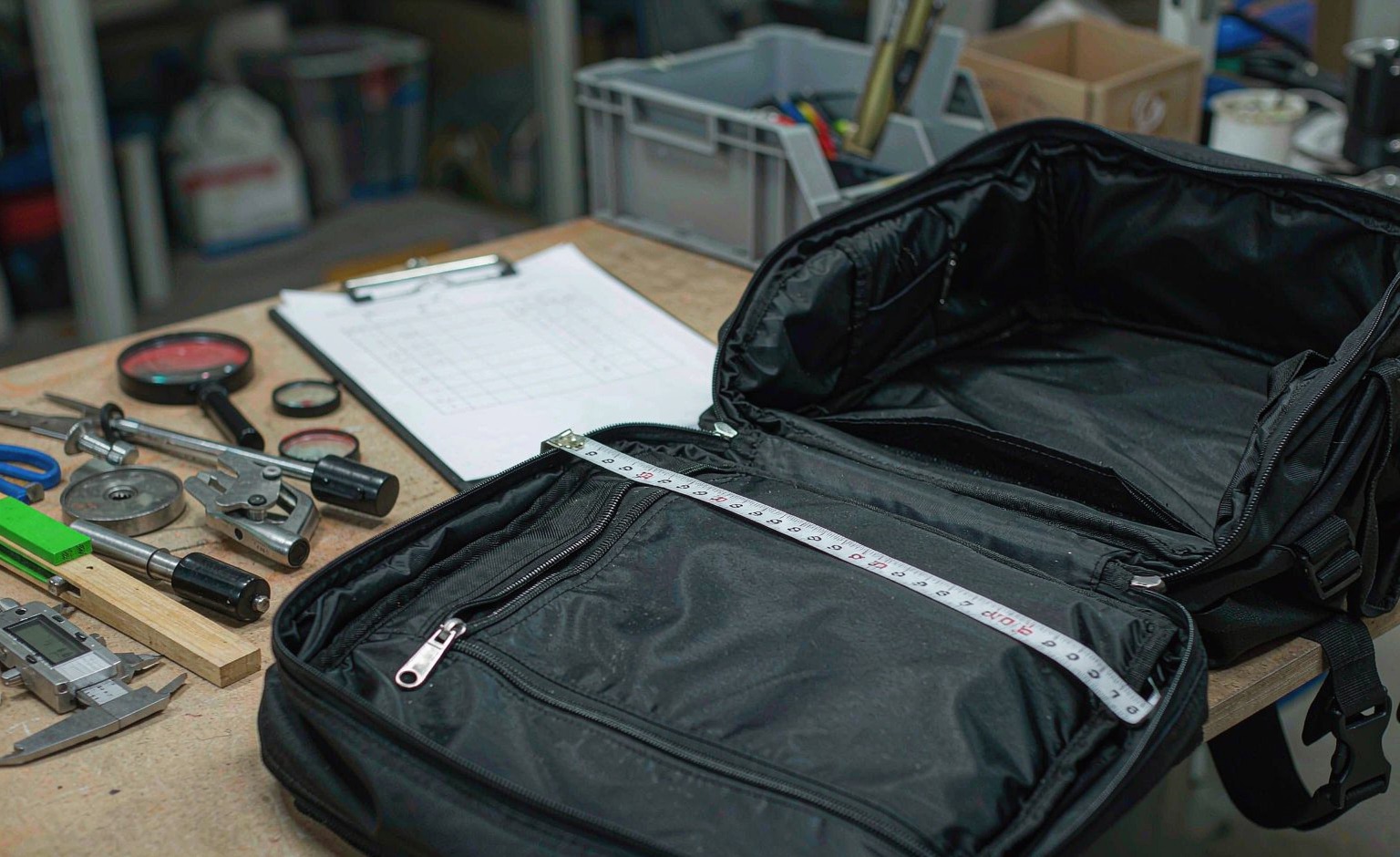
A cosmetic module inside a modular platform is the cheapest unit in the range and the one that most often decides whether the customer buys a second module, because it is the part handled every day. It is also the part most likely to fail in a way the customer notices: a leaked liner, a closure that catches, a seam that holds odour. This guide covers the engineering behind a pouch module that lives inside a larger carrier — liner selection and leak-path design, closure geometry for a pouch accessed inside another bag, attachment that does not rattle, cleaning and odour behaviour over a service life, and branding on a small surface. It also lays out the full test routines that any pouch needs beyond the standard shell work, the inspection classes that keep returns down, and the range logic that makes the smallest part of a catalogue worth developing properly.
Why the smallest module carries outsized weight
In a modular range the pouch module is the entry point. It is the lowest-priced item, it is the one a customer adds to an existing carrier, and it is the item most likely to be bought twice — once for travel and once for the gym bag. That makes it commercially disproportionate to its unit price.
It is also the item with the shortest feedback loop. A chassis is judged over months; a pouch is judged within a week, in the hand, several times a day. Anything that is annoying about it — a stiff slider, a liner that will not wipe clean, an attachment that clacks against the shell — is noticed immediately and attributed to the whole system rather than to one component.
From a range-planning view, the module is the cheapest way to extend a platform. One chassis plus four pouch variants gives four SKUs without four sets of tooling, and the pouch variants can carry different price points through liner and hardware choices rather than through structural change. That is the commercial argument for investing engineering attention in the least expensive part of the catalogue.
The engineering constraint is that the module is designed to live inside another product. It is not a stand-alone item with its own base and its own structure; it borrows structure from the carrier, and every design decision has to be made with that dependency in mind.
Selection rule: Decide the smallest module's attachment interface before the carrier is released at MOQ 500, because failure rates there run highest per unit sold and every complaint lands on the platform rather than on the pouch.
Defining what the module holds and what it protects
Start with contents, because contents drive every subsequent decision. A module carrying liquids and creams needs a welded or high-frequency-bonded liner and a leak path; a module carrying brushes and palettes needs abrasion resistance and structure; a module carrying electrical items — a shaver, a toothbrush, a trimmer — needs cable management and some crush protection.
The discipline is to name the worst-case content rather than the average one. A pouch designed around a toothbrush will be destroyed by a bottle of cleanser that leaks in transit, and the review will not mention the cleanser. Design for the leak, because the leak is what generates the return.
Protection runs both ways. The module protects the carrier from its contents, and — where the module carries hard or sharp items — it protects the contents from being crushed. A brush handle snapped inside a packed suitcase is a module-design failure, not a packing failure, and the remedy is usually a structured panel or a sleeve rather than more padding.
Volume should be stated as a usable figure with the closure open. A pouch whose stated litreage includes the space occupied by a rolled closure is misleading, and on a small item the discrepancy is proportionally larger than on a chassis.
Weight matters more than expected on a part that hangs off a harness. A pouch loaded with liquids and glass containers is dense, and mass mounted away from the spine is felt even when the total is modest. Where the module is designed to hang externally, state a loaded-mass limit and keep the empty weight as low as the liner will allow, because the two together decide whether the assembly feels balanced.
Takeaway: Write down what the module carries, what the contents need protection from and what the liner must survive leaking, then let those three answers set liner gauge, seam route and closure type before the 6-10 working days prototype round begins.
Liner chemistry and leak-path engineering
Liner choice is the single most important material decision on a pouch module, and it is where programmes most often under-specify. Three failure modes dominate: seam leakage, coating breakdown, and odour retention.
Seam leakage is a construction question. A sewn liner leaks through the needle holes regardless of how water-resistant the fabric is, so a liner intended to contain liquids needs welded or bonded seams, or a sewn seam that is subsequently sealed. Where cost rules out welded construction, the honest alternative is a drop-in liner with a roll closure rather than a claim of leak resistance.
Coating breakdown is a chemistry question. TPU laminates resist hydrolysis better than standard PU coatings and clean more easily, which matters for a part that will be wiped repeatedly with whatever the user has to hand. Confirm the coating against ASTM D751 for adhesion and against a hydrolysis ageing screen where the destination climate is hot or humid.
| Liner construction | Seam behaviour | Cleanability | Odour risk over service life |
|---|---|---|---|
| TPU laminate, welded seams | Contains liquids reliably | Wipes clean, resists staining | Low |
| PU-coated nylon, sewn | Leaks at needle holes | Wipes adequately when new | Moderate; coating may break down |
| PEVA or PVC film | Weldable, cost-effective | Clean but may stiffen in cold | Moderate; check substance compliance |
| Uncoated ripstop with a drop-in liner | Relies on the inner liner | Liner is removable and washable | Lowest, because it can be washed |
Odour retention is the failure that ends a product's life in the customer's mind even when it is functionally fine. It comes from liquids absorbed into foam, interlining or seam allowance, and the control is to keep absorbent materials out of the wetted zone entirely. Where a module must have structure, use a closed-cell material adjacent to the liner rather than an open-cell foam.
Substance compliance applies to the liner as much as to the shell. PVC and some coated constructions raise questions under REACH (EC 1907/2006) and California Prop 65, and a welded liner in contact with skin-adjacent articles should be considered under OEKO-TEX Standard 100 where the programme claims it.
Liner chemistry belongs under OEKO-TEX Standard 100 wherever skin contact is claimed, and substance declarations attached to the coating must read against REACH (EC 1907/2006) restrictions rather than against a supplier summary.
Closure and opening geometry for a pouch inside a bag
A pouch that opens beautifully on a table may be unusable inside a packed carrier, because the opening has to work one-handed, in a confined space, often while the user cannot see it. That is a different design problem from a stand-alone wash bag.
Opening geometry is the first decision. A clamshell opening that lays flat is easiest to use when the module is removed from the carrier and hardest when it is inside one; a top-opening design with a wide mouth is the reverse. Decide which context dominates — for a module designed to stay mounted, a wide top opening with a stiffened mouth usually serves better than a full clamshell.
The closure hardware is the second. A slider that runs smoothly under one hand, with a pull large enough to find without looking, matters more than the number of pockets. Where a programme wants a premium feel, a moulded pull with a defined shape is a cheap upgrade with a disproportionate perception benefit.
Mouth stiffening is the third and the most commonly omitted. A pouch whose mouth collapses when opened is annoying every single time, and a simple stiffener in the binding — or a slightly heavier denier at the mouth — fixes it for very little cost. Test it by opening the module one-handed while it is mounted inside a packed carrier, which is the condition the customer will experience.
Verdict: Prove one-handed opening with the pouch mounted inside a packed carrier, since a closure that works on a table but not in a bag generates reviews no service script can answer once 35-50 days of bulk has shipped.
Attachment: how the module meets the platform
Attachment on a pouch module has two jobs: hold the module in place, and stop it from making noise. Both are measurable and both are frequently ignored until the first review mentions rattling.
The interface should match the refit frequency. A module removed daily justifies a quick-attach set; a module that changes weekly is well served by a simple webbing or hook arrangement, and the cost saving is real across a range. Where the module is sold to fit an existing platform, compatibility is a promise: build to the same dimensional rules the chassis uses, and verify with a gauge rather than by eye.
Rattle comes from slack. A module hung on a single point swings; a module attached at two points, or at one point plus a stabilising tab, does not. On a small pouch the fix is usually a second anchor rather than a stiffer interface, and it costs a few cents.
| Attachment method | Refit speed | Rattle risk | Unit cost effect |
|---|---|---|---|
| Woven webbing field | Slow, deliberate | Lowest when fully woven | Low |
| Hook-and-loop tab | Fast | Low with a second stabilising point | Low |
| Magnetic quick-attach | Fastest | Moderate; needs a second anchor | High |
| Clip and loop | Moderate | Moderate; hardware can clack | Medium |
| Drop-in pocket, no hardware | Instant | None | Lowest |
The last row deserves a mention: not every module needs an interface at all. If a pouch lives in a dedicated sleeve inside the carrier, integrating it saves the hardware cost entirely, and the honest range plan says so rather than adding an attachment for the sake of the system story.
Cleaning, odour and service life
A pouch module will be wiped, and occasionally washed, by users who will not read a care label. Design for the behaviour, not for the instruction.
Wipe-clean surfaces come first: a smooth liner with no exposed seam allowance in the wetted zone, a mouth that does not trap residue, and no fabric loops or elastic in the bottom of the pouch where product collects. Every internal divider is a place for residue to accumulate, and each one should be justified by a content type rather than added for appearance.
Washability, where claimed, has to be tested. ISO 6330 covers domestic washing and drying, and colourfastness to washing should be assessed alongside it; AATCC 8 covers crocking. A module that survives five washes with its shape and coating intact supports a care claim; one that delaminates after two should not carry one.
Odour is the end-of-life signal. It develops when product is absorbed into materials that cannot be cleaned, and it is why closed-cell structure and welded liners are worth their cost in this specific application. Where a programme wants a longevity claim, run an accelerated soiling and cleaning cycle and inspect for residue and smell rather than relying on a material datasheet.
Bottom line: Validate cleaning with realistic soiling and a stated number of cycles rather than with a datasheet, and publish the replacement threshold before the first MOQ 500 batch is invoiced.
Branding and retail presentation of a small module
A small module is handled constantly, which makes the branding surface both valuable and exposed. A mark on a pouch is seen more often per day than a mark on a chassis, and it wears faster.
Method selection follows the substrate. Heat transfer and screen print work on smooth coated surfaces and should be tested for adhesion after abrasion and cleaning; embroidery suits textured shells but adds stiffness to a small part; a woven label or a debossed patch is the most durable option on a part this size and costs little. Confirm adhesion under AATCC 8 crocking and, where a care claim exists, after ISO 6330 washing.
Placement should follow the grip. A mark placed where the hand naturally closes over the pouch will be worn away within weeks; placed on the face that presents outward when mounted, it survives. Check the placement with the module mounted in the carrier rather than lying flat, because the visible face changes.
Size of the mark matters on a small part. A logo that fills the face of a pouch looks strong in a photograph and overwhelming in the hand, and the customer who carries it daily is the one who writes the review. A mark occupying a modest proportion of the face, placed away from the grip zone, reads as considered rather than as promotional.
Retail packaging for a module is often overlooked and it matters disproportionately online, where the product photograph is the entire sales interaction. A simple hangtag with the compatibility statement — which platforms the module fits — prevents the most common pre-purchase question and reduces returns from mismatched expectation.
Range planning: where the module sits in a catalogue
A pouch module is only profitable as part of a planned range. Sold alone it is a low-value accessory with the same development overhead as a product three times its price; sold as the second, third and fourth purchase on an existing chassis, it carries a disproportionate margin.
The planning question is how many variants to offer. Three is usually right: a compact module for daily carry, a larger module for travel, and a specialist variant — a wet or lined version is the most common — that addresses a specific content type. A fourth variant rarely earns its tooling and listing cost, and a catalogue with eight pouches confuses the customer without adding much revenue.
Price architecture follows function rather than size. A welded-liner wet module can carry a higher price than a larger unlined organiser, because the customer understands the benefit. Where a programme prices purely by volume, it leaves margin on the table and under-sells the engineered variants.
| Variant | Content it serves | Construction emphasis | Price logic |
|---|---|---|---|
| Compact daily | Small items, brushes, daily cosmetics | Light shell, simple closure | Entry price, impulse add-on |
| Travel | Full kit for a trip | Structured mouth, internal organisation | Mid price, highest volume |
| Wet or lined | Liquids, creams, damp items | Welded liner, leak path | Highest price, benefit is visible |
| Tool or tech | Cables, chargers, small devices | Cable loops, crush protection | Mid price, cross-sells to a work chassis |
Compatibility has to be stated publicly. A customer buying a module for an existing carrier needs to know which platforms it fits, and that statement should be on the product page and the hangtag rather than buried in a specification. Where the module fits a PALS field, say so and hold the dimensional rules; where it fits a dedicated sleeve, name the chassis.
Finally, plan the replacement cycle. Modules are lost, worn and re-bought more often than chassis, and a programme that keeps a module in production for the life of the platform earns repeat revenue that a chassis-only range never sees. That argument is what justifies developing the smallest part properly.
Related module and platform guides are collected in the blog index.
Testing, inspection and the commercial frame
Test routines for a pouch module differ from a chassis in emphasis rather than in kind. The specific additions are leak behaviour, closure cycling and odour.
Leak testing is simple and should be mandatory where a claim is made: fill the module with a stated volume of water, lay it on a defined surface for a defined period, and inspect. Closure cycling is equally cheap — open and close the slider a defined number of times under a representative load and check for deformation and smoothness. Both produce pass/fail evidence that a retailer understands.
On materials, screen abrasion with ASTM D3884, confirm the laminate bond under ASTM D751 and assess water resistance to AATCC 127. Crocking goes to AATCC 8 and laundering to ISO 6330, and a welded liner earns a leak test at a stated volume before any claim is printed. Where the module carries metal parts, EN 1811 covers nickel release.
Inspection should treat the liner and closure as critical points. Sample to ISO 2859-1 and take majors at AQL 2.5, with a welded-seam fault and a slider malfunction written in as majors rather than appearance faults, since both produce immediate returns. Order terms start at 500 units per colourway. A sample comes back in 6–10 working days, or 12–15 working days where a welded liner or a moulded pull is specified, and the assembly block runs 35–50 days from approval. Settlement is T/T 30/70 with prices quoted FOB Xiamen; delivery takes 25–35 days by sea, 5–8 days by air and 3–5 days by express.
For range context, the module logic on modular travel backpack platforms shows how one chassis supports several pouch variants without re-engineering the attachment each time, which is what keeps the module programme profitable.
Judgement: Clear each module run at AQL 2.5 against written defect definitions, and ship FOB Xiamen only once the liner certificate and the lot number on the carton agree.
Frequently asked questions
Why invest engineering effort in the cheapest module?
It is the entry purchase and the item handled most often, and it decides whether the customer buys a second module. Its failures are attributed to the whole system rather than to one pouch, so a returned liner costs more reputation than its price suggests.
What liner should a cosmetic module use?
A TPU laminate with welded seams contains liquids and wipes clean. A sewn PU-coated liner leaks at the needle holes; if welded construction is out of budget, specify a removable drop-in liner instead and say so plainly. Say so plainly rather than implying leak resistance.
How do you stop a pouch module absorbing odour?
Keep absorbent materials out of the wetted zone entirely. Use closed-cell structure next to the liner, avoid open-cell foam, and minimise internal dividers where residue collects, because odour is the signal that ends a product's life. Odour is what ends a product's life in the customer's mind.
Should the module open clamshell or top-open?
For a module that stays mounted inside a carrier, a wide top opening with a stiffened mouth works better one-handed. A clamshell suits a module the user removes and lays flat on a surface. A clamshell suits a module laid flat on a surface.
How do you stop a mounted module rattling?
Attack slack rather than stiffness. A second anchor point or a stabilising tab removes swing on a small pouch, while a single-point mount with a premium interface still clacks against the shell with every step. A premium interface still clacks where there is slack.
Does every module need a hardware interface?
No. A pouch that lives in a dedicated sleeve needs no attachment, and dropping the hardware saves real money across a range. Say so in the range plan rather than adding an interface for the system story. Add an interface only where refit frequency justifies it.
Which tests are specific to a pouch module?
Leak testing at a stated volume and duration, closure cycling under load, and a soiling and cleaning cycle for odour. Add abrasion, coating bond and colourfastness work on the shell as usual. Run a shower test on the assembled carrier too.
How should branding be applied to a small module?
A woven label or a debossed patch lasts longest on a part handled daily. Place the mark on the face that presents outward when mounted, keep it modest in size, and test adhesion after abrasion and cleaning. Keep the mark modest in size on a handled part.
What is the minimum order for a module programme?
A 500-unit floor applies per colourway. Allow 6–10 working days for a sample, or 12–15 working days with a welded liner or moulded pull, then 35–50 days for the assembly block. Welded liners and moulded pulls drive the longer window.
How should pouch defects be classified at inspection?
Sample to ISO 2859-1 and take majors at AQL 2.5, writing welded-seam faults and slider malfunctions in as majors rather than appearance issues, because both produce immediate returns. Both faults produce immediate returns. Closure cycling should run under a representative load.
What substance rules apply to a welded liner?
REACH documentation and a Prop 65 assessment apply to the material, and OEKO-TEX evidence is worth holding where the programme claims it. PVC and some coated films need specific substance checks before specification. Check PVC and coated films before specification.
What are the standard commercial terms?
Settlement is T/T 30/70 with prices quoted FOB Xiamen. Delivery takes 25–35 days by sea, 5–8 days by air and 3–5 days by express for approval pieces, and figures stay indicative until inputs are confirmed.