Home › Field notes › Custom Modular Bags for Tactical and Civilian Field Use: Spec Guide
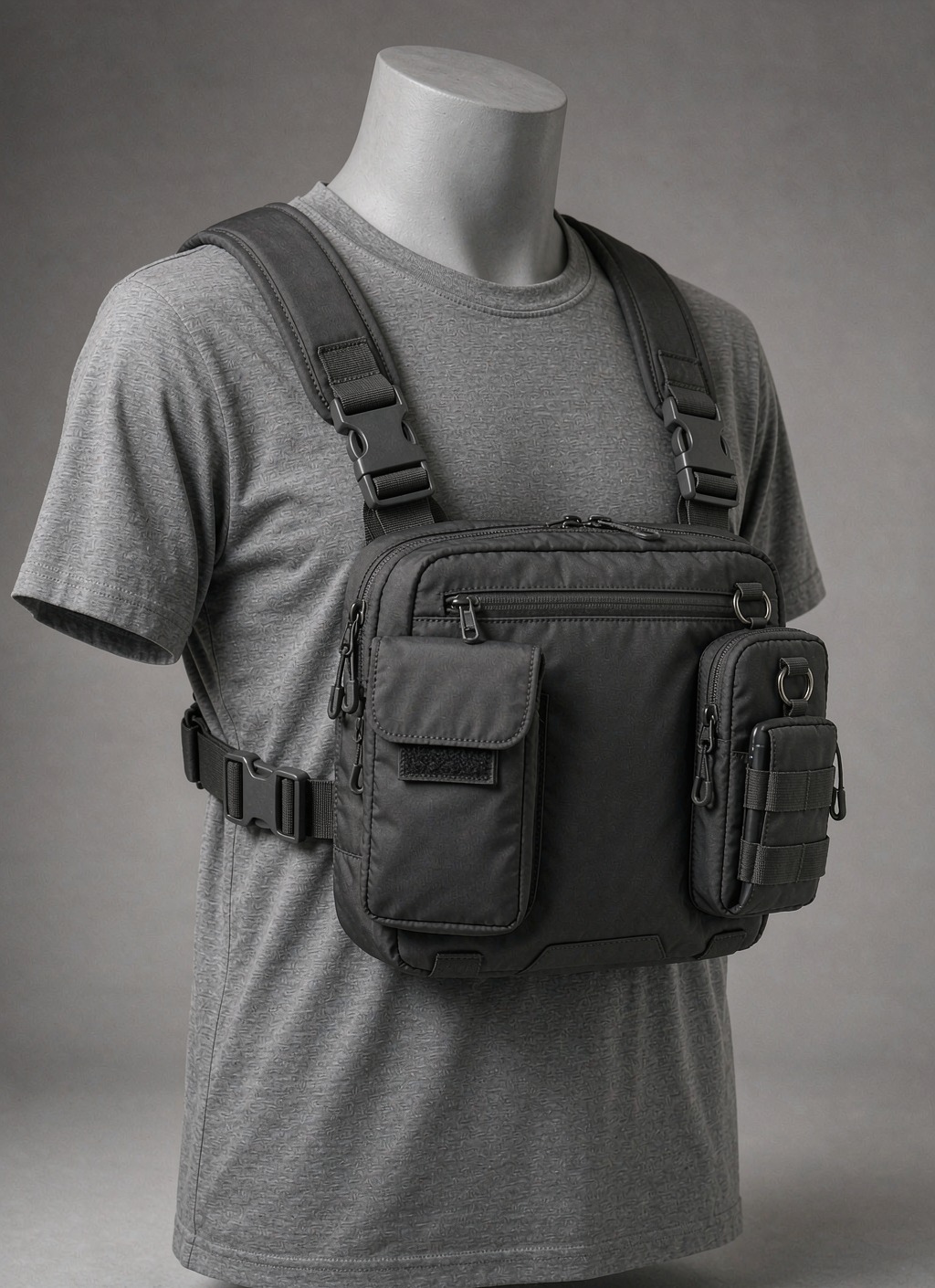
A custom tactical backpack for civilian field use is specified against the load, not against the image. The load here is lawful and civilian throughout: hand tools and test instruments, first aid kits, outdoor and hiking equipment, organised storage for sporting and training kit, and inspection gear carried by field crews. This guide does not address weapon carriage, ammunition storage, ballistic protection, or body armour, and it makes no claim of approval, certification, or endorsement by any defence, military, or government body. Within that civilian boundary, the engineering is demanding: woven attachment geometry with 38 mm between rows on 25 mm straps and a 50 mm column repeat, plus reinforcement sized to the actual load path, and claims limited to whatever test evidence actually supports. The sections below move from scope and duty profiles through geometry, reinforcement, discretion, ageing, claim discipline, acceptance testing, and finally the ordering and lifecycle notes that keep a deployed fleet coherent across several years.
Scope and the civilian boundary
Clarity about scope prevents the two problems that damage programmes in this category. The first is a specification written so loosely that a reviewer cannot tell what the product is for. The second is a marketing claim that implies a capability the product does not have. Both are avoided by stating the boundary in the specification itself.
The scope here is civilian load carriage. That includes tool and instrument carriage for trades and field service, first aid and trauma-kit style organisation for civilian responders and outdoor leaders, hiking and expedition equipment, organised storage for lawful sporting and training equipment, and inspection or survey gear. Products in this scope are sold through retail, distribution, and civilian institutional channels.
Explicitly out of scope: weapon carriage and weapon retention, ammunition storage, ballistic or stab protection, body armour, and any claim of military specification, military approval, or government endorsement. No such claim appears in this guide and none should appear on a product page, hangtag, or catalogue entry derived from it. A carrier built for tools and first aid is not a protective system, and presenting it as one creates liability rather than sales.
Where a buyer's tender genuinely requires a defence specification, that is a different product category with different qualification evidence, and it should be handled as such rather than being mapped onto a commercial modular platform. Everything below assumes the civilian scope described above.
Spec rule: Keep the written scope civilian from the first line of the brief and list load carriage only, because one stray certification claim contaminates the AQL 2.5 acceptance language that follows.
Civilian duty profiles and what each one demands
Duty profile is the input that decides every downstream choice. A bag carried in a workshop and set down on a bench has a different abrasion and contamination profile from one worn on a hillside for eight hours. Writing the profile in one sentence at specification stage prevents the most common failure in this category, which is a product engineered for an image and sold into a harder duty than it was built for.
| Load profile | Typical contents | Construction response | Acceptance check |
|---|---|---|---|
| Trade and field service | Hand tools, meters, fasteners | Dense reinforcement, wipe-clean lining | ASTM D5034 tensile, anchor pull test |
| First aid organisation | Dressings, gloves, shears | Colour-coded modules, labelled access | Module swap cycle, label legibility |
| Hiking and expedition | Water, layers, navigation kit | Harness load distribution, low-noise hardware | Load comfort trial, UV ageing |
| Sporting and training kit | Eye and ear protection, accessories | Structured pouches, abrasion-resistant base | ASTM D3884 abrasion, seam check |
| Survey and inspection | Tablet, forms, measuring tools | Rigid sleeve, document protection | AATCC 127 water resistance |
Two of these profiles deserve extra attention because they are frequently mis-specified. First aid organisation is often treated as a colour problem when it is really an access problem: the requirement is that a user can identify and extract a specific item under stress, which is solved by labelling, colour coding, and consistent internal layout rather than by a red pouch alone. Survey and inspection is often treated as a general-purpose bag when the real requirement is protecting a fragile screen and flat documents, which needs a rigid sleeve and a flat document pocket.
Takeaway: Match duty profile to environment before selecting materials, since coastal or salt-air work punishes hardware harshly and that lesson lands long after 35-50 days of bulk has been booked.
The woven attachment field: geometry, tolerance and threading
A woven attachment field is a dimensional system before it is a styling device. Three numbers control it: strap width of 25 mm, 38 mm between rows, and a 50 mm gap between columns. None of them is arbitrary. Strap width sets what can thread through, the gap between rows sets how many a pouch strap can weave through, and the column gap sets where the next strap lands. Change any one of the three and third-party compatibility is lost.
| Dimension | Nominal | Working tolerance | Defect when exceeded |
|---|---|---|---|
| Webbing width | 25 mm | ±0.5 mm | Strap binds or sits loose in the row |
| Vertical row spacing | 38 mm | ±1 mm accumulated per 10 rows | Pouch will not complete the weave |
| Horizontal repeat | 50 mm | ±1 mm | Column misalignment across panels |
| Row attachment stitch | Bar-tack at each column | No skipped tacks | Row lifts under load |
| Panel backing | One fabric layer plus stiffener | Stiffener full panel width | Field sags, pouch swings |
The tolerance that matters most is accumulated error, not individual error. A row that is one millimetre out is invisible; ten rows each one millimetre out block threading completely. This is why the field is verified with a gauge at the webbing station during production rather than measured on a finished sample, and why a jig is the correct investment for any programme exceeding a few hundred units.
Backing stiffness is the second most commonly missed requirement. A field sewn through a single fabric layer deforms under load, and a deformed field lets a mounted pouch rotate, which feels like a retention failure even when the hardware is sound. A full-width stiffener behind the panel costs little and removes a whole class of complaint. Our production team treats stiffener coverage as a specification line rather than as a construction note.
Keep the woven field measurable rather than asserted: webbing and tape strength referenced to ASTM D5034, finished weather performance to AATCC 127, and both reported for the same fabric before and after coating.
Load path and reinforcement at each anchor
Every anchor on a carrier has a load path, and the path terminates somewhere. The engineering question is whether the termination is strong enough to carry the load the anchor can generate. If the fabric tears before the hardware releases, the hardware rating is meaningless, and the buyer has paid for capability that cannot be reached.
The practical method is a load class per anchor. Light class covers modules under roughly half a kilogram, typically flat organisers and document pouches. Medium class covers tool and utility modules that see repeated access. Heavy class covers anything dense or anything that swings, including water bottles and tool rolls. Each class gets a defined reinforcement build-up: patch area, stiffener, bar-tack count, and thread specification.
Placement then interacts with load direction. An anchor loaded in shear behaves close to its rating; the same anchor loaded in peel drops substantially. A module mounted low on the side of a carrier is loaded in peel whenever the user lifts it by one corner, which is exactly what users do. The correction is either to move the module to a position where gravity assists seating, or to increase the backing area so the load spreads rather than concentrates.
Reinforcement must also be compatible with the substrate. A stiff patch on a soft fabric creates a stress concentration at the patch edge, and the failure then occurs just outside the reinforcement rather than through it. Tapered or graduated build-ups avoid that transition and are the difference between a reinforcement that helps and one that relocates the failure.
Verdict: Spread reinforcement across the full width of the 25 mm rows rather than alongside them, because additional stitches relocate a tear instead of preventing one.
Discretion versus identification
Products in this visual category face a genuine tension. Field users often want low visual signature for a carrier that will be worn in public; institutional buyers often want clear identification so a bag can be issued, inventoried, and recognised at a distance. These are opposing requirements and a single configuration serves both poorly.
The modular structure resolves the tension better than any monolithic design, because identification can be made detachable. A low-signature carrier can carry a removable identification panel, a hook-backed label, or a colour-coded module that is applied only when the duty requires it. The user changes the signature rather than the bag, and the institution keeps its asset visibility.
Colour choice should be driven by duty rather than by trend. Neutral tones hide abrasion and contamination between washes, which extends perceived service life. High-visibility accents have a genuine safety function for roadside and trail work and should be placed where they remain visible when a module is mounted, not where a pouch covers them.
Hardware noise is a specification line that buyers rarely write and users always notice. Uncovered metal hardware on a hiking or training carrier produces audible contact during movement, and it is one of the most frequently cited irritations in field feedback. Coated pullers, covered buckles, and silent magnetic-mechanical closures address it directly. Where silence matters, state it as a requirement rather than hoping for it.
Substrate, colour and ageing behaviour
Face fabric selection in this category balances abrasion, weight, and ageing. Abrasion is screened under ISO 12947 or ASTM D3884, tensile and tear behaviour under ASTM D5034, and water resistance under AATCC 127 or ASTM D751. Those four cover most of what a field carrier will encounter, and they are inexpensive relative to the disputes they prevent.
Coating is where ageing problems originate. A polyurethane coating can hydrolyse in hot, humid storage, producing a tacky surface and eventual delamination from the base fabric. The specification should name the coating chemistry, and the shipping documentation should state a maximum storage temperature. A carrier that fails in a container or in a warehouse never reaches the field, and the failure is usually blamed on the sewing rather than on storage.
UV exposure matters for any carrier used outdoors for extended periods. Webbing fuzzes and loses strength, printed labels fade, and dyed fabric shifts. Naming an end-of-life signal converts this from a vague complaint into an inspectable condition: webbing fuzz across a defined length, or visible colour shift against a retained reference swatch.
Matching colour across a modular range is harder than expected, since the carrier run and the pouch run are usually scheduled weeks away from each other. The control is a retained reference swatch cut from the carrier run, with later pouch runs matched to it under a defined light source instead of to a fresh lab dip. Our SGS-verified production base stores those references with the same revision control applied to interface drawings.
Compliance and claim discipline
Compliance in this category is ordinary consumer-product compliance, and it should be treated as such. Substance limits come from REACH (EC 1907/2006) for the European Union and from Prop 65 at California state level. CPSIA covers regulated categories sold into the United States, metal parts are screened for nickel release to EN 1811, and fabrics are certified to OEKO-TEX Standard 100. None of these is exotic, and every one of them is scope-sensitive.
Claim discipline is the more important discipline. The category attracts superlatives, and superlatives create exposure. A carrier should not be described as military-grade, military-approved, ballistic, armour-capable, or weapon-compatible. Every one of those is either false for a commercial modular carrier or implies a qualification process that has not been performed. The accurate claims are about materials, construction, and test results: abrasion cycles survived, water resistance achieved, anchor pull figures measured.
Test references should be used precisely. MIL-STD-810 is a broad environmental test method and citing it without stating which method, which parameters, and which result is meaningless; MIL-STD-105 is a historical sampling standard now superseded in practice by ISO 2859-1. If a buyer wants environmental testing, name the method and the acceptance criterion. If a buyer wants sampling discipline, cite ISO 2859-1 and AQL 2.5.
Retail and marketplace channels increasingly review claims before listing. A product page with an unsupported capability claim is a delisting risk, and the cost of removing a claim after launch is higher than the cost of never making it. Write claims from test reports, and keep the reports on file against the material lot they cover.
Bottom line: Derive every performance claim from a test report tied to a material lot, deleting language no document supports well before units reach acceptance rather than after listing copy publishes.
Verification, acceptance and release
Acceptance should be planned backwards from the failure modes rather than forwards from a standard list. The failure modes in this category are row drift that blocks threading, anchor pull-out through an under-reinforced face, peel loading from poor placement, colour drift between carrier and modules, and coating degradation in storage. Each has a verification method and each should have a numeric acceptance criterion before production starts.
| Verification item | Method | Criterion | When it is checked |
|---|---|---|---|
| Row pitch | Gauge at webbing station | Within tolerance across 10 rows | In-line, first and every fiftieth unit |
| Anchor retention | Pull test in declared load direction | No face tear below rated figure | Sampling and in-line |
| Abrasion life | ISO 12947 or ASTM D3884 | Agreed cycle count without base exposure | Material qualification |
| Water resistance | AATCC 127 or ASTM D751 | Agreed hydrostatic figure | Material qualification |
| Colour consistency | Reference swatch under defined light | No visible shift against retained swatch | Each production run |
| Final release | ISO 2859-1 sampling | AQL 2.5, critical defects zero | Pre-shipment |
One procedural point prevents most disputes: settle the defect classification before production begins, not once the inspection report is in hand. Anything rendering the carrier unusable or unsafe counts as critical, a failed load path among them. Major applies where a shopper would refuse the item, blocked threading being the clearest example. Minor is finish variation inside a band agreed in advance.
Transit protection closes the loop. Cartons should be validated to ISTA 3A drop and compression sequences, particularly for shipments that will be cross-docked or delivered to a site rather than to a retail distribution centre.
Judgement: Release each lot against written acceptance numbers, keeping the AQL 2.5 plan, the retained reference unit and the lot record together in a single folder.
Programme notes: ordering, timing and lifecycle
Order terms for a civilian field programme are simple. Five hundred units is the design minimum. Sample turnaround is 6–10 working days, moving out to 12–15 when bonded seams, cast hardware, or an untested anchor layout are involved; the USD 50–150 sample charge is credited back against the order, and tooling sits between USD 300 and 2,500. The volume build then occupies 35–50 days and ships on an ISO 2859-1 inspection at AQL 2.5.
Money moves 30 percent at material release and 70 percent once inspection clears, on prices quoted FOB Xiamen. Shipping takes 25–35 days by sea for planned replenishment, 5–8 days by air when a launch date is already public, and 3–5 days by courier for samples and small top-up batches. Seasonal ranges need capacity booked early: monthly output is planned at 200,000 units, and each programme is held on one dedicated line because repeat operators keep tolerances tighter.
Lifecycle planning is where modular design returns its cost. Modules wear faster than carriers, so the range should be specified so a worn pouch can be replaced without retiring the platform. That requires the interface to stay under revision control and requires any new module to declare the revision it was built against. A fleet with three interface revisions is three fleets, regardless of what the part numbers say.
The most useful thing a buyer can do at the start is write the duty profile in one sentence and the boundary statement in another. Those two sentences decide fabric, reinforcement, hardware, claims, and verification, and they prevent the two failures that cost the most in this category: a product sold into duty it was not built for, and a claim made that the product cannot support. Platform options for this scope are shown under tactical backpack platforms and MOLLE attachment systems.
Two further clauses are worth including in the specification. The first states the intended duty in one sentence, which anchors every downstream decision about fabric, reinforcement, and hardware. The second states the boundary explicitly, which protects the buyer, the seller, and the retail channel from claims the product cannot support. Together they take two lines to write and remove the largest single source of disputes in this product category.
Frequently asked questions
Does this guide cover weapon or ammunition carriage?
No. The scope is lawful civilian load carriage: hand tools, first aid organisation, outdoor and hiking equipment, organised sporting and training kit, and inspection gear. Weapon carriage, ammunition storage, ballistic protection, and body armour are out of scope.
Are any military approvals or certifications claimed?
None. No claim of military specification, military approval, government endorsement, or defence qualification appears here or should appear on a product page. Accurate claims concern materials, construction, and measured test results only.
What dimensions control whether third-party pouches fit the field?
Strap width of 25 mm, 38 mm between rows, and a 50 mm column gap. Accumulated drift matters more than individual error: ten rows each one millimetre out will block threading even though each row passes inspection individually.
Why does a panel need a stiffener behind the attachment field?
Without full-width stiffening the field deforms under load and a mounted pouch rotates, which reads as a retention failure even when the hardware is sound. Stiffener coverage should be a specification line, not a construction note.
How should reinforcement be sized for different modules?
Assign each anchor a load class: light below roughly half a kilogram, medium for tool and utility modules, heavy for dense or swinging items. Each class gets a defined patch area, bar-tack count, and thread specification.
Why does an anchor fail below its rated pull figure?
Peel loading instead of shear is the usual cause, followed by the face fabric tearing before the hardware lets go. Both trace back to position and backing rather than to the component rating, and both are corrected with geometry rather than with a stronger part.
How is colour consistency maintained between carrier and modules?
Hold a retained reference swatch from the carrier run and match module runs against it under a defined light source. Matching against a fresh lab dip is the usual cause of visible drift between components produced weeks apart.
What causes a coating to become tacky in storage?
Hydrolysis, accelerated by heat and humidity. Name the coating chemistry in the specification and state a maximum storage temperature in the shipping documentation, since the failure is usually blamed on construction rather than on storage.
Which test references are appropriate to cite?
ISO 12947 or ASTM D3884 for abrasion, ASTM D5034 for tensile, AATCC 127 or ASTM D751 for water resistance, EN 1811 for nickel release, and ISO 2859-1 with AQL 2.5 for sampling. Cite a method only with its parameters and result.
What is the minimum order quantity and sampling window?
Five hundred units per design. Sample turnaround is 6–10 working days, moving to 12–15 where bonded seams, cast hardware, or an untested anchor layout are involved, and the USD 50–150 charge is credited against the order.
What are the production and transit timelines?
The volume build takes 35–50 days and ships on an AQL 2.5 inspection. Transit then runs 25–35 days by sea, 5–8 by air, or 3–5 by courier, chosen by whether the goods are replenishment, a launch, or samples.
Can hardware noise be specified as a requirement?
Yes. Uncovered metal hardware produces audible contact during movement and is a frequent field complaint. Specify coated pullers, covered buckles, or silent magnetic-mechanical closures and verify the result in a wear trial.
How can a carrier be low-signature yet still identifiable?
Make identification detachable: a removable panel, a hook-backed label, or a colour-coded module applied only when duty requires it. The user changes the signature instead of the bag, and the institution keeps asset visibility.
What payment terms and Incoterm apply?
Thirty percent moves at material release and seventy percent once the inspection report clears, on prices quoted FOB Xiamen. Freight, insurance, and destination charges are then the buyer's to carry.