Home › Field notes › External vs Internal Modular Design: Pros, Cons and Selection Rules
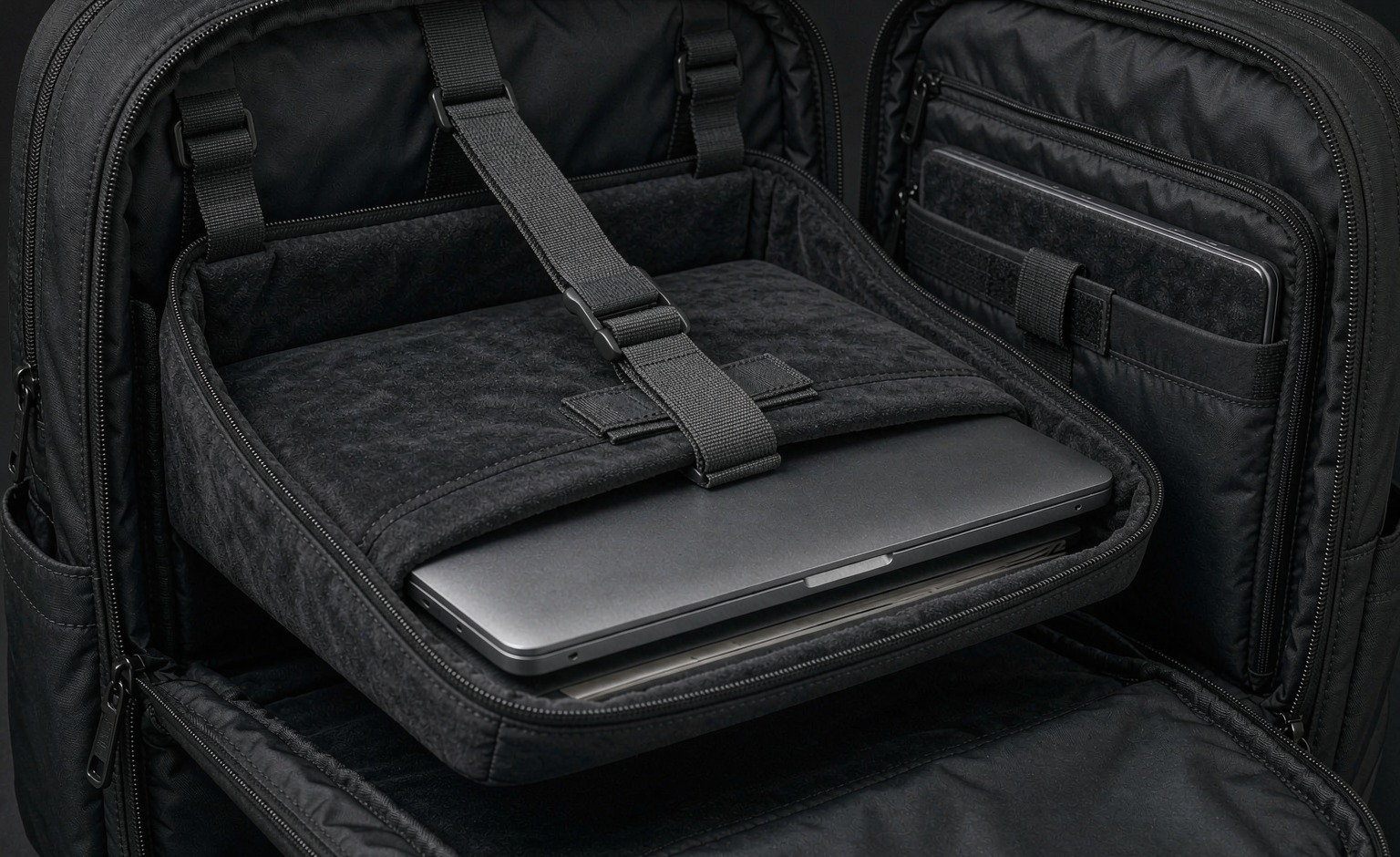
External modular design wins on access speed and on the ability to reconfigure in the field; internal modular design wins on protection, silhouette and snag resistance. The choice is not aesthetic, it is a duty-cycle decision: if the user needs an item within two seconds while moving, the interface belongs on the outside; if the item is valuable, fragile or must not catch on anything, it belongs behind a panel. Most commercial programmes end up with both, and the engineering work is deciding which items cross the boundary and paying for the consequences. Nine sections follow: the architectural distinction, reach-tier assignment, protection, silhouette, centre of mass, security, manufacturing cost, programme implications and a selection procedure. Score each one against the product's own duty cycle rather than against the category it sits in. Both scorecards are built to be filled in during a range meeting, not read afterwards. Three tables support the argument, each written to be used rather than skimmed.
The distinction that actually matters: where the interface lives
Both architectures are modular. The difference is what the user touches to reconfigure the system. An external architecture puts the interface on the outside face: rows of webbing, a daisy chain, a mounting plate, a rail. An internal architecture puts it behind a closure: dividers on a lining, a tray in a bay, a rail inside a compartment, a sleeve that accepts an insert.
That single decision propagates. An external interface is exposed to abrasion, weather and snagging, and it is reachable without opening anything. An internal interface is protected, invisible and requires the user to stop, put the bag down and open a closure before anything changes. The first is a system for people who are moving; the second is a system for people who are packing.
The commercial consequence follows too. External modules are visible, which makes them marketable and makes them a spare-part business. Internal modules are invisible, which makes them a specification line and rarely a retail line. Programmes that want an accessory revenue stream are pushed toward external architecture whether or not the duty cycle supports it, and that is where bad products come from.
Selection rule: Put frequently handled items outside and everything needing weather protection inside, because that single split resolves most architecture arguments long before costing starts at MOQ 500.
Access speed and the reach tier model
The most useful way to settle the argument is to sort contents into reach tiers and let the tier decide the architecture. Tier one is anything needed within a couple of seconds, often one-handed, often while moving: a transit pass, a phone, a torch, a water bottle, a small tool. Tier two is needed within about twenty seconds and can wait for the bag to come off one shoulder. Tier three is needed at a destination and can wait for the bag to be put down and opened.
| Reach tier | Time budget | Architecture | Failure when mis-assigned |
|---|---|---|---|
| Tier one, immediate | Under 2 seconds, one hand | External mount, fixed position | User stops walking and hunts |
| Tier two, short | Under 20 seconds, bag on one shoulder | External or outer pocket with internal divider | Contents dumped to find one item |
| Tier three, destination | Bag down and open | Internal tray or insert | No real penalty |
| Rarely used | Packed once per trip | Deep internal, no interface needed | Wasted interface cost |
| Valuable or fragile | Variable | Internal, padded, nearest the back | Impact or theft exposure |
The last row is the one that overrides everything else. Anything expensive, fragile or with a glass face goes inside and close to the wearer's back regardless of how often it is needed, because the cost of a broken screen dwarfs the cost of a slow retrieval. Every other tier is negotiable; that one is not.
Time the retrieval during development rather than arguing about it. Load the system with the specified contents, run the retrieval drill five times with the wearer standing, and record the median. A two-second budget is easy to state and surprisingly hard to meet once gloves, a jacket and a loaded shoulder strap are involved.
Verdict: Assign each carried item to a reach tier defined by gloved access time and stop designing past the third tier, since storage beyond comfortable reach stays empty yet still adds assembly minutes to every unit at MOQ 500.
Protection, weather and abrasion exposure
Anything mounted outside lives in the weather. It takes rain on both faces, it takes UV on the outer face, and it takes abrasion from every surface the user brushes past. That exposure has three costs: the module needs a water-shedding finish, the contents inside it need more protection than the same contents would need one panel inward, and the abrasion rate at the contact points is high enough that facing material choice becomes a design decision rather than a costing one.
Verify the protection with methods rather than adjectives. AATCC 127 gives a hydrostatic figure for the fabric and the seam; ISO 12947 gives abrasion behaviour for the face; ASTM D3884 covers abrasion by the rotary platform method where a coated fabric is involved; ASTM D5034 covers the seam strength that decides whether a loaded external pouch stays attached when it catches on something. Write the numbers into the specification and the product page can then say something defensible.
Internal architecture inverts all of this. Contents sit behind the shell, so the shell takes the weather and the module does not. The cost is condensation and access: a wet item placed inside stays wet, and a dirty item placed inside contaminates everything near it. Programs that move everything inward to solve a weather problem usually discover they have created a cleaning problem instead.
Seam behaviour decides most external weather complaints. A fabric with an excellent hydrostatic figure still leaks through its stitch holes, so an external pouch needs either a sealed seam, a welded construction, or a lining that separates the wet shell from the contents. Decide which at specification stage, because seam sealing is an operation with its own cost, its own inspection step and its own failure mode when it is applied over a contaminated surface.
Drainage is the companion decision. Any external compartment that can take water should be able to release it: a grommet, an open-bottom construction or a mesh panel at the lowest point. Without one, a pouch that survived the rain keeps its contents sitting in the water it collected, and the customer discovers the failure hours after the weather event.
Weather and wear arguments both need named routes: hydrostatic performance quoted to AATCC 127 for exposed panels, and abrasion exposure scored under ASTM D3884 for faces that rub against clothing throughout the day.
Silhouette, snag behaviour and moving through crowds
External architecture changes the outer envelope of the product, and that has consequences beyond measurement. A pouch mounted on the outside increases depth, catches on seat belts, turnstiles, door frames and branches, and telegraphs what the user is carrying. In a crowded transit environment the snag cost is real: users report it as annoyance, and it shows up in reviews long before it shows up in returns.
The mitigations are known and cheap. Keep the external envelope within a stated depth, radius every exposed corner, keep webbing tails short and captured, and avoid protrusions at the height where a seat belt crosses the body. A module that adds 30 mm of depth is usually acceptable; one that adds 60 mm is a different product and should be sold as a different product.
Internal architecture keeps the silhouette clean and predictable, which matters for workplace and travel contexts where a bag has to look unremarkable and fit under a seat. The penalty is bulk migration: contents that used to be outside are now inside competing for the same volume, so internal modularity usually requires more total litres for the same carried load. That is a real cost in a cabin-allowance context, and it is why travel programmes often carry one or two external mounts despite the snag risk.
Centre of mass and what happens when the wearer moves
Weight carried outside the body envelope behaves worse than the same weight carried inside it, because the moment arm is longer. A full pouch mounted on the outer face pulls the pack away from the wearer's back, the shoulder straps take the resulting moment, and the user experiences it as a bag that feels heavier than its scale weight. Moving the same mass one panel inward, closer to the spine, measurably reduces that perception.
The practical rule is to keep dense contents inboard and bulky light contents outboard. A water bottle is large and relatively dense, which makes it the worst possible external item and yet the most commonly mounted one; a compressed jacket is bulky and light, which makes it the best. If a programme must mount something dense externally, mount it low and close to the belt line rather than high on the shoulder area, where the moment arm is longest.
Dynamic behaviour is the second half. External modules move independently, so they introduce sway that internal contents do not. Anything that will be carried while running, cycling or crossing rough ground needs either a second stabilisation point or an internal home. Test it loaded rather than empty, since an empty pouch never sways and a full one always does.
Takeaway: Test external loads while walking rather than standing still, because empty pouches never sway whereas a loaded pouch mounted outward shifts the centre of mass in ways no static review reveals.
Security, noise and user signature
An external module is visible, reachable and, in a crowd, reachable by other people as well. That is the security cost, and it is not solved by a better closure: a closure that the wearer can open in one second is a closure someone else can open in two. Valuables, documents and anything with a regulation attached belong inside, behind a closure, and preferably against the back panel.
Noise is the second, underrated factor. Hardware on an external interface rattles. Metal-on-metal contact, loose webbing ends and semi-rigid pouches tapping against a shell all produce sound that users notice in quiet environments - an office, a lecture room, a shared cabin. Specify soft or captured hardware ends where the product will be used indoors, and require a silent-carry check in the evaluation: wear the loaded pack, walk a corridor, and listen.
Signature is the third. What a bag displays about its owner matters in some contexts and not in others. An external interface announces a modular system, which is desirable for a brand positioning story and undesirable where the user would rather not advertise the contents. Decide which context the product is sold into before choosing how visible the interface is.
A workable compromise exists and is widely used: a covered attachment face. The rows sit under a panel that zips or folds away, so the product reads as clean in a workplace and becomes an interface when the user wants it. The panel costs one operation and a little weight, and it removes the signature problem entirely. Where a range must serve both a professional and an outdoor channel, that single feature usually resolves the architecture argument.
Bottom line: Write required acoustic behaviour into the brief rather than discovering the answer at unboxing, because closures that rattle inside a quiet compartment generate a complaint with every use.
Manufacturing cost and inspection consequences
The two architectures cost money in different places. External architecture spends on hardware, on attachment rows and on the reinforcement behind every anchor. Internal architecture spends on panels, dividers, linings and the labour to assemble them. At low volume, external is usually more expensive per unit because closure hardware carries a minimum; at high volume, internal often overtakes it because assembly labour scales less favourably than purchased parts.
| Constraint | External architecture | Internal architecture | Score it by |
|---|---|---|---|
| Access under 2 seconds | Strong | Weak | Timed retrieval trial |
| Weather exposure | Weak | Strong | AATCC 127 on both |
| Snag in crowds | Weak | Strong | Envelope depth and corner radius |
| Spare-part revenue | Strong | Weak | Whether the part is visible |
| Security of contents | Weak | Strong | Closure reachability by a third party |
| Assembly labour | Lower | Higher | Standard minutes per unit |
| Purchased hardware | Higher | Lower | Bill of materials minimums |
Inspection differs as well. External architecture concentrates risk at the anchors, so the inspection focus is dimensional and structural: row pitch, bar-tack coverage, hardware engagement. Internal architecture spreads risk across assembly, so the focus is functional: divider fit, closure alignment, panel symmetry. Write two different inspection plans rather than reusing one, and set the sampling level at AQL 2.5 under ISO 2859-1 for both.
Programme implications: platform, roadmap and minimums
Architecture choice sets the shape of the product roadmap for years. An external platform creates an accessory business: every new module is a listing, a spare part and a reason for a returning customer to visit. It also creates an obligation to keep the interface frozen, because the whole accessory catalogue is a bet on one set of dimensions - typically 25 mm webbing with 38 mm vertical spacing and 50 mm horizontal repeat.
An internal platform creates a variant business: the same shell sold with different internal fit-outs for different uses. It is less visible, less merchandisable and far more forgiving of change, because nothing the customer owns becomes incompatible when a divider moves. Programmes serving professional or workplace channels often prefer this, since the buyer wants a clean exterior and a configurable interior.
Minimums bind both. MOQ 500 applies per variant, and an internal-fit-out variant is as much a variant as an external pouch colour, so a range of four internal configurations is four minimums. Consolidate where the demand signal is weak and differentiate where it is strong; the same rule applies to both architectures and it is the one that protects working capital.
Schedule is the last difference worth noting. An external programme front-loads its risk into hardware procurement, because a closure family in a specific colour has its own lead time and must be ordered with the fabric. An internal programme front-loads into sample rounds, because fit-out geometry usually takes two or three iterations to get right. Both still land on mass production 35-50 days after approval, but the two calendars fail for different reasons and need different contingency.
A selection procedure with gates instead of opinions
Settle the argument with a procedure. Step one: list the carried contents and assign each item a reach tier using the table above. Step two: mark every item that is valuable, fragile or regulated, and move it inside regardless of tier. Step three: assign the remainder to external or internal by tier, then check the external envelope against a stated depth limit and the internal volume against the cabin or locker limit.
Step four is the evidence gate. Build one prototype in each architecture, load both with the specified contents, and run three trials: timed retrieval for each tier-one item, a loaded carry with sway observation, and a snag pass through a doorway and a turnstile. Record numbers rather than impressions, and photograph both after the snag pass.
Step five is commercial. Price both bills of materials at the planned volume, note where screens and tooling at USD 300-2,500 apply, and confirm which architecture supports the accessory roadmap the business actually wants to fund. Sampling runs 6-10 working days for a straightforward build and 12-15 where a moulded part or printed panel is involved, and mass production 35-50 days follows approval. Only after those five steps is the architecture decision defensible.
Record the decision and the reason. A one-page architecture note - contents list with tiers, the two prototype results, the costed comparison and the chosen envelope limits - becomes the reference the next season argues against. Without it, the same debate restarts every year, usually with different people and the same opinions, and the range drifts toward whichever architect spoke last.
Judgement: Score external versus internal layouts against weighted criteria and keep that weighting sheet with the technical pack, so the next reviewer understands the earlier reasoning rather than relitigating opinions.
Frequently asked questions
Which modular architecture is better for a commuting bag?
Mostly internal, with two external positions. Transit passes and a bottle are tier-one items, but a commuter also needs a clean silhouette that fits under a seat and does not catch on turnstiles. Keep dense items inboard and cap external depth at a stated limit.
How much depth does an external pouch add before it becomes a problem?
Set the limit in the brief and check it in a snag pass. Around 30 mm of added depth is usually acceptable in a transit context; beyond roughly 60 mm the product behaves differently and should be sold as a different model. Corner radius matters as much as depth.
Do external modules need better water resistance than the body?
Yes. An external pouch takes rain on both faces while the body takes it on one. Specify a hydrostatic figure per AATCC 127 for the module fabric and seam, and confirm abrasion behaviour with ISO 12947 because the pouch also rubs against everything it passes.
Why does an external pouch feel heavier than its weight suggests?
Moment arm. Mass carried away from the spine increases the turning moment the shoulder straps must resist, so the pack pulls backward and feels heavy. Mount dense items low and near the belt line, and keep dense contents inside wherever the duty cycle allows it.
Is an external interface safe for valuable items?
No. A closure the wearer can open in one second can be opened by someone else in two. Valuables, documents and regulated items belong inside, behind a closure and against the back panel. Treat reachability as the security criterion, not closure strength.
Which architecture costs more to manufacture?
External spends more on purchased hardware and reinforcement; internal spends more on panels, dividers and assembly labour. At low volume external is usually dearer because hardware carries minimums; at high volume internal labour often overtakes it. Price both at planned volume.
How should inspection plans differ between the two architectures?
External risk concentrates at anchors, so inspect dimensions and structure: row pitch, bar tack coverage, hardware engagement. Internal risk spreads across assembly, so inspect function: divider fit, closure alignment, panel symmetry. Set both at AQL 2.5 under ISO 2859-1.
Can one product use both architectures?
Yes, and most should. The engineering work is deciding which items cross the boundary, then paying for the consequences: extra depth, extra hardware, extra reinforcement. The rule that overrides convenience is that fragile and valuable items go inside regardless of reach tier.
What standards support an external attachment specification?
ASTM D5034 for seam and grab tensile at the anchor, ISO 12947 for face abrasion, ASTM D3884 for coated fabric abrasion, AATCC 127 for water resistance, and a documented row pitch with a stated tolerance so modules remain interchangeable.
How long does it take to prototype both architectures?
A straightforward build samples in 6-10 working days and a complex one in 12-15, so budget two rounds to cover both options. Screens and tooling sit at USD 300-2,500 where a custom part is needed, and mass production runs 35-50 days after approval.
Does internal modularity require more total volume?
Usually yes. Contents that used to live outside now compete for interior space, so the same carried load needs more litres. That matters where a cabin allowance or a locker dimension applies, and it is why travel designs often retain one or two external mounts.
How is sway tested before committing to an architecture?
Load the system to the specified mass, walk a set course, and observe the external pouch against a marked reference. Repeat on uneven ground. A second stabilisation point or an internal home is required if sway exceeds the limit set in the brief.
What minimum quantity applies to internal fit-out variants?
MOQ 500 per variant, and an internal configuration counts as a variant just as a colour or an external pouch does. Consolidate where the demand signal is weak and differentiate where it is strong; the rule protects working capital in both architectures.
How should noise be controlled on an external interface?
Capture webbing ends, choose hardware that does not contact metal, and specify soft ends where the product is used indoors. Then run a silent-carry check: wear the loaded pack and walk a corridor. Users notice rattle in quiet environments long before it appears in returns data.