Home › Field notes › Fidlock vs Zipper vs Velcro: Modular Connection Comparison Data
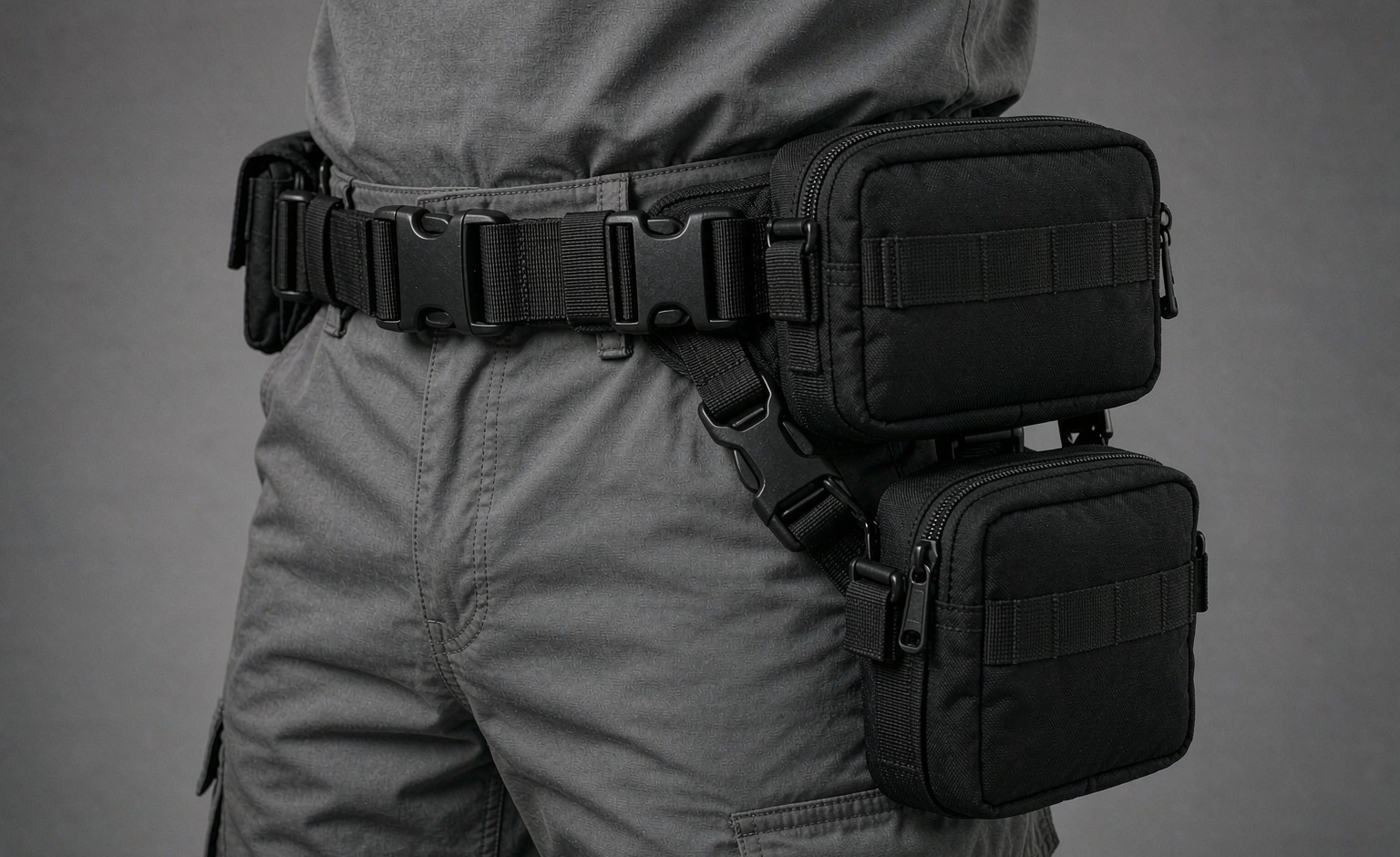
Compared on the five properties that decide field behaviour - opening motion, noise, service life, failure signature and cost - the three families separate cleanly. Hook-and-loop opens fastest and quietest and degrades gradually; a zipper gives a continuous sealed line and fails abruptly when a slider or a tooth goes; a magnetic-guided latch closes without aiming and depends on its surrounding panel staying in register. None is universally better, and the correct answer is per position on the product. Set acceptance thresholds rather than preferences, then validate at MOQ 500 with sampling 6-10 working days before committing a season. The comparison is deliberately written as thresholds rather than as measured results for any named retail model, because thresholds are what a purchase order can enforce. Nine sections cover mechanism, opening behaviour, acoustics, life curves, failure signatures, cost, environment, position and procedure. Use the last one in the range meeting. Three tables carry the comparison, each written to be filled in rather than read.
What each family is actually doing
A comparison only makes sense once the mechanism is stated. Hook-and-loop is a field of small hooks engaging a field of loops; holding force is distributed across thousands of contact points and is directional, strongest in shear and weak in peel. A zipper is a chain of discrete elements interlocked by a slider; holding force is concentrated at the elements currently engaged and the chain is continuous, which also makes it a closure rather than an attachment. A magnetic-guided latch is a two-part mechanical interlock assisted into alignment by a magnetic field; holding force is concentrated at an undercut and depends on the two halves being in register.
The mechanisms dictate everything downstream. Because hook-and-loop distributes load, it tolerates misalignment and degrades gracefully. Because a zipper is a chain, one damaged element disables the whole run. Because a latch is a single interlock, its behaviour is excellent when conditions are controlled and poor when the panel around it moves.
Naming matters in sourcing. YKK is one manufacturer of the zipper family; ITW Nexus, Duraflex, Woojin and UTX are among the suppliers in the side-release and ladderlock category; Fidlock is one manufacturer in the magnetic-guided family. Buying by family and by datasheet line keeps a second source available, while buying by brand name alone does not.
The mechanism also sets what can be claimed on the packaging. A hook-and-loop panel can be described as adjustable but not as secure; a zipper line can be described as closed but only water resistant to the figure its tape and construction were tested at; a latch can be described as self-locating only if the surrounding panel holds register. Write each claim next to the mechanism that supports it, and the product page stops making promises the sample round cannot defend.
Takeaway: Compare closure families by the motion each one demands rather than by the components each one contains, because that single property predicts user satisfaction and service life better than catalogue copy does.
Opening motion, effort and one-handed behaviour
Opening is where users form their opinion, and the three families differ in kind rather than in degree. Hook-and-loop opens with a peel, which is fast, silent and can be started anywhere along the edge, but it requires a grip on both faces and produces a tearing sound that some users dislike and some find reassuring. A zipper requires locating the pull, gripping it and traversing the full run, which is slow on a long run and awkward one-handed unless the pull is generous and the run is short. A magnetic-guided latch requires a specific deliberate motion - a lift, a slide or a twist - which is quick once learned and impossible to guess.
| Family | Motion to open | One-handed | Gloved | Condition that defeats it |
|---|---|---|---|---|
| Hook-and-loop | Peel from any point | Poor, needs two faces | Reasonable | Contamination, wear, peel loading |
| Zipper | Traverse the full run | Poor on long runs | Poor with thick gloves | Bent element, jammed slider, caught fabric |
| Magnetic-guided latch | Lift, slide or twist | Good once learned | Good | Register drift, grit in the seat |
| Side-release buckle, for reference | Squeeze both tabs | Fair | Fair | Out of sight, thick gloves |
Write the acceptance criterion as a threshold rather than as a preference. State the median opening time the product must achieve one-handed at a defined load, then measure it on five users who have not seen the product before. First-attempt success rate matters more than the median: a fitting that opens in under a second after a week of use but confuses half of first-time users will generate returns.
Acoustic behaviour and where it matters
Sound is a specification item in more channels than most designers assume. Hook-and-loop produces a broadband tear on opening and is silent on closing; the tear is the loudest event of the three by a wide margin and is the reason hook-and-loop is avoided on products used in quiet environments. A zipper produces a short rattle from the pull against the elements when the wearer moves, plus a distinct scrape on operation. A magnetic-guided latch is quiet on both operations, with a soft seat and a small click if the housing provides one.
Decide by channel. On a product sold for office, lecture or shared-cabin use, the closing and opening sounds are part of the user experience and the quietest option usually wins. On a product sold for outdoor or worksite use, an audible seat confirmation is a safety feature, because a closure that closes silently can also fail to close silently.
Mitigations exist for all three. A covered zipper garage and a captured pull remove most zipper rattle. A shorter hook-and-loop run and a lower hook density reduce the tearing volume. A latch with a designed seat click gives confirmation without noise. None of these are expensive, and all of them should be decided before the sample round rather than after the first review mentions them.
Decide how sound is judged before anybody listens. The usual mistake is evaluating acoustics in a quiet sample room, where everything sounds acceptable, and then discovering that users open the product in a shared space. Run the listening check in the environment the product is sold into - an office, a vehicle, a shared cabin - and judge whether the sound draws attention rather than whether it exists.
Bottom line: Specify target sound and tactile feedback in the brief rather than discovering both at unboxing, because closures that rattle noisily in a quiet compartment turn into a complaint with every single use.
Service life and the shape of the degradation curve
Life is not a number, it is a curve, and the shape matters more than the endpoint. Hook-and-loop degrades gradually and visibly: hook density falls, the loop field pills, and holding force declines over hundreds of cycles in a way a user can feel long before it fails. That is the safest failure shape of the three, because it gives warning. A zipper holds nearly constant for a long period and then fails abruptly, usually through a slider wear issue or a single damaged element. A magnetic-guided latch holds well and then loses engagement as the undercut wears or the panel around it drifts.
Set life requirements as a retained proportion of initial holding force at a stated cycle count, measured on the assembled product rather than on the component. That is the only formulation comparable across the three families, and it lets a purchase specification be written without quoting a supplier's internal figure.
Contamination accelerates all three and should be part of the life test. Grit turns hook-and-loop into a lint pad and reduces peel strength sharply; grit in a zipper chain wears the slider and the elements; grit in a latch seat causes false seating. Define the environment the product is sold into, then cycle with contamination appropriate to it rather than in a clean laboratory.
Failure signatures and what they cost the brand
Cost of failure is a brand question, not an engineering one. A closure that fails gradually costs nothing beyond eventual replacement. A closure that fails without warning at the wrong moment costs a lost item, a review and often a return.
| Family | Failure signature | Warning given | Typical consequence | Mitigation |
|---|---|---|---|---|
| Hook-and-loop | Gradual loss of grip | Long, user can feel it | Annoyance, lint, noise | Cover the hook face in storage; specify density |
| Zipper | Abrupt, chain opens or jams | Some, stiffness first | Lost contents, single-event return | Quality element and slider; caught-fabric guard |
| Magnetic-guided latch | False seat or gradual drift | Short | Contents lost without the user noticing | Seat confirmation; recess; stack control |
| Side-release buckle | Cracked housing or partial engagement | Short | Partial engagement then release | Grade the polymer; inspect engagement |
The third row deserves emphasis because it is the least understood. A magnetic-guided latch that false-seats gives the user no signal that anything is wrong, and the failure happens later and away from the moment of closure. That is why seat confirmation and a shielded seating face are specification items rather than refinements.
Classify by consequence in the inspection plan. Treat any mode that can release without warning as critical, whatever the product's price point, and treat gradual degradation modes as major with a stated remaining-life threshold at incoming inspection.
Verdict: Rank each family by how failure appears to a customer rather than by mean cycles alone, since abrupt failures that strand users cost more reputation than gradual degradation does across MOQ 500 returns.
Cost: unit price, assembly minutes and hidden minimums
Unit price is the least useful cost figure in this comparison. Hook-and-loop is cheap per metre and expensive in labour, because it is cut to length, positioned and sewn on two faces, often with a binding operation. A zipper is moderate in material and moderate in labour, with the assembly time dominated by setting the ends and aligning the tape. A magnetic-guided latch is expensive per unit and cheap in labour, because it is placed and fixed in one jigged operation.
The ranking therefore flips with volume and with labour rate. At low volume the latch is usually the most expensive line in the closure budget; at high volume with rising labour cost, the sewn families catch up because their minutes scale and the purchased part does not. Price all three at the planned annual volume and at the planned labour rate before drawing a conclusion.
Hidden minimums are the other cost. A latch in a non-standard colour carries its own purchase minimum on top of MOQ 500 per product variant; a zipper in a special tape colour carries a similar one. Hook-and-loop carries no colour minimum of consequence, which is one reason it remains the default for low-volume and short-run programmes despite its performance limits.
The third cost line is failure cost, and it is the one most often left out of the comparison. A cheap closure that generates returns consumes customer service time, reverse freight and often a replacement, and those costs exceed the unit-price difference between families several times over. Model closure choice as total cost of ownership per hundred units sold rather than as a line on the bill of materials, and the ranking frequently changes.
Environmental exposure: water, grit, cold and ultraviolet
Environment separates the families more sharply than any laboratory force figure. Water is straightforward: a zipper with a coated tape sheds water along its line, hook-and-loop holds water in its loop field and dries slowly, and a latch sheds water if its seat is recessed and holds it if it is not. Grit favours the zipper least and the latch most, provided the seat is shielded, because hook-and-loop accumulates contamination irreversibly and a zipper chain grinds it into the slider.
Cold affects all three through the polymer rather than through the mechanism: hook-and-loop stiffens and its hooks become brittle, zipper tape stiffens and the slider drags, and a latch housing stiffens and its engagement feel changes. Require an operating temperature range for every purchased component and test the assembled product at the ends of the range.
Ultraviolet is the slow one. Hook-and-loop loses loop strength under prolonged exposure, zipper tape chalks and the coating on a coated tape degrades, and polymer latch housings lose surface finish and toughness. Where a product will live outdoors, ask for ultraviolet stability on every component and specify the exposure the product must survive rather than leaving it to the material supplier's default.
Which family belongs at which position
The practical answer is per position, and most products should use more than one family. The table below assigns by position with the controlling reason, which is the argument to use when the question comes up in a range meeting.
| Position | Preferred family | Controlling reason | Second choice |
|---|---|---|---|
| Main compartment opening | Zipper | Continuous sealed line, familiar | Latch with a covered seat |
| Module attachment to a chassis | Magnetic-guided latch | Closes without aiming | Side-release buckle |
| Internal divider positioning | Hook-and-loop | Infinitely adjustable, quiet closed | Snap fitting |
| Lid or flap retention | Latch or hook-and-loop | Depends on noise channel | Zipper on a short run |
| Cable or strap management | Hook-and-loop | Reusable, no hardware | Elastic loop |
| Spare-part attachment sold separately | Latch on a frozen footprint | Compatibility promise | Webbing and buckle |
Note the last row. Where a module is sold as an accessory, the connection becomes a promise about compatibility, and that promise is easier to keep with a documented footprint than with a length of hook-and-loop whose position depends on how carefully the user pressed it.
Revisit the assignment whenever the channel changes. A product moved from an outdoor channel to a workplace channel inherits new acoustic and snag expectations, and a family chosen for glove-friendly operation may be the wrong one for a quiet office. Treat the table as a document reviewed at each range meeting rather than as a decision made once.
Hybrid designs are common and usually correct: a zippered main opening, a latch-retained module and hook-and-loop internal organisation is a completely ordinary specification, and the engineering work is ensuring the three do not interfere - no hook-and-loop facing a lining it will damage, no latch seat where a zipper pull can catch it.
Spec rule: Assign closure type by position rather than by price list, spending premium hardware where cycles concentrate and keeping plain closures on panels opened only occasionally.
A selection procedure that ends in numbers
Run the selection as four steps and record the output. Step one: for each position on the product, write the motion the user performs, whether it is gloved, whether it is one-handed and whether it is out of sight. Step two: write the consequence of an unannounced release at that position, and classify the position accordingly. Step three: shortlist families whose opening motion survives the conditions and whose failure signature matches the consequence - gradual failure where the contents are trivial, warned or positive-locking failure where they are not.
Step four is validation. Build production-intent samples, then measure: opening time one-handed at target load across five first-time users, acoustic behaviour judged in the channel it will be used in, retained holding force after a stated cycle count with contamination appropriate to the environment, and behaviour at the ends of the temperature range. Set the pass threshold for each before testing.
Add one trial that is easy to forget: test the closure with the product fully loaded rather than empty. A loaded pouch pulls its own closure out of alignment, and an empty one never does. Every figure gathered on an empty sample should be treated as provisional until repeated at target mass.
Then write the commercial block: part family and datasheet lines rather than brand alone, MOQ 500 per variant and any component colour minimum on top, sampling 6-10 working days for a straightforward build and 12-15 with a custom part, screens and tooling at USD 300-2,500, mass production 35-50 days, and incoming inspection at AQL 2.5 under ISO 2859-1 with the critical defect defined as any mode that can release without warning.
Turn the comparison into purchase language at the end: lot sampling taken from ISO 2859-1 at the agreed level, plus substance evidence for skin-adjacent closures within OEKO-TEX Standard 100 scope.
Judgement: End the selection procedure with numbers rather than preferences, naming cycle counts, pull figures, unit cost and the acceptance count, because opinions never survive handover to the next buyer.
Frequently asked questions
Which connection family is quietest in use?
Hook-and-loop is silent when closed but produces a broadband tear when opened, the loudest single event of the three. A zipper rattles as the pull moves against the elements. A magnetic-guided latch is quiet on both operations, with a soft seat and an optional click.
Which family fails most safely?
Hook-and-loop, because it degrades gradually and the user can feel the loss of grip long before it stops working. Zippers fail abruptly at one element or the slider. A magnetic-guided latch can false-seat with no signal, so seat confirmation is a specification item.
Is a zipper or a latch better for attaching a module?
A latch, because it closes without aiming and a module is usually out of sight. A zipper gives a continuous sealed line, which suits a compartment opening rather than an attachment. Most products use both in different positions.
How should service life be specified across the three families?
As a retained proportion of initial holding force at a stated cycle count, measured on the assembled product. That formulation is comparable across families and avoids quoting a supplier's internal figure that was measured on different fixturing.
Why does hook-and-loop lose grip in the field?
Contamination and wear. Lint and fabric dust pack into the hook side and the loop field pills, both of which reduce peel strength sharply. Specify hook density, cover the hook face during storage, and avoid peel-dominant loading in the design.
What is the most common zipper failure?
A jammed or worn slider and a single damaged element, both of which disable the whole run. Fabric caught in the chain is the other common one. Mitigate with a caught-fabric guard and by specifying the element and slider grade rather than the tape alone.
How is accidental release tested on a latch?
Run a snag pass across coarse textile and a seat-belt edge under body pressure, plus a seated-compression check and a loaded carry. Any release is critical regardless of the force figure. Add grit to the seat in one trial to check false seating.
Which family is cheapest overall?
It depends on volume and labour rate. Hook-and-loop is cheap in material and expensive in minutes; a latch is expensive in material and cheap in minutes. Price all three at planned annual volume and labour rate before concluding.
Do special colours carry extra minimums?
Yes for zippers and latches, which are purchased parts with their own colour minimums sitting on top of MOQ 500 per product variant. Hook-and-loop carries no meaningful colour minimum, which is why it suits short-run and low-volume programmes.
How does cold weather affect the three families?
Through the polymer: hook-and-loop stiffens and its hooks turn brittle, zipper tape stiffens and the slider drags, latch housings stiffen and engagement feel changes. Require an operating temperature range and test the assembled product at both ends.
Can one product use all three families?
Yes, and most should: a zippered main opening, a latch-retained module and hook-and-loop internal organisation is ordinary. The work is preventing interference - no hook-and-loop against a lining it will damage, no latch seat where a zipper pull can catch.
How should a buyer name the hardware in a specification?
By family and datasheet line. YKK is one manufacturer of the zipper family, ITW Nexus, Duraflex, Woojin and UTX are among the suppliers in the buckle category, and Fidlock is one manufacturer in the magnetic-guided family. Buying by family keeps a second source open.
What inspection level applies to closures?
AQL 2.5 with the plan from ISO 2859-1, with defect classes defined. Critical covers any mode that can release without warning; major covers dimensional drift or stiffness that degrades operation; minor covers finish within a stated viewing distance.
What are the development timings for a closure change?
Sampling 6-10 working days for a straightforward build and 12-15 where a custom part or printed panel is involved. Screens and tooling sit at USD 300-2,500. Mass production runs 35-50 days after approval.
Should internal dividers use hook-and-loop?
Usually yes. It is quiet when closed, infinitely adjustable and cheap in material, and the consequence of it releasing inside a compartment is trivial. The exception is a divider carrying something heavy, where a positive fitting is safer.