Home › Field notes › The Global Supply Chain for Modular Bags: Freight, Risk and Lead Time
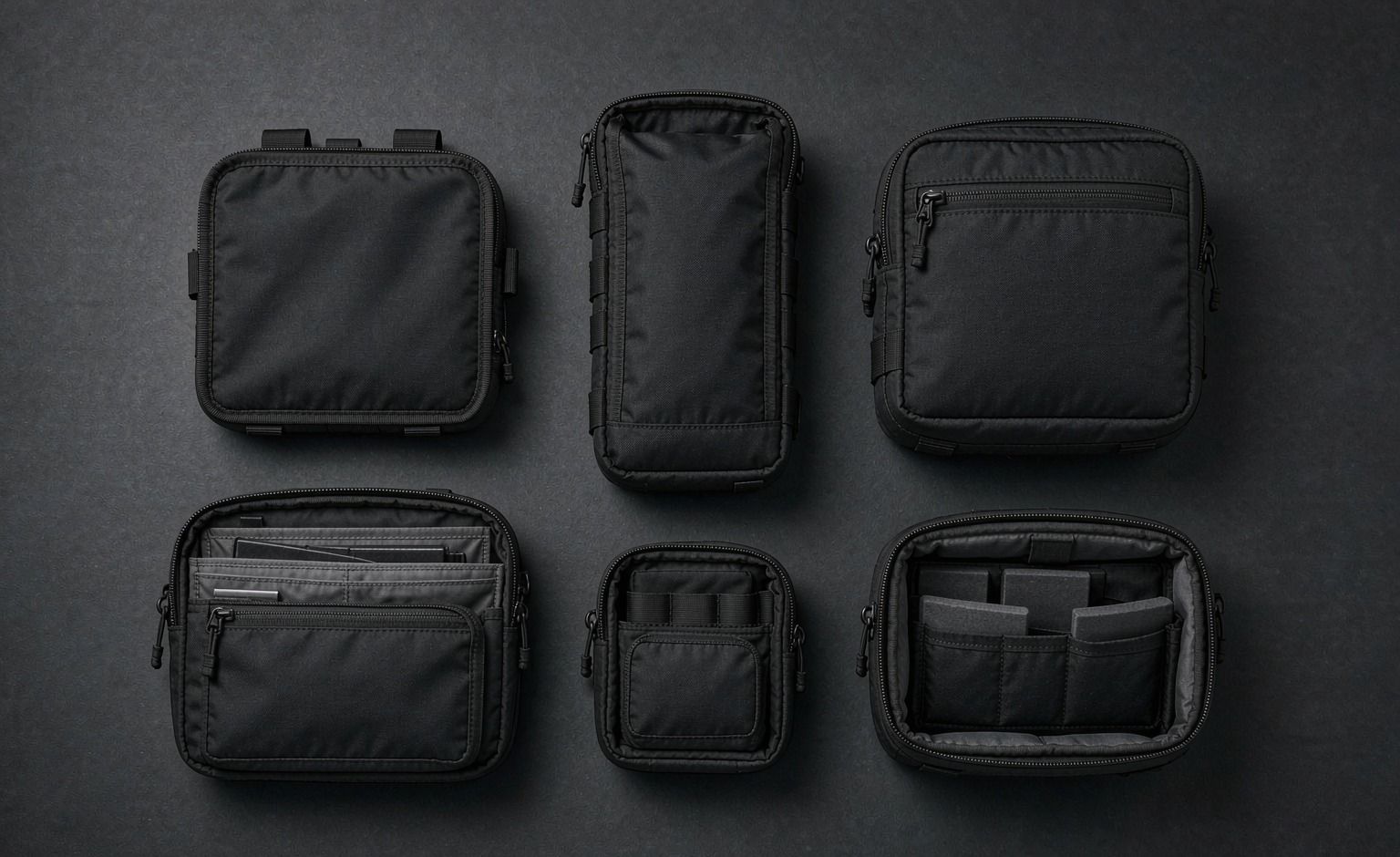
A global supply chain for modular bags is a tiered network in which shell fabric, woven tape, hardware and pre-assembled inner modules must converge on one assembly window before a single export carton is sealed. Programmes that treat it as a single-vendor purchase usually meet the tiering problem late: the coated nylon lands on schedule while a plated cam buckle keeps the sewing line idle for three weeks. Planning at MOQ 500 and above turns material call-off, tooling spend and vessel booking into three separate calendars that must be reconciled in writing. Sampling occupies 6-10 working days, or 12-15 working days where magnetic fittings or moulded parts are involved, and mass production consumes 35-50 days once materials are in hand. What follows sets out the tier map, the arithmetic behind each calendar, how freight mode changes the landed figure, and the controls that keep a modular programme on its published date.
Where a Modular Programme Sits Inside the Wider Supply Chain
A conventional bag programme buys one bill of materials per SKU. A modular programme buys a shared chassis bill plus a family of module bills, and the two behave differently in planning terms. The chassis carries the long-lead content: coated shell fabric, structural webbing, load-bearing hardware and the back-panel assembly. The modules carry the short-lead content: linings, elastic loops, small pouches and labelling. The split matters because schedule risk concentrates in the chassis even though a large share of the visible differentiation sits in the modules.
On the assembly side, our vetted partner facilities run 7 production lines with 149 machines and 137 people across a 4,950 m² SGS-verified production floor laid out so that cutting, webbing attachment, assembly and inspection follow one sequence instead of moving between buildings. Published throughput of 200,000 units per month is a single-body figure. A modular order consumes that throughput differently: every module adds a handling step, an interface verification and a packing decision that a plain pack does not require.
The planning unit should therefore be assemblies per line-week, not bags per month. A run of 500 chassis each shipping with four module types is not the same line load as 500 finished single-body packs; it represents 2,500 handling events before the first carton is taped. Buyers who state only the chassis quantity will receive a schedule that is accurate for a product they are not actually buying. That is why the custom modular backpack brief asks for module mix at quotation stage rather than after sampling.
Two further consequences follow. The chassis pattern should be frozen before module patterns are cut, because a late chassis revision invalidates every module interface drawing issued against it. And the module bill should be written so that one module can be dropped from a shipment without invalidating chassis acceptance, otherwise a single delayed pouch holds an entire container.
Selection rule: State the module mix alongside the chassis count whenever an order is placed at MOQ 500 or above, because 500 chassis shipping with four module types apiece represent 2,500 handling events against a headline throughput of 200,000 units per month.
Tier Structure and Who Carries Which Risk
The tier map behind a modular bag is shallow but wide. The first tier supplies the coated or laminated shell fabric and the structural lining. The second supplies woven tape, zippers, buckles, magnetic fittings and any moulded component. The third supplies packaging, labelling and retail collateral. Only one of those tiers normally holds a contractual relationship with the brand, and it is rarely the tier that caused the delay.
Risk follows lead time. Mill-dyed shell fabric in a specified shade is typically the longest item on the call-off, because the dye lot has to be approved before coating and finishing. Woven tape made to 25 mm width with a defined weave is next, particularly where the tape has to colour-match the shell. Moulded or plated hardware sits behind both when tooling is involved: tooling and screens for a dedicated fitting run USD 300-2,500, and that spend only amortises across volume.
What surprises buyers is that interface hardware behaves like a long-lead item even when the part itself is inexpensive. A magnetic-guided snap fitting ordered from a datasheet may well be stocked, but the matching counter-plate has to be positioned and reinforced on the chassis, which means the chassis pattern cannot be finalised until the physical fitting is in hand. Ordering that fitting late therefore does not delay the fitting alone; it delays the whole chassis downstream of it.
The control is simple and mildly unpopular: buy the interface hardware first, in sampling quantity, and treat a sampling fee of USD 50-150 per configuration as the price of a schedule that holds. The fee is refundable against the order, so the only real cost is the discipline of deciding early instead of revising later.
Verdict: Buy interface hardware inside the 6-10 working day sampling round even where the parts are cheap, since a sampling fee of USD 50-150 refunded on the order costs less than a chassis pattern held open behind a delayed fitting.
Lead-Time Arithmetic From Brief Close to Vessel
Every modular programme runs four calendars at once: material, tooling, assembly and transit. They are rarely aligned, and the gap between them is where published dates are lost. The table below converts each stage into days and names the precondition that must be true before the clock starts, because a stage counted before its precondition is met is not a plan, it is a hope.
| Programme stage | Calendar span | Precondition before the clock starts | Dominant slippage cause |
|---|---|---|---|
| Brief close and specification freeze | Variable, buyer-controlled | Module mix and interface drawings signed | Interface rules left open |
| Material call-off | Set by mill and tape supplier | Approved dye lot and coating spec | Colour approval loops |
| Sampling | 6-10 working days, or 12-15 when complex | Interface hardware physically in hand | Pattern rework after fit feedback |
| Tooling and screens | USD 300-2,500, quoted per part | Final artwork and part geometry | Artwork revision after tooling cut |
| Mass production | 35-50 days | Approved counter-sample and deposit | Material arriving in partial lots |
| Final inspection and release | Against AQL 2.5 | Approved inspection checklist | Undefined defect classification |
Read the table as a critical path, not as a sum. Sampling and tooling run in parallel; material call-off overlaps both; mass production cannot start until the last of the three is complete. In practice the longest path is rarely assembly. It is the dye-lot approval that gates the fabric, which gates cutting, which gates everything.
Bottom line: Count mass production as 35-50 days only from the point where the approved counter-sample and the deposit are both in hand, because material arriving in partial lots restarts that calendar rather than pausing it.
Freight Mode and Container Arithmetic
Freight is the last decision and the first one buyers fix in their heads, which is backwards. Mode selection should follow the volume the packed cartons actually occupy and the date the goods must be on shelf, not a habit carried over from a previous programme.
| Transit option | Door-to-door span | Volume band | Planning note |
|---|---|---|---|
| Sea freight, 20GP | 25-35 days | Up to roughly 28 CBM | Carton count decides this before weight does |
| Sea freight, 40HQ | 25-35 days | Up to roughly 68 CBM | Preferred once cartons exceed the 20GP envelope |
| Air freight | 5-8 days | Restock and launch quantities | Volumetric weight usually governs the invoice |
| International courier | 3-5 days | Samples and document packets | Sensible for a single approved reference |
Modular sets pack worse than single-body packs. A chassis that nests efficiently on its own stops nesting once three pouches are strapped to it, and the outer carton has to grow to protect the mounted fittings. That means a modular line reaches the 40HQ threshold earlier than a conventional line of the same unit count, and the freight line in a landed-cost model built on single-body assumptions will be optimistic.
The correct sequence is to pack a reference carton during sampling, measure it, and derive cartons per container from that measurement rather than from a volumetric estimate. If the reference carton is not measured, the freight quote is a placeholder, and placeholders do not survive contact with a booking deadline.
Takeaway: Measure one reference carton during sampling and then book sea freight at 25-35 days, air freight at 5-8 days or courier delivery at 3-5 days against real carton volume rather than against a volumetric estimate.
Incoterms, Payment Structure and Where Risk Transfers
Quotations for modular work are issued FOB Xiamen. Under that term the seller clears the goods for export and loads them on the nominated vessel; the buyer carries freight, insurance and everything that happens after the rail of the ship. The distinction matters for a modular order because damage in transit is the buyer's claim to pursue, and because the packing standard that protects mounted hardware has to be specified before loading, not disputed after discharge.
Payment runs on a T/T 30/70 structure: 30% to release materials and reserve line capacity, 70% against inspection release before the container is gated in. The deposit leg exists because material call-off is irreversible; once a dye lot is dyed and a buckle is plated to a specified finish, that spend cannot be redirected. The balance leg exists because it aligns the final inspection with the moment money moves, which is the only point at which quality leverage still exists.
Buyers occasionally ask for a larger balance held until the goods land. That request is understandable and structurally weak: it moves leverage to a point where the seller has no ability to correct anything, and it usually returns as a slower quotation rather than as better quality. A stronger arrangement is a defined inspection protocol with a stated AQL, plus a corrective-action clause tied to the 70% release.
Insurance deserves one line in the brief. FOB places it with the buyer, and a container of modular goods carrying mounted hardware has more to lose from a crushed carton than a conventional shipment. Naming the insured value and the coverage trigger in the purchase order costs nothing and removes the most common post-discharge argument.
Component Constraints That Decide the Calendar
Three component families drive the modular calendar more than any other: woven attachment tape, coated shell fabric, and the interface hardware set. Each has a specification property that, if left open, converts into weeks.
Woven attachment tape is specified by width, weave and repeat. A 25 mm webbing width with a 38 mm vertical spacing and a 50 mm horizontal repeat is the geometry that lets third-party pouches mount without forcing the tape. Those three numbers should appear on the drawing as toleranced callouts, not as a note. Where they are missing, the tape is sewn to an operator's judgement and every subsequent module inherits the error.
Shell fabric is specified by denier, coating and a water-resistance figure measured as hydrostatic head under AATCC 127. That method gives a millimetre column figure for the fabric alone. It says nothing about the seam, the zipper or the point where a module mounting plate penetrates the panel, which is why a fabric figure must never be printed as a finished-product claim.
Interface hardware is specified by datasheet, cycle life and finish. Finishes carry compliance exposure: nickel release is assessed under EN 1811, restricted substances under REACH (EC 1907/2006), and textile articles are commonly certified to OEKO-TEX Standard 100. A finish change requested late reopens all three, which is a further reason to decide hardware before the chassis pattern is cut.
Incoming material control closes the loop. Fabric and tape arrive against the approved reference and are inspected before cutting, because a shade deviation found after cutting is a finished-goods problem rather than a material rejection. Test evidence should name the method: tensile and tear behaviour on shell fabric is commonly read against ASTM D5034, abrasion against ASTM D3884 or ISO 12947, and coating adhesion against ASTM D751. A report that quotes a result without naming the method cannot be compared with anything.
Judgement: Freeze the 25 mm webbing width, the 38 mm vertical spacing and the 50 mm horizontal repeat as toleranced callouts before the first pattern is cut, because every module built afterwards inherits any drift in those three numbers.
Failure Signatures When a Modular Programme Slips
Slippage is rarely announced. It appears first as a symptom in one tier, and the useful skill is mapping that symptom back to its origin before it reaches the assembly floor.
| Symptom on the floor | Originating tier | Where it should be caught | Lever still available |
|---|---|---|---|
| Shell shade differs from the approved swatch | Fabric mill | Incoming material inspection | Reject the lot before cutting starts |
| Third-party pouch will not thread the tape | Tape weaving and sewing | Sampling fit check | Re-cut panel with toleranced callouts |
| Magnetic fitting releases under side load | Hardware specification | Interface load test | Change engagement geometry or add retention |
| Carton count exceeds the booking | Packing and module mix | Reference carton measurement | Reduce mounted modules per carton |
| Defect rate disputed at final inspection | Inspection protocol | Checklist sign-off before production | Classify defects against AQL 2.5 in writing |
| Goods arrive with crushed mounted fittings | Transit packing | Loading supervision | Add internal support and restack |
Every row has the same structure: the symptom is visible late, the origin is early, and the lever exists only at the point named in the third column. Programmes that skip the sampling-stage checks in the table convert a cheap rejection into an expensive one.
Spec rule: Release finished lots against AQL 2.5 at general inspection level II with Critical 0, Major 2.5 and Minor 4.0 agreed in writing, and let the 70% balance of the T/T 30/70 structure fall due only once that inspection passes.
Continuity Planning and the Purchase-Order Release Checklist
Continuity for a modular line is less about finding a second supplier for everything and more about knowing which items cannot be second-sourced. Shared interface hardware is the hardest: if the chassis geometry is built around one fitting family, an alternative supplier means a new pattern, not a new purchase order. Dual sourcing therefore belongs at the fabric and tape tiers, where an alternative mill can be qualified against the same specification without changing a drawing.
Interface hardware should instead be protected by inventory. Holding one production cycle of the specified fitting at the assembly site costs far less than re-engineering a chassis around a substitute, and it converts a supply shock into a purchasing task. The same logic applies to any part carrying tooling: once a tool exists, the risk is not supply, it is tool damage, and a spare tool is cheaper than a re-cut.
Before a purchase order is issued, seven items should be closed in writing. The module mix. The interface callouts with tolerances. The approved counter-sample reference. The inspection protocol including AQL 2.5 and defect classification. The packing reference carton and its measured dimensions. The Incoterm, stated as FOB Xiamen. The payment structure, stated as T/T 30/70. Anything left open at this point will be resolved later, under time pressure, by someone who was not in the specification meeting.
Programmes that follow this sequence tend to look slow in the first two weeks and fast in every week after. Programmes that skip it look fast until the dye-lot approval arrives. For a schedule review against your own calendar, the contact page is the right entry point; for the interface rules referenced above, see the MOLLE geometry notes under interface engineering.
Frequently asked questions
How long does a modular bag programme take from brief to vessel loading?
Assembly alone is 35-50 days once materials are in hand, but the date that matters is set earlier. Sampling takes 6-10 working days, or 12-15 working days when magnetic fittings or moulded parts are involved, and material call-off typically runs longer than both. Plan the critical path from dye-lot approval, not from the production start.
Why does MOQ 500 apply per configuration rather than per order?
Because each configuration consumes a distinct material call-off and a distinct sewing setup. A chassis plus four module types is not one setup of 500; it is several setups that share a pattern. Stating MOQ 500 per configuration keeps the quotation honest about which setups are actually being paid for.
What does a sampling fee of USD 50-150 actually cover?
It covers pattern work, cutting, assembly and the interface fit check for one configuration, and it is refundable against the order. The fee exists to make configuration decisions reversible during sampling rather than after the chassis pattern has been frozen and material has been called off.
When does tooling spend of USD 300-2,500 become necessary?
Tooling enters when a part is not a catalogue item: a dedicated buckle body, a branded puller, a moulded mounting plate, or screens for positioned artwork. Below that threshold the part is bought from a supplier range and the only cost is the sampling fee.
How much of a 20GP container does a modular order fill?
A 20GP holds roughly 28 CBM and a 40HQ roughly 68 CBM, but the binding constraint for modular goods is carton geometry rather than raw volume. Mounted pouches prevent nesting, so measure a packed reference carton during sampling and derive cartons per container from that measurement.
Is air freight ever rational for a 500-unit modular order?
Yes, for a launch date that sea transit of 25-35 days cannot meet, or for a restock where the shelf is already empty. Air runs 5-8 days door to door and is invoiced on volumetric weight, which penalises bulky cartons. It is a schedule instrument, not a cost instrument.
What does FOB Xiamen place on the buyer?
The seller clears export and loads the vessel; the buyer carries freight, insurance and all risk after the ship's rail. Practically, this means transit damage is the buyer's claim, and the packing standard protecting mounted hardware must be specified before loading rather than argued about after discharge.
Why is payment structured as T/T 30/70 instead of on delivery?
The 30% leg releases material spend that cannot be redirected once a dye lot is dyed or a finish is plated. The 70% leg is tied to inspection release, which is the last moment at which quality leverage exists. Payment on delivery moves leverage to a point where nothing can be corrected.
How is AQL 2.5 applied to a modular set with separate pouches?
The chassis and each module type are treated as separate inspection units with their own defect classification, then rolled up to a lot result. Sampling levels follow ISO 2859-1. Without that separation, a minor pouch defect can contaminate a chassis result that was otherwise acceptable.
Which component most often delays a modular chassis?
Interface hardware. The part is usually cheap and usually stocked, but the chassis pattern cannot be finalised until the physical fitting is in hand, so a late fitting order delays the entire chassis rather than one component line.
How early should interface hardware be ordered?
Before the chassis pattern is cut, in sampling quantity. Ordering it during sampling costs only the refundable sampling fee of USD 50-150; ordering it after pattern release costs a re-cut, a new counter-sample and the material already committed to the first build.
Can a late module be shipped separately from the chassis?
Yes, and the bill of materials should be written to permit it. If chassis acceptance is contractually tied to a complete module set, one delayed pouch holds an entire container. Splitting the release keeps the chassis on the vessel and moves the pouch to air at 5-8 days if the date demands it.
What documentation should be ready before goods are loaded?
Commercial invoice, packing list with carton dimensions, export declaration, and any certificate of conformity or test report named in the specification. Test reports should reference the method actually used, for example AATCC 127 for fabric hydrostatic head, so that a reviewer can reproduce the claim.
How does a buyer verify a throughput claim of 200,000 units per month?
Ask what product the figure describes. That number is a single-body throughput; modular orders consume capacity differently because each module adds handling, interface verification and packing. Request capacity expressed in assemblies per line-week for your specific mix, and check it against 7 production lines rather than against a headline figure.