Home › Field notes › Hardware Corrosion Resistance: Salt Spray Testing Scope and Limits
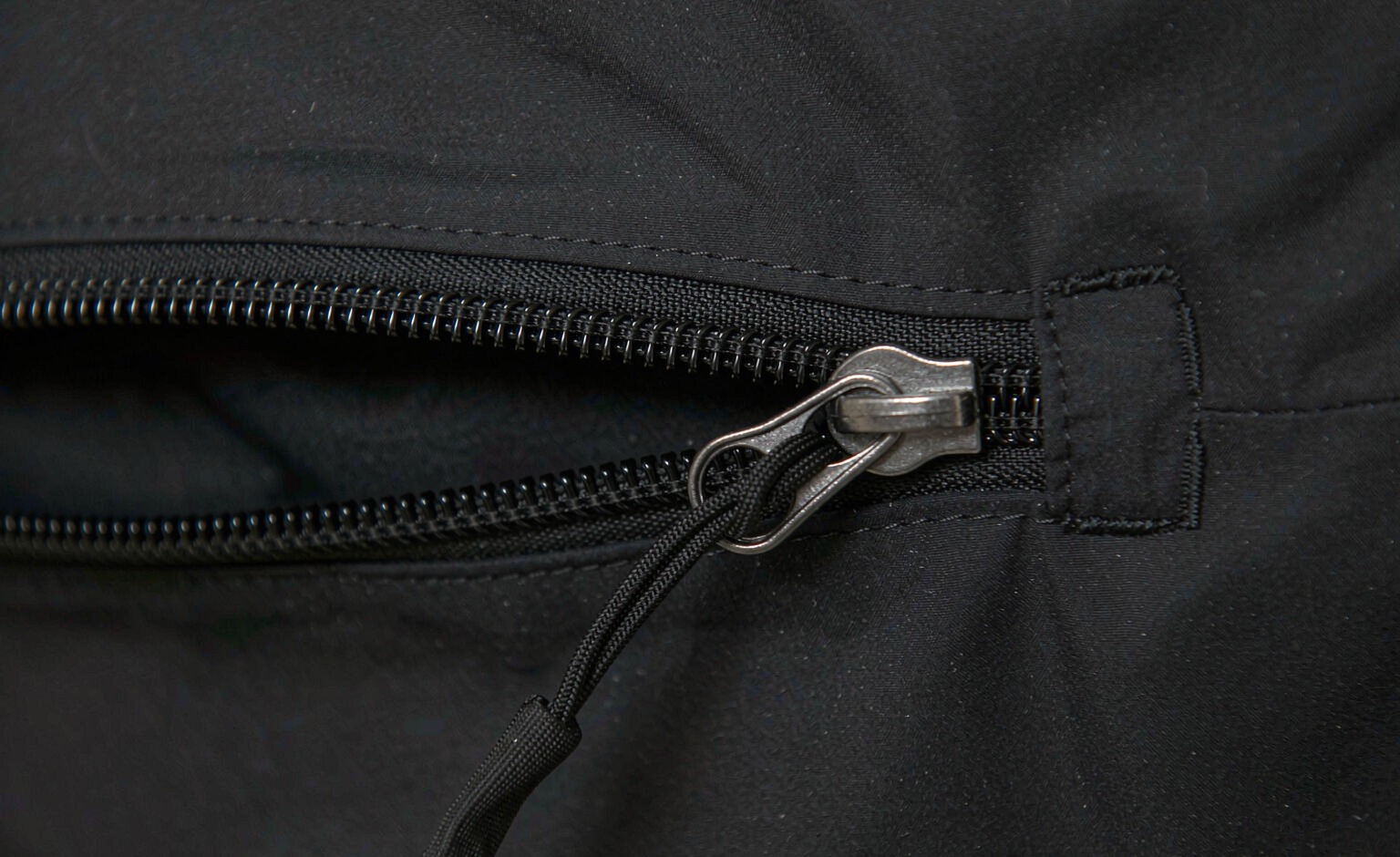
Hardware corrosion resistance is measured by exposing fittings to a controlled chloride fog and reporting how long they survive before base metal corrosion appears, and the figure is a ranking between finishes rather than a forecast of years in service. Neutral fog runs continuously at a fixed temperature with a sodium chloride solution, so it reproduces chloride attack while omitting wet-dry cycling, ultraviolet, abrasion and contact with a dissimilar metal. Read the result as a comparative screen, then specify substrate, coating type and thickness alongside it. Our production team treats corrosion as a clause with four gates: 500-piece order minimum, prototype hardware at 6–10 working days, bulk at 35–50 days, and attribute inspection at AQL 2.5. Scope is civilian load carriage only — packs, pouches, tool rolls and field electronics — with no weapon carriage, no ballistic protection or any defence certification claim.
What a Salt Spray Cabinet Actually Does to a Bag Fitting
The neutral fog cabinet is a sealed box holding a warmed sodium chloride solution that is atomised into a continuous mist, with specimens hung at a defined angle so that condensate does not pool on the face being judged. Temperature is held constant, exposure runs without interruption, and the panel is taken out at agreed intervals to be looked at. The widely used reference for this arrangement is ASTM B117, and the practice published by ISO 9227 describes the same family of spray routes, including acetic acid and copper-accelerated variants that some suppliers prefer because they reach a visible end point sooner.
What comes out of the box is an exposure time. A report might say the fitting reached a stated number of hours before corrosion product appeared on a significant surface, or it might give the percentage of surface covered with rust at each inspection point. Both forms answer the same question: how did this specimen behave under one particular, deliberately harsh, deliberately unchanging condition. Neither form answers the question a buyer actually has, which is whether a buckle will still release cleanly after two winters beside a salted road.
Three specimen facts determine whether the number means anything at all. The substrate matters, because zinc alloy die-casting and cold-rolled steel do not corrode the same way once a coating is breached. The coating system matters, since an electroplated layer, a conversion coating and an anodised layer fail by different mechanisms. And thickness matters, because a decorative plate measured in single-digit microns offers barrier protection only, and its behaviour depends on how well the underlying casting was polished before it went into the bath.
Selection rule: Accept a fog result only when the report states the substrate alloy, the coating system and the measured coating thickness in microns, because an hour count without those three cannot be compared between two suppliers.
Fog Hours Rank Finishes; They Do Not Forecast Service Years
The cabinet is deliberately constant, and real corrosion is deliberately not. In the field a fitting wets, dries, wets again, and each drying phase concentrates the salts left behind and drives the next attack deeper. Ultraviolet breaks down any organic topcoat that was sealing the surface. Grit abrades high points such as the corners of a D-ring and the mouth of a hook. A strap pulled sideways loads the coating at exactly the point where it is thinnest. None of those four appear inside a fog cabinet, so a finish that wins on hours can still lose on a frame.
Field exposure programmes and cyclic laboratory routes exist precisely to close that gap, and they alternate wetting, drying and sometimes a salt application with a drying phase at elevated temperature. Their output correlates better with road-salt service, but they take longer and cost more, which is why most buying teams use fog as a screen and reserve cyclic work for the one or two fittings whose failure would be expensive.
The practical reading rule is simple. Use fog hours to eliminate the worst candidate and to detect a process drift between batches, because a supplier whose plating bath has slipped will show it as a shorter hour count even if the visual finish looks identical. Do not use fog hours to promise a customer a service life, and do not print them on a hangtag as though they were a warranty period.
Verdict: Use neutral fog to rank candidate finishes and to catch bath-to-bath drift between production lots, and never convert the hour count into a stated service life on packaging or in a catalogue.
Finish Families Compared for Corrosion Resistance
Choosing a finish is a trade between corrosion behaviour, wear behaviour, weight and cost, and the right answer depends on where the pack is sold. A fitting buried under a flap on a commuter pack sees sweat and occasional rain; the same fitting on a coastal fishing pack sees salt aerosol every day; the same fitting on a winter worksite pack sees road salt, mud and grit. The comparison below is the one worth putting in front of a hardware supplier at the start of a programme rather than after a complaint.
| Comparison criterion | Zinc alloy with decorative electroplate | Stainless steel or anodised aluminium |
|---|---|---|
| Coastal salt aerosol | Coating breach at edges leads to white corrosion product early | Surface staining possible, structural loss uncommon |
| Winter road salt with grit | Abrasion removes the plate at contact points, then corrosion spreads | Abrasion marks but leaves the base metal protected |
| Prolonged sweat contact | Plate can blister where the casting was poorly polished | Largely unaffected by chloride from perspiration |
| Appearance after wear | Bright finish dulls, then shows base-metal bloom | Satin finish dulls evenly without bloom |
| Weight at equal size | Heavier for a given section because the alloy is dense | Lighter, or equal with a thicker section for stiffness |
| Failure signature | Bloom creeping from corners and from the gate mark | Surface rust staining or pitting in a chloride-rich crevice |
| Evidence to request | Plating thickness in microns and bath record per lot | Alloy grade, passivation record and, for aluminium, anodising thickness |
Note that the comparison says nothing about magnetic behaviour, about the feel of a latch, or about how a finish photographs on a product page. Those matter commercially, and they are decided alongside corrosion rather than after it.
Bottom line: Specify electroplated zinc alloy where cost and a bright finish dominate and the fitting is protected from abrasion, and move to stainless or anodised hardware wherever grit, road salt or coastal aerosol will reach the surface.
Coastal Air, Winter Road Salt and Indoor Humidity: Three Chemistries
Chloride arrives in three different forms and each one deserves its own clause. Coastal air carries a fine aerosol of salt solution that settles on everything and stays damp because humidity is high, so the attack is continuous and gentle and it finds its way into crevices such as the gap under a rivet head or the fold of a webbing end. Winter road salt arrives as a concentrated brine thrown up by traffic, mixed with grit, and it alternates with dry heated indoor air, so the wet-dry cycling that the fog cabinet omits is exactly what makes it aggressive.
The third case is the one buyers forget: indoor humidity without any salt at all. Swimming-pool plant rooms, food-processing areas, coastal warehouses and unventilated containers during a 25–35 day sea leg all provide warmth plus moisture, and moisture alone is enough to start corrosion on an unpassivated stainless surface or to grow mould on an organic finish. Packs stored damp in a closed box for weeks after discharge arrive looking worse than packs that were used hard and dried properly.
Each case points at a different control. Coastal service argues for a thicker coating or a different substrate. Road-salt service argues for abrasion resistance and for a finish that tolerates scratching, because the scratch comes first and the corrosion follows. Storage service argues for packaging: breathable bags rather than sealed liners, desiccant in the carton, and a carton that is not closed around a damp pack.
Takeaway: Name the chloride condition the programme actually faces — coastal aerosol, road-salt brine with grit, or storage humidity — and pick the finish, the abrasion tolerance and the packaging for that condition rather than for the fog cabinet.
Galvanic Couples Where Hardware Meets a Frame or a Stay
Corrosion accelerates sharply when two dissimilar metals touch in the presence of an electrolyte, and a pack is full of such pairs. A steel rivet through an aluminium stay, a stainless buckle threaded onto a coated aluminium frame, a brass eyelet set into a plated steel plate: in each case the less noble metal becomes the anode and corrodes faster than it would alone, and the ratio of the two exposed areas decides how fast. A small anode next to a large cathode is the dangerous arrangement, which is why a tiny steel fastener in a big aluminium panel is a worse idea than the reverse.
Three mitigations are cheap and reliable. Break the electrical path with a polymer washer, a nylon shoulder or a plastic sleeve where a fastener passes through a dissimilar panel, and the couple disappears. Choose fasteners that are closer together in the galvanic series than the two metals you started with. And keep the joint dry by design, because an electrolyte is required for the couple to work at all: a drain path at the bottom of a pocket, a coating over the contact face, and a detail that does not hold water against the joint.
Frame-integrated packs deserve specific attention here, since an aluminium stay running the height of the back panel touches hardware at several points and is often anodised, and anodising is an insulating layer that works until it is scratched during assembly. Assembly instructions should say what may contact the stay and what may not, and inspection should check that the specified isolator was actually fitted.
Judgement: Where a fitting contacts an aluminium stay or frame, break the electrical path with a polymer isolator and specify the drain path in the drawing, because no coating thickness will save a small anode coupled to a large cathode.
Reading the Corrosion Report: Hours, Ratings and Photographs
A report that contains only a number of hours is not evidence, it is a claim. What makes a corrosion report usable is the specimen description, the inspection intervals, the criterion used to decide that corrosion had started, and photographs taken at the same angle before and after. Ask for the rating to be expressed as the proportion of significant surface showing base metal corrosion rather than as a vague pass remark, and ask which surfaces were excluded from the assessment, because cut edges and the gate mark on a casting are usually excluded and they are also usually where failure begins.
| Report element | What it establishes | What it leaves open | Substitute worth requesting |
|---|---|---|---|
| Hours to first corrosion | Ranking between two finishes under identical fog | Any link to years of field service | A cyclic route with wet and dry phases |
| Percentage of surface affected | How far attack has spread at a stated interval | Whether the attack is cosmetic or structural | Function check after exposure |
| Coating thickness in microns | Barrier capacity of the as-received part | Uniformity across a complex shape | Thickness read at the thinnest point |
| Photographic record | Where the attack started on the geometry | Colour accuracy and scale | Inspection at a fixed angle with a scale bar |
| Pass remark only | Almost nothing | Substrate, coating, interval and criterion | Full specimen description with intervals |
| Batch identity | Traceability back to a plating lot | Whether later lots matched | Re-test on one lot per quarter |
One further check is worth building into every hardware approval: function after exposure. A buckle that still looks acceptable may no longer release at an acceptable force once corrosion product has built up inside the latch channel, and a hook whose gate has stiffened is a safety problem rather than a cosmetic one. Ask for release force to be measured before and after exposure and reported as a pair.
Spec rule: Require hours to first corrosion, percentage of significant surface affected, coating thickness at the thinnest point, batch identity and a post-exposure release-force pair, and reject any report offering a bare pass remark.
Compliance Overlap, Evidence Retention and Programme Gates
Corrosion specification meets chemical compliance at the coating. Restricted substance obligations under REACH (EC 1907/2006) apply to substances in articles, and plated hardware has historically been reviewed for nickel release and for hexavalent chromium in conversion coatings, so the declaration a buyer needs from the plating shop is a restricted-substance statement tied to the process, not a generic certificate. Where a programme sells into California, Proposition 65 warning practice belongs in the same conversation, and children's products attract lead limits under CPSIA.
Our production team runs hardware approval in four steps: drawing and finish specification, prototype fitting built in 6–10 working days (12–15 where a machined part or a new die enters the build), laboratory exposure on the prototype lot, then bulk with attribute inspection at AQL 2.5 under ISO 2859-1 with a Critical tolerance of 0, Major 2.5 and Minor 4.0. Bulk occupies 35–50 days after sample sign-off, the minimum order quantity is 500 pieces, and budget quotations are returned inside 24–48 hours on an indicative basis, quoted FOB Xiamen, terms T/T 30/70.
Retention is what turns a specification into a defence. Keep the plating bath record against the lot number, keep the exposure report against the purchase order, and keep retained samples from each hardware lot for at least one season. When a complaint arrives 8 months after delivery, the only way to establish whether the coating drifted or the customer's environment was unusual is to compare the retained sample with the returned part under the same route.
Hardware decisions interact with the rest of the build. Grid geometry and pouch retention are covered in the MOLLE system reference, frame and stay interfaces in the tactical pack section, and long-distance chloride exposure in the hiking pack section. Current hardware options are listed on the products page, and corrosion test scope can be scoped through the contact page.
Writing the Corrosion Clause Without Overreach
A corrosion clause should state six things and no more: the substrate, the coating system, the minimum thickness and where it is measured, the exposure route and the inspection intervals, the acceptance criterion written as a description rather than as a bare pass, and the function check required afterwards. Anything beyond those six tends to be borrowed from an automotive or marine specification that suits a different product and inflates cost without changing field behaviour.
Wording matters as much as content. Write the criterion as "no base metal corrosion on significant surfaces after the agreed exposure, with release force still inside the stated band", because that is a statement a laboratory can act on. Do not write "corrosion proof", do not write a lifetime promise, and do not print the exposure hours on a product page as though they described the product's life. A buyer who overclaims on corrosion is the buyer who pays for the returns.
Frequently asked questions
What does salt spray testing actually measure on bag hardware?
It measures how long a fitting survives a continuous neutral chloride fog before corrosion appears on a significant surface. The result ranks one finish against another under identical conditions and detects drift between plating lots rather than predicting years of field service.
- Continuous fog, constant temperature
- ASTM B117 and ISO 9227 families
- Output is hours, or area affected
Why do fog hours not predict service life for a buckle?
Because the cabinet holds conditions constant while service does not. Wet-dry cycling, ultraviolet, grit abrasion and off-axis load all accelerate real corrosion, and none appear inside the box, so a finish that wins on hours can still lose beside a salted road, which is why approval still ends at AQL 2.5.
- No cycling, no ultraviolet
- No abrasion or mechanical load
- No dissimilar-metal contact
Which chloride condition should a winter roads programme specify?
Winter road salt is a concentrated brine thrown up with grit, alternating with dry heated indoor air, so abrasion resistance comes before coating thickness. Scratching happens first and corrosion follows the scratch, which is why a harder finish outperforms a thicker soft one here.
- Brine plus grit plus wet-dry cycling
- Abrasion resistance leads the clause
- Sea transit 25-35 days in storage
How does coastal service change the hardware specification?
Coastal air deposits a fine salt aerosol that stays damp because humidity is high, so attack is continuous and crevice-driven. Move to stainless or anodised fittings, isolate dissimilar metals, and treat crevices under rivet heads as the detail that decides the outcome.
- Continuous damp chloride film
- Crevice attack under fastener heads
- Minimum order 500 pieces
What coating thickness should be requested from a hardware supplier?
Ask for the thickness in microns and, more importantly, for the read taken at the thinnest point on the geometry, because a decorative plate on a complex casting is never uniform. Corners, gate marks and recesses are where a breach begins.
- Thickness stated in microns
- Measured at the thinnest point of each 500-piece lot
- Bath record kept against lot number
What is a galvanic couple and why does it matter on a pack?
It is the accelerated corrosion that occurs when two dissimilar metals touch in an electrolyte; the less noble metal becomes the anode. A steel rivet through an aluminium stay is the classic pack example, and a small anode beside a large cathode corrodes fastest.
- Break the path with a polymer isolator
- Keep the joint dry by design
- Isolate 25 mm webbing loops from metal panels
- Move fasteners closer in the galvanic series
How should a corrosion report describe the acceptance criterion?
As a description: no base metal corrosion on significant surfaces after the agreed exposure, with release force still inside the stated band. A bare pass remark states nothing about substrate, coating, interval or criterion and cannot support an AQL 2.5 decision.
- Hours to first corrosion
- Area of significant surface affected
- Release force before and after exposure
Should hardware be function-checked after corrosion exposure?
Yes. Corrosion product inside a latch channel can raise release force long before the outside looks bad, and a stiffened gate on a hook is a safety issue rather than a cosmetic one. Measure release force before and after and report the pair.
- Release force measured as a pair
- Latch channel inspected internally
- Prototype hardware 6-10 working days
Which finishes suit a commuter pack that only meets sweat and rain?
Electroplated zinc alloy is usually sufficient where the fitting is protected from abrasion and cost matters, provided the casting is well polished before plating. Sweat is a mild chloride electrolyte, so blistering appears mainly where surface preparation was poor.
- Bright finish at lower cost
- Blistering traces to poor polishing
- Bulk 35-50 days after sign-off
Why does corrosion sometimes appear during storage rather than use?
Warmth plus trapped moisture is enough on its own. Packs closed damp inside a sealed liner, or held in an unventilated container on a 25-35 day sea leg, arrive worse than packs used hard and dried properly, because nothing removes the moisture.
- Breathable packaging, not sealed liners
- Desiccant in the carton
- Do not close cartons around damp goods
How often should corrosion testing be repeated on a running programme?
Re-test at prototype approval and then on one production lot per quarter, or whenever the plating bath record shows a change. Bulk runs 35-50 days, so schedule the pull before shipment. Quarterly re-testing is what catches a process drift that produces a visually identical part with materially shorter life.
- Prototype approval
- One lot per quarter
- Re-test after any bath change
What does REACH require for plated bag hardware?
REACH (EC 1907/2006) governs substances in articles, and plated coatings have historically been reviewed for nickel release and for hexavalent chromium in conversion coatings. Request a restricted-substance declaration tied to the specific plating process, not a generic certificate.
- Declaration tied to the process
- Nickel release and conversion coating reviewed
- California Proposition 65 in parallel
How do inspection levels apply to hardware corrosion findings?
Attribute inspection runs at AQL 2.5 under ISO 2859-1 with a Critical tolerance of 0, Major 2.5 and Minor 4.0. Visible corrosion on a significant surface is normally classed as a major defect, while superficial bloom on a non-significant surface is minor.
- Critical 0, Major 2.5, Minor 4.0
- Corrosion on significant surfaces is major
- Sampling fee USD 50-150, refundable
Can a supplier quote hours achieved without naming the substrate?
No, and a quotation that omits it should be treated as unusable. Zinc alloy die-casting, cold-rolled steel and aluminium behave differently once a coating is breached, so the hour count is meaningless without the alloy, the coating system and the thickness.
- Substrate alloy required
- Coating system and thickness required
- Inspection intervals stated
- Report tied to the 500-piece order
How does hardware choice affect freight and unit cost planning?
Stainless or anodised fittings cost more per piece but reduce returns in chloride markets, and the differential is easier to absorb at a 500-piece minimum than on a small reorder. Air freight at 5-8 days shortens humid transit compared with sea at 25-35 days.
- 500-piece order minimum
- Sea transit 25-35 days; air freight 5-8 days
- 20GP about 28 CBM, 40HQ about 68 CBM