Home › Field notes › Hook-and-Loop vs Zipper Module Attachment: Shear, Peel and Life
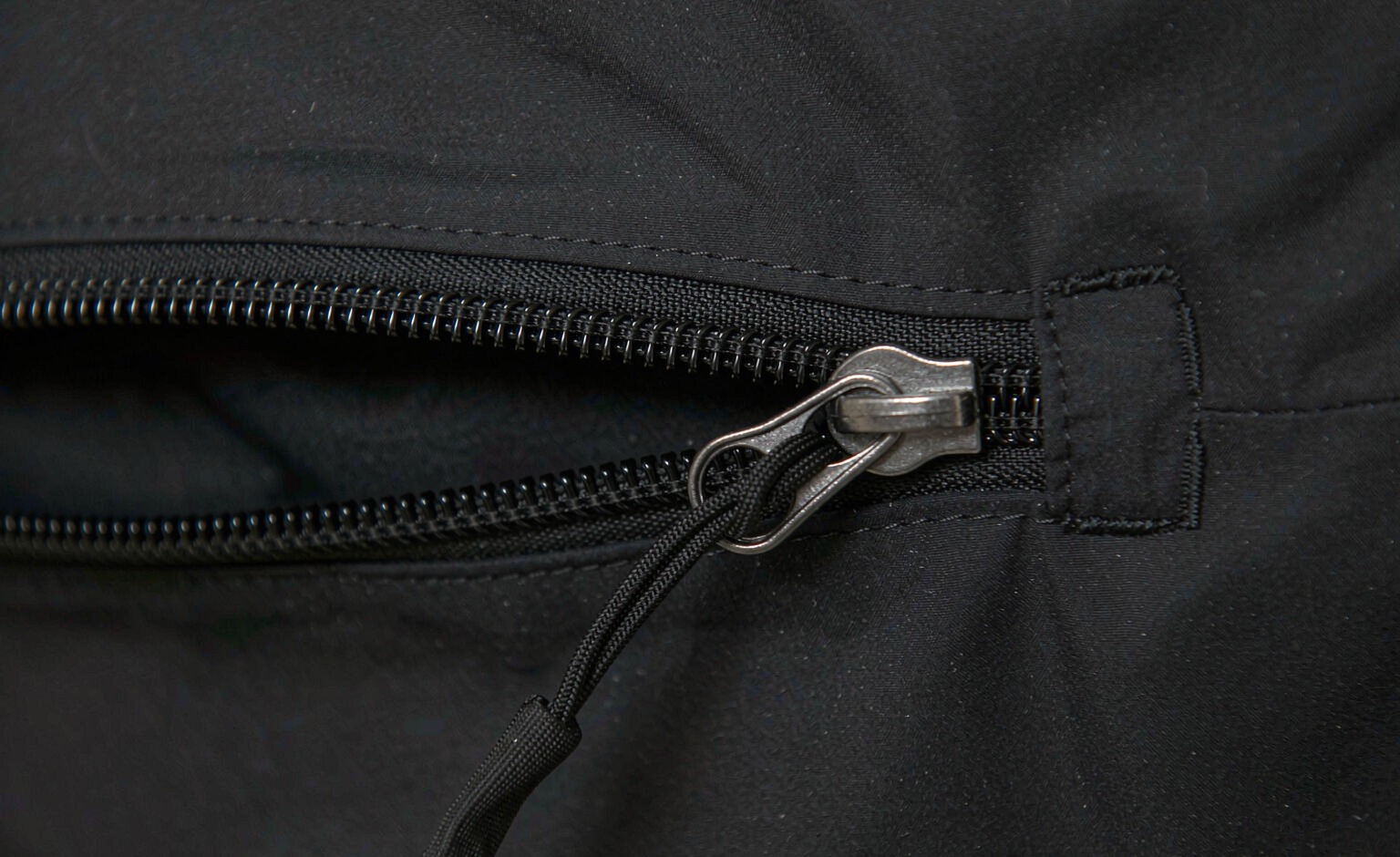
Hook-and-loop and a zipper fix a module to a host panel in opposite ways: the touch fastener makes a distributed joint that is strong in shear and weak in peel and that degrades gradually, while a zipper makes a travelling interlock that holds equally in both directions and then fails all at once. Five measurements decide between them - shear holding per square centimetre, peel resistance at the free edge, cycles before holding drops to half its starting value, behaviour after lint or grit contamination, and whether the joint can be repaired away from a sewing machine. Attachment programmes start at 500 pieces per reference, sample in 6-10 working days, build across 35-50 days and are accepted on an AQL 2.5 plan; touch-fastener performance is measured to ASTM D5169 for shear and ASTM D5170 for peel. Scope is civilian load carriage - tool rolls, first-aid modules, camera inserts, organisers - and no military certification is claimed.
A distributed surface joint against a travelling interlock
A hook-and-loop joint is a surface. Two faces are pressed together, thousands of small engages form across the whole area, and the load is shared among them. Nothing travels, nothing aligns and nothing has to match a pitch; the only requirement is that the two faces overlap. That property is why touch fastener remains the default for organisers, dividers, patches and anything that has to be repositioned freely.
A zipper joint is a line. Two chains are brought into register, a slider travels along them, and the teeth interlock one after another. Load is carried by those teeth and transferred into the tape on each side. The joint is strong and its strength does not depend on area - a short chain holds as much as a long one - but the geometry is fixed: the module has to match the host panel in chain size, length, start point and direction of travel.
The consequences follow directly. The surface joint tolerates misalignment, repositioning and partial overlap, and it can be made in any shape. The linear joint demands precision, cannot be repositioned without re-mating the whole chain, and is only made in straight or gently curved runs. For a programme with several modules sharing one host panel - the pattern set out under MOLLE system - the surface joint is far more forgiving of the tolerance stack between parts.
Bottom line: Choose the surface joint where modules are repositioned, resized or shared across a panel, and choose the linear joint where the module has one fixed position and the load is known and consistent.
Shear and peel: the two directions every attachment joint is loaded in
Attachment joints fail by direction before they fail by magnitude. Shear is the load that tries to slide one face across the other - the weight of a loaded module pulling downward against a vertical panel. Peel is the load that lifts one edge away - a module brushed against a door frame, or contents pushing outward from inside. A hook-and-loop field resists shear well and peel badly, and the gap between the two is the single most important number in the joint's specification.
The reason is geometric. In shear, every engage shares the load and the failure requires thousands of them to release at once. In peel, the load concentrates at the leading edge, and failure advances engage by engage along the edge like a zipper opening itself - except there is nothing to stop it. Designers who size a touch-fastener field from its shear figure alone produce modules that fall off door frames.
A zipper joint does not have that asymmetry. The interlocked teeth resist separation in the peel direction almost as well as they resist sliding along the chain, because each tooth is mechanically captured rather than frictionally engaged. The load in the peel direction is carried into the tape by the seam, which is why the seam and the tape - not the chain - usually set the ceiling for a zipper-attached module.
| Load direction | Hook-and-loop field | Zipper interlock | Failure signature |
|---|---|---|---|
| Shear, load along the panel | Strong, shared across all engages | Strong, carried by the teeth | Slow slip or seam run-out |
| Peel, load lifting one edge | Weak, advances from the edge inward | Nearly as strong as in shear | Progressive unzip or tape tear |
| Load applied at a corner | Poor - worst case for the field | Good - corner is captured | Edge lift or slider displacement |
| Sustained vibration | Engages relax slowly | Holds, may rattle | Creep or audible buzz |
| Effect of larger contact area | Holding rises with area | No gain beyond the seam | Area is irrelevant to a chain |
Measurement belongs on the finished assembly rather than on a loose strip. Shear and peel behaviour of a touch fastener is established to ASTM D5169 and ASTM D5170 respectively, and the tape and seam behind either joint to ASTM D5034. What the programme needs from those methods is a comparison on the actual panel stack: the same cloth, the same stitch, the same curvature - because a joint that tests well flat can behave very differently once the panel it is sewn to bends.
Judgement: Size a touch-fastener field from its peel figure rather than its shear figure, add a mechanical stop or a flap at the free edge wherever peel load is realistic, and accept a zipper joint when a corner-loaded module would otherwise be at its weakest.
Noise: the sound signature that decides some categories outright
Separating a hook-and-loop field is the loudest event in most products' acoustic signature. A 100 mm strip pulled apart produces a short broadband noise that carries across a quiet room, and there is no quiet way to do it - the sound is the engages releasing, so any design that reduces the noise has already reduced the holding. Products sold for wildlife observation, for hospital and clinical work, for shared offices or for any setting where a wearer needs to open a pocket discreetly are effectively excluded from touch-fastener closures.
A zipper is not silent, but its noise is proportional to how fast it is pulled and can be managed: a slow pull on a coil chain is quiet, a moulded-tooth chain is quieter than a metal one, and a fabric garage or a flap over the slider removes the rattle that a loose puller generates on the move. For products where the opening is operated repeatedly in company, this difference alone settles the specification.
Noise also has a second-order effect that is easy to miss: a wearer who finds a closure embarrassing stops using it. A module that is technically removable but socially awkward gets left in place, which quietly defeats the entire modular proposition. Field feedback on this point is worth collecting before a range is finalised, and it is cheap to collect - ask five users to open the module in a quiet room and watch what they do.
Spec rule: Where the product is used in quiet company - clinical, office, wildlife, hospitality - exclude the touch fastener from any closure the wearer opens routinely, and keep it only for internal dividers or for panels that stay closed for weeks at a time.
Service life in cycles: how each joint wears and what the end looks like
Wear is where the two joints differ most in character. A touch fastener degrades gradually and visibly. Hooks straighten and lose their grip, loops pill and mat down, and holding force declines as a smooth curve - typically retaining a useful fraction of its starting figure after a few thousand engage-disengage operations and continuing downward from there. The user experiences this as a module that used to feel solid and now feels marginal, and there is no single moment when it stopped working.
A zipper degrades differently: it holds its performance and then fails. The chain itself wears slowly, the slider is the part that wears fastest, and the end usually arrives as a slider that no longer closes the chain, a bottom stop that has walked, or a tape that has frayed where it enters the slider. There is little gradual loss of holding - a zipper-attached module either stays on or comes off.
| Wear axis | Touch-fastener field | Zipper interlock |
|---|---|---|
| Shape of the decline | Smooth curve from the first cycles | Flat, then a step change |
| Useful life order | A few thousand operations | Several thousand operations |
| First visible symptom | Loop face mats, hook face shines | Slider becomes loose or stiff |
| What the user notices | Module feels gradually less secure | Module is secure, then is not |
| End-of-life warning | Plenty, if anybody measures | Almost none |
Which profile is preferable depends on the consequences. A gradual decline gives warning, which suits a module holding something valuable - a camera insert, a first-aid kit - and it allows a preventive replacement interval to be published. A step failure suits a module whose loss is immediately obvious and harmless - an organiser panel, a cable pouch - and it avoids the slow uncertainty of a joint nobody can quite judge.
Verdict: Use the touch fastener where a gradual, observable decline is an advantage and a replacement interval can be published, and use the zipper where the module's loss is obvious and harmless and certainty of attachment matters more than warning.
Dirt, lint and water: the contamination failure each joint suffers
Both joints have a contamination failure and they are different. The hook face of a touch fastener collects lint, hair, fur, carpet fibre and dried mud; the loop face mats down under the same debris. Holding force falls as the faces clog, and the user's first instinct - pressing harder - packs the debris in further. Cleaning is possible but only partial: a stiff brush or a comb recovers a useful proportion of the original performance, and a wash cycle recovers more, but a heavily loaded field never returns to its starting figure.
A zipper fails on grit rather than on fibre. Sand or dried mud in the chain prevents the teeth from seating, the slider becomes stiff, and continued force damages the slider mouth - the common beach-and-desert failure. The recovery is better than for a touch fastener: flushing with clean water and working the slider back and forth removes most of it, and a stiff slider can often be eased with a dry lubricant. Salt water is the harder case, because it leaves crystals behind after the water evaporates.
Water behaviour differs in the other direction too. A touch fastener works wet and dries out with no lasting effect; it does not corrode and it does not stiffen. A zipper with metal components needs a finish clause and a corrosion screen, and a zipper whose tape has absorbed water can stiffen until it dries. For marine and wet-weather products, the touch fastener's indifference to water is a genuine advantage that is often overlooked.
Takeaway: Choose the touch fastener for fibre-heavy environments and wet service where it can be brushed out and dried, choose the zipper where the contamination is grit rather than lint and can be flushed, and specify a finish and corrosion screen for any metal chain used near salt water.
Maintainability: what a user can fix away from a sewing machine
Both joints eventually need attention, and the practical question is what a user can do about it in a workshop, a vehicle or a hotel room. A touch fastener can be cleaned with a stiff brush, a comb or a blunt knife edge; it can be re-pressed firmly to recover some grip; and a worn field can be replaced by cutting a new piece to shape and sewing it on - a job for a machine, but a simple one that any repair shop can do in minutes. The parts are cheap, universally available and do not have to match a pitch.
A zipper-attached module is harder to maintain away from a workshop. A stiff slider can sometimes be eased, a snagged chain can be worked free, and a puller can be replaced if a spare is carried - but a damaged chain or a torn tape means unpicking a seam and re-sewing a chain of the exact size, direction and length. That is a real repair job, and it needs the right part.
Design can improve both. Carrying a spare puller, specifying a slider with a replaceable pull, and leaving a little slack in the tape all make the zipper route more serviceable. Using a standard touch-fastener width, avoiding a shaped die-cut field and sewing the hook face to the module rather than to the host panel - because the hook face is the one that wears - all make the surface route easier to renew. See the compact configurations covered under modular EDC, where serviceability drives most attachment choices.
Selection rule: Put the hook face on the replaceable part, keep the touch-fastener field a standard rectangular shape that any shop can re-cut, and if the zipper route is chosen, carry a spare puller and specify a slider whose pull can be changed without unpicking the seam.
Clauses a module attachment specification needs
An attachment clause should state: joint type; for a touch fastener, the width, the area in square centimetres and which face goes on which part; for a zipper, the chain type and size, the length, the direction of travel and the start point; the test methods and the acceptance figures in shear and in peel; the cycle count with the retention figure; the stitch pattern holding the joint; and a revision identity. Anything less transfers the decision to whoever is cutting that week.
Area calculation deserves its own line, because it is the number most often guessed. A touch-fastener joint carries in proportion to the engaged area, so a module rated for a given load needs a stated overlap in square centimetres with a stated margin, and that overlap has to survive the module being fitted slightly off-centre by a user. A workable rule is to calculate the area for the rated load and then specify the field with enough margin that a 20 per cent misalignment still leaves the required area engaged.
Attachment programmes are handled on a floor of 4,950 m² that has passed third-party verification, where seven lines and 149 machines are run by 137 staff and output runs at about 200,000 pieces monthly; the founder's first year in bag production was 2004 and the company was founded in 2014. Incoming goods are accepted on an AQL 2.5 plan drawn from ISO 2859-1, with shear and peel figures checked per lot and a retained sample kept against each approved delivery. Platform geometry is documented under modular backpacks, and programme routes under custom modular backpacks.
State the engaged area in square centimetres with a margin for user misalignment, name the test method and acceptance figure in both shear and peel, and keep a retained sample per approved lot so a reorder can be compared rather than trusted.
Commercial mechanics for module attachment programmes
Attachment choices move the calendar less than they move the bill of materials, and the effect worth planning for is pattern count rather than lead time. A touch-fastener field is a cut part with no minimum beyond the roll, while a zipper-attached module needs a chain of the correct size and length in the correct colour, which is a bought-in line item with its own booking. Where a range carries several module sizes, standardising on one chain length across them removes a line item and a booking risk.
Costs follow the familiar shape. Die-cut or shaped touch-fastener fields and any bespoke zipper length or puller carry tooling quoted at USD 300-2,500 depending on the tool; standard rectangles and stock chain lengths carry none. A sample charge of USD 50-150 applies to each reference and is credited against the volume order. Each reference starts at 500 pieces, quoted indicative FOB Xiamen on terms of 30 per cent with the order and 70 per cent against the bill of lading, and a quotation follows a complete specification within 24-48 hours.
Transit is the last decision. Surface transit of 25-35 days suits a planned fill, airfreight at 5-8 days suits a committed launch, and courier in 3-5 days suits approval pieces and replacement parts. Because attachment components are light and flat, they consolidate well, and a programme approaching container scale at roughly 28 CBM should be costed both ways before booking.
Standardise on one chain length and one touch-fastener width across the module range, book any bought-in chain when the design is frozen rather than after approval, and cost the first fill both ways at container scale before choosing between surface transit and air.
Frequently asked questions
What is the main difference between hook-and-loop and a zipper for attaching a module?
A touch fastener makes a distributed surface joint - strong in shear, weak in peel, degrading gradually and repositionable anywhere. A zipper makes a linear interlock - strong in both directions, fixed in position and failing all at once. The choice is between flexibility and certainty.
Which attachment holds better in shear on a vertical panel?
Both hold well in shear, and the ceiling is usually the tape and seam behind the joint rather than the fastener itself. Touch-fastener shear is measured to ASTM D5169 and the tape and seam to ASTM D5034; test on the actual panel stack, not flat.
Why does a hook-and-loop module fall off when brushed past a door frame?
Because that is a peel load, and peel advances engage by engage from the lifted edge inward. Size the field from its peel figure measured to ASTM D5170 rather than from shear, and add a mechanical stop at the free edge.
How much hook-and-loop area does a module need?
Calculate from the rated load and then add margin so a 20 per cent misalignment still leaves the required area engaged. Holding rises with area for a touch fastener, while a zipper gains nothing beyond the strength of its tape seam. State the area on the drawing.
How many cycles does a hook-and-loop joint survive?
Expect a useful fraction of starting holding after a few thousand engage-disengage operations, declining smoothly from there as hooks straighten and loops mat. Zipper joints hold their figure longer and then step down. Publish a replacement interval for valuable contents.
Is a zipper-attached module louder or quieter than hook-and-loop?
Far quieter. Separating a 100 mm touch-fastener strip is the loudest event in most products, and it cannot be silenced without losing holding. A coil chain pulled slowly is quiet; add a garage or flap over the slider to stop the rattle on the move.
Can hook-and-loop be cleaned after it clogs with lint?
Partially. A stiff brush or comb recovers a useful proportion and a wash cycle recovers more, but a heavily loaded field never returns to its starting figure. Pressing harder packs debris in further, so brush rather than press when holding drops.
How does grit affect a zipper-attached module?
Sand or dried mud prevents the teeth seating and stiffens the slider; forcing it damages the slider mouth. Flush with clean water and work the slider back and forth. Salt water is worse, because crystals remain after the water evaporates, so rinse with fresh water afterwards.
Which attachment works better in wet or marine conditions?
The touch fastener, because water does not affect it and it dries with no lasting change. A metal chain needs a finish clause and a corrosion screen, and a wet tape stiffens until dry. For salt-water service, pair the touch fastener with a rinse routine.
Can a user repair either attachment away from a sewing machine?
A touch fastener can be brushed, re-pressed or cut to shape and sewn by any shop. A damaged zipper chain or tape needs unpicking and a chain of the exact size, length and direction. Carry a spare puller and specify a replaceable pull if serviceability matters.
Which face should be sewn to the replaceable module?
The hook face, because it is the one that wears and it is cheaper to replace a module field than a host panel. Keep the loop face on the host where it collects less debris, and keep the field a standard rectangle any shop can re-cut.
Does a zipper-attached module need to match the host panel exactly?
Yes - chain size, length, start point and direction of travel all have to match, and the run must stay straight or gently curved. A touch fastener needs only overlap, which is why it tolerates the tolerance stack between several modules sharing one panel.
How long does sampling take for a module attachment programme?
Six to ten working days for the sample round, with volume across 35-50 days. Each reference starts at 500 pieces and a quotation follows a complete specification within 24-48 hours. Book any bought-in chain when the design is frozen, not after approval.
Which inspection level applies to incoming attachment components?
Lots are accepted on an AQL 2.5 plan drawn from ISO 2859-1, with shear and peel figures checked per lot against the retained sample from the approved delivery. A changed revision identity means fresh approval rather than acceptance.