Home › Field notes › IPX Waterproof Ratings for Modular Bags: What the Code Proves
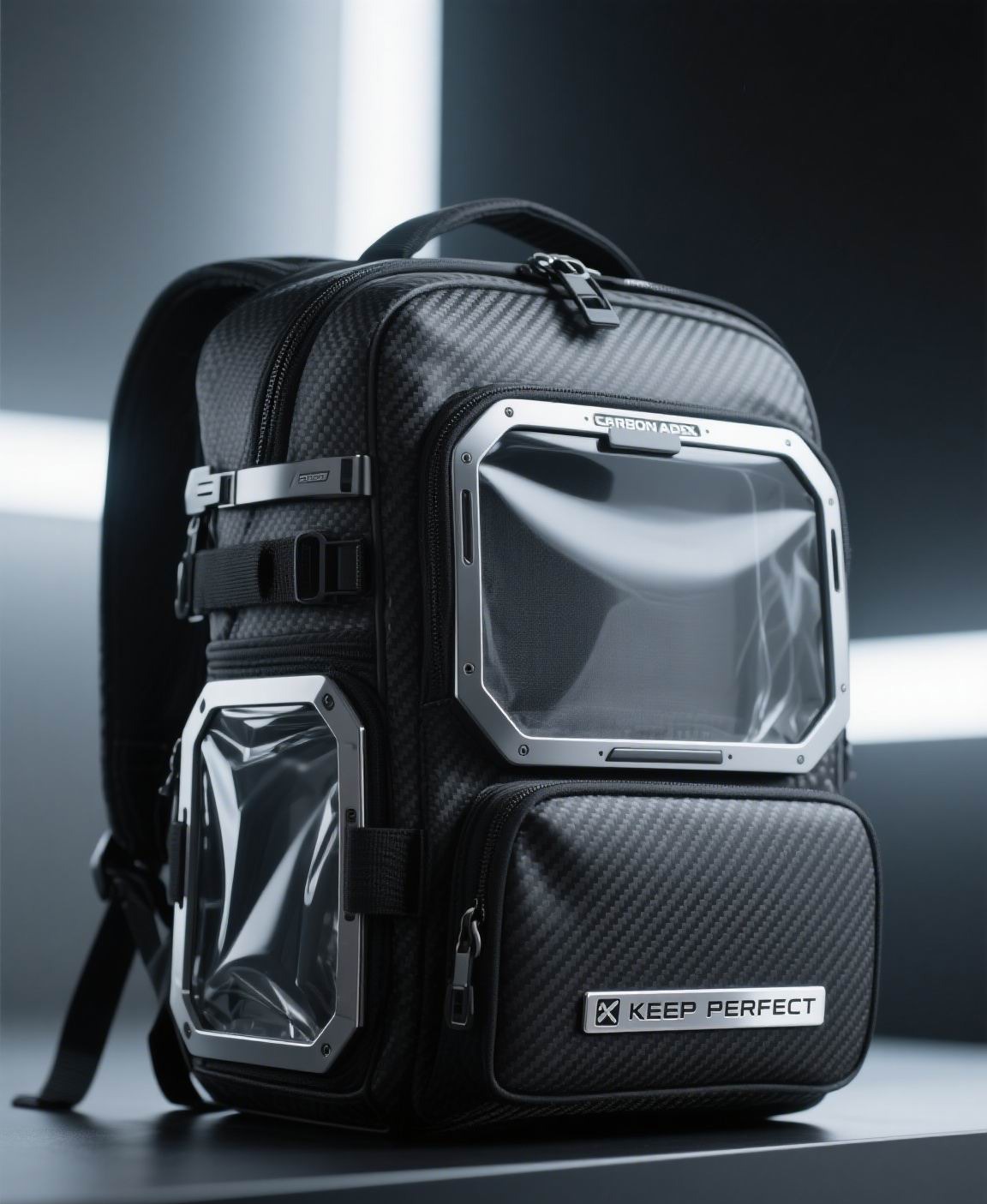
IPX waterproof ratings describe the outcome of a defined test on a complete product; they are not a property that a fabric can hold. This distinction is the source of most water-performance disputes in the bag trade. A shell material measured under AATCC 127 returns a hydrostatic head in millimetres, which tells you how much water pressure the flat material resists before it passes through. It says nothing about the seam beside it, the stitch penetrations through it, or the mounting plate that a detachable module attaches to. An IPX code under IEC 60529 is assessed on the assembled article and is the only figure that can support a product-level claim. This guide sets out what each code proves, where water actually enters, and how to specify performance without over-claiming.
What an IPX Code Actually Certifies
The IP code is defined by IEC 60529 and has two numerals. The first covers ingress of solid objects; the second covers ingress of water. Where the first is not assessed, it is written as X, which is why bag claims normally appear as IPX4, IPX5 or IPX6 rather than as a two-digit code.
The second numeral is the one that matters here, and each level corresponds to a specific exposure with a defined duration, water volume and nozzle geometry. Lower levels describe splashing or light spray from defined directions. Mid levels describe jetting from a nozzle at a stated flow and distance. Higher levels describe temporary or continuous immersion under stated conditions. None of them describe rain in general, and none of them describe what happens to a bag being worn in a storm.
Two properties of the code are worth stating because they are routinely misunderstood. It is assessed on a complete article in a defined condition, which means the result belongs to that configuration and not to the material. And it is a pass/fail classification rather than a measurement, so a product either meets the level or it does not; there is no partial credit and no figure that can be averaged.
That makes an IPX code a strong claim and a narrow one. Strong, because a third-party laboratory assessed a finished item. Narrow, because it says nothing about performance outside the tested configuration, and a modular bag has many configurations.
Selection rule: Quote the complete ingress code with both numerals and name the configuration submitted, because a rating attached to an empty chassis says nothing about the same chassis loaded with modules along its 50 mm horizontal repeat.
The Fabric Figure and the Product Figure Are Different Things
AATCC 127 measures the resistance of a flat material to water penetration under a rising column of water. The result is reported as a hydrostatic head in millimetres, which is a material property and a useful one for comparing two fabrics.
It is not convertible into an IPX level. A fabric with a high hydrostatic head can be assembled into a product that fails a low IPX level, because the water does not come through the middle of the panel - it comes through the seams, the stitch holes and the closures. The reverse is also possible: a modest fabric with well-managed seams can outperform a superior fabric assembled carelessly.
| Figure | What is tested | Claim it can carry |
|---|---|---|
| Hydrostatic head, AATCC 127 | Flat material under a water column | A statement about the material only |
| Coating adhesion, ASTM D751 | Coating bond to the substrate | A statement about coating durability |
| IPX level, IEC 60529 | Complete assembled article | A product-level ingress classification |
| Shower or spray test, in-house | Assembled article, brand-defined rig | An internal comparison only |
The fourth row is the one that causes the trouble. An in-house shower test is a valuable development tool and cannot be published as a rating, because the exposure is not defined by any standard and no third party has assessed it. Publishing it as though it were a rating is the most common route to a challenged claim.
A specification should therefore carry both figures in separate lines with their methods named: the material figure for purchasing control, and the assembly classification for the product claim. Conflating them is not a simplification; it is an error that will be found, usually by a reviewer who asks one question: which article was submitted to the laboratory. A material report cannot answer that question, and once it cannot, the claim assembled on top of it has no support.
Verdict: Keep hydrostatic head on the sheet as a material property and never promote it to a product rating, since laboratory round-trips fit inside the 6-10 working day sampling window and asking early costs less than defending a printed claim.
Where Water Actually Enters a Modular Bag
Water does not penetrate a coated panel in the middle. It enters at the discontinuities, and a modular product has more of them than a conventional one. Four paths account for nearly all ingress.
The first is the seam. A sewn seam is a row of holes through the material, and every hole is a path. Seam strategy - bound, taped, welded or turned - determines whether that path is open, and it is a construction decision rather than a material one.
The second is stitch penetrations for attachment. Every row of webbing is stitched through the shell, and in a modular product those rows are numerous and located exactly where a module sits. This is the path that modularity adds, and it is the reason a modular bag is harder to seal than the same bag without an attachment field.
The third is the closure. A coil zipper is a continuous opening with a tape seam on each side; a reversed coil with a storm flap is better and still not sealed. Where a bag carries a water claim, the closure is usually the limiting component and not the fabric.
The fourth is hardware penetration. A mounting plate, a grommet or a magnetic counter-plate fixed through the panel creates a hole with a rigid part in it, and rigid parts move relative to fabric. Any claim about the assembly has to account for those penetrations, because a test that ignores them is testing a different product.
There is a fifth path that appears only in service: abrasion at the coating. A coated fabric resists water because of a film applied to its surface, and that film is worn by contact, by grit and by flexing. Once the coating is abraded through at a fold, the substrate underneath behaves nothing like the measured material, which is why abrasion resistance read under ASTM D3884 or ISO 12947 belongs in the same specification block as the water figure.
Seams, Closures and the Penetration Problem
If the fabric is not the weak point, the seam strategy is where the engineering belongs. Four options exist and each carries a cost.
Welded construction removes the needle holes entirely by joining material with heat or radio frequency. It is the most effective route and the most constrained: it requires a thermoplastic coating compatible with the process, it limits some geometries, and it changes the repair path because a welded seam cannot simply be re-sewn.
Taped seams cover a sewn seam with a sealed tape applied under heat. Effectiveness depends on tape selection, application temperature and the coating underneath, and a tape applied to an incompatible coating will lift. Where tape is specified, the coating compatibility should be stated rather than assumed.
Bound and turned seams manage water by geometry rather than by sealing: they move the penetration path so that it is not directly exposed. They cost little and they perform moderately, which makes them the correct choice where the exposure is light.
Closures deserve the same treatment. A storm flap over a coil zipper, a garage at the slider, and a coated tape all reduce ingress without turning the bag into a sealed container. The honest framing is that these measures reduce ingress; they do not make an opening disappear.
One interaction is worth stating because it is counter-intuitive. A storm flap that covers a closure also covers the path water would take to drain away from it, so a badly detailed flap can hold water against the very seam it was meant to protect. Where a flap is specified, the drawing should show how water leaves the area rather than only how it is kept out.
Bottom line: Detail each flap so water leaves the area rather than merely being excluded, then commission two reports during the sampling round booked at MOQ 500 per configuration, one for the chassis alone and one for the mounted assembly.
What to Ask a Laboratory to Test
A test request that names only a rating will produce a report that cannot be defended. The request has to describe the article, the configuration and the conditioning, because a modular product can be submitted in several states and the result belongs to the one submitted.
| Request field | Value that must be stated | Ambiguity removed |
|---|---|---|
| Article submitted | Complete assembly, part numbers listed | Stops a material result standing in for a product result |
| Configuration | Which modules mounted, in which positions | Stops the rating applying to an untested layout |
| Orientation | Angles and rotation during exposure | Stops a favourable orientation being chosen |
| Conditioning | Temperature, ageing, flexing before test | Stops a new-sample result standing in for service |
| Endpoint criterion | What counts as ingress, and how much | Defines failure before the test, not after |
The configuration row is the critical one for modular work. A rating obtained with no modules mounted does not describe the product as sold, because mounting a module changes the geometry at the penetrations and adds its own seams. If the claim is about the product, the test has to be run on the product as configured.
Conditioning is the second most important row and the most often skipped. A fabric and a tape behave differently after flexing and after thermal ageing, and a rating obtained on a fresh sample describes a product that has not been used.
Two further fields are worth adding where the budget allows. Submit more than one unit - a single sample tells the buyer that the design can pass, while three units tell the buyer that the process can repeat it. And ask for photographs of the interior after exposure, because a pass/fail result does not say how close the article came to failing, and a near miss is information a specification should act on.
Takeaway: Write the test request around the article, the configuration and the conditioning, and ask for interior photographs after exposure, because results returned in a 3-5 day courier packet say nothing about how near to failing the article came.
Why Modular Assemblies Are Harder to Rate
Modularity multiplies the number of states a product can be in, and an ingress classification attaches to one state. That is the structural reason modular water claims are harder to hold than conventional ones.
Consider the variables. The chassis alone is one state. The chassis with one module mounted is another, and the position of the module matters because it changes how water runs. A chassis with four modules is a third. Each additional module brings its own seams, its own closure and its own penetration, and the assembly is only as good as the worst of them.
There is also an interface effect. A module mounted against a panel creates a gap that did not exist in the bare configuration, and that gap can channel water toward a penetration rather than away from it. Testing the chassis and testing the module separately will not reveal this, because the effect only exists when they are assembled.
The practical resolution is to test the worst realistic configuration and claim at that level. That is a lower number than the chassis alone would achieve, and it is the number that survives contact with a user who actually mounts four modules. Claiming the bare-chassis figure is technically true and commercially indefensible.
The same logic applies to the module itself. Where a module is sold as a separate accessory and carries its own water claim, it has to be assessed both alone and mounted, because mounting changes the shape it presents to the water and adds the interface gap. Two reports, two claims, and neither one stands in for the other.
Judgement: Build a second laboratory round into the schedule for any claim covering a mounted configuration, keeping that headroom inside the 35-50 day mass production calendar rather than hoping one certificate covers several product states.
Claim Wording That Survives Review
Most water claims fail not because the product is bad but because the wording extends past what was tested. The table sets out the common patterns.
| Claim pattern | Evidence it demands | Defensible wording |
|---|---|---|
| Fabric resistance figure quoted alone | AATCC 127 report on the material | Shell material measured at a stated hydrostatic head |
| Assembly classification | IEC 60529 report on the finished item | Rated to a stated IPX level in the tested configuration |
| Seam treatment described | Construction specification and inspection record | Seams taped, or seams welded, named per location |
| General weather claim | None sufficient | Designed to reduce ingress; performance depends on configuration |
The last row is the honest fallback and it is more useful than it looks. A buyer reading "designed to reduce ingress" knows what they are getting; a buyer reading an unqualified weather claim has been told nothing that can be checked.
Two habits protect a claim. State the configuration the rating applies to, and keep the test report with the same revision number as the product it describes. Where a product changes - a different closure, a moved seam, a new module - the rating applies to the previous revision and to nothing else.
A third habit costs nothing and prevents the most common challenge: never let the material figure and the assembly classification appear in the same sentence without naming both methods. A sentence that reads as though a hydrostatic head produced an IPX level invites exactly the question that cannot be answered, and once asked it undermines the parts of the claim that were properly evidenced.
Specifying Water Performance Without Over-Claiming
The specification should carry three separate lines, and they should not be merged into one adjective.
The first line is material: denier, coating type and hydrostatic head measured under AATCC 127, with coating adhesion under ASTM D751 alongside it. This is a purchasing control and it is checked at incoming inspection.
The second line is construction: seam treatment per location, closure type and tape, and the treatment applied where a mounting plate penetrates a panel. This is what determines the assembly result and it is a drawing-level specification rather than a material one.
The third line is the assembly classification, if one is pursued: the IPX level under IEC 60529 for a named configuration, with the report reference and the revision it was assessed against. Where no third-party assessment has been commissioned, the line should say so rather than defaulting to a number. An empty field is honest and actionable; a number inserted by convention is neither, and it becomes the specification the next team inherits. Where a buyer needs a defensible external statement and no assessment has been commissioned, the correct action is to commission one during sampling rather than to fill the field with a conventional figure.
Sampling is the place to resolve all three. A standard configuration is turned around in 6-10 working days, or 12-15 working days where welded construction or a sealed closure is involved, at a fee of USD 50-150 per configuration, refundable against the order. That is the cheapest point at which to discover that a seam strategy does not survive the chosen coating, and it is the point at which a change costs a pattern revision rather than a container of finished goods. Where inspection closes the loop, sampling levels follow ISO 2859-1 with AQL 2.5 agreed in writing, and the seam treatment should appear in the defect classification as a functional item rather than a cosmetic one, because a lifted tape is invisible from outside and is the difference between a passing and a failing assembly. For the closure and seam options used across the current range, see the modular hiking backpack notes.
Spec rule: Keep material performance, seam treatment and closure performance as three separate lines with three separate evidence sources, rather than merging all three into one adjective that no single report can support.
Frequently asked questions
Is a hydrostatic head figure the same as an IPX rating?
No. A hydrostatic head measured under AATCC 127 is a material property obtained on flat fabric under a water column. An IPX level under IEC 60529 is a classification assessed on a complete assembled article. One cannot be converted into the other.
Can a fabric with a high hydrostatic head still fail an IPX test?
Yes. Water does not pass through the middle of a coated panel; it enters at seams, stitch holes, closures and hardware penetrations. A superior fabric assembled with an open seam will perform worse than a modest fabric with a managed one.
What does the X in an IPX code mean?
That protection against solid object ingress was not assessed. The code defined by IEC 60529 has two numerals; where the first is not tested it is replaced by X, and the second numeral describes water ingress only.
Which IPX levels are relevant to bags?
Lower levels describe splashing or spray from defined directions, mid levels describe jetting from a nozzle at a stated flow and distance, and higher levels describe temporary or continuous immersion. None of the levels describe general rainfall.
Why is a modular bag harder to rate than a conventional one?
Because a rating attaches to one configuration and a modular product has many. Each mounted module adds seams, a closure and a penetration, and the assembly performs at the level of the worst element in it.
Should a rating be obtained with modules mounted?
Yes, if the claim is about the product as sold. Mounting changes the geometry at the penetrations and can channel water toward them, which is an effect that only exists when chassis and module are assembled.
What is the weak point in most bag water performance?
Usually the closure rather than the fabric. A coil zipper is a continuous opening with a tape seam either side; a reversed coil with a storm flap improves it but does not seal it.
Do taped seams make a bag sealed?
They reduce ingress at that seam, provided the tape is compatible with the coating underneath and applied at the correct temperature. An incompatible tape lifts, and a lifted tape is worse than no tape because it is invisible from outside.
Is welded construction always the best option?
It is the most effective at removing needle holes and the most constrained. It needs a compatible thermoplastic coating, limits some geometries, and removes the option of re-sewing a failed seam.
What should a laboratory test request state?
The article submitted, the configuration including which modules are mounted, the orientation during exposure, the conditioning before testing, and the endpoint that counts as ingress. Without the configuration the result describes a different product.
Why does conditioning matter before an ingress test?
Because fabric and tape behave differently after flexing and thermal ageing. A rating obtained on a fresh sample describes a product that has not been used, which is not the product the buyer receives.
How should a claim be worded if no third-party rating exists?
Describe the construction and the material figure separately, and avoid an unqualified weather claim. Saying seams are taped and the shell measures a stated hydrostatic head is checkable; a general weather claim is not.
Does a product revision invalidate an existing rating?
Yes if the revision touches a seam, closure or penetration. The report applies to the revision assessed, and where the product changes the rating should be re-established or the claim withdrawn.
How long does sampling take when sealed construction is involved?
A standard configuration runs 6-10 working days; where welded seams or a sealed closure are involved, plan 12-15 working days. The fee is USD 50-150 per configuration and is refundable against the order.