Home › Field notes › Modular Backpack for Mountain Rescue Teams: Load Envelope, Rope Carria
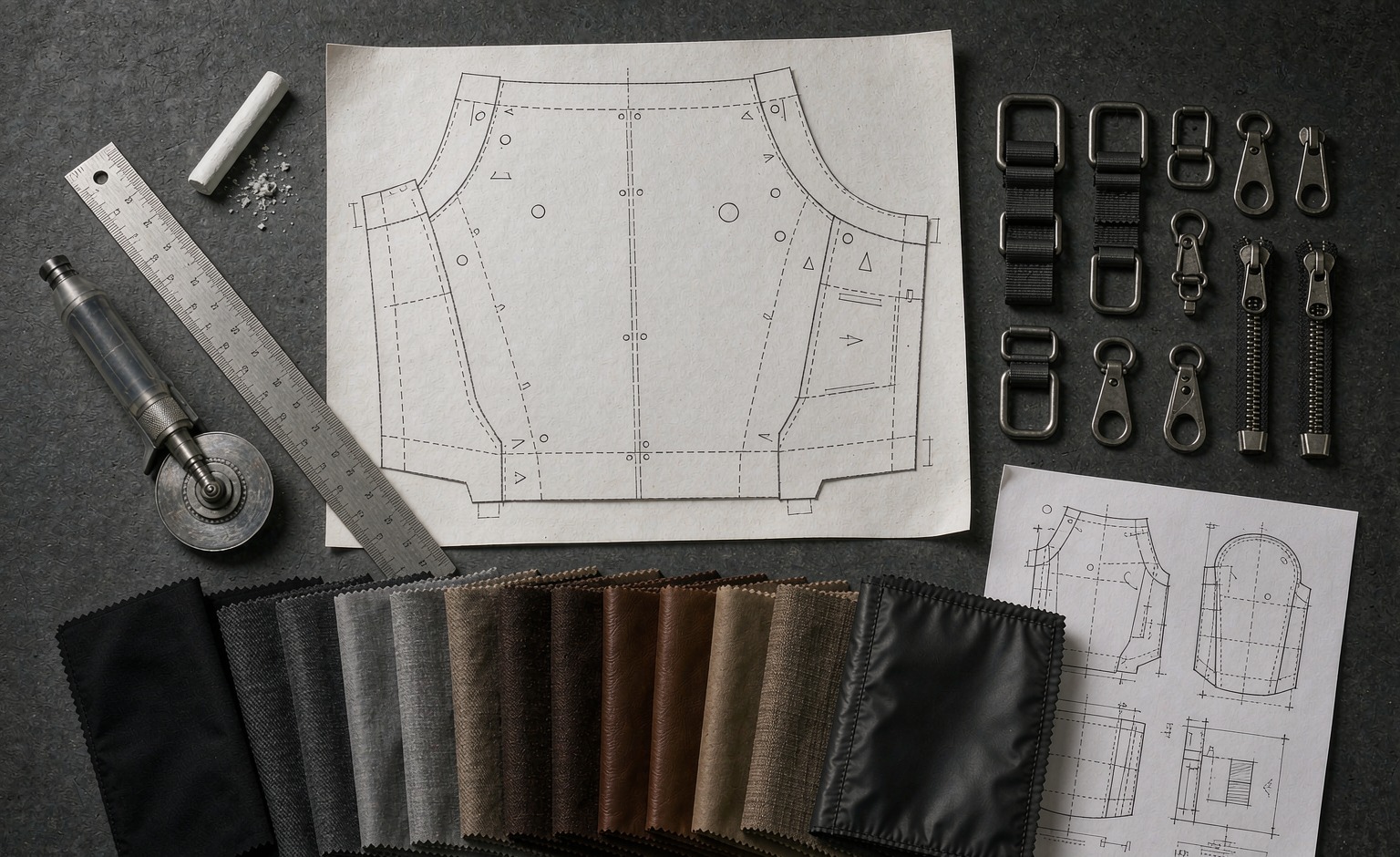
A modular backpack for mountain rescue teams is a long-duration carry platform built around an attachment grid, so rope, snow tools and equipment modules ride outside the main body and still stay inside the team size envelope. Programme gates are fixed at MOQ 500 units per reference, sampling in 6-10 working days or 12-15 where the panel layout is complex, mass production in 35-50 days, and inspection to AQL 2.5 against ISO 2859-1 level II, quoted FOB Xiamen on T/T 30/70. The boundary is that this covers civilian volunteer rescue, mountain guiding and backcountry team work only: no weapon carriage, no ballistic protection and no claim of any defence certification, and rope systems, anchors and casualty handling remain the team's own technical domain rather than anything instructed on this page.
What a Mountain Rescue Pack Has to Carry Through a Fourteen-Hour Shift
A call-out does not keep office hours. A volunteer who leaves the hut at six in the morning may still be wearing the same pack at ten at night, having crossed a ridge in cloud, waited out a squall and eaten one of the two meals carried. Every specification decision for this category starts from that duration. The load has to be tolerable at hour one and still tolerable at hour fourteen, and the layout has to survive thirty openings in the dark by somebody wearing gloves who is thinking about the hillside rather than about the bag.
Split the load in two before sizing anything. Personal kit - insulation layer, shell, spare gloves, food, two to three litres of water, a headlamp with a spare cell set and a small first-aid module - usually lands at 6-8 kg. Team hardware - a 30-50 m rope, karabiners and slings, an ice axe, crampons, a group shelter and a radio with a spare battery - adds a further 8-12 kg. The working envelope is therefore 14-20 kg before winter snow tools are counted, which is why a rescue pack is specified by declared load rating before it is specified by litre count.
Volume follows the load but is a separate decision. A 45-55 L main body absorbs personal kit and leaves the attachment face free for hardware. A 60-70 L body invites over-packing and pushes the centre of mass away from the spine, which is felt as shoulder burn on the approach and as instability on scree. The grid on the outside should be doing the work that extra litres would otherwise do badly: a rope carried externally can be dropped into a handler's hands in under fifteen seconds, while a rope buried under three layers cannot be produced at all without unpacking.
- Personal kit target: 6-8 kg including 2-3 L of water
- Team hardware target: 8-12 kg including a 30-50 m rope
- Main body target: 45-55 L with the rest of the load external
- Openings per shift: 20-35, most of them in poor light
- Carriage duration before rest: 6-14 hours on foot
Bottom line: Specify a mountain rescue pack from a declared working load of 14-20 kg carried for up to 14 hours, with a 45-55 L main body and rope and snow tools mounted on the attachment face rather than swallowed by extra internal volume.
Rope and Hardware Carriage: External Attachment Without Snag
Rope is the item that breaks ordinary hiking packs. It is heavy, it is long, it does not compress, and it is needed in a hurry rather than at a rest stop. Three carriage routes are available on a modular rescue pack, and they behave very differently once the wearer is off the path.
An under-lid rope chamber keeps the coil against the spine and fully enclosed, which is the best possible result for balance and the worst for speed, because the lid has to be opened and the contents disturbed. Side compression straps are fast and cheap but let the coil swing off-axis, and the free loops catch on rock, scrub and door frames. A cradle on the attachment face sits between the two: the coil is held low and central by a profiled panel, released by one buckle, and re-stowed without opening the main body.
Whichever route is chosen, the hardware - karabiners, slings, ice axe and crampons - should be on the same face as the rope, arranged so the heaviest item is closest to the spine and the sharpest item is pointed away from the wearer's legs. Crampons need a dedicated sleeve or a stiffened pocket; carried loose they abrade everything they touch and their points find the pack's own lining within a season. Ice axe shafts want a sleeved lower loop and an upper retainer, because a shaft held only at the top describes an arc across the wearer's field of view on every step.
| Selection criterion | Under-lid rope chamber | Side compression straps | Cradle on the attachment face |
|---|---|---|---|
| Time from stopping to rope in hand | 25-40 s, lid must be opened | 15-25 s, two straps released | 8-15 s, single buckle |
| Effect on centre of gravity | Best, coil sits against the spine | Poor, coil swings off-axis on scree | Fair, coil sits low and central |
| Snag behaviour in scrub and rock | None, fully enclosed | High, free loops catch on rock | Moderate, cradle is profiled |
| Practical load limit | 8-12 kg, limited by lid volume | 4-6 kg before slip | 10-14 kg with a stiffened panel |
| Weather protection for the coil | Good, shell fabric covers it | Poor, coil is exposed | Partial, needs a flap over the cradle |
| Interference with hip belt | None | High, straps cross the belt | Low if the cradle sits above the belt |
| Re-stow time after use | 40-70 s, lid must be closed again | 30-50 s, coil tends to twist | 20-35 s, coil drops into the cradle |
| Added empty mass | 60-110 g | 25-50 g | 140-260 g with stiffener |
Access to modular attachment grid geometry matters here because the cradle has to land on a known pitch, not on a decorative pattern of slots. Hardware mounted to a face whose rows do not match the strap width will work loose under a 10 kg coil in a single descent.
Verdict: Choose an attachment-face cradle when the team carries 8 kg or more of rope and needs the coil out in under 20 seconds; choose an under-lid chamber when balance and weather protection outweigh speed, and reserve side compression straps for light backup lines under 5 kg.
Alpine Weather Sealing: Face Fabric, Coating and Seam Construction
Alpine weather is not a single condition. A rescue pack meets driven rain at 2 °C, wet snow that loads the shoulder straps, and dry cold that makes coatings stiff. The specification has to survive all three across several hundred field days, which makes fabric selection a laboratory question before it is a marketing one.
Two measurements carry most of the decision. Resistance of the finished cloth to water penetration is tested to AATCC 127, and resistance to surface wetting and spray is handled separately, because a fabric can shed a shower and still wet through under the pressure of a hip belt pressing it against a rock. Abrasion resistance of the face cloth is tested to ISO 12947, which is the more important number for a rescue pack: a coating that survives the rain test and then abrades off the shoulder yoke in one winter has failed the actual service condition.
Coating choice follows. A polyurethane coating gives a flexible, repairable finish at moderate hydrostatic performance; a thermoplastic polyurethane laminate gives higher performance and better cold flex but is harder to field-repair and heavier per square metre. Film thickness is the variable that moves both numbers, and it is the variable most often cut when a buyer pushes on unit price without re-testing the cloth.
Seams decide whether the fabric choice survives assembly. Every needle hole is a leak path, so the specification has to state which seams are taped, which are bound and which are left plain with a storm flap over them. Zips are the other leak path: a covered zip with a garage at the top and a storm flap over the teeth keeps water out of the main body far better than a water-resistant zip used without a flap.
Selection rule: Write a hydrostatic figure for the finished cloth measured to AATCC 127, an abrasion figure measured to ISO 12947, and a named seam treatment for every seam on the drawing; reject any quotation that gives a fabric name without those three callouts.
Night Identification: Reflective Area, Colour Choice and Light Mounting
Rescue work runs into darkness more often than any other civilian carrying category. Identifying a team member at night is not a matter of picking a bright colour; it is a matter of retroreflective area placed where it moves, plus a light that can be mounted and removed without tools.
Retroreflective material works by returning light to its source, so a head torch beam finds a reflective band long before it finds a coloured panel. What matters is unbroken area, not decoration: a continuous 50 mm band across the lid and down both shoulder straps outperforms a scatter of small logos of the same total area, because the eye tracks a line and loses a cluster. Bands should sit on moving parts - the top of the lid, the front of each shoulder strap and the back of each hip belt wing - because movement is what separates a person from the terrain behind them.
Colour still carries a function in daylight and in cloud. A mid-tone body colour with a high-contrast lid panel is easier to pick out against both snow and rock than a single dark shell, and it does not show abrasion and grime as quickly as a pale one. Team identification is better handled by a removable panel than by body colour, so one production run can serve several teams and a replacement panel can be issued without replacing the bag.
Light mounting is a hardware decision. A dedicated loop or elastic keeper on each shoulder strap takes a compact marker light, and a patch field on the lid takes a blinking marker; both must be reachable with gloves on and must not interfere with the hip belt when the wearer bends. Battery access should not require unpacking the main body, because a light that needs the bag opened is a light that stays switched off.
- Reflective band width: 50 mm continuous on lid and straps, 25 mm acceptable on hip belt wings
- Reflective placement: at least three separate moving surfaces
- Marker light mount: one elastic keeper per shoulder strap, tool-free
- Team identity: removable 80-120 mm panel, replaceable without replacing the bag
- Glove compatibility: every night-access fastener usable with a 5 mm glove thickness
Takeaway: Require a continuous 50 mm retroreflective band on at least three moving surfaces plus a tool-free marker light mount on each shoulder strap, and treat team identity as a removable panel rather than a body colour.
Harness Geometry and Load Transfer on Steep Ground
A rescue pack spends more of its service life off the horizontal than any other load platform. Side slopes, scree and step-ups punish a harness that works fine on a flat test walk, and the failure shows up as hip belt slip, shoulder burn and a wearer who stops to adjust every fifteen minutes.
Load transfer is the whole problem. On a well-fitted pack the majority of the declared load should be carried on the hips, with the shoulder straps stabilising rather than supporting; if the shoulders are taking the weight, the hip belt is too narrow, too soft, or sitting in the wrong place. A belt in the 80-110 mm range, stiffened across the lumbar section and tapering at the ends, carries far better than a wide soft belt that rolls.
Torso length is the fitting variable that matters, and it is the one most often ignored in a team order. A single-size harness leaves the shortest and tallest members carrying badly for the whole life of the bag, so a programme should be specified with two or three torso lengths sharing one body and one attachment face. Load lifters running from the top of the shoulder straps to the frame at roughly 45 degrees pull the load back toward the spine; without them the pack sags and the wearer leans, which is how backs get hurt on long descents.
The frame itself should be a sheet or a hoop stiff enough to move load to the belt without adding a kilogram of hardware. A stiffened frame sheet behind a padded back panel is enough for a 14-20 kg declared load; an external frame earns its mass only when loads go higher or when a sled or stretcher has to be lashed to the pack.
Our own field feedback on long-distance hiking carry platforms points the same way: fit range beats feature count. A team that buys one torso size to save unit cost spends the difference in discomfort and in bags retired early.
Judgement: Order two or three torso lengths sharing a single body and attachment face, specify an 80-110 mm stiffened hip belt, and accept the added pattern cost, because a single-size harness leaves the shortest and tallest team members carrying a 14-20 kg load badly for the whole service life of the bag.
Attachment Faces Compared: Sewn Webbing Rows, Laser-Cut Slots and Hybrid Panels
The face that receives the pouches is where the word modular either means something or does not. Three constructions are in common use, and the choice is a trade between load capacity, exterior profile, threading speed with gloves on and repairability in the field.
Sewn webbing rows use the geometry widely published for PALS grids: 25 mm webbing, 38 mm vertical spacing between rows and a 50 mm horizontal repeat for the stitch islands that open the gaps a strap enters. The rows are stitched to a backing stack, and each row end is anchored into a structural seam so that pouch load returns into the body rather than into the face cloth. This is the heaviest and the most capable construction, and it is the one that can be repaired with a needle and thread in a hut.
Laser-cut slots in a laminate sheet remove the webbing entirely. The panel is flat, snag-free and light, and it photographs very well. It is also less tolerant: slots cut too close together tear, the laminate stiffens in the cold, and a torn slot cannot be field-repaired. Hybrid panels sew webbing rows onto a laminate face, buying pull strength at the cost of some of the flatness.
Tensile behaviour of the webbing and of the seam that anchors it is measured to ASTM D5034, and abrasion of the same webbing to ASTM D3884. Neither number predicts whether a pouch will stay put on a hillside on its own; that behaviour comes from pitch accuracy, end anchoring and the number of rows a given pouch actually engages, which is why the drawing has to state all three.
| Selection criterion | Sewn webbing rows | Laser-cut slots | Hybrid laminate face |
|---|---|---|---|
| Grid geometry to hold | 25 mm webbing, 38 mm pitch, 50 mm repeat | Slot pitch set by the cutting file | 25 mm webbing on a laminate base |
| Usable pull per attachment | Highest, load returns to structural seams | Lowest, load sits in the laminate | High, limited by the laminate bond |
| Exterior profile and snag | Raised rows, higher snag | Flattest, lowest snag | Intermediate |
| Threading speed with gloves | Slow, strap must be woven | Fast, strap enters directly | Slow, same weave as sewn rows |
| Cold-flex behaviour | Good, webbing stays flexible | Poor, laminate stiffens below 0 °C | Intermediate |
| Field repair route | Needle and thread in the hut | None, panel must be replaced | Partial, rows can be restitched |
| Added mass per 100 cm2 | 35-55 g | 18-30 g | 40-70 g |
| Service life before face service | Longest | Shortest under abrasion | Long |
Spec rule: Select sewn webbing rows when a mounted module exceeds 3 kg or will be re-attached more than 200 times, select laser-cut slots when the exterior must stay flat and loads stay under 1.5 kg, and select a hybrid face when both a 25 mm grid and a stiff mounting base are required on the same panel.
Inspection Intervals, Field Repair and Retirement Triggers
Fleet spares are simpler when every bag comes off one modular backpack platform. A rescue pack is safety-adjacent equipment in the sense that a strap failure at the wrong moment puts a second person at risk. That makes inspection a scheduled activity rather than an occasional one, and it makes retirement criteria worth writing down before the first bag goes out.
The inspection unit should be service days, not calendar months, because two teams in the same season accumulate wildly different wear. A busy team may put 80 service days on a pack in twelve months; a standby team may put eight. Written criteria also protect the programme from the opposite failure - bags kept in service for a decade because they still look presentable.
Field repair is limited by construction. Webbing rows can be restitched, buckles can be replaced from a spares kit, and a torn pocket can be patched. A delaminated face, a cracked stiffener or a hip belt whose internal stiffener has fractured cannot be repaired outside a workshop, and a pack with those faults should be withdrawn rather than downgraded to training use, because training use is where a bag is most likely to be loaded heavily and least likely to be inspected.
| Component | Check every N service days | Retirement signal |
|---|---|---|
| Shoulder strap anchorage | 10 | Stitch run-out visible, or webbing thinning at the fold |
| Hip belt stiffener | 20 | Fracture, or permanent roll that will not lie flat |
| Attachment rows | 10 | Island stitch broken on more than two adjacent rows |
| Main zip | 5 | Split teeth, or slider that will not fully close |
| Rope cradle buckle | 5 | Any crack, or gate that releases under 5 kg |
| Retroreflective band | 20 | Delamination over more than 20 percent of its length |
| Face coating | 30 | Abrasion through to substrate at any fold |
Inspect strap anchorages and attachment rows every 10 service days, retire any pack with a broken island stitch across two adjacent rows or a cracked cradle buckle, and never downgrade a withdrawn rescue pack to training use.
Production Capacity, Sampling Gates and Inspection Records for Rescue Programmes
Team orders arrive in bursts: a season starts, a grant clears, or a vehicle is refitted, and the whole fleet has to land in one delivery window. Capacity planning therefore matters more here than in steady retail replenishment.
Our production team runs a 4,950 m² SGS-verified production floor staffed by 137 people across 7 production lines with 149 machines, and the site turns out up to 200,000 units per month across all programmes. For a rescue fleet the binding constraint is rarely cutting capacity; it is the panel and webbing layout, which is why complex faces add days to sampling rather than hours. Expect sampling in 6-10 working days for a straightforward layout and 12-15 where the face, the cradle and the harness are all new, then 35-50 days for mass production once the pre-production sample is signed.
Every order moves through the same gates: sampling, pre-production sample for sign-off, inspection to AQL 2.5 based on ISO 2859-1 level II with critical defects held at zero, major at 2.5 and minor at 4.0, then shipment. Inspection records belong with the fleet documentation rather than in a buying folder, because they are what lets a team trace a failure back to a lot two winters later. Production experience behind the panel layouts proposed for this category reaches back to 2004 on the founder's side, with the company itself dating from 2014.
Plan a rescue fleet against 6-10 working days of sampling and 35-50 days of mass production, and file the AQL 2.5 inspection record with the fleet documents so a later failure can be traced to its production lot.
Freight Cube, Sampling Cost and Landed-Cost Planning for Team Orders
Packs are bulky and light, so freight is cube-driven rather than weight-driven, and a fleet order can fill a container long before it reaches a weight limit. Packed flat and nested, a rescue pack occupies roughly the cube of its own panel area plus harness; packed with the hip belt extended it can be 20-30 percent worse. Deciding the pack-out method before the carton is designed is the cheapest logistics decision available.
A 20GP container holds about 28 CBM and a 40HQ about 68 CBM, and those two numbers are the whole of cube planning for most fleet orders. Sea freight runs 25-35 days door to port, air freight 5-8 days and express courier 3-5 days, so the realistic way to hit a season start is to sample early and ship by sea, holding air only for the replacement panels and spares that a team will need mid-season.
Sampling cost is small and should be treated as insurance. A first sample costs USD 50-150, credited back when the bulk order lands; tooling and screens for a new panel or a printed identification patch run USD 300-2,500 depending on how much of the face is new. Quotation comes back in 24-48 hours against a completed specification for buyers running custom modular backpack programmes, FOB Xiamen, with T/T 30/70 as the standard payment structure.
Transit damage is worth testing rather than assuming. Pre-packed kits shipped as a unit behave differently from flat-packed empty bags, and a drop-and-vibration check on a fully packed carton, inspected on the sampling logic of ISO 2859-1, catches carton weaknesses before a season rather than during it.
Ship the fleet by sea on 25-35 day transit with cube planned at 28 CBM per 20GP, hold air freight for mid-season spares only, and budget USD 50-150 for sampling with USD 300-2,500 for new tooling.
Frequently asked questions
What size should a modular backpack for mountain rescue teams be?
Work from a declared load rather than a litre count: 14-20 kg is the realistic envelope for a full shift, split roughly 6-8 kg of personal kit and 8-12 kg of team hardware. A 45-55 L main body covers personal kit and leaves the attachment face free for rope and snow tools.
- Main body 45-55 L
- Rope carried externally
- Load rating stated on the drawing
How should a rescue pack carry a 50 m rope?
A cradle on the attachment face gives 8-15 second deployment with the coil held low and central, while an under-lid chamber protects the rope better but takes 25-40 seconds. Avoid side compression straps above 6 kg, because the coil swings off-axis on scree.
- Cradle load limit 10-14 kg
- Chamber best for balance
- Straps only for short backup lines
Does a modular rescue backpack need taped seams?
Every needle hole is a leak path, so the drawing must state which seams are taped, which are bound and which sit under a storm flap. A water-resistant zip without a flap still leaks; a covered zip with a garage at the top performs far better in driven rain.
- Tape the main body seams
- Bind abrasion-exposed seams
- Flap every external zip
Which fabric tests matter for an alpine rescue pack?
Water resistance of the finished cloth is measured to AATCC 127 and abrasion resistance of the face cloth to ISO 12947. The abrasion figure usually decides service life, because a coating that rubs off the shoulder yoke in one winter has failed regardless of its hydrostatic result.
- AATCC 127 for water
- ISO 12947 for abrasion
- Both on the finished cloth
How much retroreflective area does a night rescue pack need?
Ask for a continuous 50 mm band on at least three moving surfaces - lid, both shoulder straps - rather than a scatter of small logos. Movement is what separates a person from the terrain, and the eye tracks a continuous line far better than a cluster of the same total area.
- 50 mm continuous bands
- 25 mm acceptable on belt wings
- Three moving surfaces minimum
Should a rescue team order one harness size or several?
Two or three torso lengths sharing one body and one attachment face. A single-size harness leaves the shortest and tallest members carrying a 14-20 kg load badly for the whole service life, and the saving in unit cost is spent in discomfort and early retirement.
- Two or three torso lengths
- One shared body and face
- Hip belt 80-110 mm stiffened
How wide should the hip belt be on a mountain rescue pack?
80-110 mm, stiffened across the lumbar section and tapered at the ends. A wide soft belt rolls and slips, which pushes load back onto the shoulder straps; the majority of a 14-20 kg declared load should sit on the hips.
- 80-110 mm width
- Stiffened lumbar section
- Load lifters near 45 degrees
Is sewn webbing or laser-cut attachment better for rescue use?
Sewn webbing rows win above 3 kg per module and where field repair matters, because they can be restitched in a hut and load returns into structural seams. Laser-cut slots suit flat profiles and loads under 1.5 kg, but stiffen in cold and cannot be repaired in the field.
- Sewn rows above 3 kg
- Laser slots under 1.5 kg
- Hybrid where both are needed
What is the minimum order for a custom rescue pack programme?
MOQ is 500 units per reference. Sampling takes 6-10 working days for a straightforward layout and 12-15 where face, cradle and harness are all new, with mass production at 35-50 days after pre-production sample sign-off.
- MOQ 500 per reference
- Sampling 6-10 working days
- Mass production 35-50 days
How quickly can a rescue team get a quotation and a sample?
A quotation comes back in 24-48 hours against a completed specification, quoted FOB Xiamen on T/T 30/70. A first sample costs USD 50-150, refunded against the order, and tooling or screens for a new face run USD 300-2,500.
- Quote in 24-48 hours
- Sample fee USD 50-150
- Tooling USD 300-2,500
How often should a mountain rescue pack be inspected?
Work in service days, not months: check strap anchorages and attachment rows every 10 service days, the main zip and cradle buckle every 5, and the hip belt stiffener and reflective bands every 20. A busy team may accumulate 80 service days in a season.
- Rows and anchorages every 10 days
- Zip and buckle every 5 days
- Stiffener every 20 days
When should a rescue pack be retired rather than repaired?
Retire on a broken island stitch across two or more adjacent rows, a cracked cradle buckle, a fractured hip belt stiffener or a split main zip. Do not downgrade a withdrawn pack to training use, because training loads are heavy and inspections are rare.
- Two adjacent rows broken
- Any buckle crack
- No training downgrade
How is a rescue fleet shipped and how much cube does it take?
A 20GP holds about 28 CBM and a 40HQ about 68 CBM; sea freight runs 25-35 days, air 5-8 days and express 3-5 days. Ship the fleet by sea and hold air for mid-season spares and replacement identification panels.
- 28 CBM per 20GP
- 68 CBM per 40HQ
- Sea 25-35 days
Can a rescue pack be built to match an existing team colour scheme?
Yes, and it is better handled with a removable identification panel than with body colour, so one production run can serve several teams. Panels run 80-120 mm, are replaceable without replacing the bag, and carry the team mark rather than the shell.
- Removable 80-120 mm panel
- One run, several teams
- Replaceable in the field