Home › Field notes › Modular Bags in Corporate Gifting: Value, Etiquette and Selection
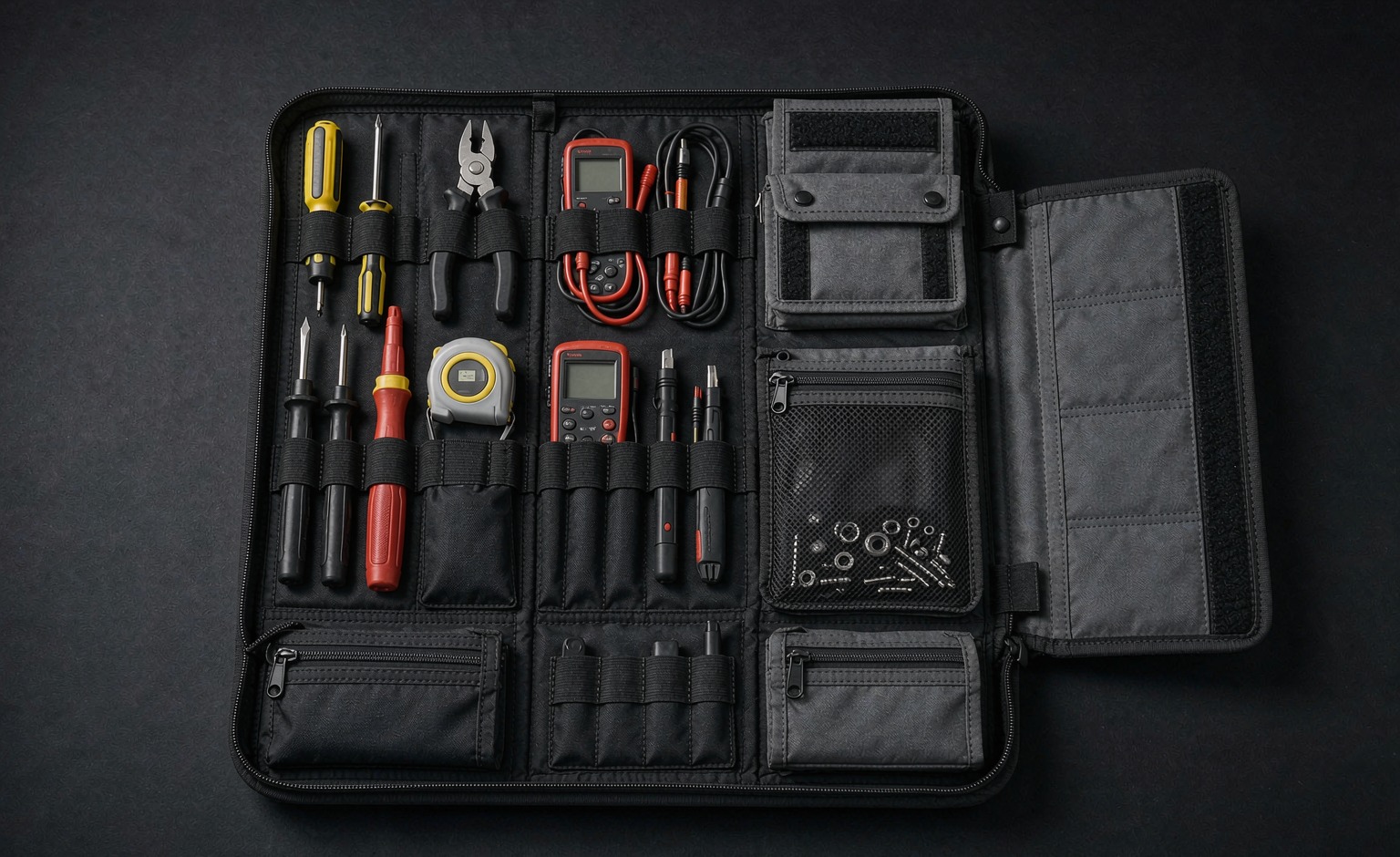
A modular bag works as a corporate gift because it adapts to a routine the recipient already has, while a single-purpose gift asks the recipient to build a new one. That difference shows up in the only metric that matters: the share of gifts still in use six months later. Getting there requires matching the specification to the recipient rather than to the budget, understanding what each price tier actually buys at indicative FOB Xiamen pricing on a 500-unit minimum, and respecting the etiquette constraints that apply to gifting but not to retail. A sampling fee of USD 50–150, refundable against the order, buys the physical piece that lets a decision be made on evidence. The sections below cover personas, tiers, perceived value, etiquette, claim discipline and measurement.
Measurement, etiquette and claim discipline are covered alongside selection, because those three decide whether a programme is renewed rather than whether it is delivered.
Why bags stay the default gift, and why so many of them disappoint
Bags persist as corporate gifts for three structural reasons. They are gender-neutral, they are size-forgiving, and they are used in public, which means the branding travels. No other category in the same price band combines those three properties. A drinkware item is used in public but is less personal; an apparel item is personal but is size-critical and therefore generates exchanges.
Yet a large share of gifted bags are quietly discarded, and the reasons are consistent. The first is capacity mismatch: a bag too small for a commute is left at home, and one too large for a city office feels like luggage. The second is aesthetic mismatch: a bag styled for trail use sits unused in a finance department. The third is the absence of any feature worth noticing, which turns the gift into a generic container with a logo on it.
Modularity addresses the first and the third directly. A configurable capacity means the same unit works for a light day and a heavy one, which removes the most common reason for abandonment. And a detachable module is a feature worth noticing: it gives the recipient something to discover, and discovered features are remembered far better than described ones.
It does not address aesthetic mismatch, and buyers should not pretend otherwise. A modular bag styled for outdoor use is still an outdoor bag. The specification has to be chosen against the recipient's actual environment, which is the work of the next section.
Selection rule: Choose the specification against the recipients working environment rather than against a catalogue photograph, because a carrier styled for trail use still reads as trail equipment to someone carrying it into a city office at a 500-piece minimum.
Five recipient personas and the specification each one responds to
The single most effective change a gift buyer can make is to stop selecting one item for everyone. Corporate recipients fall into recognisable groups with different daily routines, and the bag that delights one group is wrong for another. Define the groups from the recipient list before looking at any product.
| Recipient group | Dominant routine | Specification that earns a place in that routine | Detail that loses the gift |
|---|---|---|---|
| Office-based knowledge staff | Short commute, laptop and lunch, desk storage | Flat laptop sleeve, a clean external profile, a detachable lunch or cable module | External webbing rows that read as outdoor equipment |
| Sales and field-facing staff | Driving, client visits, samples, documents | Document panel that lies flat, a quick-access module, a strap that stays on the shoulder | Anything that creases documents or needs two hands to open |
| Engineering and site staff | Site visits, tools, protective equipment, vehicle storage | Abrasion-resistant base, a tool module, a separate clean compartment | A light lining that tears on a tool corner within weeks |
| Remote and hybrid staff | Home, co-working, occasional travel | One chassis with a travel module and a work module | A fixed layout that suits neither mode properly |
| Executive recipients | Meetings, short trips, minimal carry | Restrained external detailing, quality hardware, an individually marked plate | Large logo placement and visible cost-saving on fittings |
Two or three specifications usually cover an entire list, and a modular platform makes that affordable because the chassis is shared. Buy one shell in a neutral colourway, then differentiate by module set and by marking. The perceived difference between the sales specification and the engineering specification is substantial while the tooling is common.
Do not over-segment. Four specifications on a list of 600 means four runs of roughly 150 units, each below the 500-unit floor, and the per-unit cost rises accordingly. Two specifications at 300 each is below the floor as well; the practical answer is one chassis with two module sets and two markings, ordered as a single 500-unit run of shells.
Where the recipient list genuinely cannot be reduced, consider gifting a module rather than a full bag. A well-made pouch or organiser at a lower unit cost, given to the broad tier, plus a full bag for the top tier, keeps the total spend within budget while lifting the perceived generosity of the broad-tier gift above what its cost suggests.
Budget tiers and what each one actually buys
Gift budgets are set per recipient and then multiplied by headcount, which means the per-unit figure is the number that gets negotiated hardest. Understanding what each tier buys prevents the common failure of promising a premium item at a mid-tier price and then discovering at sampling that the hardware cannot support the intent.
Indicative pricing must always be read with its qualifiers: indicative only, FOB Xiamen, 500-unit MOQ. Landed cost adds freight, duty and handling, and on a bulky item the landed figure can be materially above the FOB figure. Any internal approval should be sought against landed cost, because that is the number the finance team will eventually see.
| Band, indicative FOB Xiamen | Construction supported | Module allowance | Compromise to expect |
|---|---|---|---|
| Entry band | Single-fabric shell, standard lining, one attachment field | One module included | Generic hardware, limited colour control, simpler marking |
| Mid band | Two-fabric shell, better lining, reinforced anchor points | Two modules included | Still a chosen-hardware decision; tooling at the lower end |
| Upper band | Branded hardware, coated base, structured panels | Three modules or a padded module | Fewer colourways available at the 500-unit floor |
| Executive band | Premium shell, metal fittings, individual marking | Full module set | Setup spend at the top of the USD 300–2,500 range |
The structural point about tiers is that the visible differences cost less than the invisible ones. A recipient notices hardware, lining and the feel of a zip. The aspects that consume budget without being noticed are structural complexity and unusual panel geometry. Spend on what is touched.
Sampling is cheap relative to the decision it informs. A sampling fee of USD 50–150, refundable against the order, buys a physical piece that can be handled, loaded and shown to whoever approves the brand. Skipping the sample to save that fee is a false economy on a five-figure programme, and the fee is recovered anyway once the order is placed.
Verdict: Handle and load a physical sample on every budget tier before committing five figures, since the sample fee is credited back once the order follows and skipping it is a false economy at this scale.
Attributes that read as expensive without costing proportionally more
Perceived value is not a function of cost; it is a function of a small number of sensory signals. Four of them carry most of the effect, and three of the four are cheap to improve.
The first is hardware. A zip that runs smoothly under one finger, a buckle with a positive click, and a magnetic closure that self-locates are felt every time the bag is used, and each costs a modest increment over a generic fitting. This is the highest-return line in a gift specification. The second is the lining: a dark, tightly woven interior hides wear and reads as considered, while a pale loose lining shows every mark within a month.
The third is edge and seam finish. Bound internal seams, consistent stitch density at visible corners, and a clean edge at the lid are noticed subconsciously even by a recipient who could not name what they are looking at. The fourth is weight distribution: a bag that stands up when set down feels engineered, and one that slumps feels cheap regardless of what it cost.
What does not carry perceived value in proportion to cost is structural complexity. A multi-panel shell with compound curves costs more in tooling and in labour, and a recipient does not perceive it as better. Keep the geometry simple and move the spend to hardware and lining. This is also the specification that survives production best, because simpler geometry holds tolerance more reliably across a long run.
Packaging belongs in the same calculation. A rigid carton, a tissue wrap and a single printed card add a small amount per unit and change the recipient's first impression substantially. On a gift, that first impression is the entire point, so packaging should be treated as part of the product rather than as a logistics cost.
The only honest measure: what share is still in use
Gift programmes are usually reported on units dispatched and on budget consumed, neither of which says anything about whether the gift worked. The metric that does is the use-after-gift rate: the share of recipients still using the item at a defined point after handover. Measure it at six months, because that is far enough out for novelty to have worn off and short enough to inform the following year.
Measuring it is easier than it sounds. A three-question survey sent to the recipient list, asking whether the item is still used, what it is used for, and what would improve it, typically returns a usable response rate from a staff list and a lower one from a client list. Supplement it with observational evidence: internal recipients can be counted in a workplace, which is more reliable than any survey.
Interpret the answers against the failure modes identified earlier. If the dominant answer is that the bag is too small or too large, the capacity band was wrong. If it is that the bag is not the recipient's style, the aesthetic mismatch was not addressed. If it is that the recipient does not know what the module is for, the explanatory card was missing, which is the cheapest of all the problems to fix.
A programme achieving a use-after-gift rate above roughly 60 % among staff recipients is performing well. Below 40 %, the specification is wrong for the audience and no amount of branding will rescue it. Set the target before the programme starts so the result can be judged rather than rationalised.
One further measure is worth tracking because it is free: unsolicited mentions. Count how often the item comes up in internal channels or in client correspondence without prompting. That count is noisy but it is the closest thing to a measure of goodwill, which is the actual objective of a gift.
Bottom line: Record the share of gifts still in use six months after handover instead of reporting units dispatched, and feed that figure into the next brief before reordering at MOQ 500, because usage predicts whether a second cycle will be welcomed.
Etiquette, policy and the value cap
Gifting operates under constraints that retail does not, and ignoring them creates a problem for the recipient rather than for the giver. The most common is the value cap. Many organisations, and particularly public bodies, regulated firms and healthcare institutions, set a monetary threshold above which a gift must be declared or refused. A gift above that threshold is not generous; it is an administrative burden and potentially a disciplinary matter.
Check the cap before selecting the product, and check it per recipient organisation rather than once globally, because thresholds differ substantially between a private-sector client and a public-sector one. Where a single programme covers both, the safe answer is usually two tiers: a modest item for capped recipients and a fuller one for the rest.
Timing is the second etiquette dimension. Gifts arriving during a religious or public holiday period are appropriate only where the recipient observes it, and a mixed list needs a neutral window. Gifts arriving during a period of announced redundancies or a public controversy are worse than no gift. A calendar check by someone who understands the recipient organisation is worth more than any product decision.
Personalisation has a boundary too. A name on an item is well received by an individual and creates a data-handling obligation at scale. Above a few hundred recipients, mark by team or by role instead, and store any name list only for as long as dispatch requires.
Finally, reciprocity. A gift that is clearly expensive can put a recipient under an obligation they did not accept, and in procurement contexts that is actively unwelcome. The objective of a corporate gift is recall and goodwill, not indebtedness, and the specification should be chosen with that distinction in mind.
Takeaway: Establish the recipients value cap and disclosure obligations before shortlisting anything across the 500-unit budget split, since a gift that obliges someone to declare it produces a problem for them rather than goodwill for the giver.
Sustainability wording that survives scrutiny
Almost every corporate gift programme now carries an environmental claim, and a large share of those claims cannot be substantiated. The risk is not regulatory so much as reputational: a recipient who checks and finds nothing behind the claim forms a worse impression than if no claim had been made.
The discipline is to state what is measured. Recycled content should carry a percentage and a material: a shell fabric containing a stated share of recycled polyester, evidenced by a transaction certificate, is a claim that can be defended. The word sustainable on its own is not a claim, it is an aspiration, and it should not appear on a product.
Durability is the strongest environmental argument available to a bag programme and the one most often left unsaid. An item used for five years displaces several cheaper ones, and that displacement is a larger effect than most material substitutions. Say so explicitly: state the intended service life and the repairability of the components, and make spare parts available.
Modularity supports this directly. A bag whose strap, buckle or pouch can be replaced individually does not become waste when one component fails. Offer a spares path, even a simple one, and the claim becomes verifiable rather than rhetorical. This is also the cheapest way to make a sustainability statement true rather than merely defensible.
Packaging claims should follow the same rule, and should reflect the infrastructure available to the recipient rather than the theoretical recyclability of the material. A carton that is recyclable in principle and not collected in practice is not recyclable from the recipient's point of view.
Where a recycled-content figure does appear on a gift, ask for the transaction certificates behind it rather than for a printed logo, because the chain-of-custody scheme maintained by Textile Exchange is what lets a claim be traced from the finished panel back to the input it came from.
Seasonal concentration and why capacity tightens every year
Corporate gifting is heavily concentrated. A large share of annual volume is required to land in a window of about eight weeks, which means a large share of the industry's production capacity is demanded in the same window every year. Buyers who place orders inside that window compete for slots rather than reserving them.
The arithmetic makes the point. Working backwards from an early December handover: a reference piece takes 6–10 working days, 12–15 where complex; the build takes 35–50 days from approval; ocean transit takes 25–35 days. Add internal approval cycles and the artwork deadline lands in mid-year. A buyer who starts in September has already lost the sea option and is choosing between air freight at 5–8 days and a late delivery.
Air freight is not a solution at gift volumes. On a bulky item, air cost per unit can exceed the gross value of the gift, and the alternative, a partial air shipment covering only the first wave, is the standard mitigation rather than the exception. Plan for the sea window and treat air as insurance against a specific, identified risk.
The structural remedy is to move the programme earlier rather than to negotiate harder. A gift handed over in October faces a far less congested production calendar than one handed over in December, and many recipients prefer it because it arrives before the holiday rush. Where the date is fixed by an event, place the order in the preceding cycle entirely: produce in the quiet quarter and hold in a warehouse.
Warehousing cost is small compared with the cost of a missed date. Holding finished stock for six to eight weeks is usually a small fraction of the freight premium that a rushed shipment incurs, and it removes the critical path from the busiest period of the year.
Judgement: Book capacity and hold finished stock ahead of the concentrated eight-week window rather than paying for a rushed shipment, because even counting the T/T 30/70 settlement cost, stock held off the critical path is cheaper than freight bought in panic.
Measuring the programme and briefing the following cycle
A gift programme that is not measured gets repeated with the same assumptions and the same weaknesses. The briefing for the following cycle should be written while the current one is still fresh, and it should contain five items: the recipient segmentation that was used, the use-after-gift result, the landed cost per unit by tier, the calendar that actually happened rather than the one planned, and the three changes to make.
The calendar that actually happened is the most valuable of those five. Record the date each gate was completed against the date it was planned, because the gap between the two is the specific buffer the next cycle needs. Programmes that record this converge on a reliable calendar within two cycles; programmes that do not repeat the same panic every year.
Freeze what worked. Because a modular platform keeps its interface constant across cycles, the following year can introduce a new module or a new colourway without re-opening the shell tooling or the approval sequence for the mark. That is the cheapest available refresh and it is the main reason to standardise on a modular chassis for a recurring programme.
Quality discipline should be written into the brief as well. Inspection at AQL 2.5 under ISO 2859-1 remains the release standard, and on a gift the defect list should include presentation: placement drift on the mark, a scuffed outer face, and a carton that has been crushed in transit. A gift with a mark 3 mm off centre is a rejected gift, not a minor defect.
Finally, decide the spare-parts question before the programme ships. A small allocation of replacement straps, buckles and modules, held centrally, converts a complaint into a five-minute fix and supports the durability claim at the same time. It costs very little and it is what makes a service-life statement credible rather than aspirational.
Spec rule: Record complaints, replacements and preferred colourways while the current cycle is live, keep release at the stated quality limit, and let a named spare-part offer accompany the gift so complaints convert into five-minute fixes.
Frequently asked questions
Why do modular bags perform better as gifts than ordinary ones?
Because configurable capacity removes the commonest reason a gifted bag is abandoned: it does not fit the day. A detachable module also gives the recipient something to discover, and discovered features are remembered better than described ones. Neither effect fixes a style mismatch, so the specification still has to suit the recipient.
How many specifications should one gift programme cover?
Two or three at most. Four specifications on a 600-person list means four runs below the 500-unit floor, which raises unit cost. Buy one shell and differentiate by module set and marking, ordered as a single 500-unit run of shells.
What does the sampling fee cover and is it recovered?
A fee of USD 50–150 buys a physical piece that can be handled, loaded and shown to whoever approves the brand. It is refundable against the order, so it costs nothing on a confirmed programme while removing the largest single risk in the decision.
How should indicative pricing be read?
Always as indicative only, FOB Xiamen, 500-unit MOQ. Landed cost adds freight, duty and handling, and on a bulky item the landed figure sits materially above the FOB figure. Seek internal approval against landed cost rather than FOB.
Which attributes make a bag feel expensive?
Hardware that runs smoothly under one finger, a dark tightly woven lining, clean bound internal seams, and a base that lets the bag stand upright. Structural complexity costs far more and is not perceived as better, so keep geometry simple and move spend to hardware and lining.
How do I measure whether a gift programme worked?
Use the use-after-gift rate at six months: the share of recipients still using the item. Above roughly 60 % among staff recipients is good; below 40 % means the specification is wrong for the audience and branding will not rescue it.
What is the value cap issue with corporate gifts?
Many public bodies, regulated firms and healthcare institutions set a threshold above which a gift must be declared or refused. Check it per recipient organisation, because thresholds differ, and run two tiers when one programme covers both capped and uncapped recipients.
Should gifts carry an environmental claim?
Only a measured one. State recycled content as a percentage of a named material, backed by a transaction certificate. Durability and repairability are usually the strongest true claims, because an item used for five years displaces several cheaper ones.
When must artwork be approved for a December handover?
Around mid-year. A reference piece takes 6–10 working days, 12–15 where complex; the build takes 35–50 days; ocean transit takes 25–35 days. Starting in September means air freight at 5–8 days or a late delivery.
Is air freight a sensible fallback for gifts?
Rarely for the full quantity. Air cost per unit on a bulky item can exceed the gift's value. The standard mitigation is a partial air shipment covering the first wave, with the balance following by sea.
Is it better to produce early and warehouse the stock?
Usually. Holding finished stock for six to eight weeks costs a small fraction of the freight premium on a rushed shipment, and it takes the programme off the critical path during the busiest production window of the year.
Should the gift carry a personal name?
On an executive tier under about 200 recipients, yes. Above a few hundred, mark by team or role instead, because names create a data-handling obligation and a sorting cost at dispatch that scales badly.
What inspection level should apply to a gift order?
ISO 2859-1 sampling at AQL 2.5, with the defect list extended to presentation: mark placement beyond tolerance, a scuffed outer face, a crushed carton. On a gift, presentation defects are major rather than minor.
How does modularity support a sustainability statement?
Through repairability. A bag whose strap, buckle or pouch can be replaced individually does not become waste when one component fails. Offering a spares path makes the service-life statement verifiable rather than rhetorical.
What should the briefing for the next cycle contain?
Five items: the segmentation used, the use-after-gift result, landed cost per unit by tier, the calendar that actually happened against the one planned, and the three changes to make. The calendar gap is what calibrates next year's buffer.
Is packaging worth the extra spend on a gift?
Yes. A rigid carton, a tissue wrap and a single printed card add little per unit and change the first impression substantially. On a gift the first impression is the entire point, so packaging belongs in the product budget rather than in logistics.