Home › Field notes › Modular Bags for Event and Conference Organizers: Pickup Flow
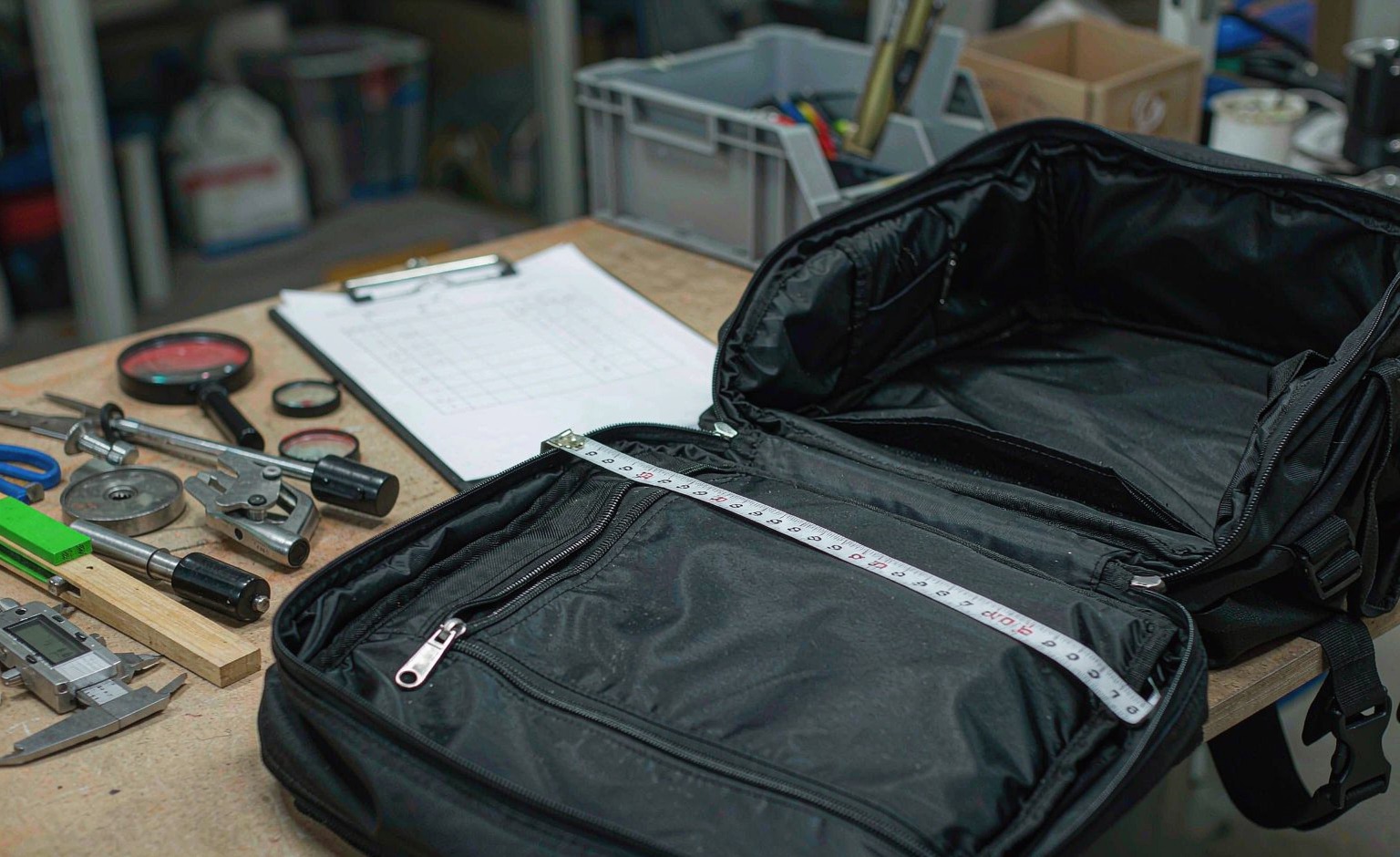
Conference bags are specified by crowd flow first and by product second, because a delegate pack that bottlenecks the lobby on the morning of day one fails regardless of how good the bag is. Throughput is the governing number: a staffed collection point handles about 120 delegates an hour at a realistic 30 seconds each, so a 1,800-delegate event needs five positions or a pre-stuffed bag placed on the seat. Capacity, carton breakdown and venue storage follow from that choice. Ordering runs on a hard calendar: a build of 35–50 days plus ocean transit of 25–35 days, against a 500-unit floor and AQL 2.5 release. The sections below cover each decision in the order an organiser meets it.
Carton breakdown, the sponsor marking hierarchy and the leftover decision are covered here as gates with owners rather than as post-event cleanup. Peak-minute arrival, not daily average, is the figure that sizes the collection desk.
Throughput: the number that decides the distribution model
Every conference organiser has seen the lobby at 08:20 on day one. Registration opens, several hundred people arrive within twenty minutes, and whatever system was designed for an average flow has to cope with a peak three to five times that average. The bag decision is made inside that peak, not inside the average, and the first useful step is to quantify it.
Measure the peak in attendees per ten minutes, not per hour. A pattern of 1,800 delegates over ninety minutes is not 1,200 an hour in any useful sense; it is a concentrated arrival where perhaps 600 arrive in the first fifteen minutes. Designing for the hourly average produces a queue that clears at 09:40, which is after the opening keynote has started.
| Model | Time per delegate | Delegates per position per hour | Positions for a 600-per-15-minute peak | Consequence |
|---|---|---|---|---|
| Pre-stuffed bag handed at registration | about 8 seconds | about 450 | 3 | Fastest; requires stuffing labour in advance |
| Pre-stuffed bag placed on the seat | 0 seconds at the desk | unlimited | 0 | Zero queue; needs early venue access and security |
| Self-serve shelf, delegate chooses colour | about 20 seconds | about 180 | 7 | Choice is popular; needs wide aisles and restocking |
| Bag plus separate module pick-up | about 35 seconds | about 100 | 12 | Highest engagement; only viable at small events |
| Ship to delegate address before the event | 0 seconds | unlimited | 0 | Removes the queue entirely; adds freight per address |
Read the table alongside the venue constraints rather than in isolation. A seat-drop requires venue access the day before and a security arrangement; a self-serve shelf requires floor space that most registration areas do not have. The fastest model is often the one that removes the transaction from the peak entirely, which is why pre-stuffing is the default at scale.
Pre-stuffing is a labour project with a known cost. Two people stuffing a delegate pack of five items complete roughly 60 to 80 bags an hour, so 1,800 bags is about 25 person-hours, which is a single team over three days. That is a budget line worth pricing honestly rather than absorbing into general event staff time, because the alternative is a queue that damages the first impression of the whole event.
Where the event spans several days, consider a staged issue: the bag on day one, a module distributed on day two at a session. It spreads the flow, it gives attendees a reason to return to the exhibition area, and it makes the modular feature visible rather than merely described.
Selection rule: Derive the distribution model from the arrival curve rather than from total headcount, letting a day-two module release move part of the flow off registration morning before committing print artwork across the 500-unit minimum.
Sizing the bag to the actual contents
The most common specification error at conferences is a bag sized by appearance rather than by contents. A slim tote looks elegant in a photograph and will not hold an A4 programme, a water bottle, a lanyard, a notebook and the exhibition giveaways a delegate accumulates by lunchtime. By mid-afternoon the delegate is carrying two bags, one of which is not yours.
Build the contents list first and dimension from it. Programme or tablet in centimetres, bottle diameter, notebook format, and an allowance of roughly two litres for the material picked up during the day. A bag that holds the opening contents plus that allowance is a bag that stays on the delegate's shoulder all day, which is the entire purpose of the exercise.
Capacity should then be stated in the specification as a fitted volume rather than as a nominal litre figure. A 14-litre nominal bag that fits an A4 folder flat is more useful than an 18-litre nominal bag with a tapered base that does not. Fit-test with the actual contents, not with a tape measure.
Closure matters at conferences in a way it does not elsewhere. Delegates are standing, walking and holding a coffee; a bag that requires two hands and a surface to close will be left open all day, and an open bag sheds contents. Specify a closure that works one-handed, and test it standing up rather than on a bench.
Weight is the last sizing constraint and often the one that decides whether the bag is carried home. A delegate who has walked an exhibition floor for six hours will abandon a heavy bag at the hotel. Set an empty-weight ceiling and hold the specification to it, accepting a simpler construction if that is what the ceiling requires.
Verdict: Size against a written contents list rather than against a photograph and hold an empty-weight ceiling even when reaching it means a simpler construction, because a heavier specification quoted across a 500-unit order costs the same whether delegates carry it home or leave it on a chair.
Carton breakdown, venue storage and the load-in window
Conference venues are hostile to freight. Loading docks are shared, access windows are narrow, and storage before the event is usually a room that was not designed for it. The carton plan has to fit those constraints rather than assume a warehouse.
Break the shipment into cartons sized for the stuffing operation rather than for transport efficiency. A carton of 25 bags can be carried by one person to a stuffing table and emptied; a carton of 100 needs a pallet truck and a second handling step. The extra cartons cost a little in corrugated and save a great deal in venue labour, which is charged at event rates.
Label cartons by contents as well as by sequence. A carton marked bags only, and another marked inserts only, lets the stuffing line be assembled in the order it will be used and avoids the common situation where the insert carton is at the bottom of the stack.
Plan the load-in against the venue's access window and confirm it in writing. Venues frequently offer a window of two or three hours on the day before, and a freight delay that misses it means a delivery arriving during build-up with nowhere to put it. Book the delivery for the earliest day the venue will accept and hold the goods there; storage cost is trivial next to the cost of a missed window.
Security is worth a specific decision. Delegate packs left in an unsecured room overnight are a genuine loss risk at large events, and the loss is not merely financial: a partially stuffed allocation discovered on the morning is a visible failure. Ask the venue for a lockable space and name a responsible person in the plan.
Cartons travelling to a venue on their own rather than inside a palletised load can be checked against the parcel sequence published by ISTA 3A, which gives the venue plan a stated tolerance for drops and stacking instead of a hopeful one.
Ordering timeline worked backwards from the event date
Event dates do not move, which makes the ordering calendar the least forgiving part of the organiser's plan. The pipeline components are fixed and the only variable is when the organiser starts them.
| Gate | Days before the event | What happens | Buffer to hold |
|---|---|---|---|
| Contents list and capacity frozen | 150–165 | Delegate pack contents measured; fit test defined | 2 weeks for sponsor changes |
| Reference piece approved | 130–145 | Sample produced in 6–10 working days, 12–15 if complex | 1 week for courier at 3–5 days |
| Deposit and slot reservation | 125–140 | T/T 30/70 deposit releases the booking | None; the slot is the constraint |
| Production complete and inspected | 70–85 | Build of 35–50 days, released at AQL 2.5 | 3 days for rework |
| Ocean transit and customs | 35–50 | 25–35 days afloat plus clearance | 1 week for port congestion |
| Venue delivery and stuffing | 2–5 | Cartons broken down; packs assembled | 1 day for a late registration top-up |
The two buffers that matter most are port congestion and sponsor change. Sponsors join late and their material has to go inside the bag, which means the capacity decision can be reopened after the specification has been frozen; holding two weeks against that is realistic. Port congestion is unpredictable and a week of buffer on the ocean leg is cheap.
Where the calendar is already compressed, the honest options are few. Air freight takes 5–8 days and courier 3–5 days, which can rescue a late decision but at a cost per unit that on a bulky bag can exceed the bag itself. The better mitigation is to reduce the quantity on the air leg: ship the confirmed delegate count by air and the registration-day contingency by sea.
Order quantity should be set against registered delegates plus a contingency of 8 % to 12 %, because on-site registration is normal at most conferences and a delegate who cannot be given a bag is a visible failure. The surplus is then handled by the leftover plan in a later section rather than by under-ordering.
Bottom line: Count the pipeline backwards from the event date, including 6-10 working days of sampling, 35-50 days of production and 25-35 days of sea transit, then accept a deliberate surplus because a delegate without a bag is a visible failure.
Sponsor marking and the visibility rules
Conference bags carry more branding per square centimetre than almost any other product, and that is exactly why they go wrong. A bag bearing the event identity, three sponsor marks and a venue logo reads as advertising rather than as a gift, and the delegate's response is to leave it in the hotel room.
Set a marking hierarchy and enforce it. One dominant mark, belonging to the event, at the primary placement. Sponsors at a defined secondary placement, all at the same size, in an order agreed before production rather than negotiated after. Anything else is a visual argument on the delegate's shoulder.
Sponsor contracts drive the placement, so agree the rule set at the point the sponsorship is sold rather than after the bag has been specified. A sponsor sold a logo of a stated size in a stated position will hold the organiser to it, and a change made later requires either a second production run or a broken contract.
Resolution and colour count matter on a deadline. A single-colour mark is faster to approve, faster to set up and less likely to drift; a full-colour mark on a coated panel needs a proof cycle and a physical swatch. Where a sponsor joins late, offering a single-colour option is often the only way to keep the calendar intact.
A modular structure gives sponsors something better than space: a module. A sponsor-branded pouch, distributed at their stand rather than in the bag, converts passive logo placement into an active visit, and it can be added after the main bag specification is frozen. This is the most valuable commercial use of modularity at an event.
Cross-border handovers change which statements have to travel with the cartons, so confirming destination requirements against the export guidance held by trade.gov costs less than discovering a missing document after twelve offices have already been invoiced.
Registration data, pre-assignment and the no-show problem
Delegate counts change until the doors open, and the bag plan has to tolerate that. Registration typically runs at 85 % to 95 % attendance against confirmed numbers, which means an order placed against confirmed registrations will leave a surplus rather than a shortage, and the surplus is the manageable outcome.
Pre-assignment helps where the event has tiers: speaker, delegate, press, exhibitor. Pre-assigning by tier and printing a name or a tier colour on the pack removes decision-making at the desk and speeds the line. It also creates a data-handling obligation, so keep the name list only for as long as dispatch requires and default to tier marking where the count is large.
No-shows produce the surplus. A 1,800-bag order against 1,600 attendees leaves 200 units, which is not a rounding error at the unit costs involved. Plan for it explicitly rather than hoping attendance improves: set the contingency at the low end of the range where the registration curve is flat, and at the high end where it is still climbing.
Late registration is the opposite risk and the more damaging one, because a delegate who has paid and cannot be given a bag is a complaint. Hold a reserve at the registration desk rather than in the storage room, so the decision to release it is made by the person who can see the queue.
Track what is actually issued. A count taken at the end of each session, against the cartons opened, tells the organiser the real attendance figure within an hour and lets the remaining allocation be adjusted. Most events never know how many bags were distributed, and that is why the surplus is always a surprise.
Takeaway: Track quantities issued rather than quantities ordered and reconcile within an hour of doors opening, keeping any contingency inside one reorder that still clears the 500-unit minimum, since attendance typically lands well below confirmed registrations.
Leftovers, and deciding their destination before ordering
Surplus conference bags have one predictable fate if no decision is made: they sit in a storage unit for two years and are written off. The decision costs nothing before the event and cannot be made well after it, because the obvious destinations all require preparation.
Three destinations are worth planning. The first is the following event, which works only if the bag carries no year-specific marking; a design without a year, or with a year applied as a removable module, is reusable and this is the single cheapest way to protect the surplus. The second is a sponsor or partner distribution. The third is a staff or volunteer allocation, which is genuinely popular and costs nothing.
Where the surplus carries a dated mark, donation is the remaining option and it needs a recipient identified in advance. Charities and schools accept bags readily but need notice, and a donation made in the week after an event usually goes nowhere because nobody has time to arrange it.
A modular design reduces the surplus problem structurally. If the shell is undated and only the module carries the year, the leftover is a shell plus a dated module, and the shell can be reissued next year with a new module. The written-off value is then a fraction of what it would otherwise be.
Record the outcome in the event file: quantity ordered, quantity issued, quantity surplus and where it went. Two cycles of that record makes the contingency figure accurate, and most organisers find they have been over-ordering by a consistent margin.
Judgement: Decide where surplus goes before ordering rather than after the event closes, because two cycles of recorded issue quantities usually reveal a consistent over-ordering margin that nobody had put a number on.
Cost per delegate and what a conference bag is actually for
The unit price of a conference bag is a poor decision criterion, because the bag's value is not in the object but in what it does during the event. The useful measure is cost per delegate-day of visible use: the total spend divided by the number of delegates who carried it in the venue. That number can be estimated from observations on the floor and it is the one worth optimising.
Split the total honestly. Product, freight and duty, stuffing labour, venue storage and any sponsor module production are all part of the figure, and the stuffing labour at event rates is frequently larger than organisers expect. A full accounting usually moves the decision away from the cheapest bag, because a slightly better bag that is actually carried delivers a lower cost per delegate-day of use.
What makes a bag carried rather than abandoned is, in order: capacity that fits the contents, a closure that works standing up, an empty weight low enough for six hours of walking, and restraint in the branding. Those four properties cost less than most of the cosmetic features that organisers spend on, and they are the ones that decide whether the bag is on a shoulder in the exhibition hall.
Sponsor value follows the same logic. A logo on a bag that stayed in the hotel room delivered nothing, and a sponsor who works that out will not renew. Organisers who can report an observed carry rate have a materially stronger renewal conversation than those who can only report units distributed.
Set the quality gate accordingly. Release at AQL 2.5 under ISO 2859-1 and add the checks that a delegate will perform: closure operation one-handed, the strap adjustment working on the first attempt, and the mark placement within tolerance. A bag that fails any of those three is abandoned rather than returned, which is the worst possible outcome because it is invisible in the returns data.
Finally, book capacity early where the event recurs. Annual conferences benefit from declaring two cycles of volume so fabric and hardware are held against them. Our SGS-verified production base covers 4,950 m² with 7 production lines, 137 people and 149 machines at 200,000 units per month, and a recurring event that declares its volume gets a reserved window rather than a negotiation each year.
Accessibility and carry comfort at a standing event
Conference delegates spend an unusual amount of time standing and walking slowly, which is a different physical condition from commuting. A bag designed for a fifteen-minute walk behaves differently over six hours on a hard floor, and the complaints that follow are predictable.
Strap width and padding are the first lever. A narrow strap concentrates load and becomes uncomfortable within an hour; a wider strap with modest padding spreads it and costs very little. Where the delegate pack is heavy, a bag that can be carried on the shoulder and on the back gives the delegate an alternation, which is the most effective comfort measure available.
Accessibility deserves an explicit decision. A delegate using a wheelchair or a walking aid needs a bag that attaches or sits without occupying their hands, and a conference that provides only a hand-carried tote has excluded them. Offering a strap configuration that allows the bag to hang from a chair or frame is a small specification detail with a real effect on inclusion.
Open-plan access matters too. Delegates need a badge, a phone and a water bottle repeatedly through the day, and a bag that requires being set down to reach any of those will be set down and eventually left. Put the high-frequency items in an externally reachable module and the bag stays on the person.
Test all of this standing up. Fit the bag with the actual delegate pack, walk for twenty minutes, and try to reach a badge and a bottle without putting the bag down. That single test finds more specification problems than any review meeting, and it can be run on the reference piece before production.
Spec rule: Run a stand-and-reach check on the reference piece taken from sampling rather than from the first 500-unit batch, asking one person to reach a badge and a bottle without setting the chassis on the floor.
Frequently asked questions
How many collection positions does a conference need?
Divide the peak arrival, measured in attendees per ten minutes, by the throughput of the chosen model. A hand-out at about 8 seconds sustains roughly 450 per position per hour, so 600 arrivals in fifteen minutes needs three positions. Self-serve at 20 seconds needs seven.
Is pre-stuffing worth the labour cost?
Almost always at scale. Two people complete 60 to 80 packs an hour, so 1,800 bags is about 25 person-hours. That is cheaper than a queue that clears after the opening keynote, and it removes the transaction from the arrival peak entirely.
What capacity should a conference bag be?
Dimension it from the contents, not from appearance. Programme or tablet in centimetres, bottle diameter, notebook format, plus roughly two litres for material picked up during the day. Fit-test with the real contents rather than trusting a nominal litre figure.
Why do delegates abandon conference bags?
Four reasons in order: capacity that does not fit the contents, a closure needing two hands, empty weight too high for six hours of walking, and excessive branding. The first three cost less to fix than most cosmetic features organisers spend on.
How far before the event should the bag be ordered?
Freeze the contents list about 150 to 165 days out. A reference piece takes 6–10 working days, 12–15 if complex; the build runs 35–50 days; ocean transit adds 25–35 days. Hold two weeks for sponsor changes and one week for port congestion.
How much contingency quantity should I order?
Add 8 % to 12 % to confirmed registrations. On-site registration is normal, and attendance runs at 85 % to 95 % of confirmed numbers, so a surplus is the likely and manageable outcome. Hold a reserve at the registration desk itself.
How should sponsors be placed on the bag?
One dominant event mark at the primary placement, sponsors at a defined secondary position at equal size, in an order agreed before production. Agree the rule when sponsorship is sold, because a later change means a second run or a broken contract.
Can a sponsor be added after the specification is frozen?
Yes, if the design is modular. A sponsor-branded pouch distributed at their stand can be produced after the main bag is fixed, and it converts passive logo placement into an active stand visit, which sponsors value more.
What is the best way to handle surplus bags?
Decide before ordering. Omit the year from the shell so the surplus is reusable next year, or apply the year to a removable module so only the module is written off. Identify a donation recipient in advance if the mark is dated.
Should cartons be sized for transport or for handling?
For handling. A carton of 25 can be carried to a stuffing table and emptied by one person; a carton of 100 needs a pallet truck. The extra corrugated costs little and venue labour is charged at event rates.
How do I know if the bag programme worked?
Measure cost per delegate-day of visible use: total spend divided by delegates observed carrying it in the venue. Include stuffing labour and venue storage, because they are frequently larger than expected.
What inspection checks matter for a delegate bag?
Beyond AQL 2.5 under ISO 2859-1, check the three things a delegate does: closure operating one-handed, strap adjustment working first time, and mark placement within tolerance. Failure on any of these means the bag is abandoned rather than returned.
Should the bag be dated with the year?
Preferably not on the shell. A year on a removable module protects the surplus value, because the shell can be reissued with a new module while only the module is written off.
How should accessibility be handled?
Provide a strap configuration that lets the bag hang from a chair or frame, so a delegate using a wheelchair or walking aid does not need a free hand. Put high-frequency items in an externally reachable module.
Is shipping to delegate addresses a good alternative?
It removes the queue completely and suits a distributed or virtual-first event, but adds freight per address and requires accurate data earlier than most events have it. Compare the per-address freight against the cost of additional collection positions.
Should the event declare recurring volume to the production side?
Yes where the conference is annual. Declaring two cycles lets fabric and hardware be held against them, which converts a congested negotiation into a reserved window and removes most of the calendar risk.