Home › Field notes › Modular Messenger Bags: Professional Carry, Verified by Test Data
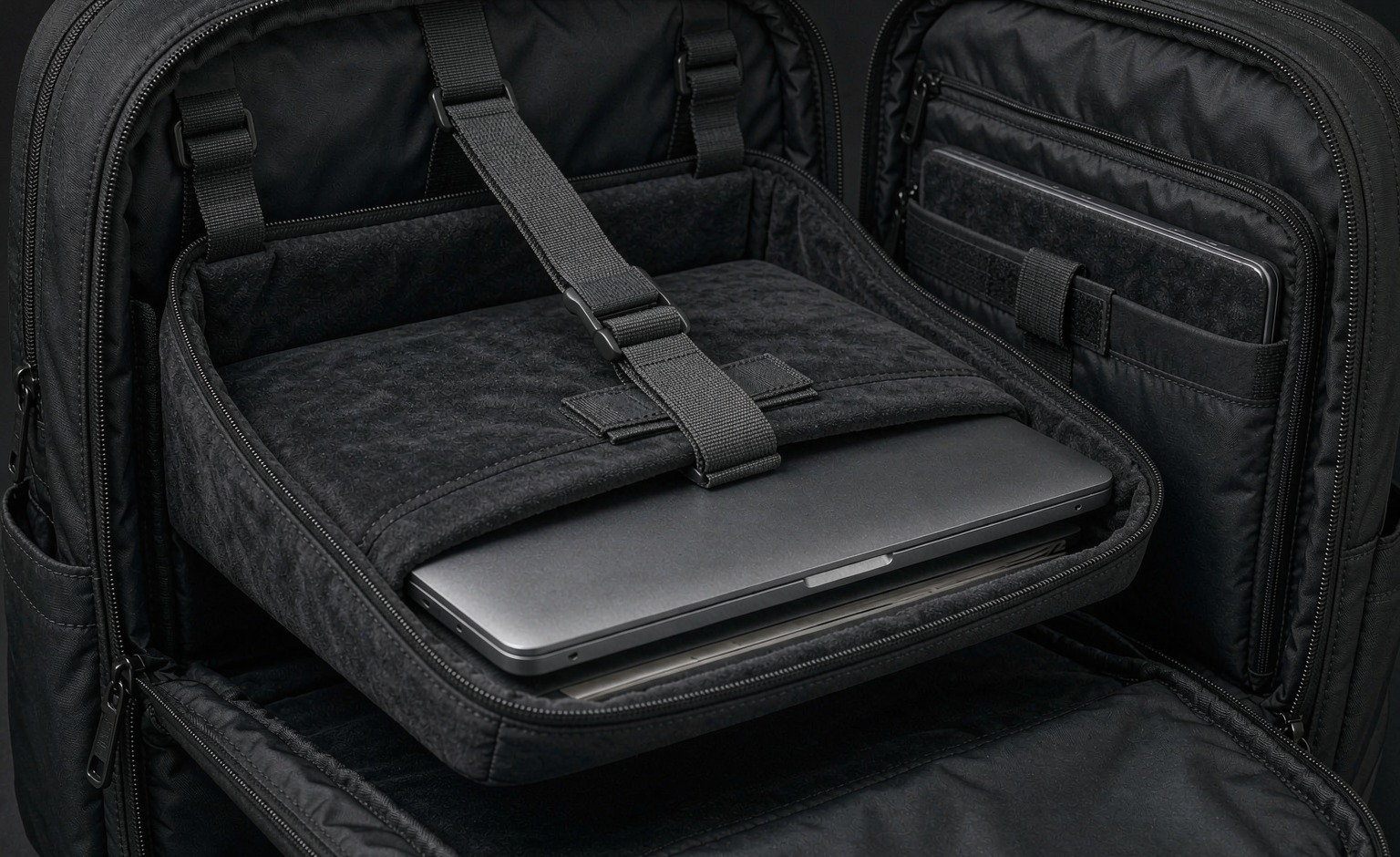
A modular messenger bag meets professional expectations when it resists rotation under one-shoulder load, holds documents genuinely flat, and accepts attachments without advertising them. Those three conditions translate into concrete specification lines rather than styling notes: a stabiliser with real geometry rather than decorative webbing, a file section built around A4 and legal dimensions with a stiffened back that will not fold pages, and closure hardware chosen for silent one-handed release. Fabric then has to survive the shoulder-panel abrasion that quietly destroys tailored jackets, verified through cycle testing rather than assertion. Development follows the usual sequence here: reference units within 6-10 working days, then 35-50 days of production from sign-off and release against a 2.5 acceptance number with defect classes agreed beforehand. What follows below covers each of those conditions in the order a development team encounters them, starting with rotation and ending with the commercial calendar and the evidence due before tooling.
Rotation: the failure that makes every other feature irrelevant
Single-shoulder carry is inherently unstable. With mass suspended from one point on the opposite shoulder, any movement of the torso produces a pendulum, and the user corrects it by gripping the strap, which defeats the entire purpose of a cross-body format. Every other decision sits downstream of solving this.
The dominant variable is the horizontal distance between the strap's anchor points on the body. Wide anchor separation resists rotation because load arrives closer to vertically; narrow separation produces the classic swing. In practical terms this is why messengers that anchor near the two upper corners behave so much better than those anchored mid-panel, despite looking less tidy on a drawing. Panel stiffness plays a supporting role: a floppy body allows the anchors to migrate toward each other under load, undoing whatever separation the drawing specified.
Second comes strap width and grip. A narrow strap concentrates pressure and slides down a coat shoulder; something around 38 to 50 mm distributes load and stays where it was placed. The underside matters too: a surface with genuine friction beats a smooth face every time users wear a suit.
Third, the stabiliser strap, which is the one component most often present but non-functional. A stabiliser works only when it takes load, which requires it to anchor at a point that actually moves under rotation and to be adjustable enough to sit correctly on torsos of different depth. Anything less is decoration that the buyer pays for twice, and it is worse than absent because reviewers will read it as evidence the problem was understood and mishandled. One useful check: load the unit, walk twenty metres, and count how often the user touches the strap. More than twice and the geometry needs revisiting.
Judgement: Fix rotation before anything else, with a stabiliser strap or a contoured pad, because a bag that swings on every stride makes every pocket unusable however well it is laid out.
Document handling: what actually keeps paper flat
This is the reason professional buyers choose the format and the reason they return it. A messenger that creases a contract has no value to the person buying it, regardless of how well anything else performs. The requirement is simple to state and surprisingly easy to get wrong.
Start with dimensional intent. Design the file section around the largest paper size in the target market rather than the most common one, allowing clearance for a slim folder or laptop alongside. Anything requiring the user to angle paper into place will generate creased corners, because users will always use the space rather than leave documents at home. Retention then prevents movement during carry, which is the mechanism that actually creases corners.
Then specify stiffness honestly. A file divider needs a genuine stiffener, not merely extra layers of fabric, because unsupported fabric deforms into whatever curve the loaded body takes. Closed-cell foam or an injection-moulded insert both work; neither is expensive at this scale.
| Content | Dominant damage | Required construction | Verification check |
|---|---|---|---|
| Loose A4 documents | Corner creasing from sliding | Stiffened divider, positive retention | Shake test loaded with 200 sheets |
| Bound contracts | Spine damage when forced | Clearance sized for the bound thickness | Insert and remove twenty times |
| Laptop or tablet | Edge impact through the base | Suspended sleeve, raised from base | Drop test with an inert dummy load |
| Pens and styluses | Leakage staining pale linings | Lined pocket with a closed base | Leak trial using a spent cartridge |
| Business cards | Bending at the corners | Rigid slip pocket, not a mesh panel | Dimensional check after compression |
The third row deserves emphasis, because laptops in messengers get dropped more often than in backpacks: a single-shoulder bag swings away from the body far more readily when set down. Any electronics position must be suspended away from the base, not merely padded against it, and the drop trial should be run from the height of a chair arm rather than from desktop height. Retention deserves the same scrutiny as padding, because a projecting device slides out during the very movement that makes this format pleasant to use.
Bottom line: Keep a flat document sleeve against the back panel and specify a stiffener that survives folding, since a creased document is the complaint that actually reaches customer service.
Keeping attachments without losing the silhouette
Here lies the genuine design tension. Attachment systems are visually associated with field equipment, and a professional silhouette depends on visual calm. Resolving it is a placement problem rather than a philosophical one.
Hidden fields work well. A tape panel placed under a flap, inside a rear slip pocket, or behind a magnetic closure panel is completely invisible when closed and fully functional when opened. Users accept the extra second because nothing about the external appearance changes. The mechanism does need checking though: a field hidden beneath a flap is only usable when the flap is open, so confirm the pouch stays accessible while the closure remains partially engaged.
Where external rows are wanted, keep them small and symmetrical. Two short columns on the gusset read as a design detail rather than as equipment. Full-width rows across the front panel immediately change how the product is read in a meeting, which limits where the buyer can carry it.
The interface standard still applies for hidden fields: 25 mm tape, rows 38 mm apart, repeating at 50 mm, so third-party pouches mount. Nothing about hiding a field requires abandoning interoperability, and keeping it means later modules can come from anywhere rather than only from your own catalogue. The final consideration is silence. Anything mounted externally will tap against the body while walking, so require that every visible fixing point be usable either empty or filled, and check the acoustic result by walking rather than standing still.
One-shoulder load and the duration ceiling nobody publishes
Every carry format has a tolerable duration, and honest ranges say so in their guidance rather than leaving users to discover it. Cross-body carry is comfortable for a moderate load over a short distance and poor for everything beyond that, which is exactly the boundary professional users need stated plainly.
The controlling factors are mass and asymmetry rather than volume. A load below roughly three kilograms is comfortable for most adults over twenty to thirty minutes of standing or walking. Beyond five kilograms, or beyond thirty minutes, the trapezius on the carrying side takes enough asymmetric load that most people switch to hand-carry, and the product design should accommodate that switch rather than pretend it will not happen.
Therefore specify a hand-carry position. A padded grab handle or a sleeve that accepts a roller handle turning the messenger into a companion piece enormously extends useful life. It costs a few grams and converts a single-mode product into something usable across a whole working day.
Write the guidance into care copy as tolerable duration and recommended mass, based on your own validation rather than borrowed from a competitor. Genuine limits build credibility with professional buyers far better than imaginary versatility, and they reduce returns from users who expected something the format cannot deliver.
Abrasion against tailored clothing: the suit-destroying problem
Professionals wear tailoring, and tailoring is far less tolerant than a technical shell. A strap decoration that looks premium in isolation will abrade a wool shoulder noticeably within weeks, and the cost of that damage vastly exceeds the product price, so this becomes a reputational issue rather than a cosmetic one.
Abrasion testing needs to ask the right question. Standard reporting under ISO 12947 usually scores the test fabric, but here the user's garment is the item at risk, so request cycle data with simultaneous assessment of the abraded counter-surface. A fabric that survives thirty thousand cycles itself while polishing its partner fails this test.
Surface construction follows from that result. Smooth, tightly woven webs with bound rather than raw edges abrade less than textured or coarse constructions. Avoid raised printing, stiff embroidery and coarse grip coatings anywhere predictable contact occurs, and keep hardware clear of the shoulder path entirely. Where a grip coating is genuinely needed to stop strap migration, confine it to the section clear of tailoring and recheck counter-surface abrasion afterwards.
| Contact position | Dominant mechanism | Specification response | Method cited |
|---|---|---|---|
| Strap across the shoulder | Repeated sliding abrasion | Smooth bound webbing, no print | Abrasion with counter-surface, ISO 12947 |
| Body panel against the hip | Fretting and pilling of the garment | Closed face fabric, no coarse texture | Pilling assessment plus visual grading |
| Dark transfer onto pale cloth | Dye migration under pressure | Verification in both dry and wet states | Rub fastness, AATCC 8 |
| Metal feet resting on a chair | Scratching polished furniture | Covered or polymer feet | Visual inspection after repeated contact |
| Hardware knocking against buttons | Impact damage to both parties | Recessed hardware placement | Layout review with a worn garment |
The third row causes the most expensive complaints, because dye transfer onto a pale shirt or jacket lining is effectively permanent. Verify dark colourways in wet as well as dry rubbing and do not sign off any colourway that only passes one condition.
Verdict: Specify a smooth low-abrasion panel facing and verify it by rubbing the production material against worsted wool, because abrasion of tailored clothing is reported by zone and not as one fabric figure.
Closure families: why a guided magnetic fitting suits this format
The professional messenger has an unusual combination of closure requirements. It must open and close repeatedly during a meeting, it must do so quietly, it should work one-handed while standing, and it must not announce itself visually. No single solution leads on all four, so ranking them explicitly is useful.
| Closure family | One-handed operation | Acoustic behaviour in meetings | Visual discretion | Selection verdict |
|---|---|---|---|---|
| Guided magnetic fitting | Excellent | Quiet | High when shrouded | Preferred for the main flap |
| Reverse-coil zip | Poor standing | Low but audible when pulled | High | Suits internal security pockets |
| Turned metal clasp | Moderate | Sharp click | Moderate, reads nostalgic | Acceptable if deliberate |
| Hook-and-loop field | Excellent | Very loud | Low | Avoid on professional lines |
| Side-squeeze buckle | Good | Click on release | Low | Better on external straps |
Select a supplier in that family by performance rather than badge. Ask for retained pull-off force, engagement cycles and behaviour after contamination, then write all three into the tech pack with thresholds. Several suppliers offer stepped grades behind a superficially similar part, so naming a brand alone secures nothing.
Also check what happens when the closure fails to seat. A guided fitting that holds a partial engagement silently gives no feedback, whereas a mechanical catch that visibly does not close tells the user something is wrong. Consider a secondary visual cue, such as a contrasting stitch that only aligns when fully closed. Finally, decide what happens after ten thousand cycles, because retained force declines gradually and users notice the flap easing open rather than reporting a discrete failure. State an end-of-life threshold in the specification so field staff know when replacement is due.
Takeaway: Choose a guided magnetic closure for this format only where a mechanical interlock carries the load, and re-check closure force after abrasion cycling to ISO 12947 and seam testing to ASTM D5034.
Evidence package and the gates that close before tooling
Four pieces of evidence should exist before money is committed to plates or mouldings. Each covers a failure mode that final inspection cannot detect later, because each concerns how the product behaves rather than how it looks.
First, counter-surface abrasion data on the strap as discussed. Second, retained pull-off force and cycle results for whatever closure was chosen, tested after dust exposure rather than only when clean. Third, dimensional stability of the file section after compression, since a divider that warps no longer protects paper.
Fourth, seam strength evidence on the strap anchorage using ASTM D5034 for woven assemblies, because strap anchorage is where the whole load path concentrates and where catastrophic failures originate. Ask for failure load rather than pass or fail, then compare it against the heaviest load the range claims to support.
Record all four against the reference unit so that release later has something to check conformance against. Add a fifth item that costs nothing and catches real returns: a loaded walk-and-open trial, where a user retrieves a document while standing and while walking. This exposes closures that need two hands and files that spill their contents once the body rotates, neither of which appears in any laboratory report. Final inspection confirms that shipped production matches the unit that was approved; only this early package establishes whether that approval was sound in the first place. Treat the two as complementary rather than substitutable, because neither alone protects the buyer.
Spec rule: Close tooling after a loaded carry trial, an abrasion result by zone under ISO 12947 and a seam result on woven assemblies to ASTM D5034, each written with a numeric threshold.
Programme arithmetic: variants, quantity and calendar
Professional ranges reward restraint more than most segments, because buyers in this channel are homogeneous in their expectations and heterogeneous only in size preference. Three colourways and two sizes usually clear every viable account; six colourways rarely find incremental demand.
Every detachable reference carries MOQ 500, so the module count on a messenger line should be lower still. Two is realistic: something for documents and something for small accessories. A third is defensible only where attach data from the first two already supports it, not because the catalogue looks thin without it.
Reference units cost USD 50-150 each and are credited against the production invoice, while plates or moulded hardware run USD 300-2,500 depending on cavity count. Amortise those against realistic lifetime volume, because spreading a plate across forever quantities is how ranges quietly lose money for years.
From sign-off, allow 35-50 days before goods are ready, then choose the transport leg by how much of the selling window remains: 25-35 days across water for anything planned, 5-8 days by air for genuine shortages, and 3-5 days by courier for replacement components. Quotes come FOB Xiamen on T/T 30/70, so working capital clears on documents rather than on arrival, which means the cash commitment lands several weeks before the units can be sold. Build that gap into the launch budget explicitly. Capacity itself rarely constrains a professional range: our vetted partner facilities run up to 200,000 units per month, so the schedule risk sits in approvals and transport rather than in output. Two short meetings usually prevent every one of those risks from materialising: one agreeing defect classes before inspection begins, and one agreeing the shipping document set before the booking is made.
Selection rule: Plan MOQ 500 per reference, sampling 6-10 working days and mass production 35-50 days, then sea freight 25-35 days or air 5-8 days against a launch shortage.
Frequently asked questions
How do we stop a messenger bag rotating during use?
Increase the horizontal separation between strap anchors, widen the webbing to around 38-50 mm for grip, and make the stabiliser genuinely load-bearing with real adjustment range. Rotation is a geometry problem before it is a padding one, so solve it on the drawing rather than by adding foam afterwards.
What paper sizes should the file section be designed around?
Design to the largest size in the target market rather than the most common, plus clearance for a slim folder. The file divider needs a real stiffener rather than extra fabric layers, because unsupported layers take the curve of a loaded body and corners crease where users least expect it.
Can we add attachment rows without losing a professional appearance?
Yes, by placing them under the flap, inside a rear pocket or behind a closure panel, where they are invisible when closed. Keep the standard interface: 25 mm tape, rows 38 mm apart, repeating at 50 mm. Hidden rows still accept third-party pouches, so nothing is sacrificed by concealing them.
Why does the strap damage tailored jackets so quickly?
Abrasion data usually measures the test fabric, not the garment being rubbed. Request cycle testing with simultaneous assessment of the counter-surface, then specify smooth bound webbing with no print, embroidery or coarse grip coating in any contact path. A webbing that survives while polishing its partner has still failed.
What load and duration should we state in guidance?
Validate your own figures rather than borrowing them. Broadly, three kilograms or less is comfortable for most adults over twenty to thirty minutes; beyond five kilograms or half an hour, most people switch to hand-carry. Publishing honest limits builds credibility and reduces returns from users expecting more.
Which closure works best for a professional messenger?
A guided magnetic fitting leads on the four criteria that matter here: one-handed operation, quiet action, visual discretion and repeat cycles. Specify retained pull-off force and behaviour after contamination, not a brand name, since several suppliers offer different grades behind a similar part.
Should hook-and-loop ever appear on a professional line?
Almost never on any exterior closure. The peel sound carries across a quiet room, the loop field collects lint visibly on dark cloth, and the visual language reads as equipment rather than professional. Reserve it for internal dividers where silence and appearance do not matter.
How much should a laptop position be suspended from the base?
Messengers get set down and swung more than backpacks, so the electronics position should be raised clear of the base rather than merely padded against it. Validate with an inert dummy mass dropped from a realistic height, and check that no hardware sits directly beneath the sleeve.
What colour fastness thresholds suit dark professional colourways?
Require rub fastness under AATCC 8 reported in both dry and wet states, with defined grey-scale grades for each. Never sign off a dark colourway passing only one condition, since transfer onto a pale shirt or lining is effectively permanent and far exceeds the product value in reputational cost.
How many modules and colourways should a first professional range carry?
Two detachable references and two or three colourways. Each module carries MOQ 500, buyers in this channel share homogeneous expectations apart from size, and incremental colour rarely finds incremental demand. Borrowed credibility is not worth the inventory risk of six variants.
What should we verify about strap anchorage before bulk release?
Request failure load rather than a simple pass or fail, using ASTM D5034 for woven assemblies, and compare it against the heaviest load the range claims to support. Strap anchorage concentrates the entire load path, so it is the origin of most catastrophic field failures.
What are the commercial terms and typical timeline?
Quotes come FOB Xiamen on T/T 30/70, so the balance clears against documents rather than arrival. Reference units cost USD 50-150 credited to the invoice, plates or mouldings run USD 300-2,500, and production needs 35-50 days from sign-off, followed by 25-35 days on the water.
How do we keep the range credible with professional buyers?
Publish measured limits, not superlatives. State tolerable load and duration, cite the method behind every durability claim, and keep a hidden interface so the silhouette stays appropriate in meetings. Buyers in this channel reward honesty about boundaries far more than enthusiasm about features.