Home › Field notes › Modular Backpack Quick-Release Systems: Engineering Selection Guide
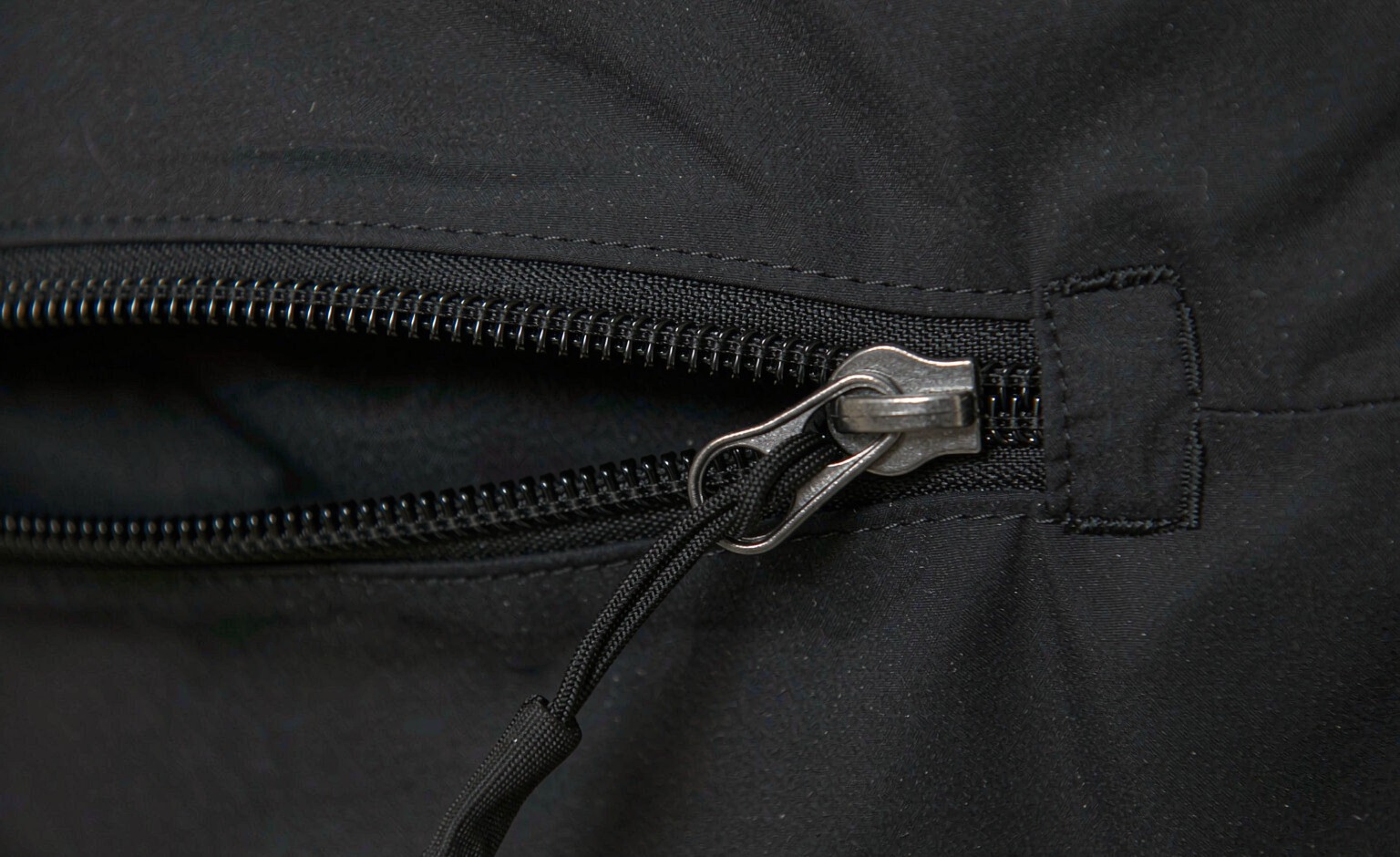
A quick-release connection system on a modular backpack is specified by release force first and by opening speed second: the fitting must stay shut under the strap tension it will actually see, then still separate with one gloved hand inside roughly two seconds. Three interface numbers sit underneath that decision because they govern which hardware families can be used at all — 25 mm webbing, 38 mm vertical spacing and 50 mm horizontal repeat — and each needs a stated tolerance and a stated rejection trigger in the tech pack rather than a nominal value. Programme arithmetic follows the same discipline: MOQ 500 per hardware reference, sampling 6-10 working days for a soft-goods carrier stretching to 12-15 where a moulded housing or an overmoulded pull tab enters the build, then mass production 35-50 days, with release against AQL 2.5 under ISO 2859-1, level II, Critical 0 / Major 2.5 / Minor 4.0. Quotations are issued FOB Xiamen on T/T 30/70. The guidance below covers civilian load carriage only — commuting, hiking, work tools, photography and first aid — and makes no claim about weapon carriage, ballistic protection or any military certification.
What a quick-release fitting must do on a modular backpack
A quick-release fitting is any component that holds two ends of one load path together under tension and separates them again on a deliberate input: a squeeze, a lift, a rotation or a pull. The definition is broader than most tech packs assume. It covers the side-release buckle closing a sternum strap, the G-hook hanging a pouch from a row of tape, the cam lever tensioning a compression strap, the magnetic pair that lets a lid fall open one-handed, and the plain thread-through loop that never separates until somebody unpicks it on purpose.
Three requirements compete inside every one of those fittings, and no family wins all three. Retained strength asks for a deep engagement and a stiff release member. A low release input asks for the opposite. Resistance to unintended opening asks for shielding, which adds bulk and costs glove access. Every specification decision in this category is really a statement about which of the three the product will sacrifice, and the honest answer is usually that a structure-duty position sacrifices speed while an accessory position sacrifices strength.
Two platform dimensions frame the choice before hardware is even discussed. Width sets both the hardware catalogue available and the stitch footprint available to absorb load, which is why 25 mm webbing is the working standard on a modular chassis. Spacing then decides how many rows a fitting consumes: on a 38 mm vertical spacing grid, a tall moulded buckle body can occupy the room a second module wanted, and the 50 mm horizontal repeat decides whether one fitting can be mirrored left and right from a single reference or has to be bought as two.
The first sorting decision is duty class. A structure-duty fitting sits in the path that transfers carried mass into the harness: shoulder strap to body, hip belt to frame sheet, a heavy module to the back panel. An accessory-duty fitting retains something that, if it opened, would annoy the user but would not drop a load. Writing that class onto the interface drawing before any hardware is selected is the cheapest control available in the whole category, and it removes most of the arguments that otherwise surface at pre-production.
Selection rule: Classify every quick-release fitting on a modular backpack as structure duty or accessory duty before selecting hardware, and permit a structure-duty fitting on 25 mm webbing only when it carries a stated retained-load figure at least three times the working load it will see in service.
Side-release buckle mechanism: release force, accidental opening and one-hand operation
The side-release buckle is the default choice because it is cheap, stocked in every size and understood by every user. Mechanically it is simple: the male member carries two flexible prongs, each ending in a catch; the female body carries two windows; squeezing the prongs inward withdraws the catches and lets the members separate. Everything that matters about the fitting follows from prong geometry and prong material, which is why two buckles of identical outline can behave completely differently after a season.
Release force is the number that governs the entire trade. A 25 mm acetal buckle with a standard prong section usually measures between 25 N and 60 N; a stiffened prong or a deeper catch pushes the figure past 80 N, which resists accidental opening far better but becomes genuinely difficult in a winter glove. Specify a band rather than a single target, and require the measured figure on both new units and units that have been cycled, because the two numbers diverge on poorly designed parts.
Accidental opening is the failure users report most, and it has three routes. Something outside the fitting presses a prong — a strap edge, a car seatbelt, the corner of a locker shelf. The webbing itself presses a prong from inside when a strap is tensioned around a small radius. Or the body flexes enough to unseat a catch under a diagonal pull. Recessed windows, a shrouded housing and a prong profile tucked below the rim address all three, at the cost of a slightly larger part and a marginally higher unit price.
One-handed operation then decides whether the fitting is genuinely quick. Measure it rather than assuming: time from grip to separation, dominant hand only, on a loaded pack, with a 3 mm glove and again bare-handed. A fitting that opens in 1.2 seconds with a bare hand and cannot be opened at all in a glove is not a quick release, whatever the datasheet claims, and it will generate the same complaints as a broken part.
Material selection closes the loop. Acetal holds dimensions well and releases crisply but is less tolerant of impact once the temperature falls; nylon 6/6 absorbs moisture, grows by a few tenths of a percent and can stiffen the release after a wet season. Where a metal spring sits inside the body, ask for corrosion evidence rather than a visual check, because a spring that has lost section will not announce itself until the release force has already collapsed.
Verdict: Choose a side-release buckle for a 25 mm modular strap when measured release force stays inside 25-60 N after cycling, the prongs sit recessed below the housing rim, and gloved opening succeeds within two seconds on a pack carrying its full working load.
G-hook and magnetic fittings compared: which closure for which duty
A G-hook is a hook that seats over a bar or a webbing loop and is held in place by the load itself. Releasing it requires a lift followed by a rotation, which is a two-part motion and therefore far harder to trigger by accident than a single squeeze. Under tension the hook seats deeper; it unseats only once the strap goes slack and something pushes it sideways, so the dominant failure condition is a slack strap rather than a loaded one.
For module hanging that behaviour is close to ideal. A pouch on a G-hook can be lifted off in roughly two to four seconds, cannot be squeezed open by a passing strap edge, and contains no spring to fatigue. The cost is bulk: a metal G-hook stands proud of the panel, and on a 38 mm vertical spacing grid it consumes clearance that a flat moulded buckle would have left free for a second row.
Magnetic fittings work on a different principle. A magnet pair assists alignment while a mechanical interlock carries the load; the user feels the assembly snap together and separates it with a slide or a twist. One-handed and gloved operation is the best of any family in this category, which is why the format suits lids and pockets opened many times a day far better than it suits load paths. Magnet grade falls as temperature rises, ferrous debris collects at the interface, and the assembly costs several times a moulded buckle. Sourcing is concentrated too: buyers normally work with a supplier in that family rather than treating the part as a commodity, so hardware lead time and the MOQ 500 reference commitment should both be confirmed before the design is frozen.
Two cautions belong in the written specification. First, the magnet must never be the sole retention on a loaded path; the mechanical interlock has to carry the load with the magnet contributing nothing beyond alignment. Second, re-test seating after grit exposure, because ferrous dust at the interface reduces holding force while still producing a reassuring click, which is a dangerous combination.
Bottom line: Hang a module from a G-hook when the strap stays tensioned and a proud fitting is acceptable, and keep magnetic closures for lids and pockets opened many times daily, where one-handed gloved access matters more than unit cost and where the interlock, not the magnet, carries every newton of load.
Cam lever locks and thread-through webbing: routes that avoid a buckle
Cam levers — the lever-lock and ladderlock family — grip webbing by pressing a toothed cam against it, and release by rotating the lever off the cam. They are adjustable as well as releasable, which makes them the natural answer for compression straps and for any run whose length changes by several centimetres between uses. Release force is set by cam geometry and by friction between cam and webbing, so it varies with webbing finish, webbing stiffness and surface contamination, not only with the fitting itself.
That dependence is also the weakness. Under sustained vibration a cam can creep, and a stiff glazed webbing reduces friction enough to let a loaded strap walk several millimetres before anyone notices. Specify a positive over-centre action, state the retained load after a defined vibration exposure, and re-check after laundering, because softeners and dirt move surface friction in both directions and the direction is not always predictable.
Thread-through fittings have no moving part at all: the webbing passes through a slot or a ladder and is retained by geometry and friction. Accidental release risk is effectively zero, cycle life is effectively unlimited, and unit cost is minimal. Opening takes fifteen to twenty-five seconds and is close to impossible in a thick glove, so this route belongs wherever a module is mounted once per season rather than once per day. On a 25 mm webbing row it is also the flattest option available, which matters when the panel has to slide behind a car seat or into a narrow locker.
Hook-and-loop is the last closure in everyday use and it deserves an explicit limit. In shear it holds respectably; in peel it opens at a small fraction of that force, which is exactly why a hook-and-loop patch must never be the only thing retaining a loaded module. Closure life is finite — a few thousand operations before the loop field pills and the hook field clogs — and both contamination and machine washing accelerate the decline. Treat it as a secondary retention or as a rattle suppressor, never as the load path.
Takeaway: Use a cam lever where strap length changes between uses and creep can be measured, a thread-through anchor where a module is mounted once per season, and hook-and-loop only as a secondary retention that is never asked to carry load on its own.
Five quick-release families compared by the criteria that decide a programme
The table below compresses the selection into one view. Read it by duty class first and by opening speed second; programmes that read it the other way round tend to fit beautiful hardware in positions where a part opening accidentally costs far more than the time saved. Figures are the bands we write into a specification as acceptance limits, not as marketing claims, and every one of them should be confirmed on the actual webbing chosen for the build.
| Criterion | Side-release buckle | G-hook | Magnetic pair | Cam lever | Thread-through |
|---|---|---|---|---|---|
| Release force band | 25-60 N typical squeeze | Lift then rotate, no squeeze figure | 10-30 N slide or twist | 15-40 N lever lift | No release; unpicks only |
| Gloved one-hand opening | 1.5-3 s, fails in thick gloves | 2-4 s | Under 1.5 s | 2-5 s | 15-25 s, impractical |
| Cycle life target | 5,000 open-close | 10,000, no spring to fatigue | 5,000-8,000 | 3,000-5,000 | Effectively unlimited |
| Accidental-open resistance | Moderate; recessed body helps | High loaded, low when slack | High; interlock carries load | Moderate; creeps under vibration | Highest of the five |
| Grit and sand tolerance | Poor; grit jams prongs | Good | Poor; ferrous dust at the face | Moderate | Good |
| Low-temperature behaviour | Acetal stiffens below -20 °C | Stable | Magnet grade falls when hot | Stable | Stable |
| Unit cost band | Lowest | Low to moderate | Highest by a wide margin | Low | Lowest |
| Duty class permitted | Accessory and semi-structure | Semi-structure | Accessory only | Semi-structure | Structure where removal is rare |
Two rows decide most arguments. Cycle life separates the families more sharply than buyers expect, because a buckle opened six times a day reaches 5,000 operations in under three years, which is shorter than the service life most owners assume. Grit tolerance decides the field categories: a desert or beach programme should not put a side-release buckle where sand can pack behind the prongs, whatever its opening-time advantage.
Judgement: Select the quick-release family for a modular backpack by duty class and environment first — thread-through or G-hook where grit, cold or load dominate, side-release or magnetic where a closure is opened more than five times a day and the load stays under 2 kg.
Failure signatures in quick-release fittings and the diagnostic route for each
Field returns in this category cluster into a small number of signatures, and each one has a diagnostic that produces a number rather than an opinion. Working from signature to mechanism to response keeps the conversation out of the blame phase, which is where hardware disputes usually stall.
| Signature | Mechanism | Diagnostic route | Specification response |
|---|---|---|---|
| Opens while loaded | Prong pressed by a strap edge or seatbelt | Load the body progressively and record the force that separates it | Recessed windows plus a shrouded housing |
| Opens when slack | G-hook unseated by a lateral push | Slacken the strap by 20 mm and push sideways | Keeper loop or a secondary retention |
| Will not open | Grit packed behind the prongs | Operate after a controlled sand exposure, then after washing | Relocate the fitting or change family |
| Will not latch | Catch worn or webbing folded under it | Gauge catch height against the drawing | Latch-force band plus a wear gauge limit |
| Prong root crack | Fatigue after repeated flexing | Cycle to 5,000 then inspect the root radius | Larger root radius, tougher resin |
| Housing split | Impact once the resin leaves its ductile range | Drop a loaded unit after a cold soak | Impact-modified resin or a metal body |
| Strap creeps | Cam friction lost through glazing or vibration | Vibrate at rated load and measure slip | Over-centre cam, stiffer webbing |
| Spring corrodes | Salt and humidity reaching the spring | Spray exposure followed by a function check | Stainless spring or a sealed body |
| Brittle fracture in cold | Resin below its usable temperature | Operate at -20 °C after a four-hour soak | Specify resin by low-temperature impact |
| Closure force decays | Loop field pilled, hook field clogged | Track closure force over repeated operations | Demote hook-and-loop to secondary duty |
Four of these signatures deserve more attention than they usually receive. Uncommanded opening while loaded is the one that ends programmes, because it drops whatever the strap was holding and the user rarely reports it as a hardware issue. Wear at the catch arrives gradually and is almost always discovered during a cycle test rather than in the field, which is a good argument for running one early. Foreign-object jamming is environmental: a fitting that works perfectly in a showroom can seize completely after one sandy afternoon. And low-temperature embrittlement is invisible until the single cold morning when a housing splits rather than flexes.
One-handed operability is the fifth failure and the only one that never appears in a laboratory report, because nobody tests it. A fitting that needs two hands or a surface to brace against will be defeated in use: users will leave it undone, which converts a retention problem into a much larger one. Test it gloved, loaded and standing, not seated at a bench.
How to test quick-release hardware before tooling release
Six checks retire most of the risk, and none of them needs unusual equipment — what they need is an agreed threshold written down before the test starts, because a result without a limit is an anecdote. Run them in this order, since each narrows what the next one has to prove, and keep the reports: evidence that can be re-read beats evidence that has to be remembered.
| Test | Method reference | Threshold to write into the pack | Sampling rule |
|---|---|---|---|
| Cycle open-close life | In-house rig on production 25 mm webbing | 5,000 cycles, release force within ±20% of new | 8 units per reference |
| Back-release trial | 10 participants, 8 kg loaded, standing | Remove and refit within 10 s, one-handed | 10 packs |
| Static retained load | Tensile on the woven assembly per ASTM D5034 | Report failure load; require ≥3× working load | 5 units per lot |
| Cold operation | -20 °C soak for 4 h, then operate gloved | Opens within 5 s, no cracking | 5 units |
| Damp-heat re-test | 40 °C at 95% RH for 48 h, then re-test | Release force within ±25% of new | 5 units |
| Transit survival | Packed shipper per ISTA 3A | No fitting separated, no cracked housing | 1 shipper per carton spec |
| Incoming inspection | ISO 2859-1, level II | Critical 0 / Major 2.5 / Minor 4.0 | Per delivered lot |
The back-release trial is the one most often skipped and the one that catches the most. Ask ten people who have not seen the product to take the pack off and refit a module while standing, time them, and count every operation that needed a second hand or a surface. Results above ten seconds or requiring two hands predict field complaints with uncomfortable accuracy.
Static retained load should be reported as a failure load rather than as a pass or fail, because the figure is what lets a designer judge a later change. A fitting failing at 900 N against a 300 N working load is comfortable; the same fitting at 350 N is not, and a bare pass certificate hides the difference entirely.
Then close the loop on incoming goods. Cycle and pull testing validates the design; sampling validates the delivered lot, and the two are not interchangeable. Agree the defect classification before inspectors arrive — what counts as critical, what as major — because otherwise the inspector's personal standard becomes the contract and every dispute afterwards is unwinnable.
Spec rule: Release a quick-release fitting to tooling only after 5,000 cycles with release force held within ±20%, a standing back-release trial under 10 seconds with one hand, and a reported static failure load at least three times the working load, with incoming lots sampled at AQL 2.5.
Grading the load path: structure duty versus accessory duty
Grading is the discipline that keeps fast hardware out of positions where fast is the wrong property. Three tiers are enough. Tier one is structure duty: anything whose failure drops carried mass — the shoulder strap to body joint, the hip belt closure, the anchorage of a module above roughly 4 kg. Tier two is semi-structure: compression runs, sternum straps and stabiliser straps, where failure is uncomfortable and untidy rather than dangerous. Tier three is accessory duty: pouch lids, tool wraps, identifier panels and anything under about 1 kg.
The rule for tier one is deliberately conservative. A quick-release fitting may sit on the main load path only if it reports a static failure load at least three times the working load, has a secondary retention that survives with the primary released, and passes the cold and damp-heat re-tests. Where any of those three is missing, the correct answer is a sewn or permanently laced joint with a buckle reserved for adjustment rather than separation.
Tier two is where quick release earns its place, and where the comparison table above should be read most closely. A compression run that is opened twice a day for three years reaches roughly 2,000 operations, comfortably inside the cycle band of a side-release buckle or a cam lever. The fitting should still be specified with a stated release-force band and a recessed body, because a compression strap runs close to other straps and to the user's clothing.
Tier three is where speed should be optimised without apology. A lid opened twenty times a day justifies a magnetic assembly despite the cost, and a module that never carries more than a first-aid kit can hang from almost anything. The only hard rule at this tier is that hook-and-loop stays secondary.
Programme work is coordinated through a 4,950 m² SGS-verified production floor with 137 people, 7 production lines and 149 machines, supporting capacity up to 200,000 units per month; the founder has worked in bag production since 2004 and the company was established in 2014. Hardware programmes run sampling, then a pre-production sample built from production-intent components, then AQL 2.5 inspection, then shipment. Capacity is seldom the limiting factor on a hardware reference; the limiting factors are the tooling decision and the approval loop around it.
Quick release against fixed MOLLE lacing, plus quantity and schedule
Fixed lacing — a module threaded permanently into the tape rows — has no hardware to fail, sits flatter than any quick-release fitting and costs almost nothing. It also takes minutes rather than seconds to reconfigure, cannot be done in gloves, and quietly punishes a wrong mounting decision by making the user live with it. Choosing between the two is a question about frequency and load, not about which technology is newer.
A usable dividing line: where a module will be removed and refitted fewer than about thirty times across its service life and carries more than 4 kg, lace it permanently. Where removal happens more than fifty times and the load stays under 2 kg, a quick-release fitting pays for itself in user satisfaction alone. Between those bounds, decide on environment — grit and cold push toward lacing, frequent access pushes toward hardware.
Quantity then shapes what is feasible. Every distinct hardware reference carries MOQ 500, which is the reason a range does not ship with six different buckle sizes: two or three families, each ordered in volume, cost less and inspect more cleanly than six thin references. Development units run USD 50-150 each and are refundable against the production order, while a dedicated moulded housing or pull tab sits in the USD 300-2,500 tooling band depending on cavity count.
Schedule follows the same pattern as any structural reference. Sampling 6-10 working days suits a soft-goods carrier; a moulded housing or an overmoulded pull stretches that to 12-15, after which mass production 35-50 days begins once the pre-production sample is approved. Release runs against AQL 2.5 under ISO 2859-1, level II, with Critical 0 / Major 2.5 / Minor 4.0 agreed in advance, and quotations are FOB Xiamen on T/T 30/70.
Freight closes the calendar. Sea freight 25-35 days carries planned volume, air 5-8 days rescues a genuine stockout against a launch commitment, and express 3-5 days moves spare fittings and replacement housings. Our production team can quote either route; the discipline is to decide which one applies before the order is placed, because a hardware reference discovered late and flown in costs more than the fitting it replaced.
Frequently asked questions
What release force should a quick-release buckle have on a modular backpack?
Specify a band rather than a single figure: 25-60 N measured on new units and again after cycling, with the cycled value held within ±20% of the new one. Below that band the fitting opens under a seatbelt; above roughly 80 N it stops being operable in a winter glove. Every hardware reference carries MOQ 500, so confirm the band before ordering.
How do you stop a quick-release fitting opening accidentally under load?
Three measures, in order of effectiveness: recess the prong windows below the housing rim, add a shrouded body that prevents a strap edge reaching the prongs, and fit a secondary retention that survives with the primary released. Verify by loading the body progressively and recording the force at which it separates, then sample incoming lots at AQL 2.5.
Which quick-release fitting suits a modular backpack used with winter gloves?
G-hooks and cam levers perform best, because both are operated by a lift or a rotation rather than a pinch. A side-release buckle in a thick glove frequently cannot be squeezed at all. Whichever family you choose, test at -20 °C after a four-hour soak and require opening within five seconds.
How many open-close cycles should a quick-release buckle survive?
Write 5,000 cycles as the acceptance threshold for a side-release buckle on 25 mm webbing, with release force afterwards held within ±20% of the new measurement. A closure opened six times daily reaches that figure in under three years. Confirm the result during sampling 6-10 working days rather than discovering it in the field.
When should a module be laced into MOLLE instead of using quick-release hardware?
Lace it permanently when removal happens fewer than about thirty times in service life and the module carries more than 4 kg, because fixed lacing has no fitting to fail and sits flatter on the panel. Quick release suits frequent access under 2 kg. Grit and cold environments push the decision toward lacing. All builds assume 25 mm webbing.
Does a magnetic closure belong on the main load path of a modular backpack?
No. A magnetic pair may assist alignment, but the mechanical interlock must carry the whole load with the magnet contributing nothing, and magnet grade falls as temperature rises. Keep magnetic assemblies on lids and pockets opened many times daily. Confirm hardware lead time early, since each reference carries MOQ 500 and this family is sourced from a supplier in that family rather than as a commodity.
Can quick-release hardware be re-tested after cold and humidity exposure?
Yes, and it should be mandatory. Soak units at -20 °C for four hours and operate them gloved, then condition a second set at 40 °C and 95% relative humidity for 48 hours and re-measure release force. Acceptance is opening within five seconds cold, and release force within ±25% of the new value after damp heat.
Why does a cam lever creep on a compression strap?
The cam holds by friction, and friction falls when webbing glazes, when softeners remain after washing, or when sustained vibration walks the lever off its over-centre position. Specify a positive over-centre action, state retained load after a defined vibration exposure, and re-check after ISO 6330 laundering.
What sampling and inspection level applies to quick-release fittings?
Incoming lots are sampled at AQL 2.5 under ISO 2859-1, level II, with Critical 0 / Major 2.5 / Minor 4.0 and the defect classification agreed before inspectors arrive. Design-level tests are separate: 8 units for cycle life, 5 for static retained load, 5 for cold and 5 for damp heat.
How long does a custom quick-release module take to develop?
Sampling runs 6-10 working days for a soft-goods carrier and 12-15 where a moulded housing or an overmoulded pull tab is involved. Mass production 35-50 days follows pre-production approval, then sea freight 25-35 days, or air 5-8 days for a genuine shortage. Tooling sits between USD 300 and 2,500.
Should hook-and-loop ever carry load on a modular backpack?
Only as a secondary retention. Hook-and-loop holds acceptably in shear but peels at a small fraction of that force, and closure force decays over a few thousand operations as the loop field pills and the hook field clogs. Use it to stop rattle or to hold a panel flat, never as the sole retention on 25 mm webbing.
Which webbing size and grid pitch do quick-release fittings require?
Fittings are sized to 25 mm webbing, which sets both the hardware catalogue and the stitch footprint available to absorb load. Placement follows the grid: 38 mm vertical spacing decides how many rows a tall buckle body consumes, and the 50 mm horizontal repeat decides whether one reference can be mirrored left and right.
How is one-handed opening measured for a quick-release fitting?
Time from grip to separation on a pack carrying 8 kg, standing rather than seated, dominant hand only, repeated with a 3 mm glove. Run ten participants who have not seen the product. Anything above ten seconds, or any operation needing a second hand or a bracing surface, is a usability defect rather than a feature.
What quantity and payment terms apply to a quick-release hardware programme?
Every hardware reference carries MOQ 500, quoted FOB Xiamen on T/T 30/70 with the balance released against shipping documents. Capacity reaches 200,000 units per month, so schedule risk sits in tooling and approvals rather than output. Sea freight 25-35 days handles planned volume, air 5-8 days a stockout, express 3-5 days spare housings.