Home › Field notes › Modular vs Fixed Compartment: The Real Cost Trade-off
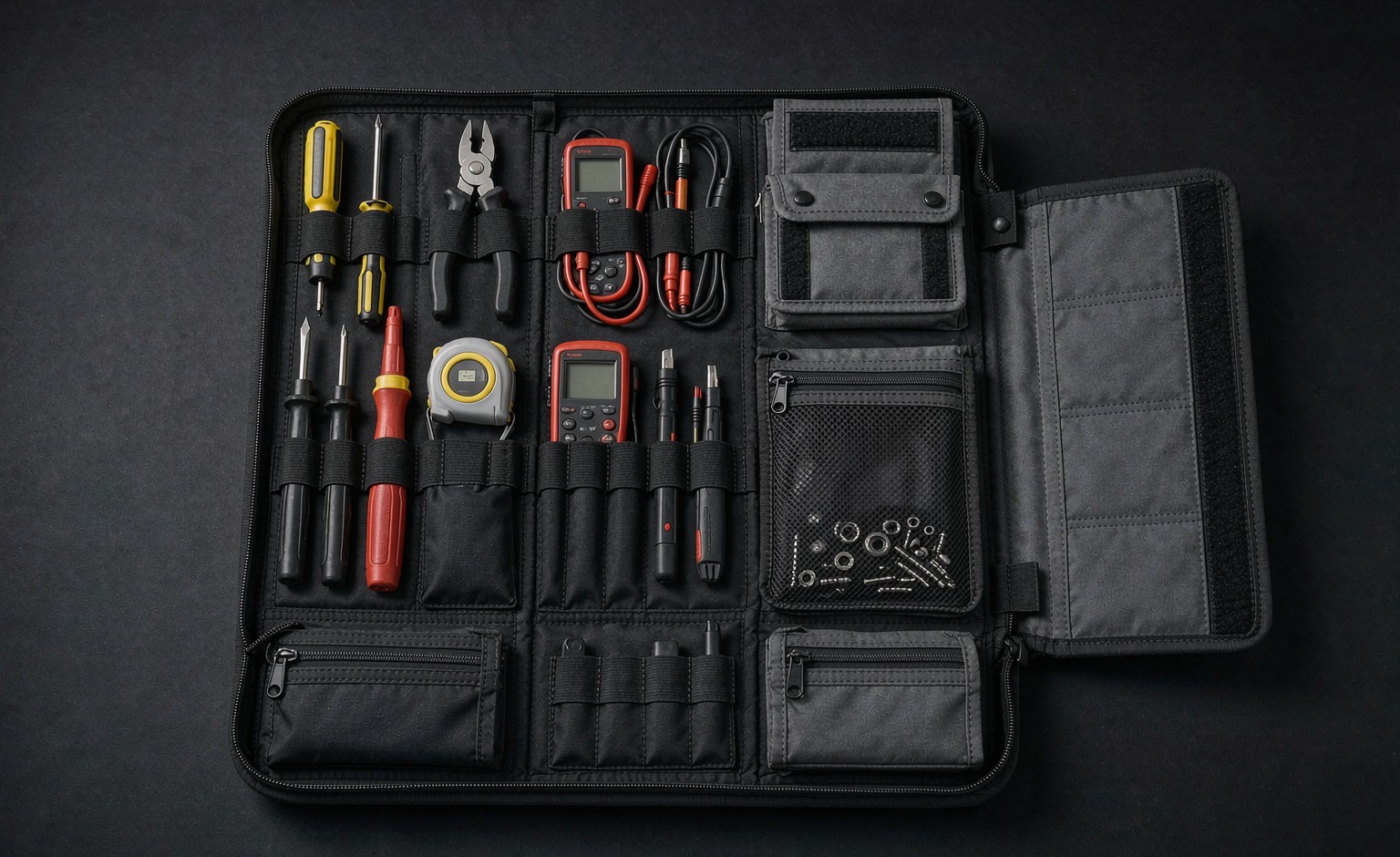
A modular compartment architecture costs more per unit than a fixed one - typically 18-35 percent more at first cost - and repays that only above roughly 1,500-2,500 units per year once tooling is amortised, shared across references, and when the range genuinely needs multiple configurations. The gap comes from duplicated shells, added interface hardware, extra sewing minutes and repeated laboratory batches rather than from any single expensive component: five pouch references each carrying a 500-unit floor means five separate development, sampling and test obligations. Export paperwork and tariff classification should be checked against sources such as WTO reference material and national guidance from Trade.gov before stating a delivered figure. Figures here are indicative only, read against MOQ 500 per reference and quoted FOB Xiamen, with shipments released at AQL 2.5 following ISO 2859-1. Nothing here touches weapon carriage, ballistic protection or any military specification claim.
Where the cost of a modular architecture actually accumulates
Conversations about modular versus fixed usually begin with unit price and should not. Unit price is the last place the difference appears; most of it is committed earlier, in decisions about how many references exist, how much hardware each requires, and how many separate laboratory populations those references create.
A fixed architecture has one shell, one closure set, one hangtag and one carton. A modular equivalent may have the same chassis plus three to six modules, each with its own shell fabric, its own closure hardware, its own labelling, its own packaging and its own first-article approval. Every one of those is a small line item that multiplies by the reference count.
The multiplication is the thing that surprises range planners. Launching with two pouch styles rather than one does not double pouch cost; it adds a whole reference, meaning another pattern, another sample round at USD 50-150, another test population and another 500-unit minimum. Three references is not three times the cost but roughly 2.4-2.8 times, because shared chassis work is spread while per-reference work is not.
Design effort belongs in the same accounting, and it is the line most often forgotten when a team compares this route against a single-purpose rugged chassis. A fixed interior is drawn once. A modular interior requires interface drawings, engagement specifications, revision control across compatible generations, and care instructions explaining what attaches to what. Those are real costs even when they do not appear on a quotation sheet.
Spec rule: Cost every module as its own reference with its own tooling, sample, test and minimum quantity line, and never assume that adding a pouch adds only the pouch price.
Bill of materials: duplicated shells, duplicate hardware, shared chassis
Open two bills side by side and the pattern is consistent. The fixed version has perhaps 40-60 line items; the modular version of the same product has 90-150, even though around a third of them repeat the same component used in a different position.
Interface hardware dominates the incremental list. Each attachment point carries either tape rows, slot panels, hook-and-loop tape, buckles or a combination, and because these are bought by the metre or by the hundred they rarely benefit from the volume discounts that apply to shell fabric or webbing. A field adding 0.6 m of tape rows plus three buckle sets typically adds USD 1.40-3.20 in hardware alone.
Duplicated shells come next. A removable module needs its own outer fabric, lining, stiffener, closure and binding, whereas a fixed divider needs none of those - it is a piece of fabric with binding. That single difference accounts for most of the first-cost gap and explains why modules cost what looks like disproportionate money for their size.
Shared components are where modularity recovers ground. One harness, one chassis pattern, one main closure set, one back panel and one compliance file spread over three or four configurations. Programmes that genuinely share those elements see the gap narrow noticeably; programmes that quietly redraw the chassis for each variant see none of the benefit.
Judgement: Freeze the chassis, harness and closure set across the whole range before adding any module, because every element redrawn per variant destroys precisely the sharing that makes modular economics work.
Sewing minutes, line balancing and the second shift problem
Labour differences between the two approaches are larger than most quotations imply, and they behave non-linearly. A fixed interior might assemble in 45-60 minutes of line time. Adding one removable module adds roughly 10-18 minutes spread across sub-assembly and final assembly, plus handling.
Interfaces are slow for structural reasons. Applying rows of tape demands multiple passes and bar-tacks; laser slot panels require precise placement; hook-and-loop fields must be aligned or they grab prematurely. All of that happens on vertical surfaces where operators work slower than on flat goods.
Handling is the hidden cost. Modules cannot travel down the line attached to the chassis, so each represents a separate work-in-progress item: its own bin, its own move, its own station time and its own opportunity to be mislaid. The second shift problem arises here, when a partially built chassis meets a missing pouch and the line stalls rather than ships.
Pack-out follows the same logic. Every module needs to be counted, bagged, labelled and placed with its chassis, adding perhaps 60-120 seconds per order unit at final packing. Over 500 units that is a meaningful number of labour hours and a meaningful defect opportunity for wrong-item complaints.
Yield behaviour differs as well. Because interfaces involve multiple passes and precise placement, defects concentrate there rather than in the body, so a modular line typically runs a slightly lower first-pass yield than its fixed equivalent. Correcting that gap costs either better fixture investment or more rework capacity, and both belong in the model before anyone compares unit prices.
Takeaway: Add an allowance of 10-18 assembly minutes plus 60-120 seconds of pack-out time for every module introduced, and plan work-in-progress storage accordingly or the line will stall rather than simply run slower.
Tooling, artwork and how many sample rounds realistically happen
Fixed architectures are cheap to develop because almost nothing needs a tool. Soft patterns, standard webbing, standard closures and existing labelling mean one or two sample rounds settle the design. Modular programmes rarely escape that easily.
Moulded or formed components are the main reason. A shaped base tray, a stiffened perimeter ring or a formed pocket face each require their own screen or die, commonly landing between USD 300 and 2,500 depending on complexity. None of that is recoverable if the reference is later dropped from the range.
Sample rounds multiply too. Experience across ranges suggests a fixed interior is settled in 1-2 rounds while a modular system takes 2-4, since the chassis is approved first and each attachment type then needs its own fit and load verification. Each round burns 6-10 working days before anything can start.
Artwork and labelling follow along behind. If every module retails separately, every module needs its own hangtag, its own barcode and its own compliance wording - which is another small-multiplier, the kind of thing that quietly consumes the margin a costing claimed to preserve.
Bottom line: Budget two to four sample rounds and a screen or die charge between USD 300 and 2,500 for each formed module part, and delete any reference whose tooling cannot be recovered inside two seasons.
Test obligations multiply with every reference
Testing is where the economics change most sharply and most unexpectedly. A laboratory does not test a product; it tests a material combination in a construction. Three modules in three colourways are therefore not one test but several populations, each invoiced separately.
| Obligation | Fixed interior | Semi-modular, one interface | Fully modular, four references |
|---|---|---|---|
| Abrasion populations to ASTM D3884 | Two shell fabrics | Three including interface tape | Six to nine across all units |
| Tensile checks to ASTM D5034 | Harness webbing only | Harness plus attachment tape | Harness, tape and each module closure |
| Water resistance to AATCC 127 | One shell fabric | Shell plus one module face | Shell plus every module fabric |
| Colour transfer to AATCC 8 | Trim against shell | Adds tape and binding | Every colour pairing per unit |
| Engagement or pull verification | Not applicable | One interface pair | One per module to chassis pairing |
| Release audits at AQL 2.5 following ISO 2859-1 | One population | Two populations | One per reference per shipment |
| Recycled content trace, where claimed, against Textile Exchange schemes | Single transaction certificate | Certificate per material group | Certificate per module fabric |
| Compliance file pages at handover | Roughly 20-30 pages | Roughly 40-60 pages | Commonly 90-140 pages |
Reading down the final column shows why a small launch can feel expensive without any component being individually costly. Six to nine abrasion populations instead of two changes the development invoice more than a one percent fabric saving ever will.
Documentation effort deserves its own line in the plan. A fully modular programme may hand over 90-140 pages of compliance evidence, and somebody on the buying side has to read, file and renew it. Late or skipped review of those claims causes mismatches later.
After-sales obligations: spares, revisions and the orphaned reference
Customer service carries costs that nobody forecasts at development stage. A fixed compartment fails rarely and is repaired or replaced whole. A modular system generates questions about compatibility, requests for individual spares, and eventually the hardest problem in the category: the orphaned module.
Spare availability implies stocking components that may never sell at full margin. Buckles, strap tails and replacement panels need their own minimum quantities, and each is again subject to a 500-unit floor when ordered afresh. Keeping a 3-5 year spare commitment is realistic only if those parts are genuinely shared across several chassis generations.
Revision control is the deeper issue. When a chassis is revised - different binding, a new face layout, a moved seam - previously sold modules either fit the new version or they do not. Publishing a compatibility generation statement protects against complaints, and freezing interface geometry for at least 24 months protects against obsolescence.
Returns behaviour differs too. Fixed interiors are returned for defects; modular systems are returned for misunderstood capabilities, which is a documentation problem rather than a quality one. Clear statements of what attaches to what reduce that category substantially, and writing them during development costs almost nothing compared with the same clarification written by a support agent eight months later.
Decide early whether units may also be sold separately at retail. Doing so changes labelling, barcoding, packaging and sometimes the declared product name, and it commits the brand to supporting a spare pipeline rather than merely honouring warranty claims.
Verdict: Commit spares only for parts shared across generations, freeze the published interface geometry for at least 24 months, and issue a compatibility generation statement with every chassis revision.
Three configurations compared across the full cost stack
Putting every layer into one view is the most useful exercise available. The following table stacks material, labour, tooling, testing and service lines against three configurations of the same nominal product.
| Cost line | Fixed single body | Chassis plus one shared family | Fully swap-out system |
|---|---|---|---|
| Shell and lining components | Baseline | Baseline plus 8-14 percent | Baseline plus 30-60 percent |
| Interface hardware | None | USD 1.40-3.20 per chassis | USD 4-9 across dependent units |
| Sewing minutes per assembled unit | 45-60 minutes | 58-78 minutes | 75-110 minutes |
| Pack-out seconds per order unit | Baseline | Plus 30-60 seconds | Plus 90-180 seconds |
| Tooling exposure in development | Usually none beyond screens | USD 300-1,200 | USD 900-2,500 or more |
| Sample rounds before approval | 1-2 rounds | 2-3 rounds | 2-4 rounds |
| Laboratory populations | Two to three | Four to six | Six to nine |
| Documentation pages handed over | 20-30 pages | 40-60 pages | 90-140 pages |
| Spare parts commitment | Whole unit only | Hardware and webbing | Each module plus its hardware |
| Indicative first-cost premium | Baseline | About 10-18 percent | About 18-35 percent |
Two findings deserve emphasis. First, the middle column frequently delivers most of the perceived modularity at a fraction of the cost, letting one shared family serve several chassis without a separate business unit managing it. Second, the premium in the final column is real but not primarily material - it is labour, testing and documentation piled up.
Ranges aimed at compact everyday configurations should pay particular attention to the pack-out line, because small modules in small quantities are exactly where handling cost outruns material cost.
Export documentation, capacity and programme mechanics
Costing does not stop at the factory gate. Tariff classification, origin declaration and the destination's documentation expectations all differ between a single-body product and a set shipped together as a kit, and getting that wrong changes the delivered figure more than any sewing saving.
Classification questions should be settled with reference material published by the WTO on origin and valuation rules, and with practical guidance from Trade.gov on documentary requirements; where recycled content is claimed, traceability follows Textile Exchange practice with a transaction certificate per material group.
Delivered sums are always indicative and read FOB Xiamen against 500 units per style. Transit choices then run around 25-35 days by sea, 5-8 by air and 3-5 by express, with approximately 28 CBM of usable space in a twenty-foot container and roughly 68 CBM in a high-cube forty-footer - figures worth checking against how flat each module actually packs.
Capacity is seldom the constraint. The SGS-verified production base covers 4,950 m², where 7 lines carrying 149 machines are run by 137 people for planned output of 200,000 units each month; the founder has been making bags since 2004 and the operating company was set up in 2014. Terms normally settle T/T 30/70 against release inspection, and further detail sits on the services page alongside the modular platform range, while teams needing a shared-geometry programme can start from the documented development route.
Break-even by volume and how to choose
Two numbers decide the answer: how many chassis ship per year, and how many distinct configurations customers genuinely need. Neither is usually known precisely at planning stage, so reason in bands rather than points.
Below roughly 800-1,200 units annually across the whole range, the fixed architecture almost always wins on cash, since no realistic volume amortises tooling across several references. Between 1,500 and 2,500 units the shared-interface option starts paying, particularly where one family serves several chassisscan share a single test population. Above 3,000 units the fully modular route usually justifies itself, provided the range genuinely uses more than two configurations.
Service and replacement revenue deserves inclusion. Selling a replacement pouch to an existing customer costs nothing in acquisition, and a modular line with 3-5 units per customer generates repeat purchases a fixed line cannot. Over three years that stream changes the arithmetic appreciably.
Selection rule: Choose fixed below about 1,200 units a year, a single shared interface family between 1,500 and 2,500 units, and a fully swap-out system above 3,000 units where at least three configurations actually sell.
Frequently asked questions
What does a modular compartment add to unit cost?
Typically 18-35 percent first cost for a fully swap-out system, or 10-18 percent for one shared interface family. That premium is mostly duplicated shells, interface hardware at USD 1.40-9.00, added sewing minutes and separate test populations rather than expensive materials. Indicative only, read FOB Xiamen against 500 units per reference.
Why do modular ranges cost more to sample than fixed ones?
Because each attachment family needs its own verification after the chassis is approved, so rounds run 2-4 against 1-2 for fixed interiors, and each round consumes 6-10 working days. Formed parts also add screen or die charges between USD 300 and 2,500 per component.
How many extra laboratory populations does a four-module range create?
Expect six to nine against two or three for a fixed body: abrasion to ASTM D3884 for every module fabric, water testing to AATCC 127 per face, transfer to AATCC 8 per colour pairing, plus one engagement verification per module-to-chassis combination.
- Per-reference laboratory invoices
- Transaction certificates where recycled content is claimed
- Renewal calendar
Does every module really carry its own minimum order?
Yes. MOQ runs at 500 units per reference, so a chassis with four pouch types represents five separate obligations. Plan replacements carefully, because reordering a single dropped pouch later still meets that floor and often cannot be justified by demand alone.
When does tooling stop dominating the decision?
Above roughly 1,500-2,500 units a year, once screen and die charges between USD 300 and 2,500 are spread across enough pieces. Below that, a shared interface family using existing standard components usually beats any bespoke formed part on cash flow.
How many units per year justify a fully modular architecture?
Above about 3,000 units where at least three configurations sell consistently. Below 1,200 units a fixed body is almost always cheaper in cash terms, and between those bands one shared interface family gives most of the perceived benefit at a fraction of the cost.
What hidden service costs follow a swap-out system?
Spare stocking, revision control and orphaned references. Each replacement component meets a 500-unit floor when reordered, so only commit spares for parts shared across generations, freeze interface geometry for at least 24 months to avoid stranding sold modules, and budget warehouse space for the stock itself.
How should interface revisions be communicated to customers?
Publish a compatibility generation statement with every chassis revision, naming which module editions fit which chassis editions. Without that document, every later change is argued individually with customers, and the handling cost exceeds the cost of writing the statement. Date each generation and archive the previous list so support staff can answer older questions.
Which export documents differ for a kit versus one body?
Tariff classification and origin declarations can change when several units ship together. Confirm rules against WTO reference material on origin and valuation and check documentary expectations through Trade.gov guidance, then verify the result with the broker before quoting a delivered figure.
How long does development take for a modular range?
Sampling occupies 6-10 working days per round, with 2-4 rounds typical, followed by 35-50 days of mass production once the sample is signed off and materials confirmed. Formed components stretch that to 12-15 working days of sample time, which is why freezing the reference list early shortens the calendar more than any other single step.
Where do pack-out errors come from in modular ranges?
Every extra unit adds 60-180 seconds of counting, bagging and placing, plus a chance of mismatched sets. Barcode each module, verify at final pack rather than at line end, and keep replacement listings clear so a customer can order a missing piece easily.
Should a small brand start fixed and add modules later?
Usually yes. Validate demand with a fixed architecture, then introduce one shared interface family once volume justifies it; adding a pouch later costs USD 50-150 for samples and 6-10 working days, which is cheaper than carrying unsold module stock from launch.
How do I compare quotations that mix both architectures?
Ask for the reference count, the labour minutes, the tooling lines and the intended laboratory populations stated separately. Quotations quoting only a unit price hide the largest modular costs, which sit in tooling, testing and documentation rather than materials, and should be referred back for restatement before two offers are compared.
Is after-sales revenue enough to justify modularity?
Often yes, over roughly three seasons. A customer owning three to five units generates repeat purchases at no acquisition cost, which a fixed line cannot match; model that income explicitly rather than ignoring it, then compare against the 18-35 percent first-cost premium.