Home › Field notes › Module Weight Budget for Backpacks: Mass Targets and Centre of Gravity
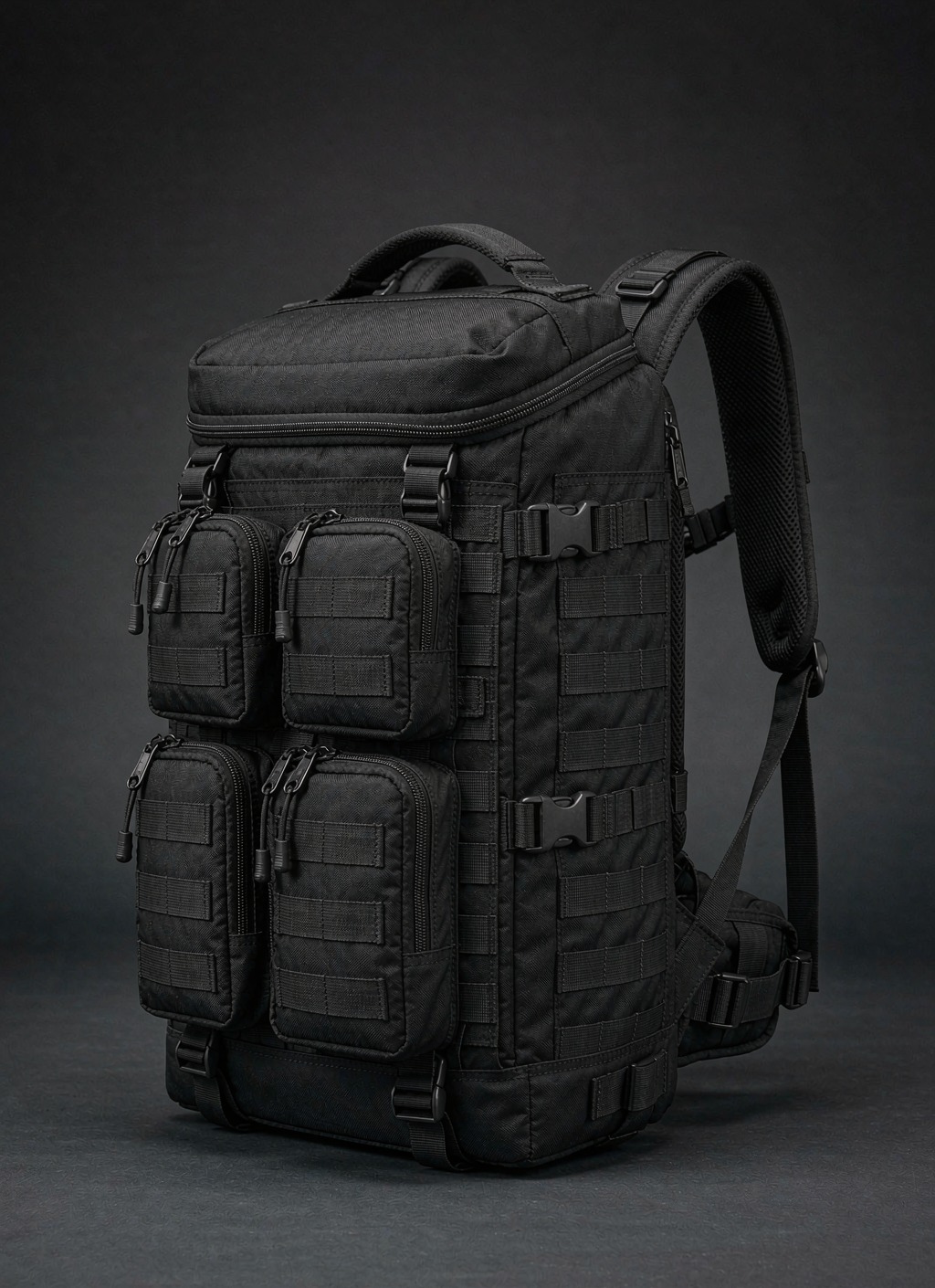
A module weight budget sets three ceilings before sampling begins: empty chassis mass, total mass accepted from mounted modules, and the window within which the loaded centre of gravity may move. Typical civilian targets are 1.1–1.6 kg for a 30–40 litre empty chassis, 2.5–4.5 kg of modules on top, and a combined centre held between 60 and 140 mm above the hip belt centreline. Exceeding the third ceiling costs more than the first two combined, because mass carried high behaves like three to four times its own weight at the shoulders, and generates the chassis rotation that drags the whole load backwards off the pelvis. Every programme we quote holds the same commercial anchors: MOQ 500 per colourway, a prototype built in 6–10 working days, 12–15 for laminated versions, and assembly across 35–50 days from approval. This budget applies to civilian modular carriers for work tools, electronics, first aid and trail use; it says nothing about weapon carriage, ballistic systems or any military qualification.
The Three Numbers a Module Weight Budget Has to Fix
Teams usually start weight conversations with total mass, which is the one figure least connected to comfort. Three numbers do the real work, and they are decided in a specific order.
First comes empty chassis mass. This is what a wearer lifts before anything useful has been put in, and it is the figure that appears in product copy and comparisons. Second comes the module allowance: the mass the platform is designed to accept from pouches, panels and sleeves. Third — and most often skipped — is the centre-of-gravity window, expressed as a vertical distance above the belt centreline plus a lateral and fore-aft tolerance.
Order matters because each number constrains the next. A chassis speced at 1.8 kg empty leaves little room if the intended department-store comparison sits at 1.4 kg, and it also pushes the platform into modules that have to be lighter than their natural construction allows. Buyers comparing several bodies at once can usually see the effect directly across the reference programme range, where two chassis of similar litre count carry very different module allowances. Conversely, a tight centre-of-gravity window may force certain heavy items to be carried low and inward, which then changes what pouch shapes the platform can sell.
A worked set for a 35-litre civilian platform looks like this:
- Empty chassis including belts and framesheet: 1.45 kg.
- Maximum accepted module load: 3.8 kg.
- Working gross for duty planning: 5.3 kg; peak permitted 7.0 kg.
- Vertical centre of gravity at working gross: 80–130 mm above belt centreline.
- Fore-aft moment arm: no more than 90 mm behind the back panel face.
Those figures are not universal, and pretending otherwise causes arguments later. They are targets derived from a duty profile, and the duty profile has to be written down before any of them mean anything.
Spec rule: Fix chassis mass, module allowance and centre-of-gravity window in that order and record the duty profile they were derived from, because a centre limit without a stated load case cannot be verified on a sample and will be renegotiated every season.
Starting From the Wearer: Realistic Gross Mass by Role
Duty profile drives everything downstream, so it deserves numbers rather than adjectives. Across civilian buyers we see four recurring clusters, each with a different relationship between volume and mass:
- Urban commute: 4–6 kg gross, including a laptop sleeve and one or two small pouches. Volume is generous relative to mass, so the centre of gravity stays low naturally and the risk is bulk rather than weight.
- Trades and field service: 8–12 kg gross, much of it dense and angular — hand tools, meters, fixings. Volume under-runs while mass overruns, and every module choice should be made on anticipated contents rather than on litres.
- Trail day use: 6–9 kg gross with water accounting for 1–3 kg, which tends to dominate the vertical centre because bottles are often carried high or outside.
- Response and first aid: 5–9 kg gross, but with an unusual constraint — opening speed outranks comfort, so contents sit closer to the opening even when that raises the centre.
A work-oriented chassis that will realistically see 10 kg needs its module allowance set near 6 kg, not near 3 kg, because the base contents already account for most of the working gross. Getting this wrong produces the most common post-launch complaint in the category: bags sold on litre count that cannot hold tools without sagging.
One adjustment applies across all four clusters. Published litre figures measure volume, and nothing about volume predicts mass. When the duty involves dense contents, write the budget in kilograms and treat litres as a secondary line, then check prototypes with real contents rather than with packing peanuts.
Bottom line: Write the budget in kilograms using expected contents rather than in litres, since dense service loads routinely fill 8–12 kg into a body whose volume suggests 6 kg, and volume-derived budgets fail the first field trial by a wide margin.
How Much Weight Should Sit in the Chassis Versus the Modules
The ratio between empty chassis and accepted modules is a design decision disguised as an accounting one. A heavy chassis with a low module allowance gives predictable handling and boring handling; a light chassis accepting lots of modules gives flexibility and surprises. Three philosophies dominate:
| Criterion | Chassis-first allocation | Module-first allocation | Even-split allocation |
|---|---|---|---|
| Typical split at 6 kg working gross | 4.4 kg chassis capability, 1.6 kg modules | 2.6 kg chassis capability, 3.4 kg modules | 3.5 kg chassis capability, 2.5 kg modules |
| Handling predictability | High; every configuration feels similar | Low; two pouches change everything | Moderate; sensitive to module placement |
| Shell and fabric requirement | Structured shell, 420–1000D body fabrics | Light body relied upon less for structure | Mid-weight fabrics throughout |
| Suspension specification | Fixed because duty is known | Must tolerate a wide load band | Tuned to one configuration |
| Unit cost at MOQ 500 | Higher per unit, fewer SKUs | Lower chassis cost, more module SKUs | Median |
| Range expansion latitude | Narrow; added modules quickly exceed budget | Wide; new modules are the growth path | Moderate |
| Revision risk after launch | Low | High, if the module roster grows | Moderate |
Reading the split correctly prevents a frequent procurement error. A buyer comparing two quotations on chassis price alone is frequently comparing two entirely different budget philosophies, and the cheaper sample is often the one that will need a heavier duty suspension once real pouches are attached.
Allocating mass also has a quantitative component worth enforcing. Give each module family a declared mass class — light under 150 g, medium 150–450 g, heavy above 450 g empty — and require every new reference to declare which class it belongs to before the range settles.
Judgement: Choose chassis-first allocation when every configuration must feel alike and the module list is fixed, and module-first only when the suspension can accept a load band wider than 2:1, because otherwise an expanding pouch roster quietly turns handling inconsistency into a returns line.
Centre of Gravity: Vertical, Lateral and Fore-Aft Budgets
Centre of gravity deserves its own budget line because it is the part a wearer feels first. Vertical position above the belt centreline governs how much of the load transfers through rotation into the shoulder straps; lateral offset produces the asymmetric tug that twists a torso on uneven ground; fore-aft distance creates the pendulum that makes a bag pull away from the back.
Vertical budget is the one most easily written into a drawing. Keep the combined centre between 60 and 140 mm above the belt centreline at working gross, and below 100 mm once gross exceeds 10 kg. Anything higher and no amount of hip belt work will hold the share on the pelvis, because the moment arm rotates the whole chassis backwards.
Fore-aft behaviour is where external modules cause the most trouble. Every millimetre of stand-off from the back panel multiplies payload mass into a torque about the lumbar contact point. A 2 kg pouch sitting 120 mm off the panel generates roughly the rotational demand of 4 kg carried close to the back, which is why tail-end sagging complaints almost always trace to external modules rather than to the harness.
Lateral tolerance is the tightest of the three. Keep imbalance between left and right below 300 g on any configuration intended for walking longer than thirty minutes; above roughly 500 g, most wearers unconsciously lift one shoulder to compensate, and that asymmetry produces complaints described as strap discomfort rather than as imbalance.
Practical control comes from a single instruction in the tech pack: every module family declares mounting zone, empty mass and maximum intended contents mass, and the combination is checked against the three axes rather than against the total. That declaration works best when the mounting zones are already fixed on a standardised attachment grid, because rows cannot be added afterwards to solve a balance problem.
Verdict: Budget all three axes separately — 60–140 mm vertical, under 90 mm fore-aft stand-off and less than 300 g lateral imbalance — because total mass alone never reveals whichever axis has quietly gone out of tolerance.
What Overrunning the Budget Costs in Comfort and in Structure
Overshoot presents itself twice: once to the wearer, later to the returns desk. Both costs are predictable enough to be provisioned.
On the perceived side, mass above the centre band behaves disproportionately. Four hundred grams carried 100 mm higher than budget reads roughly like one and a half kilograms at the shoulders, which is why a specification that overshoots by 400 g produces complaints that sound like the bag is three kilograms too heavy. The wearer response is also predictable: belt loosened to escape shoulder pressure, chassis then swings, and every other comfort feature loses its effect.
On the structural side, overshoot shows up at predictable locations:
- Shoulder strap upper anchors, where the stitch box sees cyclical peel rather than shear.
- The junction between belt and chassis, especially where the stiffener terminates.
- Mounting rows carrying heavy pouches, where elongation of the top row is the first visible sign.
- Zipper tapes on horizontal openings, which deform under load even when closure itself is fine.
- Back panel lamination, where additional flex meets an adhesive interface.
Cost is then straightforward to model. A return costs several multiples of the incremental fabric needed to have prevented it, and the review language associated with structural returns damages ranges that are otherwise healthy. Weight-related complaints are rarely reported as weight — they surface as comfort or durability failures, which is why the true cost of missing the budget is usually booked under a different heading.
Treatment at the drawing stage costs almost nothing. Moving a heavy module 40 mm inward, or requiring a lower mounting row, generally requires no new material and no new tooling.
Takeaway: Provision every 400 g of overshoot as roughly 1.5 kg of perceived shoulder load and expect it to surface as anchor or seam failures, since keeping to the declared centre window usually costs nothing beyond module placement instructions.
Measuring and Policing Module Mass Through Development
A budget without a measurement routine becomes decorative by the second round. Three habits keep it alive from first sample through bulk.
First, weigh everything at each stage and record it against the drawing. Empty chassis mass at development sample, pre-production sample and shipment sample; module masses at the same three points. Record actual weight rather than the target so trend is visible, and expect drifts of 20–60 g between rounds merely from trim and thread substitutions.
Second, allocate tolerance explicitly rather than letting it accumulate unchecked. Give the chassis ±60 g and each module family ±15 g at 500 pieces, then require that the sum of declared tolerances still leaves at least 400 g against the centre-of-gravity envelope.
Third, run checks at the reference configurations, not at the extremes. Define three — minimum practical, working, and peak — and test the loaded centre at all three. Skipping the minimum case is a common error, because an empty chassis with a single low pouch can place its centre worse than one carrying far more.
| Element | Nominal mass and centre height | Permitted drift at 500 units | Record required at each gate |
|---|---|---|---|
| Empty chassis with belts | 1,450 g, centre 110 mm above belt line | ±60 g, ±15 mm centre height | Weighted figure on the first-article sheet |
| Light pouch family | 90–150 g each, mount low or lateral | ±15 g per reference | Declaration from the module tech pack |
| Medium pouch family | 150–450 g each, mount on the main panel | ±20 g per reference | Weighted pre-production sample |
| Heavy sleeve and panel family | 450–900 g each, mount close to the back | ±25 g per reference | Loaded centre measurement on the rig |
| Accessory straps and hardware | 40–120 g per set | ±10 g per set | Trim card with the pre-production file |
| Combined gross at working load | 5,300 g, centre inside 80–130 mm | ±120 g gross, band not exceeded | Photograph and reading from the reference trial |
Where a coating or laminate enters the construction to save elsewhere, adhesion behaviour under load belongs in the same file; the relevant ASTM D751 route gives repeatable adhesion and tear figures that survive a specification argument.
Selection rule: Police three reference configurations rather than the extremes, tolerate ±60 g on the chassis and ±15–25 g per module family, and require weighted figures at development, pre-production and shipment, because a budget checked only once silently absorbs every later substitution.
Where Recycling Claims and Material Substitution Touch the Budget
Sustainability commitments have weight consequences, and those consequences belong inside the budget rather than alongside it. Recycled polyester yarns now perform close to virgin equivalents at equal denier, so substitution often costs only grams. Recycled nylon remains less predictable in supply and carries its own minimum lot, and switching constructions can shift a chassis by 40–90 g through coating pickup alone.
Traceability documentation also has a development cost. Where a buyer requires certified recycled content, the chain-of-custody evidence referenced to the Global Recycled Standard has to be arranged with the fabric mill before the first sample, not requested after bulk has shipped. Anything involving a certificate should also be listed on the same enquiry sent through the project brief, since mills need lead time to issue statements.
Substitution discipline protects the budget. Require any material change proposed after pre-production approval to be quoted with the resulting mass delta first; a change costing 80 g should be visible before it is accepted.
Dimensional control on the resulting construction then uses attribute sampling; we reference ISO 2859-1 for that plan with critical tolerance at zero and AQL 2.5 applied to major characteristics.
In practice, that requirement appears as one line in the change-control form: every post-approval substitution must declare its mass delta before acceptance, and coating swaps alone should be expected to move a chassis by 40–90 g.
Programme Gates, Documentation and Commercial Timing
Because mass targets touch every development round, they belong on the same gated calendar as everything else. Five checkpoints keep the budget honest:
- Brief close: duty profile written, chassis and module allowances agreed, centre window recorded.
- Development sample: first weighted figures, checked before any styling conversation begins.
- Pre-production sample: weighted in production materials, loaded centre measured against all three reference configurations.
- Pilot run: twenty to fifty units weighed individually to establish the real distribution, not just the mean.
- Shipment release: attribute inspection, retained golden reference updated and stored.
The SGS-verified production base we work with holds 4,950 m² of floor space, 137 people, 7 production lines and 149 machines, with monthly output reaching 200,000 units, and it is the founder's grounding in bag production since 2004 alongside an entity established in 2014 that shapes how these gates are run. A straightforward build returns inside 6–10 working days and a laminated version in 12–15, bulk occupies 35–50 days after sign-off, tooling and screens cost USD 300–2,500, and inspection is released at AQL 2.5 with critical defects tolerated at zero.
Documentation travels with the goods rather than arriving after them. Each reference ships with its weighted pre-production record, the module class declarations, and the loaded-centre readings from the three configurations; for anything shipped by sea across 25–35 days, those records matter more than the certificate package.
Buyers planning container loading usually work from roughly 28 CBM in a 20GP and 68 CBM in a 40HQ, and a modular platform assembled from many small references consumes cartons faster than its litre count suggests, so carton planning belongs in the same review as the weight budget.
The five gates are only useful if they are entered into the calendar before sampling starts. A budget checked at one point describes the sample that happened to pass, and every later substitution is absorbed silently unless the weighing ritual is repeated at each gate.
Frequently asked questions
What should a module weight budget contain for a 35-litre chassis?
Three ceilings: empty chassis mass near 1.45 kg, a module allowance around 3.8 kg, and a loaded centre between 80 and 130 mm above the belt centreline. Add a fore-aft limit near 90 mm and a lateral imbalance cap of 300 g, then verify all three at the pre-production sample stage. Validate those figures before the order moves past a 500-piece minimum.
How much weight can a modular backpack carry before the harness fails?
Civilian platforms are typically specified to 12–15 kg working gross with a structural margin beyond that, chosen so failures appear in webbing or thread rather than in hardware. Keep at least 400 g of headroom against the centre envelope so a modules upgrade can not push the loaded centre out of band. Check it against the golden reference retained from the previous 35–50 day run.
Why does 400 g of extra mass feel like much more on the shoulders?
Mass carried above the centre window acts through a longer moment arm, so roughly 400 g placed 100 mm too high behaves like about 1.5 kg at the strap. Wearers respond by loosening the belt, and the resulting swing degrades every other comfort feature the designer added. Confirm whether the longer 12–15 working day sampling round applies here.
Should the budget be written in litres or in kilograms?
Kilograms, for any duty with dense contents. Trades loads put 8–12 kg into bodies whose volume suggests far less, so litre-derived budgets fail the first loaded trial. Use litres only to size volume, and validate every prototype with real contents rather than void filler. Ask whether the 12–15 working day complex sample is really required.
What tolerance should be allowed on chassis mass at 500 units?
Allow ±60 g of mass and ±15 mm of centre height on the chassis, with ±15–25 g permitted per module family. Ensure the summed tolerance still leaves around 400 g against the centre-of-gravity envelope, and confirm during a pilot run of twenty to fifty weighed pieces. Record the result on the sheet that accompanies every AQL 2.5 release.
Which three configurations should be measured for centre of gravity?
Minimum practical, working load, and peak permitted load. The minimum case matters more than teams expect, because an empty chassis with one low pouch can place its centre worse than a fully loaded configuration, yet it is the configuration most often skipped in reviews. Confirm it on the prototype built inside 6–10 working days.
How far behind the back panel may heavy modules sit?
Keep heavy content within about 90 mm of the back panel face. Every millimetre of stand-off multiplies payload into torque at the lumbar contact; a 2 kg pouch at 120 mm behaves rotationally like roughly 4 kg carried close, which is where most rearward-sag complaints originate. Verify at first article, then again during the 35–50 day build.
Does recycled fabric change the weight budget?
Recycled polyester usually matches virgin yarn gram for gram at equal denier, while recycled nylon brings supply variability and coating changes can move a chassis by 40–90 g. Require any substitution after approval to declare its mass delta before acceptance and arrange chain-of-custody documentation early. Require this evidence before T/T 30/70 settlement terms are triggered.
How is the loaded centre of gravity actually measured?
Suspend the loaded bag from two points, or stand it on a narrow pivot with the harness supported, and compute position from balance readings. Record vertical height above the belt centreline plus lateral and fore-aft offsets, then compare against the three reference configurations rather than against an average. Ask for this measurement while the 6–10 working day sample is still open.
What does a shipping sample record include for a weight budget programme?
Weighted pre-production figures, per-module mass class declarations and loaded-centre readings from the three configurations, filed with attribute inspection results at AQL 2.5. Retain a golden reference per colourway; sea freight occupies 25–35 days and records must precede arrival at the destination warehouse.
How does the module roster affect the chassis-versus-module split?
A module-first allocation would suit a growing pouch roster only if the suspension tolerates a load band wider than 2:1. Otherwise choose chassis-first so every configuration handles alike, accepting a higher unit cost in exchange for far lower revision risk across the range. Agree this while the USD 50–150 sampling charge is still refundable.
What are the sampling and lead-time terms for a weight-controlled programme?
MOQ 500 per colourway, prototypes at 6–10 working days rising to 12–15 for laminated constructions, assembly across 35–50 days once inputs land, tooling at USD 300–2,500, inspection at AQL 2.5, settlement T/T 30/70 and shipment FOB Xiamen. Quotation comes back within 24–48 hours against a complete brief.
Which is more important to budget: total mass or mass placement?
Placement. A slightly heavier load centred low and close to the back is consistently rated more comfortable than a lighter load carried high and outward. Budget total mass to protect strap anchor and stitch-box life, then spend the remaining discipline on the 60–140 mm vertical window. Raise it during the 6–10 working day sampling window when change is still cheap.
How should carton and container planning link to the budget?
Plan cartons during the weight review, since a modular range with many small references eats carton count faster than litre count implies. Work to roughly 28 CBM per 20GP and 68 CBM per 40HQ, and keep the packed-carton figure alongside the mass figures on one sheet.