Home › Field notes › Removable Hip Belt vs Fixed Hip Belt: Load Transfer and Failure Modes
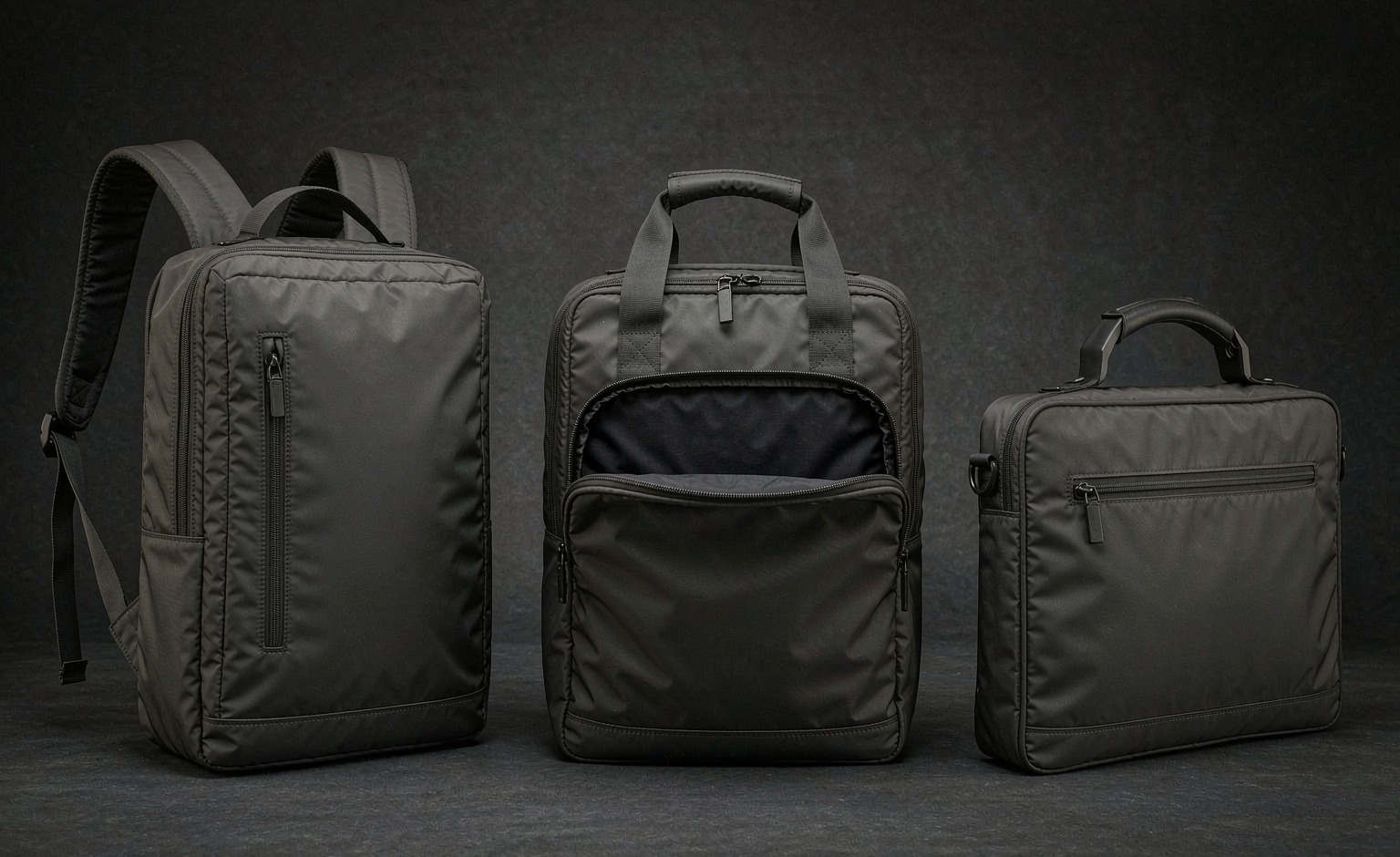
A fixed hip belt transfers carried mass better than a detachable one, because its load path runs straight into the frame seam, while a detachable belt buys stowability, size tolerance and a cleaner travel silhouette at the cost of a weaker route through hook-and-loop shear and a sleeve seam. On a loaded platform the belt should be carrying 60-80 per cent of the mass, so the interface is a structural decision rather than an accessory one; detachable hardware adds 60-140 grams and moves the critical joint away from the frame. Development runs at 500 pieces per reference with sample rounds of 6-10 working days, bulk over 35-50 days, and release against ISO 2859-1 at AQL 2.5; webbing strength is checked to ASTM D5034. Scope is civilian carriage - trekking, worksite, travel and field service - with no ballistic, weapon or defence claim anywhere in the document.
What a hip belt is actually for: moving mass, not adding padding
The belt is a load-transfer device. Its job is to take mass off the shoulders and settle it on the iliac crest, where the skeleton carries it with far less fatigue, and on a properly fitted hiking platform the belt ends up carrying 60-80 per cent of total mass. Comfort is a by-product of that transfer, not the purpose of the padding.
Four dimensions decide whether the transfer happens. Wrap angle - the arc of contact between belt and body - should land between 120 and 160 degrees, because below 120 the belt bridges and above 160 it interferes with leg lift. Wing width at the padding should be 75-100 mm, tapering to 25 mm webbing where it meets the buckle. Foam should be 8-12 mm of closed-cell EVA in the 45-70 kg per cubic metre band, soft enough to conform and dense enough not to bottom out. And the belt centre line should sit over the iliac crest, which on most adult bodies is 40-70 mm below the waist line people actually measure.
Getting the centre line wrong is the single most common fitting complaint, and it is a pattern problem rather than a materials one. A belt set too high rides on soft tissue and slides up; a belt set too low loads the greater trochanter and chafes within an hour. The fix is a torso-length callout on the specification, not a softer foam.
Loads above roughly 8 kg expose every weakness in the interface. Below that mass, shoulder straps dominate and belt architecture barely matters; above it, belt creep, hook-and-loop shear and sleeve seam peel all become visible within a day's use. Programmes whose declared load exceeds 8 kg should treat the belt as the primary structural decision on the whole body.
Spec rule: Specify wrap angle between 120 and 160 degrees, wing width of 75-100 mm, foam of 8-12 mm at 45-70 kg per cubic metre, and a torso-length callout that places the belt centre line over the iliac crest.
How a detachable belt reroutes the load
A fixed belt is sewn into the same seam that closes the back panel, so the downward and rearward pull from the load travels through belt foam, into belt webbing, into the frame seam, and from there into the stay or frame sheet. It is a short, stiff path with one joint, and that joint is a structural seam the body needs anyway.
A detachable belt adds joints. The common construction is a sleeve channel behind the back panel, 100-140 mm tall, with a hook-and-loop panel of roughly 50 mm by 150 mm taking shear and two 25 mm straps or a pair of 38 mm buckles taking the rest. Load now travels from foam into the belt body, into the hook-and-loop interface in shear, into the sleeve fabric, and only then into the back panel seam - three joints where there was one, and the weakest of them is a hook-and-loop bond whose peel strength is a fraction of its shear strength.
That distinction matters because the load is rarely pure shear. When a wearer leans forward, the bottom edge of the belt tries to peel away from the sleeve, and peel is exactly the direction hook-and-loop resists poorly. A shear value recorded in the 200-450 N band for a 50 mm by 150 mm panel tells you nothing useful about a peel load applied along a 30 mm edge.
The better detachable designs deal with this by geometry rather than by buying stronger tape. Extending the sleeve to wrap 30-40 mm under the belt, adding a mechanical stop at the lower edge, and routing one webbing strap through a loop anchored to the frame seam all convert peel back into shear, and they cost far less than a larger hook-and-loop panel.
Selection rule: Accept a detachable belt only where the sleeve wraps under the belt and a mechanical or webbing stop returns peel load into shear, because hook-and-loop alone will creep on any programme carrying more than 8 kg.
Stowability, travel and the case for taking the belt off
The arguments for detachability are real but narrower than most range copy suggests. A belt that comes off lets a 40 litre body pass an airline carry-on gauge, because a fitted belt adds 120-180 mm to the packed girth. It lets the same body be worn as a plain rucksack in an urban setting where a hip belt reads as technical clutter. And it removes the belt from harm when the pack goes into a hold or a vehicle boot.
A fixed belt can be stowed too, and the stowage is cheaper. A 25 mm webbing wrap with a small hook-and-loop tab folds the wings back against the body in under ten seconds, adds perhaps 15 grams, and cannot be lost. Several travel-oriented ranges do exactly this and never offer a detachable belt, which is worth noting before assuming detachment is required.
The genuine case for detachment is sizing. A fixed belt has to be cut to a hip range, which multiplies SKUs: a range offered in three torso lengths and three hip sizes is nine combinations against three for a one-size detachable belt spanning 760-1,270 mm. For a brand carrying inventory across several markets, that SKU reduction is often worth more than the load-path penalty.
The counter-case is loss. A belt that comes off becomes a part that gets left behind, and a lost belt turns a functional pack into a shoulder-only carry. Spare belt listings are cheap to maintain and worth publishing at launch rather than after the first support ticket.
Verdict: Choose detachment for SKU consolidation and airline girth rather than for comfort, and publish a spare belt listing at launch, because a lost belt turns a load-carrying platform into a shoulder-only pack.
Cost and bill-of-materials: what detachability actually buys
The direct cost of detachment is small and the indirect cost is not. Hardware is the direct part: a sleeve panel, a hook-and-loop pair, two straps or buckles and the extra labour to assemble them, which together land in the USD 0.80-2.40 band per unit depending on hardware grade, and add 60-140 grams of carried mass that the wearer pays for on every trip.
The indirect part is engineering and documentation. A detachable interface needs its own drawing, its own pull test, its own cycle test for the hook-and-loop, a spare-part listing, and a fitting instruction in several languages. Spread across a 500-piece minimum that overhead is visible; across a seasonal programme of 20,000 units it disappears.
| Line item | Detachable interface | Permanently sewn belt |
|---|---|---|
| Hardware added | Sleeve, hook-and-loop pair, two buckles | None |
| Mass added | 60-140 g | Baseline |
| Indicative unit delta | USD 0.80-2.40 | Baseline |
| Engineering documentation | Drawing, pull test, cycle test | One seam callout |
| SKU count across three markets | Three torso lengths | Nine combinations |
| Spare-part listing | Required at launch | Not applicable |
| Tooling | None normally | None normally |
The SKU row is the one that flips the decision. Nine combinations against three changes working capital, forecast error and markdown exposure, and on a range selling into several markets it routinely outweighs both the unit delta and the load-path penalty. Programmes that sell in one market with predictable sizing rarely see that benefit.
Quotation structure matters here as elsewhere. Ask for hardware cost, assembly labour and documentation as separate lines, because a supplier quoting one blended figure makes the detachable option look cheaper than it is by omitting the cycle test and the spare-part listing. Prices are quoted FOB Xiamen, indicative, at 500 pieces.
Bottom line: Weigh the USD 0.80-2.40 unit delta and the 60-140 gram penalty against the SKU reduction from nine combinations to three, because for multi-market ranges the inventory saving is usually the larger number.
Removable versus fixed compared across nine engineering criteria
Nine criteria settle most decisions and, as with any closure or seam choice, the weighting belongs to the channel. A long-distance trekking range weights load transfer and creep resistance heavily. A travel range weights girth and SKU count heavily. A worksite range weights snag resistance and cleaning heavily, because a hook-and-loop sleeve collects dust and swarf.
| Criterion | Detachable belt | Sewn belt |
|---|---|---|
| Joints in the load path | Three, weakest is hook-and-loop | One, a structural seam |
| Behaviour above 8 kg carried | Creep at the sleeve | Stable |
| Packed girth contribution | Zero when removed | Plus 120-180 mm |
| SKU combinations, three markets | Three | Nine |
| Mass penalty | 60-140 g | Baseline |
| Indicative unit delta | USD 0.80-2.40 | Baseline |
| Risk of part loss | Real, needs a spare listing | None |
| Interaction with the attachment grid | Belt wings can occlude lower rows | Same, but fixed and predictable |
| End-of-life recyclability | Separable materials | Mixed assembly |
One row deserves expansion because it is regularly missed at design stage. Belt wings pass across the lower part of the side or front panel, and on a body carrying an attachment field they can cover the lowest two rows of a 25 mm tape grid set at 38 mm pitch. That occlusion is predictable on a sewn belt and variable on a detachable one, so the usable-row count should be declared separately for the belt-fitted and belt-removed states.
Strength verification is straightforward and should be written into the purchase order. Webbing and webbing-to-body joints are pulled to ASTM D5034, metal hardware near sweat and salt is checked to ASTM B117, and finished lots are released to ISO 2859-1 sampling at AQL 2.5. Recording the actual figure rather than a pass statement is what makes a later comparison possible.
Takeaway: Score the nine criteria against the declared carried mass first, because above 8 kg the load-path row dominates every other consideration and below it the SKU and girth rows decide the outcome.
Failure modes: what creeps, what tears and what simply gets lost
The two architectures fail differently and on different timescales. A sewn belt fails late and structurally: the anchor seam peels after years, foam takes a compression set after roughly three to five seasons, and ladderlock hardware slips under a shock load. A detachable belt fails early and at the interface: hook-and-loop loads with lint, the sleeve sags, and the belt rotates downward under load.
Hook-and-loop is the dominant detachable failure and it is a maintenance failure more than a materials one. Loop pile fills with lint, dust and hair, and shear capacity falls measurably after 500-1,000 attachment cycles in a dirty environment. A cleaning instruction in the care label and a hook-side cover strip when the belt is removed delay it substantially, and both cost nothing to specify.
| Signature | Architecture affected | Preventive callout |
|---|---|---|
| Belt rotates downward under load | Detachable, shear path too short | Sleeve wrap of 30-40 mm plus a lower stop |
| Hook-and-loop loses grip | Detachable, dirty service | Cleaning instruction and hook cover strip |
| Sleeve seam runs out | Detachable, sleeve seam too light | Sleeve seam returned to the frame seam |
| Anchor seam peels | Sewn, load above 8 kg | Anchor into the frame seam, bar-tack the ends |
| Foam takes a compression set | Both, after three to five seasons | Foam at 45-70 kg per cubic metre |
| Ladderlock slips on impact | Both, shock loading | Specify a low-profile aluminium or steel buckle |
| Belt is simply lost | Detachable only | Spare belt listing published at launch |
Diagnosis is quick once the symptom is named. Rotation under load points at the shear path length, not at the tape grade; a sleeve that has stretched points at the seam that closes it rather than at the fabric; and a belt that sits correctly when empty and drops when loaded is almost always a peel problem that a lower stop will solve.
Retain two counter-samples per reference - one intact, one sectioned through the belt anchor or sleeve - and file the pull-test figures with them. When a complaint arrives in the third season, the sectioned sample establishes within minutes whether the construction changed or the use case did.
Judgement: Specify a sleeve wrap, a lower mechanical stop and a cleaning instruction together, because those three callouts address the three detachable-belt failures that account for most field complaints in civilian service.
Specification callouts and the bench checks that catch them
Eight callouts cover a hip belt specification: wrap angle, wing width, foam thickness and density, belt length range, anchor method, hardware grade and size, interface type where detachable, and the load figure the belt is declared to carry. Without the last one, none of the others can be verified, because every test result is a function of the declared load.
| Feature | Method | Pass condition |
|---|---|---|
| Wrap angle | Goniometer on a fitted fit form | 120-160 degrees |
| Foam thickness and density | Calliper and mass per volume | 8-12 mm, 45-70 kg per cubic metre |
| Belt length range | Steel rule, extended and retracted | Covers 760-1,270 mm |
| Anchor strength | ASTM D5034 on the joint | Result recorded against the declared load |
| Interface shear, detachable | Tensile pull at the belt centre line | No movement at the declared load |
| Interface peel, detachable | Peel at the lower edge, 30 mm | No lift at the declared load |
| Cycle life, hook-and-loop | 500-1,000 attach and release cycles | Shear retention recorded after cycling |
| Hardware corrosion | ASTM B117 salt fog on fittings | No functional corrosion at the recorded hours |
Two of those rows are routinely skipped and should not be. The peel check on a detachable interface is the one that predicts rotation in service, and it takes under five minutes with a spring balance and a clamp. The cycle check predicts the complaint that arrives in month eight, which no single pull test will surface.
Put the declared load onto the drawing, the sewn-in care label and the product copy at the same time. A belt declared for 8 kg and sold as a 15 kg trekking belt will fail at the anchor, and the failure will be argued rather than accepted, because nothing in the documentation said what the belt was built to carry.
Programme terms, capacity and release inspection
Programme work is coordinated through a 4,950 m² SGS-verified production floor where 137 staff operate 149 machines on 7 production lines, turning out up to 200,000 units monthly. Belt-heavy assemblies need the stations with bar-tack and heavy-webbing capability, the same stations that build our heavy-load shell formats, so a build calling for a 38 mm buckle set and a sleeve with a bar-tacked stop has to be reserved on those lines in advance.
Timing starts with prototype rounds: a webbing-sewn belt comes back in 6-10 working days, while a moulded wing or formed foam part pushes a round to 12-15. Three rounds are normal, after which a pre-production unit is built and bulk occupies 35-50 days from material confirmation. Prototype charges sit at USD 50-150 per reference, credited back once bulk is booked, and mould or screen work is quoted at USD 300-2,500.
Release is documented in three steps. First-piece approval records the eight callouts and the pull-test figures; in-line checks confirm bar-tack placement at the anchor and at the sleeve stop; final random inspection draws to ISO 2859-1 at level II, allowing no critical faults, a 2.5 major limit and 4.0 for minor. A missing bar-tack at a belt anchor is a major; a cosmetic foam mark inside tolerance is a minor. Terms are 30 per cent on order and the balance before shipment, with prices given FOB Xiamen against 500 pieces.
Freight and packing follow the same plan. A 20GP takes about 28 CBM and a 40HQ about 68 CBM once bodies are nested, with 25-35 days by ocean, 5-8 days by air and 3-5 days by courier, so the shipping method belongs in the brief rather than in a conversation after the goods are packed.
Which belt architecture for which programme
Start from the declared carried mass. Below 8 kg, shoulder carriage dominates and a detachable belt costs nothing functionally, so SKU consolidation and travel girth should decide. Above 8 kg, the belt is the primary structure, and a sewn belt with its anchor in the frame seam is the defensible answer unless a sleeve with a wrap and a lower stop has been tested at the declared load.
Then check the market count. A single-market range with predictable hip sizing on a shared modular platform gains little from detachment and loses load-path integrity for nothing. A three-market range with wide hip variance gains a SKU reduction from nine combinations to three, and that is usually worth more than the difference in load transfer.
Then check the service environment. Hook-and-loop sleeves and dusty or swarf-filled worksites are a poor match; a sewn belt with a webbing wrap for stowage survives that environment and cleans easily. Where detachment is required in such an environment, specify a buckled mechanical interface instead of hook-and-loop and accept the extra assembly time.
Finally, document the belt in the range copy honestly. State the load the belt was built to carry, state whether it detaches, and publish the spare listing if it does. Those three sentences remove the majority of the support burden a hip belt generates, and they cost less than the average single return.
Closing rule for the brief: declare the carried mass, the market count and the service environment before choosing an architecture, because each of those three inputs overrides the general preference for a sewn belt under specific and identifiable conditions.
Frequently asked questions
What percentage of carried mass should a hip belt actually transfer?
On a properly fitted platform the belt should be carrying 60-80 per cent of total mass, with the shoulders taking the remainder. Below about 8 kg carried, the split barely matters; above it, the belt becomes the primary structure. Wrap angle should be 120-160 degrees with the centre line over the iliac crest. MOQ is 500 pieces per reference.
How does a detachable hip belt change the load path?
It adds joints. Load runs from foam into the belt body, into hook-and-loop in shear, into the sleeve fabric and only then into the back panel seam - three joints against one for a sewn belt. The weakest is a hook-and-loop bond whose peel strength is a fraction of its shear strength, which is why loaded belts rotate downward. Prototype work occupies 6-10 working days.
Which foam specification suits a load-carrying hip belt?
Closed-cell EVA of 8-12 mm thickness at 45-70 kg per cubic metre, soft enough to conform to the iliac crest and dense enough not to bottom out under load. Thinner foam bridges, softer foam takes a compression set within three to five seasons. Wing width should be 75-100 mm, tapering to 25 mm webbing.
How much mass does detachable belt hardware add?
Between 60 and 140 grams depending on hardware grade, covering the sleeve panel, the hook-and-loop pair and the two buckles. That mass is carried on every trip. The indicative unit delta is USD 0.80-2.40 at 500 pieces per reference, quoted FOB Xiamen.
Does a detachable belt reduce SKU count?
Yes, materially. A one-size detachable belt spanning 760-1,270 mm lets a range be offered in three torso lengths, while a sewn belt cut to a hip range needs nine combinations across three markets. That reduction often outweighs the load-path penalty for multi-market programmes. Minimum order is 500 pieces.
Can a sewn hip belt be stowed for airline travel?
Yes, with a 25 mm webbing wrap and a small hook-and-loop tab, folding the wings back in under ten seconds for roughly 15 grams of added mass. A fitted belt adds 120-180 mm to packed girth, so stowage matters less than detachment for a carry-on gauge, but it cannot be lost.
Why does a detachable belt rotate downward when loaded?
Because leaning forward applies peel along the lower edge rather than shear across the panel, and hook-and-loop resists peel poorly. Extend the sleeve to wrap 30-40 mm under the belt and add a lower mechanical stop; both convert peel back into shear cheaply. Sample rounds take 6-10 working days.
How long does hook-and-loop last on a detachable belt?
Shear capacity falls measurably after 500-1,000 attachment cycles in a dirty environment as loop pile fills with lint and hair. A cleaning instruction on the care label and a hook-side cover strip when the belt is removed extend service life substantially at no material cost.
Which test method applies to hip belt webbing strength?
Webbing and webbing-to-body joints are pulled to ASTM D5034, with metal fittings near sweat checked to ASTM B117 salt fog. Lot release draws under the ISO 2859-1 level II tables: no critical faults, a 2.5 major limit, 4.0 for minor. Record figures rather than pass statements.
What sampling window applies to a new belt assembly?
A webbing-sewn belt returns in 6-10 working days per prototype round; a moulded wing or formed foam part needs 12-15. Plan on three rounds, then bulk runs 35-50 days once materials are locked. Prototype charges are USD 50-150 per reference, credited against the confirmed order.
Should a worksite platform use a detachable belt?
Usually not. Hook-and-loop sleeves collect dust and swarf, and a sewn belt with a webbing wrap for stowage cleans easily and cannot be lost. Where detachment is genuinely required in that environment, specify a buckled mechanical interface rather than hook-and-loop. Bulk production takes 35-50 days.
Can a hip belt cover attachment rows on the panel?
Yes. Belt wings commonly occlude the lowest two rows of a 25 mm tape field set on the 38 mm pitch. Declare the usable row count separately for the belt-fitted and belt-removed states, because occlusion on a detachable belt varies with fit and is not predictable from a photograph.
What belt length range should a one-size belt cover?
760-1,270 mm covers most adult hip measurements and is the range that makes a single detachable belt viable across three markets. Verify on a fit form at both extremes, because a belt that fits at the middle can bottom out its webbing at the ends. Prototypes take 6-10 working days.
How should the declared load be communicated to the buyer?
Put the declared load onto the drawing, onto the sewn-in care label and into the product copy together. A belt built for 8 kg and sold as a 15 kg trekking belt fails at the anchor, and the claim is then argued rather than accepted because nothing documented what the assembly was designed to carry. MOQ sits at 500 pieces per reference.