Home › Field notes › RFQ Checklist for Modular Backpack Programmes: Fields From ID to CBM
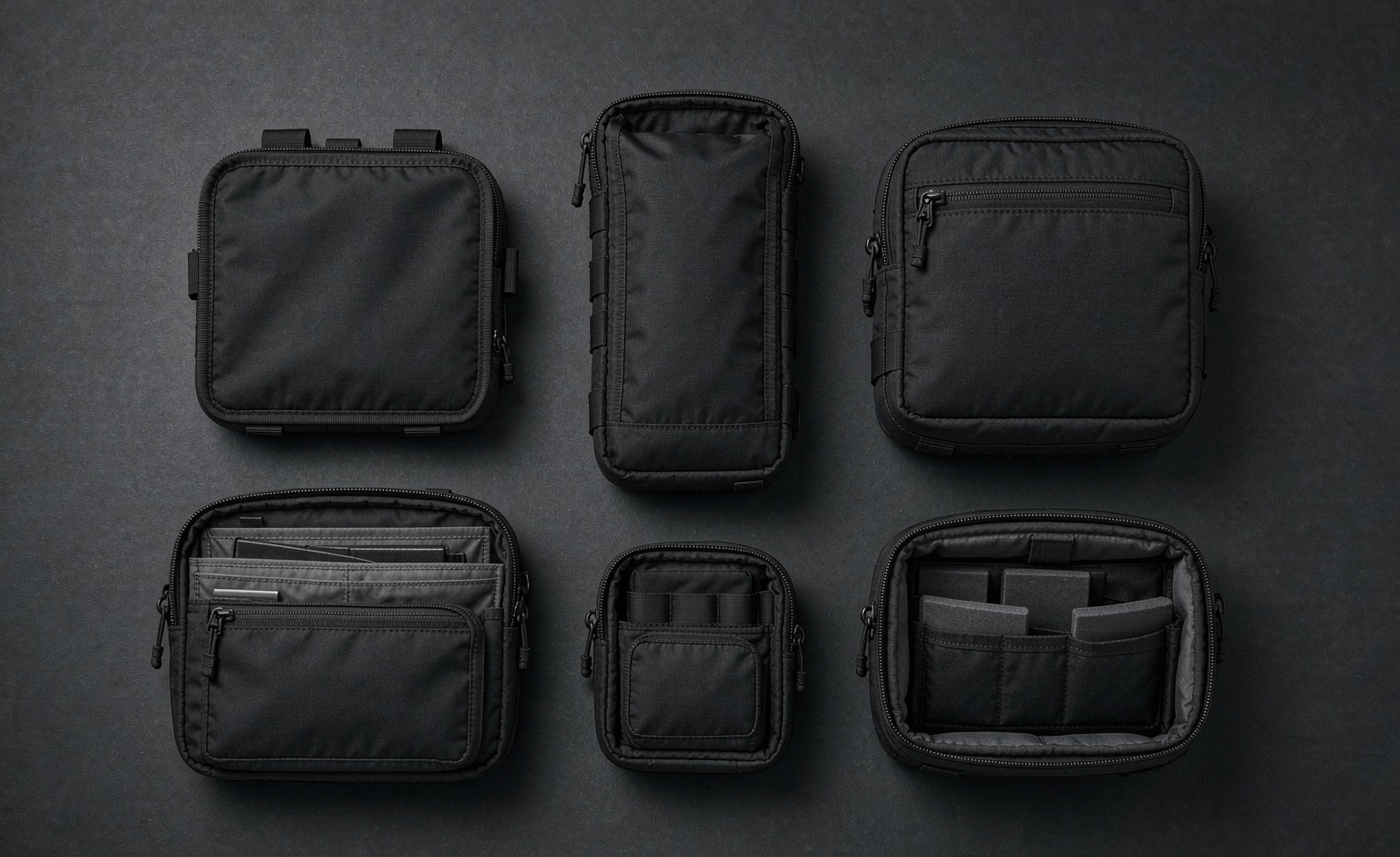
A modular backpack RFQ is complete when a single submission answers five blocks — programme identity, construction and materials, modular interface geometry, compliance and testing, and commercial terms including carton cube — so a quote can be returned in 24-48 hours without a follow-up round. Missing fields are what turn a 24-48 hour quote into a week of clarification. Programmes start at a 500-unit floor per reference, sample in 6-10 working days and run 35-50 days in bulk, quoted FOB Xiamen and released against AQL 2.5 inspection. Coverage here is civilian carry only: hiking packs, commuter bags, worksite tool carriage and first-aid kits. Enquiries about weapon carriage, ballistic protection or military certification claims fall outside the checklist.
Why Modular RFQs Stall on the Identity-to-CBM Chain
An enquiry for a conventional bag can survive gaps, because there is little that has to line up with anything else. An enquiry for a modular programme cannot, because the host bag is only half the product: the pouches, panels and inserts that mount to it are the other half, and they are governed by numbers that have to be stated before anything can be estimated.
The chain runs in one direction. Identity tells the estimator what is being quoted. Construction tells them what it is made of. Interface geometry tells them whether existing modules will mount. Compliance tells them what evidence has to be produced. Commercial terms and carton cube tell them what it costs to land. Break a link and the estimator has to guess, and a guess is either padded or wrong.
The two most expensive gaps are the same two every season. Leaving hardware unnamed forces the estimate to assume branded components, which pushes the figure up. Leaving carton dimensions out forces the freight estimate to assume a cube, which pushes the landed figure up again. Neither guess is malicious; both are simply the only option when a field is blank.
| Block | Core fields | Assumption forced by a blank |
|---|---|---|
| Identity | Style reference, intended use, target season, quantity per colourway | Quantity assumed at the 500-unit floor |
| Construction | Base fabric, denier, coating, lining, colour reference | Mid-range fabric assumed, coating unspecified |
| Interface | Webbing width, row pitch, repeat, row and column count | Standard grid assumed, pouch fit unverified |
| Compliance | Required methods, market, documentation list | No testing included in the figure |
| Commercial | Incoterm, port, payment, carton size, pieces per carton | FOB Xiamen assumed, freight excluded |
Bottom line: Supply carton dimensions and hardware naming in the first submission, because those two blanks are the ones an estimator resolves by padding the figure rather than by asking.
Block One: Programme Identity and Scope Fields
Identity sounds trivial and is not. The estimator needs a style reference, a plain-language description of intended use, the target season or delivery window, quantity per colourway, and the number of colourways. Quantity per colourway matters more than total quantity, because a 500-unit floor normally applies per reference and splitting one reference across four colourways changes the cutting plan.
Intended use deserves real words rather than a category. Field service work, daily commuting, hiking, tool carriage and first-aid modules each imply different abrasion, load and access expectations. A bag that has to be opened 40 times a day is a different specification from one opened twice.
State whether the programme is new or a revision of an existing reference. A revision enquiry on a custom modular backpack, carrying the previous style number and the change summary can be quoted far faster than a fresh one, because the pattern, tooling and consumption data already exist.
Finally, name the decision maker and the response deadline. An RFQ without a named contact and a decision date is the one most likely to sit in a queue while the estimator works on enquiries that have both.
One more identity field is worth including: whether the programme is expected to repeat. A line stating that a reference will reorder each season changes how tooling and pattern costs are treated, because a one-off and a three-season reference do not carry the same amortisation.
Block Two: Construction, Fabric and Colour Fields
Fabric is specified by construction and finish, not by feel. Give the fibre, the denier, the weave, the coating type and the finish. Polyester and nylon behave differently under abrasion and under UV, and a coating that improves water resistance can reduce breathability and change how the panel sews.
Colour needs a reference system and a tolerance statement. A single Pantone reference plus a stated acceptance tolerance gives the dye house something to hit; the word navy gives it nothing. Where a pack combines a shell, a lining and webbing in nominally the same colour, ask for the three to be matched under the same light source and say which one governs.
The lining is frequently omitted and always used. State its denier, colour and whether it needs a finish. An unstated lining gets substituted with whatever is in stock, and the brand discovers the difference when a customer posts a photograph.
Reference test methods here rather than later. Abrasion resistance to ISO 12947 and tearing strength to ASTM D5034 give the fabric buyer a target that can be verified at goods-in.
Spec rule: State fibre, denier, weave, coating and finish together with a colour reference and a tolerance, because a fabric described without a coating and a tolerance cannot be sourced consistently across two production lots.
Block Three: Modular Interface and Attachment Fields
This is the block that separates a modular programme from an ordinary one, and it is the one most often left to a note saying MOLLE compatible. That note is not a specification. The estimator needs webbing width, vertical row spacing, horizontal repeat, row count, column count, the offset from a stated datum, and the bar-tack count at each webbing end.
The baseline figures for a PALS-type field are 25 mm webbing, 38 mm between rows and a 50 mm repeat across the panel. Give those explicitly, or state the alternative geometry if the programme uses one. Modules bought in from elsewhere are built to the published geometry, and a field built to something close to it will not accept them reliably.
Say whether the field is sewn webbing or cut from laminate. Both meet the same published geometry, but they differ in profile, snag behaviour and how the panel behaves under repeated attachment. The attachment field chosen at this stage also decides which tooling is needed, which feeds straight into the quote.
Then state the load expectation: what a mounted pouch is expected to carry, and how many attach and detach cycles the field should survive. Those two numbers decide webbing specification and bar-tack pattern, and they cost nothing to write down.
Takeaway: Replace any compatibility note with six numbers — webbing width, row pitch, repeat, row count, column count and datum offset — because compatibility claimed in words cannot be checked and compatibility stated in numbers can.
Block Four: Compliance, Testing and Documentation Fields
Name the market first. The United States, the European Union and the United Kingdom ask for different evidence, and a programme that ships to all three needs a documentation plan rather than a test report. Export and market-access requirements are summarised for traders by trade.gov, and the rules of origin that decide where a good is considered to come from are explained by the WTO.
Then list the methods the brand actually wants run, with acceptance figures. Abrasion, tearing strength, coating adhesion, colour fastness to rubbing and to laundering, and any restricted-substance screening the retailer requires. Listing a method without an acceptance figure produces a report nobody can act on.
State the inspection plan as well. Attribute sampling against ISO 2859-1 at AQL 2.5, with critical defects at zero, is the common arrangement, and naming it in the RFQ means it is priced rather than discovered.
Transit testing belongs in this block if the goods ship parcel-delivered. ISTA 3A is the usual reference, and it is priced as a test rather than assumed.
Finally, say who pays for testing and whether reports must be from a named laboratory. That single line is a recurring source of dispute when it is left out.
Block Five: Commercial, Logistics and Carton Cube Fields
Commercial fields are short and decisive: Incoterm, named port, payment terms, target price band if the brand has one, and required delivery date. Quotes are returned FOB Xiamen with payment on T/T 30/70 unless something else is stated, and a freight quote to a different port changes the landed figure materially.
Carton data is where modular programmes lose money. Give the packed carton dimensions in millimetres and the pieces per carton, or state flat-pack dimensions if the pack ships unassembled. Roughly 28 CBM fits a 20GP and around 68 CBM a 40HQ, so the difference between a packed and a flat carton is the difference between one container and two on a mid-sized order.
An RFQ that supplies carton dimensions gets a freight figure. One that does not gets a freight estimate with a caveat, and the caveat is where the trouble starts when the goods are booked. Freight is quoted to the port named in the commercial block, so the two fields should be filled together rather than in separate rounds of correspondence.
Where a programme ships modules separately from the host bag, say so and give both carton sizes. Mixed shipments are common on modular lines and are the single most frequent cause of a carton count that does not reconcile at the warehouse.
| Step | Field required | Effect on the quote |
|---|---|---|
| Carton volume | Length, width, height in millimetres | Sets cubic metres per carton |
| Carton count | Order quantity divided by pieces per carton | Sets total cube for the shipment |
| Container selection | Total cube against 28 CBM or 68 CBM | Decides whether one 40HQ is enough |
| Transit mode | Required delivery date against 25-35, 5-8 or 3-5 days | Decides sea, air or courier |
Verdict: Supply packed carton dimensions and pieces per carton with the first enquiry, because container selection against 28 CBM and 68 CBM is arithmetic that cannot be performed from a pack dimension alone.
Enquiry Depth Compared: Sketch, Reference Sample and Full Specification
Three submission depths are common, and each produces a different kind of quote. A sketch-only enquiry produces an indicative range. A reference sample plus notes produces a close estimate with stated assumptions. A full specification produces a firm figure with a short validity period and a defined sample plan.
None of these is wrong. A brand in concept stage should not be asked to produce a nine-page document. What matters is knowing which depth was submitted, because the accuracy expectation attached to each is different, and disappointment usually comes from expecting firm-figure precision on a sketch-only submission.
| Judged on | Sketch only | Reference sample plus notes | Full specification |
|---|---|---|---|
| Quote accuracy | Indicative range | Close, with stated assumptions | Firm figure |
| Quote turnaround | 24-48 hours | 24-48 hours | 24-48 hours |
| First sample match | Low | Moderate | High |
| Assumptions recorded | Many, unwritten | Few, written | None material |
| Sample rounds to approval | Three or more | Two | One |
| Best used at | Concept stage | Adaptation of an existing style | Production commitment |
Note the second row: turnaround is the same across all three depths. The 24-48 hour figure describes how fast an estimate is returned, not how precise it is, and the precision is bought with submission depth rather than with time.
Judgement: Match the accuracy expectation to the depth submitted, because a sketch-only enquiry returned in 24-48 hours is a range for budgeting and not a figure for a launch commitment.
Why Each Field Matters: Omission Consequences Written Out
The clearest way to read a checklist is by consequence. The table below takes the fields most often left blank and states what actually happens downstream, in the order the problem appears in the calendar rather than the order it appears on the form.
| Left blank | When it surfaces | Consequence |
|---|---|---|
| Hardware brand or equivalent | At quotation | Estimate assumes branded components, figure rises |
| Carton dimensions | At booking | Freight quoted against guessed cube, container under-filled |
| Grid geometry | At first sample | Existing pouches will not mount, field re-cut |
| Colour tolerance | At goods-in | Dye lot accepted or rejected on opinion |
| Test acceptance figures | At report review | Report shows data with no pass or fail |
| Quantity per colourway | At production planning | 500-unit floor applied to the wrong reference |
Two entries in that table are recoverable only by spending calendar time. A re-cut grid costs a sample round, and a dye-lot argument at goods-in costs the whole 35-50 day window if the decision goes against the shipment.
The remaining entries cost money rather than time, and the money is usually recoverable by filling the field on the next programme — which is the real argument for keeping a checklist template at all.
Quote Turnaround and What Happens After the RFQ Lands
A complete submission sent through the enquiry route is quoted in 24-48 hours. That figure covers the estimate, not the sample. Sampling then takes 6-10 working days, and 12-15 where tooling or print screens are needed, and the sampling fee of USD 50-150 per reference is refundable on order. Tooling and screens are quoted separately, typically USD 300-2,500 depending on what has to be cut.
Once the quote is accepted, the sequence is PP sample, then bulk across 35-50 days, then release inspection at AQL 2.5, then shipment. Transit choices then run 25-35 days for sea, 5-8 for air and 3-5 for courier, and the mode is chosen against the delivery date rather than the freight saving.
On the production side, our 4,950 m² SGS-verified production floor carries 7 production lines and 149 machines worked by 137 people, with monthly capacity rated at 200,000 units. Bag production has been the founder's trade since 2004, and the business dates from 2014. Enquiries that arrive with the five blocks filled move from quote to PP sample without a clarification round.
Frequently asked questions
What is an RFQ checklist for a modular backpack programme?
A single submission covering five blocks: programme identity, construction and materials, modular interface geometry, compliance and testing, and commercial terms with carton cube. Filled completely, it produces a quote in 24-48 hours without a clarification round. Programmes run from a 500-unit floor per reference and bulk takes 35-50 days.
Why do modular backpack RFQs need more fields than ordinary bag enquiries?
Because the bag is only half the product. Pouches and inserts mount to a field governed by numbers — 25 mm webbing, 38 mm between rows, 50 mm repeat — and those numbers have to be stated before anything can be estimated. An enquiry leaving them out forces the estimator to assume a standard grid.
Which fabric fields belong in an RFQ?
Fibre, denier, weave, coating type, finish, colour reference and colour tolerance, plus the lining specification. Reference the methods too: abrasion to ISO 12947 and tearing strength to ASTM D5034. A fabric described without a coating and a tolerance cannot be sourced consistently across two production lots.
How should attachment geometry be written in an RFQ?
With six numbers rather than a compatibility note: webbing width of 25 mm, spacing of 38 mm between rows, repeat of 50 mm across, row count, column count and offset from a stated datum. Add bar-tack count per webbing end and say whether the field is sewn webbing or cut laminate.
What does leaving hardware unnamed do to a quote?
It pushes the figure up. With no brand or equivalent stated, the estimator assumes branded components, which, when named, usually sit second only to fabric in what drives the total. One line naming the brand, or stating that a functional equivalent is acceptable, removes that assumption and the padding with it.
How is carton cube calculated for an RFQ?
Length times width times height in millimetres, divided by one million, gives cubic metres per carton. Divide order quantity by pieces per carton for carton count, then compare total cube against a 20GP at roughly 28 CBM or a 40HQ at roughly 68 CBM.
Which Incoterm and payment terms should an RFQ state?
Name the Incoterm and the port. Quotes are returned FOB Xiamen with payment on T/T 30/70 unless something else is stated. Asking for a delivered quote to a different port without giving carton dimensions produces a freight estimate with a caveat rather than a figure.
What compliance information belongs in the first submission?
The destination market, the test methods wanted with acceptance figures, the inspection plan, and who pays for testing. Attribute sampling to ISO 2859-1 at AQL 2.5 with critical defects at zero is the common arrangement. Market access and origin questions are covered by trade.gov and the WTO.
Should an RFQ include a target price band?
Yes, where the brand has one. A band lets the estimator propose an alternative construction rather than quote something that will be rejected. Without it, the first quote is built to the specification as written, which may be more expensive than the programme can carry.
How long does a modular backpack quote take?
Quotes are returned in 24-48 hours for any submission depth. That figure describes speed, not precision: a sketch-only enquiry returns an indicative range in the same 24-48 hours that a full specification returns a firm figure. Sampling then takes 6-10 working days.
What does sampling cost after an RFQ is accepted?
A sampling charge of USD 50-150 applies per reference and comes back to the buyer once an order is placed. Allow 6-10 working days for the sample, or 12-15 when tooling must be cut, then 35-50 days for bulk.
How does quantity per colourway affect an RFQ?
Materially, because a 500-unit floor normally applies per reference. Splitting one reference across four colourways changes the cutting plan and the fabric minimum. State quantity per colourway rather than a single total, and say how many colourways the programme carries at launch.
Which transit mode should the RFQ assume?
Let the delivery date decide. By sea allow 25-35 days, by air 5-8 days, by courier 3-5 days. Give the required delivery date in the RFQ and the mode follows; asking for the cheapest mode without a date usually produces sea transit the calendar cannot absorb.
What happens after a modular backpack RFQ is accepted?
Sequence runs PP sample, bulk production, release inspection and shipment. Bulk occupies 35-50 days once the 500-unit floor per reference is confirmed, inspection runs at AQL 2.5, and shipment then moves by whichever mode the delivery date allows.
Can an RFQ start from a reference sample instead of a drawing?
Yes, and it is common when adapting an existing style. Send the sample so colour and trim are captured, then append a dimensional drawing, a written material list and the grid geometry. That combination reaches a firm figure faster than a sample alone, which carries no tolerance or acceptance criteria.