Home › Field notes › Why Modular Backpacks Won: The Demand Shift Behind the Trend
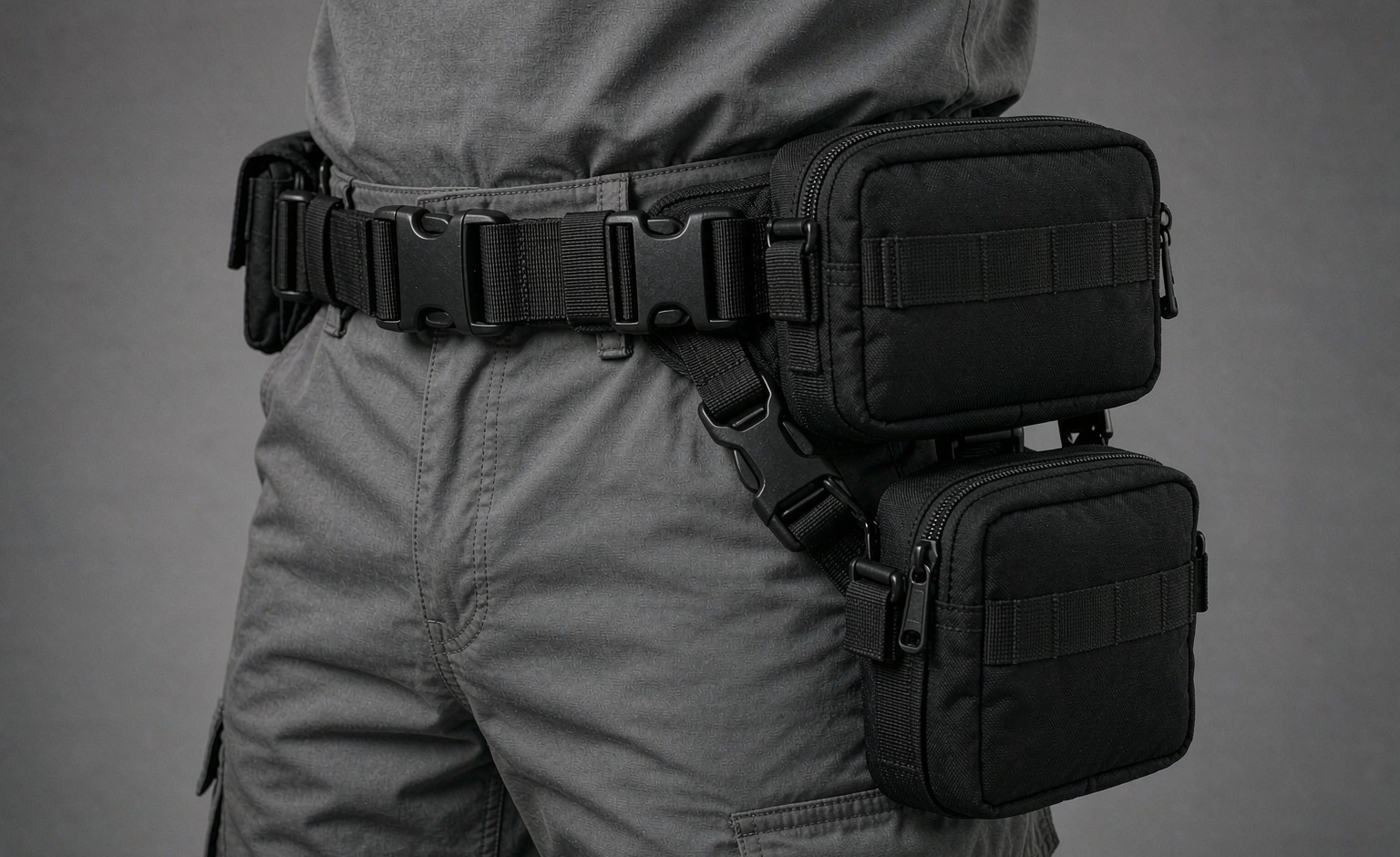
Modular backpacks crossed into mainstream demand because they answer an unremarkable problem: one person now carries several distinct loads across a single week, and buying a separate bag for each is expensive, wasteful and difficult to store. A single chassis with swappable pouches resolves that at a lower total cost, provided the interface is trustworthy. That is the whole proposition, and it is why the trend is durable rather than seasonal. For a brand, the commercial translation is concrete: MOQ 500 per reference, a module catalogue that generates repeat purchases, and release held at AQL 2.5 so the mounting geometry holds across every unit in the run. The sections separate the durable parts of that shift from the seasonal ones, because a range plan built on a fashion cycle behaves very differently from one built on a change in how people divide their week. Every claim is tied to an observable behaviour.
From single-purpose buying to platform buying
The conventional bag market was organised around purpose. A hiking pack, a commuter pack, a travel pack and a day pack were separate purchases, each optimised for one load and each idle for most of the week. That model worked when a person's week was more uniform, and it stopped working when weeks stopped being uniform.
What replaced it is platform buying. The customer buys one chassis, chosen for fit and carrying comfort, and then buys capability in the form of modules: a device sleeve for the working day, a wash module for an overnight, a tool organiser for a site visit, a lens pouch for a weekend. The chassis is a durable purchase; the modules are the variable layer. That inversion is the trend, and it is structural rather than fashionable, because it follows from how people now divide their time.
Platform buying has a specific consequence for product planning that many brands miss. The chassis decision is made once and is therefore made carefully, on fit, comfort and perceived durability. The module decision is made repeatedly and is therefore made quickly, on price and obvious utility. A range that invests its entire development budget in the chassis and treats modules as accessories will fail at the second decision, which is the one that actually generates repeat revenue.
The second consequence is about trust. A customer only buys a platform if they believe the mounting system will still be supported in three years. That belief is not created by marketing; it is created by a published interface, a module line that visibly persists, and a stated version policy. Brands that understand this treat the interface as a public commitment rather than as an internal drawing.
Selection rule: Selection rule: Track the shift from single-purpose buying to platform buying by watching attach rate rather than by watching search volume, because the second purchase after an opening run of 500 units is where the behaviour actually shows.
The cost-per-use arithmetic consumers actually apply
Consumers rarely articulate it, but the arithmetic behind a modular purchase is simple and it runs in their favour. Divide the price by the number of distinct loads the system covers, and compare that with buying each load its own bag. A platform covering four loads at a chassis price plus three modules is materially cheaper than four purpose-built bags of comparable quality, and it occupies less storage, which matters more than manufacturers usually assume.
| Need expressed | Attribute it rewards | Product response | Evidence that confirms it |
|---|---|---|---|
| One bag for several weekly loads | Breadth of module coverage | Module catalogue mapped to named scenarios | Attach rate per chassis sold |
| Not replacing the whole bag when needs change | Interface continuity over time | Published geometry with a version policy | Module reorders from existing owners |
| Comfort that does not degrade when loaded | Harness and load-path quality | Load-path reinforcement at module anchors | Comfort scored in post-purchase surveys |
| Fast reconfiguration without fumbling | One-handed release under load | Fitting selected by dominant force direction | Time-to-reconfigure measured in user trials |
| Confidence that pouches will not fall off | Retention under dynamic load | Bar-tack coverage specified as an area | ASTM D5034 result on the assembled anchor |
| A bag that still looks acceptable after a year | Coating and abrasion resistance | Solvent-qualified topcoat with an abrasion target | ISO 12947 result plus field return coding |
Two caveats keep this arithmetic honest. Modularity stops paying when a customer has one dominant load, because the chassis overhead is then pure cost. And it stops paying when the module catalogue is poorly matched to real scenarios, because unused pouches are worse than no pouches: they represent money spent on capability the customer never needed. Both conditions are testable before a range launches, which is the point of collecting scenario data rather than preference data.
The four levers that drive accessory attach rate
Attach rate is the number that decides whether a modular range is profitable, and four levers control it. Each lever is a design or commercial decision rather than a marketing one, and each can be acted on at specification stage.
Scenario clarity is the first. A module sells when a customer can name the occasion for it. A wash module, a device sleeve and a tool organiser have obvious occasions. A generic utility pouch does not, and generic pouches consistently underperform in attach rate despite being the cheapest to make. Naming the scenario on the product page and on the packaging is half the work.
Mounting confidence is the second, and it is engineering. A customer who has watched a pouch detach once will not buy a second pouch. Retention depends on the fitting, on the reinforcement behind it, and on the tolerance stack across the whole assembly, and it needs a numeric acceptance line rather than a feel test. Fit should be checked with a gauge, and retention with a pull figure on the assembled unit.
Price laddering is the third. A module priced near the chassis price will not sell as an accessory, because the customer reads it as a second bag. A module priced as an impulse purchase, below the threshold at which a consumer deliberates, converts far more often and generates more total margin across the catalogue.
Availability is the fourth and the most frequently broken. A module that is out of stock for two seasons disappears from the customer's mental catalogue permanently. Keeping the core module line continuously available matters more than adding new modules, and it is a supply planning decision rather than a product one.
Bottom line: Bottom line: Build for the four levers that drive accessory attach rate, namely published geometry at 25 mm webbing, visible spare parts, a naming scheme buyers can search and a second purchase inside the same season.
Interface literacy is now a purchase criterion
Five years ago, compatibility was a specification footnote that almost nobody read. Today a meaningful share of buyers ask about it before purchasing, and a larger share understand the geometry well enough to check whether a pouch they already own will mount. That shift is what turns the interface from an engineering detail into a commercial asset.
The geometry most buyers now recognise is 25 mm webbing with 38 mm row spacing and a 50 mm column pitch. Publishing it, with a tolerance band rather than a nominal figure, lets a customer verify compatibility themselves and removes the need for a support conversation. Publishing the version alongside it does something more valuable: it tells the customer that compatibility is being managed deliberately, which is the belief that makes a platform purchase feel safe.
Literacy also creates a specific failure. A buyer who understands the geometry will notice spacing drift immediately, and will report it publicly. A two-millimetre variation across a panel, invisible in a showroom and tolerable on the bench, becomes a jam under load and a review that says the pouches do not fit. Gauging spacing across the whole panel of the first unit produced, and holding that band through every run, is the control that prevents it.
For brands the practical instruction is to treat the interface drawing as public documentation. Put it on the product page, put the version on the label, and keep the module register current. Every one of those actions reduces the friction a literate buyer experiences, and literate buyers are the ones who buy multiple modules.
Verdict: Verdict: Publish the interface numbers in the product copy, because interface literacy has become a purchase criterion and a listing omitting the 38 mm pitch and the 50 mm repeat loses comparisons the listing cannot enter.
What owners actually report as the failure point
Return and review data on modular products clusters around a small number of failure points, and the pattern is consistent enough to be specified against. Understanding it is the cheapest way to reduce returns, because each failure has a known control.
Mounting failures come first: a pouch that releases unintentionally, a mounting column that stretches, or an anchor that tears under a loaded pouch. All three are specification problems. The release-force band was not stated, the tolerance on the repeat was not held, or the bar-tack coverage behind the anchor was not specified as an area. Each has a numeric control and a test: a gauge for the repeat, a pull figure for retention, and ASTM D5034 on the assembled anchor.
Surface failures come second, and they are the ones that generate the most emotional reviews because they are visible. Coating haze after cleaning, print lift on a brand mark, and abrasion at base corners. These are qualified against ISO 12947 for abrasion, AATCC 8 for colour transfer, and a wipe cycle followed by an adhesion check for solvent exposure.
Closure failures come third and are the most under-specified. Slider fatigue on a main opening that is cycled thousands of times a year is predictable and preventable by selecting the chain class by position. YKK #5 for light modules, #8 for main openings and #10 for closures that must work under compression is a ladder that maps to actual duty, and specifying it on the tech pack costs nothing.
How the pattern spilled across categories
Modularity did not stay in the outdoor category where it became visible. It moved into travel, into work carry, into everyday carry and into hobby-specific use, and it moved for the same reason in each case: the load varies more than the bag used to allow for.
| Category | Trigger behind adoption | Specification focus | Range risk to watch |
|---|---|---|---|
| Travel | Cabin-only packing and a working day inside the itinerary | Sizer-box dimensions, wipe-clean coatings, device bay | Assembled depth drifting past the cabin limit |
| Work and commute | Device plus documents plus a gym or food load | Flat document sleeve, false-floor device bay | Modules making the silhouette look unpacked |
| Everyday carry | Small items that differ by day and by task | Quick-access pouch placement and one-handed release | Pouch count exceeding what users will configure |
| Hiking and trail | Load varying by trip length and season | Load-path reinforcement and weather resistance | External pouches shifting the packed balance |
| Trade and field service | Tool sets varying by job rather than by day | Abrasion class and anchor strength under point loads | Heavy pouches overloading a light chassis |
| Hobby and camera | Equipment that changes faster than bags are replaced | Padded module geometry and shock isolation | Proprietary geometry stranding the accessory line |
The spill-over matters commercially because it changes the addressable module catalogue. A brand whose chassis serves travel and work can sell the same device sleeve into both, which improves the economics of every module in the line. A brand whose chassis serves only one scenario has to fund each module from a smaller base, which is why single-scenario modular ranges tend to have thin catalogues and weak attach rates.
Takeaway: Takeaway: Collect wear-trial logs and warranty returns before writing the second range plan, and let the reported failure point move the specification rather than the review score, then cost the fix inside a 6-10 working day sampling round.
Evidence to collect before committing to a range
The trend is real, but it does not transfer automatically to a specific brand's customers. Before committing to a modular range, collect four pieces of evidence, all of which are obtainable without a production order.
Scenario inventory comes first. Ask existing customers what they carry on a typical Monday, a typical Saturday and a typical trip. The answer is usually three different loads, and the differences between them define the module catalogue. Preference surveys do not produce this; scenario questions do.
Compatibility awareness comes second. Ask whether customers already own pouches or accessories and whether they would expect them to mount. A customer base with existing compatible gear is a very different proposition from one starting from zero, and it changes whether the open lattice or a brand-owned fitting should lead.
Price tolerance for modules comes third, and it is best tested directly rather than inferred. Present three price points for a named module and record which converts. The answer is usually lower than internal assumptions, because customers price an accessory against an accessory, not against a bag.
Failure tolerance comes fourth and is the most useful. Ask what would cause the customer to stop trusting the system. The answer is almost always an unintentional release rather than a cosmetic flaw, which tells the brand where the specification budget belongs.
Converting the trend into a range plan
A modular range plan differs from a conventional one in three ways, and each difference is a decision to make before the brief closes rather than after the samples arrive.
Weight the chassis and the modules separately. A conventional plan spreads units evenly across styles. A modular plan concentrates units in the chassis, because every chassis sold is a future module customer, and it keeps the opening module buy deliberately light until attach rate is known. A 500-unit opening buy might sensibly carry 400 chassis across two colourways and 100 units each of two named modules, with the second buy weighted by whatever the attach data shows.
Fix the interface before anything else is designed. The geometry decision constrains every module that follows, and changing it later strands whatever has already been made. Publish it, version it, and write the tolerance band into the tech pack.
Plan the second buy at the same time as the first. Modular economics depend on repeat module purchases, and those only happen if the module line is continuously available. Booking material for a second run while the first is still in production is what prevents the two-season stockout that kills a module catalogue permanently.
The mechanics are unchanged by all of this. sampling occupies 6-10 working days, widening to 12-15 where a moulded part or a welded module enters the specification, with a sampling fee of USD 50-150 per reference refunded against the order. The production span is 35-50 days, release depends on AQL 2.5 from ISO 2859-1, and terms are T/T 30/70 priced FOB Xiamen. The trend changes what to build; it does not change how a build is controlled.
Where modular demand is heading, and what that implies for a brief
Three directions are visible in how buyers now specify modular products, and each one has a consequence for a brief written today rather than next season.
The first is that compatibility is becoming a stated requirement rather than a bonus. Buyers who own pouches ask whether a chassis accepts them before they look at colour or price, and they ask in writing. A brief that does not state the interface geometry, its tolerance band and its version is a brief that will generate a support burden and a public complaint. Stating those three things takes one paragraph and removes an entire category of friction.
The second is that the module catalogue, not the chassis, is becoming the differentiator. Two chassis of similar quality are hard to tell apart; two catalogues are not, because one may cover six named scenarios and the other two. Investment in module development now returns more per unit of effort than investment in chassis novelty, and a range plan should reflect that weighting rather than the historical one.
The third is that durability expectations are rising relative to price. Buyers who have owned a modular system for two years compare the condition of the mounting columns with the condition of the fabric, and they report the difference. That makes retention and coating the two specification areas where under-spending is most visible, and it makes the numeric acceptance lines behind them, a release-force band, a gauged repeat, an abrasion cycle count and a wipe-cycle result, the most valuable lines on the tech pack.
The practical summary for a brand entering now is to spend effort in an unglamorous order. Fix the geometry first. Name the scenarios second. Write numeric acceptance lines third. Then design the silhouette, which is the part everyone wants to start with and the part that matters least to whether the system still works in year three.
Range planning starts from the chassis platform and from the module catalogue intended to hang off it.
Spec rule: Spec rule: Convert the trend into a range plan with one chassis at 500 units and two modules, allow 35-50 days for production, and set the second buy only after attach rate has been measured for a full quarter.
Frequently asked questions
Why did modular backpacks move into mainstream demand?
Because one person now carries several distinct loads across a week and buying a separate bag for each is expensive and hard to store. One chassis with swappable pouches solves that at lower total cost, provided the mounting system is trustworthy.
What is platform buying and how does it differ from purpose buying?
Purpose buying matches one bag to one load. Platform buying treats the chassis as a durable purchase chosen on fit and comfort, then buys capability as modules. The chassis decision is made once and carefully; the module decision repeats and is made quickly.
How should a brand split a first order between chassis and modules?
Weight the chassis. A 500-unit opening buy might carry 400 chassis across two colourways plus 100 units each of two named modules, then weight the second buy by measured attach rate rather than by assumption.
What drives accessory attach rate?
Four levers: scenario clarity, so a customer can name the occasion; mounting confidence, checked with a gauge and a pull figure; price laddering below the deliberation threshold; and continuous availability of the core line.
Why does a generic utility pouch underperform?
Because it has no named occasion. Modules sell when a customer can picture when they will use them, so a wash module or a device sleeve converts better than a generic pouch despite costing more to specify.
What interface geometry do buyers now recognise?
webbing of 25 mm, spaced 38 mm vertically, repeating at 50 mm, published as a tolerance band rather than a nominal figure. Publishing it lets a customer verify compatibility without a support conversation.
What is the most common mounting failure reported by owners?
Unintentional release, followed by stretched mounting columns and torn anchors. All three are specification problems with numeric controls: a release-force band, a gauged repeat, and bar-tack coverage specified as an area.
How is retention under load verified?
With a pull figure on the assembled anchor rather than on a swatch, referencing ASTM D5034 for grab strength. A cut sample cannot reproduce how force travels through the assembly, and how force travels is what fails.
Which closure class should a main opening use?
YKK #8 for a main opening, #5 on light pouches and inner pockets, and #10 where a closure must work under compression. Slider fatigue, not chain separation, is the usual end of life at current cycle counts.
When does modularity stop paying for the customer?
When they have one dominant load, because the chassis overhead is then pure cost, and when the module catalogue is poorly matched to real scenarios, because unused pouches represent capability they never needed.
What evidence should be collected before committing to a range?
A scenario inventory from existing customers, their current compatibility awareness, direct price tolerance testing on a named module, and their stated failure tolerance. All four are obtainable without a production order.
How should a second buy be planned?
At the same time as the first. Modular economics depend on repeat module purchases, so book material for the follow-on run while the opening order is still in production to avoid a two-season stockout.
What are the sampling and production windows?
Sampling takes 6-10 working days, or 12-15 on complex builds, with a fee of USD 50-150 per reference refunded against the order. The build occupies 35-50 days once the deposit lands.
What inspection and payment terms apply?
Release stands at AQL 2.5 using ISO 2859-1 sampling, with interface fit and spacing as their own defect class. Terms are T/T 30/70 priced FOB Xiamen, with the balance paid after inspection passes.