Home › Field notes › Roll-Top vs Zippered Main Opening: Sealing, Access and Failure Modes
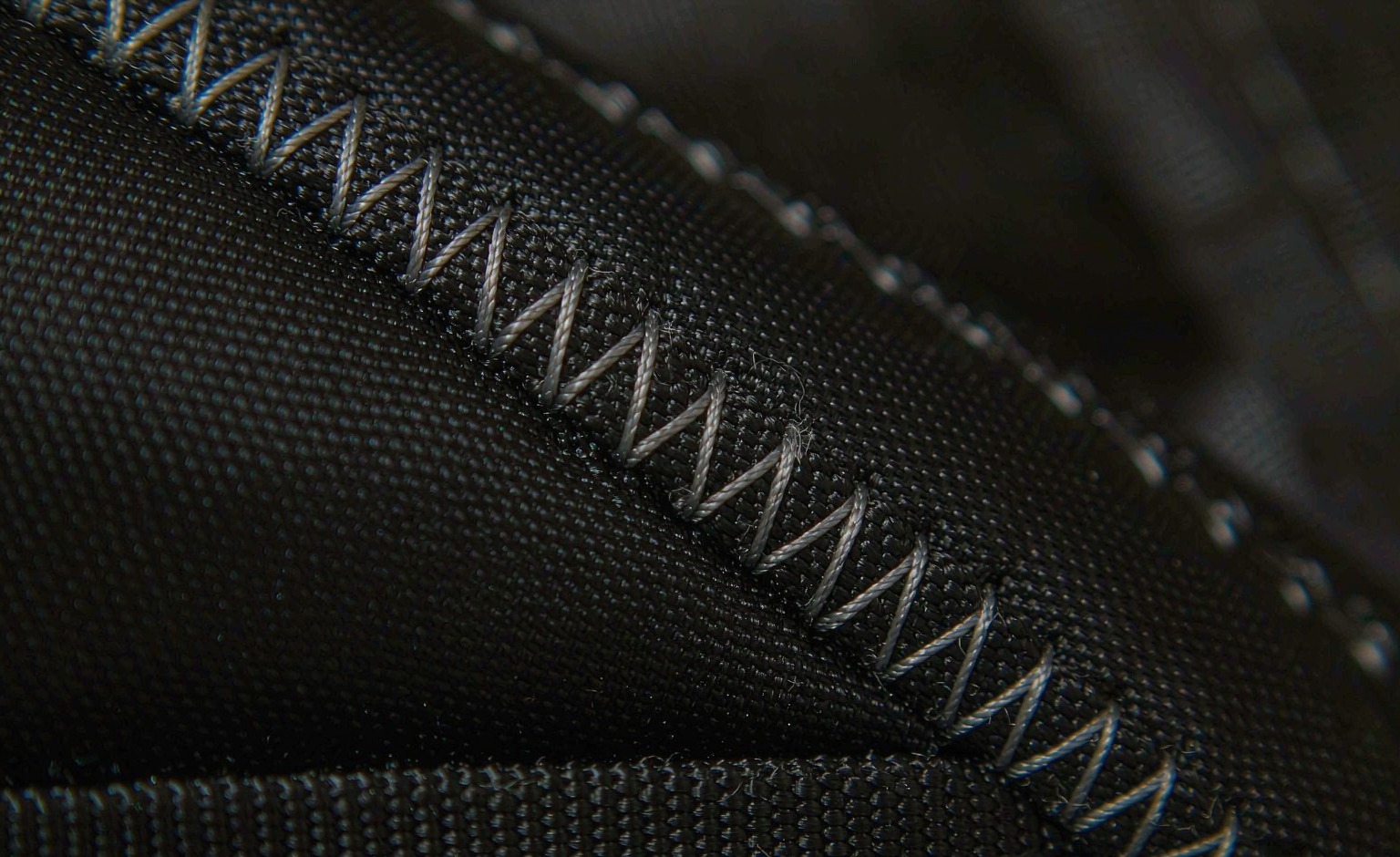
A roll-top throat sheds rain better than a zippered main opening built on the same shell fabric, because three folds put a changing-direction path between the weather and the load, while the zippered opening wins every access-speed test and gives repeatable one-hand entry. Quoted programmes begin at 500 pieces per reference, sample rounds occupy 6-10 working days, bulk sewing takes 35-50 days after sign-off, and finished lots are released against ISO 2859-1 sampling at AQL 2.5 with Critical 0, Major 2.5 and Minor 4.0. Scope is civilian carriage throughout - commuting, worksite kit, field service instruments, hiking and organised daily carry - and nothing below describes weapon carriage, ballistic protection or any defence certification.
What a roll-top throat genuinely keeps out
A rolled throat is a folded labyrinth rather than a gasket. Water running down the back panel meets the first fold, has to reverse direction to climb it, meets a second fold, reverses again, and with three folds on a coated face fabric the droplet has spent its energy before it reaches the contents. The buckle contributes nothing to that: a 25 mm side-release clip only stops the roll unwinding under vibration and road shock.
Three conditions decide whether the labyrinth exists at all. The throat needs at least 90 mm of free fabric above the packed level, so that three folds can be formed without tension pulling the top edge flat. The face fabric needs enough coating stiffness to hold each fold open instead of collapsing into a flat crease. And the top edge needs a stiffener, or the roll creases into a channel that points inward and delivers water straight to the load.
When the design fails, it fails at the corners. At the two side seams the fold has to change from a flat horizontal roll into a vertical seam, and the radius there is larger than a coated woven will hold without help, so a 2-3 mm gap opens at each corner. Throats specified without a corner gusset or a sealed corner produce their first leak complaint from the corners, not the centre, which is why the corner detail belongs on the control drawing and not on the sample note.
Immersion is a separate claim. A folded throat sits in the shower class; asking it to survive being dunked asks a fold to behave like a seal, and the immersion grades published for enclosures under IEC 60529 are reached with welded seams and welded corners rather than with folding. Write the marketing claim to match the construction and both the buyer and the end user stop being surprised in the wet.
Spec rule: Specify a rolled throat with at least 90 mm of free fabric above the load line, three complete folds, a stiffened top edge and sealed corners, then publish the result as shower resistance rather than as immersion protection.
Zippered openings: the leak path is the tape, not the teeth
A zipper resists water in three places and leaks in three others. The coil or tooth chain itself sheds most incident water, the slider is the weakest point because it opens a gap by design to let the chain pass, and the tape - the woven strip either side of the chain - is stitched to the shell with a needle that perforates the fabric and leaves a thread running from the outside face to the inside face.
The thread is the real leak path. Capillary action along a polyester sewing thread moves water inward at a rate that has nothing to do with the coating on the shell, and at eight stitches per 25 mm a 600 mm opening carries roughly 190 perforations, each one a candidate wick. Taping the stitch line from the inside with a 20-22 mm polyurethane tape applied at 130-160 °C under 2.5-3.5 bar for 8-15 seconds closes most of them; leaving it untaped closes none.
Gauge selection follows body volume and expected overpack. A #5 coil suits accessory pockets and a 12-18 litre day panel, a #8 coil is the sensible default for a 25-45 litre main opening, and a #10 chain earns its extra mass above 60 litres or on a worksite body that will be closed against a bulging load. Reverse coil - chain on the inside, tape on the outside - plus a storm flap covering the tape is the configuration that actually keeps weather out.
Testing has to match the claim. Hydrostatic resistance of the finished fabric and taped seam is measured to AATCC 127, and coated-fabric strength is checked to ASTM D751; a spray-only result on a bare face fabric says nothing about a stitch line that was never taped. Buyers who write both methods into the purchase order stop receiving samples that pass a drizzle test and fail a storm.
Selection rule: Choose a zippered main opening when entry speed matters more than shower endurance, and pay for reverse coil, a taped stitch line and a storm flap rather than buying a larger gauge and hoping the tape treatment is unnecessary.
Variable capacity versus fixed volume: measuring the swing
A roll-top gives volume you can vary; a zipper gives volume you cannot. On a 32 litre nominal body, rolling tight over a half-full load brings usable volume to roughly 24 litres, while closing the throat with a single fold at the top edge reaches about 40 litres - a swing near 60 per cent on one shell. The zippered equivalent is fixed at the seam line and moves perhaps 5 per cent as the fabric relaxes.
That swing has two faces. It is a merchandising asset, because one SKU covers a commute load and an overnight load, and it compresses a half-empty pack into a smaller silhouette that fits under an aircraft seat. It is also a pack-out liability, because a customer who fills to the top of the unrolled throat cannot close it, blames the closure, and returns the pack.
The way to keep the asset and drop the liability is to declare both numbers. Publish a rolled-down figure and a rolled-up figure, print a fill line inside the throat at the level where three folds are still possible, and make the warranty text refer to that line. Returns on roll-top bodies drop sharply once the fill line exists, because the ambiguous case disappears.
Fabric consumption moves too. The extra throat adds roughly 8-12 per cent to shell fabric on a 30-40 litre body, plus the stiffener, the two side-release buckles and the webbing anchor. Against a zippered opening of the same nominal volume, that is the real cost of the capacity swing, and it belongs in the costing sheet before the range is priced rather than after.
Verdict: Take the roll-top when one shell must serve two load classes and the range can publish a fill line; take the zippered opening when the load is predictable and the extra 8-12 per cent of shell fabric buys nothing the customer asked for.
Access speed, one-hand operation and gloved handling
Speed is the closure test a zipper wins outright and the one a roll-top loses outright. Reaching a rolled throat means releasing the buckle, unrolling three folds, digging, then re-rolling and re-clipping: 8-14 seconds with two hands on a good day, and closer to 20 seconds with cold hands. A zippered opening with a cord pull takes 2-4 seconds with two hands and can be worked one-handed if the shell has a grab loop above the slider.
One-hand operation is a specification, not a property. It needs three things - a grab loop within 60 mm of the slider start position so the body does not have to be twisted, a pull long enough to find by feel, and a shell stiff enough that the opening does not collapse on itself while one hand holds the pack. Without all three, the stated 2-4 seconds becomes 10 seconds in practice and the buyer's own staff will report it.
Gloved handling changes the hardware callouts. A zipper pull should be at least 25 mm of cord or webbing with a stiffened end, because a bare 12 mm metal pull cannot be found through a work glove. A roll-top buckle should be 25 mm minimum and 38 mm where operators wear insulated gloves, and the buckle should be a side-release type that clears with a thumb press rather than a squeeze-and-lift type.
| Handling task | Rolled throat | Zippered opening |
|---|---|---|
| Open from closed, bare hands | 8-14 s | 2-4 s |
| Open and close fully, bare hands | 18-26 s | 5-8 s |
| One-hand entry without a grab loop | Not practical | 6-10 s |
| One-hand entry with a grab loop fitted | Not practical | 3-5 s |
| Open wearing insulated work gloves | 15-22 s | 5-9 s |
| Hardware required | Two 25 mm buckles | One #8 coil, one pull |
| Degenerate case when cold or wet | Stiff folds, slower | Grit in slider |
Modules change the answer modestly. A first-aid or instrument module that hangs on an external grid is reached without opening the main body at all, which is why work-oriented modular bodies pair a zippered main opening with external attachment rather than choosing between the two.
Bottom line: Pick a zippered opening whenever the contents are needed more than four times an hour or while the pack stays on the shoulders, and accept the rolled throat only where delay is tolerable and the pack is set down before it is opened.
Roll-top versus zippered compared across nine buying criteria
Nine criteria settle most range decisions, and they rarely point the same way, so the useful exercise is weighting them per channel rather than arguing them in the abstract. A hiking and travel channel weights weather and volume swing heavily. A worksite and field-service channel weights speed and gloved operation heavily. A daily-carry channel weights silhouette and one-hand entry heavily.
| Criterion | Rolled throat | Zippered closure |
|---|---|---|
| Shower resistance at the closure | Strong with three folds and sealed corners | Depends on tape sealing and storm flap |
| Immersion resistance | Not offered | Not offered |
| Usable volume swing | About 60 per cent | About 5 per cent |
| Entry speed, bare hands | 8-14 s | 2-4 s |
| One-hand entry | Not practical | 3-5 s with a loop |
| Shell fabric consumption | +8-12 per cent | Baseline |
| Field repairability | Buckle replaceable in minutes | Slider replaceable, tape not |
| Compression of a partial load | Excellent | Poor |
| Customer misuse exposure | Overpack past the fill line | Burst from overpack |
Two rows deserve comment because they are routinely misread. Immersion resistance is absent from both columns: neither closure makes a pack submersible, and any range copy implying otherwise will be tested by a customer within a season. Field repairability also differs in kind rather than degree, because a failed buckle is a 25 mm part that any operator can swap, while a burst chain or peeled tape needs a sewing machine and a tape press.
The weighting exercise should be written down and attached to the range brief. When the closure decision is revisited eighteen months later, the document is what stops the argument restarting from zero, and it takes under an hour to produce against the table above.
Takeaway: Weight the nine criteria by channel before choosing, because a rolled throat wins weather and volume while a zippered closure wins speed and one-hand entry, and no single configuration wins both columns.
Failure modes ranked by what comes back first
Warranty and complaint data cluster differently for the two closures. Rolled throats come back for corner leaks, stiffener delamination, buckle cracking in cold weather and loss of fold memory after long compression. Zippered openings come back for slider wear, tape peel at the ends, chain burst from overpack, capillary leakage along an untaped stitch line, and loss of durable water repellent after repeated washing.
Cold is the dominant environmental factor for both. A polyacetal side-release buckle loses impact strength below roughly -10 °C and will crack on a hard press, which is why winter-channel hardware should be specified with an impact-modified resin and tested at temperature rather than at room condition. A zipper slider stiffens with grit and salt, and a rinse-and-dry instruction in the care label prevents a large share of slider complaints.
Time constants differ as well. A roll-top's fold memory decays over roughly three to five years of compression in storage, and a pack that has sat flat for a season arrives at the customer with a throat that refuses to hold three folds. A zippered opening's durable water repellent decays across 20-30 domestic wash cycles, after which the face fabric wets out and the taped seam takes the whole load.
Both closures share one failure that has nothing to do with the closure: the anchor. The throat or the tape is only as good as the seam that attaches it to the body, and peel at that seam is diagnosed by pulling the closure away from the shell at 45 degrees and watching where the load line travels. If it travels into the side seam, the anchor is correct; if it stops at the stitch line, the anchor is the defect.
Judgement: Budget for corner sealing and cold-rated buckles on a rolled throat and for taped stitch lines and a serviceable slider on a zippered opening, because those two line items cover the majority of closure complaints in civilian service.
Specification callouts and the bench checks that catch them
A closure specification needs six numeric callouts and a method for each, or it is not a specification. Free throat length, fold count, top-edge stiffener width, buckle size and resin, tape width and application window, and stitch density at the anchor are the six for a rolled throat. Gauge, chain type, pull length and type, storm flap coverage, tape width and application window, and stitch density at the tape are the six for a zippered opening.
| Feature | Method | Pass condition |
|---|---|---|
| Free throat length | Steel rule, throat empty | 90 mm minimum above the fill line |
| Fold count achievable | Manual fold at nominal load | Three full folds, no gap at corners |
| Corner seal integrity | Shower rig, 5 min per side | No moisture on indicator paper |
| Fabric hydrostatic resistance | AATCC 127 on finished fabric | Result recorded, claim matched |
| Tape adhesion | Peel at 180 degrees, 25 mm strip | No lift after 20 wash cycles |
| Slider cycles | Manual open-close rig | 2,000 cycles without skipping |
| Chain burst | Transverse load at closed slider | No tooth separation below the recorded figure |
| Cold buckle impact | Condition at -10 °C, 4 h, then press | No crack, latch still releases |
Counter-samples settle arguments. Retain two signed units per reference - one as the appearance standard and one cut in half through the closure so the tape, stiffener and anchor can be compared against a production unit - and store them for the life of the style plus one season. When a complaint arrives eighteen months later, the half-cut sample is the fastest way to establish what changed.
Documentation closes the loop. Photograph each callout at first-piece approval, file the measurement sheet with the purchase order, and reference both in the inspection report, because an inspector working at ISO 2859-1 acceptance levels cannot judge a throat length that was never written down.
Programme terms, sampling windows and release inspection
Our production team runs closure development on the same calendar as the rest of the shell: a 500-piece minimum per reference, sample rounds across 6-10 working days, 12-15 working days where a formed stiffener or a welded corner is involved, and bulk sewing over 35-50 days once the sample is signed off and materials are confirmed. Sample charges are USD 50-150 per reference and are refunded against the order; tooling and screens for a welded corner or a custom buckle sit at USD 300-2,500.
Capacity behind that calendar is a 4,950 m² SGS-verified production floor with 137 people, 7 production lines and 149 machines, turning out up to 200,000 units per month across the full range. Closure work draws on the tape press and weld cells on two of those lines, which is why a programme that specifies both a welded corner and a taped zipper should be booked against that capacity rather than assumed.
Release follows a written path: pre-production sample, first-piece approval with the closure callouts measured, in-line checks during bulk, and final random inspection at AQL 2.5 under ISO 2859-1 with Critical 0, Major 2.5 and Minor 4.0. Payment is T/T 30/70 and quotations are stated FOB Xiamen, indicative and tied to the 500-unit minimum; a firm quote is returned within 24-48 hours of a completed brief.
Freight planning belongs in the same document. Sea transit runs 25-35 days, air 5-8 days and express 3-5 days, and consolidated closure-heavy bodies pack at roughly 28 CBM per 20GP and 68 CBM per 40HQ once compression is applied, so the pack-out method affects the landed figure as much as the unit price does.
Which closure for which programme, and how to decide
Decide by naming the dominant use, then checking whether the closure opposed to it can be mitigated. A travel range or a hiking programme whose dominant use is a variable daily load takes the rolled throat and mitigates speed with external attachment for the items needed often. A worksite, field-service or first-aid programme whose dominant use is frequent entry takes the zippered opening and mitigates weather with tape sealing, a storm flap and a cover.
Hybrid bodies exist and are usually the wrong answer. A zippered main opening under a rolled throat adds the cost of both closures, adds two failure sets, and produces a throat that cannot be rolled properly because the zipper sits in the fold line. Where a hybrid is genuinely wanted, put the zipper on the front panel and the roll on the throat, so each closure does one job.
Channel matters as much as use. Retail channels photograph the rolled throat well and explain the volume swing in one line of copy, which lifts conversion; institutional channels specify access time and care nothing for the photograph, and will penalise a rolled throat in the evaluation. Ask which channel carries the volume before the decision is frozen.
Whatever the choice, write the closure claim into the care label and the range copy at the same time. A rolled throat described as shower resistant and a zippered opening described as weather resistant with taped seams are both defensible; either described as waterproof is not, and the correction after launch costs more than the sentence did.
Closing rule for the brief: name the dominant use, mitigate the opposing criterion with hardware rather than with range copy, and keep a single closure per body, because hybrid throats double the failure set while delivering neither benefit in full.
Frequently asked questions
What makes a roll-top closure resist rain better than a zippered main opening?
A rolled throat forces water to reverse direction at each of three folds, so the droplet loses energy before reaching the load, while a zippered opening presents a stitch line and a slider gap on the same fabric. The advantage holds only with 90 mm of free throat, a stiffened top edge and sealed corners. Programmes start at 500 pieces per reference with sampling across 6-10 working days.
How many folds should a roll-top throat have to stay dry in heavy rain?
Three complete folds is the practical minimum; two leaves a path that a driven shower will find, and four consumes throat length that most bodies do not have. Each fold must close without a visible gap at the corners, which is where one-fold and two-fold closures fail first. Sample rounds take 6-10 working days, or 12-15 where a sealed corner is specified.
Does a zippered main opening leak through the teeth or through the tape?
Mostly through the tape and its stitch line. At eight stitches per 25 mm a 600 mm opening carries about 190 needle perforations, each with a thread that wicks water inward by capillary action, whereas the chain itself sheds most incident water. Tape the stitch line from the inside and add a storm flap before increasing gauge.
Which zipper gauge suits a 35-litre modular backpack?
A #8 coil is the sensible default for a 25-45 litre main opening; #5 suits accessory pockets below 18 litres, and #10 earns its mass above 60 litres or on worksite bodies closed against a bulging load. Pair it with reverse coil and a storm flap. Bulk sewing runs 35-50 days after sample sign-off.
How much capacity swing does a roll-top actually deliver on a 32-litre body?
Measured with a fill medium, a rolled-down half load reaches roughly 24 litres and a single-fold closure at the top edge about 40 litres, a swing near 60 per cent against about 5 per cent for a zippered shell. The throat adds 8-12 per cent to shell fabric consumption. Publish both figures and print an internal fill line. Orders begin at 500 pieces per reference.
Can a roll-top main opening be worked with one hand?
Not practically. Releasing the buckle, unrolling three folds and re-rolling needs two hands and roughly 18-26 seconds for a full open-and-close cycle, whereas a zippered opening with a grab loop completes in 3-5 seconds one-handed. Where one-hand entry is a requirement, specify a zippered opening and a grab loop within 60 mm of the slider start.
Which closure suits a first-aid or instrument module better?
A zippered opening, because entry frequency is high and delay is costly. Better still, hang the module on the external grid so the main body never opens; a 25 mm webbing field with a 38 mm row pitch accepts a first-aid pouch without touching the closure. Release inspection is at AQL 2.5, Critical 0, Major 2.5, Minor 4.0.
Why do roll-top corners leak before the centre of the closure does?
The fold has to turn from horizontal to vertical at the side seam, and the radius there exceeds what a coated woven holds unaided, opening a 2-3 mm gap at each corner. Specify a corner gusset or a sealed corner and verify on a shower rig for five minutes per side with indicator paper inside. Sample rounds run 6-10 working days, or 12-15 with a sealed corner.
How long does a zippered opening keep its weather resistance?
Durable water repellent on the face fabric declines across roughly 20-30 domestic wash cycles, after which the fabric wets out and the taped seam carries the whole load. A care label with a rinse-and-dry instruction and a re-proofing note extends useful life materially. Bulk production runs 35-50 days; sampling is 6-10 working days.
What does AQL 2.5 mean when a closure is being inspected?
It is the acceptance quality limit applied to a random sample drawn under ISO 2859-1, level II, with Critical defects at 0, Major at 2.5 and Minor at 4.0. A non-functioning slider or an untaped stitch line is a Major; a cosmetic pull mark is a Minor. Payment is T/T 30/70 and quotations are FOB Xiamen.
Should a worksite backpack use a zippered main opening?
Yes, in nearly every case. Operators wearing gloves reach the body several times an hour, and 2-4 second entry beats 8-14 seconds decisively; weather is handled with a taped stitch line, a storm flap and a cover. Specify a pull of at least 25 mm that can be found through an insulated glove.
How is roll-top buckle strength specified for cold-weather channels?
Name the size, 25 mm minimum and 38 mm for insulated gloves, plus the resin and a conditioning test: four hours at -10 °C followed by a press and release, with no cracking and a latch that still opens. Standard polyacetal loses impact strength in the cold. Tooling for a custom buckle runs USD 300-2,500.
What sampling window applies when changing only the main closure?
Six to ten working days per round for a cut-and-sew closure change, stretching to 12-15 working days if a formed stiffener, welded corner or custom buckle is involved. Expect two to four rounds before sign-off. The sample fee is USD 50-150 per reference and is refunded against the order.
How should both closures be written into one range specification?
Use one shared callout sheet with six numeric lines per closure type - throat length, fold count, stiffener width, buckle size, tape width and stitch density for the roll; gauge, chain type, pull, flap coverage, tape width and stitch density for the zipper - and attach the method and pass condition for each. Minimum order is 500 pieces per reference.