Home › Field notes › Spacer Mesh vs Closed-Cell Foam Back Panel: Which Keeps a Back Dry
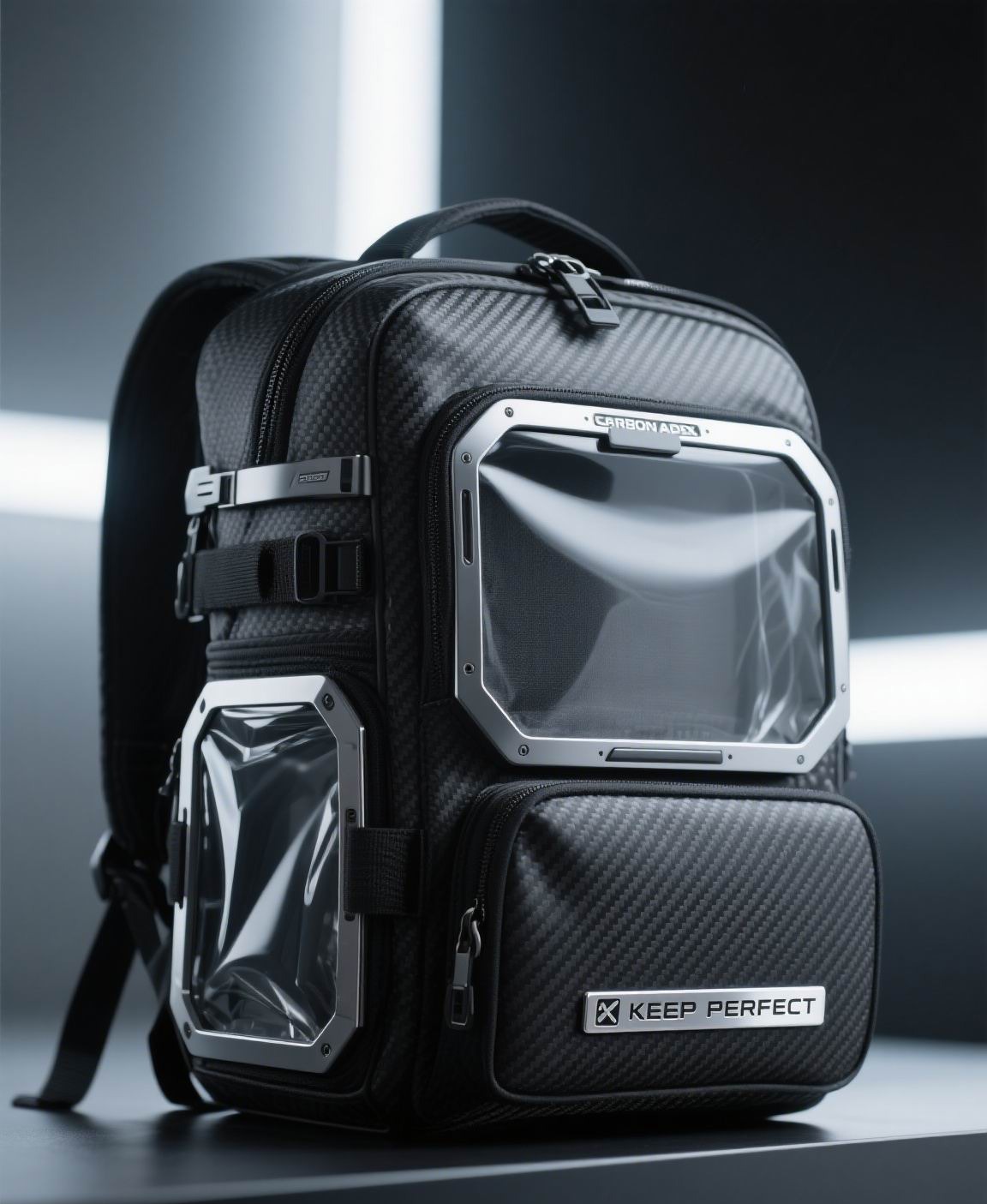
A suspended spacer mesh back keeps the wearer drier under light to moderate loads by holding most of the back clear of the bag, while a closed-cell padded panel stays more stable under heavy loads and insulates better in cold; choose mesh below roughly 8 kg and padding above it. The mechanism differs completely: air moves through a 6-12 mm gap, whereas padding relies on contact and perforations. Commercial terms sit at MOQ 500 per reference, 6-10 working days per sampling round, 35-50 days bulk and AQL 2.5 release, with dampness and transfer behaviour checked against methods published by AATCC and lot sampling referenced to ISO 2859-1. Scope is civilian carriage - commuting, hiking, work, travel and daily kit - with no impact-protection or defence claim implied anywhere in these figures.
Air gap versus contact: two incompatible comfort models
The two constructions start from opposite assumptions. A suspended panel assumes the wearer's back should touch as little as possible, so it stretches a knitted spacer or monofilament mesh across a frame with an intentional stand-off. A padded panel assumes the opposite, spreading load across the largest possible contact area so pressure stays low.
Both are internally consistent and both work, which is why the argument never resolves by principle. It resolves by load, climate and how the product is worn.
The failure to understand this appears in mixed specifications. A brand asks for both "maximum ventilation" and "maximum padding" in one panel, receives something with holes drilled through foam, and discovers that neither objective was met because the holes moved little air while removing real support.
Stand-off geometry sets everything downstream. Below roughly 4 mm, the gap closes under body weight and the panel behaves like padding with poor support; between 6 and 12 mm it behaves as intended; above roughly 15 mm the pack starts to feel deep and unstable against the desk or the car seat.
Takeaway: Decide which comfort model you are buying before specifying details, because a perforated pad requested as a compromise delivers perhaps a third of either benefit and all of neither one's advantages.
One clarification helps buyers read supplier proposals correctly. "Breathable" in a quotation usually describes the face fabric's air permeability measured flat, which tells you almost nothing about how much air crosses a loaded panel. Ask instead for the stand-off height maintained at your stated design load, since that is the only figure that predicts the Dry-back result customers care about.
Panel curvature is the related detail worth pricing. A flat suspended panel touches more of the back than a gently curved one does, so curvature buys ventilation without any additional depth, and it costs nothing beyond tooling.
How vapour actually leaves: wicking, gap flow and the role of motion
Wet-back complaints are usually a vapour problem rather than a liquid one, and understanding the path is what separates effective panels from decorative ones.
Three stages matter. Vapour leaves the skin into whatever touches it; it moves sideways through an air space; and it exits at the edges of the panel. A suspended panel handles all three if the gap stays open, because sideways movement through still air is fast enough to keep ahead of production.
Motion provides most of the driving force. Walking creates pressure differences at the panel edges that pump air through the gap, which is why the same construction feels excellent on a trail and mediocre sitting at a desk. Static use needs larger edge openings to compensate.
Pump effectiveness depends on compression, however. Once load squashes the spacer enough to close its internal channels - which happens progressively as load rises - the mechanism stops regardless of how open the face fabric is.
Judgement: Judge ventilation under load rather than empty, since the value sits in how much gap survives when the pack carries what customers will actually put in it, not in how open the structure looks on a fixture.
Wicking adds a second mechanism worth specifying separately. A face fabric that moves liquid away from the skin keeps the contact patch feeling dry even when ventilation is poor, and that behaviour is testable; simply stating "wicking" without a method and a target is how two very different textiles end up quoted as the same thing.
Edge geometry closes the loop. Vapour reaching the middle of the panel still has to leave somewhere, and a panel whose edges are sealed into tight binding traps what it collected, so leave an open edge or a vented trim at the sides.
Where each construction loses its advantage: practical load crossover
Load crossover is the single most useful number for range planning, and field reports converge on a fairly stable picture.
Below about 6 kg the suspended panel wins clearly. Contact area stays low, gap survives, and the wearer finishes a climb drier. Between 6 and 9 kg it depends strongly on how the load is distributed: a dense compact load closes the gap faster than a soft, wide one at the same mass.
Above roughly 9-10 kg most wearers prefer padding, and the reason is stability rather than temperature. A suspended panel under heavy load starts to behave like a hammock, and the load swings rather than riding.
Body shape moves those numbers more than specifiers like to admit. A wearer with pronounced spinal curvature contacts the spine ridge well before the quoted crossover, while a flatter back tolerates a heavier load before preference flips.
- Under 6 kg: suspended construction usually preferred
- 6-9 kg: decide by whether the load is dense or bulky
- Above 9-10 kg: padded panel usually preferred
- Adjust one band either way for pronounced spinal contact
Selection rule: Quote a crossover load in the product brief rather than describing the panel in adjectives, then validate it with three wearers above and three below that figure before the design is frozen.
Tracking on the back: shear, slip and lateral drift while walking
Nobody writes this down and everybody feels it. A panel either moves with the body or slides against it, and that behaviour decides whether a pack feels planted during scrambling.
A suspended panel has unavoidable compliance. Its face fabric moves relative to the frame, which allows shear and lets the load drift laterally when the wearer twists. Some drift is pleasant - it absorbs movement - but it becomes tiring on steep ground because the body keeps correcting.
Padding, particularly against a higher-friction knit, resists shear strongly. The load stays where it was placed, which suits technical carries and anyone spending time off-path. The cost is less forgiveness in twisting movement.
Friction levels are adjustable. A knit face against a base layer grips more than a monofilament face, and a panel that grips too much pulls clothing upward at the shoulders.
The practical test compares two walkers over thirty minutes on mixed terrain; preference usually stabilises within that window. Our distance-oriented hiking formats are developed against exactly that protocol.
Two construction details make the difference between pleasant compliance and annoying drift. Tensioning the panel diagonally rather than only top-to-bottom reduces sideways travel without making it rigid, and narrowing the contact width at the shoulders removes most of the upward drag on clothing that this construction can otherwise produce.
Verdict: Accept some shear in a suspended panel for urban and mixed use because it absorbs twisting movement, but specify a padded higher-friction construction wherever the product will be worn off-path where lateral drift becomes tiring.
Cold weather: how winter changes each construction
Low temperature is where padding recovers ground. The air gap that keeps a summer back comfortable becomes a conduction path in cold, and the same construction that felt excellent in July can leave a wearer cold in December.
Suspended panels have essentially no insulation value. Air moves, and moving air carries heat away, so winter users report a distinctly cool patch where the panel sits. Padding behaves as a modest insulator, particularly closed-cell material whose sealed cells slow conduction considerably.
Spacer fabric also stiffens. The monofilament yarns that hold the two faces apart become less compliant below freezing, so the panel feels firmer and transmits more pressure than it did at room temperature - an effect that surprises people who trialled in a warm warehouse.
Snow and freezing rain introduce a different problem: a wet suspended panel can freeze into an uncomfortable board, while a wet closed-cell pad simply stays wet and cold, shedding nothing.
Indoor transitions add a smaller but repeatable effect. Moving from cold into a warm office leaves condensation inside whichever construction warmed slower, so the first twenty minutes indoors can feel damper than the walk outside did - worth mentioning in care notes rather than pretending away.
Spec rule: Trial every suspended design conditioned for four hours below freezing before committing to a winter range, because stiffness changes are invisible at room temperature and generate the majority of cold-climate returns.
De-icing behaviour after a freeze is worth one instruction card line as well: flexing a frozen panel to break ice damages monofilament, so advise room-temperature thawing instead.
Cleaning, hygiene and realistic service life
Both constructions get dirty with sweat salts and dust, but only one is easy to clean well.
A suspended panel can be hosed or wiped and dries within roughly an hour because air reaches both faces. That property matters for rental fleets, shared kit and anybody using a pack daily in hot conditions, and it is often the deciding factor in institutional tenders.
Padding holds perspiration in its face fabric and takes considerably longer to dry - overnight if truly soaked. Its advantage is that there is no gap to collect grit, nothing to snag, and no exposed monofilament to abrade.
Snagging is the specific vulnerability of the open construction. A monofilament face catches on belts, key rings and carton staples, and a run once started travels. Padded panel failures are slower and less dramatic: gradual flattening and eventual face fabric wear.
Document handling in the retail chain matters too. Exposed mesh on a shelf collects dust and shop-soil faster than a smooth face, so specify the transit cover rather than assuming the retail packaging will protect it.
Bottom line: Specify the suspended face only where users can genuinely clean it, and always pair it with a transit cover, since rot-resistant monofilament is far easier to soil than to repair once a run starts.
Spacer mesh against closed-cell padding: eleven selection criteria
| Wear criterion | Spacer mesh suspension | Closed-cell padded panel |
|---|---|---|
| Preferred load band | Up to roughly 6-8 kg | Roughly 8 kg upward |
| Back contact area | Low, mostly stand-off | High across the panel |
| Vapour removal route | Sideways through the gap | Through perforations only |
| Cleaning and drying time | Wipe down, about one hour | Longer, often overnight |
| Shear behaviour under twist | Compliant, allows drift | Resists shear, stays planted |
| Cold weather sensation | Conducts, feels cool | Insulates modestly |
| Low-temperature stiffness change | Stiffens noticeably below freezing | Changes far less |
| Snag vulnerability | Runs once caught | Wears slowly instead |
| Effective panel depth | Adds 6-12 mm stand-off | Adds 8-20 mm thickness |
| Interior volume penalty | Small, curvature only | Larger for thick pads |
| Inspection points needed | Tension, edge binding, snags | Thickness loss, face wear |
The realistic outcomes show up in pairs of rows rather than one at a time. The first two rows are decided by load alone, the next two by hygiene conditions, the following pair by climate, and the last three by how the product will be handled after it leaves the shop.
Programmes serving mixed climates often run both: a suspended version for warm channels and a padded version for cold ones, sharing the same chassis so only one set of tooling is involved. Flat-panel travel-focused variants usually take the padded route even in warm channels, because they spend more time carried through terminals than on rough ground.
Read the table against the selling climate first: rows six and seven eliminate one column in cold-region assortments before price or preference enters the conversation, which usually shortens the decision considerably.
Care intervals and routine handling by construction type
| Usage pattern | Cleaning interval | Method | Drying expectation | Inspection trigger |
|---|---|---|---|---|
| Daily urban commute | Fortnightly | Damp cloth wipe | Under two hours | Salt staining visible |
| Hot climate worksite | Weekly | Hose and mild soap | About one hour | Odour after drying |
| Weekend trail use | After each trip | Rinse and air | Two to four hours | Visible snag or run |
| Shared or rental fleet | Between users | Approved disinfectant wipe | Under one hour | Binding edge lift |
The fourth row drives the most enquiries and deserves a comment: shared-use fleets need a stated disinfectant compatibility, because alcohol-based wipes attack some coatings used on both constructions and nobody discovers this until the second month.
Inspection triggers are written to be observable rather than measurable on purpose. A store assistant can spot a lifted binding edge or an obvious run; asking them to judge remaining thickness invites argument.
Where a washable claim appears in consumer copy, washing behaviour should be verified to a standard laundering method before it is printed, since shrinkage of the face changes tension and therefore the stand-off.
Retail display deserves one last line here. Suspended panels photograph poorly if they were packed flat for transit and have not recovered, so include forwarding instructions allowing standing time between unboxing and merchandising, otherwise the shelf looks different from what the website promised.
The table exists to be copied into care cards: give each usage pattern one interval, one method and one observable trigger, because vague instructions generate more returns than no instructions at all.
One row deserves expansion because it is commonly mishandled. Hot-climate worksite use pushes salt loading far beyond what a fortnightly wipe removes, and the resulting staining is usually mistaken for mould; it is not, and it responds to plain water rather than to any fungicidal treatment that a customer might otherwise try.
Entity facts, verification support and ordering route
On the production side, work is coordinated across a 4,950 m2 SGS-verified floor with 7 production lines, 149 machines and 137 people against monthly capacity near 200,000 units. Suspended panels need tensioning fixtures rather than a different line, so both details of construction can be carried inside one range without duplicating capacity.
Verification follows the claim. Moisture handling and Water-repellency statements are checked against methods published by AATCC, including its water resistance method where a coating is present, and colour transfer is examined before any dark panel meets light clothing. Textile durability traces to ISO references and any washable claim to the appropriate laundering method.
Chemical documentation sits across the range rather than per part: REACH declarations, California Prop 65 screening where required, CPSIA where a product may be used by younger wearers, and OEKO-TEX Standard 100 for textile elements.
Ordering follows the standard route. Pricing back in 24-48 hours on indicative FOB Xiamen at MOQ 500 per reference, sampling 6-10 working days at USD 50-150 refundable against the order, formed components extending to 12-15 working days, tooling USD 300-2,500 where needed, then 35-50 days bulk under T/T 30/70 with sea 25-35 days, air 5-8 days or courier 3-5 days. Release at AQL 2.5, Critical 0 / Major 2.5 / Minor 4.0, and specification support is available through the contact route.
Two points close it out honestly: validate whichever construction you select both loaded and cold, because those two conditions produce most of the difference the specification is trying to capture, and record the crossover load so the next range does not re-litigate the same decision.
A closing note on evidence retention helps repeat orders behave predictably. Keep one counter-sample per lot with its tension and stand-off recorded, so a later complaint can be compared against what actually shipped rather than against memory, and request this at purchase order stage rather than after the first disagreement arises.
Frequently asked questions
What is a spacer mesh back panel on a backpack?
It is a knitted spacer fabric tensioned across a frame so the two faces are held apart, leaving roughly 6-12 mm of open gap between them. The wearer contacts the face fabric only at the edges, which keeps most of the back clear of the bag.
Is a suspended panel cooler than a padded panel?
Yes under loads up to roughly 6-8 kg, because sideways air movement through the gap removes vapour faster than perforations through foam can. Once load compresses the gap closed, that advantage disappears quickly.
At what load does padding become the better choice?
Around 9-10 kg for most wearers, mainly for stability rather than temperature. Below 6 kg suspension is clearly preferred, and between those bands the answer depends on whether the load is dense or bulky.
Why does a suspended panel slip sideways while walking?
Its face fabric moves relative to the frame, so the absorbed twisting motion appears as lateral drift. That compliance feels comfortable on pavement and tiring on steep ground, which is why off-path products usually specify padding.
Does a mesh back work in cold weather?
It works but feels cool, because the gap conducts rather than insulates and the monofilament stiffens below freezing. Trial samples conditioned four hours below zero before committing a suspended design to winter channels.
How long does each panel take to dry after cleaning?
A suspended face dries in about an hour because air reaches both sides; a padded panel holding moisture in its face fabric commonly needs overnight. Shared fleets care about this more than any other single property.
What damages a spacer mesh panel most often?
Snagging. Belt buckles, staples and key rings catch the monofilament face and once a run starts it travels. Padded panels fail differently and more slowly, through gradual flattening and face fabric wear.
Can both constructions share one chassis?
Usually yes, which lets one range serve warm and cold channels without duplicating tooling. Tensioning fixtures change, not the line, so both variants can be built in one production window of 35-50 days.
How deep does the panel make the pack feel?
Suspension adds 6-12 mm of stand-off and a little curvature; padding adds 8-20 mm of thickness. Above roughly 15 mm of stand-off a suspended pack starts to feel unstable against a seat or desk.
How do I check whether ventilation still works after months of use?
Load it as customers would and look at how much gap remains, since compression rather than face fabric wear is what closes it. Any resulting thinning beyond about 10 percent means the mechanism has stopped working.
Which cleaning products are safe for these panels?
Mild soap and water suit both. Alcohol-based disinfectant wipes can attack coatings used on either construction, so obtain written compatibility before approving them for shared or rental fleets.
Should the care card quote numbers or instructions?
Numbers, always. One interval, one method and one observable trigger per usage pattern converts faster and returns fewer products than narrative care guidance, and it gives retail staff something repeatable to say.
Which laboratory methods support evaporation claims?
Moisture and water-repellency behaviour are checked against methods published by AATCC, with any washable claim verified to the relevant laundering method, because face shrinkage changes tension and therefore stand-off.
How do I start a development conversation?
Send the target load, selling climate and construction preference; indicative FOB Xiamen pricing follows within 24-48 hours at MOQ 500, with sampling in 6-10 working days at USD 50-150 refundable against the order.