Home › Field notes › Thread Selection for Load Seams: Bonded Nylon, Tex Numbers and Needle
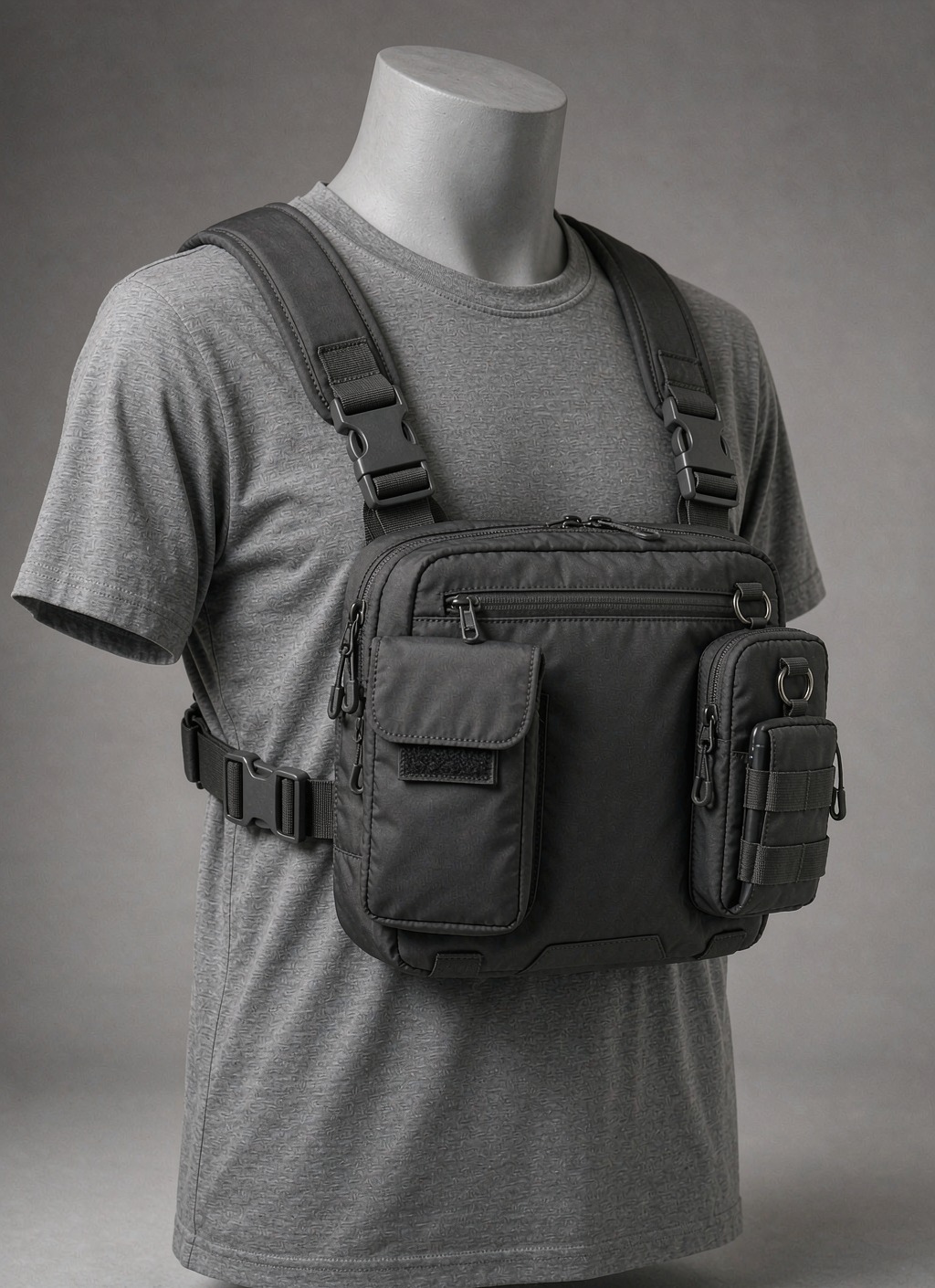
Thread selection for load seams comes down to one relationship: the thread has to be strong enough to carry the seam and weak enough to break before it tears the fabric, which on a 500 denier woven polyester face carrying 25 mm webbing anchoring means a Tex 70 bonded nylon run through an Nm 100/16 point. Tex is the mass in grams of 1,000 m of thread, so Tex 70 is roughly twice the diameter of Tex 35 and needs a needle one metric size larger, and getting that pairing wrong causes more seam failures than picking the wrong polymer. Programme work is coordinated through our 4,950 m² of SGS-verified floor space, where 149 machines sit across 7 production lines behind a 200,000 unit monthly ceiling; samples take 6-10 working days and bulk runs 35-50 days from MOQ 500. Thread and seam tensile behaviour is checked against ASTM D5034, bonded and coated constructions against ASTM D751, and release sampling against ISO 2859-1. Scope is civilian load carriage only, covering work kits, travel, hiking and daily carry, with no weapon, ballistic or defence-certification claim anywhere in this document.
What bonding actually does to a nylon thread
Bonded nylon is a continuous-filament nylon 6.6 thread carrying a resin impregnation applied after spinning. The resin is not decoration: it locks the filaments together so the thread behaves as a single rod during stitch formation instead of as a bundle of loose filaments that can splay, catch and fail to loop.
That single change produces four measurable effects. Loop formation becomes reliable at high machine speed, which is why skipped stitches fall when a line moves from soft to bonded thread. Abrasion resistance rises, because the resin sheath takes the rubbing against the needle eye and the fabric rather than the filaments. Seam pucker drops, since a bonded thread holds its length instead of stretching during sewing and relaxing afterwards. And the knot and seam strength retention after sewing improves, because filaments that cannot splay cannot cut each other at the interlock.
There is a cost. Bonded thread is stiffer, so it does not lie as flat in a tight curve, and it is less forgiving in a tension setup that is slightly tight: the thread will not stretch to compensate and the seam will show the imbalance immediately as a line of interlock dots on the face. Machine setup has to be correct rather than approximately correct.
Resin type matters for aftercare. Some bonding resins soften in dry-cleaning solvent, some board up under high ironing temperature, and the thread supplier's aftercare sheet should be part of the tech pack rather than an afterthought, because the seam can survive sewing and fail in the customer's first wash.
Selection rule: Specify resin-bonded nylon 6.6 for every structural seam on a modular panel, accept its stiffness as the price of reliable loop formation, and file the supplier aftercare sheet with the tech pack so washing and pressing limits travel with the specification.
Reading Tex, ticket number and denier on the same cone
Three numbering systems describe the same thread and get mixed up constantly. Tex is the mass in grams of 1,000 m: Tex 70 means 1,000 m weighs 70 g. Denier is the mass in grams of 9,000 m, so denier is nine times the Tex figure. Ticket number, written as a hash followed by digits, is a cotton-count-derived commercial label that runs opposite to thickness: a higher ticket means a finer thread.
The practical route is to specify in Tex only and let the supplier translate. A control drawing that says "Tex 70 bonded nylon 6.6, colour matched to face, UV stabilised" cannot be misread. A drawing that says "#69" can, because ticket numbering varies slightly between thread families and a buyer comparing two quotes may be comparing two different diameters.
Where a specification inherits an existing ticket number, convert rather than guess. Ticket 69 corresponds to about Tex 70, ticket 40 to about Tex 27 and ticket 92 to about Tex 105, but the conversion depends on ply construction, so the confirmation should come from the thread data sheet and not from a conversion table found in a handbook.
Ply construction matters as much as count. A two-ply Tex 70 and a three-ply Tex 70 have the same mass but different surface behaviour: the three-ply is rounder, abrades differently and sits differently in the seam. Where abrasion at the seam line is the failure mode being solved, specify ply count as well as Tex.
Verdict: Write thread callouts in Tex with polymer, finish and ply construction named, and never let a ticket number stand alone on a control drawing, because ticket scales run opposite to thickness and vary between thread families.
Matching thread Tex to needle diameter and fabric mass
The pairing rule is a clearance rule, not a strength rule. The needle has to punch a hole large enough for the thread to pass through without being crushed, and the fabric must then close around the thread. A rule of thumb that holds in production: the needle diameter should be roughly 1.4 to 1.8 times the thread diameter, which puts Tex 35 on Nm 80/12, Tex 70 on Nm 100/16 and Tex 135 on Nm 110/18 or 120/19.
Under-size the needle and three things go wrong together. The thread is scuffed as it passes, so its as-sewn strength falls below its off-cone strength. The loop forms late because friction delays it, so skips appear at the highest machine speeds. And the needle deflects on heavy stacks, which is how a needle break and a burr on the throat plate happen in the same shift.
Over-size it and the problems are quieter but just as real. The hole is larger than the thread, so the seam leaks where water resistance matters, the fabric closes around nothing, and on a coated face the coating bridges the gap and crazes at the stitch line. Over-sizing is the more common error on waterproof builds because someone is chasing fewer skips.
Fabric mass sets the third corner of the triangle. Tex 135 is pointless on a 210 denier liner: the thread is stronger than the fabric can transmit, so the seam fails by tearing the liner beside the thread. On 1000 denier faces with heavy webbing stacks, Tex 70 is marginal and Tex 135 earns its place, provided the needle moves up with it.
Bottom line: Keep the needle at 1.4-1.8 times the thread diameter, pair Tex 35 to Nm 80/12, Tex 70 to Nm 100/16 and Tex 135 to Nm 110/18, and step the thread down rather than up whenever the face fabric is the lighter element in the stack.
Thread versus fabric: the strength matching principle
A seam has two candidate failure points, the thread and the fabric beside it, and the specification should choose which one fails. The correct choice is the thread. A thread that breaks can be re-sewn and the panel is still usable; a fabric that tears along the stitch line usually means a new panel.
That gives a simple design test: the single-thread breaking force should sit below the force needed to tear the fabric between penetrations at the specified stitch density. On a 500 denier woven polyester at 8 stitches per inch, the fabric between penetrations will typically hold more than a Tex 35 thread but less than a Tex 135 one, which is exactly why Tex 70 is the common answer for structural work at that weight.
The test changes with density. Raise the count to 11 stitches per inch and the fabric between penetrations carries less, because more yarns have been cut; the same Tex 70 thread that was correctly matched at 8 stitches per inch is now over-matched. This is the practical reason thread selection and stitch density belong in the same section of a tech pack rather than in separate ones.
As-sewn strength is lower than off-cone strength, typically by 10 to 30 percent depending on how much the thread was scuffed passing through the needle and the fabric. Specify against as-sewn figures wherever the supplier publishes them, and if they do not, apply a derating factor in the calculation rather than assuming the cone figure survives sewing.
Takeaway: Choose the thread so that it yields before the fabric tears, verify the choice at the stitch density actually specified rather than in isolation, and work from as-sewn strength with a 10-30 percent derating from the cone figure.
UV attenuation, hydrolysis and what service life really costs
Nylon 6.6 loses tensile strength under ultraviolet exposure faster than polyester does. In bench exposure on our own racks, an unstabilised bonded nylon thread left on a south-facing rack showed a visible strength loss within one summer season, while a UV-stabilised grade on the same rack held most of its original figure. The thread is the first thing to go on a pack that lives outdoors, long before the face fabric looks tired.
The mechanism is surface-dominated, and thread is all surface: a filament bundle has far more exposed area per unit mass than a woven face. That is why a seam on an exterior pocket can lose strength while the fabric around it still tests fine, and why a UV-stabilised grade is worth specifying on any seam exposed to direct sun.
Moisture is the second ageing route. Nylon absorbs water, around 4 percent by mass at saturation, and wet nylon is slightly weaker and slightly more extensible; it also dries back out, so the effect is reversible rather than cumulative. Polyester absorbs far less, under 1 percent, which is part of why polyester thread is favoured where dimensional stability in wet service matters more than ultimate strength.
Storage is the part buyers control and often ignore. Thread cones left on a machine under a skylight age faster than thread in a closed cabinet, and a cone that has been on a machine head for six months is not the same thread as a fresh cone from the same lot. Date-code the cones and rotate stock.
| Behaviour | Bonded nylon 6.6 | Bonded polyester | Textured polyester |
|---|---|---|---|
| Ultraviolet strength retention | Moderate, yellows first | Good | Good |
| Moisture uptake | About 4 percent | Under 1 percent | Under 1 percent |
| Elastic recovery after load | High | Moderate | Highest |
| Stiffness and pucker behaviour | Stiff, low pucker | Stiff, low pucker | Soft, higher pucker |
| Where it belongs | Anchoring and perimeter seams | Exterior seams in strong sun | Stretch panel insertion |
| Shade handling | Acid dyes, wide range | Disperse dyes, longer lead time | Limited shade range |
Judgement: Specify a UV-stabilised bonded nylon on any seam exposed to direct sun, expect unstabilised grades to lose visible strength within a single summer season outdoors, and date-code cones at issue so that thread sitting on a machine head is not treated as fresh stock.
Thread selection compared by seam role
One thread across an entire bag is the default and it is wrong. The seam that anchors a webbing island, the seam that closes a liner and the seam that topstitches a lid do three different jobs, and the table below sets a working allocation for woven polyester and nylon faces between 210 and 1000 denier.
| Seam role | Thread callout | Needle pairing and priority |
|---|---|---|
| Webbing island and hardware anchoring | Tex 70 bonded nylon 6.6, UV stabilised | Nm 100/16, thread yields before fabric |
| Structural perimeter, panel to body | Tex 70 bonded nylon 6.6 | Nm 100/16, balanced tension critical |
| Shoulder strap and handle roots | Tex 135 bonded nylon where stack exceeds 4 layers | Nm 110/18, penetration clearance first |
| Liner closing and internal pockets | Tex 35 bonded polyester | Nm 80/12, low pucker priority |
| Zipper tape insertion | Tex 40 bonded polyester | Nm 90/14, flat profile priority |
| Topstitch on a lid or flap | Tex 40 bonded polyester, colour matched | Nm 90/14, appearance priority |
| Elastic and stretch panel insertion | Tex 35 textured polyester | Nm 80/12, extensibility priority |
Two allocations in that table get argued about. Polyester thread on structural seams is a legitimate alternative where UV exposure is severe and ultimate strength is not the binding constraint: polyester loses less strength under the same exposure, and on a pack that lives on a job site for years that can matter more than the higher starting figure of nylon. The trade is real and it should be recorded rather than defaulted.
Colour matching is not cosmetic either. A thread dyed to match a dark face absorbs more heat in sun than a natural or light-coloured thread of identical specification, and the darker thread runs marginally hotter at the needle. On high-speed runs through coated faces this is enough to change skip behaviour.
Where a hardware family is named in a specification, treat it as a family reference rather than a single approved part: a supplier in that family may offer several chain constructions at the same nominal size, and the thread callout has to suit the one actually fitted. The same restraint applies to slide fasteners, where a chain drawn from a graded lot behaves differently from an ungraded one under the same seam.
Spec rule: Allocate thread by seam role rather than by bag, keep Tex 70 bonded nylon on anchoring and perimeter work, move to Tex 135 only where the stack exceeds four layers, and record any switch to polyester thread as a deliberate UV trade rather than a substitution.
Machine setup: tension, lubrication and the defects it prevents
Thread problems that look like material failures are usually setup failures. Three adjustments account for most of what arrives on a complaint bench: upper tension, thread lubrication and needle-to-looper timing.
Upper tension set too high pulls the interlock to the face, showing as a dotted line and producing a seam that is pre-stressed before any load arrives. Set too low and the interlock sits inside the stack, which looks better and produces a seam that opens under load because the threads are not locked at the surface. The correct setting puts the interlock midway through the stack, and the check is destructive: cut the seam and look where the knot sits.
Lubrication applied through a thread stand pad rather than a dip tank keeps the dose consistent; over-lubricated thread attracts dust and stains light faces, under-lubricated thread scuffs at the eye and loses as-sewn strength. On bonded thread the dose is lower than on soft thread, because the resin already provides part of the surface behaviour.
Timing is the one that produces skips. If the needle rises before the loop has fully formed, the looper misses it, and the miss is intermittent, which is why it survives a one-off inspection. Timing belongs on the preventive maintenance schedule with a fixed interval rather than being adjusted when a problem appears.
Needle condition closes the set. A point that has been through 40 hours of coated face work is blunt enough to raise friction heat and glaze the fabric. Change needles on a counted interval, not when the operator notices a problem.
Set upper tension so the interlock sits midway through the stack, lubricate through a metered pad at a lower dose for bonded thread than for soft, and put looper timing and needle changes on a counted maintenance interval because both failures are intermittent and both survive a single inspection.
Verification: what to test and what to keep
Thread verification does not need a large laboratory. Four checks cover the decisions that matter, and each one maps to a published method rather than to an in-house opinion.
| Property under check | Method applied | Record retained |
|---|---|---|
| As-sewn seam strength | ASTM D5034 grab method on the assembled stack | Pull reading per lot, three specimens |
| Bonded or laminated face behaviour | ASTM D751 for coated constructions | Coating adhesion note per lot |
| Abrasion at the seam line | ISO 12947 on the sewn specimen | Cycle count to first thread break |
| Dimensional behaviour after washing | ISO 6330 on a sewn panel | Pucker grade and shrinkage figure |
| Lot release | ISO 2859-1 level II | Inspection sheet, AQL 2.5 |
Keep the cone label with the record. A pull reading without the thread lot and cone date is not evidence, because the next dispute is rarely about the method and always about whether the same thread was used. Photograph the label, staple it to the pull sheet, and file both against the order number.
Retain a sewn counter-sample from the approved lot. When a repeat order arrives a year later, the counter-sample answers whether the new seam behaves like the old one in under an hour, without reopening the specification argument.
Programme controls: sampling, approval and shipment
Vetted partner facilities provide the capacity behind these programmes: 4,950 m² of SGS-verified floor space, 137 people, 149 machines spread over 7 production lines and a 200,000 unit monthly ceiling, with production leadership in bags since 2004 and the company established in 2014. Pricing comes back within 24-48 hours; a sample set takes 6-10 working days, or 12-15 where the build involves laminated faces; bulk runs 35-50 days from MOQ 500 per reference, and release is drawn to AQL 2.5 with zero tolerance on critical defects, 2.5 on major and 4.0 on minor. Sample charges are USD 50-150 and are credited back against the order; tooling and screens are USD 300-2,500.
Shipment planning runs FOB Xiamen on T/T 30/70 terms, with transit of 25-35 days by sea, 5-8 by air and 3-5 by courier. Carton planning works from roughly 28 CBM for a 20GP container and about 68 CBM for a 40HQ, which for a typical 40 litre pack means the container decision is driven by carton cube rather than by unit count.
Related engineering context sits in the MOLLE system engineering notes, the modular EDC and modular chest and waist platform pages, and the durability discussion in stitch density standards for load seams. Component ranges are listed on the products page, and bespoke programmes start from custom modular backpacks.
Frequently asked questions
What does Tex mean on a sewing thread specification?
Tex is the mass in grams of 1,000 m of thread, so Tex 70 means 1,000 m weighs 70 g. It runs with thickness, unlike ticket number which runs against it, so specifying in Tex removes most substitution errors. Name polymer, finish and ply alongside it.
Why is bonded nylon used for structural bag seams?
The resin locks the filaments so the thread forms a reliable loop at speed, resists abrasion at the needle eye and holds its length instead of relaxing into pucker. Those three effects matter more on a dense anchoring seam at 8-10 SPI than the cone strength figure.
Which needle size matches Tex 70 bonded nylon thread?
Nm 100/16 is the standard pairing, keeping the needle at roughly 1.4-1.8 times the thread diameter on a 500 denier face at 8-10 SPI. A finer needle scuffs the thread, delays loop formation and produces intermittent skips that survive one end-of-line inspection.
When should a Tex 135 thread replace Tex 70?
Step up when the stack exceeds four layers, as at a shoulder strap root sewn over webbing and binding, and move the needle to Nm 110/18 with it. The face fabric still has to be heavy enough that it tears only after the thread does.
How does stitch density change the thread choice?
Density and thread are one decision. Raising the count from 8 to 11 stitches per inch leaves the fabric between penetrations carrying less load, so a Tex 70 that was correctly matched at 8 becomes over-matched at 11. Re-check the pairing whenever the count moves.
How much strength does thread lose during sewing?
As-sewn strength typically runs 10 to 30 percent below the cone figure, depending on scuffing at the needle and the fabric. Apply that derating in the calculation rather than assuming the published cone number survives sewing on 500 denier at 8-10 SPI.
Does nylon thread degrade under ultraviolet exposure?
Yes, faster than polyester. In our bench exposure an unstabilised bonded nylon lost visible strength within one season of about 6 months on a south-facing rack, while a UV-stabilised grade held most of its original figure over the same period.
Should polyester thread be used instead of nylon outdoors?
Where ultraviolet exposure is severe and ultimate strength is not the binding constraint, yes. Polyester loses less strength under the same exposure and absorbs under 1 percent moisture against roughly 4 percent for nylon, so it also holds dimensions better in wet service.
What causes skipped stitches with bonded thread?
Usually late loop formation from looper timing, an under-sized needle such as Nm 90/14 running Tex 70, or a blunt point, rather than the thread itself. The miss is intermittent, so it passes a one-off check; put timing on a counted maintenance interval.
How should upper thread tension be set on a lockstitch?
Set it so the interlock sits midway through the stack on a 500 denier face at 8-10 SPI, then cut a seam and look where the knot lies to verify. High tension pulls the knot to the face and pre-stresses the seam; low tension buries it.
Which standards are used to verify thread performance?
As-sewn seam strength follows ASTM D5034, coated constructions follow ASTM D751, seam abrasion follows ISO 12947, and release follows ISO 2859-1 level II at AQL 2.5. Keep the cone label photographed beside the readings, and photograph each cone again at goods-in so the lot stays traceable.
What thread evidence should be retained with an order?
Three items: the cone label photographed and filed with the pull sheet so the thread lot is traceable, pull readings per lot from three specimens, and a sewn counter-sample from the approved 500 unit build. Together they show whether a repeat lot matches the first.
How long does sampling take for a thread change?
Sampling runs 6-10 working days, or 12-15 where the construction involves laminated faces, followed by a pre-production sample for sign-off and bulk across 35-50 days. Sample charges are USD 50-150 and are credited back against the order, and the pre-production sample is signed off before the 35-50 day bulk window is booked.
Does thread colour affect seam performance?
Beyond appearance, yes. A dark dye absorbs more heat in sun and runs marginally hotter at the needle, which on high-speed runs through coated faces at 10 SPI is enough to change skip behaviour. Match colour knowingly rather than by default.
What is the MOQ for a bag built to a custom thread callout?
MOQ is 500 units per reference. Because thread is bought per shade, a custom colour may carry a minimum dye lot from the thread supplier, so confirm shade availability before the 6-10 working day sampling clock starts, since a late colour change restarts it.
How should thread cones be stored on the production floor?
In closed cabinets away from direct sun, date-coded at issue and rotated every 6 months. A cone left on a machine head under a skylight for half a year is not the same thread as a fresh cone from the same lot, and ageing shows first as skips.