Home › Field notes › Ten Modular Laptop Backpack Configurations: A Selection Framework
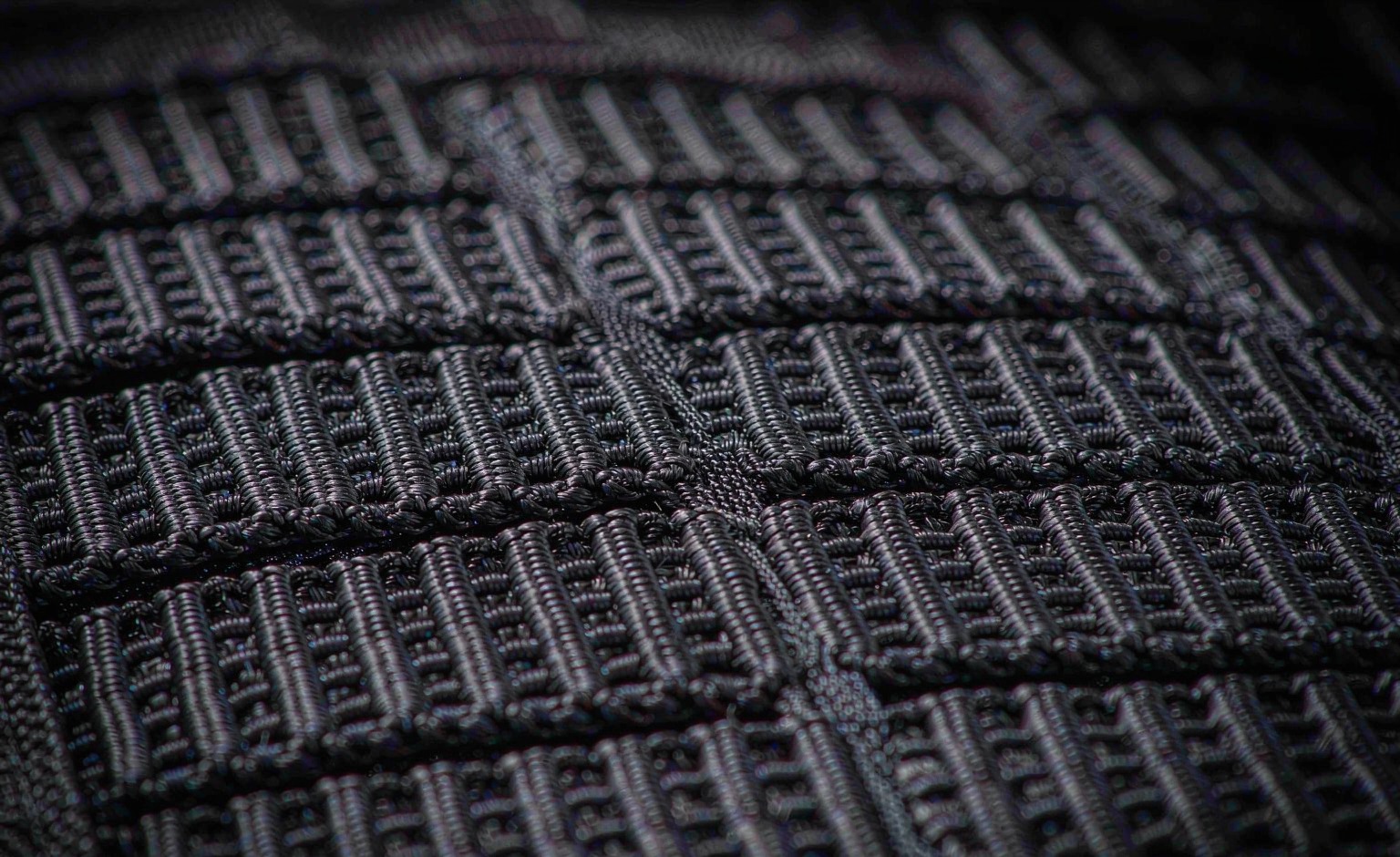
Ten modular laptop backpack configurations beat any ranked product list, because a configuration can be specified and a ranking cannot: each archetype below is written as device clearance, carry duration, module count and opening behaviour rather than as a brand score. The framework exists because commercial reviews date within a season, while the underlying trade-offs - suspended floor versus padding, internal versus external module mounting, roll-top versus clamshell - stay valid across years. A buyer picks the archetype that matches the user group, weights it, and turns it into a tech pack. Interface geometry stays constant - 25 mm tape laid in rows spaced 38 mm vertically, repeating every 50 mm along the row - so modules remain interchangeable across the chosen chassis. Commercial planning runs from a 500-piece floor per reference: 6-10 working days to sample, 35-50 days to build, then the lot judged at AQL 2.5. Each archetype is written as a specification line rather than as a score, so the framework survives the model changes that date any ranked list within a season.
Why a ranked product list is the wrong instrument for a specification
A published ranking answers a question a professional buyer is not asking. It compares finished retail products on attributes that are partly subjective and partly unavailable - comfort feel, style, value impression - and it goes stale as soon as any listed model is revised. None of it can be written into a tech pack, and none of it survives contact with a specific user group that carries a specific device on a specific journey.
What a buyer needs instead is a decision structure: given a device, a journey and a set of tasks, which configuration class performs best and what does that class demand in construction? That question has durable answers because it is about geometry and duty cycle rather than about model years. Ten archetypes cover the space adequately, and the boundaries between them are defined by measurable thresholds rather than by marketing categories.
The framework also resolves a recurring commercial problem. Brands frequently ask for "the best" laptop backpack and receive a sample built to a reviewer's preference rather than to their users' behaviour. Converting the request into an archetype with a device bay dimension, a carry duration and a module count makes the brief testable, and a sample can then be accepted or rejected against it.
Nothing here rates a named commercial product, and no scores are assigned between archetypes. An archetype is not better or worse than another; it is better or worse fitted to a defined user. The scoring table later in this guide is applied by the buyer, against the buyer's own weights.
Selection rule: Selection rule: Replace any ranked product list with a selection framework, because a ranking written for one user group mis-specifies every other group and expires with the next model year, while a framework still specifies a programme of 500 units correctly.
The ten archetypes and the boundary that separates each
| Archetype | Defining threshold | Module count | Opening behaviour |
|---|---|---|---|
| Slim office sleeve carrier | Device only, under two hours carry | Two | Top access, single compartment |
| Daily commuter chassis | Device plus lunch and layer, one to two hours | Three | Clamshell, flat open |
| Hybrid office and gym | Device plus a change of clothing | Four | Clamshell with separated base |
| Cabin travel shell | Overnight, cabin sizer constrained | Five | Clamshell, suitcase opening |
| Field service carrier | Device plus hand tools on site | Six | Front panel open, tools forward |
| Technical survey rig | Device plus instruments, tripod outside | Six | Panel open with external lash |
| Creative kit hauler | Device plus camera or audio inserts | Five | Rear access, contents hidden |
| Education load carrier | Device plus textbooks, high static mass | Three | Top access, reinforced base |
| Two-device professional | Two devices, separate bays | Four | Dual compartment, front and rear |
| Convertible carry platform | Backpack plus briefcase plus shoulder | Four | Detachable harness, dual handle |
Bottom line: Bottom line: Name the archetype before naming the feature set, and separate ten configurations by duty profile rather than by price, because two archetypes at the same price serve different users, and a framework scored on duty profile still holds once the order reaches 500 units.
Sizing the device bay: clearance, floor and the case you forgot
Every archetype above shares one non-negotiable dimension: the bay is sized over the cased device, not over the published device. Cases add thickness on all four sides and on both faces, and a bay cut to the naked dimension guarantees a forced insertion on day one. The specification should name the largest cased device the bay must accept and the clearance around it.
The suspended floor is the second shared requirement. A defined gap between the base of the bay and the base of the bag, maintained under packed load, converts a drop onto the bottom corner into deflection rather than direct impact. The failure to guard against is a gap that looks correct when empty and collapses when the bag is full, which is why the acceptance test specifies a loaded drop.
Bay position differs by archetype and drives balance. Rear-positioned bays, against the wearer's back, keep dense mass close to the spine and are correct for education and field archetypes where static mass is high. Front-positioned bays protect the device from external impact and are preferred where the bag is placed down repeatedly, at the cost of pushing mass away from the spine.
Finally, the bay must be separable from the module volume in a way that protects both. A device sliding against a metal tool handle is a scratched screen waiting to happen, so the divider between bay and module space should be padded on the bay side and stiff enough not to be displaced by the contents of the other compartment.
Verdict: Verdict: Size the device bay to the largest case a user might bring rather than to the bare device, add a suspended floor and corner clearance, then verify both on a sample produced in 6-10 working days before stating the protected bay rating using the code in IEC 60529.
Archetypes one to four: office, commute, hybrid and cabin
The slim sleeve carrier serves a user who carries a device and nothing else, typically between meetings or across a campus. Its engineering priority is thinness and a flat profile against the back; a suspended floor is still required but the harness can be light because carry duration is short. Modules are limited to a charger pocket and a document sleeve, and the archetype fails when a user tries to use it for a full working day.
The daily commuter chassis is the volume workhorse and the archetype most brands should start with. It carries a device, a layer, a lunch and a small accessory set for one to two hours a day, favouring a clamshell that opens flat for security screening. Balance matters more here than in the slim carrier, because the load is asymmetric and the bag is worn for longer.
The hybrid office and gym archetype adds a separated base compartment for clothing or footwear. The engineering issue is odour and moisture isolation, which argues for a lined, vented base rather than a simple divider, and for a closure that seals that compartment independently. This archetype is where a welded or coated base panel earns its cost.
The cabin travel shell is governed by an external constraint rather than by user preference: the airline sizer box. Nominal capacity is misleading because harness, structure and the device bay consume volume, and the usable figure typically sits well below the number printed on a hangtag. A modular travel backpack built around a shared chassis handles this better than a fixed silhouette, because the module set can be reduced for a short trip without changing the shell.
Archetypes five to seven: field service, survey and creative kit
The field service carrier puts tools forward and the device rearwards, which solves both access and protection: the user reaches tools without opening the main volume, and the device stays between the load and the wearer's back. The module count is high and the attachment lattice carries real load, so alternating attachment is preferred over single-pass because it distributes pull across more stitching.
The technical survey rig adds external lash points for a tripod or a long instrument. Those lash points are the archetype's governing detail: they concentrate load into small areas and they are frequently underspecified, so the specification should state the load each lash point must hold and the reinforcement behind it. Compression straps that pass under the load, rather than only over it, stop the carried item from sliding down.
The creative kit hauler inverts the usual access logic. Contents are valuable and visible, so access is from the rear panel while the bag is worn, which keeps zips and openings away from a crowd. Inserts for camera bodies or audio recorders are the modules that justify the archetype, and they need rigid walls rather than soft dividers if the contents are to survive being set down hard.
All three of these archetypes share a duty cycle that is harder than office carry: they are put down on rough surfaces, worn for longer, and loaded with denser objects. Harness specification, abrasion class and seam strength should all move up a step relative to the office archetypes, and the acceptance tests should reflect that rather than reusing the commuter drop height.
Scoring an archetype against your own user group
| Criterion | Suggested weight | Evidence to score from | Score band |
|---|---|---|---|
| Device fit and protection | High | Cased device clearance, loaded corner drop | One to five |
| Carry duration comfort | High | Harness class, static mass, spinal moment | One to five |
| Access behaviour match | Medium | Opening type against observed retrieval | One to five |
| Module usefulness | Medium | Count of modules used in a normal week | One to five |
| Interface interchangeability | Medium | Lattice conformance and gauge check | One to five |
| Programme cost fit | Low | Tooling band and unit cost at MOQ 500 | One to five |
Takeaway: Takeaway: Score each archetype against the buyer's own user group on a written scale, weight the criteria before looking at the configurations, discard any archetype winning only on criteria nobody in the group named, and validate the winner on a 6-10 working day sample.
Archetypes eight to ten: education, two-device and convertible
The education load carrier is defined by static mass rather than by volume. Textbooks are dense and the load barely changes through the day, so the harness and the base are the governing elements. A reinforced base that resists being set down on a hard floor, and a harness rated for the actual mass rather than for the volume, separate a durable product from one that fails in a term.
The two-device professional carries a laptop and a tablet, or a work device and a personal one, and needs two separated bays. The engineering risk is that both bays end up rear-positioned, which pushes total mass away from the spine; the usual resolution is one rear bay and one mid-volume bay with a stiff divider, accepting slightly less protection on the second device to preserve balance.
The convertible carry platform adds briefcase and shoulder modes to the backpack mode, which is commercially attractive and mechanically demanding. Straps have to stow without creating bulk, handles have to take the full loaded mass, and the attachment points used in each mode have to be independently rated. A convertible platform with a detachable harness is the configuration to study here, because the failure mode is usually a handle or a strap anchor that was only ever rated for the empty bag.
These three archetypes are also the ones where a buyer is most tempted to over-specify. Adding a module that a user will not carry costs mass, cost and complexity, and the weighted grid above is the instrument that prevents it: if a module is not used in a normal week, it should leave the specification.
Where chassis programmes go wrong
Four errors account for most chassis samples that come back wrong, and all four are visible in the brief rather than in the sample. The first is a bay dimensioned from a device specification sheet rather than from a cased device in a sleeve, which guarantees a forced fit. The second is a device positioned for protection without regard for balance, so the finished bag pulls away from the wearer's back under a full load.
The third is a module count set by what looks generous in a product photograph rather than by what a user reaches for in a week. Unused pockets are not neutral: they add mass, they consume volume, and they make the bag harder to pack. The weighted grid exists to remove them, and it only works if the usage evidence is real.
The fourth is an interface chosen for appearance. Proprietary docking looks tidier in a render and converts a platform into a closed system, whereas the conventional lattice keeps third-party and future pouches usable. Buyers almost always regret the proprietary choice by the second season, when the module they want to add is not available for their own dock.
Two further errors appear later, at production rather than at design. Bay clearance and row pitch are dimensional and pattern-driven, so a mistake affects every unit rather than a few, and they are the two items worth checking on the first articles off the line rather than at final release. And where a rigid insert is used, its own tolerance stack with the shell is rarely specified, which is how a bay ends up tight on some units and loose on others.
All six are avoidable with a written brief and a first-article check, and none of them is solved by a better sample review, because by then the pattern already exists.
A first-article check is worth defining precisely, because it is the least formal and most valuable gate in the whole programme. Before bulk cutting begins, measure the bay clearance on the first unit, check row pitch with a gauge across several rows, and confirm the harness attachment against the drawing. Those three measurements take twenty minutes and they catch the pattern-driven errors that final inspection can only quantify after the lot is built. Recording them, with the date and the unit number, also gives a buyer evidence if a later dispute turns on when a problem first appeared.
Turning the selected archetype into a build order
Once an archetype is chosen and weighted, the conversion into a build order is mechanical. Write the bay dimension over the largest cased device, the suspended-floor gap under packed load, the harness class against static mass, the module list with attachment method, and the opening type. Add the lattice conformance statement - rows of 25 mm tape at 38 mm vertical pitch, repeating at 50 mm - so the chassis accepts existing and future pouches without adaptation, including those from the wider modular backpack platform.
Then attach the acceptance tests: insertion and removal cycles, loaded flat and corner drop, retention shake for each pocket, and a harness static load. Each test needs a stated criterion, because a test without a pass threshold settles nothing when a disagreement arises mid-run.
The calendar that follows is unremarkable and worth knowing precisely. A sample takes 6-10 working days on a conventional construction; where a moulded bay, a welded base or a rigid insert enters the build, 12-15 is the realistic figure. Bulk production then occupies 35-50 days, the longer end applying when a rigid part or a bought-in hardware set carries a lead time of its own. Five hundred pieces is the floor per reference.
Dimensional findings belong in a class of their own when the lot is judged at AQL 2.5, following ISO 2859-1 acceptance logic, because clearance and row pitch are cut from one pattern and are therefore wrong across every unit rather than in a scattered few. Logo tooling spans USD 300-2,500; the USD 50-150 charged for a sample is credited against a confirmed order; all pricing indicative only, FOB Xiamen; transit adds 25-35 days when shipped by sea, 5-8 days when flown and 3-5 days by express.
Two mistakes recur in chassis programmes and both are avoidable at brief stage. The first is selecting an archetype from what the market is selling this season rather than from what the user group does every day; the weighted grid exists to stop that, and it only works if the usage evidence behind each score is real rather than assumed. The second is specifying modules before the chassis is settled, which locks pouch geometry to a shell that may still change bay position or panel layout. Chassis first, modules second, and the reverse order costs a re-cut.
Spec rule: Spec rule: Convert the chosen archetype into a build order at 500 units, allow 35-50 days for production, and release the lot only after AQL 2.5 inspection against ISO 2859-1 level II.
Frequently asked questions
Why does this guide use configuration archetypes instead of ranking products?
Because a ranking cannot be written into a tech pack and goes stale when a model is revised. Archetypes are defined by geometry and duty cycle, so they remain valid and can be converted directly into specification lines.
How should a device bay be dimensioned?
Over the largest cased device the product must accept, with stated clearance on all sides. Cases add thickness on four sides and both faces, so a bay cut to the naked device forces insertion.
What is a suspended floor and why does it matter?
A defined gap between the bay base and the bag base that converts bottom-corner impact into deflection. It must be maintained under packed load; a gap that collapses when full offers no protection.
Which archetype suits a one to two hour daily commute?
The daily commuter chassis: device, layer, lunch and a small accessory set, with a clamshell that opens flat for security screening and a harness rated for the actual static mass.
How many modules should a laptop chassis actually carry?
Only those used in a normal week. Unused modules add mass, cost and complexity, and the weighted scoring grid is the instrument that removes them from the brief.
What lattice geometry keeps pouches interchangeable?
25 mm webbing in horizontal rows at 38 mm vertical spacing with a 50 mm horizontal repeat. Modules built to those numbers mount on any chassis built to them.
When is alternating attachment preferred over single-pass?
Where the module carries real load and is fitted once, such as field service tool pouches. Alternating attachment distributes pull across more stitching; single-pass suits modules swapped daily.
Which archetype needs the strongest harness?
The education carrier, because textbooks give high static mass that barely changes through the day. Harness specification should follow measured mass rather than bag volume.
How are two devices carried without wrecking balance?
One bay rear-positioned and one mid-volume with a stiff divider. Putting both against the back panel pushes total mass away from the spine and is felt as a backward pull.
What usually fails first on a convertible platform?
The handle or strap anchor, because it was rated for the empty bag rather than the loaded one. Each carry mode needs its attachment points independently rated.
How long does sampling take for a chassis with a rigid insert?
6-10 working days for a conventional build and 12-15 where a moulded bay, welded base or rigid insert is involved. The additional time is component procurement rather than sewing.
What are the commercial terms for a chassis programme?
Five hundred pieces per reference is the floor. Release is judged by ISO 2859-1 acceptance counting at AQL 2.5, a USD 50-150 sample charge is credited against a confirmed order, badge tooling spans USD 300-2,500 by technique, and pricing is indicative and quoted FOB Xiamen.
Is a proprietary docking system worth it on a laptop chassis?
Seldom. It looks tidier in a render and locks the platform to one module family, which is usually regretted by the second season. The conventional lattice keeps third-party and future pouches usable.
How should a bay with a rigid insert be toleranced?
Specify the tolerance stack between insert and shell, not just the nominal bay size. Without it, some units arrive tight and others loose from the same pattern.
What is the most common cause of a failed chassis sample?
A bay cut to the device rather than to the cased device. Every other error - balance, module count, interface choice - is visible in the brief and can be corrected there; a forced fit is discovered only when the sample arrives.
When is external module mounting justified on a laptop chassis?
Where the item is retrieved repeatedly through the day and speed outweighs the lever arm created. For anything dense or heavy, internal mounting keeps the mass inside the wearer's envelope and is usually correct.