Home › Field notes › What Denier Means in Backpack Fabric: 500D, 900D, 1000D and 1680D Sele
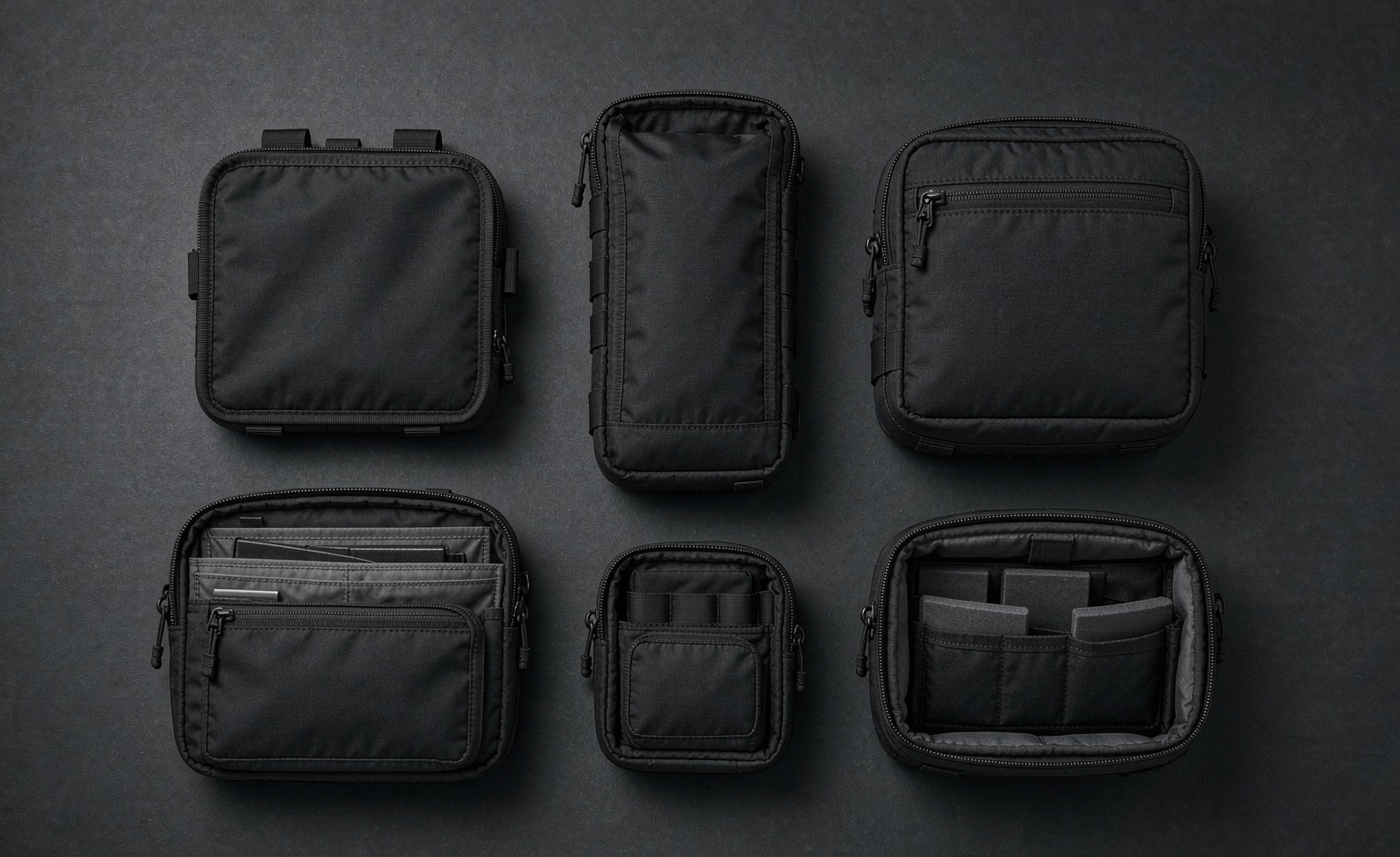
Denier in backpack fabric is a yarn measurement: the mass in grams of 9,000 metres of a single yarn, so a higher number means a thicker, heavier yarn and nothing else. Abrasion life, tear resistance and stitch holding are set by weave, thread count, GSM, coating and finish acting together, which is why a well-built 500D shell can outlast a poorly built 1000D one. Common shell options sit at 500D, 900D, 1000D and 1680D, and the correct choice is made zone by zone rather than across the whole body. Orders begin at 500 units per colourway, sampling occupies 6-10 working days and volume production a further 35-50 days once the sample is approved. The guidance covers civilian bags only, spanning outdoor, worksite, travel and daily carry, and contains no claim of ballistic performance or defence certification.
What Denier Measures in Backpack Fabric: A Yarn Count, Not a Performance Grade
Denier is defined as the mass in grams of 9,000 metres of a single yarn. A 500D yarn is one in which 9,000 metres weighs 500 grams; a 1000D yarn is twice as heavy over the same length. The related unit decitex measures the mass of 10,000 metres, and conversions between the two are routine in mill documentation. That is all the number says.
What it does not say is how the finished cloth behaves. A cloth woven from 500D yarns can be denser, stiffer and more abrasion-resistant than one woven from 1000D yarns, simply because the finer yarn was packed at a higher thread count with a tighter weave and a better finish. Buyers who specify a denier figure and stop there routinely receive a shell that meets the number and fails the product.
Three confusions follow from treating denier as a grade. The first is mass: two cloths of the same denier can differ substantially in grams per square metre, because GSM depends on yarn spacing and on any coating applied afterwards. The second is strength: tensile and tear behaviour are governed by yarn tenacity, weave geometry and coating, not by yarn thickness alone. The third is hand feel: stiffness comes largely from finish and coating, so a heavy denier can feel soft and a light one can feel board-like.
The practical fix is to specify the cloth rather than the headline number. A material line should carry denier, fibre, weave type, thread count, GSM with a tolerance, coating type and mass, finish, and the laboratory results that were accepted at approval. Six fields instead of one, and each is measurable at incoming inspection. Bodies built this way keep their material behaviour stable across reorders, which is what lets a shared modular backpack platform hold one approved shell across several models.
Verdict: Denier describes yarn mass and nothing more, so a material specification must add fibre, weave, thread count, GSM with tolerance, coating and finish, because abrasion life and tear behaviour are produced by that combination rather than by the headline figure.
Weave, Thread Count, GSM and Finish: What Actually Sets Shell Behaviour
Four variables sit between a yarn count and a finished shell, and each one can outweigh the denier figure entirely.
Weave geometry comes first. A plain weave gives a balanced, stable cloth with good dimensional control. A ripstop weave inserts heavier reinforcement yarns at regular intervals, so a tear that starts is arrested at the next reinforcement line rather than running across the panel; this is why a lighter ripstop often outperforms a heavier plain weave in service despite using less material. An oxford weave pairs a heavier yarn with a lighter one to give a softer, fuller hand at moderate mass. A dobby or jacquard construction adds pattern at the cost of some uniformity.
Thread count is the second variable and is usually omitted from buying documents. More yarns per unit area in both directions mean smaller interstices, better resistance to snagging, higher dimensional stability and a smoother printing surface. Fewer yarns per unit area give a cheaper, lighter cloth that abrades and distorts sooner. Two shells quoted at the same denier can differ by a wide margin in service life purely through this one variable.
GSM is the third, and it is the honest way to compare mass. Coating is the fourth: a polyurethane coating adds mass, blocks water, stiffens the hand and changes how a needle passes through the cloth, while a PVC coating gives a waterproof but heavier and stiffer result that behaves differently in cold conditions. A thermoplastic polyurethane film laminate sits between the two in both cost and behaviour. Finish, including any durable water repellent treatment, affects wetting and staining but contributes little to mechanical performance.
Read together, these four explain most apparent contradictions in the market. A 900D shell that feels heavier than a 1000D one usually carries a heavier coating. A 500D shell that outlasts a 900D one usually has a ripstop grid and a higher thread count. A shell that seams beautifully at approval and perforates in bulk usually had its coating changed without a new sewing trial.
Takeaway: Judge a shell by GSM, weave type, thread count and coating rather than by denier alone, prefer a ripstop grid where tear propagation is the risk, and require a fresh sewing trial whenever the coating or thread count changes.
500D Versus 900D Versus 1000D Versus 1680D: Selection Criteria Compared
Four denier points cover most civilian shells, and each occupies a defensible position once the decision is made by zone rather than by habit. The comparison below is written for a coated polyester or nylon shell of comparable construction, because changing weave or coating moves every row of the table.
Lighter shells at 500D suit panels that are seen rather than abused: front faces, lid tops, linings and organiser pockets. They print well, fold cleanly, keep total mass down and reduce freight cost per unit. Their limitation is abrasion at contact points and tear propagation once a cut starts, which is why they should not be used alone on a base panel or a shoulder yoke.
Mid-range shells at 900D and 1000D carry the main body. They balance mass against service life, accept printing and embroidery without distortion, and sew predictably on standard equipment. The 1000D point is the conventional reference and is widely stocked, which shortens material lead time; the 900D point gives most of the same behaviour at slightly lower mass and is often the better value where freight cost matters.
Heavy shells at 1680D belong at contact points: base panels, corner reinforcements, hip wrap zones and the underside of a harness. They resist abrasion and puncture well but add mass exactly where it is least welcome, fold poorly, need heavier needles and stronger machines, and make small radius corners bulky. Using them across an entire body is almost always a mistake, because the mass penalty is paid on every panel while the benefit is only needed on a few.
| Criterion | 500D | 900D | 1000D | 1680D |
|---|---|---|---|---|
| Typical shell mass | Lightest of the four | Moderate | Reference weight | Heaviest, and bulky at folds |
| Abrasion at contact points | Lowest; needs reinforcement at wear zones | Good on most panels | Good across the body | Highest of the four |
| Tear propagation | Poor unless a ripstop grid is specified | Acceptable | Acceptable to good | Best, but heavy |
| Hand and drape | Softest and folds cleanly | Balanced | Firm but workable | Stiff, poor at small radii |
| Print and embroidery | Best surface for fine detail | Good | Good, with some show-through risk | Poor for fine detail |
| Sewing behaviour | Forgiving; small needle, low perforation risk | Predictable on standard machines | Predictable on standard machines | Needs heavier needle and stronger feed |
| Material availability | Widely stocked | Common but less universal | Most widely stocked of the four | Stocked in fewer colours |
| Cost position | Lowest | Moderate | Moderate | Highest |
| Best position on a body | Front face, lid, lining, organisers | Main shell where mass matters | Main shell as a default | Base panel, corners, harness underside |
Selection rule: Put 500D on panels that are looked at rather than rubbed, 900D or 1000D on the main shell where 1000D wins on availability and 900D wins on mass, and 1680D only on base panels, corners and harness contact zones, because a full-body upgrade buys abrasion where it is not needed and pays for it in freight.
How to Choose Denier for a Modular Backpack Shell Zone by Zone
A single denier across an entire body is easy to buy and rarely correct. The better method is to divide the body into zones by what each one experiences, then assign a material to each.
Zone one is the base and lower corners. These take abrasion from being set down, dragged and scraped, and they take puncture from contents pressing outward. This is where a heavy shell or an applied reinforcement panel earns its mass. Zone two is the shoulder yoke and the underside of the harness, which rubs against clothing for hours at a time; a smoother, denser cloth matters more here than raw thickness, and a very stiff shell causes discomfort by refusing to flex.
Zone three is the main front and side panels, which are seen, printed and occasionally scraped. A mid-range shell usually gives the best balance of appearance, mass and life. Zone four is the lid and top surfaces, which see little abrasion but plenty of handling, so a lighter shell with a good finish keeps mass down without a durability penalty. Zone five is the interior, where lining cloth should be chosen for visibility, snag resistance and colour fastness rather than for strength.
An interface complicates the picture. An attachment face adds its own layers, and the shell behind it has to accept the stitch load those layers deliver, so the attachment zone often needs a step up in material class or an added backing layer even when the rest of the panel does not. Where a programme publishes a mounting map, the material class per zone belongs on the same drawing.
Mass budget closes the loop. Adding material class to every zone produces a body that is durable and unsellable, so the discipline is to upgrade only where the failure evidence justifies it. Field returns, warranty claims and a wear trial on a dressed sample are better guides than intuition, and hiking-oriented bodies in particular benefit from the lighter end, as set out for distance-oriented modular packs.
Bottom line: Assign denier by zone, upgrading the base, corners and harness contact areas, keeping the main panels at a mid-range shell, specifying lighter cloth for lids and linings, and adding a backing layer wherever an attachment face stitches into the panel.
Abrasion, Tear and Tensile: What the Laboratory Actually Measures
Denier arguments are usually settled, if at all, by laboratory work, and the value of that work depends entirely on choosing the method that matches the failure being investigated.
Abrasion is the most commonly cited concern and has two established routes. The rotary platform abrader method, ASTM D3884, reports behaviour under a rotating abrasive action, while the Martindale route, ISO 12947, reports it under a defined rubbing pattern. Results from the two are not interchangeable, and a specification that quotes a cycle count without naming the method is not a specification. Neither method predicts snagging, which is a separate failure and better assessed by a wear trial.
Tensile behaviour of the woven cloth is measured by the grab method, ASTM D5034, which answers whether the material survives a straight pull. Tear behaviour is a different question again and is frequently confused with tensile in buying documents; a cloth can be strong in tension and still propagate a tear readily once cut, which is precisely the case a ripstop grid addresses. Coated cloth brings its own questions, covered by ASTM D751, including coating adhesion and behaviour under flex.
Water and appearance questions sit alongside. Resistance of the finished cloth to water penetration is measured to AATCC 127, colour transfer under rubbing to AATCC 8, and behaviour after domestic laundering through ISO 6330. Hydrolysis of a coating in hot, humid storage is not covered by any of these and needs a separate conditioning trial, which is the failure that surprises brands shipping to tropical markets.
Two cautions apply throughout. First, a laboratory report describes the sample submitted, so it has to be tied to a specific material reference and coating batch. Second, no laboratory result replaces a wear trial on a finished body, because most real damage begins at seams, corners and hardware contact rather than in the middle of a panel.
Judgement: Order abrasion, tensile, tear and coating adhesion as separate tests with the method named in each case, tie every report to a material reference and coating batch, and always finish with a wear trial on a dressed sample because field damage starts at seams and hardware rather than mid-panel.
Construction Consequences: Needle Size, Seam Efficiency and Stitch Holding
A shell decision made on abrasion alone often fails at the sewing machine. Heavier cloth changes what the production line can do, and those constraints should be part of the material choice rather than a discovery during sampling.
Needle size is the first consequence. A heavier shell with a stiff coating needs a larger needle to penetrate a multi-layer stack, and a larger needle leaves a bigger hole. Where a seam is later loaded, that hole can become the start of a tear, which is why a heavy shell with a poor stitch density band can perform worse in a seam than a lighter one. Stitch density therefore has to be re-derived for each material, not carried over from the previous programme.
Seam efficiency is the second. The strength of a sewn seam is a fraction of the strength of the cloth it joins, and that fraction falls as the cloth gets stiffer, because stiff material resists the flattening that lets a seam bed down. A heavy shell can therefore deliver a disappointing assembled result despite excellent material test figures. Seam construction, including the number of rows and whether the seam is bound or turned, has to be reviewed alongside the material.
Stitch holding is the third and matters most where an attachment face is sewn on. Load from a pouch reaches the shell through stitch islands, and the shell has to resist both pull-through and tear along the stitch line. A light shell without a backing layer will fail here regardless of its abrasion figures, which is why the material class for an attachment zone is a construction decision rather than a marketing one.
Equipment and cost follow. Heavier shells need stronger feed, slower running and more frequent needle changes, which raises the conversion cost per unit. Folded corners become bulky and may need to be redesigned. Cutting yields can fall where the cloth is stiffer and less tolerant of nesting. All of these belong in the quotation rather than in a change order after approval.
Spec rule: Re-derive needle size and stitch density for every material change, review seam construction and backing coverage for any zone carrying an attachment face, and ask for the conversion cost impact of a heavier shell during quotation rather than after approval.
Compliance, Traceability and Material Documentation for Shell Fabrics
Shell material carries more documentation obligations than any other component, because it is the largest surface area in the product and the first thing a retailer's compliance team asks about.
Restricted substances come first. Screening against the candidate list maintained under REACH (EC 1907/2006) is expected for the European market, California Prop 65 declarations for the United States, and CPSIA where a product may be used by children. Certification of the finished textile to OEKO-TEX Standard 100 is requested by many retail channels at onboarding and is far cheaper to obtain at material selection than after a season has been booked.
Traceability is the second obligation and is increasingly linked to recycled content claims. Where a range claims recycled fibre, the chain of custody has to be documented rather than asserted, and the framework published by Textile Exchange is the reference most brands are asked to work to. A claim that cannot be traced should not be printed on a hangtag, because the exposure falls on the brand rather than on the mill.
Documentation practice is the third. Each approved material should carry a reference, a mill name, a coating specification, a GSM tolerance, the laboratory reports accepted at approval and a revision mark. Incoming inspection checks GSM and width against that record, and any change of mill or coating starts a new approval cycle. That discipline is what makes a reorder twelve months later behave like the first one.
| Documentation item | Question it answers | Who asks for it | Record retained |
|---|---|---|---|
| Material reference and mill name | Which cloth was approved and who made it | Internal quality and incoming inspection | Approved material list with revision mark |
| GSM reading with tolerance | Whether the delivered cloth matches the approved mass | Incoming inspection at goods receipt | Weighing record tied to the roll reference |
| Coating specification | What was applied, at what mass, and how it affects sewing | Production engineering before bulk cutting | Coating note plus the sewing trial result |
| REACH (EC 1907/2006) screening | Whether restricted substances are present above limits | European retail onboarding | Test report dated within the agreed window |
| California Prop 65 declaration | Whether a warning obligation arises in the United States | United States retail and marketplace review | Signed supplier declaration on file |
| OEKO-TEX Standard 100 certificate | Whether the finished textile is certified for skin contact | Retail channels at onboarding | Certificate number and validity dates |
| Recycled content chain of custody | Whether a recycled claim can be substantiated | Brand sustainability review and retail audit | Transaction certificates against the claim |
Vetted partner facilities provide the capacity behind this discipline: a 4,950 m² SGS-verified production floor where 137 people run 149 machines arranged across 7 production lines, with monthly output of 200,000 units, working to ISO 9001 process control and ISO 2859-1 sampling. The founder entered bag production in 2004 and the business was set up in 2014. Every order runs sampling, a confirmed pre-production sample, and an AQL 2.5 inspection before loading, with current shells listed under the modular product range.
Cost, Freight and Programme Route for a Denier Decision
Material class drives three costs, and only one of them appears on the material invoice.
The first is material cost, which rises with denier, with coating mass and with any certification the mill has to maintain. The second is conversion cost, which rises with needle changes, slower running, heavier thread and bulkier folds. The third, and the one most often missed, is freight: a heavier shell raises the packed weight of every unit, and across a container that difference is real money rather than a rounding error. Consolidation is usually planned around 28 CBM for a 20GP container and 68 CBM for a 40HQ container, but volumetric and weight limits interact, so a mass increase can shift a shipment from weight-limited to volume-limited or the reverse.
Transit choice interacts with the calendar rather than with the material, though a heavier shell makes air freight less attractive. Sea transit runs 25-35 days, air freight needs 5-8 days and express courier 3-5 days. Where a launch date is fixed, the material decision has to be made early enough that sea remains viable, because the cost of an urgent air shipment usually exceeds the saving from any material optimisation.
The programme route itself is unchanged by the material choice. A colourway carries a floor of 500 units, the sampling charge is USD 50-150 and is netted off the final invoice, and tooling or screens sit between USD 300 and 2,500 by complexity. Sampling takes 6-10 working days, or 12-15 working days where a fresh cloth has to be sourced and signed off, and volume production takes 35-50 days; release follows an AQL 2.5 inspection, on T/T 30/70 terms. Indicative pricing comes back inside 24-48 hours, quoted FOB Xiamen.
What changes is the approval sequence. A new material needs its laboratory reports, its sewing trial and its incoming inspection record before bulk is released, and those three items are what make a heavier or lighter shell a controlled decision rather than a substitution. Programmes that skip them usually meet the denier number and miss the product, which is the failure this page set out to prevent.
Verdict: Cost a denier decision across material, conversion and freight rather than on the material invoice alone, allow 12-15 working days for sampling when a new cloth has to be approved, and release bulk only once laboratory reports, a sewing trial and an incoming inspection record are on file.
Frequently asked questions
What does denier mean in backpack fabric?
Denier is the mass in grams of 9,000 metres of a single yarn, so 500D means 9,000 metres of that yarn weighs 500 grams. It describes yarn thickness only. Abrasion life and tear behaviour come from weave, thread count, GSM, coating and finish acting together.
- Yarn mass, not a grade
- 500D = 500 g per 9,000 m
- Decitex uses 10,000 m
Is a higher denier backpack fabric always stronger?
Not necessarily. A densely woven 500D ripstop with a good coating can outlast a loosely woven 1000D cloth, because weave geometry, thread count and coating govern abrasion and tear more than yarn thickness does. Specify the cloth, not the headline figure.
Which denier should a modular backpack shell use?
Most bodies work best with a mid-range shell at 900D or 1000D on the main panels, 500D on lids, linings and organisers, and 1680D restricted to base panels, corners and harness contact zones. Assign the class zone by zone rather than across the whole body.
What is the difference between 500D and 1000D fabric?
The yarn in 1000D is twice as heavy over the same length, so the cloth is generally heavier and firmer, though coating and weave can reverse the impression. 500D prints better and folds more cleanly; 1000D resists abrasion better at comparable construction.
When is 1680D fabric worth the extra mass?
Where abrasion and puncture resistance dominate: base panels, lower corners and the underside of a harness. Across a whole body the mass penalty is paid on every panel while the benefit is only needed on a few, so full-body upgrades are rarely justified.
How does denier relate to GSM?
Denier measures the yarn; GSM measures the finished cloth in grams per square metre. Two cloths at the same denier can differ noticeably in GSM because of yarn spacing and coating mass. Compare shells on GSM with a stated tolerance rather than on denier alone.
Which laboratory method measures fabric abrasion?
Two routes are common: ASTM D3884 uses a rotary platform abrader, and ISO 12947 uses the Martindale pattern. Results are not interchangeable, so a cycle count quoted without the method named is not a usable specification.
Does denier affect how a backpack shell sews?
Yes. Heavier, more heavily coated cloth needs a larger needle, and a larger needle leaves a bigger hole that can start a tear at a loaded seam. Stitch density has to be re-derived for each material rather than carried over from a previous programme.
Why does a seam fail when the fabric tests well?
Seam efficiency falls as cloth gets stiffer, because stiff material resists the flattening that lets a seam bed down. Stitch holes also act as tear initiators. A heavy shell can therefore assemble poorly despite strong material test figures.
Should an attachment face use a heavier shell?
The zone behind an attachment face needs either a step up in material class or an added backing layer, because pouch load reaches the shell through stitch islands and can pull through or tear along the stitch line. Abrasion figures alone do not predict this failure.
What compliance documentation does shell fabric need?
Restricted substance screening against REACH (EC 1907/2006), California Prop 65 declarations, CPSIA where relevant, and OEKO-TEX Standard 100 certification where a retail channel asks for it. Recycled content claims need a documented chain of custody.
How long does sampling take with a new fabric?
Sampling occupies 6-10 working days on a standard build, stretching to 12-15 working days where a new cloth has to be sourced and approved. Volume production then runs 35-50 days, with an AQL 2.5 inspection before loading.
What are the commercial terms for a custom shell programme?
A colourway carries a floor of 500 units, with a sampling charge of USD 50-150 netted off the final invoice and tooling or screens priced between USD 300 and 2,500. Payment is T/T 30/70 and indicative pricing comes back inside 24-48 hours, quoted FOB Xiamen.
How does fabric choice affect freight cost?
A heavier shell raises the packed weight of every unit, and across a container that is real money rather than a rounding error. Sea transit runs 25-35 days, air 5-8 days and express 3-5 days, so a lighter shell also keeps air freight viable for urgent launches.
Can recycled content be claimed without traceability?
No. A recycled claim needs a documented chain of custody under a recognised framework such as the one published by Textile Exchange, and the exposure for an untraceable claim falls on the brand rather than on the mill.