Home › Field notes › 500D vs 1000D Backpack Fabric: How to Choose the Right Weight
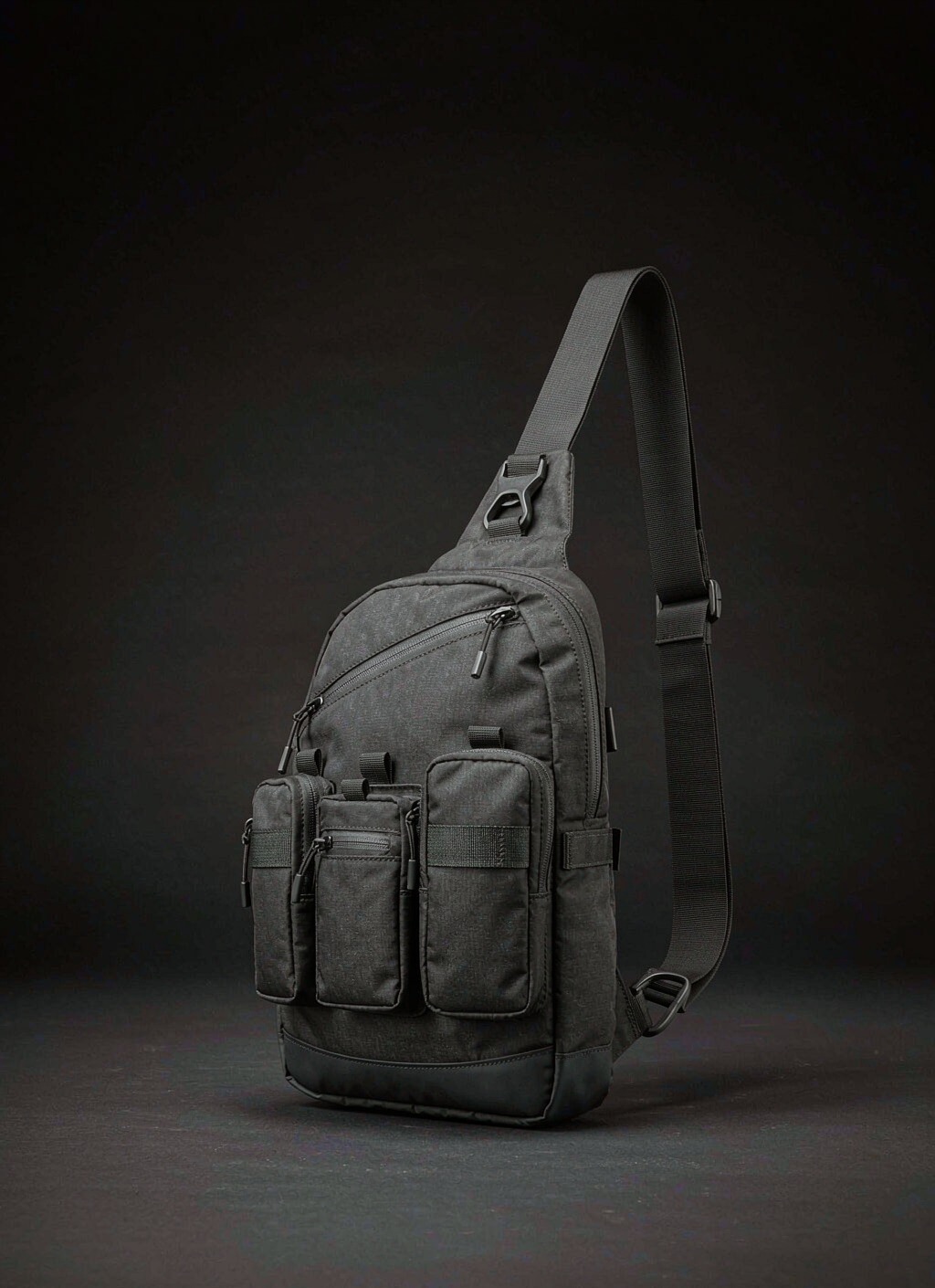
500D and 1000D describe yarn mass, not durability: 1000D buys roughly twice the linear density, about 1.41 times the yarn diameter and a stiffer, heavier cloth, while abrasion and tear life are governed mainly by fibre family, weave, thread count and coating. A 500D high-tenacity nylon in a tight ripstop can outlast a 1000D polyester in a loose plain weave, so the number on the swatch card is an input to the decision rather than the answer. Three commercial figures are fixed either way: 500 units opens a reference, a first sample takes 6-10 working days from a complete brief, and the bulk order needs 35-50 days before release at AQL 2.5. The scope covers civilian carry equipment only - commuter and travel bodies, hiking shells, worksite tool carriage, camera and first-aid kits - and ballistic performance, weapon carriage and any military certification claim sit outside it, with nothing below implying otherwise.
What denier measures, and the three properties it does not
Denier is a linear density: the mass in grams of 9,000 m of a single yarn. A 500D yarn weighs 500 g over that length and a 1000D yarn weighs 1,000 g. Nothing else is contained in the figure - not strength, not abrasion, not whether the cloth will survive a season on a worksite. It is a way of counting how thick the thread is, and a useful one, provided it is read as an input.
Doubling it has one clean geometric consequence and several messy practical ones. The clean one is diameter: for the same polymer, yarn diameter rises with the square root of linear density, so a 1000D yarn is roughly 1.41 times the diameter of a 500D yarn - not twice. That factor explains most of what follows, from hand feel to how much cloth fits into a seam.
The first thing denier does not tell you is the fibre. A 500D nylon and a 500D polyester are different materials with different abrasion response, different moisture behaviour and different dye chemistry, and the polymer frequently matters more to service life than the count does. The second is filament character: a yarn can be continuous filament or staple spun, and the number of filaments inside a given denier changes surface area, lustre, friction and how the yarn behaves when a needle passes through it. The third is construction - weave, thread count and finishing - which routinely outweighs the count on the label.
Brand names complicate the picture in a way that deserves plain handling. Cordura is a trademarked family of fabrics made by licensed mills rather than a single product, so a buyer who asks for "1000D Cordura" is really asking for a performance level associated with that family. The name should be treated as a specification reference, and the mill, the construction and the coating behind the offer should be confirmed in writing. We describe such families neutrally and claim no agency for, or use of, any third-party brand.
Spec rule: Write denier as one line of a five-line material callout - count, polymer, construction, coating and test acceptance - because a specification that stops at the count has specified the thickness of the thread and nothing that determines how long the body lasts.
500D and 1000D in numbers: diameter, finished mass and cost
Numbers make the trade-off concrete. Start with the yarn itself: 500 g against 1,000 g per 9,000 m, and a diameter ratio near 1.41. Then move to the cloth, where construction and coating dominate the final figure.
Finished mass is the number buyers feel. Woven 500D body cloth, before any coating, commonly lands around 180-240 g/m2 depending on thread count and weave; the same construction in 1000D sits nearer 300-380 g/m2. A polyurethane back-coat then adds its own mass, typically a few tens of grams per square metre, and heavier coatings for hydrostatic performance add more. Two quotes for "1000D" can therefore differ by more than the difference between 500D and 1000D, which is why finished grams per square metre belongs on the specification alongside the count.
Cost follows mass but not proportionally. Yarn is bought by weight, so a heavier cloth consumes more kilograms per body; against that, 1000D constructions sometimes run at lower thread counts, which reduces weaving time. In practice a body cut from 1000D costs more per unit than the same body in 500D, and the premium is usually smaller than buyers expect and larger than the mass ratio alone would suggest, because cutting, needle wear and seam bulk all add minutes.
Finished garment mass is where the decision becomes visible to the wearer. On a 30 L body, moving the shell from 500D to 1000D can add several hundred grams once lining, hardware and harness are unchanged, and that addition comes straight out of the payload the chassis was rated for. For a commuting or travel product weighed on a scales at an airport gate, that is the number that generates complaints.
| Criterion | 500D construction | 1000D construction |
|---|---|---|
| Linear density | 500 g per 9,000 m | 1,000 g per 9,000 m |
| Relative yarn diameter | 1.00 | About 1.41 times |
| Finished mass, uncoated | Roughly 180-240 g/m2 | Roughly 300-380 g/m2 |
| Coating added | Tens of grams per square metre | Tens of grams per square metre |
| Bending stiffness | Supple, drapes over a frame | Boardy, holds its own shape |
| Seam bulk at a folded edge | Moderate | High; needs a bigger needle |
| Abrasion ranking | Good, strongly construction dependent | Better in identical constructions |
| Mass on a 30 L body | Lower by several hundred grams | Higher; payload reduced accordingly |
One line in that table deserves emphasis: abrasion reads "better" for 1000D only when the constructions are otherwise identical. Change the fibre or the weave and the ranking can invert, which is the subject of the next section.
Verdict: Buy 1000D where the body is punished by contact - base panels, tool bags, worksite shells - and buy 500D where wearer mass, drape and sewing minutes matter more, then spend the saved mass on coating quality rather than on a heavier yarn.
Why denier is not durability: the four controls that actually decide
Four failure modes account for nearly every fabric return, and denier is the dominant control in at most one of them. Mapping each mode to what governs it is the fastest way to stop arguing about the number on the swatch.
Abrasion is governed by fibre toughness first and by surface construction second. Energy has to be absorbed at the point of contact; a tough fibre in a weave that presents many short floats absorbs it well, while a coarse weave in the same count exposes long floats that catch and abrade faster. Denier helps only in that a thicker yarn has more material to lose before it fails.
Tear propagation is governed by yarn mobility and by any reinforcement grid. Once a cut exists, the tear advances until something stops it: in a ripstop construction that is the next heavy yarn, and the grid does more for tear resistance than doubling the count does. A 500D ripstop routinely outperforms a plain-woven 1000D cloth in this mode.
Puncture is the one mode where mass genuinely dominates, because a sharp point has to displace material. Here 1000D earns its place, especially at base panels and anywhere a tool corner is carried against the shell.
Ultraviolet and hydrolysis resistance are governed by the polymer and by the coating, not by the count at all. A thick polyester cloth and a thin one degrade at similar rates in sunlight; what differs is how soon the loss becomes visible as a strength problem.
| Failure mode | Dominant control | Secondary control | Does denier decide it |
|---|---|---|---|
| Surface abrasion | Fibre toughness | Weave float length, thread count | Partly; more material to lose |
| Tear propagation | Reinforcement grid, yarn mobility | Weave type | Rarely |
| Puncture | Mass in the contact zone | Coating film | Often |
| Ultraviolet degradation | Polymer chemistry | Coating and finish | No |
| Coating delamination | Bond chemistry and substrate dryness | Film type | No |
| Seam failure | Stitch density, thread, needle damage | Cloth stiffness | No |
| Colour loss | Dye class and light fastness | Surface finish | No |
Read the last column and the argument resolves itself. Denier is a genuine lever for puncture and a weak one for abrasion; it is irrelevant to ultraviolet, coating and seam behaviour. Programmes that argue about count while their returns are dominated by coating delamination are optimising the wrong variable.
Takeaway: Identify the failure mode in your own return data before choosing a count - puncture history justifies 1000D, abrasion history usually justifies a better weave or a tougher fibre, and coating history is not fixed by changing denier at all.
Weave, thread count and coating: where abrasion resistance really lives
Two cloths of identical denier can differ more than two cloths of different denier, and the reason is construction. Thread count sets how tightly yarns are packed; weave sets how much yarn surface is exposed to the rub; coating sets which surface actually contacts the abrasive.
Thread count works because a tightly packed cloth presents a flatter surface and restricts yarn movement. A 500D woven at a high thread count can present a smoother, harder-wearing face than a 1000D woven loosely, and it will also resist seam slippage better. This is the single most under-specified line on fabric specifications, and it is free to state.
Weave choice then decides float length. Plain weave gives short floats and a flat face; oxford and basket weaves give a more textured hand and longer floats; ripstop inserts heavier yarns at intervals purely to arrest tears. For a shell that meets concrete, vehicle tailgates and conveyor edges, short floats and a high thread count do more than an extra 500 denier.
Coating is the surface the world actually touches, and it is the cheapest abrasion improvement available. A polyurethane film applied to the back or face changes the friction, the water behaviour and the wear pattern of the cloth, and a heavy coating on a 500D base can outperform a lightly coated 1000D in the same test. Resistance to water penetration in the finished assembly is reported as a head of water under AATCC 127, and the result tracks the film and the weave rather than the yarn size.
Colour transfer deserves one line because dark shades in heavy counts are the worst combination: more dye, more surface dye, more transfer. The check is AATCC 8, and it should be run on the coated cloth rather than on the greige, since coating changes the surface.
Bottom line: Spend on thread count, weave and coating before spending on denier, because the first three change the surface that meets the world while the fourth only adds material behind it.
Stiffness, bulk and what the sewing room experiences
Heavier cloth changes the job on the machine, and those changes become cost. A 1000D shell resists turning, holds a crease where a 500D shell would relax, and produces thicker seam stacks at every folded edge. Seam bulk shows up as pucker, as skipped stitches when the machine meets a rise, and as a hard ridge where a binding crosses a seam.
Needle selection follows. Thicker cloth needs a larger needle, and a larger needle generates more heat and a bigger perforation; on coated cloth that perforation is a water path and, under load, a tear line. Stitch density then has to be balanced against perforation damage: too dense and the needle cuts a line the seam can tear along, too sparse and the seam can migrate. Both limits depend on the cloth in front of the operator, so they should be settled during material sign-off instead of being left to a standard construction note.
Pattern-making absorbs the rest. A stiffer shell needs more generous allowances at curves, different binding behaviour at corners, and often a slightly different panel sequence so that the machine is never asked to turn a sharp corner through four layers. Programmes that switch count late usually discover this during the first pre-production sample, which is the most expensive place to discover it.
Comfort is the wearer-facing consequence. A stiff shell does not conform to the back, so contact area drops and pressure rises at the points where it does touch; a supple shell spreads load better. On bodies carried for hours rather than minutes, that difference is felt even when the pack is empty.
There is one place where stiffness is an asset: a panel that has to hold a shape unsupported, such as a lid, a flat document sleeve or a moulded front face. There, 1000D earns more than its mass costs, and hybrid construction - a heavier panel on a lighter shell - is usually the smarter answer than going heavy everywhere.
Judgement: Go heavy at the zones that are punished and stay light everywhere else, because a uniform count either over-builds the panels nobody touches or under-builds the two that generate all the returns.
Where each weight belongs across a range
Allocation by zone beats allocation by product. Most ranges sell several bodies, and a single count across all of them means paying for mass where it does nothing while leaving the two contact zones under-built. The table below assigns weight by zone, with the exception noted for each.
| Zone | Count to specify | Reason | Exception |
|---|---|---|---|
| Main shell, 20-30 L day body | 500D | Supple, lower mass, prints cleanly | Worksite bodies may go heavier |
| Base and lower side panels | 1000D | Puncture and set-down abrasion concentrate here | None; this is the zone to spend on |
| Shoulder strap contact face | 500D, smooth construction | Conforms and does not abrade clothing | Add a heavier facing only at the yoke |
| Tool and worksite shells | 1000D or 500D ripstop | Puncture from tool corners | Ripstop wins where tear history dominates |
| Travel bodies | 500D | Airline mass limits and handling | Reinforce the base panel instead |
| Pouch and module faces | 500D | Every gram is multiplied across the set | Heavier where a pouch meets the ground |
| Linings | Lighter counts | Lining abrasion is mild; mass is wasted | Use heavier only behind mounting faces |
Note the last row. Linings are routinely over-specified because nobody wants to write a second material line, and the mass saved by a lighter lining is available for the base panel where it does something. Programmes that publish a two-material fabric plan - one count for structure, one for lining - get a better product at the same cost.
Where a range sells attachments alongside bodies, the lightest practical count on pouch faces matters more than it appears, because four pouches at 300 g each remove 1.2 kg from the payload before anything is loaded. Small-format programmes can align that thinking with everyday carry module planning, and crews carrying hand tools daily should weigh the puncture column against the work chassis reference.
Test evidence that settles an argument between two quotes
When two suppliers both claim superior durability, three methods and one reference sample end the discussion. Abrasion is compared by cycling to an agreed end point under ISO 12947, with the abradent and the end point fixed in writing before either sample is mounted. Water behaviour of the finished cloth comes from AATCC 127. Colour transfer by rubbing comes from AATCC 8.
The reference sample is the part programmes skip. Laboratory output ranks candidates; it does not tell you whether a cloth survives your market. Run a sample with known field behaviour - the fabric currently in service and broadly accepted - through the identical method in the same session, and express every new candidate as a ratio against it. That converts an abstract cycle count into a decision.
Two further exposures are worth adding for outdoor and marine ranges: ultraviolet conditioning before abrasion, because cloth that has been sunned abrades differently from cloth that has not, and a wet abrasion run, because a saturated cloth behaves differently from a conditioned one. Neither adds much time and both change rankings often enough to justify the slots.
Records close the argument permanently. File the cycles, the abradent, the end point, the conditioning and the photographs against the contract number, so that next season's repeat can be compared with the cloth that passed rather than with the cloth everybody remembers. Re-testing triggers should be written at the same time: a new mill, a new coating supplier or a new thread count each pull verification forward.
Selection rule: Accept a count only after the candidate has been expressed as a ratio against a reference sample with known field behaviour, run in the same session with the same abradent and the same end point, because absolute cycle counts from separate laboratories cannot be compared at all.
Programme terms, fabric qualification and who runs the floor
On the production side, fabric approval runs as a gate before cutting begins: substrate and coating are approved together, laboratory submissions go out as a single batch, and the pre-production sample is sewn from the approved lot rather than from a swatch-card equivalent. Only after that does the order open.
The floor behind this work measures 4,950 m² and carries 149 machines set along 7 production lines, staffed by 137 people and producing close to 200,000 units monthly; SGS verification covers the site, and our production team books capacity per reference. The founder has been in bag production since 2004 and the company was set up in 2014.
Settlement and schedule do not shift with the count. One reference begins at 500 pieces, with colourways pooling that figure as long as every shade keeps a runnable minimum; prototypes reach the bench 6-10 working days once the brief is finished, or 12-15 where a laboratory submission or a fresh laminate sits in the path, and the run itself takes 35-50 days. Development pieces are billed at USD 50-150 and returned on order, while dies, screens or jigs start at USD 300 and reach 2,500. Shipment release follows ISO 2859-1 level II at AQL 2.5, critical defects accepted at zero with majors at 2.5 and minors at 4.0 logged apart; pricing is indicative, FOB Xiamen, settled T/T 30/70 and returned within 24-48 hours of a finished brief. Freight is 25-35 days ocean, 5-8 days air or 3-5 days courier, and container arithmetic starts to bite around 20GP near 28 CBM and 40HQ near 68 CBM.
Two further readings help when the decision touches the rest of the platform. The counting system itself, including why a supplier's denier figure can be honest and still misleading, is set out in what denier measures and what it hides; the construction side - ripstop against oxford, and how a weave changes the same yarn - is covered in our note on pack body weave construction. Programmes planning a shell from scratch can lock fabric, panel size and mounting geometry together through the custom modular backpack development route.
Writing the fabric clause so a mill cannot substitute quietly
The clause has five lines and each one blocks a specific substitution. First, count and polymer - 500D nylon 6.6, for instance, rather than 500D. Second, construction: thread count per centimetre, weave type and finished grams per square metre with a tolerance. Third, coating: type, method, mass per square metre and adhesion requirement. Fourth, test methods with numeric acceptance figures. Fifth, an accepted-equivalents list naming what may replace what.
- Count plus polymer plus grade, never a count alone
- Thread count per centimetre, weave type, finished mass with tolerance
- Coating type, application method, mass per square metre, bond requirement
- Abrasion cycles to an agreed end point, hydrostatic head, rubbing grade, laundering procedure
- Accepted equivalents, and the substitutions that force re-testing
- Retained reference swatch filed against the contract number
The tolerance line is the one most often missing. Finished mass varies within a mill and between lots; without a stated band, a cloth that is 8 per cent lighter than the sample passes because nobody wrote a number down, and 8 per cent is roughly the difference between two neighbouring counts. Write the band, weigh the roll, and keep the reading.
Finally, state what happens on failure. A clause that says a lot may be rejected is only useful if it also says whether the supplier re-runs, credits or replaces, and by when. That sentence is worth more than any test figure in the document.
Frequently asked questions
What does denier actually measure in backpack fabric?
Denier is linear density: the mass in grams of 9,000 m of one yarn, so 500D weighs 500 g over that length and 1000D weighs 1,000 g. It says nothing about strength, abrasion or coating, and diameter rises only about 1.41 times when the count doubles.
- Mass per 9,000 m
- Not strength
- Not abrasion
Is 1000D always more durable than 500D?
No. In identical constructions it resists puncture better and usually abrasion too, but fibre family, weave, thread count and coating frequently matter more. A 500D high-tenacity nylon ripstop can outlast a loosely woven 1000D polyester, particularly against tear propagation.
How much heavier is a 1000D body than a 500D body?
Uncoated cloth moves from roughly 180-240 g/m2 to roughly 300-380 g/m2, and on a 30 L body that can add several hundred grams once coating, lining and hardware are counted. That mass comes straight out of rated payload.
Which failure mode does denier genuinely control?
Puncture, because a sharp point has to displace material. It is a weak lever against abrasion, and irrelevant to ultraviolet degradation, coating delamination and seam failure, which are governed by polymer chemistry, bond quality and stitch engineering respectively.
Should the base panel use a different count from the shell?
Yes. Base and lower side panels take set-down abrasion and puncture and justify 1000D, while the shell benefits from the lower mass and better drape of 500D. Zone allocation beats a single count across the whole body.
What is more cost effective, a heavier yarn or a better coating?
Usually the coating, because it changes the surface that meets the abrasive while a heavier yarn only adds material behind it. Improve thread count and weave next; raise the count last.
How does a heavier count affect the sewing room?
Thicker cloth resists turning, creates bulkier seam stacks, needs a larger needle and generates more needle heat, which perforates coated cloth and creates a water path. Stitch density then has to be balanced against that perforation damage.
Which test method compares abrasion between two fabric quotes?
ISO 12947 cycles to an agreed end point, and is only comparable once the abradent and the end point are fixed in writing. Water behaviour comes from AATCC 127 and colour transfer from AATCC 8, both run on the coated cloth.
How should a candidate fabric be judged against laboratory data?
Run a reference sample with known field behaviour through the identical method in the same session and express the candidate as a ratio against it. Absolute cycle counts from separate laboratories cannot be compared.
Do heavier fabrics resist ultraviolet exposure better?
No. Ultraviolet resistance is a property of the polymer and the coating, not the count; a thick polyester and a thin one degrade at similar rates in sunlight, and only the visible onset differs.
What hydrostatic head figure should be specified?
Choose the number from the end use and read it under AATCC 127 on the coated, finished cloth rather than on the greige. Because the film and the weave produce the result, two fabrics sharing a count can sit far apart.
How long does fabric sampling take?
Expect 6-10 working days for a first piece once the brief is finished, or 12-15 when a laboratory submission or a fresh laminate sits in the path; the queues rather than the sewing usually account for the difference. Production then runs 35-50 days.
What order quantity applies to a custom fabric programme?
500 pieces opens a reference, and colourways may pool that figure as long as every shade keeps a runnable minimum. Prices are indicative, quoted FOB Xiamen and settled T/T 30/70.
What should be written on the fabric line of a specification?
Name the count with the polymer and its grade, add threads per centimetre plus the weave, give finished mass with a tolerance band, describe the film and its mass per square metre, list test methods with numeric acceptance, and close with an accepted-equivalents list. Without the band, a cloth materially lighter than the sample still passes.
Is a ripstop grid worth specifying instead of a heavier count?
Often yes, because the grid stops a running tear where it meets the next heavy yarn, and that is precisely the mode a heavy plain weave loses on. It avoids the mass penalty and costs less than lifting the whole shell a count.