Home › Field notes › Barcode and GS1 Requirements for Bag Programmes: Retail Symbol, Carton
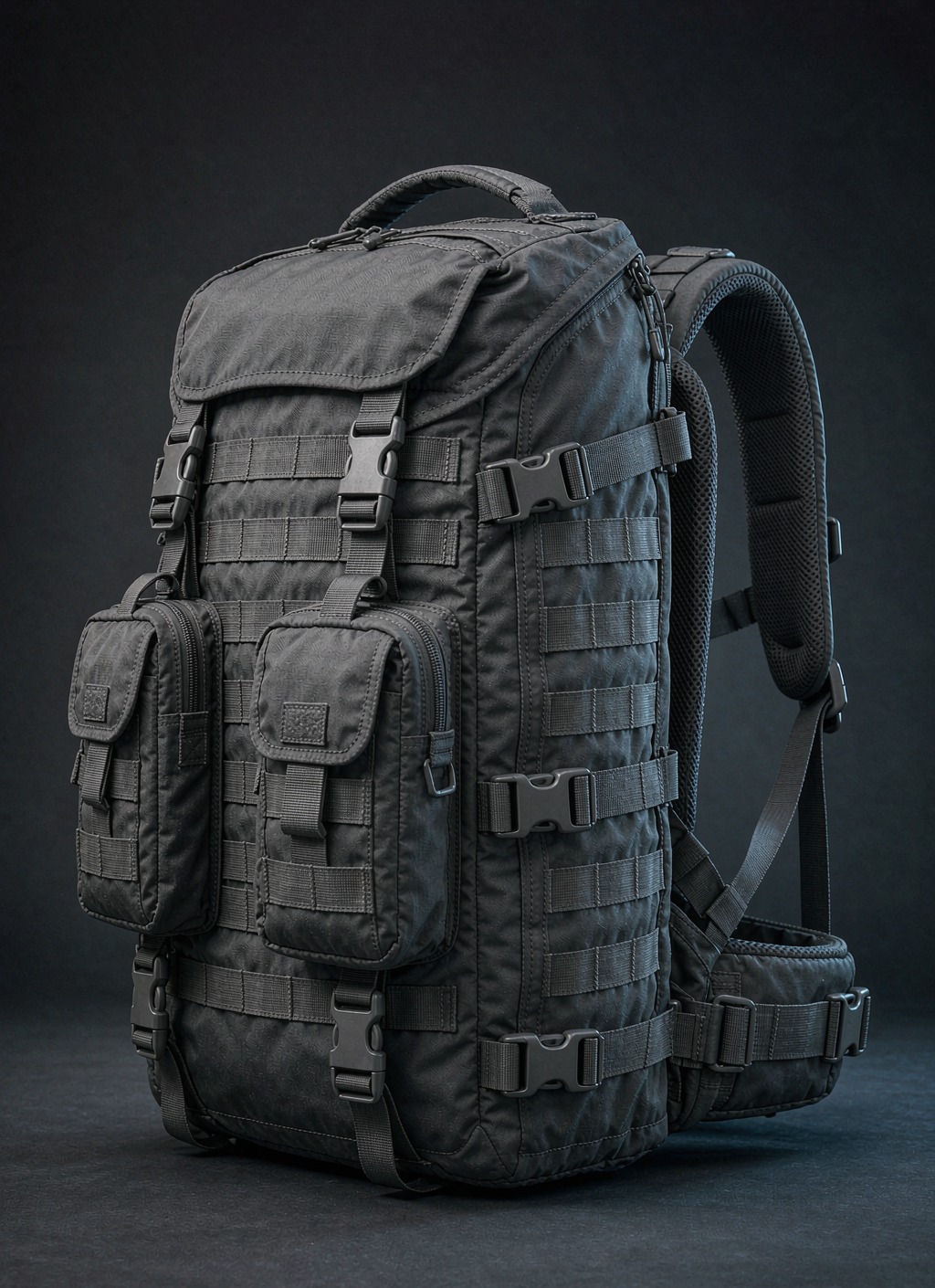
Barcode and GS1 requirements for a bag programme are three separate decisions: the retail symbol that identifies one sellable unit, the carton code that identifies one shipping box, and the GS1 company prefix that generates both. Orders begin at 500 units per reference, samples come back in 6-10 working days, bulk runs take 35-50 days, and finished lots are checked to AQL 2.5 before release on FOB Xiamen terms. The boundary is that numbering rules and label content are destination-market dependent; confirm them with your broker or retailer before artwork is released, because a symbol that scans correctly can still be rejected for carrying the wrong identity.
What a Retail Barcode Actually Carries: Identity, Not Information
A retail barcode is a key, not a description. The scanner reads a string of digits, hands those digits to the retailer's item file, and the item file returns the description, the price and the tax treatment. Nothing about the product travels in the symbol itself: no colour, no material, no capacity, no country of origin. That single fact explains most barcode failures in imported bag programmes, because a symbol can be printed perfectly, verified at a good grade, and still resolve to the wrong product or to nothing at all.
The number inside a standard retail symbol is a GTIN. Its structure is a GS1 company prefix, then an item reference assigned by the prefix holder, then a check digit that guards against keying errors. An EAN-13 carries 13 digits; a UPC-A carries 12 and is transmitted as 13 with a leading zero. The check digit is calculated from the preceding digits, which is why a single transposed digit in a manually keyed order form is caught before it reaches the printer rather than after 5,000 hangtags have been printed.
Each sellable variation needs its own GTIN. A modular platform offered in four colourways and two sizes consumes eight numbers, and a pouch sold both separately and inside a starter bundle consumes two. Teams routinely under-count this at the quotation stage and discover mid-programme that the prefix they hold does not release enough item references, which forces either a second prefix allocation or a renumbering exercise across artwork, carton labels and retail listings at the same time.
Selection rule: Allocate one GTIN for every sellable variation before artwork starts, counting colourway, size and bundle configuration as separate variations, because a later renumbering touches the hangtag, the carton label, the listing data and the warehouse pick face simultaneously.
EAN-13, UPC-A and ITF-14 Compared: Which Symbol Identifies Which Pack Level
Three symbols appear in a typical export bag order, and confusing them is the most common specification error. EAN-13 sits on the retail pack and identifies one sellable unit. UPC-A is the North American retail equivalent and identifies the same level with one fewer printed digit. ITF-14 sits on the corrugated carton and identifies a fixed quantity of units, not the unit itself. A carton printed with the retail EAN-13 is a carton that tells the receiving scanner it contains one bag when it contains thirty, and the discrepancy surfaces as a receipt exception rather than as a printing fault.
The second distinction is data capacity. The retail symbols are fixed-length identities: they carry a number and nothing else. A carton symbol, by contrast, is often expected to carry batch, quantity or serial data, and that requires a different symbology with application identifiers rather than a longer ITF-14. Where a retailer's routing guide asks for a batch or a production date on the label, the answer is a GS1-128, not a bigger barcode. Our production team raises this at the artwork stage rather than at the packing stage, because the label layout and the printer's plate or thermal template both change.
| Decision criterion | EAN-13 | UPC-A | ITF-14 |
|---|---|---|---|
| Pack level identified | One sellable unit | One sellable unit | One fixed-quantity carton |
| Printed digits | 13 | 12 | 14 |
| Where it is printed | Hangtag, polybag label, retail sleeve | Hangtag or retail sleeve for North America | Corrugated shipping carton, usually on two adjacent faces |
| Variable data such as batch or serial | None | None | None without a GS1-128 companion |
| Typical misuse | Printed on the carton instead of the unit | Used outside its home market without check | Printed with a quantity that no longer matches the pack |
| Consequence at the receiving door | Receipt counted as one unit | Item not found in the destination item file | Quantity exception and manual recount |
Placement follows from the table. A retail symbol belongs on a flat, visible face of the pack where a till operator or a self-scan camera can reach it, which is why a hangtag or a printed polybag label is used rather than a patch sewn into the lining. A carton symbol belongs on two adjacent faces of the box so that it can be read whichever way a pallet is turned, and never across a seam, a tape join or a ventilation hole.
Verdict: Print the EAN-13 or UPC-A on the sellable pack, print a separate 14-digit carton code on two adjacent faces of the outer box, and move to a GS1-128 only where the routing guide asks for batch, date or serial data.
GS1 Membership and the Company Prefix: Where the Digits Come From
A GS1 company prefix is allocated by a GS1 member organisation to a member company, and it belongs to that company for as long as the membership is renewed. It is not allocated to a product, a factory or an order. The practical consequence for an import programme is that the brand owner, not the production base, should hold the prefix: if the digits belong to the brand, the brand can move production between facilities, add references and relist on a new marketplace without renumbering anything.
Prefix length governs how many item numbers you can issue. A shorter prefix leaves more digits for the item reference, and the arithmetic is fixed by the 13-digit envelope once the check digit is reserved. The table below sets out the relationship in the form used for planning, so a programme can check capacity before it commits to a reference count.
| Prefix allocation | Item-reference digits remaining | GTINs available to the holder |
|---|---|---|
| 7-digit prefix | 5 | 100,000 |
| 8-digit prefix | 4 | 10,000 |
| 9-digit prefix | 3 | 1,000 |
| 10-digit prefix | 2 | 100 |
Membership mechanics are local, not universal. The annual fee and the allocation policy are set by the member organisation in the country of registration and scale with turnover band, so the cost line in your budget should be confirmed with that organisation rather than estimated from another market. Renewal is annual: a lapsed membership does not invalidate the numbers already printed on stock, but it does stop new allocations and can affect the brand's standing with retailers who check membership status during vendor onboarding.
Trade documentation sits alongside the numbering. Shipment papers, origin statements and the commercial invoice are checked by customs against the physical cartons, and the general framework for those documents is described on WTO trade-facilitation material, while market-specific export paperwork guidance is published by the U.S. Department of Commerce. Neither body issues your GTIN; they matter because a carton whose code, marks and papers disagree creates a clearance question that has nothing to do with whether the symbol scans.
Bottom line: Hold the company prefix in the brand entity's own name with enough item-reference capacity for three years of reference growth, and treat the annual renewal as a fixed compliance cost rather than a discretionary one.
Why Printing Another Company's Barcode Is a Risk You Carry
Three routes lead to a borrowed number, and all three put the liability on the brand. The first is reuse: a previous customer's EAN-13 is still in the artwork file, the new reference looks similar, and the plate is reused without a check. The second is convenience: a supplier offers its own code "until you get yours", and the first container ships. The third is purchase: numbers bought from a reseller rather than allocated by a member organisation. The symbol scans in all three cases, which is exactly why the problem is discovered at the till or by a retailer's data team and not in the packing hall.
The exposure has four heads. Commercial: the retailer's system resolves the number to the registered owner's product, so the wrong description and the wrong price appear, and the chargeback is raised against the selling party under the trading agreement. Operational: the goods cannot be received without relabelling, and a relabel across a full container consumes more calendar time than the 35-50 day production window that made the shipment late in the first place. Contractual: the GTIN is licensed to the member, and using it without authorisation is a licence breach as well as a misrepresentation of the product's identity. Platform: marketplaces that match listings to GTIN data will delist an item whose number belongs to another company, and the listing history and review base go with it.
The remedy is cheap and the cure is expensive. A number allocation costs a membership fee and a few days; a relabel at the destination warehouse costs the handling rate, the new label print, and the shelf window. Where a shipment has already landed, the realistic options are relabel in the destination market or return, and both are usually more expensive than the unit cost of the bag. Prevention is a single line on the artwork approval form: the GTIN shown must be traceable to a prefix held by the brand, and the artwork file must show the allocation record.
Takeaway: Treat any GTIN that cannot be traced to a prefix held in the brand's own name as a stop-ship condition, because a borrowed number scans perfectly and fails commercially.
Inner Pack and Outer Carton: Making Two Code Levels Agree
Two levels of packaging means two levels of identity, and they must be built to agree. The retail unit carries its GTIN. The inner pack — a polybag of a fixed count, or a retail-ready multipack — carries either the same unit GTIN with a stated quantity or its own GTIN if it is itself sellable. The outer carton carries a 14-digit code that identifies that carton configuration: same product, fixed count, fixed packing arrangement. A carton that is sometimes packed 30 and sometimes 32 needs two codes or a fixed count, not one code and a hope.
Quantity discipline is the part that fails under schedule pressure. A last-minute top-up to fill a container changes the carton count without changing the carton code, and the receiving scanner books the declared quantity against a different physical quantity. The fix is to make the carton code a function of the pack specification: reference, colourway and count. Change any of the three and the code changes with it. Where a mixed carton is genuinely required for a promotional assortment, the carton needs its own identity and a contents statement on the label, because a mixed carton carrying a single-product code is the hardest exception to resolve at goods-in.
Carton count also drives the numbering plan backwards to the order quantity. At a 500-unit minimum and 25-40 folded units per export carton, one reference in one colourway is 13-20 cartons; a four-colourway order is roughly 50-80 cartons, each needing a correct, scannable, correctly-oriented label. That is a small number of labels per order, which is precisely why a single template error repeats across the whole shipment instead of showing up as an isolated fault. Verification therefore happens at first-off and at intervals, not only at the end.
Logistics references are the third layer. Where a retailer or a third-party logistics provider tracks pallets rather than cartons, a serial shipping container code is assigned to the pallet, and that 18-digit number is separate from both the unit GTIN and the carton code. The three layers do not derive from each other and should not be generated by hand; they are issued by the party that owns the prefix and recorded against the order. The packing and labelling sequence used on custom modular backpack programmes is where these numbers are written into the carton specification before a single box is packed.
Judgement: Make the carton code a function of reference, colourway and fixed count, then verify the first-off carton against the packing list before the run continues, because a template error repeats across every carton in the shipment.
Symbology for Cartons: ITF-14, GS1-128 and Application Identifiers
An ITF-14 is the workhorse carton symbol: 14 digits, an interleave of wide and narrow bars, and a pair of bearer bars top and bottom that keep the symbol readable when the corrugate is flexo-printed at speed. Its virtue is tolerance of rough print surfaces, and its limitation is that it carries nothing beyond the 14 digits. It answers "what is this box" and is silent on which batch, which production date and which serial.
Where that extra data is required, the carton label moves to GS1-128, which is a Code 128 symbol whose data is structured into application identifiers. The identifier in parentheses tells the scanner how to read what follows: (01) for the GTIN, (10) for the batch or lot, (17) for an expiry or limit date, (21) for a serial, and (00) for a serial shipping container code of 18 digits. A label can carry several, and the receiving system parses them by the identifier rather than by position, which is why the same label can be read by two different partners with different layouts.
The decision is made for you by the destination. A retailer's routing guide states which symbology, which identifiers and which label stock it accepts, and a warehouse with automated sorting will specify label placement to within a tolerance. This is a destination-market dependent requirement: confirm it with the retailer's routing guide or your broker before the label template is built. Guessing leads to a reprint of every carton label, and at 50-80 cartons per four-colourway order that is a reprint of the whole label set rather than a patch.
Print method follows volume and variability. Fixed data on every carton — the 14-digit code — is economically printed direct to corrugate or pre-printed on the box. Variable data — batch, date, serial — is applied as a thermal transfer or direct thermal label at packing. Mixing the two on one label is normal and is the reason the label template is signed off together with the carton artwork rather than after it.
Spec rule: Use an ITF-14 where the carton only needs to declare what it contains, escalate to GS1-128 with the identifiers named in the destination routing guide as soon as batch, date or serial is required, and never hand-key a 14-digit code into a template.
Print Quality, Quiet Zone and Verification: Making the Symbol Scan First Time
A barcode that scans on a phone app is not a barcode that has been verified. Phone apps read a symbol under forgiving conditions; a verification instrument measures the symbol against a standard and returns a grade. Linear symbols are graded to ISO/IEC 15416 and two-dimensional symbols to ISO/IEC 15415, and the grade scale is 0 to 4 with 4 the best. The minimum acceptable grade is set by the retailer, not by the printer, and it is written into the specification so that a marginal symbol is caught before a container ships rather than at goods-in.
Substrate decisions drive the grade. Dark bars on a light background with enough contrast is the first requirement, which rules out printing a retail symbol directly onto a dark fabric label or onto unbleached corrugate without a white patch. Red is a frequent trap: red bars read as light to a red-light scanner, so a brand colour used for the bars can pull the grade down even where the artwork looks strong. Curvature, gloss and stitch lines do the rest — a symbol printed across a hangtag fold, a perforation or a sewn seam loses the quiet zone and with it the scan.
| Gate | What is measured | Action when the symbol fails |
|---|---|---|
| Artwork release | Quiet zone, bar colour, symbol size on the intended substrate | Recolour or reposition before plates and screens are cut |
| First-off print | ISO/IEC 15416 grade on three to five samples from the run | Adjust ink density or plate, then re-grade the same count |
| Packing line | One scan per carton against the packing list | Relabel that carton before it is stacked |
| Goods-in at destination | One scan per carton at receipt | Raise the exception while the carrier is still present |
Verification frequency is a cost decision with a clear answer. Three to five graded samples per print run catches a plate fault; one scan per carton at packing catches a template fault; one scan per carton at receipt protects the brand against a claim it cannot otherwise rebut. On a 500-unit order the whole verification sequence adds minutes, and on a 20,000-unit order it is the difference between one exception and two hundred.
Selection rule: Grade three to five symbols from every print run to ISO/IEC 15416, require the minimum grade agreed with the retailer rather than the printer, and scan every carton once at packing against the packing list.
How to Choose a Barcoding Approach for a Bag Programme: A Sequence
The order below is the order in which the decisions have to be made, because each step constrains the next and reversing the sequence costs a reprint.
- Confirm the destination market and obtain the retailer's routing guide before any numbering begins.
- Allocate or confirm a GS1 company prefix in the brand entity's name, with enough item-reference capacity for three years of growth.
- Issue one GTIN per sellable variation, counting colourway, size and bundle configuration as separate variations.
- Decide the carton configuration — reference, colourway and fixed count — and issue the 14-digit code from that configuration.
- Choose the carton symbology from the routing guide: ITF-14 for identity only, GS1-128 where batch, date or serial is named.
- Design the label template and the corrugate print together, including quiet zones, bar colour and placement on two adjacent faces.
- Build the artwork with the GTIN traceable to the allocation record; block release if it is not.
- Verify at first-off, at intervals through the run, per carton at packing, and per carton at receipt.
- Record the full number set against the order so a repeat order reproduces it exactly.
Step nine is the one most often skipped and the one that pays. A repeat order that reproduces the previous number set exactly needs no new artwork, no new listing data and no new vendor onboarding; a repeat order with a fresh number set needs all three. Consolidating the set into the specification sheet alongside the packing and inspection requirements keeps it available when the account manager who built it has moved on.
Takeaway: Run the sequence in the order written, because steps two to five are irreversible once plates are cut and cartons are printed, and step nine is what makes the second order cheaper than the first.
Programme Facts: Capacity, Sampling and Inspection Discipline
Our production team runs sampling in 6-10 working days for a standard build and 12-15 working days where the construction is complex, with a sampling fee of USD 50-150 that is refunded against the order; tooling and screens cost USD 300-2,500 where new plates, dies or print screens are needed. Minimum order quantity is 500 units per reference, bulk production takes 35-50 days, and payment runs T/T 30/70 with shipment FOB Xiamen. Sea freight is 25-35 days, air 5-8 days, and courier 3-5 days, which is why a numbering error found after despatch has no cheap fix.
The SGS-verified production base we work with holds 4,950 m² of floor with 7 production lines and 149 machines, staffed by 137 people and rated at 200,000 units per month, and the founder has worked in bag production since 2004 with the company established in 2014. Carton-level checks run to AQL 2.5 under the sampling plan in ISO 2859-1, with critical, major and minor defect classes fixed in advance so that a label defect is graded before the lot is presented, not argued afterwards. Container planning uses 28 CBM for a 20GP and 68 CBM for a 40HQ.
Barcode labels and identity data are reviewed at the pre-production sample stage alongside the carton specification and the packing list, so the number set is on the record before bulk begins. Where a customer's own artwork carries the GTIN, the allocation record is requested at the same gate. This is administrative control rather than a laboratory service: the symbol is graded at print and scanned at packing, and any regulated labelling content is confirmed by the brand with its broker or retailer for the destination market.
Related reading on the same programme: barcode verification at the packing line, hangtag and care label content, and shipping mark format for export cartons. Platform options are on the product range, and label or artwork questions can be sent to the enquiry desk.
Bottom line: Put the number set on the specification sheet at sampling time, grade the symbol at print, and scan every carton once at packing, because each of those three gates costs minutes and the cheapest of them prevents the only barcode failure that is expensive.
Frequently asked questions
What are the GS1 requirements for a modular bag sold in retail?
You need a company prefix allocated to your own entity, one GTIN per sellable variation, and a carton code for each fixed carton configuration. Numbering is destination-market dependent, so confirm the routing guide with your retailer or broker. Orders start at 500 units with sampling in 6-10 working days and bulk in 35-50 days.
How many digits does a GS1 company prefix leave for item references?
A 7-digit prefix leaves five item-reference digits and capacity for 100,000 GTINs; an 8-digit prefix leaves four and 10,000; a 9-digit prefix leaves three and 1,000; a 10-digit prefix leaves two and 100. Choose the prefix length against three years of reference growth, not against today's catalogue.
What is the difference between an EAN-13 and an ITF-14 barcode?
An EAN-13 carries 13 digits and identifies one sellable unit; an ITF-14 carries 14 digits and identifies one carton holding a fixed quantity. Printing the retail code on the carton makes the receiving system book one bag where thirty sit inside. Two adjacent carton faces should carry the 14-digit code.
Can a bag factory allocate a barcode on our behalf?
It can print one, but the prefix should be held in your own name. A code issued from a supplier's prefix belongs to that supplier, and the retailer's item file resolves to whoever owns the number. Allocation is a membership matter with your local GS1 organisation, and it costs far less than relabelling a landed container.
Why is printing another company's barcode a commercial risk?
The symbol scans, then resolves to the registered owner's product in the retailer's item file, producing a wrong description, a wrong price and a chargeback under the trading agreement. Marketplaces delist items whose GTIN belongs to another company, and the listing history goes with them. Treat an untraceable number as a stop-ship condition.
Do I need a separate barcode for each colourway of the same bag?
Yes. Colourway, size and bundle configuration are each a sellable variation and each needs its own GTIN, because the item file holds one description and one price per number. A programme with four colourways and two sizes consumes eight numbers before any bundle is counted.
Should the outer carton carry the same number as the retail pack?
No. The carton needs a 14-digit code built from reference, colourway and fixed count, so the receiving scanner books the declared quantity. If the count changes, the code changes with it. A mixed promotional carton needs its own identity plus a contents statement on the label.
When does a carton need a GS1-128 instead of an ITF-14?
When the destination routing guide asks for batch, production date or serial data. ITF-14 carries only 14 digits; GS1-128 structures data with application identifiers — (01) GTIN, (10) batch, (17) date, (21) serial, (00) an 18-digit shipping container code. Confirm the requirement before the label template is built.
How is barcode print quality verified before a shipment leaves?
Linear symbols are graded to ISO/IEC 15416 and 2D symbols to ISO/IEC 15415, on a 0 to 4 scale with the minimum grade set by the retailer. Grade three to five samples from each print run, scan one symbol per carton at packing against the packing list, and scan again at receipt.
Why does a barcode fail to scan even when it looks correct?
Usually quiet zone, contrast or substrate. Red bars read light to a red-light scanner, dark or unbleached corrugate without a white patch kills contrast, and a symbol crossing a fold, perforation or seam loses the quiet zone. Grade the symbol rather than trusting a phone app.
How many cartons does a 500-unit bag order produce?
At 25-40 folded units per export carton, one reference in one colourway is roughly 13-20 cartons, and a four-colourway order is roughly 50-80. Every carton needs a correct label on two adjacent faces, which is why a template fault repeats across the whole shipment instead of appearing once.
What information does a shipping mark need alongside the carton barcode?
Reference, colourway, quantity, carton number in sequence, gross and net weight, and dimensions. Marks must agree with the packing list and the commercial invoice, or the discrepancy becomes a clearance question rather than a scanning one. Confirm the exact format with your broker.
How far ahead should barcode artwork be locked before mass production?
Lock it at the pre-production sample gate, before plates and screens are cut. Sampling runs 6-10 working days and tooling costs USD 300-2,500, so a renumbering after tooling touches the hangtag, the carton label, the listing data and the pick face at the same time.
Does a barcode number affect how a bag is listed on a marketplace?
Yes. Marketplaces match a listing to GTIN data held by the brand, so a number that belongs to another company leads to delisting and loss of review history. Hold the prefix yourself, issue your own GTINs, and keep the allocation record with the specification sheet for every repeat order.