Home › Field notes › Colour Fastness Requirements for Backpacks: Routes and Grade Reading
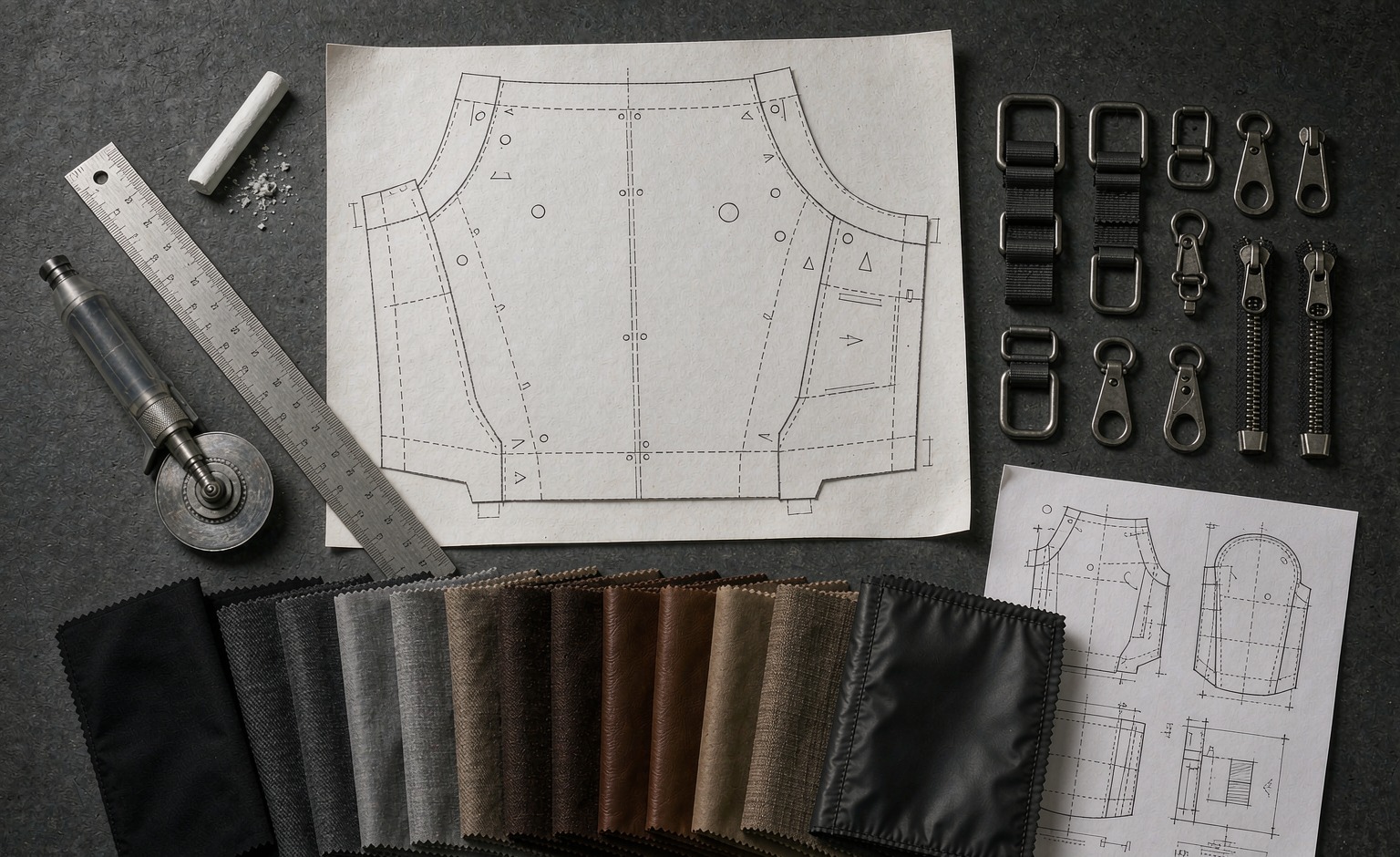
Colour fastness requirements for backpacks state how much shade change and how much colour transfer each dyed component may show when it is rubbed, washed, exposed to light or wetted with perspiration, and they have to be written per component rather than per bag. A workable clause names the route, names the adjacent cloth used for the staining read, and states the lowest grade that clears the lot. Our production team books those reads during prototype work at 6–10 working days, extending to 12–15 when a fresh laminate enters the build, and repeats them on bulk by attribute inspection planned to ISO 2859-1 at an acceptance quality limit of 2.5. Orders begin at 500 pieces and bulk occupies 35–50 days. Scope stays civilian: commuting, worksite tools, hiking and first-aid modules, never weapon carriage, ballistic protection or defence certification.
What Colour Fastness Requirements Cover on a Finished Pack
A colour fastness requirement is two measurements sharing one name. The first is the change in the specimen's own shade after it has been through a route, read against a grey scale that steps from 1 to 5 in half steps, where 5 stands for no perceptible difference. The second is how much dye left the specimen and settled on an adjacent undyed cloth, read on a separate scale built for staining rather than for change. A shell that keeps its own shade perfectly can still fail the programme by marking a pale shirt, and the two failures need two different clauses.
One pack rarely carries one dyed material. A 600 denier polyester shell may be piece-dyed, the lining a cheaper yarn-dyed taffeta, the binding tape a third source, the 25 mm webbing a fourth and the hook-and-loop tape a fifth, with a printed label and a zipper tape taking the count to seven. Each substrate holds a different dyestuff class fixed by a different process, so a single line reading "colour fastness 4" leaves six of the seven uncontrolled. Shade matching between those seven is a separate problem again, and it is judged under a controlled light booth rather than by eye on a bench.
The clause therefore belongs in a grid: one row per component, one column per route, one named adjacent cloth for every staining read. That grid is also the artefact a laboratory needs, because a report reading "shell, rubbing, 4" without saying whether the cloth was conditioned dry or damp cannot be compared with next season's result, and comparison across seasons is the whole point of keeping records.
Selection rule: Write colour fastness as a component-by-route grid with a named adjacent cloth for every staining read, and send back any report that offers one grade for the whole pack.
Dry and Wet Crocking: Why Coated Shells Read Lower Than the Base Cloth
Rubbing, usually called crocking, is the fastest read and the one that reaches a complaint desk first. The route published as AATCC 8 draws a white cloth across the surface under a stated load and stroke length, once with the cloth dry and once after it has been wetted to a defined pick-up percentage. The dry pass catches loose surface dye and powdery finishing residue left by a weak wash-off; the damp pass catches dye soluble enough to migrate when a pack rests against a humid shirt on a long walk.
Coated constructions behave differently from woven ones. In a piece-dyed woven fabric the dye sits inside the fibre, so a proper reduction clear after dyeing lifts most of the loose fraction and the read holds steady for years. In a coated or laminated build the pigment sits in a surface film only a few tens of microns thick, and anything that softens that film can move the read down a full step months after the laboratory passed it: plasticiser drifting to the surface, solvent from a cleaning wipe, or simply heat inside a container during a 25–35 day sea leg.
Three controls follow cheaply. Ask for the wet read and the dry read as separate lines rather than one averaged figure. Ask for the panel to be cut from the finished laminate, never from the base cloth before coating. And ask for the whole sequence to be repeated after a heat-ageing step of at least 7 days at a temperature agreed with the laboratory in advance, because that step is what separates a stable finish from a migrating one.
Verdict: Judge rubbing on the finished laminate with the wet and dry passes reported separately and re-read after 7 days of heat ageing, rather than accepting a single dry figure taken on the base cloth.
Light, Perspiration and the Combined Read That Most Specs Miss
Light and perspiration attack different chemistry and are usually bought as one line. Light fastness exposes a specimen to a filtered xenon source under controlled humidity until a stated end point is reached, with the well-known procedure AATCC 16 and the xenon-arc reference ISO 105-B02 both in wide use; the read is shade change against the grey scale, and it is the route that governs a pack left on a dashboard or hung on a worksite fence for a summer. Perspiration instead wets the specimen with an acidic and an alkaline solution, holds it at body temperature for several hours against an adjacent cloth, and reads both change and staining, with AATCC 15 the common reference.
The gap most specifications leave open is the combination. A shoulder strap in July is wet with sweat and in full sun at the same time, and the two acting together degrade some dyestuff classes faster than either alone. Laboratories publish combined routes inside the ISO 105 family for exactly this case, and a programme selling into hot climates should ask for it by name instead of assuming that passing light and perspiration separately covers the pair.
Back panels and hip-belt linings deserve their own rows in the grid, because they carry sweat, sunscreen and body oil for hours at a time and they sit against clothing the customer cares about. A dark lining that bleeds onto a pale shirt is the single most expensive colour complaint in the category, and it is caught by one extra row on a grid that costs almost nothing to add.
Bottom line: Request light, perspiration and the combined light-and-perspiration route as three separate rows for every panel that touches skin or sun, and never let one result stand in for the other two.
Laundering, Chlorinated Water and Field Cleaning
Machine washing is rare for a loaded pack, but the claim still matters because care labels, healthcare wipe-down routines and poolside use all introduce chemistry that plain water does not. The domestic procedure reference ISO 6330 sets out how a specimen is washed, rinsed and dried, and the accompanying read is normally taken against a multi-fibre adjacent strip carrying several fibre types so that staining can be reported per fibre rather than as one average. That per-fibre breakdown is what tells you whether the dye moved onto acetate, cotton or nylon, which in turn points at the dyestuff class.
Chlorinated water deserves a separate mention for resort, pool and municipal programmes. Chlorine attacks some dye classes directly and degrades elastane and certain coatings at the same time, so a pack that survives 5 domestic cycles can still chalk or shift shade after a season of poolside service. Seawater brings salt plus ultraviolet plus abrasion from sand, a combination no single laboratory route reproduces, which is why the specification should list the chemistry the programme expects rather than borrowing a generic apparel clause.
Where a bag will be wiped with disinfectant rather than washed, ask the laboratory to add a wipe solvent to the sequence. Alcohol-based wipes and quaternary disinfectants extract plasticiser and surface dye far faster than water does, and a healthcare or municipal buyer will reasonably expect the finish to survive a routine they perform several times a shift.
Takeaway: Name the actual chemistry the pack will meet — detergent, chlorine, seawater or disinfectant wipe — on the specification, and judge staining per fibre rather than against one averaged strip.
Reading Grades Without Over-Specifying a Backpack
The commonest error at specification stage is demanding the highest grade everywhere. Fastness routes trade against each other: a dyestuff selected for outstanding light performance on a polyamide shell can be mediocre at wet rubbing, and pushing every line to the top of the scale narrows the dyestuff field so far that shade matching across seven components becomes impossible and cost rises without any improvement the customer can see. The right grade is the one that matches the consequence of failure, and consequence differs by panel.
A lining against pale clothing carries a staining risk that a customer notices immediately, so that row justifies a demanding read. The underside of a top lid, seen by nobody, does not. Printed logos sit in a third category again: they are a film sitting on the fabric rather than a dye inside it, so they are judged by adhesion and by the read after rubbing, not by the same clause as the shell.
| Judgement point | Piece-dyed woven shell | Coated or laminated shell |
|---|---|---|
| Dry rubbing behaviour | Stable once the loose fraction is cleared after dyeing | Depends on the condition of the surface film on the day of test |
| Wet rubbing behaviour | Usually one step below the dry read, and stable in service | Can drop a further step once plasticiser reaches the surface |
| Response to light | Fades progressively and evenly across the panel | Hazes or chalks first, then loses shade unevenly |
| Response to perspiration | Chiefly a staining risk onto adjacent clothing | Staining plus film softening wherever sweat is held |
| Response to laundering | Shade loss dominates and staining stays modest | Hydrolysis and edge lift appear alongside shade loss |
| Specimen that must be submitted | Finished cloth cut from the production roll | Finished laminate, with the cut edge included |
| Evidence worth retaining | Dye lot number and the grade recorded per route | Dye lot, film batch, film thickness and ageing history |
Judgement: Set each grade from the consequence of failure on that panel — demanding for a lining resting against pale clothing, moderate for a lid underside nobody sees — and never push every row to the top of the scale, since doing so shrinks the dyestuff field until matching seven components becomes unachievable.
Why Coated and Laminated Shells Fail Differently From Woven Cloth
A laminate puts pigment and polymer in a surface film, and every failure mode of that film becomes a colour failure. Plasticiser migration brings dye to the surface where a rubbing pass can pick it up. Hydrolysis, driven by humidity and time, breaks down ester-based polyurethane films so the surface goes tacky and then chalky, and the chalk reads as a shade change even though no dye has moved. Abrasion removes the film locally and exposes a paler base coat or a white scrim, which customers describe as fading when it is actually wear.
Thermoplastic polyurethane films resist hydrolysis better than ester-based polyurethane coatings and stay flexible at low temperature, which matters for programmes shipping into cold regions; plasticised polyvinyl chloride stays cheapest and softest but carries the plasticiser migration problem described above. Film thickness moves the result as well: a heavier film hides the weave and holds more pigment, and a thin film over a dark base cloth shows every scratch as a pale line.
Laser-cut attachment panels add one more mechanism, because the cut edge is bare polymer with no fibre to hold anything, and it is the first place a rubbed read drops. Any pack using a cut grid should have the edge condition photographed at inspection and the same edge re-read after conditioning.
Spec rule: For a coated or laminated shell, specify the film chemistry and thickness alongside the fastness grades, and re-read the cut edge and the folded edge separately from the flat panel.
Return Causes That Trace Back to a Colour Fastness Gap
Returns desks rarely report "poor colour fastness"; they report a shirt with a mark on it, a panel that no longer matches the one next to it, or a print that has gone. Each of those maps to a clause that was either missing or written too loosely to be tested, and the mapping is what turns a complaint into a specification change rather than a debate.
| Symptom reported by the customer | Mechanism behind it | Read that would have caught it | Control written into the specification |
|---|---|---|---|
| Mark left on a pale shirt | Soluble dye moved from lining under damp contact | Wet rubbing of lining against cotton adjacent cloth | Lining row on the grid with a named adjacent cloth |
| Two panels drifting apart in shade | Separate dye lots approved by eye, not by booth | Instrumental shade difference recorded per lot | One dye lot per colour per order, delta recorded |
| Pale haze appearing at fold lines | Film hydrolysis or plasticiser bloom | Change read after 7-day heat ageing | Film chemistry named and ageing step mandated |
| Logo flaking after a season | Print film lacks adhesion to a soft coating | Rubbing read on the printed area itself | Print tested as its own component row |
| Webbing staining the shell beneath it | Cheap dyestuff on tape, transferred under load | Wet rubbing of the tape against shell cloth | Tape given a route and a grade, not a colour name |
| Lining marking the contents inside | Unfixed dye released in a hot vehicle | Change and staining after heat conditioning | Conditioning temperature stated on every report |
Notice how many of these share a root cause: the component was specified by colour name rather than by route and grade. A webbing tape ordered as "black" has no fastness obligation at all, and the cheapest tape that looks black will be supplied.
Writing the Requirement, Retaining Evidence and Programme Gates
Programme work is coordinated through our SGS-verified production base, where 137 people operate 7 production lines and 149 machines across a 4,950 m² floor, with nominal capacity of 200,000 units per month. The founder has worked in bag production since 2004 and the company was established in 2014. Each colour decision is evidenced in sequence: laboratory dips, a prototype build, a pre-production sample signed off against the grid, then bulk, where attribute sampling follows AQL 2.5 under ISO 2859-1 level II, with Critical defects tolerated at zero, Major at 2.5 and Minor at 4.0. Reports are retained against the dye lot number so a complaint two seasons later can be traced to a batch.
Commercial gates are predictable and should be written into the sourcing calendar. The order floor is 500 units per colour, prototyping occupies 6–10 working days for a conventional build and 12–15 where a new laminate or a new print is involved, and bulk takes 35–50 days after sample approval. Sampling carries a fee of USD 50–150 per style, refundable against the order, and new tooling or screens run USD 300–2,500. Budget figures come back in 24–48 hours and remain indicative only; terms are quoted FOB Xiamen with T/T 30/70.
Freight planning changes when colour is critical, because a long hot transit is itself a conditioning step. Sea freight runs 25–35 days, air 5–8 days and courier 3–5 days; a 20GP holds roughly 28 CBM and a 40HQ roughly 68 CBM. Where a programme ships a pale colourway into a hot market, air freight shortens the heat exposure even though it costs more per unit, and that trade belongs in the sourcing decision rather than in the complaint file.
Colour control sits alongside the rest of the build rather than apart from it. Attachment grid geometry is treated in the MOLLE system reference, panel layout for tool-heavy loads in the work pack section, and sun-exposed carry in the hiking pack section; bespoke colourways route through the custom modular programme. Test scope and quotation detail are listed under our services, and related reading sits in the blog index.
Frequently asked questions
What do colour fastness requirements for backpacks actually cover?
They cover how much a dyed component changes shade and how much dye it transfers, separately, under routes such as rubbing, light, perspiration and laundering. A backpack needs one row per component because shell, lining, tape and print use different dyestuff classes.
- Change in shade read on a 1-5 grey scale
- Staining on adjacent cloth read on another
- One route and one grade per component row
How is a colour fastness grade read on the grey scale?
The scale steps from 1 to 5 in half steps, with 5 meaning no perceptible difference and 1 the greatest. Half steps matter commercially, because the difference between a 3 and a 3-4 is often the difference between an accepted and a rejected lot at AQL 2.5.
- 5 = no perceptible change
- 3-4 is a common commercial boundary
- Read under controlled lighting
Why does wet rubbing matter more than dry rubbing on a coated shell?
Dye in a surface film becomes mobile once the film is damp or softened, so the wet pass finds transfer the dry pass misses. A pack resting against a humid shirt in summer reproduces the wet condition exactly, which is why complaints usually cite damp contact rather than dry friction.
- Report wet and dry as separate lines
- Test the finished laminate, not base cloth
- Re-read after 7 days of heat ageing
Which panels on a pack most often fail a colour fastness read?
Back panels and shoulder straps fail most, because they meet sweat, sunscreen and sun together for hours. Linings against pale clothing follow closely, and laser-cut or folded edges come next since the cut polymer edge has no fibre to retain pigment.
- Skin-contact panels: perspiration plus light
- Linings: wet rubbing onto cotton
- Cut edges: photographed at AQL 2.5 inspection
How does light fastness differ from colour fastness to rubbing?
Light fastness measures shade change under a filtered xenon source over time; rubbing measures dye physically transferred by friction. A fabric can hold its shade perfectly under light and still mark a shirt, so the two routes are never interchangeable on a specification.
- Light: AATCC 16 or ISO 105-B02
- Rubbing: AATCC 8, wet and dry
- Both rows required per component
What is the combined light and perspiration read used for?
It exposes a wetted specimen to light at the same time, reproducing a sweaty strap in full sun. Some dyestuff classes degrade faster under the pair than under either route alone, so hot-climate programmes should request the combined route rather than infer it.
- Requested for skin-contact panels
- Part of the ISO 105 family
- Prototyping at 6-10 working days
Does a backpack need laundering fastness if it is never machine washed?
Yes, because care labels, disinfectant wipes and poolside chlorine all introduce chemistry that plain water does not. Specify the chemistry the pack will actually meet, and read staining per fibre rather than as one averaged figure across a multi-fibre strip.
- Detergent, chlorine, seawater or wipe solvent
- ISO 6330 washing procedure
- Per-fibre staining breakdown
How many components should appear on a colour fastness grid?
Seven is typical for a modular pack: shell, lining, binding tape, 25 mm webbing, hook-and-loop tape, printed label and zipper tape. Each row needs its own route, grade and adjacent cloth, and any component ordered by colour name alone carries no obligation at all.
- Shell, lining, binding, webbing
- Hook-and-loop, print, zipper tape
- One adjacent cloth named per row
When should colour fastness reads be repeated during a programme?
Three times: at laboratory dip approval, on the pre-production sample, and on bulk under attribute inspection. Repeating at bulk catches a dye-lot substitution, which is the most common cause of a shade drift complaint arriving two seasons after delivery.
- Dip approval before prototype
- Pre-production sample close-out
- Bulk sampled at AQL 2.5, zero Critical tolerance
Why do two panels of the same nominal colour drift apart in production?
Because they came from different dye lots or different mills and were matched by eye on a bench instead of instrumentally in a light booth. Instrumental measurement records a delta that can be held to a tolerance, while visual approval records nothing that can be re-checked later.
- One dye lot per colour per 500-piece order
- Record the instrumental delta
- Retain reports against lot number
How does a printed logo change the colour fastness requirement?
A print is a film sitting on the fabric, not a dye inside it, so it is judged by adhesion and by a rubbing read taken on the printed area itself. Give the print its own row with its own grade, and include the wipe solvent if the pack will be disinfected in service.
- Print tested as a separate component
- Adhesion plus rubbing read
- Tooling or screens USD 300-2,500
What evidence should a buyer ask for with a colour fastness report?
Ask for the component identity, the route, the adjacent cloth type, the conditioning history and the photograph of the panel after testing. A report missing the conditioning temperature cannot be compared with next season's result, and comparison is the reason records are kept.
- Component and route named
- Adjacent cloth type stated
- Conditioning temperature and 7-day duration
Can a colour fastness problem appear after delivery rather than at inspection?
Yes. Plasticiser migration, hydrolysis and heat during a 25-35 day sea transit all move the read downward after the laboratory passed it, which is why an ageing step belongs in the approval sequence and why transit mode is a colour decision as much as a logistics one.
- Add a 7-day heat ageing step
- Sea leg 25-35 days, air 5-8 days
- Trace complaint back to dye lot
How does MOQ 500 affect colour testing cost per unit?
At an order floor of 500 units per colour the laboratory fee is spread across a small run, so testing is proportionally expensive and the sampling fee of USD 50-150 matters. Consolidating colourways, or repeating a proven dye recipe, keeps the per-unit cost predictable.
- 500 units minimum per colourway
- Sampling fee USD 50-150, refundable on order
- Bulk 35-50 days after approval