Home › Field notes › Custom Modular Backpack Sampling: Sketch to Approved Prototype
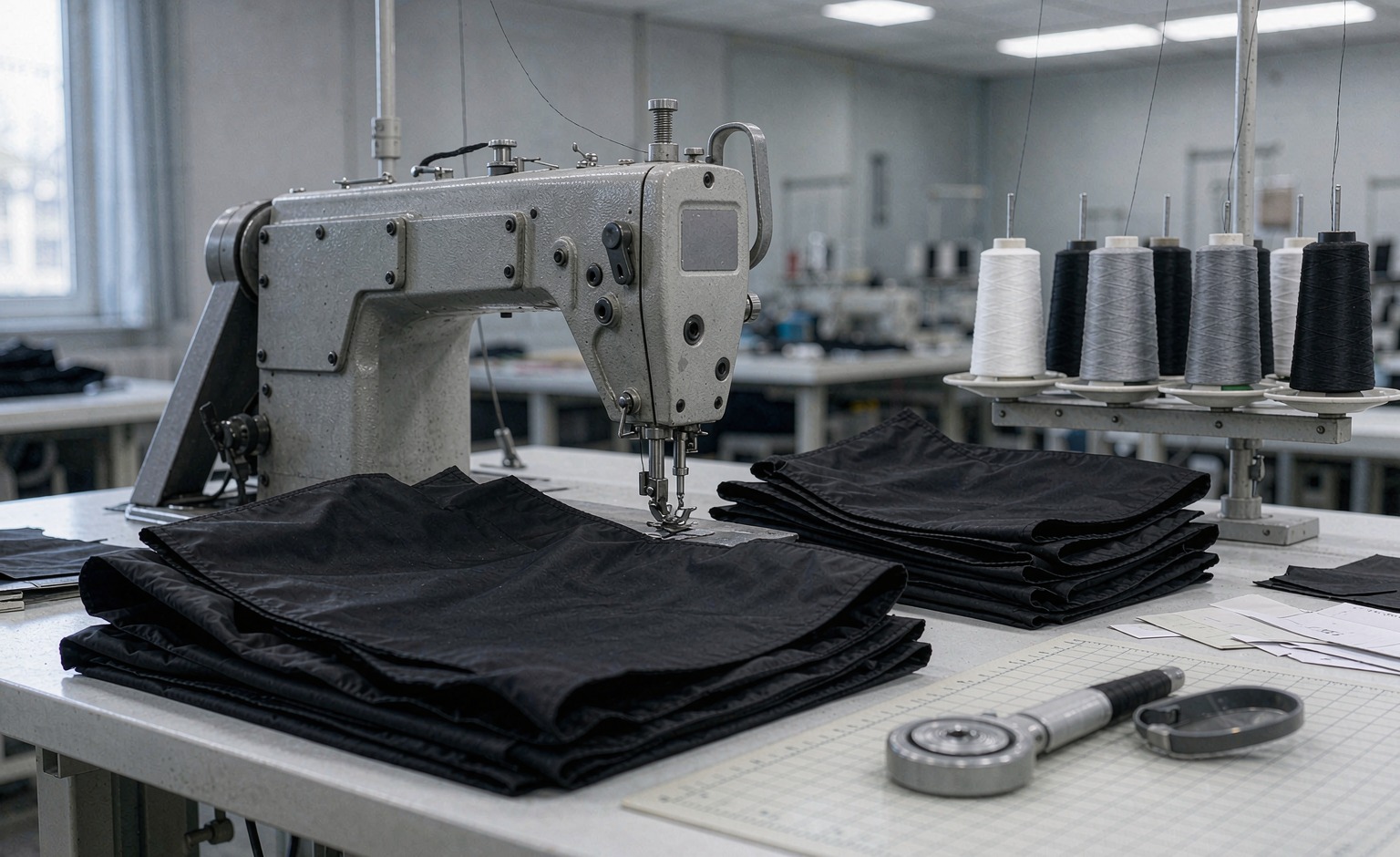
A custom modular backpack sampling process is a sequence of gates, and each gate exists to answer one question that is cheap to answer then and expensive to answer later. Round one confirms concept and material. Round two validates construction and the interface under load. The first article — built on production tooling by production operators — is the only unit that tells you what the bulk run will look like. Approval is not a feeling about a sample; it is a signed reference plus a written acceptance criteria set. This guide sets out the gates, the loops that waste them, the costs, the handover into bulk, and the timeline arithmetic a planner needs in order to promise a delivery date with a straight face. It is written for brand and procurement teams running their first modular build, where the interface adds a validation step that a conventional pack does not have.
Sampling is a gate sequence, not a single event
The most expensive misconception in this category is that sampling is one step: you send a design, a sample comes back, you approve it. On a modular platform that model fails, because a single sample can confirm the appearance of a product while saying nothing about whether the interface holds, whether the bulk run will repeat it, or whether the materials will age the same way.
Treat sampling as four gates with distinct outputs. Gate one produces a concept confirmation — is this the product the buyer meant? Gate two produces a construction validation — does the interface hold under load, and do the modules fit? Gate three produces a first article — can the production process repeat it? Gate four produces an approval artefact — a signed reference plus written criteria that a third party can apply later.
Each gate has an exit condition, and the exit condition is evidence, not enthusiasm. A sample that looks right but has not been measured has not cleared a gate; it has been admired. Writing the exit conditions before the first sample is made is the single practice that most reliably prevents loops.
There is a commercial reason for the same discipline. Each extra round consumes 6–10 working days of calendar inside a season that has already been sold to a retailer. Three extra rounds on a modular programme can move a delivery from sea freight to air freight, and that difference is usually larger than the entire sampling budget.
Bottom line: Run sampling as a gate sequence rather than as one event, because each skipped gate reappears as a defect during the 35-50 days bulk phase, when answering costs several times more than the round would have.
Round one: concept and material confirmation
Round one answers whether the design intent has been understood and whether the material choices behave as expected in the hand. It is not the round to judge attachment strength, and treating it as such wastes it.
What to check: overall proportions and volume against the brief; panel layout and pocket positions; material hand and colour against the master reference; branding placement and legibility at the intended size; and the general quality of make. Photograph the sample next to the brief and annotate it, because a photograph with notes survives a meeting and a memory does not.
What not to check: whether the interface will hold for six months. A hand-made sample is usually sewn by the most skilled operator available, with freshly sharpened needles and no production time pressure. It is a best case, and drawing durability conclusions from it is how programmes approve a construction that the line cannot repeat.
Record the sample's mass at this gate as well. Weight is the specification most often quoted to a retailer and the one most likely to drift once a real fabric lot and production tolerances replace a hand-cut sample. Weighing the concept sample and recording the figure gives the programme a baseline to argue from later rather than a surprise at first article.
Where the round one sample uses a substitute material because the specified fabric was not available, say so in writing and mark the sample. A confirmation given on a substitute is a confirmation of the shape, not of the product, and the distinction will matter when the real fabric arrives.
Send the round one sample to everyone who will judge it, and collect written feedback before the next round starts. Sequential feedback — the design director sees it, then the merchandiser, then the compliance lead — produces three rounds of changes on one sample. Simultaneous feedback with a single consolidated response produces one, and the difference is two rounds of calendar.
Confirm the module set at this gate as well. If the platform is intended to launch with three pouches, the concept round should include all three, even as rough versions, because the way they sit together is a property of the system rather than of any individual part.
Material confirmation should quote named routines rather than impressions, with crocking referenced to AATCC 8 and any lot release plan taken from ISO 2859-1, so approved and rejected lots are described in the same vocabulary.
Round two: construction and interface validation
Round two is the engineering round. It exists to test the two things a modular platform can fail at: the interface, and the repeatability of the construction.
Interface validation means mounting the heaviest permitted module and cycling it. Load the module to its rated mass, cycle attach and detach a defined number of times, then inspect for elongation at a defined gauge length, row bow, stitch breakage and hardware wear. Record a number, not a verdict: a field that moves 1.5 mm after a defined cycle count is a different product from one that moves 6 mm.
Dimensional validation means using a gauge. Build or specify a go/no-go gauge for the interface dimensions and check it on the sample and on every subsequent article. A gauge converts a subjective judgement about whether a pouch "fits" into a measurement that an inspector can apply at 500 units.
| Sampling gate | Question it settles | Evidence produced | Loop it prevents |
|---|---|---|---|
| Concept sample | Is the intent understood? | Annotated sample photographs | Rework after a misread brief |
| Construction sample | Does the interface hold? | Cycle results and gauge readings | Field failure after launch |
| First article | Can the line repeat it? | Unit built on production tooling | Bulk that does not match the sample |
| Approval | What exactly was signed off? | Signed reference plus written criteria | Disputes at final inspection |
Where the round two sample reveals a problem, the corrective action should be written as a construction change rather than as a request for better attention. "Reinforce the mounting face with a specified backing patch" is enforceable. "Please improve the stitching" is not, and it produces a third round.
Spec rule: Thread every proposed module on the second-round shell and record the result inside the 6-10 working days round-two window, since interface tolerance validated on a drawing has never survived contact with production fabric.
The first article is not a sample
The first article is the most misunderstood artefact in the whole process. It is a unit built on production tooling, with production jigs, by production operators, at production speed — and it is the only unit that predicts the bulk run.
Samples are made by specialists who compensate for a design that is hard to build. Lines are staffed by operators who cannot. A design that survives only because a specialist made it will fail at volume, and the failure appears as inconsistency rather than as a single dramatic defect: some units fine, some units wrong, nobody able to say why.
So the first article should be measured against the drawing, not compared against the sample. Check every callout that carries a tolerance, check the interface with the gauge, check assembly symmetry, and check the marking placement against a datum. Where a dimension is out, decide whether the drawing or the process is wrong, and change the right one.
| Check | How the check is run | Meaning of a failure |
|---|---|---|
| Interface gauge | Go/no-go gauge on every field | Jig or process cannot hold the dimension |
| Dimensional callouts | Measured against the drawing | Drawing and process disagree; resolve which is wrong |
| Assembly symmetry | Left-to-right comparison at defined points | Pattern or operator method needs correction |
| Marking placement | Dimension from a stated datum | Artwork positioning needs a jig |
| Loaded cycle on the interface | Rated mass for a defined cycle count | Construction change required before bulk |
Keep the first article. Mark it with the revision letter and the date, and store it. When a question arises at final inspection eight weeks later, the physical reference is what settles it, and a stored unit is worth more than any photograph.
Approval: what to sign and what to keep
Approval is a document, not a moment. It consists of a signed physical reference and a written acceptance criteria set, and both are needed because each answers a different future question.
The physical reference answers "what did we agree the product looks like". The written criteria answer "how do we decide whether a bulk unit matches it". Without the second, an inspector at destination is making judgements, and judgements are where disputes come from.
The criteria should state: the dimensional tolerances that are checked and how many units are checked; the gauge used on the interface; the defect definitions and their classes; the inspection level under ISO 2859-1 with majors at AQL 2.5; and the laboratory reports that must accompany the shipment. Where a protection or weather claim is made, state the test and the result the claim rests on.
Sign off the inputs as well as the product. Approved fabric lot, approved hardware finish, approved trim colour and approved packaging are all part of the reference, and each of them can drift independently of the product itself.
Decide who can sign. On most programmes the answer is unclear, and the consequence is an approval that one person believes is provisional and another believes is final. Name the signatory in the development plan, along with a deputy, and require the signature on the physical reference rather than in an email thread about it.
Write down what the approval does not cover. A prototype approved in one colourway has not approved a second colourway; a chassis approved with one module has not approved a heavier module. Stating the limits of the approval prevents the most common escalation, in which a change is treated as covered because it looks similar.
Verdict: Sign against a physical reference carrying its own revision letter, store two sealed units away from light, and let those units settle disputes the AQL 2.5 report cannot express.
Where sampling loops go wrong
A loop is an extra round caused by a preventable condition. Four causes account for most of them, and all four are visible in advance if anyone looks.
The first is an unresolved decision inside the brief. Two stakeholders disagree about a pocket position, the sample is made one way, and the other stakeholder wins the argument afterwards. Resolve internal disagreement before the sample, not with it. The second is a specification written as prose — "strong stitching", "a premium feel" — which cannot be evaluated, so the sample is rejected on grounds nobody can act on.
The third is approving a sample built with a substitute component. When the real component arrives the product changes, and the change is discovered at bulk. The fourth is the most expensive: changing the interface after modules have been designed against it, which re-validates the whole catalogue.
| Loop cause | Round it consumes | Control that prevents it |
|---|---|---|
| Unresolved internal decision | Concept round | Name a decision owner before sampling starts |
| Specification written as prose | Any round | Write criteria as numbers and gauges |
| Substitute component approved | Construction round | Mark substitute samples and re-run the round |
| Interface changed late | All module rounds | Freeze the interface before module design |
| Criteria decided after seeing the sample | Approval | Write acceptance criteria before round one |
The last row is the quiet one. A programme that decides what "good" means after seeing the first sample will move the goalposts, and the production reference becomes whatever the sample happened to be — which is exactly the condition that produces disputes at final inspection.
What sampling costs and what is refundable
Sampling has a visible cost and an invisible one. The visible cost is the sampling fee and any tooling; the invisible cost is the calendar, and on a seasonal programme the calendar is usually larger.
A sampling fee of USD 50–150 per round is normal, and on most programmes it is refundable against the order. Confirm the refund mechanism in writing — whether it is credited against the first invoice or deducted from the order value — because a verbal assurance does not survive a change of account manager.
Tooling and screens run USD 300–2,500, depending on whether the programme needs a moulded part, a new print screen, a jig or a gauge. On a modular platform the jig and gauge for the interface are usually in the lower part of that range and are the best value in the whole budget, because they are what make the bulk run repeatable.
Express courier for approval pieces adds a modest charge at 3–5 days transit. It is almost always worth paying: a physical reference in the buyer's hands settles questions in minutes that photographs argue about for days.
Budget the internal cost too. Someone has to review each sample, consolidate feedback and issue a response, and on a modular platform that review includes the interface and the module set, not just the appearance. A programme that takes three days to consolidate feedback has spent three days of a sampling window on administration, which is the loop cause nobody writes down.
Takeaway: Ask which sampling charges are refundable against MOQ 500 before the first round opens, then confirm the answer in the order rather than relying on the conversation that preceded the order.
Handover from approval to bulk
The handover package is what converts an approved prototype into a production order that matches it. It is short and it is frequently incomplete.
It should contain: the approved reference, marked and dated; the drawing at the approved revision with tolerances; the bill of materials with confirmed components and lots; the interface definition; the acceptance criteria and inspection plan; the packaging specification with carton dimensions and units per carton; and the laboratory reports required for the destination. Anything missing from that list becomes a question during production, and questions during production are slower than questions before it.
Confirm the input dates at the same time. Fabric, hardware, branded trim and packaging each have a delivery date, and the bulk window starts when the last of them lands, not when the approval is signed. Naming an owner for each input line is the cheapest schedule insurance available.
Then book the inspection before production starts, not after. A booked inspection date creates a deadline that the rest of the plan organises itself around, and it removes the two-week wait that otherwise appears between a finished order and a released one.
Add a pre-production meeting, even a short one. Fifteen minutes in which the production side restates the critical dimensions, the interface gauge and the defect classes is enough to surface a misunderstanding that would otherwise be discovered on finished goods. Ask them to repeat the acceptance criteria back rather than to confirm they have read them.
Finally, agree what happens if something goes wrong mid-run. A defined escalation path — who is told, how fast, and what authority they have to stop the line — turns a mid-production surprise into a managed decision. Without it, the default is silence until the inspection, which is the most expensive possible outcome.
Timeline arithmetic for a modular programme
Work backwards from the date the goods must be on the shelf, and the plan becomes obvious. The blocks are stable and the mistakes are always in the same place: someone plans forward from today and discovers the problem in the last month.
Each round takes 6–10 working days, stretching to 12–15 working days when a moulded part or a bonded construction is specified. Plan two rounds, because one is optimistic on a modular platform and three means the brief was not closed. The production block occupies 35–50 days from the point approvals land. Add 25–35 days for sea transit, 5–8 for air and 3–5 for a courier parcel.
Add the blocks the plans forget. Laboratory work runs in parallel with sampling but its results gate the shipment. Inspection is booked after production and takes days. Document preparation and booking take a week. Each is small; together they are three weeks, which is the difference between shipping by sea and shipping by air.
Order entry begins at 500 units per colourway, and consolidating colourways into one production run usually improves both price and schedule. Money moves T/T 30/70 on a Xiamen FOB quotation, and goods are released after inspection to ISO 2859-1, where major faults are held at AQL 2.5 and critical faults sit in a separate class. Where the programme is a first modular build, the gate sequence on PALS webbing field engineering is the closest reference for what to validate and when.
The gate sequence described here is run through the services page for first modular builds, where the interface adds a validation step a conventional pack does not have.
Judgement: Put gate dates, a 25-35 days sea leg and the inspection date on one calendar and circulate that calendar, so nobody plans a launch around a prototype that has not cleared approval.
Frequently asked questions
How many sampling rounds should a modular programme plan for?
Two. One is optimistic because a modular platform has an interface to validate as well as an appearance to confirm, and three usually means the brief was not closed before the first round opened. One round cannot validate an interface.
How long does each sampling round take?
6–10 working days per round, rising to 12–15 working days when a moulded shell or bonded seam is in the design. Extra rounds consume calendar inside a season already sold to a retailer. Extra rounds consume calendar already sold to a retailer.
What is the difference between a sample and a first article?
A sample is made by a specialist and represents the best case. A first article is built on production tooling by production operators and predicts the bulk run, which is why it should be measured against the drawing rather than compared to the sample.
How should the interface be validated?
Mount the heaviest permitted module at its rated mass, cycle attach and detach a defined number of times, and record elongation at a gauge length. Check dimensions with a go/no-go gauge rather than by eye. Measure it against the drawing, not against the sample.
What should an approval package contain?
A signed physical reference marked with its revision and date, plus written acceptance criteria covering tolerances, gauge checks, defect classes and the laboratory reports required. State what the approval does not cover. A gauge turns judgement into a measurement. Mark the reference with its revision letter and the date.
What does sampling cost?
A fee of USD 50–150 per round, usually refundable against the order, plus tooling and screens at USD 300–2,500. Confirm the refund mechanism in writing, and budget the internal review time as well. State what the approval does not cover.
Why do sampling loops happen?
Unresolved internal decisions, specifications written as prose, approving a sample with a substitute component, changing the interface late, and deciding acceptance criteria after seeing the sample rather than before. Budget the internal review time as well. Mark the reference with its revision letter and the date.
What is the minimum order quantity?
Order entry begins at 500 units per colourway. Consolidating colourways into one production run usually improves both the price and the schedule, because fixed blocks amortise across more units. Write acceptance criteria before round one. Mark the reference with its revision letter and the date.
How long is bulk production?
35–50 days from approval, starting when the last input lands rather than when the approval is signed. Name an owner for each input line before production opens. Fixed blocks amortise across more units. Mark the reference with its revision letter and the date.
What transit times should be planned?
25–35 days for sea freight, 5–8 for air and 3–5 for a courier parcel. Add time for laboratory results, inspection booking and document preparation, which together run to about three weeks. Name an owner for each input line.
What inspection level applies to bulk?
Inspection to ISO 2859-1, with major faults held at AQL 2.5 and criticals in a separate class. Book it before production starts so the plan has a deadline to organise itself around. Laboratory results, booking and documents run to about three weeks.
What are the commercial terms?
Money moves T/T 30/70 on a Xiamen FOB quotation, and any figure quoted before inputs are confirmed should be treated as indicative only rather than as a committed price. Treat unconfirmed figures as indicative only. Mark the reference with its revision letter and the date.