Home › Field notes › Embroidery vs Screen Print vs Woven Label: Choosing a Logo Route
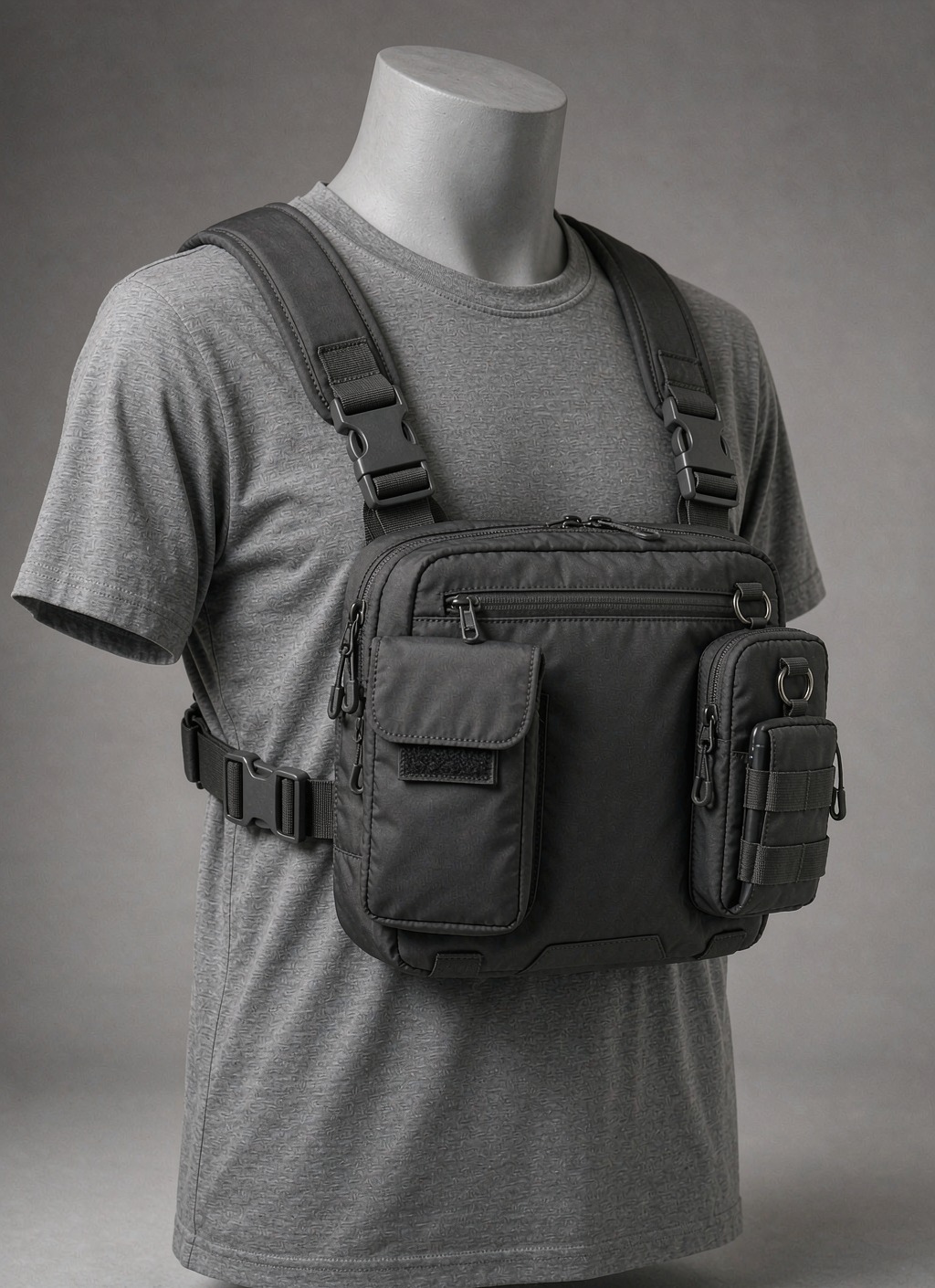
Embroidery, screen printing and a woven label put the same artwork onto a backpack panel by three different physical mechanisms, and the right choice is made on cost structure and service life rather than on how the drawing looks on a screen. Direct embroidery drives thread through the shell, screen printing cures an ink film on top of it, and a woven label is a separate loom-made component sewn onto the assembly. One-off screens or tooling sit at USD 300-2,500 per design, sampling takes 6-10 working days and 12-15 on a demanding construction, bulk occupies 35-50 days, and the minimum is 500 units per reference. All sums are indicative and quoted on FOB Xiamen terms for civilian load carriage — hiking, commuting, worksite tools and first aid — and durability outcomes depend on the test method and acceptance tolerance the two sides put in writing before sampling begins.
What Embroidery, Screen Printing and a Woven Label Each Do to a Panel
Embroidery, screen printing and a woven label differ first in where the mark ends up. A multi-head machine drives a threaded needle through the shell and a backing layer, so the mark is a raised structure of stitch on the face with backing trapped on the reverse, and the shell itself is perforated along every stitch path. A screen print leaves the shell intact: ink is pushed through a tensioned mesh and cured into a film that sits on the face, commonly 80-150 µm thick depending on mesh count and the number of passes. A woven label is not applied to the shell in the same sense at all — it is a finished tape woven on a label loom from dyed yarns, cut to length and sewn on as a component.
Those three mechanisms produce three different failure modes, and naming the mechanism in the specification is what prevents later argument. A perforated shell loses part of its coating integrity along the stitch line: on a 210D or 420D nylon carrying a PU coating, every needle hole is a possible wicking path, which is why a panel on a modular backpack shell that has to shed water is normally printed or heat-applied instead of stitched through. An ink film fails differently — it cracks when the substrate stretches beyond what the film can follow, and it peels when the surface energy of a coating is too low for the ink to anchor. A sewn-on component fails at its attachment, at the stitch line, at the cut edge, or at the adhesive film if it was heat-applied rather than sewn.
The reverse of the panel matters as much as the face. Embroidery needs backing under the stitch — tearaway on a stable woven shell, cutaway on anything with stretch or a knit construction — and part of that backing stays in the panel and changes its hand. A panel embroidered before assembly is easy to hoop; a panel already sewn into a three-dimensional bag often will not fit a hoop at all, which forces the mark onto a flat sub-panel or pushes the decision toward ink. Screen printing needs a flat, supported surface under the mesh at the moment of print, so a finished bag with a padded back panel cannot take a direct screen without a platen built for that curvature.
Weight and profile separate the routes too. A dense fill stitch covering 60 × 40 mm can add several grams and roughly 0.8-1.2 mm of relief, an ink film adds under 0.2 mm, and a woven label adds the thickness of the tape plus the seam that holds it down. Relief is felt when the panel presses against a wearer's back, and it is visible when a 25 mm webbing strap crosses over it.
Embroidery vs Screen Print vs Woven Label: Threshold, Cost Driver and Detail Limit Compared
Placed side by side, the three routes separate on four questions: what has to be paid before any unit exists, what the unit price actually tracks, how small the artwork can go before it stops being legible, and which fabric finishes each one tolerates. Those four answers, written into a specification, remove almost all of the ambiguity that later turns into a claim.
The entry threshold is the first fork. Embroidery needs a digitised stitch file rather than a drawing, and that file has to be rebuilt when the size moves appreciably because stitch direction, density and underlay are all size-dependent. Screen printing needs artwork separated into colours and a mesh per colour, which is where the one-off band comes from. A woven label needs warp preparation on the label loom, and label looms carry their own minimum quantity that can sit above the 500-unit bag minimum, so a small first order may be asked to buy more labels than it needs.
| Decision criterion | Direct embroidery on the shell | Screen print as a cured ink film | Loom-woven label sewn on |
|---|---|---|---|
| One-off charge before units run | Digitised stitch file, rebuilt when size changes | Colour separation plus a mesh per colour, USD 300-2,500 | Warp preparation and loom setup at the label supplier |
| What the recurring price tracks | Stitch count, number of heads, number of placements | Colour count, printed area, passes and cure time | Tape size, yarn count and the quantity tier bought |
| Behaviour at the 500-unit minimum | Runs at the bag minimum without a separate floor | Runs at the bag minimum; screens are amortised into it | Label loom minimum can exceed the bag minimum |
| Smallest legible lettering | About 4-5 mm cap height, 1.2 mm minimum stroke | About 1 mm hairline before the mesh fills in | About 1.5-2 mm before the weave closes the gap |
| Gradients, halftones and photography | Not reproducible; satin and fill structures only | Halftone possible, breaks up on a textured shell | Simulated by yarn shading, not true tone |
| Effect on a coated waterproof shell | Perforates the coating along every stitch path | Shell stays intact; the film bridges the coating | Perforates only along the label seam line |
| First thing to fail in service | Thread snag, abrasion of the raised stitch | Cracking on a stretch panel, peeling on low-energy coatings | Cut-edge fray or a lifting corner |
| Sampling route and duration | 6-10 working days for a first article | 6-10 working days including a cure check | 12-15 working days on a multi-colour woven design |
The last row is the one buyers underestimate: a woven label is usually the slowest of the three to sample, because the loom setup happens at a supplier that is not making the bag, and a correction means a fresh setup rather than a fresh print pass.
Selection rule: Choose embroidery when the mark is above 4-5 mm cap height and the shell is uncoated or lightly finished, choose screen printing when the panel is coated, waterproof or stretch and the artwork carries fine lines or halftones, and choose a woven label when the mark must read as a separate retail element and the label minimum can be absorbed inside the 500-unit order.
How the Unit Price Is Built: Stitch Count, Colour Count and Loom Setup
No per-unit figure belongs in a specification, because the number is meaningless without the parameter behind it. What does belong is a written statement of what the price moves with, so that a revision can be priced before it is made rather than after. Each route has one dominant driver and two secondary ones, and quoting on the driver is what keeps a programme stable across seasons.
For embroidery the dominant driver is stitch count. A 60 × 40 mm mark built from a satin structure may run 1,500-2,500 stitches, while the same footprint filled at high density can exceed 8,000. Machine time follows stitch count, thread consumption follows it, and the number of heads in use sets how many panels move per hour. Secondary drivers are the number of placements on one bag and the number of colour changes in the design, because a colour change on a multi-head machine is a stop.
For screen printing the dominant driver is colour count, since each colour is a mesh, a pass and a cure step. A one-colour mark on a flat panel is the cheapest printed outcome available; a five-colour mark with a white underbase on a dark shell is five passes plus flash curing between them. Secondary drivers are printed area and the substrate's absorbency — an uncoated 600D polyester drinks ink and may need two passes for opacity, while a coated shell holds the film on the surface and needs one.
For a woven label the dominant driver is quantity tier, because loom setup is fixed and spread across the run. Secondary drivers are tape width, the number of colours in the weave and whether the cut edge needs ultrasonic sealing or a merrowed border. Buying one season at a time therefore costs more per label than buying two.
| Cost element | What actually drives it | Where the charge lands | Exposure if artwork is revised |
|---|---|---|---|
| Digitising and separation | Complexity of the drawing, number of colours, final size | One-off, before sampling, inside the USD 300-2,500 band | Re-invoiced when size or structure changes materially |
| Physical tool | Mesh count, frames, loom warp, cutting die for the label shape | One-off, owned by the maker unless written otherwise | Mesh re-tensioned or re-burned; warp re-prepared |
| Machine time per unit | Stitch count, passes, cure cycle, loom speed | Amortised into the unit price of the bag | Changes only if the revised artwork changes the count |
| Placement count | Number of positions on one bag and accessibility of each | Unit price, roughly linear in placements | Unchanged unless a placement is added or moved |
| Sampling itself | Number of rounds, number of routes sampled in parallel | Sampling fee USD 50-150, returned as credit on an order | A second round may add a further fee by agreement |
| Second colourway | Whether the same tool can run both colourways | Unit price, usually no new one-off charge | Only re-charged if a new mesh or warp is required |
The practical consequence is that a buyer should ask for the driver, not the price. "How many stitches is this mark" and "how many screens does this take" are questions that let a revised drawing be priced in minutes, while a flat per-unit figure hides everything and expires the moment the artwork moves.
Verdict: Write the driver into the specification — stitch count for embroidery, colour count and printed area for screen printing, tape size and quantity tier for a woven label — so that any later artwork revision can be costed from the driver instead of re-quoted from scratch, and so that the indicative USD 300-2,500 one-off band is only charged again when a new physical tool is genuinely required.
Fine Lettering, Hairlines and Gradients: Where Each Route Loses Legibility
Almost every logo dispute starts as a legibility dispute. A brand mark is drawn for a screen at 1,200 px and then produced at 22 mm wide, and the route that carried the detail at screen size simply stops carrying it at production size. Knowing where each route breaks lets the artwork be simplified before sampling rather than after three rounds of it.
Embroidery breaks at thin strokes first. A satin column narrower than about 1.2 mm cannot hold a stable edge because the needle needs room to place the two sides of the column, and below that the stitch collapses into an irregular line. Cap height under about 4-5 mm loses the counters of letters — the enclosed space in an "e" or an "a" fills with underlay — so the word turns into a smudge at arm's length. Serifs are the next casualty, because a serif is a thin stroke.
Screen printing breaks at halftones on textured shells. A 600D or 1,000D weave has a visible surface relief of roughly 0.2-0.4 mm, and a halftone dot smaller than the weave repeat lands partly on a crown and partly in a valley, which makes tone read as mottle. On a smooth coated shell or on a woven label tape the same halftone reads cleanly. Very fine hairlines below roughly 1 mm also close up as the ink flows after the mesh lifts.
A woven label breaks at the weave's resolution. The loom places warp and weft at a fixed density, so a diagonal thinner than about 1.5-2 mm becomes a stair-step, and a gap between two elements narrower than a couple of yarns fills in during weaving. The compensation is that a woven label holds fine detail better than embroidery does at the same size, because there is no needle displacement and no underlay closing the counters.
| Artwork element | Legibility floor in production | Why the limit exists | Workaround that keeps the mark readable |
|---|---|---|---|
| Cap height of lowercase text | 4-5 mm on embroidery, 2-3 mm printed, 2-3 mm woven | Underlay and needle displacement close the counters of small letters | Drop the tagline, keep the wordmark, scale the lockup up by 30% |
| Minimum stroke width | 1.2 mm stitched, 1.0 mm printed, 1.5-2.0 mm woven | A satin column needs two needle placements; ink flows after the mesh lifts | Thicken strokes in the production drawing, not in the brand guide |
| Serifs and hairline details | Not reliable on any route below 25 mm mark width | A serif is a thin stroke and is the first element to collapse | Use the sans-serif variant of the mark for small placements |
| Gradients and tonal shading | Printed only, and only on a smooth or coated face | Stitch and weave cannot render continuous tone | Convert the gradient to two flat tones and separate them |
| Photographic or bitmap content | Halftone print at 45-65 lpi on a flat panel | Dot size competes with the weave relief of the shell | Move the image to a label or a transfer on a smooth sub-panel |
| Reversed-out text on a dark field | 4-5 mm stitched, 2 mm printed with underbase | Show-through of a dark shell kills contrast without a white base | Add a knock-out plate or an opaque underbase pass |
Takeaway: Simplify the mark for the smallest placement on the bag, not for the largest: cap height at 4-5 mm, strokes at 1.2 mm or wider and no serifs below a 25 mm mark width will pass on all three routes, while anything finer needs the artwork redrawn before sampling rather than argued about after the first article arrives.
Service Life: Washing, Rubbing, Light and Abrasion on a Branded Panel
Durability is a test result, not an impression, and a logo specification that says "durable" is unenforceable. What is enforceable is a named method, a named rating and a named tolerance. Four exposures cover nearly every field complaint: laundering, rubbing, light and abrasion.
- Laundering. Colour change and staining are assessed after a domestic wash cycle; the reference used in most bag programmes is ISO 105-C06, with the result read on a grey scale rather than by eye alone.
- Rubbing. Dry and wet crocking of an ink film or a dyed thread is measured to AATCC 8, and a low wet rating on a print is the usual reason a mark transfers onto a light-coloured garment.
- Light. Xenon exposure is read to ISO 105-B02 against a blue wool reference; polyester thread holds up better here than rayon, which is why rayon is rarely specified for outdoor product.
- Abrasion. A raised stitch abrades where a strap crosses it, and the shell underneath is assessed to AATCC 61 for appearance change and to ISO 12947 for fabric breakdown.
The three routes rank differently across those four exposures, which is why a single "best" route does not exist. Embroidery is strong on light and laundering and weak on snag and strap abrasion, because the raised stitch is the highest point on the panel and takes the wear first. Screen printing is strong on abrasion if the film is properly cured and weak on repeated flexing, because a cured film of 80-150 µm on a stretch woven will eventually craze. A woven label is strong on light and laundering and weak at the edge, because the cut edge is where a washing machine attacks first — which is why a heat-sealed or ultrasonically cut edge is specified on any bag that will be laundered rather than wiped.
Two conditions have to be written down or the test result cannot be argued. The first is the acceptance rating: a grey scale rating of 4 after washing is a common commercial threshold, but it must be stated, because 4 and 4-5 are different outcomes and both are defensible. The second is the substrate and the colourway tested, since a mark that passes on a 600D polyester in black may not pass on the same fabric in a fluorescent shade, where dye depth is limited.
Bottom line: Name the method, the rating and the colourway in the specification — for bag programmes that means ISO 105-C06 for laundering, ISO 105-B02 for light and AATCC 8 for rubbing, read on a grey scale with a stated acceptance rating — because a logo claim without a method and a number cannot be settled when a shipment is contested.
Which Shell Fabrics Accept Which Logo Route
Fabric decides the route more often than artwork does. A specification that names the artwork but not the shell is a specification that will be re-quoted, because the same drawing behaves differently on a 210D ripstop and on a 1,000D coated polyester.
Coated and laminated shells are the clearest case. A PU, PVC or TPU coating is there to stop water, and a needle punches through it, so direct embroidery on a waterproof panel needs a compensating step — a backing tape, a sealant over the stitch on the reverse, or a move to print. Ink behaves differently again on a low-energy coating: without a primer or a corona treatment the film can sit on the surface and peel in a peel test, so a coated shell routinely needs an ink system matched to it, and a cross-hatch adhesion check written into the first-article report.
Lightweight shells fail on a different mechanism: pucker. Below roughly 210D, and especially on a ripstop with a grid every 5-10 mm, the tension of a dense fill stitch pulls the panel into a drum, and the distortion is visible from two metres. The remedy is a lighter stitch structure, a cutaway backing and a lower density — or printed artwork, which adds no tension at all.
Stretch and knit constructions rule out most screen films unless the ink system is elastomeric, because the film has to follow a substrate that moves 10-20% and returns. Air mesh, spacer mesh and neoprene panels are usually labelled rather than printed or embroidered for this reason: a woven label sewn at two edges floats over a substrate that moves underneath it.
| Shell fabric and finish | Route that holds in service | Route to avoid or qualify | Limiting mechanism |
|---|---|---|---|
| 600D or 1,000D polyester, uncoated | Embroidery and screen print both run cleanly | None; verify colour fastness of the dye | Stable construction; no coating to perforate |
| 210D or 420D nylon with PU coating | Screen print with a matched ink system | Embroidery without a reverse sealing step | Needle holes create wicking paths through the coating |
| TPU laminate or welded panel | Heat-applied transfer or a sewn label on a seam | Direct stitch through the laminate | Perforation and needle heat damage the film |
| Lightweight ripstop under 210D | Printed mark, or embroidery at reduced density | Dense fill stitch at full density | Stitch tension pulls the panel into visible pucker |
| Air mesh, spacer mesh, neoprene | Woven label sewn at two edges only | Screen print with a rigid ink film | Substrate stretches 10-20%; a non-elastic film crazes |
| Cordura-type textured weave above 500D | Embroidery; print needs a heavier deposit | Fine halftone print work | Weave relief of 0.2-0.4 mm breaks up small dots |
| Recycled polyester with GRS yarn | All three, with fastness re-tested per lot | Assuming the virgin-yarn fastness result carries over | Recycled feedstock shifts shade and dye uptake |
Judgement: Fix the shell first and then the route — coated or laminated panels below 420D go to print or a sewn label, uncoated shells at 600D and above take embroidery safely, stretch panels take a label sewn at two edges, and any recycled-content fabric needs its fastness re-tested by lot before a logo route is approved.
Sampling, Screens and the Calendar Behind a Branded Panel
A logo decision is also a schedule decision, and the schedule differs by route because the correction loop differs. An embroidery correction is a change to a stitch file and a re-run on the same machine. A print correction is a new pass, or a new screen if the colour count or the artwork changed. A woven-label correction goes back to a supplier and costs a fresh loom setup, which is why multi-colour woven designs are the slowest of the three to converge.
The calendar that applies to a branded panel on a custom modular backpack programme runs as follows. A quotation is returned in 24-48 hours against a drawing and a named route. Sampling takes 6-10 working days for a single route and 12-15 working days when the construction is demanding or when a woven label has to come from a separate supplier. Bulk occupies 35-50 days after the pre-production sample is approved. The minimum is 500 units per reference, and inspection is run to AQL 2.5 on ISO 2859-1 level II with critical defects at zero, major at 2.5 and minor at 4.0.
Two money items sit in front of sampling and are frequently confused, and both are handled by the sampling and artwork desk as separate lines on the quotation. The one-off tooling or screen charge of USD 300-2,500 buys preparation, the physical tool and the first-off correction, and it is capital rather than a deposit. The sampling fee of USD 50-150 is separate and is returned to the buyer as a credit once an order is placed. A buyer who treats the tooling charge as refundable will be disappointed; a buyer who treats the sampling fee as forfeit will leave money on the table.
Logo placement and logo colour are inspection items, not aesthetic preferences, and they are cheaper to fix on a pre-production sample than on a shipped order. Placement is measured from two datums — usually a seam and an edge — with a tolerance of ±3 mm on a flat panel and ±5 mm across a curved one. Colour is judged against a signed reference under a stated light source, because a mark approved under a warm store light will be rejected under daylight. Raise any change of position with the enquiry desk before panels are cut, not after.
Spec rule: Lock the route, the shell, the placement datums with a ±3 mm flat-panel tolerance and the signed colour reference before the sampling fee is paid, then hold the pre-production sample as the physical standard, because a logo approved verbally is a logo that will be re-approved three times during a 35-50 day bulk run.
Gates, Records and the Production Facts Behind These Figures
Our production team runs logo work through four gates that a buyer can audit: artwork and route confirmation, a first article at 6-10 working days (12-15 on a demanding build), a pre-production sample held as the physical standard, and inspection to AQL 2.5 on ISO 2859-1 level II before release. Each gate produces a record — a digitised file revision note, a first-article report with the fastness readings, a signed sample and an inspection report — and the record is what settles a dispute rather than an opinion.
Our SGS-verified production base holds a 4,950 m² floor with 7 production lines, 149 machines and 137 people, turning out 200,000 units per month, and the founder has worked in bag production since 2004 with the company established in 2014. Capacity matters to a logo decision in one specific way: a route that needs a dedicated machine or an outside supplier, such as a woven label loom or a cure tunnel, has to be booked into the 35-50 day window rather than added to it, and a booking missed in week one is a booking that costs the season.
Commercial terms stay fixed across routes. Quotations are indicative, valid against a stated drawing and quantity, quoted FOB Xiamen, and a revised drawing is re-quoted in 24-48 hours from the cost driver rather than renegotiated from nothing. Payment runs T/T 30/70, with the balance against the inspection outcome. Freight is quoted separately: sea at 25-35 days, air at 5-8 days and express at 3-5 days, with consolidation planned at roughly 28 CBM per 20GP and 68 CBM per 40HQ.
Everything here concerns civilian load carriage — hiking, commuting, worksite tools and first aid. No claim of military certification, ballistic performance or weapon carriage is made or implied anywhere in this guide, and any logo durability target is a commercial agreement between buyer and supplier rather than a regulatory threshold.
Frequently asked questions
Which logo route lasts longest on a 600D polyester backpack panel?
On an uncoated 600D polyester shell, embroidery and a woven label both outlast a print on laundering and light, because thread and woven yarn hold their colour better than a surface film. A print wins on abrasion under a strap, since it adds nothing raised. Confirm to ISO 105-C06 and ISO 105-B02. Minimum 500 units, sampling 6-10 working days.
Does embroidery damage the water resistance of a coated backpack shell?
Yes, unless the specification compensates for it. Every needle hole crosses the coating and can wick, which is why a PU-coated 210D or 420D nylon is normally printed or heat-applied. Where a stitched mark is required, add a reverse sealing step. Sampling runs 12-15 working days on that build; MOQ 500; AQL 2.5 on ISO 2859-1 level II.
How many colours can screen printing hold on a backpack panel?
Screen printing holds one colour per mesh, so the practical limit is set by registration and by the cost of each pass rather than by the process. Four to six colours is common on a flat panel; beyond that a transfer is usually cheaper. One-off screens sit at USD 300-2,500, sampling at 6-10 working days, bulk at 35-50 days.
What is the smallest letter height embroidery can reproduce legibly?
About 4-5 mm cap height, with a minimum stroke of 1.2 mm. Below that the counters of lowercase letters close with underlay and the word reads as a smudge. Serifs collapse first. If the tagline cannot meet that floor, drop it and keep the wordmark. Sampling 6-10 working days; sampling fee USD 50-150, refundable on order.
When should a woven label replace direct embroidery on a modular bag?
Use a woven label when the mark must read as a retail element, when the shell is coated or stretchy, or when the artwork carries detail finer than 4-5 mm. Note that the label loom carries its own minimum, which can exceed the 500-unit bag minimum. Sampling for a woven design takes 12-15 working days.
What does the one-off tooling or screen charge of USD 300-2,500 cover for a logo?
It covers preparation, the physical tool and the first-off correction. Preparation is artwork conversion and programming; the tool is a mesh, a frame, a cutting die or a loom warp; correction is the second trial after the first shot. It is capital, not a deposit. The refundable element is the sampling fee of USD 50-150.
How long does sampling take for a branded panel with three logo routes?
Sample the routes in parallel rather than serially. Embroidery and screen print each return a first article in 6-10 working days; a woven label takes 12-15 working days because setup happens at a separate supplier. Bulk then occupies 35-50 days from approval of the pre-production sample. MOQ 500 per reference; quote returned in 24-48 hours.
Can one design be split across embroidery and screen print on the same bag?
Yes, and it is often the right answer: a stitched wordmark on the front pocket and a printed mark on the lid or the harness. Each placement is priced on its own driver — stitch count or colour count — and each adds to machine time. Expect two one-off charges if two tools are needed, inside the USD 300-2,500 band.
Why does a screen print crack on a stretch panel but not on a woven shell?
A cured film of 80-150 µm does not follow a substrate that stretches 10-20% and returns, so it crazes. On a stable woven shell at 600D the substrate barely moves and the film survives. Specify an elastomeric ink system, or move the mark to a woven label sewn at two edges only.
Does a woven label need a heat-sealed edge to survive repeated washing?
On any bag that will be laundered rather than wiped, yes — the cut edge is the first point a wash cycle attacks. Ultrasonic cutting, a heat-sealed edge or a merrowed border all work; the chosen finish must be named in the specification. Verify to ISO 105-C06, then inspect to AQL 2.5 before shipment.
How is logo placement checked during inspection against AQL 2.5?
Placement is measured from two datums, normally a seam and a panel edge, with ±3 mm on a flat panel and ±5 mm across a curved one, and misplacement beyond tolerance is classed as a major defect. Sampling runs 6-10 working days, bulk 35-50 days, inspection to ISO 2859-1 level II with critical defects at zero.
What payment terms apply to a first branded backpack order?
Standard terms are T/T 30/70 — 30% to release materials and tooling, 70% against the inspection outcome — quoted FOB Xiamen. Tooling or screens at USD 300-2,500 are invoiced separately from the sampling fee of USD 50-150, which returns as credit once an order is placed. Quotations come back in 24-48 hours.
Should logo artwork be supplied as vector or as a raster file?
Supply vector artwork with text converted to outlines, plus a raster reference at 300 dpi or better. Vector lets a digitised stitch file and a colour separation both be generated without redrawing, which is what keeps sampling inside 6-10 working days. State the production size in millimetres, not the screen size in pixels.
Can a logo reference a Pantone colour for embroidery thread and screen ink?
Yes, but treat it as a target, not a guarantee. Thread, ink and woven yarn sit on different materials with different lustre, so a single Pantone reference will read differently on each. Nominate a control material and a tolerance in writing. See the separate guide on Pantone matching for fabric and trims.
What is the minimum order for a bag carrying both a woven label and a printed mark?
The bag minimum is 500 units per reference, but the woven label has its own loom minimum that can sit above it, so a first order may buy more labels than it consumes. Plan two seasons of labels at once to spread the setup. Bulk occupies 35-50 days once the pre-production sample is signed off.
When is a woven label cheaper than embroidery at 500 units?
A woven label wins when the mark is dense — above roughly 8,000 stitches — or when it appears on more than one panel, because stitch count drives embroidery cost while label cost is driven by quantity tier. It loses when the artwork needs fewer than about 1,500 stitches. Ask for the driver, not the price.