Home › Field notes › EVA vs PE Foam Back Panel: Which Padding Survives a Season
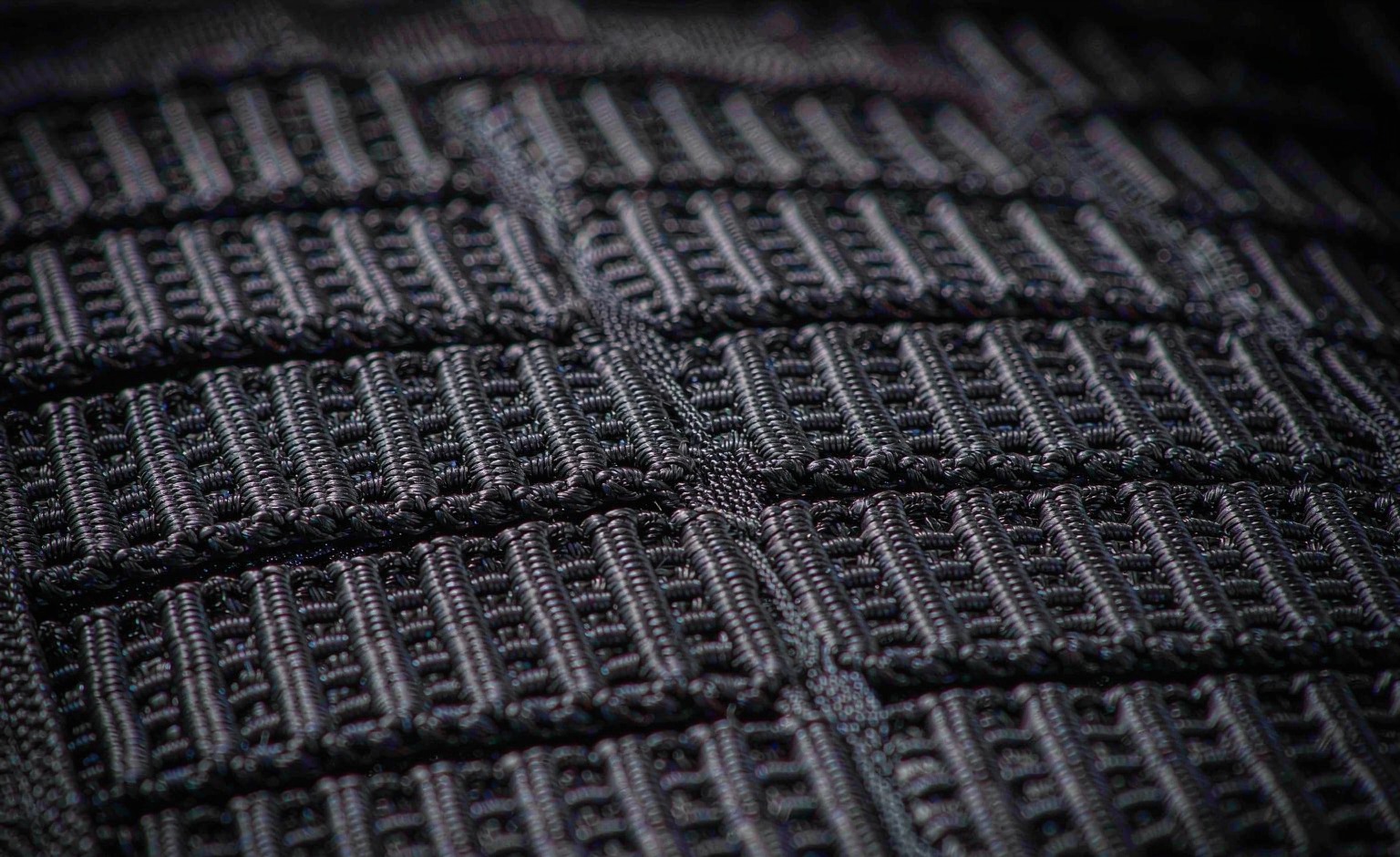
EVA gives the softer first touch and moulds easily into shaped channels, while polyethylene foam holds thickness better under sustained load, weighs roughly a third less at equal section and usually costs less per pad; pick EVA for three-dimensional comfort shapes and PE for flat panels expected to stay flat. Usable bands are realistic and narrow: EVA sits around 60-120 kg per cubic metre at 8-15 mm, cross-linked polyethylene around 25-45 kg per cubic metre at 8-20 mm.Programme terms are MOQ 500 per reference, sampling 6-10 working days with formed pads reaching 12-15, bulk 35-50 days and lot release at AQL 2.5, with foam and laminate behaviour checked to methods published by ASTM and sampling referenced to ISO 2859-1. Everything here concerns civilian carry - hiking, commuting, tools and travel - and no padding claim is tied to impact protection of any kind.
Cell structure: what the two closed-cell foams actually are
Both materials are closed-cell sheet, meaning each cell is a sealed pocket of gas rather than a continuous channel. That is why neither absorbs meaningful water and why both float, and it is why perforating them later is a manufacturing decision rather than a natural property.
The difference that matters comes from the polymer itself. Ethylene-vinyl acetate carries vinyl acetate groups that disrupt crystallinity, leaving a rubbery material with a soft hand and good flex life at room temperature. Polyethylene is more crystalline, which gives it a firmer touch at the same thickness but also better recovery once cross-linked, because the network remembers its original dimensions.
Cross-linking is the second variable and it is frequently omitted from specifications. A non-cross-linked polyethylene pad behaves predictably badly: it creeps under load and takes a permanent dent. Cross-linked grades recover far better and cost more, which is why two quotations for "PE foam" can differ substantially without either being wrong.
Specify both variables, therefore: base polymer and cross-link state, along with density and thickness. A request that says only "8 mm PE foam" is notyet a specification.
Skin formation during manufacture is a third variable that rarely appears on drawings but shows up in performance. Sheet foam develops denser faces against the tooling, and leaving those skins intact changes the way a pad bends across the shoulders; skiving them off changes it again, and the two behave as different products.
Sourcing stability deserves a line as well. Resin lots vary more than purchasers expect, so any public claim tied to recycled content should be traceable through chain-of-custody documentation rather than asserted from a supplier quotation.
Verdict: Write four parameters into the material line - polymer, cross-link state, density band and finished thickness - because three of them are invisible in a sample yet account for nearly all variation in how the pad behaves after six months.
Rebound: how quickly each pad returns between steps
Rebound is what a customer describes as springiness and it is measurable without laboratory equipment. Press a ball-ended probe into the pad to half its thickness, release, and watch whether the surface recovers within roughly one second, three seconds, or noticeably longer.
In the density bands used for back panels, cross-linked polyethylene generally returns faster because its network stores strain elastically. EVA is more viscoelastic: it absorbs the energy rather than returning it immediately, which is exactly the behaviour that reads as cushioned rather than bouncy when somebody first shoulders the pack.
Neither is objectively better; they suit different products. A running or cycling pack benefits from quick recovery because load pulses rapidly. A heavy hauling pack benefits from absorption because slow recovery dampens the bounce that otherwise appears in gait.
Temperature then modifies the answer. Both stiffen when cold, but EVA changes noticeably earlier, so a pad tuned for room temperature can feel board-like on a winter morning.
Bottom line: Match recovery speed to the rhythm of the activity rather than maximising it, because a panel tuned for fast rebound on a slow-walking heavy load transmits more bounce into the shoulders than it removes.
Compression set: what stays flattened after a season of use
Compression set is the complaint behind every soft-grown-hard review. Load is applied for hours at a time, every day, and a pad either returns overnight or gradually keeps a reduced profile where the shoulders press.
The practical field test is straightforward and takes a week. Mark the pad thickness at three points, load the pack to roughly 8 kg against a wall for seven nights, then re-measure at room temperature after a twenty-four hour recovery. Loss beyond roughly 10 percent at the contact patch signals a grade problem rather than a user problem.
Sustained compression is where uncured low-density EVA struggles most. Its cells collapse progressively under constant strain, particularly at density toward the bottom of its usable band and particularly where the pad also sees body heat. Cross-linked polyethylene resists this better because recovery is built into its structure. High-utilisation fleet programmes typically grade one band higher than retail equivalents for this reason, and the reference right to do so sits alongside our flagship panel-equipped products.
Durability planning follows directly. Grade up rather than grade down: spending a little more on density buys back far more in field life than adding thickness to a weak material, because thin dense foam outlasts thick soft foam.
Heat accelerates everything. A panel worn against a warm back for several hours at a time sits well above ambient for much of the working day, and that elevated temperature is the condition under which most permanent thinning actually occurs, which is why a laboratory result run at room temperature flatters the material.
Takeaway: Buy density before thickness, since a pad at the upper half of its density band recovers for years while extra millimetres of weak foam merely postpones the same flattening by a season.
Perforation and air channels: moving vapour without losing support
Holes in a closed-cell pad do two things: they let warm vapour escape sideways and they reduce contact area, which lowers the clammy feeling that reviewers describe accurately even if they cannot explain the cause. They also remove support locally, so pattern design is a compromise.
Two parameters drive the outcome. Open area ratio - typically 8-20 percent for backs - sets how much vapour escapes, while hole layout sets whether the remaining land still bridges between the body and the stiffening layer behind.
Material behaviour during perforation differs. EVA accepts drilled or punched holes with clean walls and tends to hold its shape around them because of its elastic skin. Polyethylene perforations also stay open but the material is more prone to tear propagation from a poorly cut edge, so tooling sharpness and inspection matter more.
A channel-and-hole hybrid usually outperforms either alone: two or three vertical channels, roughly 6-10 mm wide, with 3-5 mm holes distributed between them, giving a path for air to travel rather than isolated vents that only work directly under them.
Judgement: Keep total open area between 8 and 20 percent, combine vertical channels with distributed holes rather than relying on holes alone, and check edges rather than holes during inspection, since a torn edge propagates while a clean one does not.
Conformity against the back and interaction with the frame behind
A pad only performs as part of a stack. Behind it sits either a formed sheet or a pair of stays, and ahead of it a face fabric; how those three layers interact decides whether the padding works or merely fills space.
EVA has the advantage where the stack includes three-dimensional shapes, because it thermoforms readily into a moulded relief - a lumbar bulge, a pair of shoulder-side ridges, a central spine channel - often removing several cut-and-sew operations. That moulding behaviour is also why it shows up in higher-priced panels despite costing more per litre.
Cross-linked polyethylene suits a flatter construction, where the stack relies on the frame behind for shape and the pad simply prevents pressure points. Used that way its lower density is a genuine advantage, particularly in larger travel formats where a panel can be 300 mm tall.
The frame junction deserves explicit attention: wherever a stay or sheet edge presses toward the back, the pad has to be thick enough to stop that edge from being felt, and neither material can solve it below roughly 6 mm at that point.
Neckline contact is the other place where stacks fail quietly. A pad that extends above the point where the shoulder line meets the spine tends to roll when the wearer looks down, so terminating formed relief roughly 40 mm below the top binding keeps the whole construction lying flat under movement.
Tolerance between pad and panel pocket deserves one number too. A pad cut within about 3 mm of the pocket on every side slips in without folding, while anything larger forces a crease at installation that becomes a permanent fold lines within weeks.
Selection rule: Choose EVA when the design wants moulded three-dimensional relief that also replaces sewn parts, choose cross-linked PE for flat panels where low mass and shape retention dominate, and keep at least 6 mm over any frame edge in both cases.
Unit cost, lamination behaviour and cutting waste
Raw polymer is only part of the number. Three downstream operations decide what a pad actually costs: lamination to the face fabric, conversion into shape, and the waste each of those generates.
Lamination favours different methods for each polymer. EVA accepts heat and flame lamination readily and bonds well to knit faces without much adhesive. Polyethylene has a higher melt point, so it usually wants a film adhesive or a carefully controlled flame pass, which adds a consumable and a process variable.
Conversion is where die source choices bite. Both cut cleanly when blades are sharp, but their compression under the beam differs, so a die tuned for one produces feathered edges on the other. Ask for the die to be validated on the actual production material rather than on a substitute sheet.
Nesting efficiency then decides the waste figure. Moulded EVA parts can be near-net-shape with almost no offcut, while flat-cut PE pads leave skeleton waste that is usually unrecyclable in this application.
Finally there is freight arithmetic: a low-density pad is genuinely lighter, but cartons are sized by the pack, so the saving appears only when it lets Carton dimensions cross below a stacking threshold in the 20GP volume range.
Spec rule: Ask for material, lamination method, conversion route and skeleton waste stated as separate lines, since a cheaper polymer can lose its advantage entirely to a film adhesive and 20 percent offcut.
EVA against polyethylene back padding: ten criteria scored
| Padding criterion | EVA foam pad | Polyethylene foam pad |
|---|---|---|
| Typical density band | 60-120 kg per cubic metre | 25-45 kg per cubic metre |
| Typical finished thickness | 8-15 mm | 8-20 mm |
| First-touch sensation | Soft and cushioned | Firmer at equal section |
| Recovery speed after compression | Slower, more absorbent | Faster in cross-linked grades |
| Resistance to permanent thinning | Weaker at low density | Strong once cross-linked |
| Mass at equal section | Heavier per pad | Roughly one third lighter |
| Three-dimensional moulding | Thermoforms into relief | Usually cut flat only |
| Perforation behaviour | Clean walls, holds shape | Clean, but edge-tear sensitive |
| Lamination route | Heat and flame readily | Often needs film adhesive |
| Conversion waste | Near-net-shape when moulded | Skeleton waste from flat cutting |
Read the top half as what the wearer feels and the bottom half as what the buyer pays for. They frequently point at different answers, and resolving that tension honestly is the actual specification decision rather than picking a winner on points.
A mixed route often wins in practice: a moulded EVA insert taking the three-dimensional lumbar shape with a lighter cross-linked PE field behind it, giving both without paying full-size cost for either.
The mixed route does carry one condition worth writing down. Two materials with different recovery rates sitting in one stack create a visible step where they meet unless the transition is zoned rather than butt-jointed, so bond their edges with a taper and let the stitch line fall outside the contact patch.
The comparison reduces to one question a buyer can answer: does this product sell on moulded comfort or on staying light and flat, because the answer selects rows four through seven before any cost discussion begins.
Pad construction windows by product application
| Application | Polymer | Section | Open area | Face fabric |
|---|---|---|---|---|
| Daily commuter, 18-24 litre | EVA, mid density | 8-10 mm | 10-14 percent | Warp-knit tricot |
| Technical hiking, 35-50 litre | Cross-linked PE | 12-18 mm | 12-20 percent | Abrasion-resistant knit |
| Work and tool carry | EVA, upper density | 10-14 mm | 8-12 percent | Coated knit, wipe-clean |
| Travel, flat panel formats | Cross-linked PE | 10-15 mm | 14-20 percent | Mesh-laminated knit |
The second column and the fourth interact, and that interaction is usually missed. Open area removes support, so a high open-area figure needs either higher density or greater thickness to compensate; specifying both independently produces a pad that feels comfortable for a month and then bottoms out.
Face fabric selection is not cosmetic either. A warp-knit tricot stretches across perforations and can bridge them, closing the airflow path; an open mesh laminated to the pad keeps the path clear but abrades faster against clothing and against the rows behind.
Reference configurations shown alongside our tool-oriented carry platforms follow the third row, where wipe-clean faces matter more than breathability. Those products also tend to run denser pads, because the loads they meet are compact and hard-edged. Flat-panel travel-oriented constructions take the opposite view and prioritise reduced depth.
Seasonal ranges introduce one more variable worth budgeting for: a winter colourway often ships with a heavier face fabric, and that change alone alters how much vapour reaches the perforations, sometimes by enough that the summer construction should not be copied across unchanged.
These four rows are starting points rather than answers: adjust density upward before adding thickness, keep open area and face fabric moves together, and re-measure any changed stack rather than assuming the previous result carries over.
Entity facts, compliance documentation and ordering steps
Vetted partner facilities provide the forming and laminating steps behind these constructions, coordinated through a 4,950 m2 SGS-verified floor holding 7 production lines, 149 machines and 137 people at 200,000 units of monthly capacity. Moulded inserts and flat pad fields run on the same line with different fixtures.
Documentation follows the claim. Face fabric abrasion is referenced to ISO 12947, laundering behaviour to ISO 6330 where washability appears in copy, foam and laminate assessment to methods published by ASTM, and lot release to AQL 2.5 with Critical 0, Major 2.5 and Minor 4.0.
Chemical compliance is a whole-range exercise rather than a per-pad one: REACH declarations, California Prop 65 screening where the destination requires it, CPSIA documentation for youth-adjacent products, and OEKO-TEX Standard 100 for textile components where it is claimed.
The commercial route is unchanged. Enquiries return indicative FOB Xiamen pricing within 24-48 hours at MOQ 500; sampling occupies 6-10 working days per round, extending to 12-15 where moulded inserts are being developed, at USD 50-150 refundable against the order; tooling for moulds or dies sits in the USD 300-2,500 band; bulk runs 35-50 days under T/T 30/70; then sea at 25-35 days, air at 5-8 or courier at 3-5. Further reference material is listed under programme services.
Two scheduling points decide most delays here: mould development pushes sample rounds toward 12-15 working days, and laboratory populations should be booked before the 35-50 day bulk window opens rather than discovered missing during it.
Frequently asked questions
What is the difference between EVA and PE foam in a back panel?
EVA is a rubbery copolymer that feels soft immediately and thermoforms into three-dimensional relief; polyethylene is more crystalline, firmer at equal thickness and, once cross-linked, better at returning to its original thickness. Density differs too: 60-120 against 25-45 kg per cubic metre.
Which foam keeps its thickness longer under shoulder load?
Cross-linked polyethylene generally does, because recovery is built into its network. Low-density EVA cells can collapse progressively under continuous strain, particularly where body heat is also present, so grade upward rather than adding millimetres.
Why does my back panel feel hard after six months?
Permanent compression set is the usual cause. Load the pack overnight for seven nights, measure before and after at three points, and treat more than roughly 10 percent loss at the contact patch as a material grading problem rather than wear.
Is thicker padding always more comfortable?
No. Thin dense foam outlasts thick soft foam and often feels better after a season. Density governs long-term behaviour; thickness mainly affects the first wearing, so adjust density upward first and add thickness only where a frame edge needs covering.
How much open area should perforations cover?
Between about 8 and 20 percent for back panels. Below that, vapour has nowhere to go; above it, remaining support bridges badly and the pad bottoms out. Combine vertical channels with distributed holes rather than relying on holes alone.
Does either foam absorb water?
Both are closed-cell, so absorption is negligible and buoyancy is retained. Water enters only through cut edges or perforations, which is why edge sealing and clean tooling matter more than any coating of the faces.
Which material perforates more cleanly?
EVA gives clean walls and tends to hold shape around each hole thanks to its elastic skin. Polyethylene also perforates cleanly but is more sensitive to tear propagation from a poorly cut edge, so check edges rather than holes at inspection.
Can either foam be moulded into a lumbar shape?
EVA thermoforms readily into relief and can replace several cut-and-sew operations, which is why it appears in higher-priced panels. Cross-linked polyethylene is normally converted flat, relying on the frame behind it for shape.
How does cold weather affect these pads?
Both stiffen when cold, but EVA visibly earlier, so a pad tuned at room temperature can feel board-like on a winter morning. Trial samples conditioned at minus 10 degrees for four hours before committing to a winter launch.
What lamination method suits each polymer?
EVA accepts heat and flame lamination directly to knit faces with little adhesive. Polyethylene melts higher, so it usually needs a film adhesive or a tightly controlled flame pass, adding both a consumable and a process variable.
Why do quotations for PE foam vary so much?
Cross-link state is often unspecified. Non-cross-linked grades creep and dent early, while cross-linked grades recover well and cost more. Request polymer, cross-link state, density band and thickness so two offers are comparable.
How much padding is needed over a frame edge?
At least roughly 6 mm at the point where a stay or sheet edge presses toward the back. Below that no closed-cell polymer prevents the edge from being felt, regardless of which grade is chosen.
Which face fabric works with perforated pads?
An open mesh laminated to the pad keeps the airflow path clear but abrades faster against clothing and rows. A warp-knit tricot wears better but can bridge across perforations and close the path, so choose deliberately.
How long does sampling take for moulded inserts?
Sampling occupies 6-10 working days per round for flat-converted pads and 12-15 working days once moulded inserts enter development, at USD 50-150 per sample refundable against the order, with tooling in the USD 300-2,500 band.