Home › Field notes › IEC 60529 IPX Ratings for Bags: Enclosure Codes, Test Scope and False
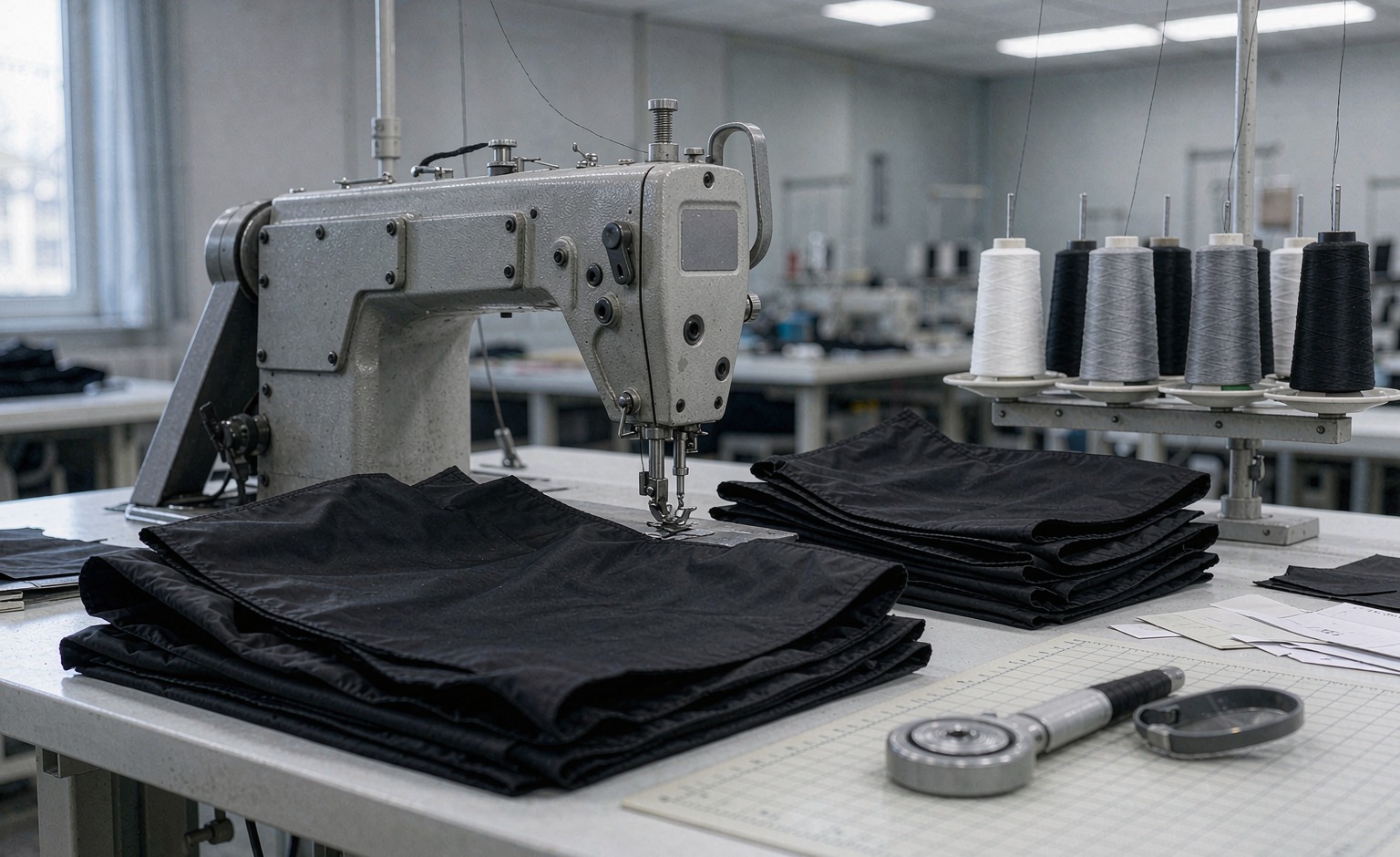
An IEC 60529 IPX rating is awarded to a complete enclosure tested as a single assembled specimen, so it classifies that object and never the fabric the object is made from. Codes quoted on soft goods — IPX4, IPX5, IPX6, IPX7 — describe the type of water exposure survived on the day of the test, not a property of nylon, polyester or any coating applied to them. Commercial gates sit behind any claim: a 500-piece floor per reference, samples in 6-10 working days, volume across 35-50 days, and release by attribute inspection at AQL 2.5. The boundary is plain: civilian load-carriage goods such as hiking packs, commuter bags, worksite tool rolls and first-aid modules rarely qualify as enclosures, because closures, stitch perforations and panel seams behave nothing like a gasketed housing. This page is general trade information rather than legal advice.
An IP Code Certifies an Enclosure, Never a Piece of Cloth
The IP code published as IEC 60529 is built from two characteristic digits plus optional supplementary letters. The first digit classifies protection against access to hazardous parts and against solid foreign objects; the second classifies protection against water. Where a digit is replaced by the letter X, the specimen was simply not assessed for that ingress route — the letter records an omission, not a zero. Supplementary letters cover a few specific applications and are easy to misread when copied from a catalogue page.
An enclosure, in the sense the standard uses, is a housing with defined joints: gasket seats, cable entries, port covers, fastener schedules and a closure that compresses predictably. The specimen arrives at the laboratory assembled to drawing and is tested in the condition it will be sold. Nothing in that description fits a sewn textile shell. A pack body is a membrane pierced hundreds of times by needles, closed by a slider that must move freely, and pierced again wherever a strap or a MOLLE attachment grid is stitched through the face.
Fabric behaviour is measured by entirely separate routes. Resistance to water penetration under increasing pressure is reported as a hydrostatic head, run on the finished cloth by methods such as AATCC 127, and the corresponding ISO route gives the same kind of figure in the same units. Surface wetting and repellency are separate properties again, and both degrade with laundering long before the cloth wears out. A coated shell can post an excellent head figure and still wet out along a 120 mm zipper run, because entry happens at the closure rather than through the membrane.
The practical consequence for a brand is simple. If an IP claim is genuinely wanted, a sealed sub-assembly has to be designed and drawn: a rigid electronics pod, a welded or RF-sealed insert, a moulded case that clips into the pack body. That part can be tested and coded. The textile around it is described with head figures, spray durations and seam-wicking results, and the two never merge into one number.
Spec rule: Reserve an IP claim for a sub-assembly that has a drawn sealing boundary — housing, gasket, port cover and fastener schedule — and describe the surrounding shell with a hydrostatic head value plus a stated spray duration, because a 25 mm webbing channel and a sewn closure will not behave like a gasketed lid.
How the Second Characteristic Digit Is Actually Earned
Water grades are produced by distinct apparatus families. Splash grades use a spray rig or an oscillating tube that wets the specimen from several directions while it is rotated or repositioned. Jet grades direct a stream from a nozzle of defined bore at a stated flow and distance. Immersion grades put the specimen in a tank where depth and duration are fixed by the code, and the continuous-immersion grade is declared by the maker rather than by the standard, since the service condition belongs to the product.
What the standard governs is the exposure: apparatus geometry, flow, orientation, duration and the condition of the specimen. What it does not govern is the pass mark for the product. Acceptance is an agreement between the parties commissioning the work — how much internal water is tolerable, whether a function check must still pass afterwards, whether any corrosion or marking is permitted. A laboratory report that states a code without stating the acceptance criterion used is only half a document.
A type test is also not a lot acceptance exercise. It is run on a small number of representative specimens, drawn from tooling and components that match production, and the result says nothing about the spread across a run. Production uniformity is handled separately: attribute inspection against an AQL 2.5 plan drawn from ISO 2859-1, plus a periodic re-test that pulls fresh specimens from a bulk lot at a frequency the brand defines in its control plan.
Sampling discipline matters as much as the cabinet. Specimens should come from production tooling, not from a hand-made prototype; gasket batches, plating batches and assembly settings should be recorded; and any change to moulding, coating or fastener schedule invalidates the earlier result. A rating earned on one component set does not travel to the next revision of the same drawing.
Verdict: Treat an IP result as a type-test record valid for one component set and one tooling revision, and pair it with AQL 2.5 release inspection plus a retest pulled from bulk at a frequency fixed in the control plan.
Closures, Needle Holes and Seam Paths Decide the Outcome
Water enters a bag at the places where the shell is interrupted. A coil zipper with a coated tape slows wicking along the tape itself, but water still travels through the slider, around the end stop and along the stitch line that anchors the tape to the panel. A storm flap over the closure helps only when it is cut to stay in place under load; a flap that lifts at the corner when the pack is full is decoration.
Every needle perforation is a capillary path. Seam sealing tape applied at a controlled temperature, pressure and dwell closes those paths, and the tape itself then becomes a new part to qualify: peel strength after flexing, adhesion after heat ageing, and behaviour after laundering all belong on the same control plan as the cloth. Tape that lifts at one corner returns the seam to its original leak rate.
Geometry decides how much water arrives at any of those interruptions. A rolled top closure sheds spray better than a flat panel with a horizontal seam sitting at the base of a suspension channel, because the flat seam collects and holds whatever runs down the back panel. Vents, drainage eyelets, cable ports and buckle mounting points behave the same way: each is a deliberate hole placed for a reason, and each needs a cover, a gutter or a drainage path.
Load changes the picture again. A strap under tension pulls fabric away from the closure line and opens a gap that is closed when the same pack sits on a shelf, so water entry under load is a different failure mode from water entry at rest. Test protocols that only ever wet an empty, unloaded shell systematically miss it.
Bottom line: Rank leak risk by interruption density — every 100 mm of sewn zipper run, every needle row through a load-bearing panel and every vent is a candidate entry point, and a hydrostatic head figure on the cloth does nothing to close any of them.
IPX4, IPX5/6 and IPX7/8 Compared by Exposure Type and Blind Spot
Choosing between the codes starts from the exposure a product actually meets, not from the highest number that sounds defensible in a listing. Splash codes suit goods that meet rain and spray while carried. Jet codes suit goods that are hosed down or meet a strong directed stream. Immersion codes suit goods that may end up under water, and they are the ones most often borrowed for soft goods where they fit least well.
| Criterion | IPX4 splash code | IPX5 and IPX6 jet codes | IPX7 and IPX8 immersion codes |
|---|---|---|---|
| Water delivery | Spray from several directions, specimen repositioned during the run | Directed stream from a nozzle of defined bore at set flow and distance | Tank immersion; depth and time fixed by the code or declared by the maker |
| Product family it suits | Outdoor luminaires, junction boxes, enclosures meeting driving rain | Housings washed down with a hose or hit by a strong stream | Housings that may be submerged briefly or continuously in service |
| Behaviour of a soft shell | Shell flexes under the wearer, so load deflects part of the spray | Jet loads the closure line directly and can drive water under a flap | Trapped air changes buoyancy, so wetting is uneven and results scatter |
| First failure point | Zipper tape and the stitch line beside it | Zipper, panel-to-panel joins and any unbonded seam | Seams, vents, drainage eyelets and any port cover |
| What the code omits | Nothing about abrasion, ultraviolet ageing or wash durability | Nothing about water pushed through by strap tension or body load | Nothing about how long the part stays sealed once it leaves the lab |
| Evidence a buyer should ask for | Cabinet type, orientation schedule, duration, acceptance criterion | Nozzle bore, flow, distance, duration, product function check afterwards | Depth, duration, water temperature, specimen state, post-test function check |
Takeaway: Match the code to the exposure frequency a product truly meets — rain while carried sits at the splash end, deliberate hosing at the jet end, and accidental submersion at the immersion end — and never quote an immersion code for a shell whose closure was never drawn as a seal.
Ratings Commonly Misquoted on Soft Goods
Most disputes over IP claims on bags are not technical; they are editorial. A listing writer takes a code earned elsewhere and attaches it to a sewn product, and the mismatch surfaces months later in a warranty queue. The corrections below are short enough to paste into a tech pack note.
| Phrase in circulation | What the code actually covered | Correction for the specification |
|---|---|---|
| Waterproof shell rated IPX7 | A sealed specimen survived tank immersion; the cloth itself has no code | Move the claim to the removable insert and test the insert alone |
| IP67 backpack | The first digit requires a dust-tight result on the same specimen | Quote IPX7 on the insert and describe the shell by spray and head figures |
| Tested to IPX4, guaranteed for life | One type test on one specimen on one day | Retest after abrasion, after laundering and at each seasonal gate |
| IP69K pressure-wash ready | That code belongs to a different family written for vehicles and machinery | Remove the claim or cite the published source that defines it |
| Rating holds after repair | Rework changes gasket compression, seam geometry and fastener setting | Retest after any closure, pattern or component change |
| Same rating across all colours | Coating and finish vary by colourway; pigment load changes film behaviour | Test the darkest and lightest colourway at minimum |
A second category of error is quieter and more expensive: the claim is technically true for the insert and silently extended to the whole product in photography, packaging copy and retail listings. One sentence in the specification — stating exactly which part carries the code — prevents most of it.
Judgement: Write the rated part number into the specification next to the code, so the marketing file, the retail listing and the warranty text all describe the same sub-assembly rather than the whole pack.
Writing a Water-Protection Specification That Survives Review
A defensible specification separates the three things a buyer actually needs: how much water pressure the finished cloth withstands, how the assembled shell behaves under a defined spray, and whether a sealed sub-assembly holds its boundary under immersion. Each has its own method, its own sample and its own retest point.
| Route | Outcome reported | Programme moment |
|---|---|---|
| Hydrostatic head on finished cloth | Pressure at which penetration appears, reported in a water column | At fabric approval, before any pattern is cut |
| Spray or shower on the assembled shell | Wetting pattern and internal moisture after a stated duration | At prototype sign-off, on a loaded pack |
| Immersion of a removable insert | Whether the sealed part keeps its boundary and still functions | At tooling approval for the insert, then on samples from bulk |
| Seam wicking check on the closure line | Time or pressure before water tracks along the stitch row | Whenever tape, thread or stitch density changes |
| After-wash retest | Head and spray figures once the finish has been laundered | At each seasonal repeat and after any finish supplier change |
Commissioning order matters more than the list suggests. Fabric approval comes first because a cloth that fails head testing should never reach a cutting table; shell testing follows once panels and closures exist; insert testing runs on the moulded or welded part, which usually has its own tooling calendar and its own custom modular backpack programme milestones. The same routes apply whether the shell is a commuter pack or a modular hiking backpack, and the work is booked through the sampling and inspection services team. Repeating all three on every colourway is unnecessary; running the extremes of the colour range plus every structural change is proportionate.
Selection rule: Commission head testing at fabric approval, shell spray testing at prototype sign-off on a loaded pack, and insert immersion at tooling approval, then repeat the spray and head pair after laundering at each seasonal repeat.
After Abrasion, Laundering and Cold: Where the Rating Goes
A code describes a specimen on the day it was tested. Service removes that condition quickly. Abrasion from a back panel rubbing against a jacket or a vehicle seat thins the finish and raises the surface energy of the cloth, so water stops beading and starts wetting out. Ultraviolet exposure attacks coatings and tape adhesives over months. Flexing at the same fold line cracks a film that looked intact when flat.
Laundering is the largest single step change. Detergent removes finishes, mechanical action abrades the face, and heat softens or embrittles tape adhesives depending on their chemistry. A shell that posted a strong head figure when new can lose a large part of it in a handful of domestic wash cycles, which is why an after-wash figure belongs in the specification rather than a new-state figure alone.
Cold behaves differently again. Coatings stiffen, seam tape loses tack, and a slider that was free at room temperature drags, so a closure that sealed in the laboratory may not seat fully at low temperature. Conditioning specimens at the temperature range the product will meet closes that gap, and the range should come from the destination market rather than from habit.
Compression under load is the last piece. Water pushed through a shell by a strap, a hip belt or a body pressing against a back panel is a pressure event the cabinet never applies, which is exactly why a loaded spray test on the assembled pack earns its place alongside a flat-fabric head figure.
Publishing two figures for every water claim — as-new and after-conditioning — tells a buyer more about service behaviour than either number alone, and it is the cheapest way to stop a returns argument before it starts.
Records, Inspection Cadence and Programme Gates
Our production team runs water-protection work on a 4,950 m² SGS-verified production floor staffed by 137 people, where 149 machines sit across 7 production lines and monthly output reaches 200,000 units. Bag production experience in the team goes back to 2004 and the business was founded in 2014. A quotation comes back inside 24-48 hours. Prototype builds take 6-10 working days where the construction is standard, stretching to 12-15 for a demanding one, and bulk then fills 35-50 days once the 500-piece order floor is met. Release is by attribute inspection at AQL 2.5 — Critical 0, Major 2.5, Minor 4.0 — sampled to ISO 2859-1 level II, with goods shipped FOB Xiamen on T/T 30/70 terms. Transit then runs 25-35 days by sea, 5-8 days by air or 3-5 days by courier.
On the document side, each water claim should carry four files: the laboratory report with apparatus and acceptance criterion stated, the specimen record naming tooling revision and component batch, the drawing revision the specimens were built to, and the retest schedule agreed with the brand. When a claim is made about an insert, the part number and the revision of its gasket schedule belong in the same folder, otherwise the next component substitution quietly breaks the evidence chain.
Retest cadence should be event-driven rather than calendar-driven. Re-run after any change to cloth, coating supplier, tape, thread, slider, tooling or assembly setting; re-run when a colourway is added at the extremes of the range; and re-run at each seasonal repeat even when nothing changed, because finish chemistry supplied under the same commercial name is not guaranteed to be identical year on year. A single annual confirmation test is cheap next to a season of returns.
Holding four documents against every water claim — report, specimen record, drawing revision and retest schedule — and triggering a fresh test on any change to cloth, coating, tape, slider or tooling rather than on a fixed date, keeps the evidence usable for the life of the programme.
Frequently asked questions
What does an IPX4 rating actually mean on a bag?
IPX4 means a specimen survived a splash exposure from several directions in a cabinet for a defined duration, and the first digit was not assessed at all. It says nothing about the cloth, the seam or the zipper. Ask for the apparatus type, the orientation schedule and the acceptance criterion, then use the 6-10 working day prototype window to check the shell itself under spray.
Why can a fabric be waterproof while the assembled bag still leaks?
Water enters at interruptions, not through the membrane. A coated cloth can post a strong hydrostatic head and still pass water along a sewn zipper tape, through needle perforations and around a slider. Test the assembled shell under spray at prototype sign-off and seal the seam rows if the leak path is a stitch line.
Does an IEC 60529 rating cover the zipper on a backpack?
The code covers the specimen as delivered, which does include the closure if the closure was part of it. A zipper is not a sealed boundary in the sense the standard assumes, so a rating on a soft shell is unusual. Put the code on a removable insert and describe the pack closure with a spray test instead.
How many specimens does an IP test require?
An IP result is a type test run on a small number of representative specimens, not a statistical lot acceptance. Production uniformity is handled separately through an AQL 2.5 attribute plan with Critical 0, Major 2.5 and Minor 4.0, applied at release once the 35-50 day bulk run is finished.
When should a brand commission IP testing for a bag programme?
Commission it at tooling approval for the sealed sub-assembly, before mass production starts, so a design change is still affordable. Book it during the 6-10 working day sampling window, or 12-15 where the build is complex, before the 500-piece order floor is committed.
Can a removable electronics insert carry the rating instead of the whole pack?
Yes, and it is usually the correct approach. A moulded or welded pod has a drawn sealing boundary — gasket, port cover, fastener schedule — which is what the standard was written for. Quote the part number next to the code and describe the surrounding shell separately.
Is IPX8 simply IPX7 held under water for longer?
Both are immersion grades, but the continuous grade is declared by the maker because the service condition belongs to the product. Depth, duration and water temperature are therefore part of the report, not an assumption. Never borrow an immersion figure from a catalogue without those three parameters.
Does a water rating survive domestic laundering?
Usually not at the as-new figure. Detergent strips finishes, mechanical action abrades the face, and heat affects tape adhesives, so a head figure measured new can drop substantially after a few cycles. Publish an after-wash figure in the specification and retest at each seasonal repeat.
Which digit should be quoted when only water was tested?
Replace the untested digit with the letter X and quote IPX4, IPX5 or IPX7 as appropriate. Writing a zero implies a result that was never produced. The same discipline applies to the first digit of a dust claim, which soft goods with stitched channels rarely satisfy.
How does hydrostatic head relate to an IP code?
They measure different things and neither converts into the other. Head reports the pressure at which water penetrates a taut membrane; an IP code reports whether a finished enclosure kept water out under a defined exposure. Use head for cloth selection and a spray or cabinet result for the assembled product.
What documentation should accompany an IP claim in a tender?
Four files: the laboratory report with apparatus and acceptance criterion, the specimen record naming tooling revision and component batch, the drawing revision the specimens were built to, and the agreed retest schedule. State the release method too: attribute sampling at AQL 2.5.
Should a bag specification say waterproof or water-resistant?
Water-resistant is the honest default for a sewn shell, because it admits a limit without promising a boundary the product does not have. Reserve waterproof language for a sealed insert that has been tested, and name the part in the same sentence to keep the claim audit-proof.
Does sea freight humidity affect a water-protection claim?
Transit itself does not invalidate a laboratory result, but a long humid voyage can stain finishes, soften tape adhesives and corrode hardware. A humid voyage can stain finishes and corrode hardware — allow 25-35 days by sea against 5-8 by air and 3-5 by courier — so desiccant and packing belong in the specification.
How quickly can a sample be built for water testing?
Standard builds are sampled in 6-10 working days and complex ones in 12-15, with the quote returned inside 24-48 hours. Laboratory time is additional and depends on the route chosen, so book the cabinet slot when the sample order is raised rather than after the sample arrives.