Home › Field notes › ISTA 3A Parcel Testing for Bag Shipments: Sequences, Verdicts and Pack
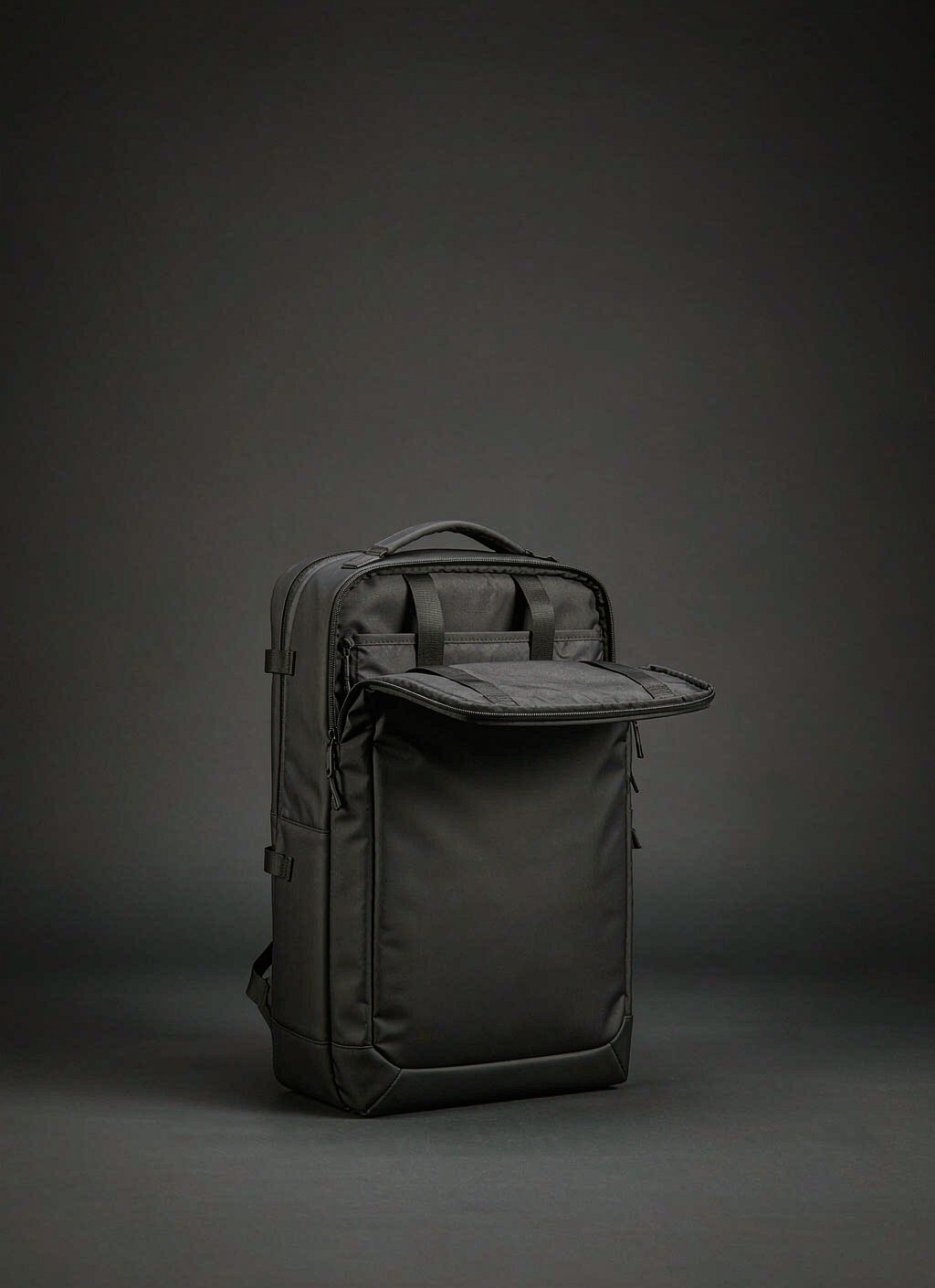
ISTA 3A is a general simulation procedure for one packaged product travelling through a parcel network, and for bag programmes it converts a damage complaint into a documented pass or fail on the exact pack-out used. A single sequence covers atmospheric conditioning, random vibration beneath a top load, free-fall drops onto faces, edges and corners, and a second vibration run with the load removed, with defined variants for flat and elongated parcels. Acceptance is not set by the procedure: the brand declares what product damage and what package condition it will tolerate, and the laboratory reports against that statement. Programme arithmetic follows the result — MOQ 500 per reference, prototype sampling at 6-10 working days, mass production 35-50 days, AQL 2.5 release inspection, then sea freight 25-35 days, air 5-8 days or express 3-5 days. Scope is civilian distribution through retail, e-commerce and wholesale channels; nothing here concerns weapon carriage, ballistic protection or defence qualification. The content here is general trade information, not legal advice for any market.
Where General Simulation Sits Among the ISTA Series
Procedures published by ISTA are grouped by how faithfully they try to reproduce a distribution environment. The 1-series tests are non-simulation screens: useful as a quick comparison between two pack-outs, weak as evidence about a real network. The 2-series are partial simulations, combining selected hazards. The 3-series are general simulations, and 3A is the one written for a single packaged product moving through a parcel system rather than a palletised load.
That distinction is the whole decision for most bag brands. A carton containing one backpack shipped to a consumer, one duffel shipped to a retailer, or one sample shipped to a buying office is a parcel consignment, and 3A is the matching procedure. The moment goods are unitised — shrink-wrapped to a pallet, containerised, or moved as a master carton of many units — the relevant procedure changes to the unitised route, because stacking, handling equipment and vibration input are entirely different.
Bags complicate the choice in one specific way: the product is soft and often ships inside its own carton with a void, or inside a polybag inside a carton, or occasionally in the bag's own body with no carton at all. A procedure written for a rigid box assumes the box carries the load; a pack-out where the bag itself absorbs the drop energy behaves differently at every step of a sequence.
| Family | What it reproduces | Fit for a bag programme |
|---|---|---|
| 1-series screens | No environment; repeatable comparative handling | Quick A-versus-B comparison of two carton sizes before committing to lab time |
| 2-series partial simulation | Selected hazards run one after another | Internal screening where a full general simulation is not yet justified |
| 3-series general simulation, single parcel | A parcel network sequence with vibration and shock | One backpack, duffel or pouch in a carton shipped direct to a consumer or a store |
| 3-series general simulation, unitised | Stacked, wrapped and palletised freight | Master cartons on pallets, container loads and warehouse-to-warehouse moves |
| Project procedures | A measured lane or a specific retailer protocol | Where one carrier lane dominates volume and has recorded data |
Selection rule: Choose 3A when the unit leaves as one parcel in its own carton, switch to a unitised procedure once goods travel as a palletised master carton, and use 1-series work only to rank options before booking laboratory time.
The Sequence in Order, and Why the Order Matters
The sequence begins with atmospheric conditioning, which brings the package and its contents to a defined temperature and humidity before any mechanical input. Conditioning is not a formality for textile goods: a nylon pack conditioned cold is stiffer, a coating is less compliant, and a carton that has taken up moisture from a humid warehouse loses a meaningful part of its stacking strength. Skipping the step produces results that flatter the pack-out.
Random vibration under a top load comes next. The package sits on a vibrating table while a load simulates the weight of parcels stacked above it in a trailer or a sorting cage. This step is where carton compression and closure failure usually appear, because vibration compacts void fill, settles the contents and lets the product migrate downward until the carton loses the support it had when it was packed.
Shock follows. The package is dropped in free fall onto a rigid surface, hitting faces, edges and corners in a defined order, with the drop height set by the mass band of the parcel. The order matters: drops onto a corner concentrate energy into the smallest contact area and into the weakest geometry of a carton, which is the corner and the seam where the box is joined.
A second random vibration run, this time without the top load, closes the sequence. The point is to reproduce the loose, unstacked part of the journey, after the carton has already been weakened by the drops. Damage that appears only in this last block is common and is exactly what a single-block test would miss.
Verdict: Insist on the full order — conditioning, vibration under load, drops, then vibration without load — because damage that only appears in the final block is the signature of a carton already weakened by the drops before it.
Why a Soft, Compressible Product Behaves Unlike a Carton
A rigid product inside a carton transfers drop energy into the box and into whatever cushioning sits between them. A bag does something else: it compresses, flows into the void and then rebounds, so the carton walls see a different load history and the product itself absorbs part of the impact. That is good news for the contents and bad news for repeatability, because two nominally identical parcels can behave differently depending on how the bag happened to be folded when it was packed.
Compression also changes the geometry of the parcel over the sequence. A pack shipped stuffed holds its shape; the same pack shipped flat and empty collapses under the top load, the carton settles, and the second vibration block then works on a parcel with a large void. Flat packing is the cheapest way to save freight per unit and one of the most reliable ways to generate damage complaints, because a loose product inside an oversized carton moves with every input.
The procedure handles this with variants for flat and elongated parcels, where drop orientation and the set of faces tested differ from a standard box-shaped package. A duffel in a long carton, a rolled modular EDC pouch in a flat mailer, or a folded modular travel backpack are not edge cases for a bag programme — they are the majority of what ships.
Hardware position matters too. A buckle, a moulded handle or a stiff internal frame creates a hard point that concentrates impact into one area of the shell, and abrasion damage at that point is a cosmetic return even when the bag functions perfectly.
Takeaway: Pack the test parcels exactly as the distribution centre will pack them — stuffed or flat, folded the same way, hardware in the same position — because a bag that is free to move inside its carton produces a different result every run.
Vibration, Resonance and the Void That Opens Up
Vibration damage is cumulative and quiet. Nothing dramatic happens in the first minutes; the damage appears after the input has been applied long enough to compact the void fill, walk the product downward, abrade a print or scuff a coated face against the carton wall. Two mechanisms account for most of it: resonance of some part of the product or packaging, and relative motion between parts that were never meant to rub against each other.
A bag has several parts that can resonate independently — a long webbing tail, a hanging strap, a loose internal divider, an unbuckled sternum strap flapping against the shell. Each is a small mass on a spring, and each turns a table input into local motion that abrades. Taping, tucking or sleeving loose elements before packing is a cheap fix that shows up immediately in test results.
Void formation is the other half. Once the contents settle, the carton has dead space, the flaps lose support and the closure tape works loose. Solutions are well known and worth stating explicitly: right-size the carton, add a void fill that does not itself migrate, or use an internal fitment that holds the bag in one position. Over-filling is the opposite error and pre-loads the closure before the sequence even starts.
Related reference methods exist for individual hazards, including free-fall drop testing of loaded containers published as an ASTM method, which is useful when one hazard needs to be isolated rather than run as part of a combined simulation.
Judgement: Fix loose webbing, straps and dividers before packing rather than after testing, since most vibration damage on soft goods is abrasion between parts that were free to move rather than structural failure of the carton.
Declaring Acceptance Before the Test Starts
The most common way a parcel test wastes money is that nobody agreed what a pass looks like. The procedure reproduces hazards; it does not decide whether the result is acceptable. That decision belongs to the brand, and it has to be written down before specimens go to the laboratory, because it is the one thing that turns a report into a decision document.
Three statements cover most programmes. Product condition: what damage is tolerated — no damage at all, cosmetic marks within a stated area, or full function with visible scuffing. Package condition: whether the carton may be split, whether flaps must still close, whether the closure tape may be lifted. Function: whether every closure, buckle, zipper and strap must operate afterwards, and whether any internal component must remain in place.
Writing these as measurable statements rather than adjectives is what makes them usable. A scuff of a stated length on a stated panel, a buckle that still releases by hand, a carton that still stacks: each can be checked by an inspector without interpretation. Vague acceptance language produces a report nobody can act on and an argument nobody wins.
Cost of the decision is asymmetric. Declaring strict acceptance on a premium product and then engineering the pack-out to meet it costs packaging material; declaring loose acceptance and discovering the difference in a returns queue costs the product and the customer. Sample size follows the same logic — enough parcels to see variation, not just one.
Bottom line: Write acceptance as three measurable statements covering product condition, package condition and function before specimens ship to the laboratory, because a report without a declared pass mark cannot settle a damage dispute.
From Damage Signature to Packaging Change
Reading a failed test is a diagnostic exercise. The observed damage points at a mechanism, and the mechanism points at one or two specific pack-out changes. Working backwards from the symptom avoids the reflex of simply specifying a heavier carton, which adds cost and weight without necessarily addressing the cause.
| Observed damage | Likely mechanism | Pack-out change |
|---|---|---|
| Carton corner split after drops | Energy concentrated at the smallest contact area, insufficient board strength | Higher board grade or reinforced corner construction, not more void fill |
| Scuffing on the shell face | Product moving against the carton wall during vibration | Sleeve or wrap the product, or add a fitment that fixes position |
| Worn webbing tails and strap ends | Loose elements resonating and abrading | Tuck and tape loose elements before packing |
| Closure tape lifted, flaps open | Void opened up as contents settled | Right-size the carton and add non-migrating void fill |
| Deformed buckle or stiff frame | Hard point taking impact load | Relocate the hard point or add local cushioning at that face |
| Creased pack body, permanent fold | Compressed beyond recovery under the top load | Ship stuffed rather than flat, or reduce stack height assumption |
Two cautions apply. First, changes interact: adding void fill to fix a settle problem can pre-load a closure and create a split, so re-test after any change rather than assuming the fix is additive. Second, record what changed as a revision, because a pack-out that passed in one season and fails in the next is usually a silent material substitution rather than a new problem.
Spec rule: Change one variable per re-test round and record it as a pack-out revision, since simultaneous fixes hide which change actually worked and make the next seasonal repeat impossible to diagnose.
When to Commission 3A, and How Results Feed the Calendar
Commissioning decisions should be event-driven. A new pack-out for a new product, a change of carton supplier or board grade, a move from stuffed to flat packing, a shift to a direct-to-consumer channel, a new carrier with different handling, or a damage rate that has crossed an internal threshold — each justifies laboratory time. Routine seasonal repeats with no change in materials, channel or carrier usually do not, once the pack-out has been qualified. Carton and board options sit with the product range team, and inspection slots are booked through the sampling and inspection desk.
| Trigger | Action | Calendar effect |
|---|---|---|
| New pack-out for a new reference | Full sequence on the production pack-out | Run in parallel with prototype sampling of 6-10 working days |
| Carton board or supplier change | Re-test drops and vibration under load | Book before mass production of 35-50 days begins |
| Move to direct-to-consumer shipping | Full sequence, parcel-sized carton | Adds about a week; decide before MOQ 500 is committed |
| Damage rate above internal threshold | Diagnostic round on returned pack-out | Hold the next shipment; releases resume after re-test |
| Change from stuffed to flat packing | Re-test with top load emphasis | Freight saving is real; verify it against damage cost first |
The SGS-verified production base we work with holds a 4,950 m² floor with 137 people across 7 production lines and 149 machines, and monthly programme volume of 200,000 units; the founder has been in bag production since 2004 and the company dates to 2014. Quotation returns in 24-48 hours, prototype sampling takes 6-10 working days, mass production 35-50 days from MOQ 500, release inspection runs at AQL 2.5 under ISO 2859-1 level II on FOB Xiamen terms, then sea freight 25-35 days, air 5-8 days or express 3-5 days.
Results are only useful when they reach the decision. A pass should be recorded as the qualified pack-out revision with its acceptance statements attached, so a later substitution can be compared against it. A fail should be recorded with the mechanism, because the same mechanism will recur in the next product if nobody writes down why the last one failed.
Qualifying the pack-out once per construction at prototype stage with the full sequence, then re-testing only on a material, channel or carrier change, keeps laboratory spend proportionate while each qualified pack-out stays on file as a numbered revision.
Records, Evidence and What a Retailer Will Ask For
A parcel test report earns its keep when somebody challenges it. Retailers, marketplaces and brand partners increasingly ask for distribution evidence before accepting a pack-out, and the questions are predictable: which procedure, which revision of the pack-out, what acceptance was declared, and what date the test was run. A report that answers all four in one page closes the conversation; one that answers two of them opens a new one.
The report should name the procedure and the year of the edition used, list the specimen count and the pack-out revision, reproduce the acceptance statements, and record conditioning. Photographs of the damage — or of the absence of it — are worth more than a pass line, because they let a reviewer judge severity instead of trusting a summary.
Keep the report with the pack-out specification rather than with the product specification. The two change on different cycles: a product can run for seasons while its carton is re-specified twice, and the evidence has to follow the carton. One folder per pack-out revision, named and dated, is enough.
Finally, treat the result as a snapshot of a network, not a certificate for a product. Parcel handling changes, carrier mixes change, and a pack-out qualified for one lane is not automatically qualified for another. Re-testing on entry to a new major lane is proportionate and cheap compared with a season of damage claims.
Filing each report against a numbered pack-out revision — procedure edition, specimen count, declared acceptance and conditioning — means a retailer asking all four questions gets one page instead of a fresh investigation.
Frequently asked questions
What does ISTA 3A actually test on a bag shipment?
ISTA 3A reproduces a parcel network sequence on one packaged product: atmospheric conditioning, random vibration under a stack load, free-fall drops onto faces, edges and corners, then vibration again without the load. Acceptance is declared by the brand. Prototype sampling runs 6-10 working days before the round is booked.
When should a bag programme commission ISTA 3A testing?
Commission it for a new pack-out, a board or supplier change, a move to direct-to-consumer shipping, or when the damage rate crosses an internal threshold. Routine seasonal repeats with no material or channel change generally do not need it.
How is a pass defined in a parcel test?
The procedure does not define it. The brand declares acceptance as three measurable statements covering product condition, package condition and function, and the laboratory reports against them. Write them before specimens ship, then release bulk at AQL 2.5.
Why do bags behave differently from boxes in drop testing?
A bag compresses and rebounds, so the carton sees a different load history and the product absorbs part of the impact. Flat-packed bags collapse under the top load, opening a void, so the second vibration block works on an oversized parcel.
Does ISTA 3A cover palletised shipments?
No. It is written for a single packaged product moving as a parcel. Once goods are unitised into master cartons on a pallet or loaded into a container, the stacking and handling inputs change and a unitised procedure applies instead.
How many parcels should be tested?
Enough to see variation rather than a single specimen, since soft products packed by hand vary run to run. The count should be stated in the report along with the pack-out revision, and the specimens must be packed exactly as the distribution centre packs them.
What causes carton corner splits after drops?
Corner drops concentrate energy into the smallest contact area and the weakest geometry of the box. The fix is usually board grade or corner construction rather than extra void fill, and the change should be verified in one re-test round.
Why does my bag arrive scuffed but undamaged?
Scuffing is abrasion from the product moving against the carton wall during vibration, or from loose webbing, straps and dividers resonating. Sleeve the product, add a fitment, and tuck loose elements before packing.
Should bags be shipped stuffed or flat?
Stuffed packing holds shape and resists the top load, but costs more freight per unit; flat packing saves cube and risks creasing plus void formation. Decide with a test rather than a spreadsheet, then record the qualified packing method as a revision.
How long does a parcel test take and does it delay production?
Laboratory time is additional to sampling, so book the slot when the sample order is raised. Samples are built in 6-10 working days and bulk in 35-50, so a round run alongside sampling does not extend the critical path.
What records should be kept after a parcel test?
Keep the report with the pack-out specification, not the product file: procedure edition, specimen count, declared acceptance, conditioning and photographs. Product and carton are re-specified on different cycles, so the evidence has to follow the carton.
Does a pass on one carrier lane apply to another?
Treat a result as a snapshot of one network. Handling equipment, sorting and stacking vary between carriers and regions, so re-testing on entry to a new major lane is proportionate and far cheaper than a season of damage claims.
How does freight choice interact with parcel test results?
Longer, softer journeys accumulate more vibration input. Allow about 25-35 days on the water versus 5-8 days by air and 3-5 by express, so a pack-out qualified on an express lane deserves a fresh look before a sea programme.
Can a failed test be resolved by using a stronger carton?
Sometimes, but it is the reflex rather than the diagnosis. Map the observed damage to its mechanism first: abrasion needs a sleeve or fitment, settling needs right-sizing, and board strength only addresses corner and compression failures.