Home › Field notes › Modular Bag for Utility Meter Reading: One-Hand Terminal Access, Ticke
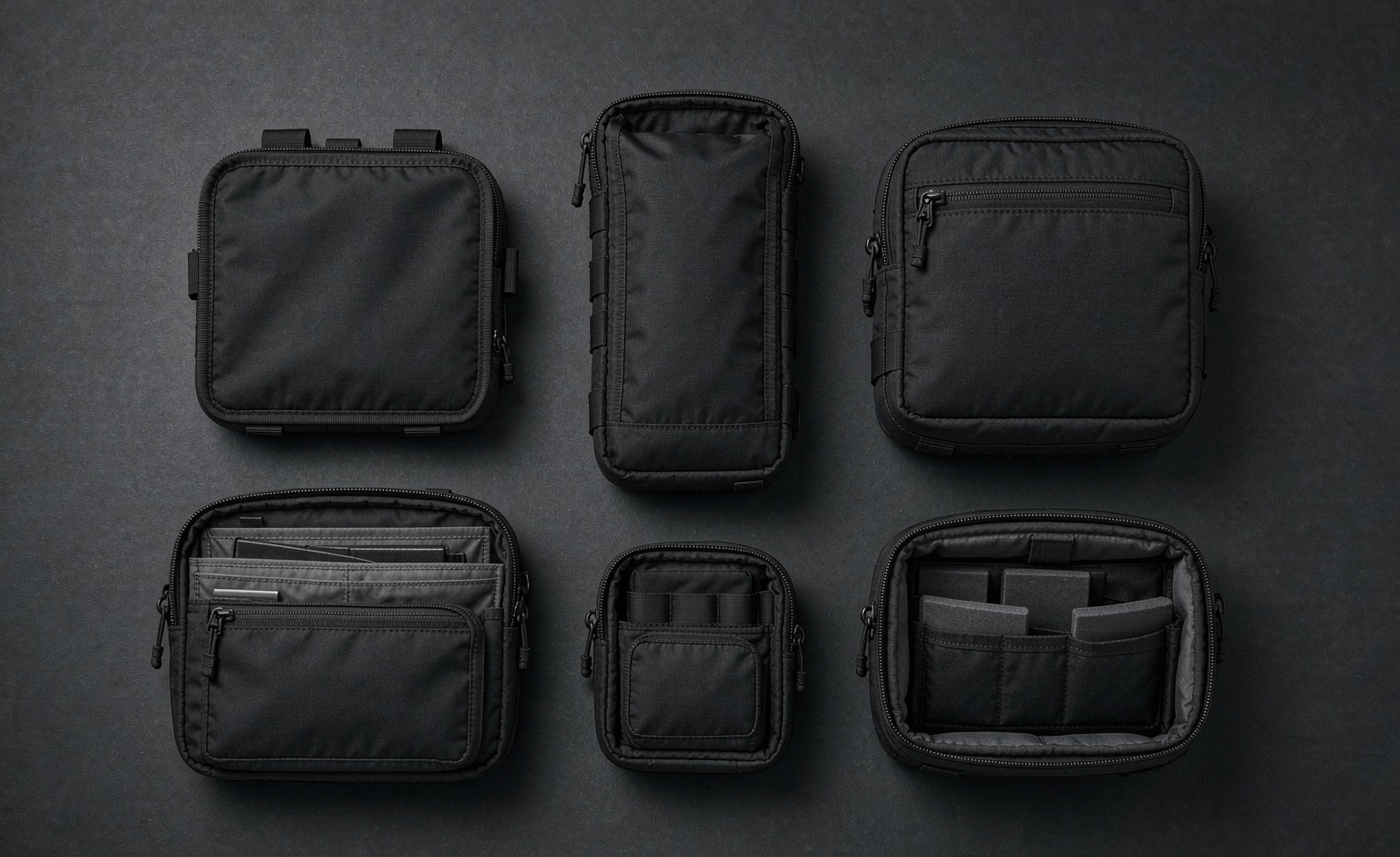
A modular bag for utility meter reading keeps the handheld terminal in a fixed outer position that opens, releases and closes with one hand, routes tickets and door tags through separate dirty and clean states, and puts retroreflective material on the face that traffic sees. Minimum quantity is 500 pieces per reference, samples are ready in 6-10 working days, volume production needs 35-50 days and dispatch follows an AQL 2.5 inspection on FOB Xiamen terms. Grid rows follow a 38 mm vertical spacing and repeat every 50 mm, the pitch PALS geometry is documented at. The boundary is civilian utility fieldwork — meter reading, meter exchange support and route inspection — and covers no weapon carriage, no ballistic claim and no military certification of any kind.
What a Meter Reading Bag Carries Across a 400-Stop Route
A reader on a dense urban route walks 8-14 km and visits 350-450 meters in a shift. The load-out is small by weight and unforgiving by organisation: a handheld terminal with a probe or optical reader head, a door tag pad, a pen, a torch for dark stairwells, a small hand tool set for lid lifting, a key or a meter-box tool, gloves, and somewhere for the tickets that have been handed in.
The weight is modest — 2.5-4 kg all in — but the access count is extreme. The terminal comes out and goes back at every one of those stops, which is 350-450 cycles a shift, or roughly one every 60-90 seconds. Any design decision that adds a second to each cycle costs the reader between six and eight minutes of productive time a day, and across a fleet of 200 readers that is the argument that settles the layout.
| Item | Cycles per shift | Position required | Failure if misplaced |
|---|---|---|---|
| Handheld terminal with reader head | 350-450 | Outer, one-hand, traffic-side away | Two-hand access; dropped device |
| Door tag pad | 60-120 | Outer, flat, dry | Wet pad; unreadable tag |
| Pen or stylus | 100-200 | Fixed loop at terminal height | Search time at every stop |
| Torch | 20-40 | Outer, hip or chest | Dark stairwell, no light |
| Lid lifter and hand tools | 10-30 | Indexed slots, rattle-free | Lost tool; noisy walk |
| Dirty ticket sleeve | 10-30 | Outer, sealed, washable | Contamination of terminal |
| Gloves, water, personal kit | 3-8 | General volume | None critical |
Two things follow from the table. First, the terminal position is the only layout decision that really matters, and everything else is arranged around it. Second, the dirty ticket sleeve is not a nicety: a gas or water meter pit produces wet, dirty paperwork, and paper that has been in a pit has no business in the same compartment as a 600 euro terminal.
Selection rule: Give the terminal a fixed outer pocket sized for one-hand release, put the ticket sleeve outside the main volume and sealed, and index every tool so no item needs to be searched for at a stop.
Single-Hand Operation: The Three-Motion Test
One-hand operation is often asserted and rarely specified. The three-motion test makes it measurable: with the bag worn and the reader standing, the terminal must be released in one motion, seated in one motion, and the pocket secured in one motion. Three motions, one hand, no second hand touching the bag, no looking down.
Release is the hardest of the three. A terminal in a pocket with a covered zip needs a pull and a lift; in an open-topped pocket with a retention strap it needs a lift only. The open-topped pocket wins on speed and loses on security, which is why the retention strap has to be part of the design rather than an accessory: a strap with a press stud or a magnetic catch that the thumb breaks on the way up.
Seating is the second motion and it is where pockets are too tight. A terminal that has to be aligned before it drops in cannot be seated one-handed, so the pocket mouth is cut 8-12 mm wider than the device on each side and the floor is shaped so the device self-centres. Self-centring is the property that makes the motion possible, and it costs nothing at the tooling stage.
Securing is the last of the three and it is the step readers skip when the pocket is awkward. A pocket that requires a second hand to close is a pocket that is left open, and an open pocket at a pit is a dropped terminal. Where the retention strap is magnetic, closing is the same motion as seating, which is the design that gets used.
Height matters as much as closure. The pocket should sit at hip to lower-chest height so the hand drops to it naturally rather than reaching across the body, and on a hip belt the pocket sits forward of the hip bone rather than behind it.
Takeaway: Require release, seating and securing as three single-handed motions, cut the pocket mouth 8-12 mm wider than the device with a self-centring floor, and close it with a magnetic or press-stud retention the thumb breaks on the way up.
Ticket and Door-Tag Flow: Dirty, Clean and Delivered States
Paperwork is the part of a reading route that generates complaints, and the failure is almost always mixing states. Three states exist on a route and each needs its own physical home.
Clean stock is the unused door tag pad and any blank forms. It lives in a flat, dry sleeve, because a wet pad cannot be written on and a reader who cannot write a tag leaves no tag. The sleeve should be flat rather than gusseted: a gusset lets the pad curl, and a curled pad jams in the hand at a stop.
In-progress paperwork is the tag being carried between the meter and the reader's hand, and it needs a temporary home that is not the teeth and not the terminal pocket. A short clip or a slip pocket on the front of the bag, reachable without breaking stride, handles this; the alternative, holding three sheets in the left hand while working the terminal with the right, is how sheets get dropped in a stairwell.
Delivered or dirty paperwork is the third state and it is where contamination happens. Anything that has been near a meter pit — wet, muddy, sometimes carrying residue — goes into a sealed sleeve with a welded seam, outside the main volume and washable. A sleeve that holds 20-30 sheets covers a shift. Specifying it as a separate module rather than a pocket means it can be emptied and wiped at the depot without touching the bag.
The last element is the return loop. Readers bring back paperwork that has to be identifiable by route and by reader, so the sleeve carries a clear external window for a route card. That is a one-line specification item that saves an admin hour at the depot every day.
Bottom line: Separate clean stock, in-progress sheets and dirty returns into three physical positions, seal the dirty sleeve outside the main volume, and give it a clear window for a route card.
Tool Indexing for Field Service: Fixed Positions Beat Search
Readers carry a small tool set — a lid lifter, a meter-box key, a small driver, sometimes a shackle tool — and the set is used rarely enough that nobody remembers where it went. Indexing fixes this and, unlike a pocket layout, indexing survives changes in the tool set.
An index is a set of fixed slots with a silhouette or a colour behind each one, so a missing tool is visible at a glance rather than discovered at a stop. Six to eight slots cover a utility tool set, and each slot is cut to the tool rather than generously sized: a loose tool rattles, and a rattling tool is the noise complaint that gets a bag design revised.
The tool zone should be separated from the terminal. Steel against a terminal screen is a cracked screen, and the tools tend to be the dirtiest things in the bag after a pit visit. A rigid divider between the two is the whole solution.
Weight placement matters even at 3 kg. Tools carried high and outboard swing; carried low and close to the body they do not. On a hip-mounted layout the tool roll goes behind the hip bone and the terminal forward of it, which keeps the heavy small parts near the body's centre and the frequently reached item nearest the hand.
Judgement: Index six to eight tools in cut-to-fit slots with a visible backing, separate the tool zone from the terminal with a rigid divider, and place tools low and close to the body so nothing swings on a 10 km walk.
Which Carry Position for a Meter Reading Bag: Three Options Compared
Position decides visibility, access speed and end-of-shift comfort, and the three viable options trade against each other in a way that makes the choice fleet-specific. The comparison below assumes a 2.5-4 kg load, a 350-450 stop route and an eight-hour shift that includes winter darkness.
| Criterion | Belt pouch | Chest rig | Shoulder bag |
|---|---|---|---|
| One-hand terminal access | Best; hand drops to the hip | Good; both hands available | Poor; bag swings away |
| Face presented to traffic | Low and close to the body | Highest and broadest | Side-on, variable |
| Comfort over an eight-hour shift | Good below 3 kg | Best for loads above 3 kg | Poor; one-sided load |
| Behaviour at a meter pit | Stays put when kneeling | Can foul the working area | Slides off the shoulder |
| Compatibility with a hi-vis vest | Excellent | Covers part of the vest | Covers the shoulder band |
| Best route profile | Dense urban, short stops | Rural, long walks, winter routes | Supervisory or low-stop routes |
The compatibility row is the one that gets missed. A utility reader wears a high-visibility vest for most of the shift, and any bag that covers the vest's retroreflective bands reduces the thing the vest is for. A belt pouch sits below the bands and a chest rig covers them, which is why fleets with a strong safety culture specify a hip-mounted layout even where a chest rig would be faster to work from.
Load is the second tie-breaker. Below 3 kg the hip is comfortable for eight hours; above 3 kg the hip starts to complain by hour six, and a chest rig distributes across the torso. The honest answer for a fleet that carries a terminal, a tool roll and a water bottle is a hip pouch plus a small chest pouch, splitting the load rather than choosing one position.
Verdict: Specify a hip-mounted terminal pouch wherever a hi-vis vest is worn, add a chest pouch once the load passes 3 kg, and avoid a shoulder bag for any route above 200 stops.
Retroreflective Area and Visibility for Roadside Work
Readers work at the kerb, at night, in rain, and often with their back to traffic while they lift a lid. Visibility is a specification item in the same class as zip quality, and it is specified as area and position rather than as a colour name.
Area comes first: a continuous band of retroreflective material, not a logo and not a scatter of piping. Scattered piping reads as decoration at 50 m and as nothing at all at 100 m. A band 50 mm wide running across the full width of the traffic-facing panel is the minimum that reads as a person rather than as a reflection.
Position comes second and it has to be described relative to how the bag is worn, not relative to the bag itself. On a hip pouch the band goes on the outer face at hip height; on a chest rig it goes across the chest panel and along both shoulder straps. The specification should say so explicitly, because a band placed on the front of a hip pouch faces the reader's own legs.
Colour is third. Fluorescent background material works in daylight and does nothing at night; retroreflective tape works at night and does little in daylight. Utility fleets get both by specifying a fluorescent body panel with a retroreflective band on top, which is also the arrangement most national roadside workwear guidance converges on.
Durability is fourth and it is the one that gets forgotten. Retroreflective tape abrades, and a band on the outer face of a hip pouch abrades against vehicle door frames every time the reader gets in. Naming a replacement interval in the specification, and making the band a sewn-on part rather than a bonded one, keeps the bag compliant for the life of the contract.
Spec rule: Specify a continuous 50 mm retroreflective band across the full width of the traffic-facing panel, position it relative to how the bag is worn, back it with fluorescent body material, and make it a sewn and replaceable part.
Weather, Gloves and the Winter Reading Season
Winter is when reading routes get harder and when bag design faults surface. Three conditions matter: rain, cold and early darkness, and each has a specific answer.
Rain is handled at the mouth rather than at the fabric. A reader working a route in persistent rain opens the terminal pocket 350-450 times, and no cover that has to be unrolled or re-closed each time will be used. The answer is a stiffened lip over the pocket mouth that sheds water while staying open, plus a drain path at the pocket floor so whatever does get in leaves. Fabric claims still matter — water resistance of the shell measured to AATCC 127 and colour transfer from trim to AATCC 8 — but the mouth does most of the work.
Cold is a glove problem. A reader wearing winter gloves cannot manage a 15 mm puller or a small press stud, so every outer pocket on a winter route uses a 30-40 mm puller and a closure that can be worked with the whole hand. The terminal pocket needs the same treatment plus a mouth broad enough to admit a gloved hand and reach past the device walls.
Darkness is a torch problem and a position problem. A torch carried loose in the main volume is a torch that is not in the hand when a stairwell is dark, so it gets an outer indexed loop at hip or chest height. It is also the item most often left behind at a stop, so the loop should be closed rather than an open clip.
Battery behaviour in cold is worth a line as well. Terminal batteries lose capacity in low temperatures, and a spare carried in an inner pocket close to the body holds charge better than one in an outer pocket. A spare battery in a terminal-isolated inner sleeve is a cheap fix for a fleet-wide winter complaint.
In practice: Shed water at the pocket mouth with a stiffened lip and a drain path, size every outer puller at 30-40 mm for gloved use, index the torch in a closed outer loop, and keep a spare battery in an inner sleeve near the body.
Acceptance Checks Before a Utility Fleet Rolls Out
Utility fleets roll out to hundreds of readers at once, which means a design fault is multiplied by the fleet size before anyone sees it. A two-day acceptance run on samples is the cheapest insurance available. Each check is performed on pre-tooling samples and then repeated on units pulled from the opening production lot, with finished-goods acceptance against the acceptance plan in ISO 2859-1 and coating behaviour of the shell to ASTM D751.
| Check | How it is run | Sample size | Release condition |
|---|---|---|---|
| Three-motion access | Release, seat and secure the terminal one-handed | 3 units, 20 trials | 60 of 60 with no second hand |
| Gloved operation | Work every outer pocket wearing winter gloves | 3 units | All pockets operable; no glove removal |
| Retention security | Invert the loaded bag and shake 10 times | 3 units | Terminal retained, pocket closed |
| Sleeve containment | 50 ml of water in the ticket sleeve, laid flat 30 min | 5 sleeves | No moisture outside the sleeve |
| Retroreflective area | Measure band width and continuity on the worn face | 3 units | 50 mm continuous across the full width |
| Lot release | Acceptance plan taken from ISO 2859-1, level II | One plan per lot | No critical, major 2.5, minor 4.0 |
Carton handling deserves a line for a fleet order. Bags are usually delivered to a depot and issued directly, so carton condition matters more than it would for a retail programme, and naming ISTA 3A testing is worth the line. Packing density sets the rollout plan: a 20GP takes around 28 CBM and a 40HQ around 68 CBM, which determines how many depots can be supplied from one shipment.
Design note: Release only after 60 of 60 one-handed terminal cycles, full gloved operation of every outer pocket, a 50 ml sleeve hold with no external moisture, and a continuous 50 mm band on the traffic-facing panel.
Order Gates, Branding and Rollout Calendar for Utility Fleets
Fleet orders are procurement exercises with a fixed issue date, so the calendar runs backwards from the rollout. Two decisions compress it more than any other: approving the terminal pocket geometry against the actual device, and fixing the branding method before the first sample.
The commercial gates are straightforward. Minimum quantity is 500 pieces per reference; samples are ready in 6-10 working days, rising to 12-15 where a moulded terminal pocket is cut, and the sampling charge of USD 50-150 is returned on the order. Tooling plus screens runs USD 300-2,500. Quotations come back within 24-48 hours and are indicative, FOB Xiamen, at the 500-piece quantity.
Vetted partner facilities provide 4,950 m² of SGS-verified production floor, 137 operators, 7 production lines, 149 machines and a rated capacity of 200,000 units monthly; the founder entered bag production in 2004 and the company dates to 2014. Series production runs 35-50 days from PP sample approval, inspection is at AQL 2.5 and settlement runs 30/70 T/T. Delivery runs 25-35 days by vessel, 5-8 by air or 3-5 by express courier.
Branding is worth deciding early because it interacts with visibility. A printed logo placed on the traffic-facing panel reduces usable retroreflective area, so the logo position and the band position are specified together rather than separately. Fleet colour is the other early decision: a dark body hides dirt across a winter route but reduces conspicuity, and most fleets settle on a mid-tone body with a fluorescent panel rather than an all-dark shell. Brief both through the custom programme desk, and see the mounting options on the chest and waist range and the everyday carry modules.
Field note: Fix terminal pocket geometry against the real device and fix logo position together with the retroreflective band, then allow 6-10 days for samples, 35-50 days for the build and 25-35 days for the sea leg.
Frequently asked questions
What size should a modular bag for utility meter reading be?
Between 4 and 8 litres for a hip-mounted layout, or 8-12 litres for a chest rig. Above 12 litres the bag starts covering the hi-vis vest bands, which costs more in safety than the extra volume is worth. Terminal pockets are the exception, since a fixed outer address matters more than the litres behind it.
How is one-hand terminal access tested before a fleet order?
With a 20-trial run per unit across three units: release, seat and secure the terminal with one hand and no second hand touching the bag. The pass condition is 60 of 60 successful cycles. Three units are used, and any trial needing a second hand fails the pocket rather than the operator.
Should the terminal pocket be open or zipped?
Open with a magnetic or press-stud retention strap. A zipped pocket needs a pull and a lift, and at 350-450 cycles a shift the extra motion costs six to eight minutes a day per reader. A magnetic retention closes in the same motion as seating, which is why it gets used and a zip does not.
How are dirty tickets kept away from the terminal?
In a sealed sleeve with a welded seam, mounted outside the main volume and holding 20-30 sheets. Acceptance fills it with 50 ml of water for 30 minutes and requires no moisture outside. The sleeve also carries a clear window for a route card, which saves admin time at the depot each day.
Which carry position works best with a high-visibility vest?
A hip pouch. It sits below the vest bands, whereas a chest rig covers part of them and a shoulder bag covers the shoulder band, reducing the conspicuity the vest exists to provide. Above 3 kg a chest pouch is added alongside the hip pouch rather than replacing it.
How much retroreflective material is enough on a reading bag?
A continuous 50 mm band across the full width of the traffic-facing panel, positioned relative to how the bag is worn. Scattered piping reads as decoration at 50 m and disappears beyond 100 m. Fluorescent body material covers daylight hours, since retroreflective tape alone does little before dark.
Can every pocket be worked while wearing gloves?
Yes, if pullers are 30-40 mm and closures can be worked with the whole hand. A 15 mm puller or a small press stud is unusable in a winter glove, which is why cold-weather routes specify oversized hardware. Acceptance requires every outer pocket to be operated with no glove removal across three sample units.
Where should the torch be carried on a winter route?
In a closed outer loop at hip or chest height. A torch loose in the main volume is not in the hand in a dark stairwell, and an open clip loses it at a stop. A torch left in the main volume is not in the hand when a stairwell light has failed.
How long does sampling take for a utility field bag?
6-10 working days, rising to 12-15 where a moulded terminal pocket has to be tooled. The USD 50-150 charge is returned once the 500-piece order is confirmed. Volume production then takes 35-50 days, with inspection at AQL 2.5 before the fleet issues.
What is the minimum order for a fleet issue of meter reading bags?
500 pieces per reference. That quantity spreads the USD 300-2,500 tooling and screen cost across the run and keeps the FOB Xiamen unit price quoted in the 24-48 hour turnaround. Samples are ready in 6-10 working days, rising to 12-15 where a moulded terminal pocket has to be cut.
How is rain handled on a route with 400 stops?
At the pocket mouth rather than the fabric: a stiffened lip that sheds water while staying open, plus a drain path at the pocket floor. No cover that must be re-closed 400 times a day gets used. Water resistance of the shell is still measured to AATCC 127, but the mouth does most of the work.
Which fabric tests should a utility bag specification name?
AATCC 127 for spray resistance, AATCC 8 for rub fastness of trim, and ASTM D751 for coating behaviour. Lot release uses the ISO 2859-1 acceptance plan at level II. Lot release uses the ISO 2859-1 acceptance plan at level II, with no critical defects permitted.
What production and delivery timeline should a fleet plan for?
6-10 working days for samples, 35-50 days for the production run and 25-35 days by vessel, or 5-8 days by air and 3-5 by courier. Plan the rollout date backwards from the sea leg. Samples are ready in 6-10 working days, and inspection at AQL 2.5 precedes dispatch.
How is fleet branding placed without hurting visibility?
By specifying the logo position and the retroreflective band in the same drawing. A printed logo on the traffic-facing panel eats usable band area, so the two are designed together rather than separately. Fleet colour is decided at the same time, since an all-dark shell hides dirt but reduces conspicuity.