Home › Field notes › How Modular Bag Systems Are Made: Production Process Steps
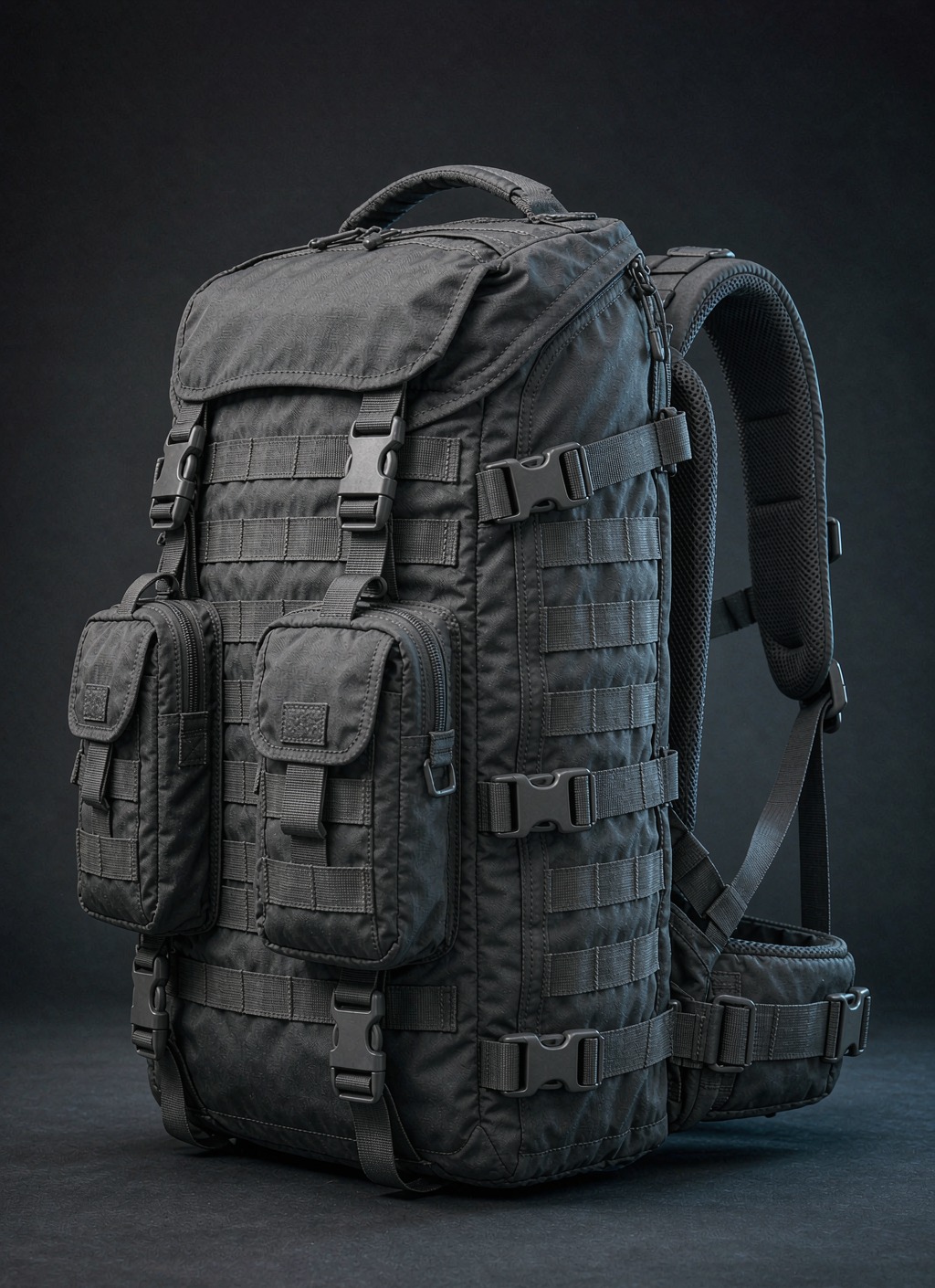
Modular bag systems are assembled in a fixed order because the interface cannot be retrofitted: the webbing field and its anchorage must be applied to the shell before the body is closed, so any change to row spacing after that point reopens the panel stage rather than the sewing stage. Everything else in the sequence follows from that constraint. This article walks the production path from the released technical file through material verification, cutting, sub-assembly, field application, main assembly and hardware fitment, and then covers the inspection stations with their reaction rules and the yield-loss sources specific to modular work. Capacity context is 7 production lines, 137 people and 149 machines on a 4,950 square metre floor, with MOQ 500 and AQL 2.5 release.
From released brief to a technical file the floor can run
Nothing reaches a cutting table until a file is closed. A closed file contains a graded specification, a complete bill of materials, released artwork, and a reference sample that both sides agree is the standard. Until those four exist, the floor can only guess, and guessing on a modular programme is expensive because interface dimensions cannot be corrected later.
The bill of materials carries more weight here than on a conventional bag. A modular programme pulls shell fabric, lining, webbing, interlining, at least two hardware families, closures, thread and often a moulded or die-cut component. Each line has its own supplier and its own availability window, and the slowest line sets the real start date regardless of how fast sewing runs.
Artwork release is the item most often underestimated. Woven labels, printed tapes, transfers and swing tickets are produced by different suppliers on their own timetables, and they frequently land after the sewn goods are already complete. The control is simple and routinely ignored: raise the trim order at the same moment bulk is given its release, rather than when packing comes into view.
Our production team issues a material-lead register at file closure. The register records every input, the mill or maker supplying it, the delivery window confirmed against it, and an alternative already approved should that source slip. That register is the document a buyer should ask for before asking for a completion date, because it is the only artefact that distinguishes a schedule from an estimate.
Selection rule: Ask for the closed technical file and the material register before asking for a completion date, because an order released at MOQ 500 is only schedulable once every input has a named source and an approved substitute.
Material inbound: verification before anything is cut
Incoming material is verified against the approved standard before it is issued to cutting. Three checks run in sequence, and each produces a record that later disputes depend on.
Shade verification is first. Fabric arrives in dye lots, and a lot that sits outside the approved band will produce a finished bag that does not match the reference. The control is a shade band card: a card of acceptable range signed at inbound, against which production and any later dispute are judged. Judgement happens under a specified light source, not under whatever lighting is available.
Physical verification is second. Fabric weight, coating behaviour and tear resistance are checked against the specification, and webbing is measured for width because a webbing that is half a millimetre wide changes how a strap threads. Hardware is checked for function, and a sample is pull-tested.
Documentation verification is third and increasingly the one that stalls shipments. REACH (EC 1907/2006) and California Prop 65 declarations for materials, OEKO-TEX Standard 100 where claimed, EN 1811 for metal in skin contact, and CPSIA coverage for school-age products must all be tied to the specific materials received. A report covering last season's supplier does not cover this season's delivery.
Fabric that fails any of the three is quarantined, not downgraded. Downgrading is how a shade deviation becomes a customer complaint three months later.
The quarantine decision has a schedule cost, and pretending otherwise causes more damage than the delay. Replacing a rejected dye lot typically adds the supplier's lead time to the front of the programme, which is why the material-lead register includes an approved substitute for every input. Where a substitute is used, the shade band card is reissued against the substitute so that production and any later dispute are judged against what was actually cut.
Verdict: Verify roll identity, physical shade and substance documentation before material is issued to cutting, since a substitution found after panels exist consumes the slot held inside the 35-50 day calendar rather than a day of incoming inspection.
Cutting and panel preparation
Cutting converts verified material into components with a stated tolerance, and on a modular programme the tolerance burden is unevenly distributed: panels carrying an attachment field need tighter control than panels that do not.
| Order | Input state | Operation | Document created |
|---|---|---|---|
| 1 | Verified material issued | Marker planning and spreading | Yield percentage per marker |
| 2 | Spread lay | Cutting to component | Cut quantity tally by size |
| 3 | Cut components | Fusing interlining to panels | Fusing temperature and dwell log |
| 4 | Fused panels | Creasing, notching and bundling | Bundle ticket against work order |
| 5 | Bundled panels | Field application where specified | Row pitch gauge reading |
| 6 | Prepared panels | Sub-assembly of pockets and modules | Sub-assembly dimension chart |
| 7 | Sub-assemblies | Main assembly | Daily output board by line |
| 8 | Assembled bodies | Hardware and closure fitment | Pull and function test log |
| 9 | Finished bodies | Inspection and packing | AQL 2.5 report and loading sheet |
Fusing deserves a note because it is the least visible operation and one of the most consequential. Temperature, dwell time and pressure determine whether an interlining bonds permanently or delaminates after the first wash. Those three parameters are logged, and a log exists precisely so that a delamination claim months later can be traced to a fusing batch rather than argued about.
Bundling by work order, rather than by colour alone, is what keeps a multi-colourway programme from mixing components. A bundle ticket travels with the work and is the unit of traceability for everything downstream.
Marker yield deserves a note because it is where material cost is quietly won or lost. A well-planned marker on a modular panel set recovers several percentage points of fabric against a rushed one, and on a shell with a directional pattern or a large panel the difference is larger still. Yield is logged per marker precisely so that a cost variance can be attributed to planning rather than argued about afterwards.
Sub-assembly: pockets, modules and lining units
Capacity planning sits behind the stage order and is worth stating plainly. With 7 production lines, 137 people and 149 machines on a 4,950 square metre floor, output reaches 200,000 units monthly, and slots are allocated against closed files rather than against enquiries. A buyer who closes early gets an earlier place in the queue.
Sub-assembly builds the parts that will later be closed into a body, and it is where modular programmes diverge most from conventional ones. On a conventional pack, pockets are built into the body progressively. On a modular programme, modules are complete products in their own right, built to their own dimension and tested before they ever meet a chassis.
That independence is the reason a modular programme can share a chassis across several listings. The body run is common; the module runs differ; the two meet late, at packing or at assembly depending on architecture. It also means each module needs its own dimension chart, its own closure test and its own retention check.
Lining units are built separately for the same reason. A lining assembly with multiple pockets, a device sleeve and a routing path is a complex unit, and building it flat before it is inserted produces a better result than constructing it inside a closed body where access is limited.
The tolerance that matters most in sub-assembly is the interface dimension on a module. A mounting strap a few millimetres out of position produces a module that sits skewed on the chassis, which users read as a defect even though every measurement on the chassis is correct.
Sub-assembly is also the natural point at which to run a retention check on each module, because the part is still open and accessible. Threading a module onto a gauge chassis and applying its rated load takes seconds at this stage and cannot be done later, once the module is packed and the chassis is closed.
Bottom line: Thread each module onto a gauge chassis under rated load while seams remain open, then plan sequence capacity against 7 production lines and 149 machines rather than against a headline unit figure for a simpler product.
Field application: the operation that fixes the sequence
The attachment field is applied at stage five, before main assembly, and that position is not arbitrary. The row-end anchorage has to be stitched while the panel is still flat and open, because the machine cannot reach it afterwards. A field applied out of sequence is therefore either poorly anchored or anchored not at all.
Three controls govern the operation. Row pitch is gauged cumulatively across the panel rather than row by row, because a sub-millimetre per-row error accumulates and a pouch that threads at the first row will not thread at the sixth. End anchorage is bar-tacked to a stated length with no negative tolerance, because a row that lifts at one end disables every position above it. And the backing behind the field is verified, because a field on an unstiffened panel will deform under load and lean the pouch away from the body.
Thread and needle selection follow from the material. A coated shell needs a needle and thread combination that does not perforate the coating along the stitch line, since perforation is where water ingress begins on a water-resistant product.
Verification at this stage is functional rather than dimensional alone: a gauge pouch is threaded through every row. That takes seconds and it catches the two defects that actually occur, progressive pitch error and weak end anchorage, neither of which is visible in a measurement of a single row.
Main assembly and hardware fitment
Main assembly joins prepared panels and sub-assemblies into a finished body. The operation order is set by access: everything requiring access to the interior or to a seam allowance must happen before that access closes.
Hardware fitment follows assembly and is the stage most often rushed at the end of a schedule. Buckles, sliders, adjusters and any magnetic-guided or mechanical snap fitting are set and function-tested. A slider installed on a chain with a damaged element will fail in the customer's hands, and a buckle with a moulding flash at the engagement face will not lock fully.
Pull testing is done on a sample per line per day rather than on every unit, which is the right balance: the failure mode is systematic, so a daily sample detects it, while unit-by-unit testing would consume the schedule for no additional assurance.
Where a programme uses a proprietary fitting, this is the stage where tooling quality becomes visible. A tool that has been cut and trialled correctly produces parts that engage with a consistent feel; one that has not produces variation that no amount of assembly care can correct. This is precisely why the tooling window, at USD 300-2,500 per item, sits before bulk rather than inside it.
Takeaway: Cut tooling before bulk rather than inside it, deciding that during the 6-10 working day sampling round, because variation introduced by un-tooled hardware cannot be corrected by assembly care later.
In-line inspection stations and the reaction each one triggers
Inspection on a modular line is positioned rather than terminal. Problems are cheaper to catch at the station that created them, and four stations carry most of the assurance burden.
| Station | Measurement taken | Reaction on failure |
|---|---|---|
| Material inbound | Shade band and fabric weight | Quarantine the lot; no downgrading |
| After fusing | Bond strength and temperature log | Hold the batch; re-fuse or scrap panels |
| After field application | Cumulative row pitch; gauge pouch thread | Stop the line; re-gauge the jig |
| After sub-assembly | Module dimension and interface position | Rework before the part enters assembly |
| After hardware fitment | Function and pull test on a daily sample | Hold the day's output pending re-test |
| Final inspection | AQL 2.5 sampling by lot size | Reject, rework or release per the report |
The distinction between a hold and a stop matters. A hold isolates output pending a re-test and costs hours; a stop halts the operation until the cause is found and costs a shift. Field application failures always warrant a stop, because the cause is a jig or a gauge rather than a unit, and continuing produces defect after defect.
Final inspection draws its sample under ISO 2859-1, where the lot quantity determines how many units get examined and how many faults are tolerated at AQL 2.5. A buyer pressing for a quicker release is pressing for fewer units to be examined, which weakens the conclusion rather than accelerating it.
Judgement: Position inspection at the station that created the fault and draw final samples under published sampling plans at AQL 2.5, because a buyer pressing for faster release is really asking for fewer units to be examined.
Yield loss sources specific to modular assembly
Modular programmes lose units in places a conventional programme does not, and the loss is concentrated at interfaces rather than at seams.
| Loss source | Stage it surfaces | Containment |
|---|---|---|
| Cumulative row pitch drift | Field application | Gauge the full panel; stop rather than rework |
| Interface misalignment on a module | Sub-assembly | Dimension chart per module type |
| Coating perforation along a stitch line | Assembly | Needle and thread matched to the shell |
| Fusing delamination | After wash or after weeks | Temperature, dwell and pressure logged per batch |
| Hardware engagement variation | Fitment | Daily sample pull test per line |
| Colour mismatch between shell and trim | Assembly | Shade band card covering every element |
The one that hurts most is fusing delamination, because it surfaces after the product is in use and therefore after release. It is also the one most completely preventable by logging three parameters, which is why the log is non-negotiable.
Colour mismatch between shell and trim is underrated. A webbing, tape or label that matched at approval can read differently against the production shade, and the mismatch is only visible at assembly. Requiring a shade band card that covers every visible element, not just the shell fabric, prevents it.
Packing, documentation and dispatch
Packing is where a good production run can still be lost. Carton configuration, marking and documentation each carry failure modes of their own.
Carton configuration is decided by volume economics. Boxing modules separately ships air, and on a modular set the wasted space frequently exceeds the volume of the goods themselves. Nesting pouches into the body cavity and stacking rigid inserts inside one another recovers enough to change which container class a mid-sized order needs, measured against a 20GP at roughly 28 CBM and a 40HQ at roughly 68 CBM.
Marking must be decided before packing begins. Where one shipment divides between several destinations, applying fresh marks once pallets are built means unpacking and rebuilding them by hand, and the hours consumed rival the original packing run.
Documentation closes the shipment: packing list, commercial invoice, the AQL 2.5 report, compliance declarations and any certificate of origin required by the destination. A mismatch between the packing list and the loading sheet is the most common cause of a clearance delay, and it is entirely clerical.
Dispatch runs FOB Xiamen under T/T 30/70, followed by sea transit of 25-35 days, air at 5-8 days when a launch cannot wait, or courier at 3-5 days for documents and spares. Cartons travelling as individual parcels should be validated per ISTA 3A, because a product that survives the user but arrives crushed has still failed. Across our vetted partner facilities the monthly ceiling is 200,000 units, and programmes are scheduled against closed files rather than against optimism, which is why the calendar rewards early preparation more than late urgency. Buyers planning a custom modular backpack programme should treat file closure as the milestone that secures a slot.
Spec rule: Validate individual cartons against a parcel sequence before dispatch, quote FOB Xiamen, and keep documents and spares on a 3-5 day courier, because doors, belts and parcel hubs punish packing that was never specified and that damage is charged to whoever specified nothing.
Frequently asked questions
Why must the attachment field be applied before assembly?
Because the row ends can only be anchored while the panel lies flat and open. A field stitched out of sequence is either weakly anchored or not anchored, which is why the operation sits at stage five and why altering row pitch afterwards sends the work back to the panel bench.
What happens if row pitch drifts during production?
The line stops and the jig is re-gauged. Pitch is gauged cumulatively across the panel because a sub-millimetre per-row error accumulates, and a pouch that threads at the first row will not thread at the sixth.
How is fabric shade controlled across a production run?
By a shade band card signed at material inbound, judged under a specified light source. Every visible element, including webbing, tape and labels, should appear on the card, not only the shell fabric.
What causes delamination in a bonded panel?
Incorrect fusing temperature, dwell or pressure. All three are logged per batch, because the failure surfaces weeks later in use and the log is what makes the cause traceable rather than arguable.
How is hardware verified during assembly?
By function and pull testing a sample per line per day. The failure mode is systematic rather than random, so a daily sample detects it without spending the schedule on unit-by-unit testing.
What does AQL 2.5 mean for release?
Sample size and accept and reject counts are fixed by lot size under the ISO 2859-1 system. Requesting faster final inspection effectively means requesting a smaller sample, which weakens the statement about the lot.
Why are modules built as separate products?
Because they are separate products. Each needs its own dimension chart, closure test and retention check, and building them independently lets one chassis run serve several listings with different modules.
What is the most damaging yield loss in modular work?
Fusing delamination, because it surfaces after release and therefore in the customer's hands. It is also the most preventable, requiring only that temperature, dwell and pressure be logged per batch.
How much tooling should a programme budget for?
USD 300-2,500 per item, with print screens at the bottom and moulded structural components at the top. Stock hardware and catalogue webbing remove both the charge and the specialist shop queue behind it.
What container sizes apply to a 500-unit order?
Compare packed volume against roughly 28 CBM for a 20GP and 68 CBM for a 40HQ. Flat-packing pouches against the body and nesting rigid inserts often keeps a 500-unit programme inside the smaller container.
What causes clearance delays at destination?
Usually a mismatch between the packing list and the loading sheet, or a lapsed compliance declaration. Both are clerical, and both are preventable by checking documents before dispatch rather than after arrival.
How long do sampling and bulk take?
Sampling runs 6-10 working days, extending to 12-15 for a laminated or moulded panel. Bulk occupies 35-50 days at MOQ 500, released per AQL 2.5 and dispatched FOB Xiamen.
What capacity sits behind these programmes?
7 production lines staffed by 137 people operating 149 machines on a 4,950 square metre floor, with monthly output to 200,000 units. Capacity is scheduled against closed technical files, so early file closure secures an earlier slot.
Should cartons be transit-tested?
Yes, per ISTA 3A where cartons ship as individual parcels. A product that survives the user but arrives crushed has still failed, and the first impression is the carton.
Which quality system governs the floor?
ISO 9001 for the quality management system, with BSCI covering social accountability. Ask for the scope section of each certificate, because coverage varies by process and a certificate for bags does not automatically cover printing or coating.