Home › Field notes › Modular Bags for Corporate Gift Programs: Logo Methods and Timing
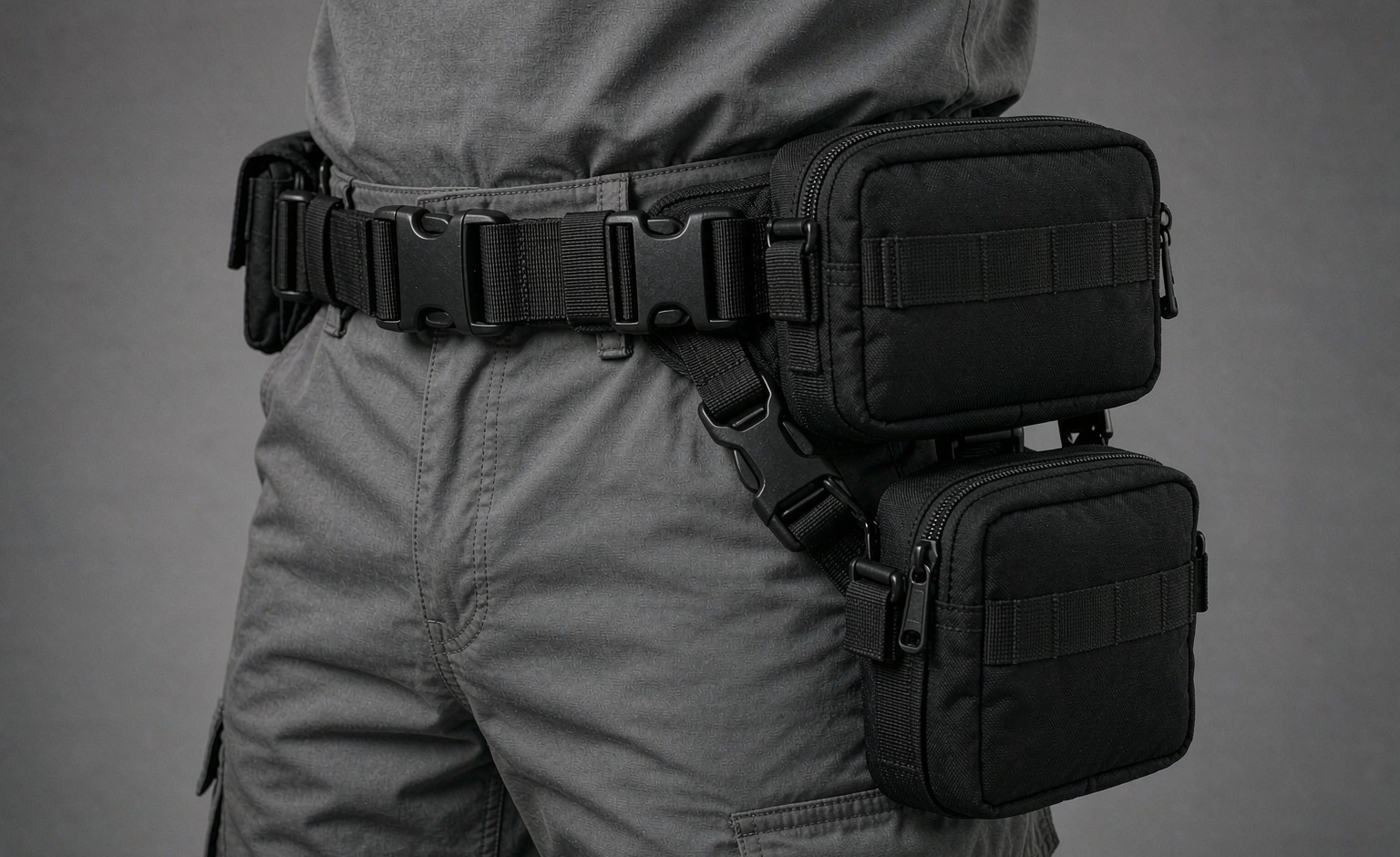
Corporate gift programmes are won on the decoration method and the calendar, not on the bag. Choose the marking route first, because it constrains the shell fabric, the panel geometry and the run length, and budget USD 300–2,500 for screens, dies, moulds and embroidery digitising before a single unit is cut. Then work the calendar backwards from the handover date: a reference sample in 6–10 working days, a build of 35–50 days, and ocean transit of 25–35 days, which means a December gifting date needs the artwork approved in July. Each specification carries a 500-unit floor, lot release follows ISO 2859-1 sampling at AQL 2.5, and payment is split 30/70 by telegraphic transfer against FOB Xiamen. The sections below cover each gate in order.
Brand governance, multi-office distribution and the leftover decision are treated here as gates with named owners rather than as administrative detail, because each one has absorbed a programme deadline at some point.
Recipient tiers first, product second
The most common error in a gift programme is selecting the bag before defining who receives it. Selection driven by a catalogue photograph produces a single specification aimed at an average recipient who does not exist, and the result is a gift that delights nobody in particular. Define the tiers first and the product decision becomes straightforward.
Most programmes have three tiers. The broad tier is employees or event attendees, where the unit cost ceiling is low and the requirement is that the item looks considered and survives a commute. The middle tier is clients and partners, where the ceiling is higher and the expectation is that the item would be bought rather than received. The top tier is a small executive group, where the number is low enough that per-unit cost matters less than the impression and personalisation.
A modular platform serves this structure unusually well, because the same chassis can be delivered at three specification levels. The broad tier receives the shell with one module. The middle tier receives the shell with two modules and a better lining. The executive tier receives the same shell with a full module set and individual marking. The tooling is shared, the visual identity is consistent, and the perceived difference between tiers is real without requiring three separate products.
Write the tier definitions down with the unit cost ceiling for each and the headcount. Those four numbers determine everything downstream, and they are the numbers a finance approver will ask for, so having them ready shortens the internal approval by weeks.
One caution on personalisation. Individual names on the executive tier are well received; individual names on the broad tier create a data-protection obligation and a sorting cost at dispatch. Where a programme crosses a personal-data boundary, check the handling requirement before committing, and default to role or team marking rather than name marking above a few hundred recipients.
Selection rule: Decide who receives the gift before shortlisting anything and keep to role or team marking once recipient counts climb, because personal-data handling discovered late costs weeks that the 6-10 working day sample window does not contain.
Decoration routes and what each one does to the shell
Decoration is a manufacturing process with a setup cost, a unit cost, a substrate constraint and a durability profile. Treating it as an afterthought is how programmes end up with a logo that lifts after three months. The four mainstream routes for a bag programme are embroidery, a woven or printed label, a heat-applied transfer, and a moulded or cast badge.
| Route | Setup spend and lead item | Substrates it marks | Behaviour in service | Run length it suits |
|---|---|---|---|---|
| Embroidery, direct | Digitising inside the USD 300–2,500 tooling range; one file per size | Woven shells and linings; not thin coatings | Excellent abrasion life; holds dirt in the thread; adds stiffness | 500 units upward, any colourway |
| Woven label, sewn | Loom setup in the same band; artwork limited by thread count | Any sewn panel with access to an edge | Very durable; fine detail lost below roughly 1 mm strokes | 500 upward; best for a consistent mark across tiers |
| Heat-applied transfer | Screens and a platen; low end of the band | Flat coated panels; not textured or padded faces | Smooth and photographic; can lift after warm washing | 500 upward where the artwork is complex |
| Moulded or cast badge | Mould or die at the upper end of the band | Requires a flat seat and a fixing method | Highest perceived value; a snag risk if poorly seated | 1,000 upward to amortise the tool |
| Laser-marked metal plate | Low setup, higher unit cost | Small flat area; needs a rivet or stitch seat | Permanent; reads as premium; small area only | Executive tier of under 200 units |
Substrate constraint is the decision most often missed. A heat-applied transfer needs a flat coated face; it will not hold on a textured or padded panel, and it will bridge across a seam. Embroidery needs a fabric that accepts a needle without tearing; on a lightly coated ripstop it can perforate the coating enough to compromise water resistance at that point. Ask the production team to mark a sample panel and then re-test, rather than approving from a rendering.
Placement interacts with the modular structure. A logo placed over an attachment field will be partly covered by a pouch on day one, and a logo placed on a panel that is removed as a module will leave the mark off the bag entirely. Mark the permanent shell, never a detachable element, and check the placement against the module set in its fully loaded configuration.
Durability should be specified as a test, not as an assurance. Colour transfer under AATCC 8 applies to printed and dyed marks, and a wash or abrasion cycle followed by a visual grade is a reasonable acceptance check for any applied mark. Where the mark sits on a coated fabric, add a coating adhesion check under ASTM D751 after marking, because the heat and pressure of application can affect the bond.
Colour matching needs a physical reference. A Pantone reference is a starting point, not a guarantee, because thread, ink, moulded resin and anodised metal each reproduce a colour differently. Approve a physical swatch on the actual substrate for each route, and keep that swatch as the retained standard for reorders in later years.
Verdict: Approve a physical swatch on the actual substrate for every decoration route and keep that swatch as the retained standard for later years, since each route reproduces the same colour differently on the same shell.
Brand governance: artwork, placement zones and the physical approval
Brand governance is the slowest part of most gift programmes and the part nobody schedules. A logo placed without a written rule set on the first programme will be placed differently on the second, and the inconsistency is visible to recipients who received both. Write the rules once and attach them to the tech pack.
The rule set needs five items. The approved artwork files and their colour references. The clear space around the mark, expressed as a proportion of the mark height. The placement zones by product, drawn rather than described. The prohibited placements, which usually include any panel that a module can cover and any panel that folds. And the size range, with a minimum below which the mark becomes unreadable on the chosen substrate.
Approval should be against a physical sample, not a rendering. A rendering cannot show thread sheen, ink thickness, or how a mark behaves across a seam, and those are exactly the properties that generate a rejection after production has started. Build the marked sample, photograph it in daylight, and circulate the physical piece to whoever owns the brand standard.
| Approval step | Artefact produced | Owner | Typical delay absorbed |
|---|---|---|---|
| Artwork and colour reference release | Vector files plus Pantone numbers | Brand owner | 3–7 days; longer if files are raster only |
| Marking method and placement proposal | Marked-up product drawing with zones | Production team | 2–4 days |
| Digitising or screen proof | Digital proof at actual size | Decoration supplier | 2–3 days |
| Marked panel swatch on the real substrate | Physical swatch, retained as standard | Production team | 4–6 days including courier at 3–5 days |
| Marked pre-production sample | Complete bag with the mark applied | Brand owner sign-off | 6–10 working days to build, then review |
| Retained standard filed for reorders | Two units held against the programme | Both parties | None, but often forgotten |
The retained standard is the item that protects a programme in year two. Two physical units from the approved lot, held by the production side and referenced in the order file, turn a future colour dispute into a comparison instead of a correspondence. It costs nothing and it is rarely requested until it is needed.
Where a programme uses a licensed mark, such as a university crest or a sponsored event identity, add the licence approval step with its own duration. Licensed-mark approvals are frequently the longest single item in the calendar and are entirely outside the production pipeline, so they belong on the critical path from day one.
The delivery calendar worked backwards from the handover date
Gift programmes are date-certain. Unlike a retail order, a late delivery is not a delay, it is a failure, because the event happens on the date and the gift has no value afterwards. That makes the calendar the primary planning artefact, and it must be built backwards from the handover date with every gate placed explicitly.
The pipeline components are fixed. Allow 6–10 working days for a marked reference piece, extending to 12–15 when the decoration is complex; the build then runs 35–50 days measured from approval of that piece. Ocean transit takes 25–35 days, air takes 5–8 days, a courier takes 3–5 days, and internal distribution to offices adds its own week or more. Add the internal approval delays from the previous section on top, and a December handover has an artwork deadline in July.
| Gate | Weeks before handover | Buffer to add | Escalation if missed |
|---|---|---|---|
| Artwork and colour reference signed off | 26–30 weeks | 2 weeks for brand review cycles | Simplify the mark to a single colour to shorten setup |
| Marked panel swatch approved | 22–26 weeks | 1 week for courier at 3–5 days | Approve from a digital proof and accept the colour risk |
| Pre-production sample approved | 20–22 weeks | 1 week; build alone is 6–10 working days | Freeze the specification; no further changes |
| Deposit released and slot reserved | 19–21 weeks | None; T/T 30/70 deposit triggers booking | Slot may be lost; ask for the next available window |
| Production complete, inspected at AQL 2.5 | 8–10 weeks | 3 days for inspection and rework | Accept a documented concession or a partial air shipment |
| Ocean transit and customs clearance | 4–6 weeks | 1 week for port congestion | Air freight at 5–8 days on a partial quantity |
| Regional distribution and office delivery | 1–2 weeks | 3 days per additional delivery country | Direct courier to the largest offices; defer the rest |
Buffer is not optional at two points in particular. Port congestion is unpredictable and a week of buffer on ocean transit is the cheapest insurance in the plan. Internal brand review is the second, because it involves people who have other jobs and whose availability the production pipeline cannot influence.
The escalation column exists because something will slip. Decide in advance which lever you will pull, because the decision made calmly in July is better than the decision made in panic in November. The usual best answer is a partial air shipment sized to cover the first delivery wave, with the balance following by sea.
Payment follows the usual commercial pattern: 30 % by telegraphic transfer to reserve the slot, the remaining 70 % once the inspection passes and documents are handed over, quoted FOB Xiamen. Where a programme delivers to several countries, agree whether the buyer consolidates in one destination or ships direct to each, because that choice changes both the freight cost and the customs paperwork.
Bottom line: Build the calendar backwards from the handover date and put every item outside the production pipeline, notably licensed-mark approval, on the critical path from the first day, because those items lengthen a critical path already carrying 35-50 days of building.
Multi-office distribution and the quantity accuracy problem
Distribution is where a well-made gift programme becomes a logistical mess. A company with twelve offices in six countries has twelve delivery addresses, twelve customs entries if shipping direct, and twelve chances for a box to arrive after the event. Consolidating into one or two regional hubs and distributing internally is usually cheaper and more reliable.
Quantity accuracy is the other distribution risk, and it is a data problem. Headcount changes between the order and the delivery date; new joiners appear, leavers disappear, and the gift list is usually compiled from a system that is a month out of date. Order against a frozen list taken at a defined moment and add a contingency of 3 % to 5 % for late additions.
The contingency creates its own question: what to do with leftovers. Decide before ordering. The three sensible destinations are a recruitment or events stock held centrally, a charity donation, and a staff sale. Leftovers with no declared destination sit in a cupboard for three years and are eventually written off, which is the worst outcome and the most common one.
Pack out for distribution, not for storage. If twelve offices each need 40 units, pack in cartons of 40 with an office label, rather than in bulk cartons of 100 that someone has to break down. The extra packing specification costs little and removes a full day of handling at the receiving end.
Finally, name a recipient owner per delivery location. A gift shipment addressed to a company arrives at a loading dock and waits. The same shipment addressed to a named person with a mobile number arrives at the right desk and is acknowledged, which is the difference between a delivered programme and a programme that is still in a warehouse on the day of the event.
Takeaway: Collect and freeze addresses, quantities and per-market marking before anything enters production, because correcting a discrepancy after cartons have travelled for 25-35 days costs a multiple of the forward freight.
The handover moment and what the packaging has to do
The recipients judge the gift in the first ten seconds, and those ten seconds are packaging. A bag in a printed carton with a card reads as a considered gift. The same bag in a plain polybag reads as a shipment. The difference in cost is small and the difference in perceived value is large, which makes packaging the highest-return line in a gift budget after the product itself.
Set the unboxing sequence deliberately. Recipient opens the carton, sees the product, sees a card explaining what it is and what the modules do. That card matters more than it sounds, because a modular bag is not self-explanatory: a recipient who does not understand that the pouch detaches will use it as an ordinary bag and the programme's differentiating feature is wasted.
Where the gift is mailed to home addresses rather than handed over, the packaging has a second job: it has to survive the parcel network. This is what ISTA 3A exists for, and a mailed gift programme should have its pack-out tested rather than assumed. A gift that arrives crushed is worse than a gift that arrives late.
Sustainability claims on packaging need the same discipline as anywhere else. A claim of recycled content should be supported by a documented percentage and a source, and a claim of recyclability should reflect the infrastructure available to the recipient, not the theoretical properties of the material. Overclaiming here is a reputational risk that no amount of good design offsets.
Judgement: Test the pack-out for a 3-5 day courier route wherever gifts are mailed rather than handed over, and match any sustainability wording to the collection infrastructure the recipient actually has.
Compliance lines a corporate gift must respect
A gift crosses two compliance boundaries that a retail product does not. The first is the recipient's own gift policy: many organisations, particularly public sector and regulated ones, cap the value of gifts an employee may accept and require disclosure above a threshold. A programme aimed at such recipients should know the cap before selecting the product, because exceeding it does not make the gift more impressive, it makes it undeliverable.
The second boundary is product compliance at the destination. European entries need a declaration under REACH (EC 1907/2006). Shipments into the United States can require California Prop 65 and CPSIA statements. OEKO-TEX Standard 100 is the textile evidence most buyers are asked to produce. Where a metal badge or buckle contacts skin, EN 1811 nickel release is worth testing. These obligations attach to the imported product regardless of whether it is sold or given away.
Origin marking is frequently overlooked on gifts because nobody is scanning a barcode. It is still required on import, and a shipment without correct origin marking can be held at customs even when no sale is involved. Include the origin on the sewn label and on the carton as a matter of routine.
Where the gift is delivered into an environment with its own rules, such as a hospital or a school, check whether any additional restriction applies to the item itself. This is a documentation question that takes an email to resolve and weeks to fix if discovered after the shipment has landed.
Specifying so that year two is simpler
Gift programmes rarely stay single-year, and the specification decisions made in year one determine whether year two is a repeat order or a fresh project. Three decisions do most of the work: freeze the chassis, keep the decoration route, and file the retained standard.
Freezing the chassis means resisting the temptation to change the bag between cycles. Because a modular platform keeps the interface constant, year two can introduce a new module or a new colourway without touching the shell tooling, which is the cheapest possible refresh. Changing the shell means new tooling, new sampling and a new risk profile.
Keeping the decoration route means the setup cost is not repeated. Screens, moulds and digitising files inside the USD 300–2,500 band are one-time spends; a route change re-opens that line and re-opens the approval sequence with it. Where a change is genuinely wanted, change the colour of an existing mark rather than the method.
Write the programme file. Artwork references, placement drawing, swatch, retained sample location, carton specification, packing list by office, inspection criteria at AQL 2.5, and the contact list. A programme with a file can be handed to a new coordinator and run unchanged; a programme without one has to be rebuilt from memory, and the rebuilt version is always slightly different.
Capacity planning belongs in the same file. A programme that repeats annually should declare its expected volume for the coming two cycles so that fabric and hardware are reserved against it. Our vetted partner facilities hold 149 machines and 137 people across 7 production lines inside a 4,950 m² SGS-verified production floor, reaching roughly 200,000 units per month when fully loaded, and a declared annual programme volume is what converts that capacity from a negotiation into a booking.
Finally, record what recipients said. A short survey, or even a collated set of comments from the office owners, will tell you whether the module concept landed, whether the size was right, and which colourway was preferred. That feedback is the only input that reliably improves a second-year gift, and it costs almost nothing to collect.
Spec rule: Freeze the interface geometry, the decoration route and retained samples during year one and capture which module concept and colourway landed, because a second-year gift built from that file fits inside the same 35-50 day slot rather than reopening the whole project.
Frequently asked questions
How much should a gift programme budget for logo setup?
Budget USD 300–2,500 across screens, dies, moulds, platens and embroidery digitising. The low end covers a single-colour screen or a digitising file; a moulded badge sits at the upper end. Setup is one-time, so keeping the same route in year two removes the line entirely.
Which marking method lasts longest on a bag?
Embroidery and sewn woven labels have the best abrasion life. Heat-applied transfers give photographic detail but can lift after warm washing. Moulded badges read as most premium but need a flat seat. Choose against the substrate, then verify with a physical swatch.
Can any logo be embroidered on any fabric?
No. Embroidery perforates the fabric, and on a lightly coated ripstop it can compromise water resistance at the mark. Thin coatings and padded panels are poor candidates. Ask for a marked sample panel and re-test coating adhesion under ASTM D751 after marking.
Where should the logo go on a modular bag?
On the permanent shell, never on a detachable module, and never on a panel that a fitted pouch will cover. Check the placement against the module set in its fully loaded configuration, and draw the prohibited zones into the tech pack.
When should artwork be approved for a December handover?
Around July. A marked reference sample takes 6–10 working days, the build runs 35–50 days, ocean transit takes 25–35 days, and internal brand review absorbs two to four weeks on its own. Working backwards from December puts the artwork deadline at 26 to 30 weeks out.
How much contingency quantity should I order?
Add 3 % to 5 % to a frozen headcount list for late joiners and address errors. Decide the destination for leftovers before ordering, because unallocated surplus sits in storage for years and is eventually written off.
Should gifts ship direct to each office or to one hub?
Usually one or two hubs, then internal distribution. Direct shipping to twelve offices means twelve customs entries and twelve chances of a late arrival. Pack in cartons sized to each office so nobody has to break bulk cartons down.
What inspection standard applies to a gift order?
ISO 2859-1 sampling at AQL 2.5 for major defects, with zero acceptance for critical ones. On a marked gift the defect list should include the mark itself: placement drift beyond tolerance, colour outside the approved swatch, and incomplete adhesion.
Do gifts need the same compliance documents as retail goods?
Yes. European entries need a REACH (EC 1907/2006) declaration, United States entries may need California Prop 65 and CPSIA statements, OEKO-TEX Standard 100 evidence is often requested on the textile, EN 1811 applies to skin-contact metal, and origin marking belongs on both the product and the carton.
Should I check the recipient organisation's gift policy?
Yes, particularly for public sector and regulated recipients, where acceptance caps and disclosure thresholds are common. Exceeding a cap does not improve the impression; it makes the gift undeliverable and creates an administrative problem for the recipient.
Is a card inside the box worth the cost?
Yes, and specifically for modular products. A recipient who does not know the pouch detaches will use the bag as an ordinary one, and the differentiating feature is wasted. A single card explaining the module set costs very little.
Should mailed gifts be transit tested?
They should. A gift delivered through a parcel network needs a pack-out tested under ISTA 3A, because a gift that arrives crushed is worse than one that arrives late. Test the production pack-out, not a convenient arrangement.
How do I keep year two consistent with year one?
Freeze the chassis, keep the decoration route, and file a programme reference. Our production side can hold two retained units from the approved lot so a later colour dispute becomes a comparison rather than a correspondence.
Can personalised names be used on a large programme?
Only with care. Names work on an executive tier under roughly 200 units. Above a few hundred recipients they add a personal-data obligation and a sorting cost at dispatch, so default to role or team marking instead.
What colour reference should I supply?
A Pantone number as a starting point plus a physical swatch approved on the actual substrate. Thread, ink, moulded resin and anodised metal each reproduce a colour differently, so the retained physical swatch is what guarantees a reorder match.
What are the settlement terms on a gift programme?
Expect a 30 % deposit by telegraphic transfer to reserve the production slot, with the 70 % balance due once the lot passes inspection and the documents are handed over, quoted FOB Xiamen. Freight, insurance and destination handling from the port fall to the buyer.