Home › Field notes › Modular Loadout for Event Medical Cover: Zoning, Access Speed and Kit
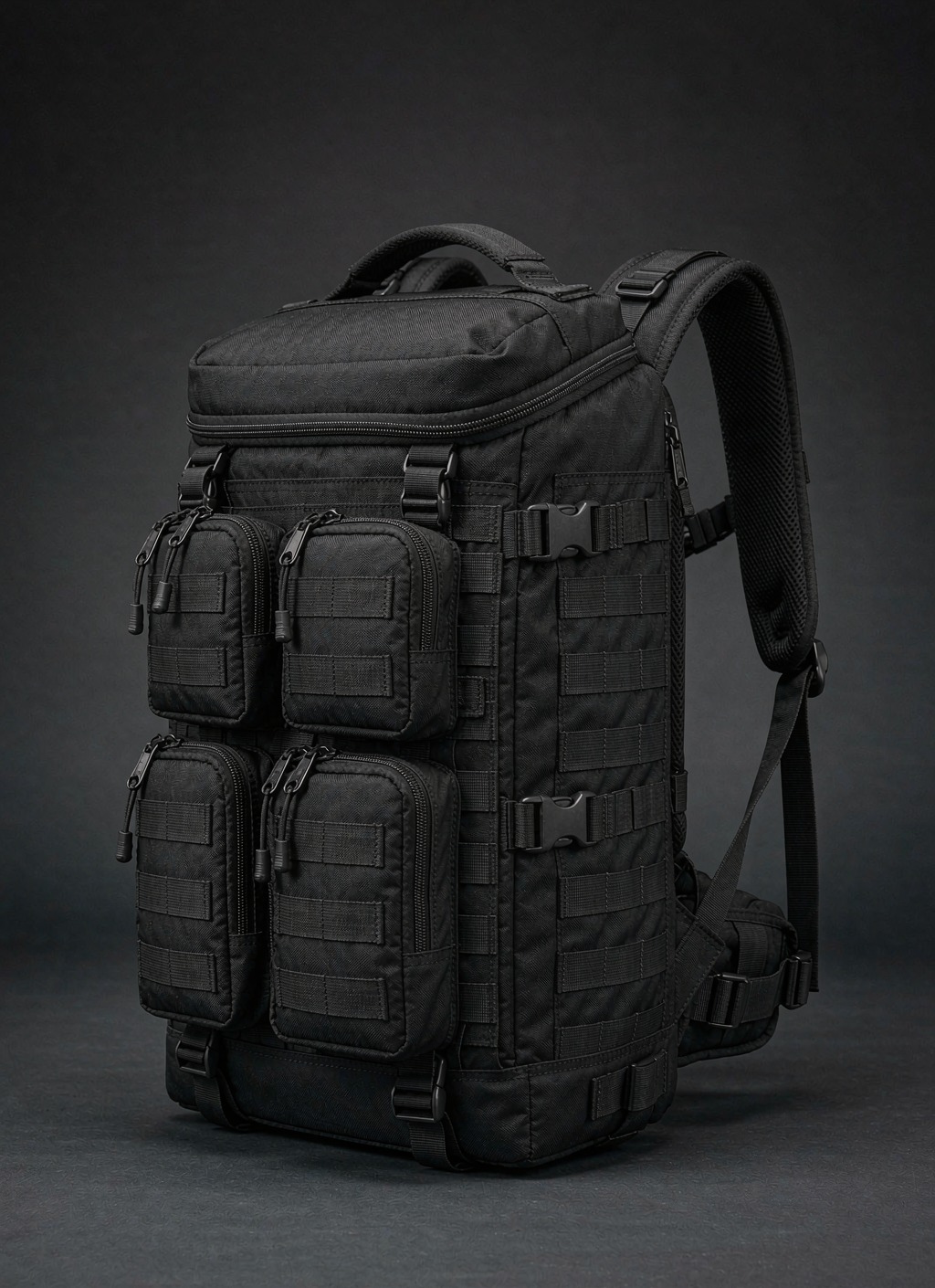
A modular loadout for event medical cover is a zoned bag system in which every module sits in one fixed, labelled position, so a responder who has never used that particular bag can still find the right module within seconds. Commercial terms do not move: 500 units minimum per reference, first samples in 6-10 working days, 35-50 days to bulk completion, inspection to AQL 2.5 on ISO 2859-1 level II, prices quoted FOB Xiamen. The boundary is firm - this page covers bag structure, zoning, cleaning and restocking only. What goes inside each module, in what quantity and under what clinical protocol, is decided by the event's own clinical lead and medical provider; nothing here is medical advice.
Why a Single-Compartment Bag Fails Event Medical Cover
Event cover has three properties that separate it from ordinary field carrying. The bag is shared, it is opened under time pressure, and it is handed between people who did not pack it. A single-compartment bag satisfies none of those conditions. One large cavity means every item is somewhere in the same volume, which is fine for the person who packed it and useless for the second person who opens it twenty minutes later.
The shared-kit problem is the one buyers underestimate. A rota over a long event day can put four or five different responders on the same bag. Each opens it, takes something, and puts it back somewhere slightly different. By the late afternoon the layout has drifted, and drift is what turns a five-second reach into a forty-second search. Zoning fixes this not by adding pouches but by making position a rule: the module for a given category lives in one slot, and the slot is labelled on the outside as well as on the module.
Time pressure is the second property. An event crowd imposes its own geometry: the responder may be kneeling, may be working in a tent with one hand holding a barrier, and may be wearing gloves. That rules out closures that need two hands on a flat surface and rules in a lid that opens away from the body with one pull and stays open while the responder works.
The third property is reset. A bag used once and repacked carefully is a different object from a bag used twelve times in a day, wiped down between uses, and restocked by a third person at a supply point. The specification has to be written for the twelfth use, not the first.
- Responders per bag per event day: 3-5 on a rota
- Openings per event day: 20-60 depending on attendance
- Reset point: a central supply table, not the bag's home
- Target reach time for any labelled module: under 5 seconds
- Working surface available: often the responder's own knee
Verdict: Reject any single-cavity design for shared event kits and specify a zoned interior in which each module has one labelled home position, because a bag opened 20-60 times a day by three to five different people will otherwise drift out of usable order within a single shift.
Zoning a Response Bag: Fixed Positions, Colour Coding and Module Sizing
Zoning starts with a decision about what a zone means. The most reliable model is by function rather than by size: one zone per category of item, one module per zone, one label per module. Three zoning approaches are in common use, and they differ mainly in how much they depend on the responder's memory.
A single-compartment interior with printed dividers is the cheapest and the weakest; the divider position means nothing once the bag has been repacked twice. Fixed colour zones - a colour per category, carried on both the module and the shell pocket it lives in - let a responder match colour to colour without reading anything, which is the behaviour you want under pressure. Removable module pods take it further: each pod is a closed unit that can be lifted out, handed over, and replaced with a sealed spare from the supply point, which is the fastest reset model available.
Sizing should be driven by the pod, not by the bag. Pick the pod sizes first from the module list the clinical lead supplies, then size the shell to hold the pods with a small margin. Working the other way round produces a bag whose cavities do not match the pods, and pods that rattle in oversized cavities are pods that tip their contents when the bag is carried at an angle.
| Selection criterion | Printed dividers in one cavity | Fixed colour zones | Removable module pods |
|---|---|---|---|
| Search time for a second responder | 20-45 s, layout has drifted | 6-12 s, colour matching | 3-8 s, pod is lifted out whole |
| Dependence on responder memory | High | Low | Lowest |
| Reset time at the supply point | 4-8 min per bag | 2-4 min per bag | 40-90 s, swap for a sealed pod |
| Handling during wipe-down | Bag must be emptied | Modules lifted one by one | Pods lifted as sealed units |
| Added empty mass | 40-90 g | 120-240 g | 260-520 g |
| Failure mode after heavy use | Divider moves, layout drifts | Colour mismatch if pods are swapped | Pod latch wear |
| Suits a rota of how many responders | One | Two to three | Four or more |
Accessories mounted outside the bag follow the same logic as the interior; a modular everyday carry setup uses identical position rules for small items, and responders transfer that habit easily.
Bottom line: Use fixed colour zones where two or three responders share a bag, move to removable sealed pods above four responders or above 40 openings a day, and size the shell to the pods rather than the pods to the shell.
Access Speed: Lid Geometry, One-Handed Opening and Pouch Retention
Access speed is a mechanical property of the bag, not a skill of the user. It is decided by four things: which way the lid opens, whether it stays open, how many fastenings stand between the responder and the module, and whether the module stays where it was put.
A lid that hinges away from the wearer and opens past 90 degrees is workable; a lid that flops back toward the body is not, because it closes on the responder's hands while they are reaching. A clamshell opening that lays the bag flat is the best arrangement on a table and the worst on a knee, so the specification should state the assumed working surface. If the bag will mostly be opened while being worn or kneeling, a front-opening panel with a stiffened lid is faster than a clamshell.
Fastenings are counted, not admired. Every buckle, zip and hook between the responder and the contents adds one to two seconds. A single-pull zip with a long garage is the fastest closure available; a two-buckle lid with a secondary storm flap is slower but survives being dragged across a field. Where the bag is carried rather than staged, retention matters more than speed, so a secondary closure on the module pockets is worth the extra second.
Retention is the part that fails quietly. A pod held by hook-and-loop alone will walk out of its cavity when the bag is carried at an angle or dropped into a vehicle. A pod on a proper grid, with the strap woven rather than hooked, stays put; this is where PALS grid geometry and strap weaving becomes a functional requirement rather than a styling one.
Takeaway: Count the fastenings between the responder and each module, keep that count at one for the highest-priority zone, and mount every pod on a woven attachment rather than on hook-and-loop alone so it cannot walk out when the bag is carried at an angle.
Shared Kits: Labelling, Handover and Restocking After a Shift
A shared kit is a process, and the bag is only the hardware the process runs on. Two documents make it work: a layout card carried in the bag, and a restocking card kept at the supply point. Both should show the same picture of the same bag, in the same colours, with the same module names.
Labelling has to survive the cleaning regime, which rules out paper labels and most printed cards unless they are sealed. A moulded or welded label on the pod, plus a matching printed field on the shell pocket, is the durable answer. Numbering the pods in the same order as the layout card lets a restocker work through the bag in a fixed sequence instead of hunting, and it makes a missing pod obvious at a glance.
Handover is where the process usually breaks. If a pod is taken out of the bag and set down somewhere, it is gone. The rule that prevents this is simple and has to be written on the card: a pod is either in the bag, in the responder's hand, or logged out at the supply point. Responder preference is to keep the whole bag with them, which means the bag itself has to be comfortable enough to carry while working rather than only while walking.
Restocking works best as a swap rather than a refill. A sealed pod comes off the supply shelf, the used pod goes into a returns tray, and the bag is back in service in under two minutes. Refilling pods in place takes four to eight minutes per bag and is where expiration and quantity errors creep in, so a programme with more than a handful of bags should be built around the swap model from the start.
- Layout card: in the bag, sealed, matching pod colours
- Restock card: at the supply point, same picture
- Pods numbered in the order the card lists
- Swap model target: under 2 minutes per bag
- Returns tray: one per supply point, cleared each shift
| Selection criterion | In-place refill | Sealed pod swap | Whole-bag exchange |
|---|---|---|---|
| Return-to-service time per bag | 4-8 min | 40-90 s | 2-4 min |
| Staff needed at the supply point | Two, one checks | One | One |
| Quantity and expiry error risk | High, items counted by hand | Low, pod sealed at source | Lowest, bag sealed at source |
| Spare stock holding required | None | One pod set per 3-5 bags | One bag per 3-5 bags |
| Traceability of a single item | Poor, no unit record | Per pod lot | Per bag serial |
| Cube cost of the spare holding | None | Low, pods nest flat | High, bags do not nest |
| Fleet size the model suits | Under 10 bags | 10 to 200 bags | Under 30 bags |
Spec rule: Number every pod in the order shown on a sealed layout card, and run restocking as a sealed-pod swap at a central supply point rather than as an in-place refill, because a swap returns a bag to service in under 2 minutes while a refill takes 4-8 minutes and invites quantity errors.
Cleaning, Wipe-Down and Return-to-Service for Shared Bags
Shared bags get dirty in a way personal bags do not, and they get cleaned far more often. The cleaning regime should be specified before the materials are chosen, because a fabric that survives the abrasion test can still fail the wipe-down test: coatings haze, prints lift and labels curl after repeated exposure to a cleaning agent.
Three surfaces need to be considered separately. The outer shell takes the most abrasion and the most cleaning, so it wants a smooth face that releases soiling rather than a textured one that holds it. The lining takes the most contamination and should be a wipe-clean film rather than a absorbent textile, with seams that can be cleaned rather than seams that trap. The pods themselves should be cleanable as sealed units, with a smooth base and no exposed textile on the outside that can wick.
Colour fastness to rubbing is measured to AATCC 8, and the result matters directly here: a printed colour zone that rubs off under cleaning has lost its function, not just its appearance. Domestic washing durability of a textile component is covered by ISO 6330, which is the reference to use if any part of the bag is intended to go through a machine cycle rather than a wipe.
Return-to-service is a documented step, not an assumption. The bag comes back from a shift, is wiped, is restocked by pod swap, and is signed back in. If a bag is visibly contaminated beyond a wipe, the specification should name the point at which it leaves service for deeper cleaning, and that point should be based on the liner condition rather than on the shell.
Judgement: Specify a wipe-clean film lining, a smooth outer face and sealed smooth-based pods, verify printed zone colours to AATCC 8, and name a documented return-to-service step so a contaminated bag leaves the rota instead of being wiped and handed on.
Transport Testing for Pre-Packed Kits and Event-Season Deliveries
A pre-packed kit is a different freight object from an empty bag. It is heavier, it does not compress, and its contents shift, so a carton that works for flat-packed empties can fail for filled pods.
Transit performance is tested rather than argued. A laboratory sequence run to ISTA 3A subjects a packed carton to drops and vibration representative of parcel handling, and it is the right reference when kits ship individually to sites. Where kits ship palletised to one venue, the sequence changes and the carton specification changes with it, which is why the pack-out method belongs on the purchase order rather than being left to the warehouse.
Sampling of the finished goods is separate from transport testing and is run to ISO 2859-1 at level II with an AQL of 2.5, split Critical 0, Major 2.5 and Minor 4.0. For event programmes the critical class should be defined explicitly on the order, because a missing pod retention strap is a functional failure rather than a cosmetic one and belongs in the class that stops a shipment.
Season timing is the practical constraint. Event calendars do not move, so sampling has to finish before the freight window rather than inside it: 6-10 working days for sampling, 35-50 days for mass production, then 25-35 days by sea or 5-8 days by air. Kits needed for a fixed date should be sampled in the off-season and shipped by sea, with air reserved for pod replacements.
Selection rule: Test pre-packed kits to ISTA 3A rather than testing empty bags, define the critical defect class on the order to include pod retention failure, and sample in the off-season so sea freight on 25-35 days fits the event calendar.
Carrying Comfort Across a Twelve-Hour Event Day
Event responders carry less weight than a mountain team but carry it for longer without putting it down. A 6-10 kg kit worn from an hour before gates open to an hour after they close produces a different complaint: not acute load pain but accumulated shoulder and neck fatigue, plus heat build-up against the back.
Back panel construction is the main lever. A suspended panel that leaves an air channel reduces heat load substantially and costs a little internal volume; a flat padded panel is cooler to buy and hotter to wear. For indoor venues and summer events the suspended panel is worth the trade; for cold outdoor events a flat panel is acceptable and simpler to clean.
Strap geometry follows the same logic as any work-orientated load platform but with a twist: the bag is frequently worn while working, so straps must not obstruct arm movement. Narrower shoulder straps with a wider contact patch, a sternum strap that can be set and forgotten, and a hip belt light enough not to interfere with bending all matter more here than ultimate load transfer.
Weight distribution inside the bag still decides how it feels. Heaviest pods should sit close to the spine at mid-back height, light bulky items low and forward, and nothing hard against the back panel. A bag loaded that way at 8 kg feels lighter than the same bag loaded badly at 6 kg.
Choose a suspended back panel for indoor and summer events, keep the declared load under 10 kg, and place the heaviest pods against the spine at mid-back height, because accumulated fatigue over a twelve-hour day is driven by heat and distribution more than by total mass.
Production Capacity and Sampling Gates for Event Cover Programmes
Event programmes tend to order in one large drop and then reorder pods. Capacity planning should reflect that split: the bag fleet is a capital purchase, the pods are consumable, and the two have very different reorder economics once the tooling exists.
The SGS-verified production base we work with holds a 4,950 m² floor with 137 people, 7 production lines and 149 machines, and monthly output across every programme running on those lines reaches 200,000 units. For a first fleet the practical sequence is sampling in 6-10 working days, pre-production sample sign-off, mass production in 35-50 days, inspection to AQL 2.5 and shipment. Pod-only reorders against existing tooling run faster because the pattern, the panel file and the colour references already exist.
On the founder's side, bag production experience goes back to 2004 and the company dates from 2014, and the layout method used for zoned kits comes out of that history: pod sizing is done from the module list first, and the shell is drawn to the pods. Getting that order wrong is the single most common cause of a second sampling round in this category, and a second round costs another 6-10 working days that an event calendar may not have.
Treat the bag fleet as a capital order built over 35-50 days of bulk production and the pods as a consumable reorder, and supply the module list before sampling so pod sizes drive the shell drawing rather than the reverse.
Freight Cube, Sampling Cost and Landed-Cost Planning for Event Kits
Cube, not weight, sets the freight bill for empty bags; for pre-packed kits both matter. An empty event bag packed flat nests well, but pods do not nest, and a fleet ordered with two pod sets per bag can easily double its cube against the same bag count.
Plan against 28 CBM for a 20GP and 68 CBM for a 40HQ, and decide on the pack-out before the carton is drawn. Transit options are sea at 25-35 days, air at 5-8 days and express courier at 3-5 days. The usual pattern for a season is one sea shipment of the fleet well ahead of the first event, plus one small air shipment of spare pods held in reserve.
Cost items that buyers forget to budget: a first sample at USD 50-150, that charge returning to the buyer when the bulk order lands; tooling and screens at USD 300-2,500 where the pod shape or the printed zone set is new; and the cost of a second sampling round if the module list arrives late. Quotations are returned within 24-48 hours of a complete specification landing for teams running custom modular backpack programmes, FOB Xiamen, on T/T 30/70 terms and a 500-unit floor per reference.
Spare planning is the last piece. A zoned kit programme should carry pods at a ratio to bags - one spare set per three to five bags is a common starting point - because a pod out for cleaning is a bag out of service under the swap model, and the swap model is the reason the programme is fast.
Budget cube at 28 CBM per 20GP for the fleet plus pod spares at one set per three to five bags, ship by sea on 25-35 days, and hold one air shipment of pods in reserve so a pod out for cleaning never takes a bag out of service.
Frequently asked questions
What is a modular loadout for event medical cover?
It is a zoned bag system in which each module occupies one fixed, labelled position so a responder who did not pack the bag can still find the right module quickly. This page covers bag structure and restocking only; module contents and quantities are set by the event clinical lead.
- One module, one position
- Label on pod and shell
- Not clinical guidance
Why does a single-compartment bag fail for event medical cover?
Because the bag is shared, opened under time pressure and repacked by people who did not pack it. With three to five responders and 20-60 openings a day, one cavity drifts out of order within a single shift and a five-second reach becomes a long search.
- Three to five responders per bag
- 20-60 openings per day
- Layout drift after two repacks
Should event medical kits use colour zones or removable pods?
Fixed colour zones suit two or three sharing one bag and give 6-12 second search times. Removable sealed pods suit four or more responders or above 40 openings a day, giving 3-8 second search and a 40-90 second reset by swapping in a sealed pod.
- Colour zones for 2-3 users
- Pods for 4 or more
- Swap reset under 2 minutes
How fast should a responder be able to reach a module?
Under 5 seconds for a labelled zone with the bag on a knee, which means one fastening between the responder and the highest-priority zone. Count the fastenings: every buckle or zip adds one to two seconds to the reach.
- Target under 5 seconds
- One fastening on priority zone
- Works one-handed
How should pods be retained inside an event medical bag?
On a woven attachment rather than hook-and-loop alone. Hook-only retention lets a pod walk out when the bag is carried at an angle or dropped into a vehicle, which is a quiet failure that is only noticed when the module is needed.
- Woven strap retention
- Secondary closure if worn
- No hook-only mounting
How do you restock a shared event medical bag after a shift?
By swapping sealed pods at a central supply point, not by refilling in place. A swap returns the bag to service in 40-90 seconds per pod set, while an in-place refill takes 4-8 minutes per bag and is where quantity errors appear.
- Swap, do not refill
- Returns tray per shift
- Under 2 minutes per bag
What labelling survives repeated cleaning on an event kit?
Welded or moulded labels on the pod plus a matching printed field on the shell pocket, with paper cards sealed rather than loose. Verify printed zone colours to AATCC 8, because a colour that rubs off under cleaning has lost its function.
- Welded pod labels
- Sealed layout card
- AATCC 8 colour check
Which linings work best for a wipe-down event bag?
A wipe-clean film lining with seams that can be cleaned rather than seams that trap soiling, plus a smooth outer face that releases dirt. Avoid absorbent textile linings in shared kits; they hold contamination and slow the return-to-service step.
- Film lining
- Smooth outer face
- Sealed smooth pod bases
How heavy should an event medical cover bag be?
Keep the declared load under 10 kg, typically 6-10 kg for a full kit, and place the heaviest pods against the spine at mid-back height. Distribution and heat matter more than total mass over a twelve-hour event day.
- Declared load under 10 kg
- Heaviest pods at mid-back
- Suspended panel in summer
How are pre-packed event kits tested for shipping?
Test the packed carton to ISTA 3A for parcel handling, and inspect finished goods to ISO 2859-1 level II at AQL 2.5 with Critical 0, Major 2.5 and Minor 4.0. A filled pod set behaves differently in transit from a flat-packed empty bag.
- ISTA 3A on packed cartons
- AQL 2.5 on finished goods
- Define the critical class
What is the minimum order for a zoned event medical bag programme?
The floor is 500 units for each reference. Expect 6-10 working days to a first sample, then 35-50 days of bulk after the pre-production sample is approved, with pod reorders against existing tooling moving faster.
- 500-unit floor per reference
- 6-10 working days to sample
- 35-50 days of bulk
How much does sampling and tooling cost for an event kit?
A first sample runs USD 50-150 and that fee comes back to the buyer once the bulk order is placed; tooling and screens for a new pod shape or printed zone set run USD 300-2,500. A second sampling round costs another 6-10 working days, so supply the module list up front.
- Sample charge USD 50-150
- New tooling USD 300-2,500
- Reply within 24-48 hours
How should an event medical fleet be shipped?
One sea shipment of the fleet at 25-35 days ahead of the season, plus one small air shipment at 5-8 days of spare pods held in reserve. Cube runs about 28 CBM per 20GP and 68 CBM per 40HQ for empty bags; pods increase cube.
- Sea 25-35 days for the fleet
- Air 5-8 days for pods
- 28 CBM per 20GP
How many spare pods should an event kit programme hold?
One spare pod set per three to five bags is a common starting point. Under the swap model a pod out for cleaning takes a bag out of service, so spares are what keep the reset time low across a full season.
- One spare set per 3-5 bags
- Cleared each shift
- Swap model depends on spares
Can one event bag fleet serve several venues with different layouts?
Yes, if the shell is drawn to hold standard pod sizes and the venue differences are handled by pod content and labelling rather than by different shells. One run then serves several layouts and reorders are simpler.
- Standard pod sizes
- Venue differences in pods
- One shell, many layouts