Home › Field notes › Modular Carry Systems for Film and TV Crews: Department Zoning, Media
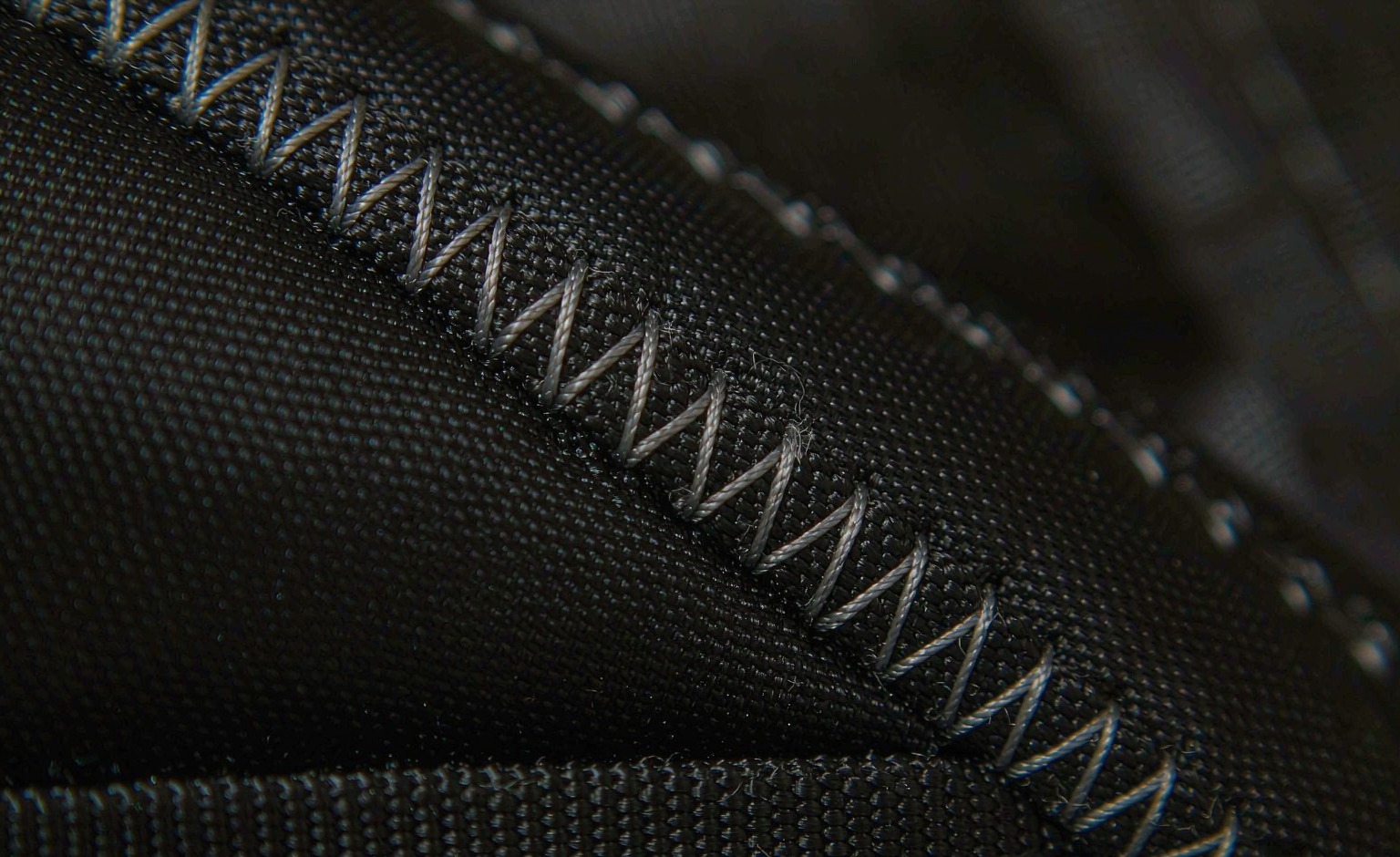
A modular system for film and TV crews works by zoning the bag around departments and retrieval frequency rather than item size, so camera, sound, media and power each keep a fixed address that opens without setting anything down. Crew-issue programmes start at 500 units per reference, first samples are built in 6-10 working days, bulk runs occupy 35-50 days and finished goods are released against AQL 2.5 with prices quoted FOB Xiamen. External attachment uses rows of 25 mm tape on a 38 mm vertical pitch with a 50 mm horizontal repeat, which matches the geometry widely published for PALS grids. The boundary is civilian load carriage for production equipment only: camera bodies, audio recorders, media, batteries and hand tools are in scope, and no claim is made about weapon carriage, ballistic performance or any military certification.
How Department Zoning Beats Item-Size Zoning on a Working Set
On a narrative unit a bag is issued to a department rather than to a person, and the department changes what it carries between setups. Zoning by item size therefore fails on the second day of the schedule: the long zoom lives in the main compartment on Monday, is swapped for a macro set on Tuesday, and by Wednesday nobody knows which pocket holds the filter wallet. Zoning by department fixes the address instead of the object, so the person reaching for a lens knows the lens pocket is on the same flank every day of the shoot.
The practical test is retrieval count. Count the openings per compartment across a twelve-hour day and the zoning writes itself. Anything opened more than twenty times a day needs one-hand access with the bag still on the shoulder, because a crew member who has to set the bag on the ground to open it has already lost the setup.
| Zone | Typical contents | Openings per 12 h day | Closure requirement |
|---|---|---|---|
| Camera flank pocket | Prime lens, filter, matte box tool | 40-60 | One-hand, silent, hold-open lid |
| Sound module | Recorder, lavaliere set, windscreens, AA cells | 20-30 | Silent, soft mouth, no hook-loop peel |
| Media wallet | CFexpress and SD cards in numbered sleeves | 15-25 | Flat, dust-resistant, removable |
| Power bay | NP-F and V-mount packs, terminals covered | 10-20 | Terminal isolation, rigid backer |
| Hand tool roll | Driver, hex keys, gaffer stub, torch | 5-10 | Rattle-suppressed, indexed slots |
| Document sleeve | Call sheet, lens log, release forms | 3-6 | Flat, dry, no crease path |
Frequency zoning also settles arguments about volume. A zone opened fifty times a day should be shallow and wide rather than deep and narrow, because depth costs retrieval time: every additional 50 mm of depth adds reach distance and forces the user to look instead of grab. Crews consistently prefer a 120 mm deep open-topped flank pocket to a 250 mm deep zipped well, even though the deeper pocket holds more.
Two zones should never share a mouth. When the media wallet and the tool roll open through the same zip, the wallet is exposed to grit every time someone fetches a hex key, and a speck of grit on a card contact costs more than the pocket saved.
Selection rule: Zone a crew bag by department and by openings per day, give any compartment opened more than 20 times a day a shallow wide mouth with one-hand access, and reserve deep volume for items retrieved fewer than 6 times a day.
Media and Card Management: Numbered Sleeves and the Three-State Rule
Media is the one category on a film set where a loss is unrecoverable, so the wallet is specced around traceability rather than capacity. Every sleeve is numbered, the number is visible when the card is seated, and the crew refers to cards by slot: "slot four is in the A-camera" is unambiguous, "the card in the side pocket" is not. Numbering also makes handover to the DIT cart a counting exercise rather than a memory exercise.
The three-state rule keeps the wallet honest. Each sleeve carries a flag that shows whether the card is formatted and unused, currently loaded in a body, or exposed and awaiting offload. A reversible tab or a rotating disc does this without removing the card, and the state is legible at a glance from 300 mm across a cart top. Colour alone is not enough, because colour-blindness affects roughly one in twelve men; pair the colour with a number or a raised position.
Sleeve construction matters more than sleeve count. The sleeve should hold the card by its edges so the contact pads never touch fabric, should be stiff enough that a seated card cannot bow, and should leave the write-protect switch visible and reachable. A loose card in a mesh pocket fails on all three counts: contact pads abrade, the card flexes against a lens barrel in the same pocket, and the switch gets flipped by accident.
The wallet itself must detach. On a two-camera shoot the media walk to the cart happens four to eight times a day, and carrying a 9 kg bag across a set to hand over six cards is wasted movement. A wallet that releases from the attachment grid on the lid panel and re-seats in one motion is the single highest-value module in this category.
Takeaway: Spec a media wallet with numbered edge-grip sleeves, a visible three-state flag per slot, and a one-motion release from the lid panel, and size the wallet at 8-12 sleeves for a two-camera unit.
Battery Carriage on Set: Terminal Isolation, Count and Charge-State Indexing
Set bags carry three battery families at once: NP-F style packs for monitors and wireless receivers, V-mount or Gold-mount bricks for camera power, and loose AA or AAA cells for lavalieres and timecode boxes. Each family wants a different pocket, because the failure modes differ.
The dominant risk with bricks is a bridged terminal. A V-mount or a D-Tap lead with an exposed connector dropped into a pocket with keys, a lens spanner or a coin can short across the contacts. The structural answer is a sleeve with a rigid backer that the terminal face sits against, or an individual pouch with a covered contact end; a shared open compartment is not acceptable for any battery above 50 Wh. Where a lead is carried with the brick, it gets its own loop so the connector cannot wander.
Loose cells want indexing, not isolation. A sound department burns through 8-12 AA cells a day, and the failure is not a short but a dead cell being put back into rotation. A cell holder with a reversible flag per slot — full, part-used, spent — removes the guesswork, and a holder that takes a full set of 12 means a swap takes one motion at the cart rather than twelve.
Heat is the third consideration. A black bag left on a truck bed at midday in a 35 °C ambient sits well above air temperature, and batteries stored that way arrive at the setup already warm. Keep the power bay on the shaded side of the bag, away from the panel that faces the sun, and avoid a fully sealed foam bay that traps whatever heat the cells generate during a fast charge.
Bottom line: Give every battery above 50 Wh an individual sleeve with a rigid terminal backer, index loose cells in a 12-slot holder with a reversible state flag, and place the power bay on the shaded side of the chassis.
Silence as a Written Specification: The Four Noise Sources on a Set Bag
Sound department will reject a bag that is audible at 3 m, and the rejection is rarely about the zip itself. Four sources account for most audible events, and each is specced out at the design stage rather than fixed with tape on the day.
Hook-and-loop peel is the loudest and the easiest to remove. A peel of 40 mm of tape is audible across a quiet interior set, so any compartment within the sound department's reach uses a covered or reversed closure instead, or a mechanical closure entirely. Where hook-and-loop is kept for a low-frequency panel, specify a shorter patch and a lift tab that lets the user break the bond progressively rather than ripping.
Metal pullers rapping against hardware is the second source. A zip slider on an unstructured web hangs and strikes the frame with every step, so high-frequency pockets get a garaged puller that parks under a fabric tab, and any metal component that can strike another gets a soft backer behind it. Side-release buckles are the third: a latch click is a single event rather than a repetitive one, but it lands exactly when the recordist is rolling, so buckles on the sound side are replaced with magnetic or ladderlock hardware.
Fabric rustle is the fourth and the least understood. A stiff, heavily coated shell crackles when it flexes, and the crackle is worst at the shoulder where the bag moves most. Specifying a softer hand on the panel that sits against the body, and avoiding a high-gloss coating at the shoulder yoke, removes most of it. Where a hard-wearing base fabric is needed, confine it to the bottom 150 mm of the chassis.
Judgement: Write silence into the specification as four separate line items — no hook-loop peel within 1 m of the sound position, garaged pullers on any pocket opened more than 20 times a day, no metal-on-metal contact at any closure, and a soft-hand fabric at the shoulder yoke.
Which Closure for Which Compartment: Three Options Compared
Closure choice drives noise, cycle life, dust behaviour and cost at the same time, and the four columns below are the ones worth arguing about before tooling is cut. The comparison assumes a 300 mm pocket mouth carrying 0.8-1.5 kg, which is the normal range for a crew-side compartment.
| Criterion | Coil zip, garaged puller | Magnetic mechanical closure | Covered hook-and-loop |
|---|---|---|---|
| Audible signature on opening | Low; a short slide with no peel | Lowest; a single soft seat | High if peeled fast; moderate if lifted by tab |
| One-hand opening with bag on shoulder | Yes, with a 30-40 mm puller | Yes, and faster than a zip | Yes, but the hand must find the tab |
| Cycle life before service | Slider is the wear point; serviceable | High; few moving parts | Hook side picks up lint; degrades first |
| Dust behaviour at the mouth | Best; tape-to-tape seal | Good; a flap is still needed | Fair; the gap under the flap passes dust |
| Added cost per compartment | Baseline | Highest of the three | Lowest, but highest service cost |
| Compartments it suits | Media wallet, document sleeve | Camera flank pocket, 40-60 openings/day | Low-frequency panels and lid liners |
The pattern that emerges from crew feedback is a mixed specification rather than a single closure across the whole bag: a magnetic closure on the one or two pockets that see 40-60 openings a day, a coil zip with a garaged puller on everything that has to stay dust-tight, and hook-and-loop only where it is covered and rarely opened. Uniformity is cheaper per unit but costs the crew time on every setup.
Nested closures are the thing to avoid. A zip behind a buckle doubles the opening time for no gain in security, and on a bag that is opened 60 times a day that doubling is the difference between a lens being on the camera and the camera assistant still reaching.
Verdict: Put a magnetic closure on any compartment opened more than 40 times a day, a coil zip with a garaged puller anywhere dust exclusion matters, and allow hook-and-loop only on covered panels opened fewer than 5 times a day.
Fast Retrieval Geometry: What a Three-Second Access Actually Requires
Three seconds is the working target between the decision to change a lens and the lens being in the hand, and the geometry that delivers it is unglamorous. Five dimensions do the work.
Mouth width comes first: the clear opening should be at least 1.4 times the widest item, so a 90 mm diameter lens wants a 130 mm mouth. Below that the hand has to rotate the item out, which is where time goes. Divider height comes second, and it works in the opposite direction: a divider taller than the item forces a lift-and-tilt motion, so divider height is set at or below item height, typically 90-110 mm for a prime set.
The lid has to stay open on its own. A lid that falls back across the mouth turns a one-hand retrieval into a two-hand one, so high-frequency pockets get either a stiffened lid that holds at 90 degrees or a magnetic hold-open. Puller length is the fourth dimension: a 25 mm puller is findable with a bare hand and marginal in a glove, so crew bags use 30-40 mm pullers with a contrasting colour per department.
The fifth is access side. A pocket that only opens from the top cannot be worked while the bag is worn on one shoulder, which is how crew members actually stand between setups. A flank pocket with a side-facing mouth, opening away from the body, is retrievable in the worn position; a top-loading well is not.
Colour coding closes the loop. Assigning one puller colour per department — camera, sound, media, power — means the hand goes to the right zone before the eye confirms it, and a new crew member is productive on the first day rather than the third.
Spec rule: Specify a mouth at 1.4 times the widest item, divider height at or below item height, a self-holding lid, a 30-40 mm contrasting puller, and side-facing access on every compartment opened more than 20 times a day.
Long Shoot Days: Load Carriage, Case Handling and Abrasion
A crew bag is worn for ten to fourteen hours and set down on concrete, gravel and truck beds. The harness therefore matters more than the pocket layout, because a bag that hurts in hour nine gets left in the truck in hour ten and the whole zoning scheme stops being used.
Load transfer is the first requirement: the harness should move most of the mass onto the hip belt rather than the shoulders, which means a hip belt stiff enough to sit on the iliac crest and a sternum strap on 25 mm tape that can be set at three heights. An 8-12 kg crew bag carried entirely on the shoulders for a twelve-hour day produces the complaints that get a bag specification rewritten.
Back panel behaviour is the second. A set bag is worn over a t-shirt in summer and over a jacket in winter, and a panel that vents well in one layer is often uncomfortable in the other. A suspended panel with a 15-20 mm air gap works across both, and a panel that sits flat against the back picks up sweat and then chills the wearer during a night exterior.
Base abrasion is the third. The bottom of the bag takes gravel, and the strap roots take the load; a higher-denier base fabric running up the first 150 mm of the chassis, with bar-tacked strap roots, is the standard answer. A luggage pass-through panel on the back lets the bag ride on a flight case handle through an airport, which is where most crew bags are actually damaged.
In practice: Specify a stiffened hip belt, a three-position 25 mm sternum strap, a suspended back panel with a 15-20 mm air gap, and a high-denier base running 150 mm up the chassis for any bag worn more than 8 hours a day.
Verification Before a Crew Accepts a Sample
Crews are brutal testers and generous reporters, which makes a structured acceptance run cheap. The checks below are the ones that catch a bad design while it is still a sample rather than 500 delivered units. Fabric and trim claims are measured rather than asserted: abrasion resistance of the shell to ASTM D3884, colour transfer of the puller webbing to AATCC 8, and water resistance of the finished shell to AATCC 127 before any coating claim goes into the specification.
| Check | Method | Sample | Pass condition |
|---|---|---|---|
| One-hand retrieval | Timed retrieval of the lens pocket, bag worn on one shoulder | 3 units, 10 trials each | Median under 3.0 s, no two-handed trial |
| Audible event | Open each compartment 1 m from a boom, normal speed | 3 units | No peel or metal strike events logged |
| Cycle durability | Open-close to failure on the busiest pocket | 5 units | No closure failure before 5,000 cycles |
| Card sleeve fit | Seat and extract a card 200 times | 5 sleeves | No contact-pad scuffing, no bowing |
| Terminal isolation | Bridge test with a loose connector in the pocket | 3 units | No conductive path under the test load |
| Inspection release | Attribute sampling to ISO 2859-1, level II | Per AQL 2.5 plan | Critical 0, Major 2.5, Minor 4.0 |
One caution about the audible test: run it in the quietest room available and record it rather than judging live. Half of what a listener blames on the bag is the contents shifting, and a recording lets the design team separate a rattle from a rustle and fix the right component.
Design note: Release a crew bag only after a 10-trial timed retrieval under 3.0 s median, a recorded 1 m audible run with no peel or strike event, and a 5,000-cycle run on the busiest pocket with no closure failure.
Programme Arithmetic for Crew-Issue Runs
Crew-issue programmes are usually bought per department rather than per head, so quantity planning starts from the zone list rather than from a total: one bag per camera assistant, one per sound recordist, one shared media wallet per two bodies. The commercial gates are stable and worth stating plainly at enquiry stage.
Minimum order is 500 units per reference. Sampling runs 6-10 working days, or 12-15 where a moulded battery bay or a stiffened lid is involved; a sampling fee of USD 50-150 applies and is credited back against the order. Tooling and print screens sit at USD 300-2,500 depending on how many hard parts the design needs. Quotations are returned in 24-48 hours and are indicative only, FOB Xiamen, on the 500-unit quantity.
Our production team coordinates crew-issue work from a 4,950 m² SGS-verified production floor where 137 operators tend 7 production lines and 149 machines at a rated 200,000 units monthly; bag production has been the founder's trade since 2004 and the business began trading in 2014. Series production occupies 35-50 days after PP sample approval, release is against AQL 2.5, and payment is T/T 30/70. Sea freight takes 25-35 days, air 5-8 and an express parcel 3-5, with a 20GP holding about 28 CBM and a 40HQ about 68 CBM.
Two things consistently shorten a crew programme: approving the zone list before the sample is cut, and naming the closure per zone in the first specification rather than after the first sample arrives. Both are free, and both are worth more than a week of calendar. See the wider range on the product index or open a specification conversation through the enquiry desk.
Field note: Budget 6-10 working days for sampling, 35-50 days for series production and 25-35 days for sea transit, and lock the zone list and per-zone closure before the first sample is cut.
Frequently asked questions
What capacity suits a second assistant camera in a modular system for film and TV crews?
Between 22 and 30 litres works for most narrative units. The distribution matters more than the total: roughly 8 litres for the camera flank zone, 4 for sound, 2 for media, 3 for power and the remainder as general volume. Crew-issue orders start at 500 units and samples take 6-10 working days.
How many card sleeves should a media wallet carry on a two-camera shoot?
Eight to twelve numbered sleeves. Two bodies shooting cards in rotation hold four to six cards each, and headroom for a spare set avoids an emergency format on set. Wallets are sampled in 6-10 working days with a USD 50-150 fee, refundable against the 500-unit minimum order.
Does every compartment need a silent closure on a film set bag?
No. Only compartments within 1 m of the sound position and pockets opened more than 20 times a day need silent hardware. Document sleeves and low-frequency panels can keep a standard zip, which keeps unit cost down across a 500-unit run.
How is battery charge state indexed without opening each pocket?
Use a reversible flag or rotating disc on each sleeve so full, part-used and spent read at a glance from 300 mm. A 12-slot holder with individual state flags lets a sound department swap a whole set in one motion at the cart.
Which webbing pitch should external crew pouches use?
Rows of 25 mm tape on a 38 mm vertical pitch with a 50 mm horizontal repeat, the geometry widely published for PALS grids. Matching the pitch lets a department add or move a pouch without a new bag, which matters across a 35-50 day production run.
Can the media wallet detach and walk to the DIT cart on its own?
Yes, and it should. A wallet that releases from the lid panel in one motion is walked to the cart four to eight times a day on a two-camera shoot, sparing the crew a 9 kg carry. Release hardware is verified for 5,000 cycles during sampling.
How heavy should an empty crew-issue modular bag be?
Between 1.4 and 2.2 kg empty for a 22-30 litre chassis. Above 2.2 kg the harness has to work harder for the same 8-12 kg of contents, and crews notice the difference after hour eight of a twelve-hour day. A chassis above that figure shifts the budget into the harness, which is the wrong place to spend it on a twelve-hour day.
What is the minimum order quantity for a crew-issue modular programme?
500 units per reference. Below that the per-unit cost of tooling and print screens, typically USD 300-2,500, dominates the quote. Quotations are indicative, FOB Xiamen, returned within 24-48 hours of a complete specification. Bulk production then occupies 35-50 days and finished goods release against AQL 2.5 before they ship.
How long does sampling take for a bag with moulded battery bays?
12-15 working days, against 6-10 for a soft-construction sample. The moulded bay needs a tool before a sample can be built, which is why the USD 50-150 sampling fee and the tooling budget are quoted together at enquiry stage. Bulk runs follow over 35-50 days, so the tooling decision is worth taking before the sample rather than after it.
Which tests should a crew bag pass before the department accepts it?
Timed one-hand retrieval under 3.0 s median, a recorded audible run at 1 m with no peel or strike event, and a 5,000-cycle open-close test on the busiest pocket. Finished goods release against AQL 2.5 under ISO 2859-1 level II.
How are V-mount batteries carried so the terminals cannot short?
In individual sleeves with a rigid backer behind the contact face, so a loose D-Tap connector or a lens spanner dropped into the same pocket cannot bridge the contacts. Shared open compartments are not acceptable above 50 Wh. Leads get their own loop so a bare connector cannot wander across the contact face during a move.
Can each department be colour-coded on the same bag platform?
Yes. One puller colour per zone — camera, sound, media, power — lets the hand reach the right compartment before the eye confirms it. Colour is paired with a number or a raised tab, since colour-blindness affects roughly one in twelve men.
How does a crew bag travel through airports and into a flight case?
With a luggage pass-through panel on the back so the bag rides a case handle rather than swinging from a shoulder strap. That is where most crew bags are damaged, and the panel costs little across a 500-unit order. A crew bag without one is carried by the shoulder strap through a terminal, which is where handles tear out.
What payment and shipping terms apply to crew-issue orders?
T/T 30/70 against FOB Xiamen. Transit is 25-35 days by sea, 5-8 by air and 3-5 by express; a 20GP holds about 28 CBM and a 40HQ about 68 CBM, which sets how many units ship per container. A 20GP holds about 28 CBM and a 40HQ about 68 CBM, which sets how many units travel per container.