Home › Field notes › Modular System for Marine and Deck Work: Corrosion, Drainage and Overb
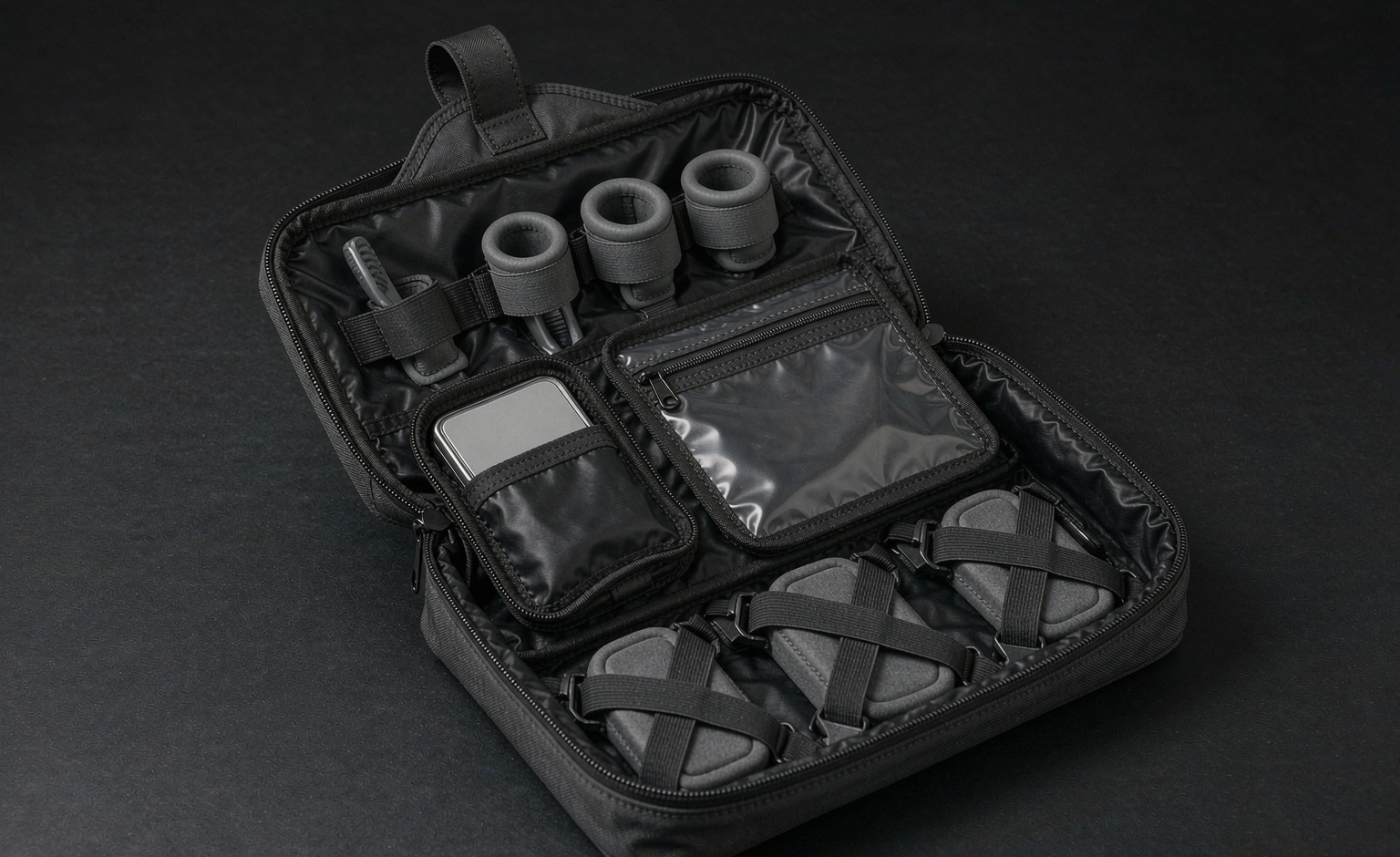
A modular system for marine and deck work is a rinse-clean carry platform built with corrosion-resistant hardware, drainage paths at every low point and high-placement reflective area, so the bag survives daily salt exposure and can be identified if it ends up in the water. Programme terms are 500 units per reference, a sample returning in 6-10 working days, 35-50 days for the bulk build itself, inspection at AQL 2.5 under general level II of ISO 2859-1, and prices FOB Xiamen with payment by T/T 30/70. Scope here is limited: this is civilian work equipment for deck and harbour crews. Personal flotation devices, life-saving appliances, man-overboard procedures and vessel safety obligations are set by flag state, class and the operator's own rules, and nothing below is safety equipment guidance.
What a Deck Bag Meets in One Working Season
Salt is the defining condition, and it is not a single stress, which is why a deck bag diverges from a shore-side work carry platform in almost every detail. A bag on a working deck meets aerosol salt spray most days, standing water in the bottom of a tender, direct sunlight for hours, diesel and hydraulic residue, and fish or bait residue on a fishing vessel. Each of those attacks something different: the metal, the coating, the thread and the print respectively.
Motion is the second condition and the one that separates deck work from shore work. Everything is done on a moving, often wet surface, with one hand for the ship. A bag that has to be set down to be opened is a bag that gets set down in the wrong place, so access has to be possible while the wearer is braced, and the bag has to stay put on a sloping deck without sliding.
The load itself is modest, generally 5-10 kg: a handheld device or a logbook, gloves, a small tool roll, a knife or a shackle key, a torch, spare batteries, a water bottle and a light shell. What makes it awkward is wet hands and cold, which turn any fiddly fastener into a forty-second problem, and any small dropped part into a lost part.
End-of-watch handling decides service life more than material choice does. Bags that get rinsed with fresh water and hung open last several seasons; bags that get thrown into a locker wet fail within one. The specification should therefore make rinsing and hanging easy, because the crew will do what is easy.
- Working load: 5-10 kg
- Watch length: 6-12 hours
- Daily exposures: salt aerosol, standing water, sunlight, fuel residue
- Handling that matters most: fresh-water rinse, hung open to dry
- Fastener requirement: operable with cold wet hands
Bottom line: Specify a 5-10 kg deck bag around corrosion-resistant hardware, drainage at every low point and fasteners that work with cold wet hands, and make the end-of-watch rinse and hang the easiest thing to do with it.
Corrosion: Hardware, Fasteners and the Salt Spray Question
Corrosion is the single largest cause of early retirement in this category, and it almost always starts at a small metal part rather than at the fabric. A seized zip slider, a buckle that will not release, or a rivet that has stained a panel will take a bag out of service long before the cloth wears through.
Exposure is reproduced in the laboratory rather than argued about. Salt spray exposure is run to ASTM B117, and it is the reference to name on a specification when a buyer wants hardware compared on equal terms. The test does not reproduce a deck exactly - no accelerated test does - but it does separate hardware choices quickly and cheaply, which is exactly what a specification stage decision needs.
Three hardware families are in play. Austenitic stainless steel in a molybdenum-bearing grade resists pitting far better than a plain 18-8 grade and is worth the premium on anything that sits low or stays wet. Nickel-plated and zinc-alloy parts are cheaper and look right on day one but stain and seize within a season. Acetal and other engineering polymers do not corrode at all, release reliably with wet hands, and are the right answer for buckles and ladderlocks even though they lack the metallic look some buyers want.
Mixing metals is the mistake to avoid. A stainless rivet against an aluminium eyelet, or a brass eyelet in a plated-steel buckle, sets up a galvanic pair that corrodes the less noble metal quickly in an electrolyte - and salt water is an excellent electrolyte. The specification should state one hardware family per assembly, or at least avoid direct contact between dissimilar metals.
| Selection criterion | Molybdenum-bearing stainless steel | Nickel-plated zinc alloy | Acetal engineering polymer |
|---|---|---|---|
| Behaviour under ASTM B117 exposure | No rust, minor staining at edges | White rust and seizure in one season | No corrosion mechanism |
| Release feel with cold wet hands | Fair, metal is cold and slick | Poor once plating degrades | Best, warm and grippy |
| Mass against a standard buckle | Heaviest | Heavy | Lightest |
| Galvanic risk in a mixed assembly | High against aluminium | High against stainless | None |
| Typical application | D-rings, low eyelets, rivets | Decorative trim only | Buckles, ladderlocks, sliders |
| Unit cost index | 100 | 35 | 25 |
Zips deserve their own decision. A metal zip in salt service is a maintenance item; a moulded polymer zip with a covered garage and a fresh-water rinse is a fit-and-forget part. Whichever is chosen, the slider should be a locking type so it does not creep open under vibration.
Verdict: Put polymer hardware on every release point a crew member touches, reserve molybdenum-bearing stainless for low eyelets and rivets, avoid mixing metal families in one assembly, and name ASTM B117 as the comparison test on the specification.
Drainage and Drying: Designing a Bag That Empties
A bag that holds water fails twice: it carries dead weight all watch, and it never dries, which is how linings rot and hardware corrodes. Drainage is a design requirement, not a feature, and it has to be thought through at the drawing stage because it cannot be added later.
Three routes are used. Perforated base panels with 6-10 mm grommets let water out of the main body and out of any pocket that sits low, and they are the most effective single measure. Mesh panels in place of solid cloth at the base and at the back of external pockets let water out and air in, at the cost of some abrasion resistance on the mesh. Open-top pockets with no floor at all drain instantly but cannot hold small items, so they suit gloves and bottles rather than tools.
Padding is the hidden offender. Open-cell foam in a shoulder strap or a back panel acts as a sponge and can hold water for days; closed-cell foam or a spacer mesh drains and dries in hours. Where padding has to be open-cell for comfort, it should be in a removable sleeve so it can be taken out and dried.
Drying provision is the other half. A hanging loop at the top, positioned so the bag hangs base-down with pockets open, is worth more than any coating. Linings should be smooth film rather than brushed textile, because film sheds water and wipes dry while textile holds it.
| Selection criterion | Grommeted base panel | Mesh base and pocket backs | Floorless open-top pockets |
|---|---|---|---|
| Time to empty a soaked pocket | 8-20 s through 6-10 mm grommets | 4-10 s, water passes straight through | 1-3 s, nothing to hold |
| Drying time hung open | 4-8 hours | 2-5 hours | 1-3 hours |
| Abrasion resistance at the base | Unchanged, cloth is intact | Reduced, mesh abrades faster | Not applicable, no base |
| Small parts retention | Full | Full | Poor, items fall through |
| Added empty mass | 20-50 g | 40-90 g | 0 g |
| Best used for | Main body, tool pockets | Bottle and glove pockets | Gloves, bottles, wet items |
Selection rule: Grommet the base of the main body and of every pocket that sits low, use spacer mesh rather than open-cell foam in straps and back panels, and fit a hanging loop so the bag can dry base-down with pockets open after every watch.
Quick Release and Snag Behaviour on a Moving Deck
Quick release on a work bag means one thing: the wearer can get out of the bag without a second person and without looking at it. That is a convenience and a snag-avoidance requirement, and it is worth being precise about what it is not - a bag is not a safety harness, and nothing here relates to fall protection, working aloft or any personal protective system.
The mechanism should be a single motion. A side-release buckle on the sternum plus a waist strap that releases the same way lets a wearer shrug out of the bag in a couple of seconds. Anything that requires threading a strap back through a ladderlock, or releasing two buckles in a set order, will not be used in a hurry, and a bag that cannot be dropped quickly is a bag that gets carried into situations where it is a hazard.
Snag behaviour is the other half of the same problem. Free webbing ends, dangling cords and loose compressions straps catch on railings, cleats, netting and hatch coamings. Every strap end on a deck bag should have a keeper, and any cord should be elastic and short rather than slack and long. The attachment face itself matters here: a raised webbing grid catches more than a flat welded loop panel, and that trade has to be made consciously.
Balance the two requirements rather than maximising either. A bag that releases instantly but has six dangling ends is worse on deck than one that takes three seconds to remove and presents a clean exterior.
Takeaway: Require a one-motion release on sternum and waist, put a keeper on every strap end, keep cords short and elastic, and accept a slightly slower release in exchange for an exterior with nothing loose to catch on railings or netting.
Overboard Visibility: Reflective Area, Colour and Light Mounting
If a bag goes into the water, the crew needs to see it. That is the practical reason visibility matters here, and it is a different problem from worksite visibility because the background is moving water rather than a static site.
Reflective material is the primary tool. A continuous 50 mm band running across the lid and over both shoulder straps returns a torch or a deck light to its source, and unbroken area matters more than total area, because the eye follows a line. Placement should be high and on outward-facing surfaces; a band low on the back panel is underwater first and hidden by the wearer second.
Colour does the daylight work. Fluorescent orange or yellow in the 50-100 mm panel range reads against grey water far better than any dark tone, and a coloured lid panel is easier to spot than a coloured base. Making the whole bag fluorescent is unnecessary and makes grime obvious; a panel on the lid and one on each shoulder is enough.
A light mount is the finishing touch. A small elastic keeper on each shoulder strap carries a compact marker light, and a patch field on the lid carries a strobe; both should be reachable with gloves on and should not foul the release buckles. Battery changes should not require opening the main body, for the same reason as on any night-work bag.
- Reflective band: 50 mm continuous, lid and both shoulder straps
- Fluorescent panel: 50-100 mm on the lid and each shoulder
- Light mount: one keeper per strap, plus a lid patch field
- Placement rule: high and outward-facing, never low on the back panel
- Release clearance: no visibility fitting may foul a buckle
Judgement: Fit a continuous 50 mm reflective band on the lid and both shoulder straps, add fluorescent 50-100 mm panels in the same high positions, and mount marker lights where they cannot foul the release buckles.
Shell Constructions Compared for Salt Service
Three shell constructions dominate this category, and the choice is a trade between seam route, repairability, mass and how the surface behaves after a season of salt and sunlight, none of which a general-purpose modular backpack has to answer. There is no outright winner; there is a winner for a given maintenance regime.
A coated woven polyester shell is the familiar option: light, repairable, easy to print on, and dependent on its coating for water behaviour. Coating adhesion and coated-fabric behaviour are covered by ASTM D751, and cloth abrasion by ISO 12947. Its weakness in this environment is the seam: a sewn seam leaks unless taped or welded, and tape is the part that fails first under repeated wet-dry cycling.
A thermoplastic polyurethane laminate gives a weldable seam, which removes the needle holes entirely, and it stays flexible in cold. It is heavier per square metre, harder to repair in the field, and its surface marks more easily. A PVC-coated tarpaulin shell is the heaviest and the most abrasion-tolerant, welds cleanly, and is the usual choice where the bag is dragged across non-skid decking daily, at the cost of mass and of stiffness in cold.
Water behaviour of the finished cloth is checked to AATCC 127, which gives a comparable figure across all three constructions. What the figure does not capture is what happens after a season: coatings chalk, welds craze at fold points, and prints lift, so the specification should pair the laboratory figure with a stated inspection interval.
| Selection criterion | Coated woven polyester | Thermoplastic polyurethane laminate | PVC-coated tarpaulin |
|---|---|---|---|
| Seam route | Sewn, then taped or welded over | Welded, no needle holes | Welded, no needle holes |
| Field repair | Easy, needle and tape | Hard, needs a welding kit | Moderate, patch and adhesive |
| Mass per square metre | Lightest | Intermediate | Heaviest |
| Cold-flex behaviour | Good | Best | Stiffens in cold |
| Abrasion against non-skid decking | Fair, coating wears | Good | Best |
| Behaviour after one season of sun | Coating chalks | Surface marks, holds strength | Colour shift, holds strength |
| Print and branding route | Screen or transfer, easiest | Limited | Screen, needs a primer |
Spec rule: Choose a coated woven polyester where field repair and branding matter, a welded laminate where seam leakage and cold flex dominate, and a PVC-coated tarpaulin where the bag is dragged across decking daily, pairing AATCC 127 and ISO 12947 figures with a stated inspection interval.
Attachment Face Versus Welded Loops in a Salt Environment
The outside of a deck bag has two jobs that pull in opposite directions: it has to hold pouches securely, and it has to rinse clean. A raised webbing grid holds pouches very well and traps salt crystals in its weave, which then abrade anything rubbing against them and stay damp after a rinse.
Welded loop panels are the alternative. Low-profile loops take a clip or a short strap, present almost nothing to snag, and rinse clean in seconds because there is no weave to hold residue. What they give up is flexibility: a pouch can go where a loop is, not anywhere on a grid, and a loop that tears cannot be restitched in the field.
A hybrid arrangement usually wins on a working boat. A small area of grid, sized to the pouches the crew actually uses, sits where it can be reached and rinsed; welded loops handle the rest of the exterior. Where a grid is used, the geometry to hold is the one widely published for PALS arrays - 25 mm webbing with rows 38 mm apart and columns repeating every 50 mm - so that pouches bought later still fit.
Rinsing access is the deciding question in the end. If a pouch face cannot be reached with a fresh-water hose at end of watch, salt will stay in it regardless of what it is made of, and the fastener behind it will seize. Layouts built around published attachment grid geometry should therefore be drawn with the rinse path in mind, not only with the pouch list.
Expect to inspect the face every 30 service days in salt use: look for lifted stitch islands, salt crystals inside the weave, and any buckle that has started to stiffen.
Production Capacity and Sampling Gates for Marine Fleets
Marine fleets are bought by operators, charter companies and harbour services, usually ahead of a season and usually with a company mark that has to sit on a fluorescent panel. Planning runs on the same gates as any other programme, with one addition: hardware has to be confirmed before the shell is cut, because a change from polymer to stainless changes the pattern.
On the production side, the SGS-verified base carries 4,950 m² of floor, 137 operators, 7 lines and 149 machines, and the monthly ceiling across the site sits at 200,000 units. A sample returns in 6-10 working days, stretching to 12-15 where the shell, the drainage layout and the hardware set are all new together; 35-50 days covers the bulk build after pre-production approval, with inspection at AQL 2.5 under general level II of ISO 2859-1 ahead of shipment.
Our founder's bag production experience dates to 2004, and the business itself opened in 2014. For this category the recurring advice from that experience is to lock hardware first: polymer for anything the crew touches, molybdenum-bearing stainless low down, and one metal family per assembly to keep galvanic pairs out of the build.
Confirm the hardware set during sampling rather than after it. A switch later in the programme changes the pattern, the panel file and sometimes the seam route, and each change costs days that a season start will not give back.
Freight Cube, Sampling Cost and Reorder Planning for Marine Orders
Deck bags pack better than hiking bags because they are simpler - no long harness, no frame sheet - but welded constructions do not compress, so cube should be confirmed from a packed sample rather than estimated from a drawing.
A 20GP swallows around 28 CBM while a 40HQ takes close to 68 CBM, and a sea leg takes 25-35 days, an air leg 5-8 days and express 3-5 days. The normal pattern for a season order is one sea shipment landed well before the first trip, with a small air top-up of replacement buckles and hardware held in reserve, because hardware is what wears out first in salt service.
Budget items are the usual ones: allow USD 50-150 for the sample, refunded against the bulk order, and USD 300-2,500 where new tooling, a welded panel file or a printed fluorescent set is needed. A quotation follows within 24-48 hours of a finished specification, whether built from the standard modular range or as a bespoke reference, FOB Xiamen, payment by T/T 30/70, and a 500-unit entry point per reference.
Hardware spares are the reorder that matters. A fleet loses buckles and sliders far faster than it loses shells, so holding a hardware set per five bags, ordered with the fleet rather than after it, keeps bags in service instead of waiting on parts. Reordering against the same pattern also means a replacement part bought next season still fits.
Plan the fleet on one sea shipment of 25-35 days, hold air freight for hardware, and treat buckles and sliders as the consumable rather than the shell.
Frequently asked questions
What makes a modular system suitable for marine and deck work?
Corrosion-resistant hardware, drainage at every low point, welded or taped seams and reflective area placed high. A 5-10 kg load carried across a 6-12 hour watch is the design case, with a fresh-water rinse at the end of it.
- 5-10 kg working load
- Grommets at low points
- 50 mm reflective bands
How is corrosion resistance checked on bag hardware?
Salt spray exposure is run to ASTM B117, which separates hardware choices quickly at specification stage. It does not reproduce a deck exactly, but it does show which parts stain and seize within a season.
- ASTM B117 for salt spray
- Polymer for release points
- One metal family per assembly
Which hardware should a deck bag use for buckles?
Acetal engineering polymer. It has no corrosion mechanism, releases reliably with cold wet hands and is the lightest option, while molybdenum-bearing stainless belongs on low eyelets and rivets rather than on buckles.
- Polymer buckles
- Stainless low eyelets
- Avoid plated zinc alloy
Why does mixing metal types cause problems in salt service?
Dissimilar metals in contact form a galvanic pair, and salt water is an excellent electrolyte, so the less noble metal corrodes quickly. A stainless rivet against an aluminium eyelet is the classic failure in this category.
- One family per assembly
- No brass against steel
- Isolate unavoidable pairs
Should a deck bag use a metal or a polymer zip?
Polymer, with a covered garage and a locking slider. A metal zip in salt service becomes a maintenance item, while a moulded polymer zip rinses clean and does not creep open under vibration.
- Moulded polymer teeth
- Locking slider
- Covered garage at the top
How should a marine bag drain after it has been soaked?
Through grommets of 6-10 mm at the base of the main body and of every low pocket, emptying in 8-20 seconds, then hung base-down with pockets open to dry in four to eight hours. Spacer mesh dries faster than open-cell foam.
- 6-10 mm grommets
- Hang base-down
- Spacer mesh, not foam
What padding works best in a bag that gets wet daily?
Closed-cell foam or spacer mesh, because open-cell foam acts as a sponge and can hold water for days. Where open-cell padding is needed for comfort, put it in a removable sleeve so it can be taken out and dried.
- Closed-cell or spacer mesh
- Removable comfort sleeve
- Smooth film linings
How much reflective area should a deck bag carry?
A continuous 50 mm band on the lid and on both shoulder straps, placed high and facing outward, plus fluorescent panels of 50-100 mm in the same positions. Unbroken area matters more than total area against moving water.
- 50 mm continuous bands
- Fluorescent 50-100 mm panels
- High, outward-facing only
Does a deck bag need a quick-release system?
Yes, one motion on sternum and waist, so the wearer can get out of the bag without help. This is convenience and snag avoidance only; a bag is not a safety harness and nothing here relates to fall protection.
- One-motion release
- Keeper on every strap end
- Short elastic cords
Which shell construction lasts longest in salt service?
PVC-coated tarpaulin for abrasion against non-skid decking, a welded laminate where seam leakage and cold flex dominate, and coated woven polyester where field repair and branding matter most. Pair AATCC 127 and ISO 12947 figures with an inspection interval.
- AATCC 127 water behaviour
- ISO 12947 abrasion
- ASTM D751 coated fabric
Is an attachment grid or welded loops better on a boat?
Welded loops rinse clean and snag less; a grid holds pouches anywhere and traps salt in its weave. A hybrid usually wins: a small grid where pouches are actually used, welded loops elsewhere, held to 25 mm webbing, 38 mm pitch and 50 mm repeat.
- Hybrid face
- 25 mm webbing, 38 mm pitch
- Rinse path drawn in
What is the minimum order for a marine bag programme?
500 units per reference. A sample returns in 6-10 working days, stretching to 12-15 where shell, drainage layout and hardware set are all new, and 35-50 days covers the bulk build after pre-production approval, checked at AQL 2.5.
- 500 units per reference
- Sample in 6-10 working days
- Bulk build 35-50 days
How much does sampling and tooling cost for a deck bag?
Allow USD 50-150 for the sample, refunded against the bulk order, and USD 300-2,500 where new tooling, a welded panel file or a printed fluorescent set is needed. A quotation follows within 24-48 hours of a complete specification, FOB Xiamen.
- Sample charge USD 50-150
- New tooling USD 300-2,500
- Quotation in 24-48 hours
How is a marine fleet shipped and what spares should it hold?
A 20GP swallows around 28 CBM and a 40HQ close to 68 CBM; a sea leg takes 25-35 days, air 5-8 days and express 3-5 days. Hold one hardware set per five bags, ordered with the fleet, because buckles wear before shells.
- 28 CBM per 20GP
- Sea leg 25-35 days
- Hardware set per five bags