Home › Field notes › Modular Travel Backpack Buyer's Guide: Specs, Gates and Trade-offs
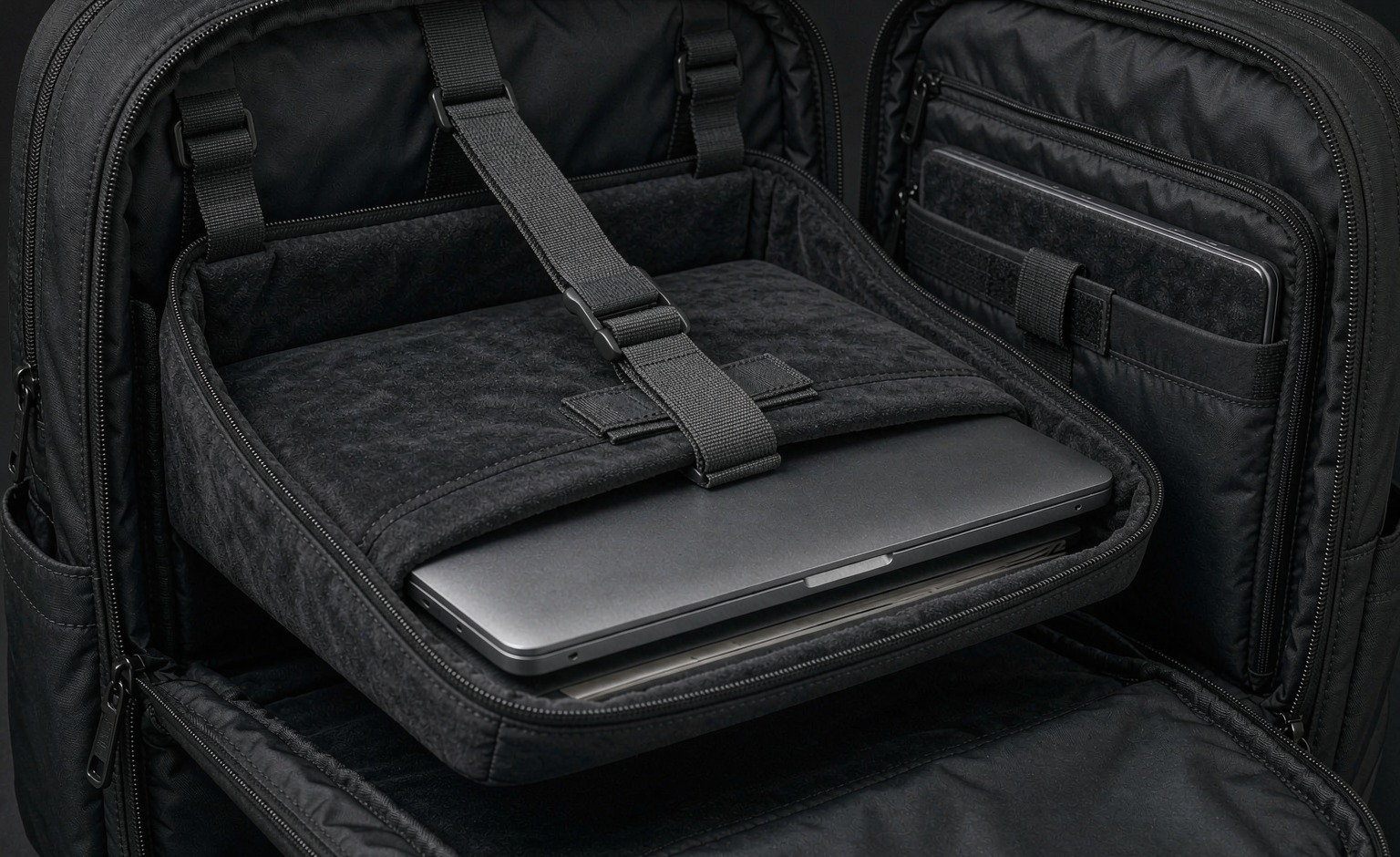
A modular travel backpack should be bought as a specification, not as a photograph: the chassis carries the engineering, the modules carry the range, and confusing the two is what makes programmes expensive. Start by fixing the capacity band honestly, because a litre figure derived from external dimensions overstates usable volume by roughly a fifth and shows up in reviews within weeks. Then decide where the development money goes, which in practice means a harness that transfers load to the hips and a shell that survives abrasion, before any thought is given to pouch count. On the commercial side the numbers are fixed and worth knowing before the first enquiry: MOQ 500 applies to each reference, sampling takes 6-10 working days or 12-15 where the build is complex, and mass production runs 35-50 days. Lot acceptance is held at AQL 2.5.
Reading a specification instead of a photograph
Two documents describe every travel article: the marketing sheet and the technical pack. They are not the same document, and the gap between them is where most disputes begin. The marketing sheet sells silhouette, colour and capacity. The technical pack states shell denier and coating, stitch density, hardware references, foam density and compression set, webbing width and pitch, and the test methods with pass levels. A buyer who approves on the first and pays against the second has no recourse when they diverge.
The first practical step is therefore to insist on a technical pack before approving any sample, and to make sure it names test methods rather than adjectives. Weather resistance is not a phrase; it is AATCC 127 at a stated hydrostatic level. Abrasion resistance is not a phrase; it is ASTM D3884 or ISO 12947 at a stated cycle count. Coating durability is not a phrase; it is ASTM D751. A supplier who cannot produce that table will also struggle to hold a tolerance when the order repeats.
The second step is to separate fixed decisions from reversible ones. Chassis geometry, harness geometry and material stack are effectively fixed once a marker is cut and tooling is committed. Colourway, trim, lining print and pouch assortment are reversible at relatively low cost. Sequencing the reversible decisions after the fixed ones are proven is the cheapest schedule protection available, and it is why programmes that sample a chassis alone first tend to launch on time.
Selection rule: Selection rule: Read the panel geometry and the seam construction before the photography, and shortlist any travel chassis whose specification states a 25 mm webbing width, 38 mm row pitch and 50 mm column repeat as numbers rather than as marketing copy.
Capacity grammar and the arithmetic behind litre claims
Capacity is the most abused number in the category. Multiplying external height, width and depth gives the volume of the bounding box, not the volume a traveller can fill, and the difference is routinely twenty percent or more once corner radius, panel curvature and foam thickness are accounted for. The honest method is displacement: fill the closed article with a measured medium and read the volume back.
| Band | Typical trip length | Overhead bin | Under-seat | Module count that suits |
|---|---|---|---|---|
| 20 to 30 litres | One to two nights | Comfortable | Often, if depth is controlled | Two |
| 30 to 40 litres | Two to four nights | Comfortable | Rarely | Three |
| 40 to 50 litres | Four to seven nights | Usually, at the limit | No | Three to four |
| 50 to 65 litres | Seven nights and beyond | Depends on carrier | No | Four, with compression |
| Above 65 litres | Expedition or group kit | Check-in likely | No | Four plus external straps |
Depth is the dimension that decides whether a bag flies. Carriers enforce a footprint and, in practice, a silhouette, and a 40-litre article that measures 300 mm deep will be gate-checked where a 45-litre article at 220 mm will not. That is why the dimensional specification should state three numbers with tolerances rather than a single litre figure, and why the depth limit belongs in the brief before the sketch stage.
Compression is the other half of capacity honesty. A bag that carries 45 litres expanded and 32 litres compressed serves two trips; a bag that carries 45 litres and cannot compress serves one and is a nuisance on the other. Compression straps, a roll-top closure or a removable lid all achieve this, and the choice should follow the trip profile rather than the trend cycle.
Chassis versus module: where the money should go
The rule that holds across almost every programme: spend on the chassis, count on the modules. The chassis does the structural work, carries the harness, takes the abrasion and determines whether the article is comfortable at all. The modules create the range, the price ladder and the reason to return to the brand. Getting this backwards produces a beautiful pouch assortment hanging on an uncomfortable bag, which is a product that sells once.
Concretely, the chassis budget should absorb the harness foam, the frame sheet or internal stays, the shell textile and the hardware. Those four inputs are what a user feels in the first ten minutes and what determines the return rate over two years. The module budget should absorb markers, labels and, where applicable, tooling in the USD 300-2,500 band for logo plates and moulded parts. Those are the inputs that create sellable variety at low engineering risk.
A useful discipline is to require that every proposed module justify itself against a written question: does this change who buys the bag, or only what it looks like on the hook? Modules answering the first question, a camera insert, a laptop sleeve, a laundry compartment, a first-aid pouch, earn their place. Modules answering only the second are colourways in disguise and should be handled as colourways, with none of the fixed cost of a reference.
Bottom line: Bottom line: Spend the budget on the chassis and treat pouches as cheap reconfigurable parts, then prove the fixed compartment first so the sampling round in 6-10 working days tests one unknown instead of two.
Harness geometry and load transfer
Comfort is a geometry problem before it is a padding problem. Load should reach the hips through a padded belt that sits on the iliac crest, and the shoulder straps should stabilise rather than carry. That requires the harness to be sized to a torso length rather than to a height, which in practice means either several chassis sizes or an adjustable back panel with a stated adjustment range.
Three measurements belong on the specification: torso length range, hipbelt circumference range and the load-lifter angle from the top of the shoulder strap to the frame. The third is the one most often omitted and the one most often wrong. A load lifter pulling at more than roughly 45 degrees from horizontal does nothing useful; one pulling at 20 to 30 degrees pulls the load toward the back and makes a heavy bag feel materially lighter.
A modular chassis adds a complication that a fixed chassis does not: external pouches move the centre of mass away from the spine. Every 100 mm of rearward projection increases the lever arm the harness must resist, which is why a fully loaded outer lattice feels heavier than the same mass carried inside. The specification should therefore state a maximum rearward projection, and the module brief should treat it as a hard limit rather than a preference.
Verdict: Verdict: State a maximum rearward projection for any rear-mounted module and enforce the figure as a hard limit, because harness geometry cannot be re-cut once the 35-50 day production window has opened.
Materials, coatings and weather claims
Shell selection for travel duty balances abrasion against weight. A 500 denier nylon carrying a polyurethane coating is the general-purpose answer and keeps an empty 40-litre chassis at a mass a traveller will accept. A 1000 D face earns its weight where the bag is checked, dragged or used as site kit, and a ripstop construction earns its place where tear propagation matters more than surface abrasion.
| Property | Method | Why it matters in travel | Typical failure |
|---|---|---|---|
| Tensile strength | ASTM D5034 | Seams and webbing roots under over-pack | Seam grin at stress points |
| Abrasion resistance | ASTM D3884 | Contact with belts, floors and vehicle trim | Face pilling then hole |
| Abrasion, Martindale | ISO 12947 | Comparable figure across suppliers | Dispute over incomparable data |
| Water resistance | AATCC 127 | Claim substantiation | Wetting through at the seam |
| Coating bond | ASTM D751 | Delamination after folding and storage | Flaking inner face |
| Colour fastness | AATCC 8 | Transfer onto light clothing | Crocking complaint on first use |
Weather claims need care. Withstanding a shower is a reasonable claim backed by AATCC 127 and a taped or coated seam design. Being waterproof is a different claim entirely, implies immersion performance, and is not a claim this site makes for its travel articles. Buyers should expect the specification to say weather-resistant and to define what that means, because an undefined claim is a returns liability rather than a marketing asset.
Hardware deserves its own line. YKK #8 suits main openings worked under tension and YKK #10 suits long runs, while YKK #5 is adequate for pouch closures. Buckles and D-rings should be screened under ASTM B117 for corrosion, and any metal part in prolonged skin contact should meet EN 1811 for nickel release, which is a legal threshold in several markets rather than a quality preference.
Opening geometry and access patterns
How a bag opens determines how it is used more than how much it holds. A top-loading article packs efficiently and gives poor access. A full-perimeter clamshell gives complete access and requires a flat surface to use, which is exactly what an airport floor does not provide. A front panel opening with a structured lid sits between the two and is usually the right answer for travel.
The traveller's real constraint is access without unpacking. A passport, a boarding card, a cable and a water bottle are needed repeatedly and unpredictably, and each trip to the bottom of a 45-litre bag costs minutes and patience. A dedicated quick-access zone, ideally on the lid or an upper front face, is worth more than an extra ten litres of nominal volume.
Closure security is the counterpart. A clamshell zip that gets pulled while the bag is packed out will burst unless the chain size and the storm flap are specified together, and a zip termination without a garage invites the slider to be driven off the tape. Both should be in the technical pack as explicit requirements, and both should be exercised in the wear trial with the bag genuinely over-packed rather than neatly staged.
One further pattern is worth designing in from the start: a dedicated compartment that isolates damp or dirty items from the main cavity. A laundry sleeve, a shoe compartment or a wet pocket accessed from the outside face resolves the problem a traveller otherwise solves with a carrier bag tied to a strap. It costs one panel and one zip, and it removes the most common reason a travel article is described as impractical in long-term reviews.
Compliance file and restricted substances
A travel article is a consumer good, and the compliance file is a fixed cost that has to be carried before the first shipment, not after a customs query. REACH (EC 1907/2006) governs substances of very high concern for the European market and requires supplier declarations backed by testing on each distinct input: coated textile, foam, print inks, webbing and hardware plating each carry a different profile.
For the United States, California Prop 65 imposes warning obligations where listed substances exceed threshold, and the economical answer is to specify below threshold rather than to print warnings. CPSIA applies where an article is marketed to children, a classification that catches school-travel and youth lines more often than buyers expect, bringing lead and phthalate limits and a tracking label. EN 1811 covers nickel release from metal components and OEKO-TEX Standard 100 offers a single certificate across the textile stack that most retailers accept as evidence of diligence.
Process documentation sits beside product compliance. ISO 9001 covers the management system behind the goods, BSCI addresses social compliance where the goods are made, and both should be requested with the certificate identifier together with its scope wording instead of a badge, because a certificate that leaves cut-and-sew out of scope demonstrates nothing. Our SGS-verified production base holds both, and the current set is available through the company profile.
Takeaway: Takeaway: Start the restricted-substance pack at the same moment as the first sample rather than waiting for approval, request certificate numbers together with scope statements, and hold the first payment under T/T 30/70 until the documentation pack has been read.
Qualification gates before volume commitment
Gates exist because interface errors are cheap to fix on paper and expensive to fix after tooling. For a travel chassis the sequence should be fixed and written, with a named owner and a pass condition for each step, so that no one is ever asked to approve something they were not told to check.
| Gate | Decision required | Pass condition | Evidence filed |
|---|---|---|---|
| Brief sign-off | Capacity band, depth limit, torso range agreed | Three dimensions and two ranges written | Signed brief |
| Material approval | Shell, lining, foam and hardware confirmed | Test reports meet stated levels | Lab reports by method |
| Chassis sample | Geometry and harness fit reviewed | Loaded comfort acceptable on a two-week trial | Wear log with photographs |
| Module interface | Pouch mounts align with the panel | No creep under loaded hang | Measurement sheet |
| Transit | Carton specification validated | Article and carton intact | ISTA 3A report |
| Lot release | Production run accepted | Defects within the agreed limit | AQL 2.5 inspection report referenced to ISO 2859-1 |
Two conventions make this work in practice. A sample takes 6-10 working days on soft goods and 12-15 where a moulded shell or laminated panel is involved, so the gate calendar has to sit inside the launch plan rather than surface at approval. The acceptance limit must also be fixed in writing before the lot is offered up, since a limit negotiated afterwards is not a limit at all. MIL-STD-105 preceded the ISO 2859-1 tables and hangs on in dated paperwork; current files should quote ISO.
Volumes, scheduling and landed cost
Volume planning opens with a 500-unit floor on every reference, so a chassis carrying three pouch modules is four separate 500-unit obligations instead of a single 2,000-unit one. That arithmetic tends to surprise a range planner exactly once. Throughput is seldom what holds things up: 200,000 units per month come off our SGS-verified 4,950 m² floor, where 7 production lines and 149 machines are run by 137 people.
Scheduling holds a stable shape. Budget 6-10 working days for sampling, or 12-15 for a complex build, with sample charges of USD 50-150 credited back on a confirmed order and tooling or screens at USD 300-2,500, moving with whether a plate, a moulding or printed artwork is involved. Production of the quantity then needs 35-50 days, counted from approval of the sample and confirmed materials. Transit adds 25-35 days by sea, 5-8 by air and 3-5 by courier, and the choice usually reflects whether the launch deadline or the gross margin is under more strain.
Settlement completes the structure. Indicative pricing is quoted FOB Xiamen at the 500-unit minimum, and payment is normally T/T 30/70: 30 percent down to release material purchasing, the remaining 70 percent on inspection release rather than on a dispatch date. Cartons should be designed rather than discovered, because a 20GP takes roughly 28 CBM and a 40HQ roughly 68 CBM, and dimensions that ignore those numbers cost money at every booking. Full commercial terms are set out on the programme services page, and the convertible layouts worth considering alongside a travel chassis are shown on the convertible range.
Spec rule: Spec rule: Set the opening order at 500 units per reference, allow 35-50 days for mass production after a 6-10 working day sampling round, and choose between 25-35 days by sea and 5-8 days by air on the margin the launch date actually protects.
Frequently asked questions
How should a buyer judge a capacity claim?
By displacement, not by multiplying external dimensions. The multiplication method describes a bounding box and overstates usable volume by roughly twenty percent once corner radius, curvature and foam are counted. Ask for a litre figure measured by filling the closed article.
Which single dimension most affects whether a bag flies as cabin baggage?
Depth. Carriers enforce a silhouette in practice, so a 40-litre article at 300 mm deep gets gate-checked where a 45-litre article at 220 mm does not. Put a depth limit in the brief before sketching, not after sampling.
Should development spend go to the chassis or the modules?
To the chassis. Harness foam, frame sheet, shell textile and hardware determine comfort and return rate over years. Modules create sellable variety at low engineering risk and should absorb markers, labels and tooling in the USD 300-2,500 band.
What load-lifter angle should the harness specify?
Between roughly 20 and 30 degrees from horizontal at the top of the shoulder strap. Beyond about 45 degrees the strap stops pulling load toward the spine and does nothing useful, which is a common and invisible specification error.
Why does a fully loaded outer lattice feel heavier than the same mass inside?
Because rearward projection lengthens the lever arm the harness must resist. Every 100 mm away from the spine increases that moment, so the specification should set a maximum projection and the module brief should treat it as a hard limit.
Which opening style suits travel best?
Usually a front panel opening with a structured lid. A top loader packs well and gives poor access; a full clamshell gives complete access but needs a flat surface an airport floor does not provide. A quick-access zone matters more than extra nominal volume.
What test methods belong on a travel chassis specification?
ASTM D5034 for tensile, ASTM D3884 or ISO 12947 for abrasion and AATCC 127 for hydrostatic behaviour, ASTM D751 for coating bond, AATCC 8 for crocking, ASTM B117 for hardware corrosion and EN 1811 for nickel release.
Can a travel article be described as waterproof?
Not on this site. Weather resistance is a claim backed by AATCC 127 and a coated or taped seam design. Waterproof implies immersion performance and is not claimed here, because an undefined claim becomes a returns liability.
Which compliance obligations apply to a travel bag?
REACH (EC 1907/2006) for the European market, California Prop 65 and CPSIA for the United States, EN 1811 for nickel release, and OEKO-TEX Standard 100 as a widely accepted textile-stack certificate. ISO 9001 and BSCI cover process.
How many modules should a travel chassis carry?
Three to four for most bands. Require each module to answer whether it changes who buys the bag or only what it looks like on the hook; anything answering only the second is a colourway and should not carry a reference's fixed cost.
How is the minimum order quantity counted across a range?
Every reference carries its own 500-unit floor, so one chassis plus three pouches means four obligations of 500 rather than a single obligation of 2,000. Planners who overlook this either tie up too much cash or abandon a variant late.
How long does the development and production cycle take?
A first sample takes 6-10 working days, or 12-15 where the specification is complex, and the production quantity needs 35-50 days from approval plus confirmed materials. Transit then adds 25-35 days by sea, 5-8 by air and 3-5 by courier.
What are the sampling and tooling costs?
Sample charges are USD 50-150, refunded as soon as an order is placed, and tooling with screens land at USD 300-2,500, moving with whether a plate, a moulded component or a printed panel is needed. Indicative only.
How should the balance payment be tied?
To the inspection result, not to a shipping date. Under T/T 30/70 the opening 30 percent releases material purchasing and the final 70 percent becomes payable once the lot passes the agreed check, turning a timing gamble into a controllable quality lever.
What container figures should carton planning use?
Roughly 28 CBM in a 20GP and roughly 68 CBM in a 40HQ. Work box dimensions to those numbers while specifying, rather than meeting a shortfall at booking when every remaining option costs more.
Is production capacity ever the binding constraint?
Seldom. Our SGS-verified floor of 4,950 m² carries 7 production lines and 149 machines worked by 137 people for 200,000 units per month, so material arrival and the reference count usually decide the schedule instead.