Home › Field notes › Modular vs Traditional Backpack: A Decision Matrix for Buyers
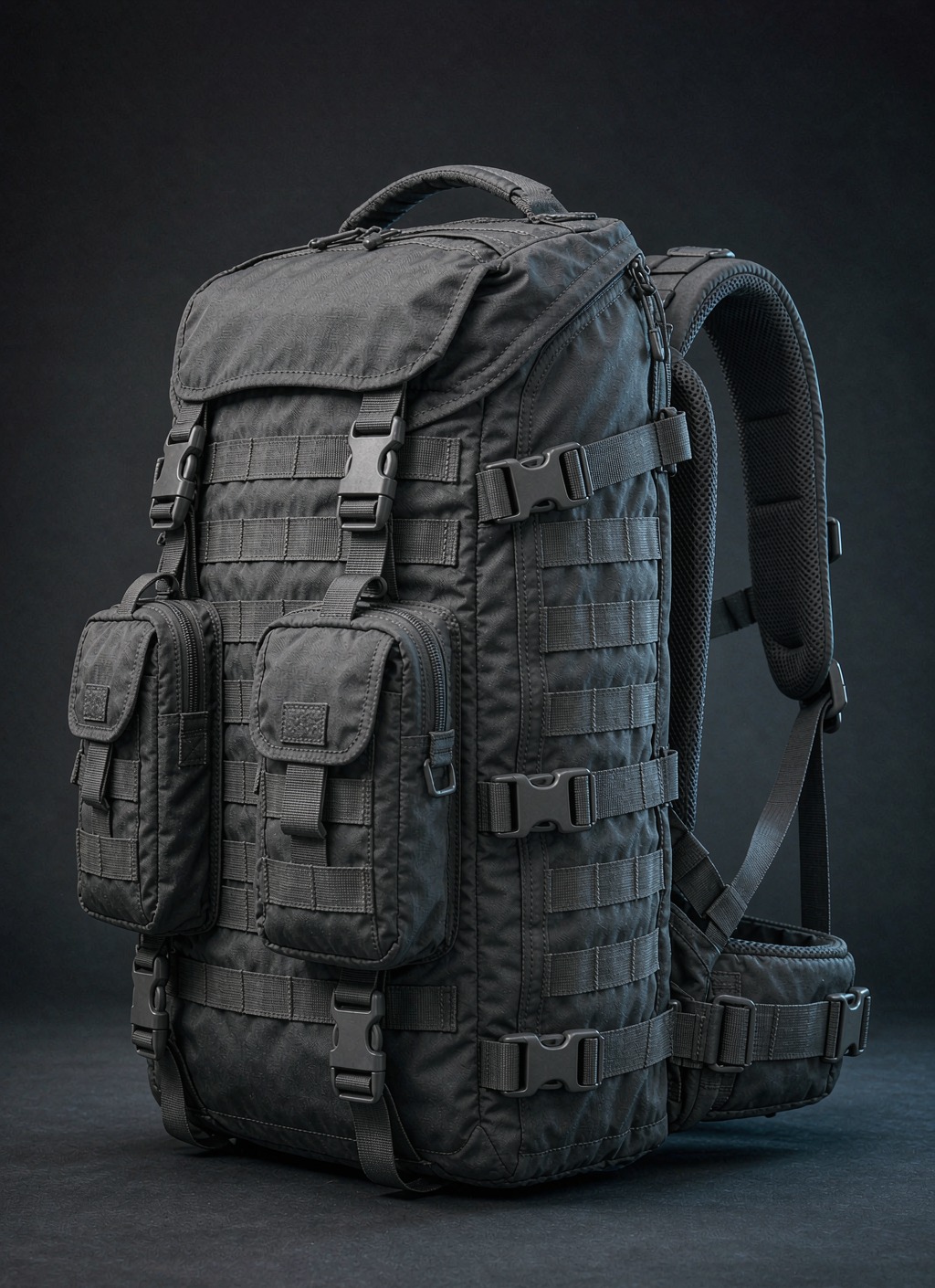
The choice between a modular and a traditional backpack is not a style preference; it is a decision about where cost, risk and flexibility sit across a product's life. A modular construction moves variety from the article to the attachment, which lowers the cost of adding a variant and raises the cost of the empty bag. A traditional construction does the opposite, and the correct answer depends on how many variants the range genuinely needs and whether customers will buy attachments later. This guide puts numbers on that trade-off rather than adjectives, using MOQ 500 as the reference volume and AQL 2.5 as the release standard both constructions are held to. Development timing is identical either way: sampling in 6-10 working days, or 12-15 when the build runs complex, then mass production across 35-50 days.
What genuinely changes, and what does not
Start by separating the two constructions honestly, because most of the marketing around modularity describes differences that do not exist. What changes is where variety lives: in a modular build the chassis is constant and the attachments rotate, while in a traditional build each variant is its own article with its own master. That single structural difference propagates into tooling, compliance documentation, inventory and replenishment revenue.
What does not change is everything that carries load. Both constructions need a harness that transfers weight to the hips, a shell that resists abrasion, a seam specification with stated stitch density, hardware that survives cycling, and a compliance file covering REACH (EC 1907/2006), California Prop 65 and CPSIA as applicable. A modular chassis is not magically more comfortable, and a traditional bag is not magically more durable. Both are decided by the same specification decisions.
What changes secondarily is the serviceable parts list. A traditional bag with a failed lining is generally a failed article. A modular bag with a failed lining is a failed module, provided the interface has been stable and the part is still stocked. That distinction is the strongest genuine argument for modularity and it only holds if the brand commits to stocking parts, which is a commercial decision rather than an engineering one.
Selection rule: Selection rule: Compare the two constructions on cost per use over the service life rather than on unit price, and fix the duty profile first, since an order of 500 units in the wrong construction is cheaper to place and dearer to own.
Cost accounting: why unit price is the wrong comparison
The most common error in this decision is comparing landed unit prices. A modular chassis costs more per unit than an equivalent traditional bag, because it carries extra webbing, reinforcement, hardware and a more complex marker. Compared on that line alone, the traditional build wins every time. The comparison that matters is the cost of delivering a range, not the cost of delivering one bag.
| Cost line | Modular construction | Traditional construction | Which wins |
|---|---|---|---|
| Chassis unit cost | Higher, panel and hardware added | Lower, simpler marker | Traditional |
| Adding a variant | One module, marker and label | Whole article master | Modular |
| Compliance per variant | Inherits the approved file | Fresh file per article | Modular |
| Transit test per variant | Usually inherited | Fresh ISTA 3A run | Modular |
| Empty weight | Higher | Lower | Traditional |
| Warranty handling | Parts shipment | Whole-article exchange | Modular |
| Inventory risk | Spread across modules | Concentrated per article | Modular |
The crossover is calculable. Count the number of variants the range genuinely needs, multiply the traditional figure by the cost of an article master including its compliance file and transit test, and compare with the modular figure of one chassis plus that many module developments. In most ranges the crossover sits at around three variants; below it the traditional build is cheaper, above it the modular build is, and the gap widens quickly after five.
Inventory risk deserves separate mention because it is the cost that actually hurts. Ten traditional articles commit ten separate stock positions each with its own forecast error. One chassis and nine modules commit the same nominal breadth with a shared, forecastable base, and the error concentrates in the cheap replaceable items rather than in the engineered one.
Weight and volume penalties, quantified honestly
Modularity costs mass and there is no way around it. An attachment panel adds webbing, backing, reinforcement and bar-tacking; the pouch adds its own back panel, its own strap runs and its own closure. Against a sewn-in pocket that shares the shell as its back wall, a mounted pouch carries perhaps twice the material for the same enclosed volume, and that is before the hardware is counted.
The volume penalty is smaller but real. A pouch stands off the panel, so the silhouette deepens for a given capacity, and depth is the dimension that decides whether a travel article flies as cabin baggage. A traditional bag can place the same capacity closer to the spine and stay within a carrier's practical silhouette, and for a range sold primarily on cabin compliance that difference matters more than any flexibility argument.
The offset is that modularity lets a user carry less when less is needed. A travel chassis with three pouches removed is materially smaller and lighter than the same chassis loaded, and a user on a two-night trip genuinely benefits. Whether that benefit is realised depends entirely on whether users actually reconfigure, which is addressed below and is the point where most modular ranges quietly fail.
A practical way to keep the penalty honest is to publish both figures. State the empty weight of the chassis alone and the weight of the chassis with the shipped module set, and treat the second as the headline number because that is what the customer carries. Ranges that quote only the bare chassis figure invite the complaint that the bag is heavier than described, and that complaint costs more than the specification honesty would have.
Bottom line: Bottom line: Weigh both constructions loaded rather than empty, and accept the mass penalty of a grid only where the pouch count carried on an average day exceeds two and the 25 mm webbing column earns its grams.
Failure modes: how each construction actually breaks
Failure analysis is more informative than specification comparison, because it shows where each construction is weak rather than where each is strong. Both constructions fail at seams, at hardware and at abrasion points. They differ in which of those dominates and in how repairable the result is.
| Failure | Modular build | Traditional build | Repair outcome |
|---|---|---|---|
| Lining contamination | Module replaced | Article usually withdrawn | Module swap versus write-off |
| Panel abrasion | Webbing frays at the roots | Shell face pills then holes | Both repairable if caught early |
| Closure burst | Pouch zip, cheap to replace | Main zip, often terminal | Module swap versus article loss |
| Interface creep | Pouch walks downward over time | Does not occur | Unique to modular builds |
| Strap root failure | Bar-tack lifts on the panel | Same failure on the body | Similar in both |
| Hardware corrosion | Buckle and slider bodies | Same components | Similar in both |
Interface creep is the failure unique to modular builds and the one worth designing against. A pouch that walks downward under load is a direct consequence of a strap weave that does not alternate rows correctly, or of row pitch drifting outside tolerance. Holding 25 mm webbing, 38 mm vertical spacing and 50 mm horizontal repeat within shop tolerance eliminates most of it, and a loaded hang test over twenty-four hours detects the rest before tooling.
Both constructions should be screened with the same methods: ASTM D5034 for tensile, abrasion under ASTM D3884 or ISO 12947, hydrostatic resistance under AATCC 127, coating adhesion under ASTM D751 and AATCC 8 for colour transfer. Neither construction earns exemption from any of them.
Repairability and service life
Service life is where modularity wins most clearly, and the mechanism is simple: the parts that fail first are the parts that are replaceable. Linings stain and delaminate before shells abrade through. Pouch zips fail before chassis zips. Straps and webbing degrade under UV before the shell does. In a traditional build each of those ends the article; in a modular build each is a parts shipment.
That advantage is conditional on three commitments. The interface must remain stable across seasons, or replacement parts stop fitting. The parts must be stocked, with a stated availability window after the chassis is retired. And the brand must actually offer them rather than treating repairability as a marketing claim. Break any of those three and the advantage evaporates, while the weight and cost penalties remain.
ISO 6330 governs the washing procedure where a washable claim is made and applies to both constructions equally. Where a range targets fleet or staff use, as in hospitality programmes, the modular advantage compounds because the cleaning cycle is what ends most articles, and replacing a washed-out liner is dramatically cheaper than replacing a washed-out bag.
A third commitment is worth adding to the list: condition grading. A fleet or a warranty programme that records why each part was replaced produces a failure distribution within two seasons, and that distribution tells the brand which module to re-engineer first. Without it, re-engineering decisions are made on the loudest complaint rather than the most frequent failure, which is a reliable way to spend development money where it does nothing.
Verdict: Verdict: Choose the construction whose failure mode can be repaired with a needle and a spare part, and confirm the interface stays at 25 mm webbing with 38 mm vertical spacing so a replacement pouch from any source still fits.
SKU economics and how a range plan changes
Range planning under modularity is a different exercise. Instead of asking how many articles to launch, the question becomes how many modules to launch against one chassis, and the constraint that binds is not design capacity but minimum order quantity. Every module reference carries a 500-unit floor, so a chassis plus four modules means five obligations of 500 rather than a single obligation of 2,500, and cash held in stock climbs with the module count.
The compensating effect is that module inventory is cheaper per unit and more forecastable. Chassis demand can be forecast from the range plan; module demand can be forecast from chassis shipments multiplied by an attach rate, which is a far more reliable basis once even one season of data exists. Over two or three seasons that improves working capital materially, even though the first season is harder.
The discipline worth adopting is to launch modules in response to measured demand rather than to complete a concept. Launching with two well-chosen modules and adding a third once attach-rate data exists ties up less capital and produces a better range than launching five at once on the strength of internal enthusiasm, and the sampling window of 6-10 working days means a later addition is not a slow one.
User behaviour: the assumption most ranges get wrong
Every modular range implicitly assumes users will reconfigure. Many do not. A proportion of buyers will mount a pouch once and never move it again, and for those users the modular construction has delivered extra weight and extra cost in exchange for flexibility they never used. That is not a hypothetical; it shows up in review language describing a bag as complicated.
The countermeasure is to make the default configuration right. If a user never touches the interface again, the bag should still work well in the state it arrived in, which means shipping a sensible module set fitted rather than loose in a box, and explaining the interface in one sentence rather than a manual. Where a range is sold online, that single sentence matters more than the interface itself, because the interface cannot be demonstrated.
The second countermeasure is honest segmentation. Sell the modular construction to users whose requirements genuinely vary between trips or between roles, and offer a simpler fixed article alongside it for users who want one bag that works. Treating those as two products rather than one avoids the worst outcome, which is a modular bag bought by someone who wanted a simple one.
Measuring whether the assumption holds is cheaper than most brands expect. Ask one question at the point of return or review: has the customer moved a module in the last month? A range tracking that figure learns within a season whether its flexibility is being used, and can then either invest in explaining the interface or stop paying for it. Programmes that never ask tend to keep funding an interface their customers have quietly ignored.
Takeaway: Takeaway: Watch how owners actually configure the bag for four weeks before finalising the module plan, because the pouch everyone buys second is rarely the one promoted first in a launch plan built on 500 units.
When the traditional construction wins outright
Three conditions favour a traditional build and should end the discussion. First, when the feature set is fixed and small: a bag that needs two compartments and will never need a third is cheaper sewn. Second, when weight is the primary purchase criterion, as in fast-and-light use, where every gram of interface is a gram not spent on capacity.
Third, when the buyer will not reconfigure and the product is sold without explanation. A promotional article given to a group, a conference bag handed out at a door, an amenity item placed in a room: all of these are used once in the state supplied, and a modular interface adds cost with no return.
A fourth condition is worth noting though it is commercial rather than technical: when a range cannot support the module count. If the volume plan only supports one reference at MOQ 500, then one article is what the range can be, and a modular chassis with no modules is simply a heavier traditional bag. Building the fixed article in that situation is the correct decision and the honest advice.
None of these conditions is permanent. A range that starts traditional because it can only fund one reference can convert later, once variant demand is visible and the volume plan supports more than one commitment. The conversion cost is a chassis development and a compliance update, which is far lower than the cost of carrying a modular range whose modules never earn their minimum. Sequencing the decision rather than settling it once is usually the wiser approach.
A decision procedure and a transition plan
The decision can be reduced to five scored questions, each answerable from a range plan without external data. Answer them honestly and the answer usually arrives without argument.
| Question | Answer favouring modular | Answer favouring traditional | Weight |
|---|---|---|---|
| How many variants will the range need? | Four or more | Two or fewer | High |
| Will customers buy attachments later? | Yes, or plausibly | No, single purchase | High |
| Does the duty profile change between uses? | Yes, by trip or role | No, identical each time | High |
| Is empty weight a primary criterion? | No | Yes | Medium |
| Can the plan support several MOQ 500 references? | Yes | One reference only | High |
| Is the article sold with explanation available? | Yes, staff or clear copy | No, handed out | Medium |
Score each answer, weight the five high-weight questions double, and act on the total rather than on intuition. Where the result sits near the middle, the safe move is to build the traditional article first and revisit modularity once variant demand has been demonstrated, because the conversion cost from fixed to modular is far lower than the cost of a stranded modular range.
Where the result favours modularity, transition in stages. Publish the interface geometry first, since it is the only irreversible decision. Build one chassis, wear-trial it with two modules, validate the compliance file, then commit volume. Our production team checks interface geometry at every sampling round, and throughput is seldom the limit: 149 machines over 7 production lines inside an SGS-verified floor measuring 4,950 m², worked by 137 people, yield 200,000 units per month. Standard settlement is T/T 30/70, meaning 30 percent at material release and 70 percent held until inspection clears; terms sit on the services page, and comparable platform options are listed on the modular platform page.
Spec rule: Spec rule: Run both constructions through one sampling round of 6-10 working days, decide on measured cost per use, then commit 500 units of the winner and hold release at AQL 2.5 inspection.
Frequently asked questions
What is the real difference between a modular and a traditional backpack?
Where variety lives. Modular keeps the chassis constant and rotates attachments, so a variant costs a module development. Traditional makes each variant its own article with its own master, compliance file and transit test. Harness, shell and compliance obligations are identical in both.
Is a modular backpack more comfortable than a traditional one?
Not inherently. Comfort comes from harness geometry, load transfer to the hips and the shell, all of which are specified the same way in both. Modularity adds rearward projection when pouches are fitted, which if anything makes load control harder.
Why does a modular chassis cost more per unit?
Because it carries an attachment panel with webbing, backing, reinforcement and bar-tacking, plus hardware a sewn layout does not need. The higher unit price is recovered through cheaper variants, not through the chassis itself.
At how many variants does the modular approach become cheaper?
Roughly three. Compare one chassis plus that many module developments against the same number of article masters, each with its own compliance file and ISTA 3A transit run. Beyond five variants the modular advantage widens quickly.
How much extra weight does an attachment interface add?
A mounted pouch can carry roughly twice the material of a sewn-in pocket of equal volume, because it has its own back panel, strap runs and closure rather than sharing the shell. That is the main technical cost of modularity.
What is interface creep and how is it prevented?
It is a pouch walking downward under load, unique to modular builds. It comes from a strap weave that does not alternate rows or from row pitch outside tolerance. Hold 25 mm webbing, 38 mm vertical spacing and 50 mm horizontal repeat and run a loaded hang test.
Does modularity actually extend service life?
Yes, where parts are stocked. Linings, pouch zips and straps fail before shells and chassis zips, so each becomes a parts shipment rather than an article write-off. The advantage requires a stable interface, a stocking commitment and a stated availability window.
What if users never reconfigure the bag?
Then they paid for flexibility they did not use. Ship a sensible module set fitted rather than loose, explain the interface in one sentence, and offer a simpler fixed article alongside for buyers who want one bag that works.
How does MOQ 500 affect a modular range plan?
Every module reference holds its own minimum, so one chassis plus four modules is five obligations of 500 rather than a single obligation of 2,500. Release modules against measured attach-rate data instead of finishing a concept on paper.
When should a brand build the traditional article instead?
When the feature set is fixed and small, when empty weight is the primary criterion, when the article is handed out without explanation, or when the volume plan supports only one reference. Any of those ends the discussion.
Which test methods apply to both constructions?
Grab tensile under ASTM D5034, abrasion under either ASTM D3884 or ISO 12947, hydrostatic resistance under AATCC 127, coating bond under ASTM D751, crocking under AATCC 8, and laundering under ISO 6330 wherever a washable claim appears.
Is a transit test needed for every variant?
For a traditional variant, generally yes, because carton dimensions change and ISTA 3A should be run again. A module on an approved chassis usually inherits the existing validation, which is one of the larger hidden savings.
How long does development take in either case?
The same in both. Allow 6-10 working days for the first sample, or 12-15 once a moulded shell or laminated panel enters the design, and the production quantity needs 35-50 days from approval plus confirmed materials.
What is the safest move when the decision is marginal?
Build the traditional article first and revisit modularity once variant demand is demonstrated. Converting from fixed to modular is far cheaper than carrying a modular range whose modules never clear their minimum.
How should the balance payment be structured for either build?
Settlement is T/T 30/70 on both: 30 percent advances material purchasing, and the 70 percent remainder waits for inspection release instead of a dispatch date. Pricing is indicative, FOB Xiamen, at 500 units.