Home › Field notes › MOLLE System Explained: Interface Logic for Modular Pouches
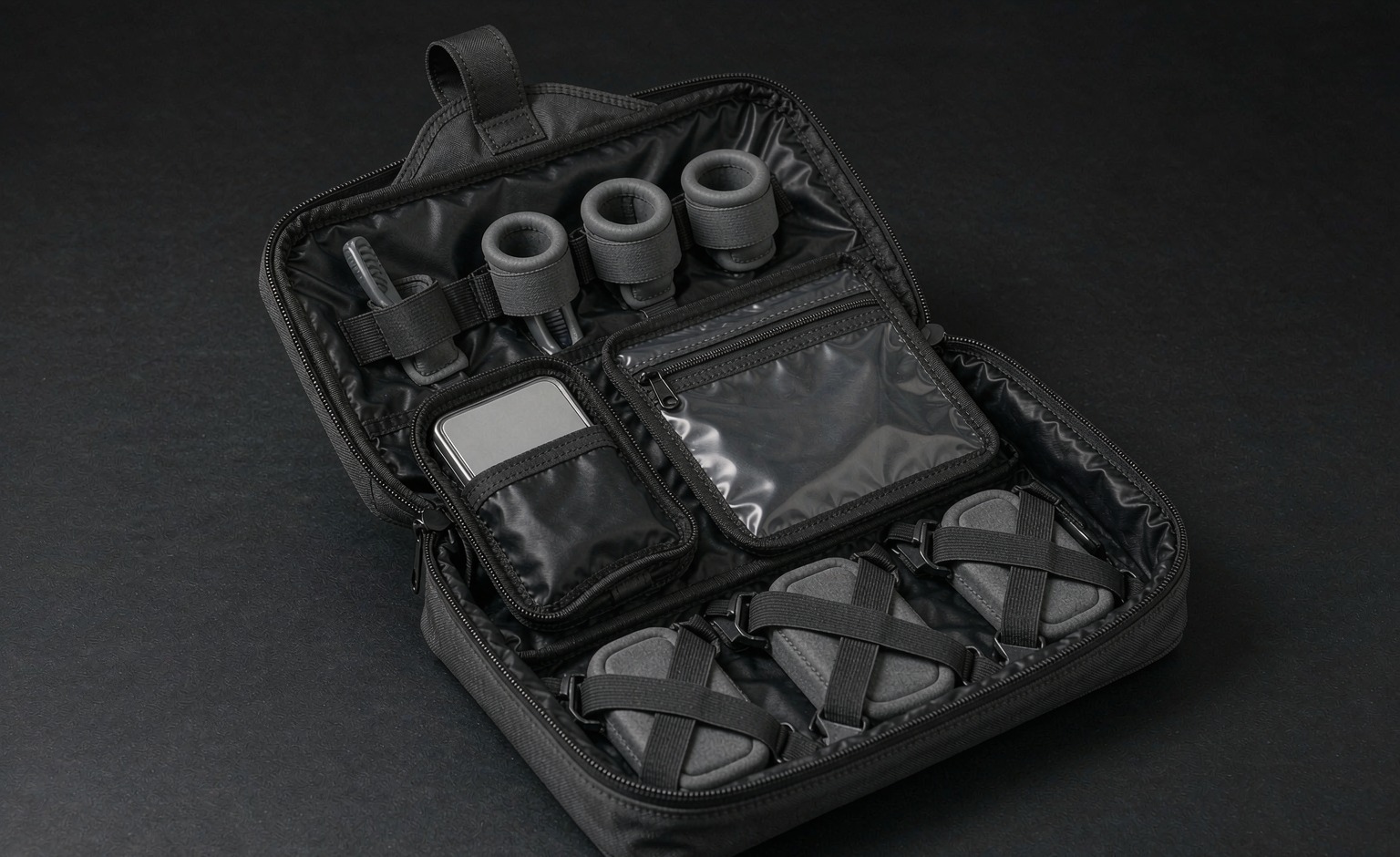
The MOLLE interface is a method of attaching a pouch to a panel using woven webbing columns, and its defining dimensions are 25 mm webbing, 38 mm vertical spacing and 50 mm horizontal repeat. Those three numbers are what make a pouch from one source mount on a panel from another, and almost every compatibility complaint traces back to one of them being wrong. The system originated in military load-carriage work and now serves civilian purposes: hiking, commuting, trade tools, first aid, photography and training kit. This article describes that civilian use only. It makes no claim of conformance to any military specification or standard, and no claim of approval or adoption by any defence organisation. Commercial planning starts at MOQ 500 per reference with sampling in 6-10 working days.
Origin, scope and what the term actually describes
The name is an acronym for a load-carrying equipment programme developed for armed forces in the 1990s, and the design problem it solved was ordinary: one platform had to accept different pouch sets on different tasks, and the attachment had to be reconfigurable by the user without tools. The solution was a lattice of horizontal webbing rows stitched to a panel, combined with vertical straps on the back of each pouch that weave through those rows and secure with a snap or a stiffened tip.
That mechanism is now used far outside its original context, on hiking packs, commuter shells, tool carriers, first-aid kits, camera bags and training kit. The mechanism is the same; the duty is not, and specification should follow the duty rather than the heritage. A pouch carrying hand tools on a site loads its interface very differently from one carrying a camera lens, and both differ from the original application.
To be explicit, because this page is read by procurement teams who need the sentence in writing: nothing here describes carriage of weapons or ammunition, nothing claims ballistic or protective performance, and nothing asserts conformance to any military specification or approval by any defence body. Standard designations that appear later are published laboratory test methods, cited so a buyer can instruct a lab, not badges of certification. The subject is a civilian attachment method for lawful civilian kit.
Selection rule: Selection rule: Treat the interface as published geometry rather than as a brand name, and specify the column at 25 mm, the row pitch at 38 mm and the horizontal repeat at 50 mm on every panel intended to accept a shared pouch.
Why the weave alternates and what it achieves
The weave is the whole idea. A pouch strap passes behind the first row, in front of the second, behind the third, and so on, then secures at the bottom. That alternation is what converts a vertical pull into friction and bearing against several rows rather than a single one, and it is why a correctly woven pouch does not slide down a panel even when loaded.
Spacing makes the alternation possible. Rows at 38 mm vertical spacing leave enough room for a 25 mm strap to pass through and turn, while keeping the stack tight enough that the pouch sits close to the panel. Columns repeating every 50 mm set how many attachment positions the panel offers, so a pouch can be positioned at 50 mm increments rather than wherever it happens to land.
The consequence of getting either number wrong is specific and predictable. Too little vertical spacing and the strap cannot turn, so users force it and tear the stitch line. Too much and the strap has slack, the pouch rocks, and the load concentrates on one row instead of spreading across several. Too wide a column repeat reduces positioning granularity; too narrow wastes panel area and adds weight without adding function.
One further detail is routinely missed: the panel must be flat where the lattice sits. A lattice stitched across a curved or gathered section will hold its stated pitch on the flat and lose it on the curve, and the pouch will mount correctly in one place and badly fifty millimetres away. The technical pack should mark a flat zone and state its minimum dimensions.
Anatomy of the pouch back
A pouch back has four elements, and failures usually originate in the one that was specified least carefully. The strap runs carry the load and must be continuous with the pouch body rather than stitched onto it at a single point. The stiffener gives the strap enough column strength to be threaded without a second hand. The tip secures the end, either by a snap, a fold-back or a moulded end. The back panel spreads the load into the pouch body.
Strap width matters as much as strap strength. A strap narrower than the gap between rows will rotate under load and gradually work the weave loose, while one that is too wide will not thread at all. Matching strap width to the 25 mm webbing nominally, with a small allowance for turning, is the practical rule, and the allowance should be stated in the technical pack rather than left to the operator.
The termination is where most field failures start. A snap that is too easy to release lets the pouch detach inside a bag; one that is too stiff discourages reconfiguration, which defeats the purpose. A fold-back or moulded tip removes the hardware entirely but slows the operation. Choosing between them is a user-behaviour decision and should be made from the duty profile rather than from cost.
Bottom line: Bottom line: Specify the pouch back by strap width, strap pitch and stiffener rather than by pouch silhouette, because compatibility is decided by a 25 mm strap woven at 38 mm pitch and by nothing else in the drawing.
Load path: what actually carries the weight
The intuitive answer, that the pouch hangs from its strap, is wrong. In a correctly woven interface the pouch is held by friction and by bearing pressure distributed across several rows, with the strap acting to maintain that contact rather than to carry the load directly. That is why a pouch can be secure even when the strap tip is not bearing, and why the stitch line at each row end is the genuine structural element.
| Element | Function in the load path | Failure if underspecified | Control |
|---|---|---|---|
| Row stitch line | Transfers pouch weight into the panel | Progressive unravelling from the row end | Bar-tack every row end |
| Webbing run | Provides bearing surface for the strap | Creep, then roll-up under cyclic load | Continuous-filament construction |
| Panel backing | Spreads point load into the shell | Shell tear at the webbing root | Reinforcement patch behind the lattice |
| Pouch strap | Maintains the alternating weave | Pouch walks downward | Width matched to row pitch |
| Termination | Prevents the strap backing out | Pouch detaches inside the bag | Snap force specified numerically |
Rearward projection changes the load path in a way buyers should quantify. Mass carried away from the panel creates a moment about the row stitch line, so a deep pouch loaded heavily imposes several times its own weight on the top row. That is why depth limits belong in the pouch brief and why a shallow, wide pouch is structurally kinder than a deep, narrow one of equal volume.
Verdict: Verdict: Route pouch load into the panel webbing and the shell rather than into the stitch line, and require a bar-tack at every row end, because stitching carries shear well and peel badly, and a 20 mm bar-tack is cheaper than a field failure reported after 500 units have shipped.
Material choices for webbing, shell and thread
Webbing selection is a specification decision with real consequences. Continuous-filament polyester holds dimensional stability and resists UV better than nylon, which matters for any article that lives outdoors. Nylon is softer and threads more easily, which users notice, and absorbs more water, which dimensional stability notices. For most civilian duty polyester is the safer default; for a pouch that is reconfigured daily indoors, nylon's handling is worth having.
| Component | Option | Suits | Trade-off |
|---|---|---|---|
| Webbing | Continuous-filament polyester | Outdoor, UV-exposed kit | Stiffer to thread |
| Webbing | Nylon | Indoor, frequently reconfigured | Absorbs water, less UV stable |
| Shell | 500 D nylon, PU coated | General civilian duty | Abrasion limit on rough ground |
| Shell | 1000 D nylon | Site work, dragged panels | Weight penalty |
| Thread | Bonded polyester | All structural seams | None material |
| Backing | Woven reinforcement patch | Behind any loaded lattice | Added cost and one process step |
Thread is the component most often value-engineered and least often tested. A bonded polyester thread resists the abrasion that occurs inside a stitch line as the article flexes, and it holds its strength under wet conditions. Cotton-wrapped or unbonded threads lose strength when saturated, which matters for any kit used outdoors, and the failure appears as seam grin long before it appears as a broken seam.
Verification rests on conventional methods: grab tensile to ASTM D5034, abrasion to ASTM D3884 or ISO 12947, hydrostatic resistance to AATCC 127, coating adhesion to ASTM D751. Beyond those, the assembled weave needs its own two checks, a loaded hang test and a pull-out test on the row stitch line, because no published method evaluates the weave as built.
Alternative interface families
The woven lattice is not the only way to attach a pouch, and a programme should choose deliberately rather than by default. Three alternatives dominate civilian design, and each trades speed against holding power.
| Family | Mount speed | Holding under load | Cost and consequence |
|---|---|---|---|
| Woven webbing lattice | Slow, tens of seconds | Highest, load spread across rows | Webbing and stitching cost only |
| Hook-and-loop field | Fast, a press | Moderate, degrades with lint | Two-sided tape, loop field wears |
| Daisy chain | Moderate, clip on | Low, single point of attachment | Cheapest, suits light items |
| Magnetic snap-fit | Fastest, one handed | High when correctly specified | Unit cost, second supplier to qualify |
| Channel and slide | Moderate | High, but position is fixed | Moulded part, tooling required |
The correct choice follows the duty profile. A pouch that stays mounted for months, a first-aid kit or a tool caddy, wants the woven lattice because holding power is what matters and speed is irrelevant. A pouch that comes off daily, a wash kit hung in a bathroom, wants hook-and-loop or magnetic hardware. A light item clipped on for a single outing is adequately served by a daisy chain.
Hybrid layouts are common and usually right. A panel can carry a woven lattice as the primary interface plus a hook-and-loop field on the lid for a flat organiser, giving both a secure mount and a fast one. The specification should state which is which, because a user who mounts a heavy pouch on the fast interface will blame the bag when it drops.
Defect register for the woven interface
Most interface complaints are traceable to a small set of manufacturing defects. Writing them into a register with a detection method and a corrective action costs nothing at specification stage and removes them from the returns stream later.
| Defect | Root cause | Detection | Corrective action |
|---|---|---|---|
| Row pitch drift | Marker or operator error, cumulative | Cumulative measurement from a datum | Re-marker with a stated datum |
| Row end lift | Back-tack used instead of bar-tack | Pull test on the end row | Bar-tack every termination |
| Pouch rocks | Webbing width under nominal | Calliper check on incoming webbing | Reject the webbing lot |
| Strap will not thread | Lattice stitched over a curve | Trial mount on a production sample | Mark a flat zone on the pack |
| Pouch detaches | Snap release force too low | Release-force gauge on the snap | Specify release force numerically |
| Shell tear at root | No reinforcement behind the lattice | Loaded pull test | Add a backing patch |
Two of these deserve emphasis because they are cheap to prevent and expensive to fix. Cumulative pitch drift is invisible in a single measurement and only appears when a pouch is mounted on the last row, so the measurement protocol must measure from a datum rather than gap to gap. And a missing backing patch is a specification omission that no inspection will catch, because the article looks correct until it is loaded.
Takeaway: Takeaway: Log defects by symptom and by cause on the same sheet, and separate a pouch that creeps downward from a pouch whose strap is too narrow, since the two faults look identical to a user and must be classified differently before AQL 2.5 inspection.
Verification plan for an interface programme
Verification should run at three levels: incoming material, assembled article and production lot. Material verification covers the webbing dimensions and the shell properties. Article verification covers the assembled weave and the pouch mount. Lot verification confirms that what was approved is what was made, which is where most programmes are weakest.
Expect 6-10 working days at sample stage in soft goods and 12-15 once a moulded component or laminated panel enters the build, and the interface review belongs on the first sample rather than after approval. The review is simple: mount every pouch in the range on every panel that is supposed to accept it, load each one to its stated capacity, and hang it for twenty-four hours. Anything that creeps or rocks fails at that point, when it is still cheap to fix.
Lot release is held at AQL 2.5 against ISO 2859-1, with the acceptance limit recorded in writing ahead of the lot being offered. MIL-STD-105 is the forerunner of those tables and persists on older specification sheets; current documents should name ISO. ISTA 3A covers the parcel transit sequence and needs running once per carton specification. EN 1811 addresses nickel release from metal components worn against skin snaps in skin contact and ASTM B117 covers corrosion on snap and slider bodies, both of which are legal or durability requirements rather than niceties.
Specifying a programme: documents, volumes and timing
The documents a programme needs are fewer than most buyers expect but must be specific. A technical pack with the three interface dimensions and their tolerances, a marked flat zone, a stated strap width and termination type, a backing requirement, a bar-tack requirement, and a measurement protocol naming the datum. Everything else is ordinary bag specification.
Volumes follow a 500-unit floor per reference, and the interface sharpens that arithmetic: a panel plus four pouch types is five obligations of 500, not one obligation of 2,500. The offset is that pouch references cost less per unit and can join the range later against measured demand, and a 6-10 working day sampling window means a later addition is not a slow one. Output is not the binding constraint: 200,000 units monthly come off 7 production lines holding 149 machines, staffed by 137 people across 4,950 m² of SGS-verified floor.
Timing and terms close the plan. The run itself takes 35-50 days once the sample is approved and materials confirmed, with sample charges of USD 50-150 credited back on a confirmed order and tooling or screens at USD 300-2,500 where a moulded part or printed panel is needed. Add 25-35 days for ocean transit, 5-8 for air and 3-5 for courier. Pricing stays indicative and FOB Xiamen against 500 units; money moves T/T 30/70, with 30 percent to start material buying and the outstanding 70 percent on inspection sign-off; and cartons are worked to about 28 CBM to a 20GP and about 68 CBM to a 40HQ. Interface options are catalogued on the system page, and full terms sit on the services page.
The scope statement from the opening bears repeating in the closing, because it is the part buyers need to quote internally: this is a civilian attachment method for hiking, commuting, work tools, first aid, photography and training equipment. It is not a weapon or ammunition carriage system, it offers no ballistic or protective performance, and no claim of conformance to any military specification or approval by any defence organisation is made or implied anywhere in this article.
Spec rule: Spec rule: Issue one interface drawing with datum, tolerances and stitch density, sample in 6-10 working days, then release 500 units per reference only after AQL 2.5 inspection and a transit test on the packed carton.
Frequently asked questions
What does MOLLE stand for and where did it come from?
It is an acronym for a load-carrying equipment programme developed for armed forces in the 1990s, where one platform had to accept different pouch sets. The mechanism now serves civilian kit: hiking, commuting, trade tools, first aid, photography and training equipment.
Does this article claim conformance to a military specification?
No. It makes no claim of conformance to any military specification or standard, and no claim of approval, certification or adoption by any defence organisation. Standard designations cited are published laboratory test methods a buyer can instruct a lab to run.
Is weapon or ammunition carriage covered?
No. Nothing here describes carriage of weapons or ammunition, and no ballistic or protective performance is claimed. The interface is described purely as a civilian method for attaching pouches carrying tools, first-aid supplies, camera gear, food, water and personal items.
Why must the pouch strap weave alternately through the rows?
Alternation converts a vertical pull into friction and bearing across several rows instead of one. Without it the pouch hangs from a single row, creeps downward under load, and concentrates stress on one stitch line that then fails progressively.
What happens if row spacing is too tight or too loose?
Too tight and the strap cannot turn, so users force it and tear the stitch line. Too loose and the strap has slack, the pouch rocks, and load concentrates on one row. The nominal is 38 mm vertical spacing on 25 mm webbing.
Why does the panel need to be flat where the lattice sits?
Because a lattice stitched across a curve holds its pitch on the flat and loses it on the curve, so a pouch mounts correctly in one position and badly a short distance away. The technical pack should mark a flat zone and dimension it.
Should webbing be polyester or nylon?
Polyester for outdoor and UV-exposed kit, because it holds dimensional stability and resists UV. Nylon threads more easily and suits pouch sets reconfigured daily indoors, but absorbs more water and degrades faster in sun.
What is the most common manufacturing defect in this interface?
Cumulative row pitch drift. It is invisible in a single gap measurement and only appears when a pouch is mounted on the last row. Measure cumulatively from a stated datum rather than gap to gap.
Why is a bar-tack required at every row end?
Because a back-tack concentrates load at one point and unravels progressively. The row stitch line is the genuine structural element in the load path, and its termination is where field failures begin.
Do I need a reinforcement patch behind the lattice?
Yes for any loaded application. Without a backing patch, point load from the pouch tears the shell at the webbing root, and the article looks correct until it is loaded, so no visual inspection will catch the omission.
Which alternative attachment methods exist, and when are they better?
Hook-and-loop fields for pouch sets removed daily, daisy chains for light single-outing items, magnetic snap-fit for one-handed mounting, and channel-and-slide where position can be fixed. The woven lattice remains the strongest for pouches that stay mounted.
Which test methods belong on an interface specification?
Tensile to ASTM D5034, abrasion to ASTM D3884 or ISO 12947, hydrostatic resistance to AATCC 127, coating adhesion to ASTM D751, corrosion to ASTM B117, nickel release to EN 1811, plus AQL 2.5 lot acceptance referenced to ISO 2859-1.
How long does development take for a pouch set?
Sampling runs 6-10 working days for soft goods and 12-15 once a moulded component or laminated panel is involved. The production quantity then requires 35-50 days counted from sample sign-off and material confirmation.
How is minimum order quantity counted across panels and pouches?
Each reference holds a 500-unit floor, so a panel plus four pouch types is five obligations of 500 rather than a single obligation of 2,500. Pouch references cost less per unit and can join later against measured demand.
What should the interface review on a first sample involve?
Mount every pouch on every panel meant to accept it, load each to stated capacity, and hang for twenty-four hours. Anything that creeps or rocks fails then, while the fix is still a marker change rather than a tooling change.
How should the balance payment be structured?
Money moves T/T 30/70: 30 percent to start material buying, the outstanding 70 percent on inspection sign-off rather than on a shipping date. Pricing is indicative, FOB Xiamen, at 500 units.