Home › Field notes › Post-Pandemic Travel Recovery: Modular Bag Specs Buyers Demand
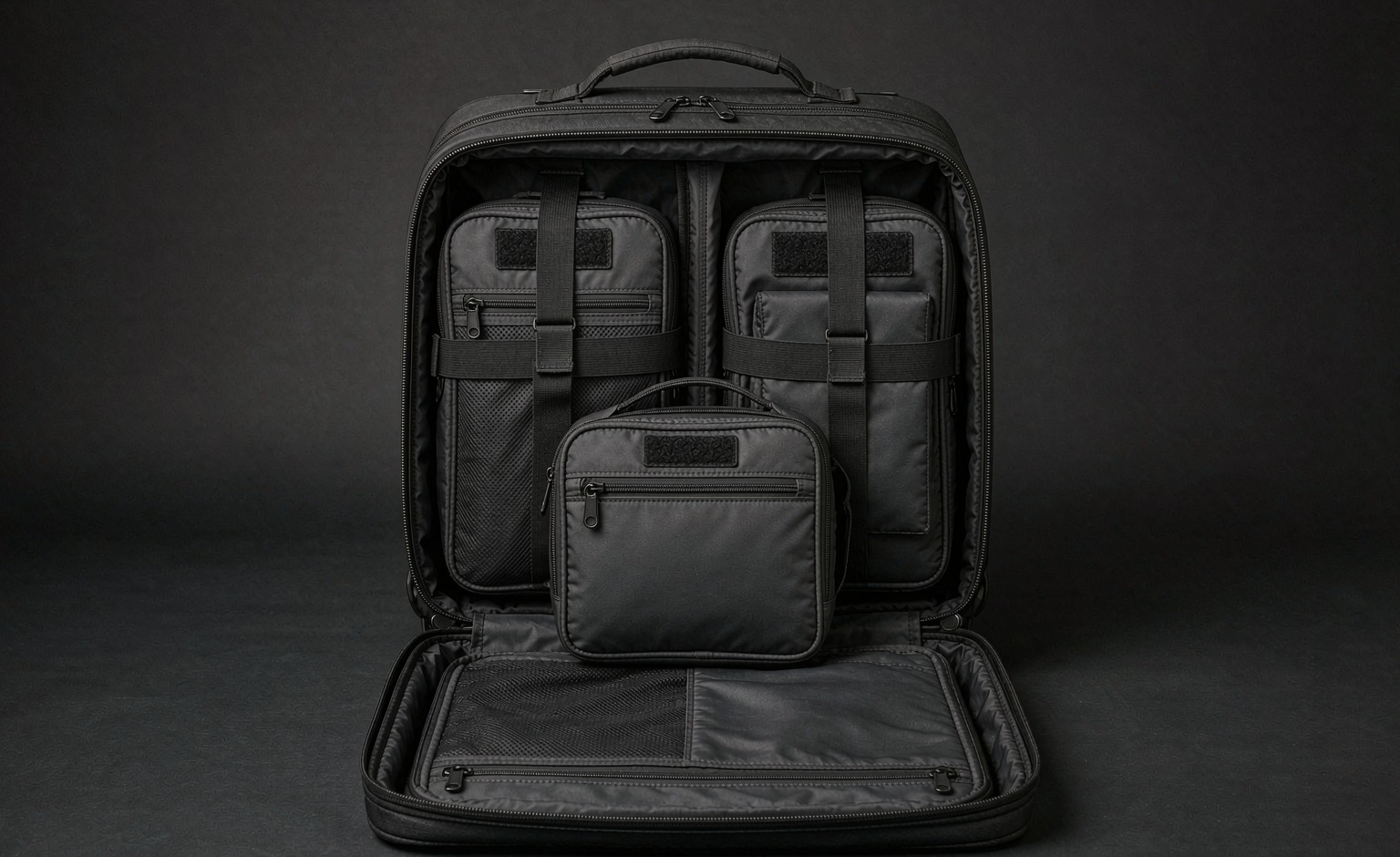
Post-pandemic travel rewrote the specification rather than the destination: modular travel bags now have to survive routine wipe-down, cabin-only volume limits, and a working day folded into the same itinerary. Three measurable shifts drive that spec, more short trips per traveller each year, a higher share of hand-luggage-only journeys, and cleaning with alcohol-based sanitisers at a frequency earlier coatings were never qualified against. Buyers planning a travel range should budget against MOQ 500 per reference and AQL 2.5 release inspection, then work backwards from the arrival date using sampling in 6-10 working days, a build running 35-50 days, and 25-35 days on the water out of FOB Xiamen. Everything below turns each behavioural shift into one written line on the tech pack and one check capable of settling a disagreement before money moves. Each section pairs a specification line with the acceptance check that settles it, so a disagreement about coating, spacing or packed volume is resolved by measurement rather than by correspondence. The order is deliberate: behaviour first, then the specification each behaviour forces, then the commercial mechanics.
What actually changed in traveller behaviour after 2020
The durable legacy of the pandemic years is not a change in how far people travel but a change in trip shape. Short breaks multiplied, average trip length contracted, and a working day was folded into itineraries that used to be purely leisure. For a bag programme that shift matters more than any headline passenger figure, because wear accrues per cycle rather than per calendar year. A travel shell that once flew four or five times annually now flies fifteen to twenty-five times, and it is lifted into overhead bins, dropped at self-service bag drops, and wiped down in hotel lobbies considerably more often than any pre-2020 specification assumed.
Three measurable behaviour changes drive the engineering response. Cycle frequency is the first: short-break travel concentrates wear into a compressed period, so abrasion and handle fatigue become the governing limits rather than ultraviolet ageing. Cabin-only travel is the second: when checked luggage disappears, every litre has to fit inside a sizer box, and packing discipline becomes a design constraint rather than a customer skill. Cleaning frequency is the third, and it is the one most specifications still ignore. Alcohol-based and quaternary sanitisers now contact the shell weekly rather than annually, and coating systems selected before 2020 were never qualified against that exposure.
A fourth change is quieter but commercially decisive. Booking windows compressed. Travellers decide later and expect gear to be available immediately, which pushes replenishment planning toward shorter, repeated buys and away from one large annual drop. That has a direct consequence for anyone specifying a travel range: the reorder calendar, not the launch calendar, sets the working capital profile. A modular travel backpack chassis shared across the range responds better to this pattern than a set of independent silhouettes, because a replenishment can target the module that sold out rather than requiring a complete new style.
None of these shifts demands a new category of product. They demand the same modular platform specified against a harder duty cycle and verified with tests that match how the bag is actually used today. The sections that follow convert each change into a written requirement and an acceptance check that can be run while a change is still cheap.
Selection rule: Selection rule: Rewrite the travel specification around cabin-only carriage and repeated wipe-down, because the duty cycle that returned after 2020 punishes coatings and linings far more than capacity, and both changes can be proven in one 6-10 working day sampling round.
Cabin-only travel and the volume arithmetic behind it
Cabin-only travel removes the safety margin that checked luggage used to provide. A forty-litre shell that comfortably absorbed a week of clothing now has to work inside a sizer box whose internal envelope is materially smaller than nominal capacity suggests, because structure, dividers and the harness all consume volume that a packing cube never does. Buyers routinely discover a two-litre shortfall at sampling, which is precisely when correcting the pattern is still inexpensive and when a tooling commitment has not yet been made.
The arithmetic is straightforward and worth completing before the brief closes. Start from the carrier's stated cabin allowance. Subtract the volume consumed by the back panel and shoulder harness, subtract the volume lost to the device bay and its padding, then subtract a real-world packing efficiency factor of roughly fifteen per cent for irregular items. What remains is the volume available for clothing and modules, and it typically sits twenty-five to thirty per cent below the number printed on the hangtag. Modular construction recovers part of that gap, because a detachable module can be carried separately at the boarding gate and reattached once the traveller is seated.
Modularity earns a second advantage here as well. Cabin weight limits are enforced inconsistently, and a traveller challenged at the gate needs to shed mass in under thirty seconds. A chassis carrying three detachable modules lets the heaviest item move into a coat pocket without unpacking the main compartment. Specifying the release force for that movement matters: too light and the module detaches under ordinary handling in a queue, too heavy and it cannot be operated one-handed while standing in an aisle. A stated release-force band, verified on a gauge rather than by feel, is the control that keeps both failure modes out of the review queue.
| Behaviour shift | Attribute loaded | Specification line to add | Test that closes it |
|---|---|---|---|
| Short-break frequency rising | Annual cycle count on shell fabric | Abrasion target matched to twenty-plus trips per year | ISO 12947 rub cycles run to an agreed end point |
| Hand-luggage-only journeys | Packed volume inside a sizer box | Base shell depth held to a stated tolerance band | Sizer-box trial using a fully loaded reference unit |
| Self-service handling | Grab handle and lift points | Reinforced handle anchorage with defined bar-tack coverage | ASTM D5034 grab test on the assembled handle |
| Routine sanitiser wipe-down | Coating and printed surface | Solvent-resistant topcoat with covered or under-film print | AATCC 127 after a defined wipe cycle |
| Device carried on leisure trips | Device bay clearance | Padded bay with corner clearance and a false floor | ISTA 3A drop sequence on the packed unit |
| Compressed booking window | Replenishment responsiveness | Module-level reorder instead of style-level reorder | Calendar audit against a 35-50 day build span |
The practical rule is to fix the base shell dimension as a hard line in the brief, with a tolerance band attached, and to refuse any pattern revision that pushes assembled depth beyond it. Dimension drift remains the most common reason a travel range fails at retail, because the customer discovers the problem at the airport rather than at home, and by then the return is already booked.
Wipe-down chemistry and the coating failures it produces
Sanitiser exposure is the failure mode most travel bag specifications still miss. A coated nylon shell is a laminate: a face fabric, an adhesive layer, and a polymer film. Alcohol-based wipes act as a solvent on the film and on the adhesive, extracting plasticiser and softening both. The visible results appear in a predictable order. First a tacky surface that collects dirt, then haze confined to the wiped area, then cracking along fold lines, and finally delamination where the film releases from the fabric entirely.
The qualification test is simple enough to run at sampling. Wipe a defined area with a seventy per cent isopropanol solution for an agreed number of double rubs, allow the panel to recover for twenty-four hours, then run AATCC 8 for colour transfer and a tape adhesion check on the coating. A coating that survives that sequence will survive hotel-lobby cleaning. A coating that hazes at fifty rubs will haze in the field, and no volume of warranty language will prevent the resulting return, because from the customer's seat the bag simply looks defective.
Hardware degrades in parallel and is easier to overlook. Sanitiser residue reaches sliders, pulls and any exposed metal finish, and the corrosion signature appears first on painted zinc alloy and on the cut edges of plated steel. Specifying YKK #5, #8 or #10 chain by duty class is the standard control, and pairing it with a corrosion check references ASTM B117 for salt spray exposure. Where a brand wants a matte black finish, the specification should name the finish system and its test, because a decorative coating that fails at three months generates returns indistinguishable from a structural failure in the customer's mind.
| Cleaning agent | Surface reached first | Degradation produced | Response to specify |
|---|---|---|---|
| Seventy per cent isopropanol wipe | Outer shell film | Plasticiser extraction, tacky surface, local haze | Solvent-resistant topcoat with a post-wipe adhesion check |
| Quaternary ammonium spray | Lining and module interior | Coating softening followed by delamination | Lining coating specified separately with wipe-cycle evidence |
| Hydrogen peroxide cleaner | Print and label surface | Colour shift and edge lift on the graphic | Covered or under-film print verified to AATCC 8 |
| Diluted bleach solution | Webbing and binding tape | Fibre weakening and shade loss | Solution-dyed webbing with a stated shade-change limit |
| Hand sanitiser residue | Sliders, pulls, metal finish | Corrosion on painted alloy edges | Named finish system checked against ASTM B117 |
| Machine wash at thirty degrees | Whole assembled unit | Seam tape lift and foam collapse | ISO 6330 cycle limit written into the care label |
Linings deserve the same attention as shells. A wipe-down routine reaches the interior of a toiletry module and the floor of a device bay more often than it reaches the outer shell, and lightweight polyester linings with a cheap acrylic coating fail fastest in those places. The remedy is to specify the lining coating as its own line item rather than inheriting whatever the shell supplier happens to offer, and to require the same wipe-cycle evidence for it before the reference is released.
Bottom line: Bottom line: Approve the coating against the cleaning agent airlines actually use rather than against water, and require a rubbing fastness result before any wipe-clean claim reaches a listing, since a coating failure found after 500 units ship is a recall rather than a revision.
Bleisure: one chassis carrying a working day and an itinerary
The bleisure pattern puts two load classes in one volume, and the two classes conflict. A working day brings a laptop, a tablet, a charger, a notebook and documents that must stay flat. An itinerary brings a wash kit, a change of clothes, and often a pair of shoes that should not share space with any of the above. A single unstructured compartment resolves that conflict badly: the shoes abrade the device, the documents crease, and the traveller stops trusting the bag.
Modular construction resolves it by separating the two classes physically rather than cosmetically. A device module carries the electronics and is the only compartment with padding and a false floor. A wash module carries liquids and is the only compartment with a welded or high-frequency seam that can be wiped and dried in minutes. A flat document sleeve sits against the back panel, where it is protected by the frame sheet and cannot be crushed by anything packed in front of it. Each module has one job, and each job has a construction consequence that can be written down and inspected.
The commercial consequence is worth stating explicitly. Sell-through data on bleisure ranges consistently shows the modules being bought as accessories after the initial purchase, which means the first order should weight the base chassis heavily and the modules lightly, then let the accessory run carry the margin in the second and third buys. That weighting is only possible if the interface was fixed before the launch, because a module that requires a revised base shell is not an accessory, it is a new product.
One caution on device bays. A bay that fits a fourteen-inch machine comfortably may still fail with a fifteen-inch machine whose charger brick sits against the corner. Specify the bay by internal clear dimension, state the largest device plus brick combination it must accept, and verify with ISTA 3A on a packed unit rather than with a tape measure on an empty one. Ambiguity here produces the single most common negative review in the category, and it is entirely avoidable with two extra lines on the tech pack.
Interface rules that let a travel range grow after launch
A modular range is only as durable as its interface rule. The geometry used across this site is fixed by three dimensions: 25 mm webbing, 38 mm vertical spacing, and 50 mm horizontal repeat. Any pouch woven or cut to that geometry will mount on any panel built to it, which is what lets a module released in year three fit a chassis sold in year one. Abandoning that discipline in favour of a proprietary pattern may look like a differentiation win, and it usually converts into a stranded accessory catalogue within two seasons.
Travel ranges benefit from a two-tier interface. The open lattice handles third-party and legacy pouches, which the traveller may already own. A brand-owned magnetic-guided or snap fitting handles the modules the brand sells, because it gives a cleaner silhouette and a faster, one-handed release at a security tray. Both tiers can coexist on one panel provided the reinforcement behind each is designed for its own load path, and provided the tech pack states which tier is load-bearing and which is not.
Versioning is the discipline that most brands skip. Write the interface into a controlled document with a version number, require every new module to declare the version it targets, and require every chassis revision to declare the versions it still accepts. That single habit prevents the most expensive modular failure, which is a silently changed spacing that voids an entire catalogue of pouches six months after the change ships. A MOLLE-compatible mounting grid specified with tolerances rather than nominal figures is what makes the version number enforceable at inspection.
Tolerance deserves emphasis because spacing drift is invisible until it fails. A repeat that varies by two millimetres across a panel will still accept a pouch on the bench and will jam in the field once the panel is under load and slightly stretched. State the spacing as a band, gauge the first-off panel across its full width rather than at one convenient spot, and hold the band through every subsequent production run.
Verdict: Verdict: Keep one interface across the whole travel range so a chassis bought in year one still accepts a pouch released in year three, and fix the column at 25 mm with rows at 38 mm in the technical pack and the care card alike.
Hardware and closure selection for a denser duty cycle
Higher cycle counts change hardware selection more than they change fabric selection. A zip on a travel shell that used to complete a few hundred open-close cycles a year now completes several thousand, and slider fatigue rather than chain separation becomes the usual end of life. Selecting YKK #5 for light modules, #8 for main compartment openings and #10 for any closure expected to work under compression is the standard ladder, and it should be written into the brief by position rather than left to a default.
Stitching carries the same logic. Handle anchorage on a bag lifted into an overhead bin twenty times a year fails at the bar tack, not in the webbing. Specify bar-tack coverage in square millimetres, specify the stitch density around the anchorage, and require a grab test to ASTM D5034 on the assembled handle rather than on a swatch. A swatch cannot reproduce the load path, and the load path is what fails.
Closures should be evaluated for one-handed operation under compression, because that is the condition a traveller actually experiences when closing an overpacked shell in an aisle. Magnetic-guided fittings score well on speed and poor on holding power when loaded in shear; ladderlocks and side-release buckles invert that trade. Where a module must release quickly at security and stay put during a sprint to a gate, the specification should name the dominant force direction and select accordingly, rather than choosing a fitting for its appearance and discovering the trade in the field.
Finally, plan for repair. A travel bag with a serviceable slider and a replaceable module strap survives a damaged part; one with a bonded construction does not. Specifying a serviceable closure costs very little per unit and materially reduces the write-off rate on warranty claims, which is where the true cost of a dense duty cycle shows up.
Planning the opening buy at 500 units per reference
Five hundred units per reference is the working entry point for a modular travel programme, and the number is not arbitrary. Below roughly that quantity the cutting marker for a multi-panel shell does not amortise its own setup, the trim and webbing buys fall under supplier minimums, and the inspection sample required by AQL 2.5 consumes a disproportionate share of the run. Above it, a first-time buyer takes on inventory risk without yet having evidence that the range will sell.
The decision that matters at 500 is how to split it. Splitting across colourways buys market information and costs unit price, because each additional colourway needs its own marker, its own thread and trim set, and its own shade-matching check. Splitting across sizes buys fit information and costs pattern development. Holding to a single colourway buys the deepest unit price and the fastest build, and yields no preference signal at all.
| Split model | Units per variant | Attribute protected | Drawback accepted |
|---|---|---|---|
| Single shell colour, three module sets | 500 in one colour | Deepest unit price and the simplest marker | No read on colour preference at all |
| Two colourways | 250 plus 250 | Colour signal at the lowest viable run size | Second marker and a second trim set |
| Three colourways | 200 plus 200 plus 100 | Broadest shelf read from one buy | Smallest run costs more and risks shade variance |
| One colour, two chassis sizes | 300 plus 200 | Size signal before committing to module volume | Two pattern sets to sample and approve |
| Base run plus limited colour | 400 plus 100 | Scarcity narrative available for launch | Limited colour may sell out and distort the read |
Cash planning follows the split. Sampling runs 6-10 working days for a conventional build and stretches to 12-15 where a moulded back panel or a welded module enters the specification, with a sampling fee of USD 50-150 per reference that is refundable against the order. Artwork, screens and any tooling add USD 300-2,500 depending on how much is new. Standard terms are T/T 30/70 against FOB Xiamen, with release held at AQL 2.5, and indicative pricing should always be read as FOB Xiamen at a 500-unit minimum rather than as a delivered figure.
Cube planning closes the loop. A packed travel chassis occupies enough volume that a 500-unit buy comfortably fills part of a container, and knowing whether the shipment lands near 20GP at roughly 28 CBM or 40HQ at roughly 68 CBM is what turns a freight quote into a landed cost. Sea transit is 25-35 days, air is 5-8 days, and courier is 3-5 days, and the choice between them is an inventory decision rather than a logistics one.
Takeaway: Takeaway: Place the opening buy at 500 units per reference across a narrow colourway set, and spend the second buy on the module that attach-rate data shows owners actually add.
A ninety-day proof plan before the second buy
A first modular travel order should be run as an instrumented trial rather than as a purchase. The point is not to get 500 units onto a shelf; it is to generate enough structured evidence that the second order can be two or three times larger without repeating the same unknowns. That requires deciding what will be measured before the first unit ships, because retrofitted measurement produces arguments rather than decisions.
The calendar works backwards from arrival. Sampling occupies 6-10 working days, extending to 12-15 if a moulded panel is involved. Sample review and correction absorbs another ten to fifteen days in practice, because first samples rarely close every line. Mass production runs 35-50 days from deposit. Final inspection to AQL 2.5 and release add a few days, and freight adds 25-35 days by sea, 5-8 by air or 3-5 by courier. Working back from a shelf date is the only reliable way to set the brief-close date, and it is the discipline that separates programmes that launch on time from those that launch late with a rushed correction.
Three metrics deserve collection in the first ninety days after arrival: attach rate, which is the share of chassis buyers who subsequently buy a module; return reason coded by failure mode rather than by customer sentiment; and wipe-down complaints logged separately from structural ones. Those three numbers tell a brand whether the interface is right, whether the construction is right, and whether the coating is right, and they do so with enough specificity to write the second brief directly.
The second buy is where modularity pays. A range that launched at 500 base units with a two-colourway split can reorder 1,500 units concentrated in the colour that sold, plus a deeper run of whichever module showed the highest attach rate. That is a materially better risk position than a second full-range buy, and it is only available to ranges whose interface rule was fixed before the first order went in.
Spec rule: Spec rule: Prove the revised specification inside ninety days with a 6-10 working day sample, a two-week wear trial and an AQL 2.5 pre-shipment inspection, then commit the 35-50 day production slot once the trial log is clean.
Frequently asked questions
How many trips per year should a post-pandemic travel bag be specified for?
Specify against twenty to twenty-five trips a year rather than the four to eight used before 2020. That cycle count raises abrasion and handle-fatigue targets above cosmetic concerns and shifts the governing test from ultraviolet ageing to rub cycles and grab strength on the assembled handle.
What cabin volume should the base shell be designed around?
Work from the carrier sizer box, not from the hangtag number. Subtract harness and device-bay volume, then apply a fifteen per cent packing efficiency factor; usable space typically lands twenty-five to thirty per cent below nominal capacity, so a forty-litre shell should be planned as roughly twenty-eight usable litres.
How do I test whether a coating survives sanitiser wipe-down?
Wipe a defined panel area with seventy per cent isopropanol for an agreed double-rub count, let it recover for twenty-four hours, then run AATCC 8 for colour transfer and a tape adhesion check. Coatings that haze before fifty rubs will fail in the field regardless of warranty wording.
Which zipper chain size suits a forty-litre travel shell?
Use YKK #8 for the main compartment opening, #5 for light modules and internal pockets, and #10 wherever a closure must work under compression. Higher cycle counts make slider fatigue the usual end of life, so specify the slider as carefully as the chain.
What is the minimum order quantity for a modular travel reference?
MOQ is 500 units per reference. Below that level the cutting marker does not amortise its setup, trim buys fall under supplier minimums, and the AQL 2.5 inspection sample consumes a disproportionate share of the run.
How long does sampling take for a travel bag with a moulded back panel?
Allow 6-10 working days for a conventional build and 12-15 working days where a moulded panel or a welded module enters the specification. The sampling fee is USD 50-150 per reference and is refunded against the production order.
How should a 500-unit opening buy be split across colourways?
A two-way split at 250 plus 250 gives a colour signal at the lowest viable run size. Three colourways at 200 plus 200 plus 100 widens the shelf read but raises unit cost and introduces shade-variance risk across the smallest run.
What inspection level applies at release?
Release is held at AQL 2.5 under ISO 2859-1 sampling, with defect classes defined in the brief rather than at the dock. Modular references should carry interface fit and alignment as their own defect class, because spacing drift fails functionally rather than visually.
How long does sea freight take from Xiamen to Northern Europe?
Sea freight runs 25-35 days port to port under normal conditions. Air freight is 5-8 days and courier is 3-5 days; treat the choice between them as an inventory decision, since faster modes also compress the window available for corrective action.
Can a module be reordered without reordering the base shell?
Yes, provided the interface was fixed before launch and versioned. A module built to 25 mm webbing with 38 mm vertical spacing and 50 mm horizontal repeat will fit any chassis built to the same rule, which is what makes module-level replenishment possible.
What does the sampling fee cover and is it refundable?
The fee of USD 50-150 per reference covers pattern work, materials pulled for the sample and the labour to build one unit. It is refundable against the production order, which means a brand that proceeds pays sampling cost once rather than twice.
How much does artwork and screen setup add to a first order?
Budget USD 300-2,500 for tooling, screens and artwork setup, depending on how much of the graphic and hardware set is new. Reusing an existing screen across colourways keeps the figure at the lower end of that band.
What care label wording is defensible after sanitiser exposure?
State a wipe-clean instruction with the agent type the coating was qualified against, and add an ISO 6330 cycle limit if the unit is machine washable. Avoid unconditional solvent claims; the defensible statement is the one backed by the wipe-cycle evidence on file.
When should the second order be placed?
Place it after ninety days of structured field data: attach rate, return reasons coded by failure mode, and wipe-down complaints logged separately. That is enough evidence to concentrate 1,500 units in the colour and module that actually sold.