Home › Field notes › Sustainable Materials for Modular Bags: Traceability and Test Proof
Sustainable materials in modular bag programmes are decided on paperwork before they are decided on polymer: a recycled-content statement holds only when a transaction certificate names the batch, the yarn source and the coating stage in one unbroken chain, and no percentage belongs on a hangtag until that chain exists. Buyers who skip it end up with a claim they cannot defend to a retailer, a marketplace or a customs authority. The engineering work sits alongside the document work and is equally measurable, because recycled polyester and nylon meet the same tensile and abrasion targets as virgin grades when filament and coating are specified correctly, and they ship against the same AQL 2.5 gate. Plan the commercial calendar around MOQ 500 per reference, sampling in 6-10 working days for a plain shell and 12-15 where a laminate or welded seam is involved, then mass production across 35-50 days before release inspection. What follows separates the document chain from the test chain, because the two fail in different places and at different points in the schedule.
What a recycled-content claim actually asserts
A sustainability statement on a bag is an assertion about mass flow, not about intent. It says that a defined quantity of input of a defined origin entered a defined article, and it has to name the boundary of that article. A claim that reads "made with recycled materials" is meaningless until three variables are fixed: whether the percentage refers to the finished product by weight or only to the face fabric, whether the feedstock is post-consumer or pre-consumer, and whether hardware, webbing, thread and lining are inside the boundary at all. Each of those choices moves the number by tens of percentage points, which is why two apparently similar bags can carry entirely different declarations.
The boundary question bites hardest on modular platforms. A base chassis and its detachable pouches are separate stock-keeping units in most ERP systems, and a certification body will treat them as separate articles unless the buyer declares them as one assembly. That is not a formality: if the chassis is claimed at a given recycled share and the pouch is not certified at all, the assembly cannot inherit the chassis claim. Buying teams that plan a modular backpack chassis with detachable pouches should therefore decide at brief stage whether certification is chased per module or for the assembled system, and write that decision into the tech pack before sampling starts.
Pre-consumer and post-consumer feedstock also behave differently under audit. Post-consumer material, typically bottle flake reprocessed into polyester chip, commands the stronger marketing position and carries the heavier documentary burden, because the chain runs from a waste collector through a reprocessor to a spinner. Pre-consumer material, usually off-cut or start-up waste recovered inside a mill, has a shorter chain and is easier to reconcile but is viewed with more scepticism by retailers. Neither is dishonest; both have to be declared accurately, and the declaration has to match what the certificate says rather than what the marketing team would prefer.
Finally, the claim has to distinguish mechanical recycling from chemical recycling and from mass-balance accounting. Mass-balance attribution allows a certified input to be allocated across a production run that also contains uncertified input, which is legitimate under several schemes but produces a headline number that no physical test on a finished bag can confirm. That is acceptable only if the wording states attribution clearly. A buyer who wants a number that survives an independent laboratory check should ask for a physically segregated, lot-specific certificate instead, and should expect to pay for the segregation in both material cost and scheduling flexibility.
Selection rule: Selection rule: Write every recycled-content claim as a percentage of the article by weight with the fibre named, and refuse any claim that cannot be traced to a transaction certificate naming the batch, then attach that certificate to the purchase order for the first 500 units.
Transaction certificates, scope certificates and the batch they must name
Two documents carry almost all of the weight in a recycled-content file. The scope certificate establishes that a named site is entitled to process certified material under a recognised standard; it is issued to the site, carries a registration number and an expiry date, and lists the product categories the site is entitled to handle. The transaction certificate is issued per shipment and is the document that actually travels with the goods: it names seller, buyer, article, net weight, and a lot or batch reference. A scope certificate without a matching transaction certificate proves that a site could have made the material, not that it did.
Three defects account for most rejected files. The first is a category mismatch, where the transaction certificate covers yarn or greige fabric but the claim is made about a finished coated laminate; coating is a processing stage and needs its own scope entry. The second is weight arithmetic, where the certified weight on the certificate is smaller than the quantity the buyer is putting on hangtags, which is discovered the moment a retailer multiplies unit weight by unit count. The third is date logic, where the transaction certificate is dated after the production window, which is physically impossible and is treated as a forged chain rather than a clerical error.
Input-output reconciliation closes the gap between the two documents. A spinner that buys a tonne of certified bottle flake does not ship a tonne of finished yarn; extrusion losses, off-spec start-up and winding waste remove a measurable fraction, and a coating line removes more in trim and edge trim. A credible file shows the conversion ratio at each step and stops the declared output from exceeding the physically available input. Buyers should ask for that sheet rather than for the certificate alone, because the ratio is where an inflated claim becomes visible without any laboratory work.
Lot discipline is the practical consequence. Certified material must be run and stored so that a lot can be identified through the cutting room, because once certified and uncertified rolls share a storage rack the chain is broken by commingling. Our production team segregates certified rolls, marks each cutting ticket with the lot reference, and reconciles issued metres against certified stock before a programme is released. That costs warehouse space and administrative time, and it is the reason a certified programme carries a slightly longer scheduling tail than an equivalent uncertified one.
Bottom line: Bottom line: Match the transaction certificate to the exact batch and the exact invoice under the Global Recycled Standard, and keep scope certificates current, because a certificate naming a different production site does not support the claim printed on the hangtag, and one missing certificate can hold a shipment of 500 units at the border.
Document set that survives a retailer review
| Artefact | Issued by | Must state | Defect that voids it |
|---|---|---|---|
| Scope certificate | Certification body, to the site | Site name, registration number, permitted process categories, expiry | Category omits coating or lamination stage |
| Transaction certificate | Certification body, per shipment | Seller, buyer, article, net weight, lot reference, date | Date falls after the declared production window |
| Input reconciliation sheet | Processor | Certified input mass, conversion loss, output mass | Output mass exceeds physically available input |
| Lot movement record | Cutting and sewing floor | Roll numbers, cutting ticket references, metres issued | Certified and uncertified rolls share one storage location |
| Finished-goods declaration | Brand, from the above | Percentage, boundary, feedstock type, attribution basis | Percentage covers the assembly while only the shell is certified |
Verdict: Verdict: Assemble the document set before the retailer asks for the document set, and include the transaction certificate, the laboratory reports and the restricted-substance declarations in one folder named by reference, so an order of 500 units can be reviewed without a second round of emails.
Restricted substances: what each regime accepts as proof
| Regime | Boundary | Evidence accepted | Typical failure |
|---|---|---|---|
| OEKO-TEX Standard 100 | Every component of a finished article, by product class | Certificate naming article class, plus component test reports | Trims and prints certified as generic, not as fitted |
| REACH (EC 1907/2006) | Substances of very high concern above threshold in articles | Supplier declaration supported by screening test | Declaration signed without a supporting laboratory report |
| California Prop 65 | Listed substances with exposure above safe-harbour level | Screening for listed metals and phthalates, warning logic | Warning applied as a substitute for reformulation |
| CPSIA | Lead and phthalates in children's products | Third-party testing by an accredited laboratory | Adult product reclassified by size and marketed to children |
| EN 1811 | Nickel release from metal parts in prolonged skin contact | Release test on the actual plated finish | Base metal tested instead of the finished plating |
Where recycled yarn changes the engineering, and where it does not
The honest engineering position is that a well-specified recycled filament performs to the same targets as a virgin one, and the places where it does not are knowable in advance. Intrinsic viscosity varies more between recycled lots because the feedstock has a wider thermal history, and that variability shows up as tenacity scatter and as uneven shrinkage when the fabric enters a coating or heat-setting frame. The practical consequence is not that recycled fabric is weaker; it is that the tolerance band around the mean is wider, so the specification has to be written around the lower bound rather than around the average.
Abrasion and tensile behaviour are then confirmed with the same two tests regardless of feedstock. ASTM D5034 gives the tensile and elongation figures used to compare shell candidates, and ASTM D3884 or ISO 12947 produce the abrasion cycles to a defined end point that determines whether a shell will survive a commuting or field duty cycle. Where a recycled candidate lands five to ten per cent below a virgin control on cycles to failure, the usual fix is a construction change - a heavier denier, a tighter weave, or a reinforced panel at the abrasion zone - rather than abandoning the material.
Colour is the second real difference. Recycled polyester has a slightly greyer base, which reduces the achievable brightness in light shades and shifts dye uptake between lots. On a modular programme this matters more than on a single-style bag because modules are sewn from the same dyed cloth at different times, and a visible shade step between a pouch and its chassis is a customer-visible defect. The control is a dyed reference swatch retained against the approved lot, with production lots approved against it under controlled lighting, plus a documented tolerance rather than a verbal approval.
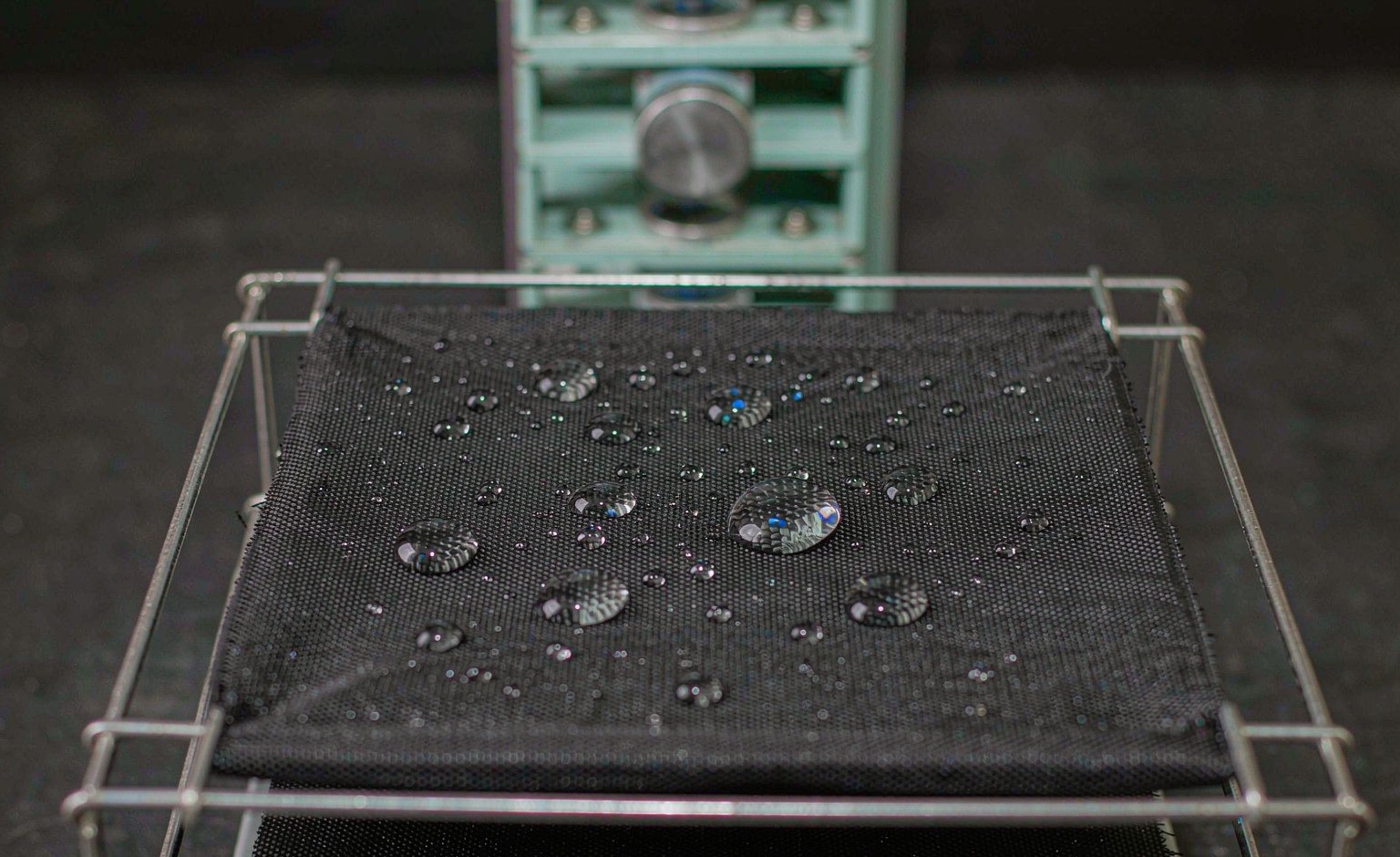
Water resistance and laundering close the set. AATCC 127 gives the hydrostatic head figure for a coated shell, and ISO 6330 sets the domestic washing and drying procedure used to check that the finish survives care rather than only surviving the showroom. A recycled shell that meets the rating when new and drops sharply after laundering has a coating-bond problem rather than a fabric problem, and that is diagnosed by testing washed specimens alongside unwashed ones rather than by testing only the fresh roll.
Takeaway: Takeaway: Re-run abrasion and grab strength on the recycled shell rather than accepting the virgin-fabric report, and treat any drop in cycle life as a specification change needing its own pass level, then re-check the 25 mm webbing column against the revised shell.
Coatings, laminates and the end-of-life penalty
Sustainability and waterproofing pull in opposite directions, and the conflict is chemical rather than commercial. A conventional polyurethane coating on a polyester face fabric produces a composite that neither stream can recycle cleanly: mechanical recycling of the composite gives a degraded polymer, and chemical recycling is disrupted by the coating. Chlorinated coatings and plasticised films add a further end-of-life problem because they introduce substances that restricted-substance screening will flag. The honest way to handle this is to state the trade explicitly in the product file rather than to claim both maximum waterproof performance and full recyclability on the same panel.
Mono-material construction is the direction that resolves most of it. An all-polyester build - polyester face, polyester backing, polyester thread, polyester webbing - can in principle enter a single-stream recovery route, whereas a mixed build cannot. The cost of that decision is performance at the extremes: all-polyester constructions tend to need a laminated membrane rather than a simple coating to reach a comparable AATCC 127 result, and membranes are more expensive and more sensitive to seam design.
Modularity changes the arithmetic in a way that is easy to miss. A platform where the abrasion-prone panel, the harness and the closure set can be replaced individually keeps the chassis in service far longer than a sealed construction, and service life dominates the environmental balance of most carried goods. A convertible backpack platform with swappable panels therefore supports a sustainability argument through durability and repair even where the material itself carries no certification, and that argument is defensible in a way a vague percentage claim is not.
End-of-life disassembly should be specified, not assumed. If a panel is welded, riveted and bonded in three different ways, no recovery stream can separate it. Written disassembly instructions, a single fastener type where function allows, and a marked material code on each major component turn a theoretical recyclability claim into one that a waste processor can act on.
Hardware and trims: the parts that quietly break a declaration
Material teams concentrate on the shell and the declaration is then invalidated by a buckle. Zips, sliders, buckles, hooks, eyelets, elastic, thread, printed labels and care labels are all components of a finished article, and any restricted-substance certificate that covers the article covers them too. A certified shell fitted with an untested plated hook fails the same screening as an uncertified shell would, and it fails at the point where nobody is looking.
Metal parts carry their own failure mode. Nickel release under EN 1811 applies to items in prolonged contact with skin, and the test has to run on the actual finished plating rather than on the base alloy. A batch of hardware that passed with one plating thickness can fail with another, so the specification should fix the plating process and thickness, not merely the colour name, and re-test should be triggered by any change of plating vendor.
Plastic hardware introduces coating and pigment risks. Painted buckles and soft-touch coatings are where screening most often finds something, because pigment and solvent systems in that part of the supply chain are less consistently controlled than in fibre production. The cheapest control is to specify unpigmented or naturally coloured engineering polymer for hardware and to put colour into the webbing and fabric instead.
Recycled content in hardware is the last gap. There is recycled polyamide and recycled polyoxymethylene available, but the certification coverage in that segment is thin and the mechanical property scatter is wider than buyers expect for load-bearing parts. The defensible position is to certify the textile assembly, leave hardware out of the percentage boundary, and state that exclusion on the declaration rather than letting a retailer discover it.
Putting a certified shell through the same duty cycle
A certified material should not receive a softer test plan than a conventional one. The release plan for a sustainable modular reference is identical in structure: approved reference sample retained before cutting, in-line checks on seam construction and spacing, and a final release inspection at AQL 2.5 under ISO 2859-1 sampling principles. Where a programme is certified, one extra item is added - a lot-traceability check confirming that the rolls issued to the cutting room match the lot reference on the transaction certificate. That check costs minutes during production and is impossible to reconstruct afterwards.
The calendar follows the standard shape with one adjustment. Sampling runs 6-10 working days for a straightforward shell, extending to 12-15 where a laminate, a welded seam or a novel recycled substrate is involved, because the extra time is almost always spent waiting for a laboratory result rather than for sewing. Mass production then spans 35-50 days, and the upper end applies where certified material has to be procured against a lot allocation rather than bought from open stock. Programme volume starts at MOQ 500 per reference, and where a range is split across colourways the 500 applies to the reference rather than to each shade, subject to a minimum run per shade that keeps a dye lot economically viable.
Freight and settlement close the loop. Sea freight at 25-35 days is the default for a planned programme, air at 5-8 days covers a launch that has already been announced, and courier at 3-5 days moves samples and approval sets. Consolidation matters here: 20GP at roughly 28 CBM and 40HQ at roughly 68 CBM set the point at which a second reference ships free of additional freight cost. The wording printed on the hangtag deserves as much care as the certificate behind it. A defensible statement names the boundary, the feedstock and the attribution basis in a single sentence - a percentage by weight of the textile assembly, post-consumer origin, tied to a named lot rather than allocated by mass balance. It avoids verbs of totality unless every component genuinely qualifies, and it does not promise end-of-life recyclability that the coating system contradicts. Marketing teams want the shortest possible phrase and compliance teams want the longest; the workable compromise is a short line on the product with the qualified version carried in the product file and on the product page, where there is space for it. Where a retailer insists on a single figure, supply the lowest one the file supports, because that is the only number still true after an audit.
Two container benchmarks shape the freight decision: a 20GP accepts about 28 CBM, a 40HQ around 68, and those figures set the point at which an additional reference travels at no meaningful extra cost. Prices quoted here are indicative only and rest on FOB Xiamen at the 500-piece threshold; screens or dies for branding add USD 300-2,500 according to process, and the USD 50-150 charged for a sample comes back to the buyer once an order is confirmed.
Capacity decides whether a certified lot can be scheduled at all. The verified floor behind this programme measures 4,950 m2, staffed by 137 operators tending 149 machines laid out as seven lines, with monthly output quoted at 200,000 pieces. Reserving one of those lines for a segregated certified lot is feasible at that scale and would not be at a smaller one, which is the practical reason a certified programme needs a production base with slack rather than one running at its ceiling.
Spec rule: Spec rule: Put the certified shell through the same duty cycle as the conventional one, sample in 6-10 working days, and hold the 500 unit run at AQL 2.5 release with the transaction certificate attached to the inspection file.
Frequently asked questions
What is the difference between a scope certificate and a transaction certificate?
A scope certificate is issued to a site and says the site may process certified material in defined categories; a transaction certificate is issued per shipment and names the actual article, weight and lot. Claims need the transaction certificate, with the scope certificate as supporting proof that the issuer was entitled to produce it.
Can a recycled percentage cover the whole bag including hardware?
Only if every component is certified and the boundary is stated that way. Most programmes certify the textile assembly and exclude hardware, because recycled certification coverage for injection-moulded load-bearing parts is thin and the property scatter is wider than buyers expect.
Why does a transaction certificate sometimes get rejected for date logic?
Because the certificate is dated after the declared production window, which is physically impossible. Certifiers treat that as a broken chain rather than a clerical error, and the fix is re-issuing against the correct window, not explaining the delay.
Does recycled polyester lose strength against virgin polyester?
A well-specified recycled filament meets the same tensile target, but the lot-to-lot scatter is wider because feedstock thermal history varies. Specifications should be written to the lower bound of the band, confirmed by ASTM D5034, rather than to the average.
How often should abrasion testing be repeated on a certified shell?
At material approval, then at any change of yarn supplier, weave, coating weight or finish. ASTM D3884 or ISO 12947 cycles to a defined end point are the comparison basis, and a five to ten per cent shortfall is usually fixed by construction rather than by changing material.
What does AATCC 127 actually measure on a waterproof shell?
It measures the hydrostatic head of the fabric, expressed as a water column the material resists under a standard rate of increase. It is a fabric-level figure, not a prediction of how a finished bag performs in rain, because seams, closures and entry points are not in the specimen.
Is OEKO-TEX Standard 100 enough to satisfy EU and US requirements?
It covers a broad restricted-substance screen for textile articles by product class, but it does not substitute for REACH (EC 1907/2006) declarations, California Prop 65 exposure logic or CPSIA testing where those apply. Treat it as one strong component of a file rather than the whole file.
How is colour consistency controlled across certified dye lots?
A dyed reference swatch is retained against the approved lot and production lots are approved against it under controlled lighting with a documented tolerance. Recycled base polymer is greyer, so light shades show lot-to-lot steps more readily than dark ones.
What happens if certified and uncertified rolls are stored together?
The chain is broken by commingling and the lot cannot be reconciled, so the claim cannot be made on that production. Segregation of certified rolls, marked cutting tickets and a metres-issued reconciliation prevent it.
Does a coating prevent the fabric from being recycled?
A conventional polyurethane coating on a polyester face produces a composite that neither stream handles cleanly, so effective recyclability drops sharply. Mono-material builds and mechanical disassembly are the two routes that keep recovery realistic.
How long does sampling take on a certified laminate?
Sampling runs 6-10 working days for a plain shell and 12-15 where a laminate, welded seam or new substrate is involved. The extra days are usually laboratory waiting time for coating bond or restricted-substance results, not sewing time.
What is the minimum order quantity for a certified reference?
MOQ 500 per reference. Where the reference is split across colourways the 500 applies to the reference, subject to a per-shade minimum that keeps a dye lot viable, and quotations are indicative only, FOB Xiamen.