Home › Field notes › How to Verify a Chinese Bag Production Partner Before Ordering
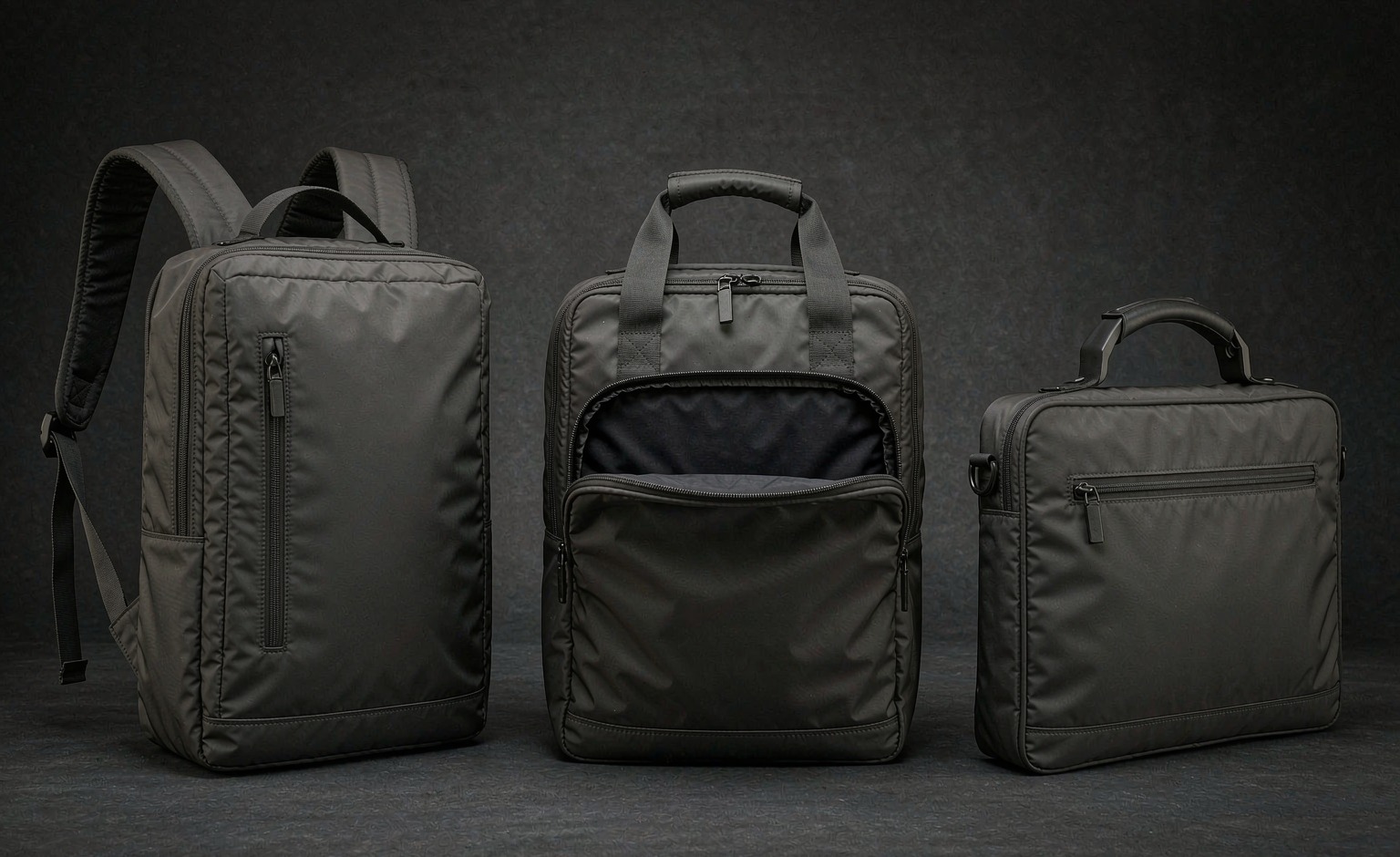
Verification of a production partner in China starts at a desk with four reconciliations, not with a plane ticket: the legal entity on the business licence must be the entity on the quotation and the entity receiving the bank transfer, the BSCI and ISO 9001 certificate numbers must validate against the issuing body's own register, claimed monthly output must be arithmetically reachable from the stated floor area, headcount and line count, and the approved sample must be a physical retained reference rather than a photograph. Those four checks remove the great majority of unsuitable candidates before any travel cost is incurred. Commercial terms are worth confirming at the same stage - FOB Xiamen, T/T 30/70 settlement, MOQ 500 per reference and AQL 2.5 release inspection - because a candidate who will not confirm standard terms in writing is signalling something. The sections below give the check sequence, the evidence each step requires and the decision gate that ends it.
Reconcile the legal entity before anything else
The first check is identity, and it is where most verification processes quietly fail. A production base may present under a trading name, an English brand name, or the name of a group, while the entity that signs the contract and receives the payment is a registered company with a uniform social credit code. Those three names have to be reconciled, and the reconciliation is done against the business licence rather than against a website or a catalogue.
Three documents establish it. The business licence shows the registered name, the credit code, the registered capital, the legal representative and the permitted business scope; the bank account details show the beneficiary name; and the contract shows the signing entity. If the beneficiary name differs from the licence name without a documented group relationship, the payment is going somewhere the buyer has not verified, and that is a risk no amount of subsequent inspection mitigates.
Business scope is the second part of the same check. A licence whose registered scope covers domestic retail or trading but not production indicates an entity that does not itself operate a production base. That is not automatically disqualifying, because plenty of capable programmes are run through a commercial entity coordinating vetted partner facilities, but it does change what the buyer should expect to see at the next step, and it changes who carries responsibility for quality.
The practical output of this section is one line in the buyer's file: verified legal name, credit code, licence expiry, and whether the entity's registered scope includes production. Everything downstream is checked against that line. A candidate who resists producing a licence scan, or who produces one with the credit code redacted, has answered the question.
Selection rule: Selection rule: Reconcile the legal entity on the business licence against the entity named on the contract, the bank account and the invoice, and stop the process before a deposit on 500 units moves whenever those four names fail to match exactly.
Validate certificate numbers with the issuing body
A scanned certificate proves that a document exists, not that it is current or that it belongs to the candidate. Social compliance and quality system certificates carry a registration number, an issuing body, a site address and an expiry date, and each of those is independently checkable. The check is done on the issuing body's own register, using the registration number, and it takes minutes.
Two failure modes dominate. The first is expiry: a certificate issued three years ago is presented as current, and the buyer discovers the lapse only when a retailer's own compliance team checks. The second is scope drift, where a valid certificate covers a different site address, or covers a product category that does not include the article being bought. Both are invisible on a scan and obvious on a register.
BSCI reporting and ISO 9001 registration are the two most commonly presented, and they answer different questions. A social compliance report describes labour conditions at a site at the time of assessment; a quality management certificate describes whether a documented system exists. Neither tells the buyer whether a specific bag will be well made, which is why they are treated as qualifying gates rather than as evidence of capability.
The four items to record are: certificate type, issuing body, registration number and the site address shown. Where the address differs from the address on the business licence, ask why before proceeding. A candidate operating from several locations is normal; a candidate whose certificate covers a location the buyer will never visit is not.
Bottom line: Bottom line: Validate every certificate number with the issuing body rather than accepting a scanned copy, and confirm the scope statement names cut-and-sew, because a system certificate whose scope omits cut-and-sew proves nothing about production and the T/T 30/70 deposit should wait for that check.
Verification artefacts and how each one is checked
| Item | Checked against | What it establishes | Stop signal |
|---|---|---|---|
| Legal name and credit code | Business licence | Identity of the contracting entity | Beneficiary name differs without explanation |
| Registered business scope | Business licence | Whether production is within scope | Scope covers trading only |
| Social compliance report | Issuing body register | Labour conditions at assessment date | Expired, or different site address |
| Quality system certificate | Issuing body register | Documented system exists | Category excludes the article |
| Capacity disclosure | Floor plan and equipment list | Whether claimed output is reachable | Output needs more hours than exist |
| Reference sample | Retained physical unit | What mass output must match | Only photographs available |
Reconcile capacity against floor area, lines and machines
Capacity claims are testable arithmetic. A site stating a monthly output and a headcount is making two claims that can be checked against each other: divide output by headcount and by available working hours, and the resulting units per person per hour has to be plausible for the product class. Where it is not, either the output figure is aspirational or the work is being subcontracted, and both matter to a buyer planning a launch date.
The second reconciliation is spatial. Floor area, line count and machine count have to be consistent: a stated number of production lines has to fit the stated area with room for cutting, storage and finishing, and a stated machine count has to be supportable by the stated headcount. A candidate claiming many lines in a small area is either counting benches or relying on outside workshops.
For reference when a buyer has no benchmark, a mid-scale operation of the type that serves branded programmes discloses something in this shape: 4,950 m2 of floor under third-party verification, 137 people, 7 production lines, 149 machines and 200,000 units of monthly output. Those numbers agree with one another, and that agreement is the point - a buyer can use the ratios as a sanity check on any other disclosure without needing to know the candidate's actual numbers.
The third reconciliation is scheduling. Ask which lines are currently committed, for how long, and what the booking position looks like across the window the buyer needs. A site running at full committed capacity can still be the right choice, but the buyer has to know that a new programme will be fitted into a gap rather than given dedicated capacity, and that changes the risk on a fixed launch date.
Verdict: Verdict: Reconcile claimed capacity against floor area, line count and machine count, and treat a monthly figure that cannot be derived from 7 production lines and 149 machines as a brochure figure rather than a measured capacity.
A neutral observation checklist for a site visit
Once the desk checks pass, a visit answers what documents cannot: whether the floor is orderly, whether work in progress is identified, and whether the equipment on the list is actually present and running. The visit should follow a written checklist so two evaluators produce comparable notes, and the checklist should be neutral in wording so it can be applied to any candidate site without implying a relationship.
Five observations carry most of the information. Material storage: whether rolls are identified by lot and protected from dust and moisture. Work-in-progress control: whether partially built units carry a ticket identifying the order and the stage. Equipment condition: whether the machines on the list are present, powered and maintained, with evidence of servicing. Finishing and packing: whether there is a defined area for final checking rather than packing happening on the production bench. And traceability: whether a finished carton can be traced back to a production batch through records rather than through memory.
Conversations matter as much as observations, and the most useful question is a process question rather than a capability question. Asking how a specific defect found at final inspection is fed back to the relevant station produces a specific answer at a site with a functioning system and a vague one at a site without. The same applies to questions about how a specification change is communicated to the floor.
Photographs should be taken against the checklist, with dates, and retained in the buyer's file alongside the documents from the desk stage. A verification file that can be reopened a year later, when a question arises about a shipped lot, is worth far more than a visit report written in prose.
Locking sample-to-mass consistency
| Control | Applied at | Record produced | Drift it catches |
|---|---|---|---|
| Retained approval unit | Sample sign-off | Physical unit, signed and dated | Substitution of material or component |
| Component approval list | Before bulk purchase | Named fabric, hardware and trim | Silent switch to a cheaper equivalent |
| First-piece check | Start of the run | Unit compared against the retained sample | Setup error at the first station |
| In-process patrol | Through production | Dated findings by station | Progressive drift in a manual operation |
| Final release inspection | Before shipment | Sampling record at AQL 2.5 | Lot-level defect rate |
Takeaway: Takeaway: Lock sample-to-mass consistency in writing by referencing the approved sample number in the contract, and require the production base to retain a sealed counter-sample for comparison at AQL 2.5 final inspection.
Quality system: sampling standards and where inspection happens
A credible quality system is visible in two places: the sampling standard it uses and the point in the process at which inspection happens. ISO 2859-1 provides the sampling principles and the accept-reject logic that AQL 2.5 sits inside, and a buyer should confirm that the candidate understands the distinction between the inspection level, the accept-reject number, and the switching rules that move between tightened and normal inspection. A site that quotes an AQL figure but cannot describe its switching rules is quoting a number rather than running a system.
Where inspection happens matters more than how much happens. Final inspection alone is a filter, not a control: it sorts good units from bad ones after the cost has been incurred. In-process checks at the stations where defects originate - cutting, sewing setup, hardware attachment - prevent the defect rather than detect it, and a site should be able to show dated records of those checks.
Defect classification is the third element. A usable system separates critical, major and minor classes and applies different accept numbers to each, so that a functional failure is not averaged away against cosmetic findings. Buyers should specify their own classification for their article rather than inheriting a generic one, because what counts as critical on a load-bearing strap is not what counts as critical on a lining seam.
Measurement capability closes the set. Dimensional checks require gauges, and a site should be able to show calibrated instruments for the dimensions that matter - webbing spacing, strap width, bay clearance. A tape measure and good intentions do not hold a tolerance across a run of thousands.
Commercial and logistics checks before the first transfer
Commercial verification runs in parallel with technical verification and is equally checkable. Incoterm should be stated precisely; FOB Xiamen means the seller's obligation ends at loading on board at that port, and the buyer should confirm which costs sit on each side of that line, including inland haulage, documentation and terminal handling. Ambiguity here is the most common source of a disputed invoice rather than of a deliberate overcharge.
Settlement structure is the second check. T/T 30/70 - thirty per cent on order confirmation and seventy against documents or before shipment, depending on the agreed wording - is the conventional shape for a first programme, and it should be written with a clear trigger for each tranche rather than a calendar date. A candidate demanding a materially larger deposit on a first order, or one willing to accept an unusually small one, both warrant a question.
Lead times should be decomposed rather than accepted as a single number. Sampling at 6-10 working days, extending to 12-15 for complex construction; mass production across 35-50 days; sea freight 25-35 days, air 5-8 and courier 3-5. A quotation that gives one number covering all of it hides where the risk sits, particularly where a bought-in component has its own lead time inside the production window.
Volume and consignment size complete the picture. MOQ 500 per reference is the conventional threshold for a custom modular bag programme, and it interacts with freight planning through container capacity - roughly 28 CBM fits a 20GP and about 68 a 40HQ - which decides whether a second reference adds any real freight cost at all. Where a candidate offers to break that threshold substantially on a first custom run, the question to ask is what is being changed in the construction to make it possible.
Red flags, and the gate that ends the process
Some signals are worth stopping for rather than negotiating around. A mismatch between contracting entity and payment beneficiary is one. A certificate that will not validate on the issuing body's register is another. Reluctance to allow an unannounced visit, or a visit routed exclusively through a showroom rather than the production floor, is a third. So is an inability to produce a retained approval sample from a previous programme.
Price signals need interpretation rather than reflex. A quotation materially below the field on a first custom programme usually means a construction change the buyer has not seen - a lighter shell, a different hardware source, a thinner coating - rather than a genuinely lower cost base. Asking what changed to reach the number is more useful than accepting it or rejecting it.
The decision gate should be written down before the process starts, so the evaluation is not re-litigated under schedule pressure. A workable gate has four conditions: identity reconciled, certificates validated, capacity arithmetic consistent, and a retained approval unit in hand with a signed specification. If all four close, the programme proceeds with AQL 2.5 release inspection and the payment structure agreed at the outset. If any one of them stays open, the correct action is to keep looking rather than to proceed with a mitigation, because a mitigation for an unverified entity is just a promise.
Verification is not a one-time event. Certificates expire, sites move, and equipment lists change, so the file should carry a review date rather than a completion date. A pragmatic cadence is a full re-check annually and a lighter one at each new programme: certificate numbers re-validated against the register, licence expiry confirmed, and the retained reference from the previous run compared against a fresh unit. That lighter check takes an hour and is the cheapest insurance available against silent drift.
Buyers should also decide in advance what happens when a candidate passes the desk stage and fails the visit. Failing on housekeeping, work-in-progress identification or equipment condition is different from failing on identity, and the usual response is a written corrective list with a re-visit date rather than an immediate rejection. Programmes are rarely won by finding a perfect site; they are won by finding an adequate one and then managing it with records.
Where a buyer prefers not to run this sequence alone, working through an established counterparty is a legitimate route. Our vetted partner facilities have passed the checks described above, and our production team maintains the verification file - licence, certificate numbers, capacity disclosure and retained references - so a brand can review it rather than rebuild it through our qualification and inspection support. That does not remove the buyer's duty to check; it removes the cost of starting from zero, and the file can be requested through the usual channel before any commitment is made.
Spec rule: Spec rule: End the verification process at a written gate covering entity, certificates, measured capacity, sample consistency and export paperwork checked against the guidance published by U.S. Department of Commerce, and release the first payment only when every line on that gate has been closed and the opening order of 500 units carries a written specification.
Frequently asked questions
What is the first thing to check when evaluating a production base?
Identity: reconcile the legal name and credit code on the business licence with the entity on the quotation and the beneficiary on the bank details. A mismatch without a documented group relationship is a stop signal.
How can a certificate scan be validated properly?
By looking up the registration number on the issuing body's own register and checking expiry, site address and product category. A scan proves a document exists; the register proves it is current and belongs to that site.
What does a social compliance report actually establish?
Labour conditions at the site on the assessment date. It is a qualifying gate rather than evidence of capability, and it says nothing about whether a particular article will be well made.
How is a claimed monthly output figure tested?
By arithmetic: divide output by headcount and available working hours and check the result is plausible for the product class. Then check floor area, line count and machine count are mutually consistent.
What capacity profile is internally consistent as a benchmark?
A mid-scale operation serving branded programmes discloses roughly 4,950 m2 of floor, 137 people, 7 production lines, 149 machines and 200,000 units per month. The value is in the ratios, not the absolute figures.
What should be observed first during a site visit?
Material storage identification, work-in-progress ticketing, whether listed equipment is present and running, whether finishing has a defined area, and whether a carton can be traced to a batch through records.
Why is a retained approval sample important?
Because mass output is judged against it. A physical signed unit with a component approval list is what prevents silent substitution of a cheaper fabric or hardware item during the run.
What does AQL 2.5 mean in practice?
An accept-reject threshold inside ISO 2859-1 sampling principles. A capable site can also describe the switching rules that move between tightened, normal and reduced inspection, not just the number.
Why is in-process inspection preferred over final inspection alone?
Final inspection sorts good units from bad after the cost is incurred. Checks at cutting, sewing setup and hardware attachment prevent the defect and show dated records by station.
What does FOB Xiamen place on each party?
The seller's obligation ends at loading on board at that port. Inland haulage, documentation and terminal handling should be confirmed explicitly, because that is where invoice disputes usually start.
What is a conventional settlement structure for a first programme?
T/T 30/70, with each tranche tied to a trigger rather than a date. A demand for a much larger deposit on a first order, or acceptance of an unusually small one, both warrant a question.
When should a buyer stop rather than negotiate?
On an unreconciled contracting entity, a certificate that will not validate, refusal of an unannounced visit to the production floor, or the absence of any retained approval sample from earlier work.
How often should a verification file be refreshed?
Run a full re-check annually and a lighter one at each new programme: re-validate certificate numbers against the register, confirm licence expiry, and compare a fresh unit against the retained reference. The lighter pass takes about an hour.
What if a candidate passes the desk stage but fails the visit?
Issue a written corrective list with a re-visit date rather than rejecting outright. Shortfalls in housekeeping, work-in-progress identification or equipment condition are manageable; shortfalls in identity are not.
Should lead times be accepted as a single figure?
No. Ask for them decomposed: sampling at 6-10 working days or 12-15 for complex builds, bulk across 35-50 days, then transit separately. A single number hides where the risk sits, especially where a bought-in component has its own lead time.