Home › Field notes › Modular Load-Carrying Platform: Carrier, Modules, Interface Contract
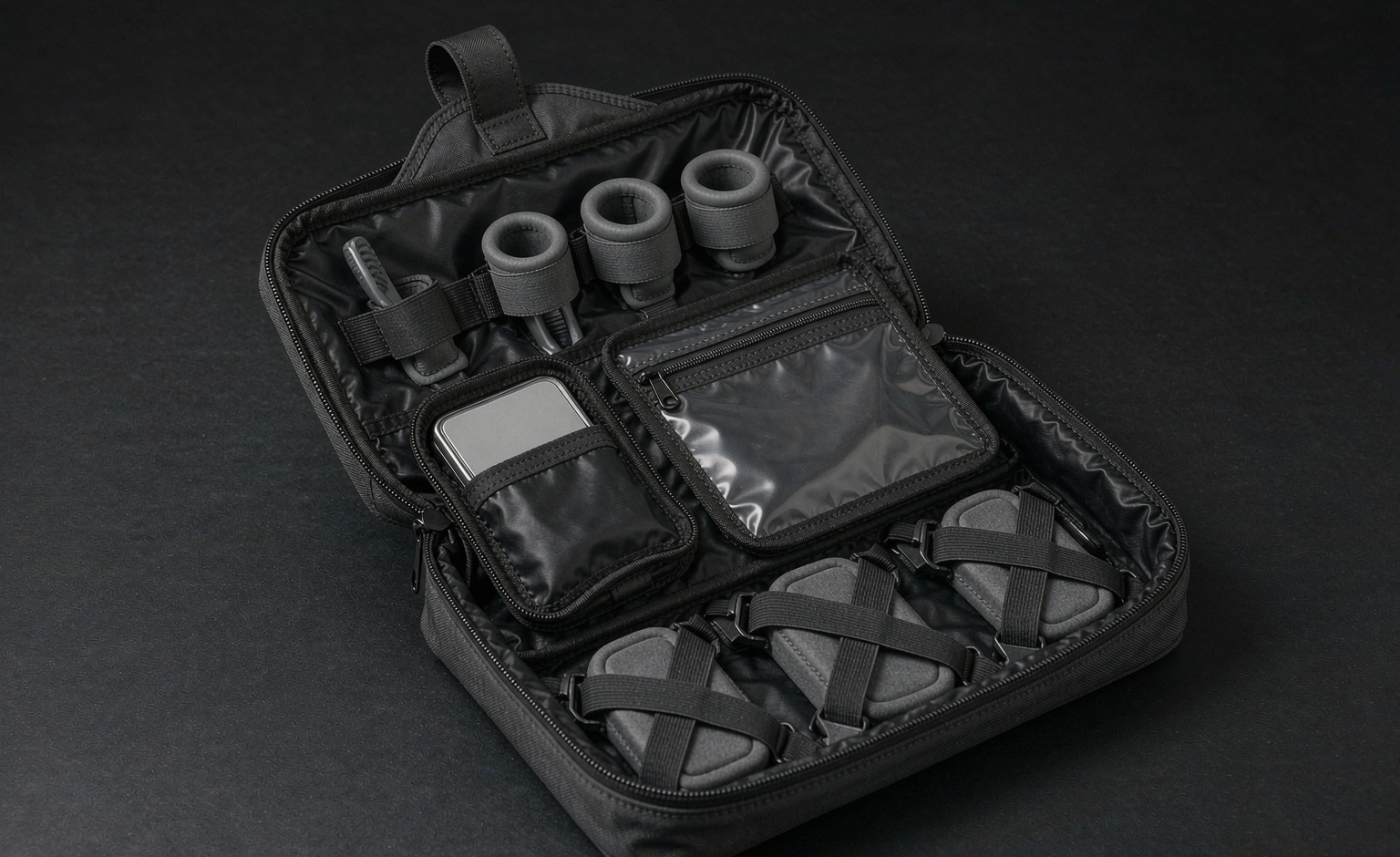
A modular load-carrying platform is a shared carrier plus a roster of detachable modules plus a written interface contract binding the two, so capacity and function can be changed without redesigning the bag itself. The three layers are separable in a specification: the carrier carries 25 mm webbing at 38 mm vertical spacing with a 50 mm anchoring repeat, the module roster is scoped by duty rather than by shape, and the contract freezes that geometry so a reorder at MOQ 500 still mounts after 35-50 days of bulk production. Scope here is civilian throughout - trail, worksite, first-aid, camera, commuter and organised daily carry - and the page makes no claim about weapon carriage, protective equipment or approval by any defence body.
A modular load-carrying platform stated as three layers
The word platform is used loosely in this category, and the looseness costs buyers money. A bag that ships with two pouches is not a platform; it is a bag with two pouches. The distinction is not snobbery, it is a testable difference: on a platform, the carrier and the modules are described in separate documents, each has its own part number, and a third document - the interface contract - defines how they meet. All three have to exist before the word applies.
Layer one is the shared carrier: harness, back panel, shell, volume, and the attachment face. Layer two is the module ecosystem, meaning every detachable element that sits on that face and the rules for adding more later. Layer three is the contract: the drawing, tolerances, materials and revision rules that make a module made next year fit a carrier made this year. Most failed programmes have layers one and two and quietly skip layer three, which is why their second season does not match the first.
Separating the layers changes who does what inside a buying organisation. The carrier becomes a multi-season asset reviewed on a slow cycle; the module roster becomes a fast-moving range reviewed every season; the contract becomes a controlled document that changes only through a formal revision. Once those reviews have different owners and different cadences, the platform behaves like a platform rather than like a product that happens to have accessories.
The commercial consequence is worth stating early. A platform concentrates engineering cost in the first season and spreads range cost across later ones, so the first reference is always the most expensive one to develop and the fifth module is always the cheapest. Buyers who judge the economics on the first season alone will conclude that platforms are expensive, which is true of season one and false of season three.
Selection rule: Accept the word platform only when three documents exist - a carrier specification, a module specification and an interface contract with a revision number - because a bag shipped with detachable pouches but no contract will not match itself across seasons.
Layer one: the shared carrier and the properties it must not change
The carrier is the slow-moving layer and should be specified as such. Its job is to carry load comfortably, protect the attachment face from deformation, and hold the interface geometry stable across every season it remains in the range. Everything about it - harness geometry, panel stiffness, shell material, seam construction - is expensive to change, which is exactly why those properties should be settled carefully at the start and then frozen.
Three carrier properties deserve hard callouts. The first is attachment-face stiffness: a face that deforms under pouch load changes channel geometry dynamically and lets straps creep, so backing stack and panel stiffness belong in the drawing rather than in a construction note. The second is harness fit, because a platform that will be loaded differently every season has to remain comfortable at both the lightest and heaviest configuration. The third is shell seam strength at the panel border, since that seam takes whatever the backing cannot spread.
The frozen list should be short and explicit. Interface geometry - webbing width, vertical spacing, anchoring repeat - must never change while the carrier is in the range, because every module ever sold depends on it. Panel outline dimensions should not change either, since module footprints are drawn against them. Colour, lining, hardware finish and branding may change freely; those are cosmetic and do not affect fit.
What may change with notice includes backing thickness, stitch density and shell fabric, provided each change is re-verified against the interface drawing. A buyer running a shared chassis across several pouch references should require a written note whenever one of these changes, together with a fresh first-off measurement, because a backing change can alter channel height even when the grid geometry is untouched.
Verdict: Freeze interface geometry and panel outline for the whole life of the carrier, allow cosmetic change without notice, and require written notification plus a fresh first-off measurement for any change to backing, stitch density or shell fabric.
Layer two: scoping the module ecosystem by duty rather than by shape
Module rosters go wrong when they are drawn as a set of shapes rather than as a set of jobs. Start from the duty: what does the user need to reach, how often, and with what mass. Reach frequency sorts modules into tiers - accessed every hour, accessed once a day, accessed rarely - and that sorting decides placement far better than a sketch does.
| Module class | Typical contents | Indicative capacity | Interface requirement |
|---|---|---|---|
| Flat organiser | Documents, cables, small tools | 0.5-1.5 litres | Three engaged rows; low peel load |
| First-aid module | Dressings, straps, instructions | 1-3 litres | Top-row anchoring; colour coding |
| Tool roll | Hand tools, fasteners, meters | 2-5 litres | Four or five rows; stiff backing |
| Camera insert | Body, lens, spare battery | 3-8 litres | Padded shell; rigid mounting face |
| Bottle carrier | Drink container | 0.5-1 litre | Closure release force specified |
| Clothing roll | Layer, wet gear | 3-10 litres | Compression straps over the pouch |
| Electronics sleeve | Tablet, radio, test instrument | 1-4 litres | Internal padding; flat mounting |
Roster size is a real decision with a correct answer for each programme. Four or five modules cover most civilian ranges and keep inventory sane; eight or more suits a brand selling into several distinct channels from one carrier. Below three modules the platform economics rarely justify the engineering, because the interface development cost is fixed regardless of how many modules share it.
Each module should carry its own part number, its own drawing and its own mass band. A roster where modules share a number because they look similar will produce reorder errors within two seasons, and those errors are expensive precisely because they are discovered by the customer rather than by the buyer.
Bottom line: Scope the roster by reach frequency and duty rather than by silhouette, keep it between three and eight modules, and give every module its own part number, drawing and mass band before sampling starts.
Layer three: the interface contract and the clauses it has to freeze
The contract is a short document and the most valuable one in the programme. It states the geometry both sides are built to, the tolerance each side may use, the materials permitted, the test evidence required at release, and the rule for changing any of it. Four pages is usually enough. What matters is that it exists, carries a revision number, and is referenced by both the carrier drawing and every module drawing.
| Clause | What it freezes | Document it lives in | Review trigger |
|---|---|---|---|
| Grid geometry | Webbing width, vertical spacing, anchoring repeat | Interface drawing, revision controlled | Any carrier redesign |
| Tolerance | Local and cumulative limits, named datum | Interface drawing plus measurement record | Change of marker or machine |
| Materials | Webbing construction, strap width, closure type | Component board | Supplier change or substitution offer |
| Anchoring | Row-end stitch density, backing stack | Construction specification | Field failure or returned unit |
| Verification | Named test methods and acceptance criteria | Test plan | New module class added |
| Revision rule | Who may approve a change and what it costs | Quality procedure | Any of the above |
The revision rule is the clause programmes forget, and it is the one that decides whether the platform survives contact with a cost-reduction request. A rule that says geometry may change only with written buyer approval and a re-sample converts a quiet substitution into a visible decision, which is usually enough to stop it. Without the rule, a cheaper webbing appears in season two and nobody notices until customers do.
Ownership should be named. Someone on the buying side must hold the contract, and someone on the production side must be accountable for building to it. Where both sides assume the other is watching revision control, nobody is, and drift accumulates across exactly the dimension that matters most.
Takeaway: Write a four-page interface contract carrying geometry, tolerance, materials, anchoring, verification and a revision rule, and name an owner on both sides, because an unowned contract is what lets a cheaper webbing enter season two unnoticed.
Platform, bag with pouches and fixed-capacity bag compared
Three constructions compete for the same budget, and the honest comparison is not a simple ranking. A fixed bag wins on weight, unit cost and simplicity. A bag with detachable pouches wins on moderate flexibility at low engineering cost. A platform wins when the range will grow, when third-party modules matter, or when the same chassis will be sold into several channels over more than two seasons.
| Criterion | Load-carrying platform | Bag with detachable pouches | Fixed-capacity bag |
|---|---|---|---|
| Adding a function after launch | Designed for it | Possible within limits | Not possible |
| Third-party module compatibility | Yes, if contract is published | Occasionally, by accident | No |
| Engineering effort in season one | Highest | Moderate | Lowest |
| Unit cost at 500 units | Highest for the chassis | Middle | Lowest |
| Empty weight penalty | Noticeable | Small | None |
| Inventory complexity | Highest SKU count | Moderate | Lowest |
| Service life and repairability | Modules replaceable separately | Pouches replaceable | Whole unit |
Weight is the criterion most often misrepresented. A platform chassis is heavier than a fixed bag of the same volume because the attachment face, its backing and its anchoring all add mass, and that penalty is paid every day even when no module is fitted. Programmes that sell into a weight-sensitive channel should measure the penalty honestly and decide whether the flexibility is worth carrying it.
Inventory complexity is the second under-counted cost. Each module is a stock-keeping unit with its own forecast, its own minimum and its own obsolescence risk, and a roster of eight modules multiplies forecasting work by eight. Retailers who understand this will accept a platform; those who do not will place small orders across many references and create the stockout pattern that kills platform programmes.
Judgement: Choose a platform when the range will grow past three seasons or third-party modules matter, choose detachable pouches for a single-season range needing modest flexibility, and stay with a fixed bag where empty weight and unit cost decide the purchase.
Compatibility across generations and the versioning discipline
Platforms age, and how they age is decided at the drawing stage. A carrier revised for a better harness is a new generation; whether existing modules still fit is a decision, not an accident. The clean rule is that interface geometry defines the generation: change it and the generation number must change, and backwards compatibility has to be stated explicitly rather than assumed.
Two policies are available and both are defensible. Strict compatibility says geometry never changes, so every module ever made fits every carrier ever made, at the cost of never being able to improve the face. Managed change says geometry may change at a generation boundary, provided the change is announced, the old modules are supported for a stated period, and the new generation is clearly marked. What is not defensible is drifting geometry without declaring it.
Module retirement needs the same discipline. When a module leaves the range, the announcement should state whether spares remain available and for how long, because customers who have built a kit around a module will otherwise discover its disappearance at the worst possible moment. A stated support window of a few seasons is normal and costs little.
Version marking should be physical. On a travel platform sold across several seasons, a generation reference moulded, printed or labelled on the carrier lets a customer or a service agent identify what they hold without consulting a catalogue, and it resolves most compatibility questions in one glance. That is a low-cost addition to a multi-season modular programme and prevents a whole class of support email.
Spec rule: Tie the generation number to interface geometry, state backwards compatibility explicitly at every generation boundary, publish a support window for retired modules, and mark the generation physically on the carrier.
Verification, capacity and the commercial terms behind a platform
Verification for a platform programme is split between process and product. On the process side, ISO 9001 covers the quality management system that keeps revision control honest, and ISO 2859-1 at AQL 2.5, level II, with Critical 0, Major 2.5 and Minor 4.0, governs release inspection. On the product side, tensile and seam behaviour of the attachment face is measured to ASTM D5034, and transit simulation under ISTA 3A protects structured carriers from carton crushing in transit.
Vetted partner facilities provide the base for this work: a 4,950 m² SGS-verified production floor holding 7 production lines, 149 machines and 137 people, rated at 200,000 units per month. The founder entered bag production in 2004 and the business was set up in 2014. The sequence for a platform launch runs sampling, pre-production sample, AQL 2.5 release inspection and shipment, with a document produced at each gate.
Volume starts at 500 units per reference. Development sampling takes 6-10 working days, or 12-15 working days when new hardware enters the build, and the subsequent bulk run occupies 35-50 days. Payment is T/T 30/70, quotation basis FOB Xiamen, and written pricing reaches the buyer within 24-48 hours. Sample charges of USD 50-150 are credited back once the order is placed, while tooling and screens fall between USD 300 and 2,500. Freight planning uses 25-35 days for sea, 5-8 for air and 3-5 for express, against 28 CBM in a 20GP and 68 CBM in a 40HQ.
Sequencing matters more here than on a single-product order, because a platform launch involves a carrier and several modules that must arrive together to be sellable. Our production team plans the carrier and the opening module set as one shipment, and holds material positions for the modules scheduled to follow, so the range can be filled in without a second full build.
Failure modes specific to a platform programme
Platforms fail in ways single products do not, and the failures are organisational as often as technical. The first is interface drift between seasons, caused by a material substitution nobody recorded. The second is module proliferation, where the roster grows until forecasting collapses under its own weight. The third is a carrier revision that silently changes panel outline and invalidates every module footprint drawn against it.
The fourth failure is commercial rather than engineering: the platform is launched into a channel that wanted a product. Retail buyers in some channels do not want to merchandise eight references against one chassis; they want one bag at one price. Launching a platform into that channel produces small orders across the whole roster and a slow, unsatisfying season for both sides.
The fifth is documentation loss. When the person who wrote the interface contract leaves and the file was never controlled, the next reorder is specified from a photograph, and the photograph cannot express tolerance. That single event undoes two seasons of careful work, and it is the most common reason a second-generation carrier fails to accept first-generation modules.
All five share one remedy: the interface contract, kept current, owned by a named person, and referenced by every drawing in the programme. Programmes that treat it as a living document rather than a launch artefact tend to reach a fourth season, which is roughly where platform economics start to pay.
In short: Review the interface contract at every season boundary and at every material substitution, because interface drift, module proliferation, silent carrier revision, channel mismatch and documentation loss all trace back to a contract nobody maintained.
Frequently asked questions
What is a modular load-carrying platform in simple terms?
It is a shared carrier, a set of detachable modules, and a written interface contract that makes them fit. The carrier holds 25 mm webbing at 38 mm vertical spacing with a 50 mm anchoring repeat, and the contract freezes that geometry so later modules still mount.
- Carrier plus modules plus contract
- Three documents, not one
How is a platform different from a bag that ships with pouches?
A platform has separate part numbers and separate drawings for carrier and modules, plus an interface contract with a revision number. A bag shipped with pouches has one drawing, so a later module cannot be specified against a declared geometry.
- Separate documents
- Declared interface geometry
Which carrier properties must never change during a platform's life?
Interface geometry and panel outline must stay fixed, because every module footprint depends on them. Colour, lining, hardware finish and branding may change freely since they do not affect fit.
- Freeze geometry and outline
- Notify on backing or fabric change
How many modules should a starting roster contain?
Three to eight is the workable band, with four or five covering most civilian ranges. Below three, interface development cost is not recovered; above eight, forecasting and inventory work multiply across every reference in a 500-unit programme.
- Four or five suits most ranges
- Each module needs its own part number
What belongs in the interface contract for a platform?
Six clauses: grid geometry, tolerance with a named datum, permitted materials, row-end anchoring, verification methods and a revision rule. Four pages normally covers it, and both the carrier drawing and every module drawing must reference it.
- Name an owner on both sides
- Revision number on each issue
How should module capacity be stated on a platform?
State capacity as a band per module class with a mass limit and a named limiting element, rather than one figure for the whole platform. A tool roll and a flat organiser fail in different places, so a single number misleads users.
- Band per class
- Name the limiting element
When does a fixed-capacity bag beat a platform outright?
When empty weight, unit cost and simplicity decide the purchase, or when the duty never changes. A fixed bag avoids the attachment-face mass penalty and the inventory load of multiple module references at MOQ 500.
- Weight-sensitive channels
- Single unchanging duty
What causes second-generation modules not to fit an older carrier?
Usually a material substitution or carrier revision that changed backing thickness, panel outline or grid geometry without a contract revision. Photographic specification is the other cause, since a photograph cannot express tolerance.
- Check the revision history
- Re-measure on a first-off panel
How should generations of a platform be versioned?
Tie the generation number to interface geometry: change the geometry and the generation changes, with backwards compatibility stated explicitly. Mark the generation physically on the carrier so users can identify what they hold.
- State compatibility at each boundary
- Publish a support window
Which quality system and inspection level apply to a platform order?
Process control is run under ISO 9001 and lot release under ISO 2859-1 at AQL 2.5, level II, with Critical 0, Major 2.5 and Minor 4.0. Product testing uses ASTM D5034 for tensile and seam behaviour.
- ISO 9001 for process
- AQL 2.5 for release
How much extra weight does a platform chassis carry?
The attachment face, its backing and its anchoring all add mass, and that penalty is paid every day even with no module fitted. Measure it on a first-off carrier and compare against a fixed bag of equal volume before committing.
- Measure on first-off, not on paper
- Decide against the channel
What minimum quantity applies to a carrier and its modules?
MOQ is 500 units per reference, so a carrier and four modules are five references at 500 each. Sampling runs 6-10 working days, or 12-15 where new hardware enters, followed by bulk production of 35-50 days.
- 500 per reference
- Plan the opening shipment as one set
How long does a platform programme take from brief to shipment?
Pricing returns within 24-48 hours, sampling takes 6-10 working days or 12-15 for new hardware, and bulk occupies 35-50 days. Sea freight then takes 25-35 days, air 5-8 and express 3-5, against 28 CBM in a 20GP.
- 35-50 days bulk
- 25-35 days sea transit
Should third-party modules be allowed on a platform?
Yes, if the interface geometry is published and held, because third-party modules grow the ecosystem at no development cost. Publish the geometry and tolerance, and require third-party straps to match the 25 mm webbing.
- Publish geometry and tolerance
- Require strap width match